Developing weaning programs
for your Katahdin flock
SUSAN SCHOENIAN
Sheep & Goat Specialist
University of Maryland Extension
sschoen@umd.edu
www.sheepandgoat.com
www.sheep101.info
www.wormx.info
www.slideshare.net/schoenian/ or go to www.sheepandgoat.com
and choose SlideShare from the Social media drop down menu
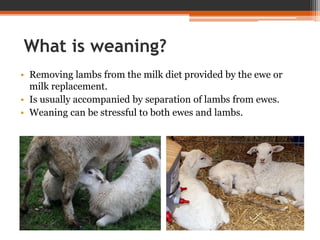
What is weaning?
• Removing lambs from the milk diet provided by the ewe or
milk replacement.
• Is usually accompanied by separation of lambs from ewes.
• Weaning can be stressful to both ewes and lambs.
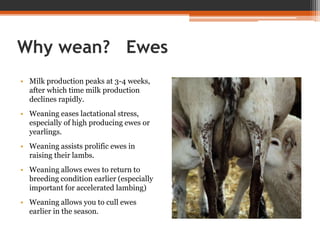
Why wean? Ewes
• Milk production peaks at 3-4 weeks,
after which time milk production
declines rapidly.
• Weaning eases lactational stress,
especially of high producing ewes or
yearlings.
• Weaning assists prolific ewes in
raising their lambs.
• Weaning allows ewes to return to
breeding condition earlier (especially
important for accelerated lambing)
• Weaning allows you to cull ewes
earlier in the season.
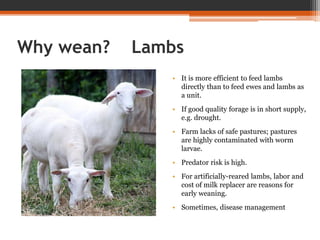
Why wean? Lambs
• It is more efficient to feed lambs
directly than to feed ewes and lambs as
a unit.
• If good quality forage is in short supply,
e.g. drought.
• Farm lacks of safe pastures; pastures
are highly contaminated with worm
larvae.
• Predator risk is high.
• For artificially-reared lambs, labor and
cost of milk replacer are reasons for
early weaning.
• Sometimes, disease management
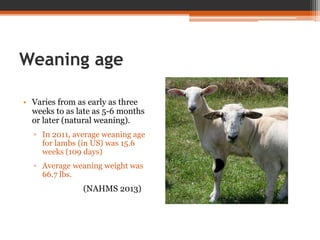
Weaning age
• Varies from as early as three
weeks to as late as 5-6 months
or later (natural weaning).
▫ In 2011, average weaning age
for lambs (in US) was 15.6
weeks (109 days)
▫ Average weaning weight was
66.7 lbs.
(NAHMS 2013)
When to wean
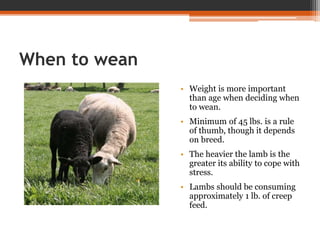
• Weight is more important
than age when deciding when
to wean.
• Minimum of 45 lbs. is a rule
of thumb, though it depends
on breed.
• The heavier the lamb is the
greater its ability to cope with
stress.
• Lambs should be consuming
approximately 1 lb. of creep
feed.
Early weaning
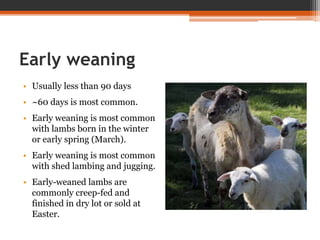
• Usually less than 90 days
• ~60 days is most common.
• Early weaning is most common
with lambs born in the winter
or early spring (March).
• Early weaning is most common
with shed lambing and jugging.
• Early-weaned lambs are
commonly creep-fed and
finished in dry lot or sold at
Easter.
Late weaning
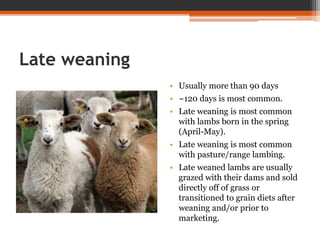
• Usually more than 90 days
• ~120 days is most common.
• Late weaning is most common
with lambs born in the spring
(April-May).
• Late weaning is most common
with pasture/range lambing.
• Late weaned lambs are usually
grazed with their dams and sold
directly off of grass or
transitioned to grain diets after
weaning and/or prior to
marketing.
Early weaning (less than 90 days)
PROS CONS
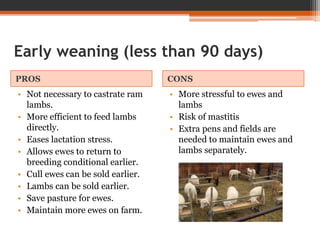
• Not necessary to castrate ram
lambs.
• More efficient to feed lambs
directly.
• Eases lactation stress.
• Allows ewes to return to
breeding conditional earlier.
• Cull ewes can be sold earlier.
• Lambs can be sold earlier.
• Save pasture for ewes.
• Maintain more ewes on farm.
• More stressful to ewes and
lambs
• Risk of mastitis
• Extra pens and fields are
needed to maintain ewes and
lambs separately.
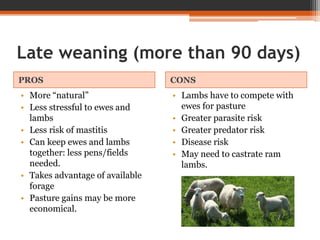
Late weaning (more than 90 days)
PROS CONS
• More “natural”
• Less stressful to ewes and
lambs
• Less risk of mastitis
• Can keep ewes and lambs
together: less pens/fields
needed.
• Takes advantage of available
forage
• Pasture gains may be more
economical.
• Lambs have to compete with
ewes for pasture
• Greater parasite risk
• Greater predator risk
• Disease risk
• May need to castrate ram
lambs.
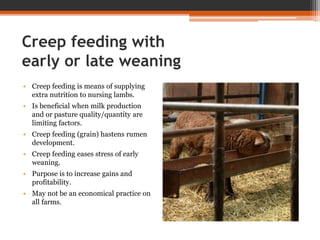
Creep feeding with
early or late weaning
• Creep feeding is means of supplying
extra nutrition to nursing lambs.
• Is beneficial when milk production
and or pasture quality/quantity are
limiting factors.
• Creep feeding (grain) hastens rumen
development.
• Creep feeding eases stress of early
weaning.
• Purpose is to increase gains and
profitability.
• May not be an economical practice on
all farms.
Creep feeding with
early or late weaning
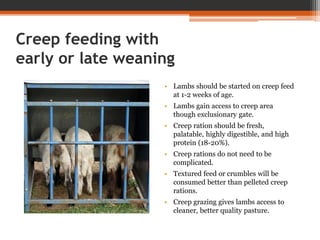
• Lambs should be started on creep feed
at 1-2 weeks of age.
• Lambs gain access to creep area
though exclusionary gate.
• Creep ration should be fresh,
palatable, highly digestible, and high
protein (18-20%).
• Creep rations do not need to be
complicated.
• Textured feed or crumbles will be
consumed better than pelleted creep
rations.
• Creep grazing gives lambs access to
cleaner, better quality pasture.
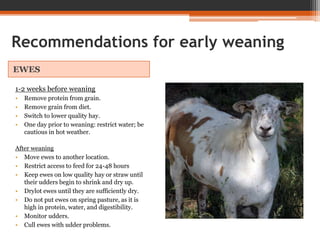
Recommendations for early weaning
EWES
1-2 weeks before weaning
• Remove protein from grain.
• Remove grain from diet.
• Switch to lower quality hay.
• One day prior to weaning: restrict water; be
cautious in hot weather.
After weaning
• Move ewes to another location.
• Restrict access to feed for 24-48 hours
• Keep ewes on low quality hay or straw until
their udders begin to shrink and dry up.
• Drylot ewes until they are sufficiently dry.
• Do not put ewes on spring pasture, as it is
high in protein, water, and digestibility.
• Monitor udders.
• Cull ewes with udder problems.
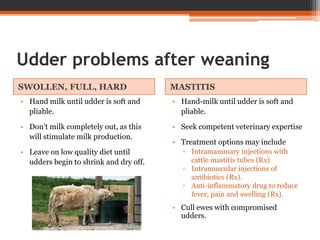
Udder problems after weaning
SWOLLEN, FULL, HARD MASTITIS
• Hand milk until udder is soft and
pliable.
• Don’t milk completely out, as this
will stimulate milk production.
• Leave on low quality diet until
udders begin to shrink and dry off.
• Hand-milk until udder is soft and
pliable.
• Seek competent veterinary expertise
• Treatment options may include
▫ Intramammary injections with
cattle mastitis tubes (Rx)
▫ Intramuscular injections of
antibiotics (Rx).
▫ Anti-inflammatory drug to reduce
fever, pain and swelling (Rx).
• Cull ewes with compromised
udders.
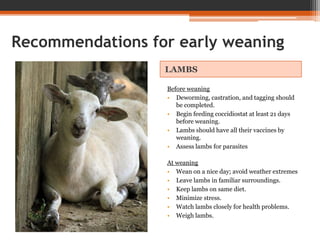
Recommendations for early weaning
LAMBS
Before weaning
• Deworming, castration, and tagging should
be completed.
• Begin feeding coccidiostat at least 21 days
before weaning.
• Lambs should have all their vaccines by
weaning.
• Assess lambs for parasites
At weaning
• Wean on a nice day; avoid weather extremes
• Leave lambs in familiar surroundings.
• Keep lambs on same diet.
• Minimize stress.
• Watch lambs closely for health problems.
• Weigh lambs.
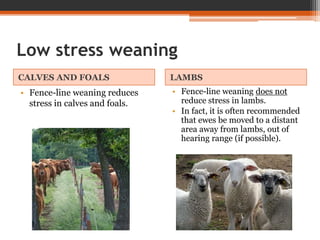
Low stress weaning
CALVES AND FOALS LAMBS
• Fence-line weaning reduces
stress in calves and foals.
• Fence-line weaning does not
reduce stress in lambs.
• In fact, it is often recommended
that ewes be moved to a distant
area away from lambs, out of
hearing range (if possible).
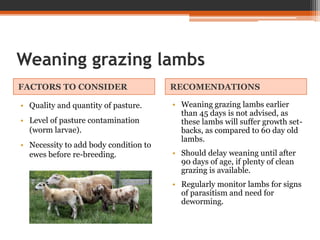
Weaning grazing lambs
FACTORS TO CONSIDER RECOMENDATIONS
• Quality and quantity of pasture.
• Level of pasture contamination
(worm larvae).
• Necessity to add body condition to
ewes before re-breeding.
• Weaning grazing lambs earlier
than 45 days is not advised, as
these lambs will suffer growth set-
backs, as compared to 60 day old
lambs.
• Should delay weaning until after
90 days of age, if plenty of clean
grazing is available.
• Regularly monitor lambs for signs
of parasitism and need for
deworming.
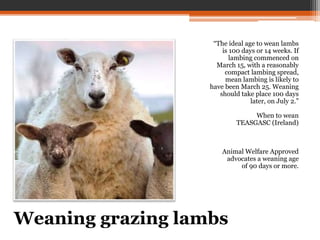
“The ideal age to wean lambs
is 100 days or 14 weeks. If
lambing commenced on
March 15, with a reasonably
compact lambing spread,
mean lambing is likely to
have been March 25. Weaning
should take place 100 days
later, on July 2.”
When to wean
TEASGASC (Ireland)
Animal Welfare Approved
advocates a weaning age
of 90 days or more.
Weaning grazing lambs
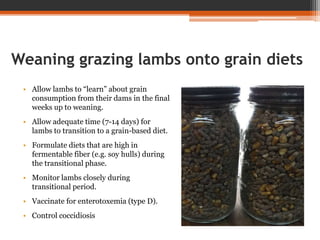
Weaning grazing lambs onto grain diets
• Allow lambs to “learn” about grain
consumption from their dams in the final
weeks up to weaning.
• Allow adequate time (7-14 days) for
lambs to transition to a grain-based diet.
• Formulate diets that are high in
fermentable fiber (e.g. soy hulls) during
the transitional phase.
• Monitor lambs closely during
transitional period.
• Vaccinate for enterotoxemia (type D).
• Control coccidiosis
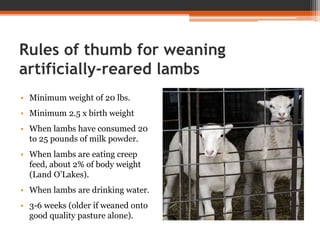
Rules of thumb for weaning
artificially-reared lambs
• Minimum weight of 20 lbs.
• Minimum 2.5 x birth weight
• When lambs have consumed 20
to 25 pounds of milk powder.
• When lambs are eating creep
feed, about 2% of body weight
(Land O’Lakes).
• When lambs are drinking water.
• 3-6 weeks (older if weaned onto
good quality pasture alone).
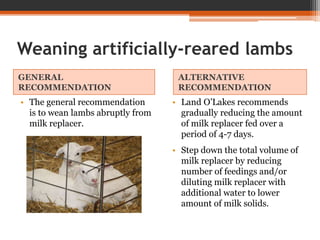
Weaning artificially-reared lambs
GENERAL
RECOMMENDATION
ALTERNATIVE
RECOMMENDATION
• The general recommendation
is to wean lambs abruptly from
milk replacer.
• Land O’Lakes recommends
gradually reducing the amount
of milk replacer fed over a
period of 4-7 days.
• Step down the total volume of
milk replacer by reducing
number of feedings and/or
diluting milk replacer with
additional water to lower
amount of milk solids.
Weaning weights
FACTORS AFFECTING GOAL
• Age
• Breed or cross
• Frame
• Birth type
• Rearing type
• Genetics
• Parasite challenge
• Pre-weaning nutrition
• 40% of mature weight
(12 week weaning age, AU)
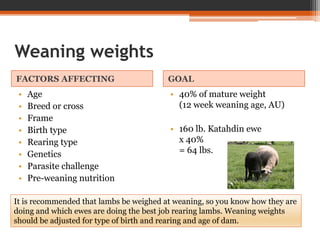
• 160 lb. Katahdin ewe
x 40%
= 64 lbs.
It is recommended that lambs be weighed at weaning, so you know how they are
doing and which ewes are doing the best job rearing lambs. Weaning weights
should be adjusted for type of birth and rearing and age of dam.
Calculating adjusted weaning weights
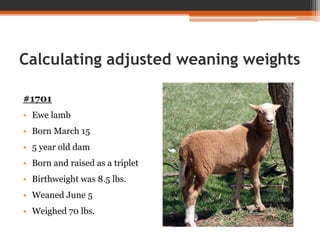
#1701
• Ewe lamb
• Born March 15
• 5 year old dam
• Born and raised as a triplet
• Birthweight was 8.5 lbs.
• Weaned June 5
• Weighed 70 lbs.
Correct weaning weight to common
age (usually 60, 90, or 120 days)
1. Determine pre-weaning gain
Pre-weaning gain = weaning weight – birth weight
2. Determine pre-weaning ADG
Pre-weaning ADG = Pre-weaning gain ÷ age at weaning
3. Determine age-corrected weight
Age corrected weight = (pre-weaning ADG x common age) + birth weight
1) 70.0 lbs. – 8.5 lbs. = 61.5 lbs.
2) 61.5 lbs. ÷ 82 days = 0.75 lbs./day
3) [0.75 x 60 days] + 8.5 = 53.5 lbs.
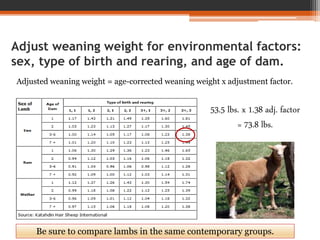
Adjust weaning weight for environmental factors:
sex, type of birth and rearing, and age of dam.
53.5 lbs. x 1.38 adj. factor
= 73.8 lbs.
Adjusted weaning weight = age-corrected weaning weight x adjustment factor.
Be sure to compare lambs in the same contemporary groups.
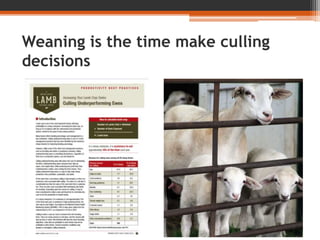
Weaning is the time make culling
decisions
SUSAN SCHOENIAN
Sheep & Goat Specialist
University of Maryland Extension
sschoen@umd.edu
www.sheepandgoat.com
www.sheep101.info
www.wormx.info
Thank you for your attention. Questions? Comments?
McComb
2004-2017

Developing weaning programs for your Katahdin flock

  • 1.
    Developing weaning programs foryour Katahdin flock SUSAN SCHOENIAN Sheep & Goat Specialist University of Maryland Extension sschoen@umd.edu www.sheepandgoat.com www.sheep101.info www.wormx.info www.slideshare.net/schoenian/ or go to www.sheepandgoat.com and choose SlideShare from the Social media drop down menu
  • 2.
    What is weaning? •Removing lambs from the milk diet provided by the ewe or milk replacement. • Is usually accompanied by separation of lambs from ewes. • Weaning can be stressful to both ewes and lambs.
  • 3.
    Why wean? Ewes •Milk production peaks at 3-4 weeks, after which time milk production declines rapidly. • Weaning eases lactational stress, especially of high producing ewes or yearlings. • Weaning assists prolific ewes in raising their lambs. • Weaning allows ewes to return to breeding condition earlier (especially important for accelerated lambing) • Weaning allows you to cull ewes earlier in the season.
  • 4.
    Why wean? Lambs •It is more efficient to feed lambs directly than to feed ewes and lambs as a unit. • If good quality forage is in short supply, e.g. drought. • Farm lacks of safe pastures; pastures are highly contaminated with worm larvae. • Predator risk is high. • For artificially-reared lambs, labor and cost of milk replacer are reasons for early weaning. • Sometimes, disease management
  • 5.
    Weaning age • Variesfrom as early as three weeks to as late as 5-6 months or later (natural weaning). ▫ In 2011, average weaning age for lambs (in US) was 15.6 weeks (109 days) ▫ Average weaning weight was 66.7 lbs. (NAHMS 2013)
  • 6.
    When to wean •Weight is more important than age when deciding when to wean. • Minimum of 45 lbs. is a rule of thumb, though it depends on breed. • The heavier the lamb is the greater its ability to cope with stress. • Lambs should be consuming approximately 1 lb. of creep feed.
  • 7.
    Early weaning • Usuallyless than 90 days • ~60 days is most common. • Early weaning is most common with lambs born in the winter or early spring (March). • Early weaning is most common with shed lambing and jugging. • Early-weaned lambs are commonly creep-fed and finished in dry lot or sold at Easter.
  • 8.
    Late weaning • Usuallymore than 90 days • ~120 days is most common. • Late weaning is most common with lambs born in the spring (April-May). • Late weaning is most common with pasture/range lambing. • Late weaned lambs are usually grazed with their dams and sold directly off of grass or transitioned to grain diets after weaning and/or prior to marketing.
  • 9.
    Early weaning (lessthan 90 days) PROS CONS • Not necessary to castrate ram lambs. • More efficient to feed lambs directly. • Eases lactation stress. • Allows ewes to return to breeding conditional earlier. • Cull ewes can be sold earlier. • Lambs can be sold earlier. • Save pasture for ewes. • Maintain more ewes on farm. • More stressful to ewes and lambs • Risk of mastitis • Extra pens and fields are needed to maintain ewes and lambs separately.
  • 10.
    Late weaning (morethan 90 days) PROS CONS • More “natural” • Less stressful to ewes and lambs • Less risk of mastitis • Can keep ewes and lambs together: less pens/fields needed. • Takes advantage of available forage • Pasture gains may be more economical. • Lambs have to compete with ewes for pasture • Greater parasite risk • Greater predator risk • Disease risk • May need to castrate ram lambs.
  • 11.
    Creep feeding with earlyor late weaning • Creep feeding is means of supplying extra nutrition to nursing lambs. • Is beneficial when milk production and or pasture quality/quantity are limiting factors. • Creep feeding (grain) hastens rumen development. • Creep feeding eases stress of early weaning. • Purpose is to increase gains and profitability. • May not be an economical practice on all farms.
  • 12.
    Creep feeding with earlyor late weaning • Lambs should be started on creep feed at 1-2 weeks of age. • Lambs gain access to creep area though exclusionary gate. • Creep ration should be fresh, palatable, highly digestible, and high protein (18-20%). • Creep rations do not need to be complicated. • Textured feed or crumbles will be consumed better than pelleted creep rations. • Creep grazing gives lambs access to cleaner, better quality pasture.
  • 13.
    Recommendations for earlyweaning EWES 1-2 weeks before weaning • Remove protein from grain. • Remove grain from diet. • Switch to lower quality hay. • One day prior to weaning: restrict water; be cautious in hot weather. After weaning • Move ewes to another location. • Restrict access to feed for 24-48 hours • Keep ewes on low quality hay or straw until their udders begin to shrink and dry up. • Drylot ewes until they are sufficiently dry. • Do not put ewes on spring pasture, as it is high in protein, water, and digestibility. • Monitor udders. • Cull ewes with udder problems.
  • 14.
    Udder problems afterweaning SWOLLEN, FULL, HARD MASTITIS • Hand milk until udder is soft and pliable. • Don’t milk completely out, as this will stimulate milk production. • Leave on low quality diet until udders begin to shrink and dry off. • Hand-milk until udder is soft and pliable. • Seek competent veterinary expertise • Treatment options may include ▫ Intramammary injections with cattle mastitis tubes (Rx) ▫ Intramuscular injections of antibiotics (Rx). ▫ Anti-inflammatory drug to reduce fever, pain and swelling (Rx). • Cull ewes with compromised udders.
  • 15.
    Recommendations for earlyweaning LAMBS Before weaning • Deworming, castration, and tagging should be completed. • Begin feeding coccidiostat at least 21 days before weaning. • Lambs should have all their vaccines by weaning. • Assess lambs for parasites At weaning • Wean on a nice day; avoid weather extremes • Leave lambs in familiar surroundings. • Keep lambs on same diet. • Minimize stress. • Watch lambs closely for health problems. • Weigh lambs.
  • 16.
    Low stress weaning CALVESAND FOALS LAMBS • Fence-line weaning reduces stress in calves and foals. • Fence-line weaning does not reduce stress in lambs. • In fact, it is often recommended that ewes be moved to a distant area away from lambs, out of hearing range (if possible).
  • 17.
    Weaning grazing lambs FACTORSTO CONSIDER RECOMENDATIONS • Quality and quantity of pasture. • Level of pasture contamination (worm larvae). • Necessity to add body condition to ewes before re-breeding. • Weaning grazing lambs earlier than 45 days is not advised, as these lambs will suffer growth set- backs, as compared to 60 day old lambs. • Should delay weaning until after 90 days of age, if plenty of clean grazing is available. • Regularly monitor lambs for signs of parasitism and need for deworming.
  • 18.
    “The ideal ageto wean lambs is 100 days or 14 weeks. If lambing commenced on March 15, with a reasonably compact lambing spread, mean lambing is likely to have been March 25. Weaning should take place 100 days later, on July 2.” When to wean TEASGASC (Ireland) Animal Welfare Approved advocates a weaning age of 90 days or more. Weaning grazing lambs
  • 19.
    Weaning grazing lambsonto grain diets • Allow lambs to “learn” about grain consumption from their dams in the final weeks up to weaning. • Allow adequate time (7-14 days) for lambs to transition to a grain-based diet. • Formulate diets that are high in fermentable fiber (e.g. soy hulls) during the transitional phase. • Monitor lambs closely during transitional period. • Vaccinate for enterotoxemia (type D). • Control coccidiosis
  • 20.
    Rules of thumbfor weaning artificially-reared lambs • Minimum weight of 20 lbs. • Minimum 2.5 x birth weight • When lambs have consumed 20 to 25 pounds of milk powder. • When lambs are eating creep feed, about 2% of body weight (Land O’Lakes). • When lambs are drinking water. • 3-6 weeks (older if weaned onto good quality pasture alone).
  • 21.
    Weaning artificially-reared lambs GENERAL RECOMMENDATION ALTERNATIVE RECOMMENDATION •The general recommendation is to wean lambs abruptly from milk replacer. • Land O’Lakes recommends gradually reducing the amount of milk replacer fed over a period of 4-7 days. • Step down the total volume of milk replacer by reducing number of feedings and/or diluting milk replacer with additional water to lower amount of milk solids.
  • 22.
    Weaning weights FACTORS AFFECTINGGOAL • Age • Breed or cross • Frame • Birth type • Rearing type • Genetics • Parasite challenge • Pre-weaning nutrition • 40% of mature weight (12 week weaning age, AU) • 160 lb. Katahdin ewe x 40% = 64 lbs. It is recommended that lambs be weighed at weaning, so you know how they are doing and which ewes are doing the best job rearing lambs. Weaning weights should be adjusted for type of birth and rearing and age of dam.
  • 23.
    Calculating adjusted weaningweights #1701 • Ewe lamb • Born March 15 • 5 year old dam • Born and raised as a triplet • Birthweight was 8.5 lbs. • Weaned June 5 • Weighed 70 lbs.
  • 24.
    Correct weaning weightto common age (usually 60, 90, or 120 days) 1. Determine pre-weaning gain Pre-weaning gain = weaning weight – birth weight 2. Determine pre-weaning ADG Pre-weaning ADG = Pre-weaning gain ÷ age at weaning 3. Determine age-corrected weight Age corrected weight = (pre-weaning ADG x common age) + birth weight 1) 70.0 lbs. – 8.5 lbs. = 61.5 lbs. 2) 61.5 lbs. ÷ 82 days = 0.75 lbs./day 3) [0.75 x 60 days] + 8.5 = 53.5 lbs.
  • 25.
    Adjust weaning weightfor environmental factors: sex, type of birth and rearing, and age of dam. 53.5 lbs. x 1.38 adj. factor = 73.8 lbs. Adjusted weaning weight = age-corrected weaning weight x adjustment factor. Be sure to compare lambs in the same contemporary groups.
  • 26.
    Weaning is thetime make culling decisions
  • 27.
    SUSAN SCHOENIAN Sheep &Goat Specialist University of Maryland Extension sschoen@umd.edu www.sheepandgoat.com www.sheep101.info www.wormx.info Thank you for your attention. Questions? Comments? McComb 2004-2017