LAMBING LUNCH
Hannah Pegram, Rachel Davies,
Andrew Littlejohn, Amelia Lynch
Disclaimer
We aren’t here to replace your lectures, more
just share our experiences of things we have
picked up from our own lambing experience.
This is not complete but merely a brief overview
of things which may help you when you go
lambing
We’re also not here to scare/overwhelm you.
Lambing is a great experience to go and do and
it will help you a lot for husbandry etc.
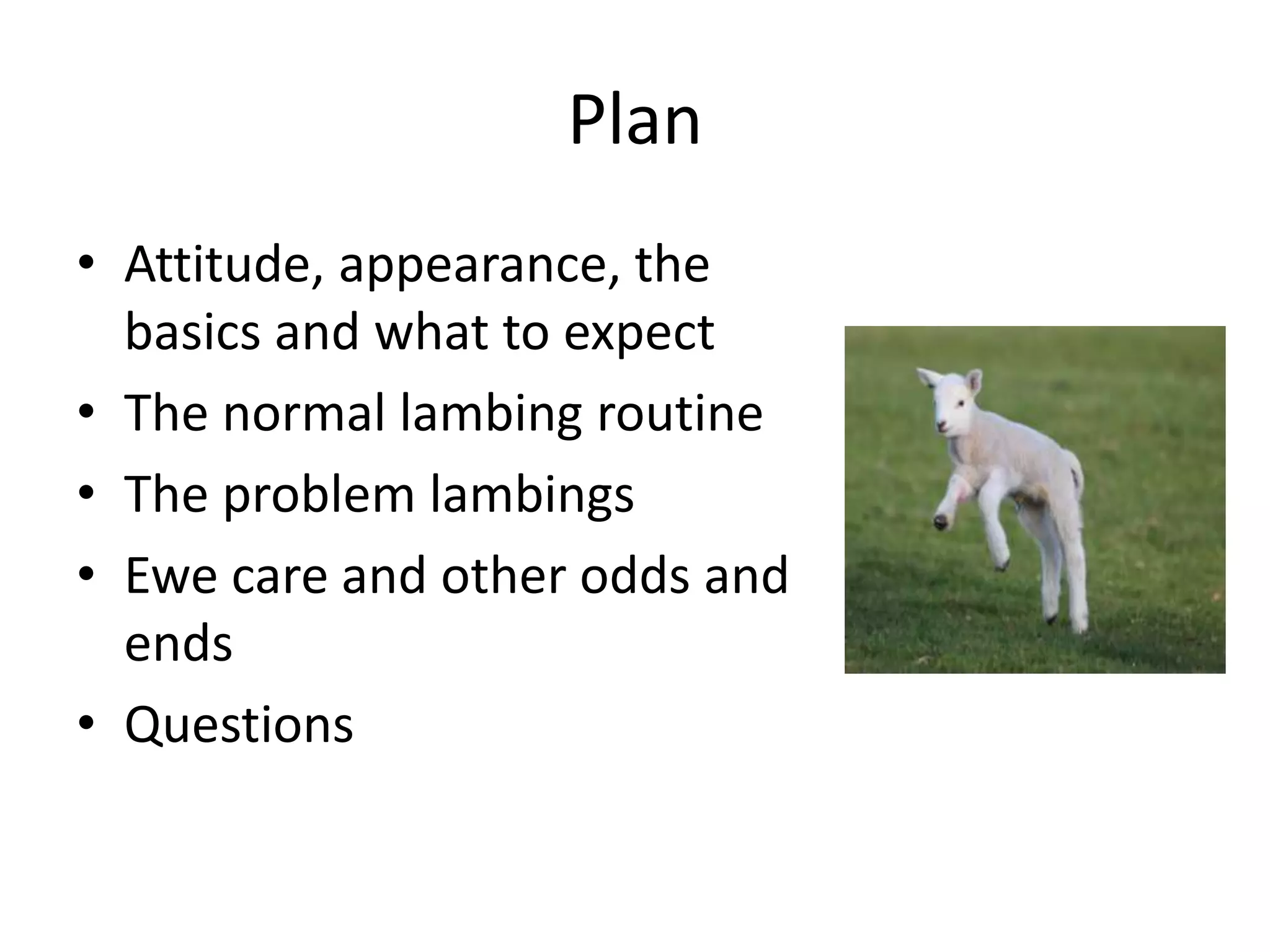
Plan
• Attitude, appearance, the
basics and what to expect
• The normal lambing routine
• The problem lambings
• Ewe care and other odds and
ends
• Questions
The Basics
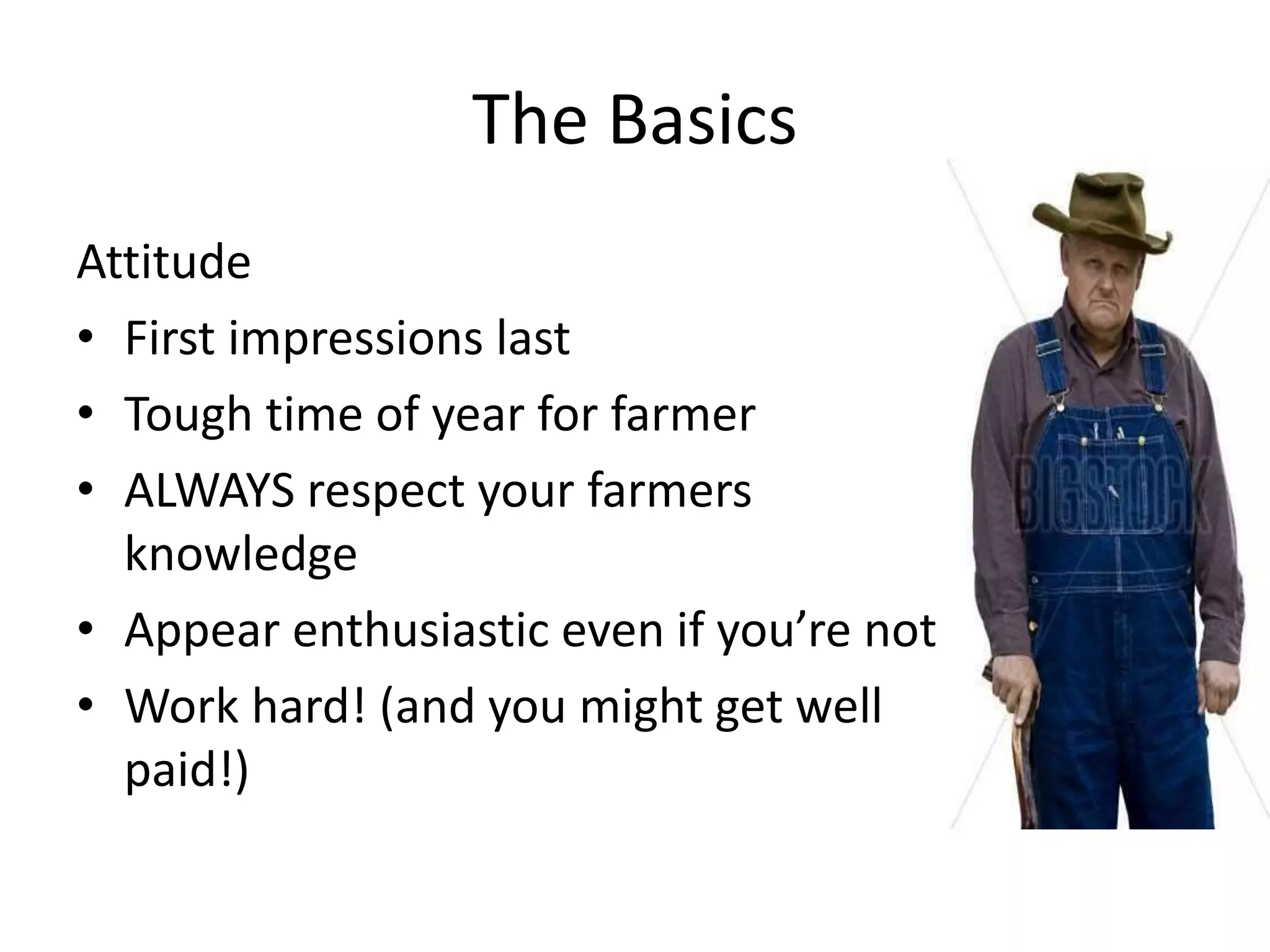
Attitude
• First impressions last
• Tough time of year for farmer
• ALWAYS respect your farmers
knowledge
• Appear enthusiastic even if you’re not
• Work hard! (and you might get well
paid!)
The Basics
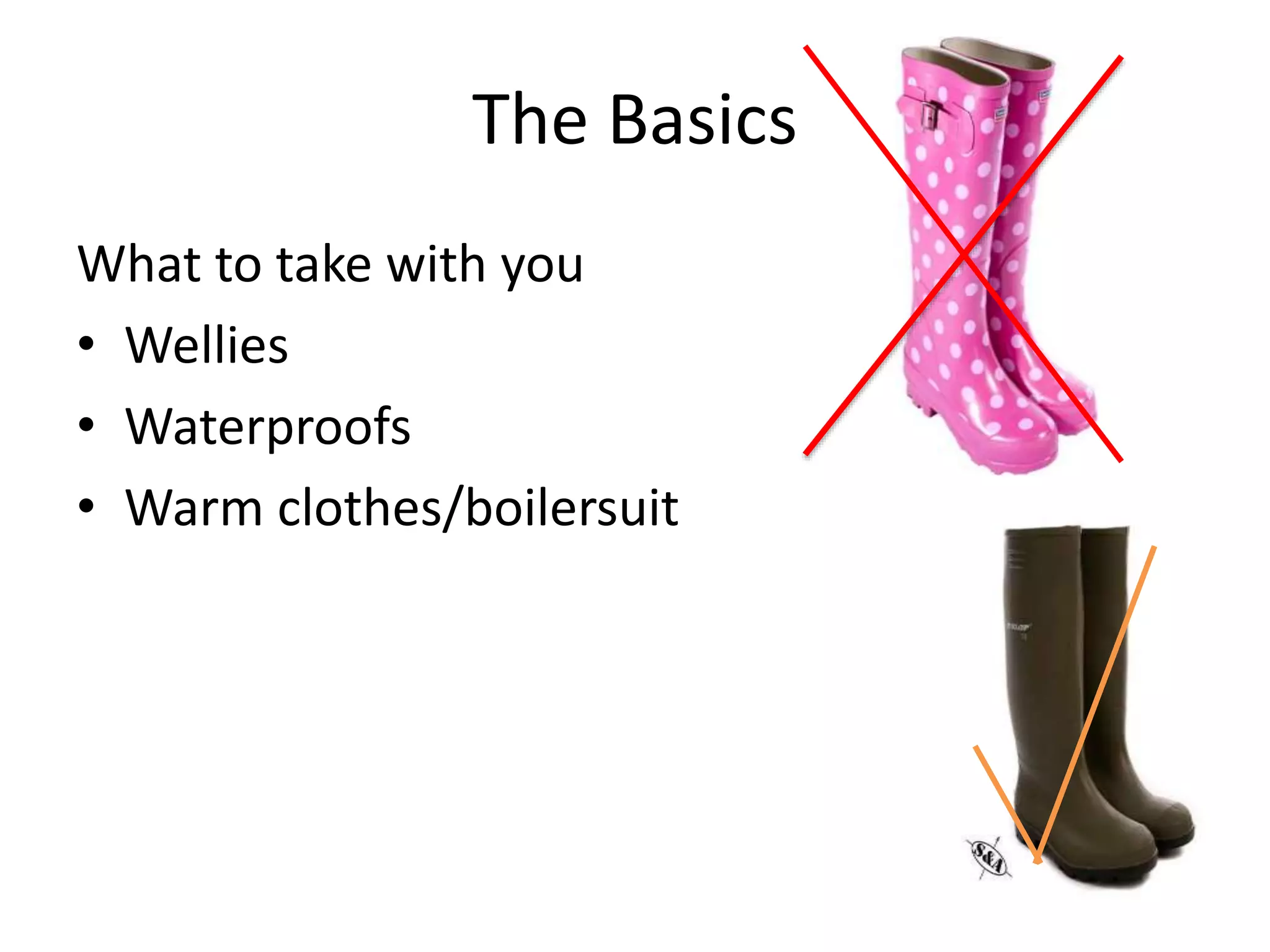
What to take with you
• Wellies
• Waterproofs
• Warm clothes/boilersuit
The Basics
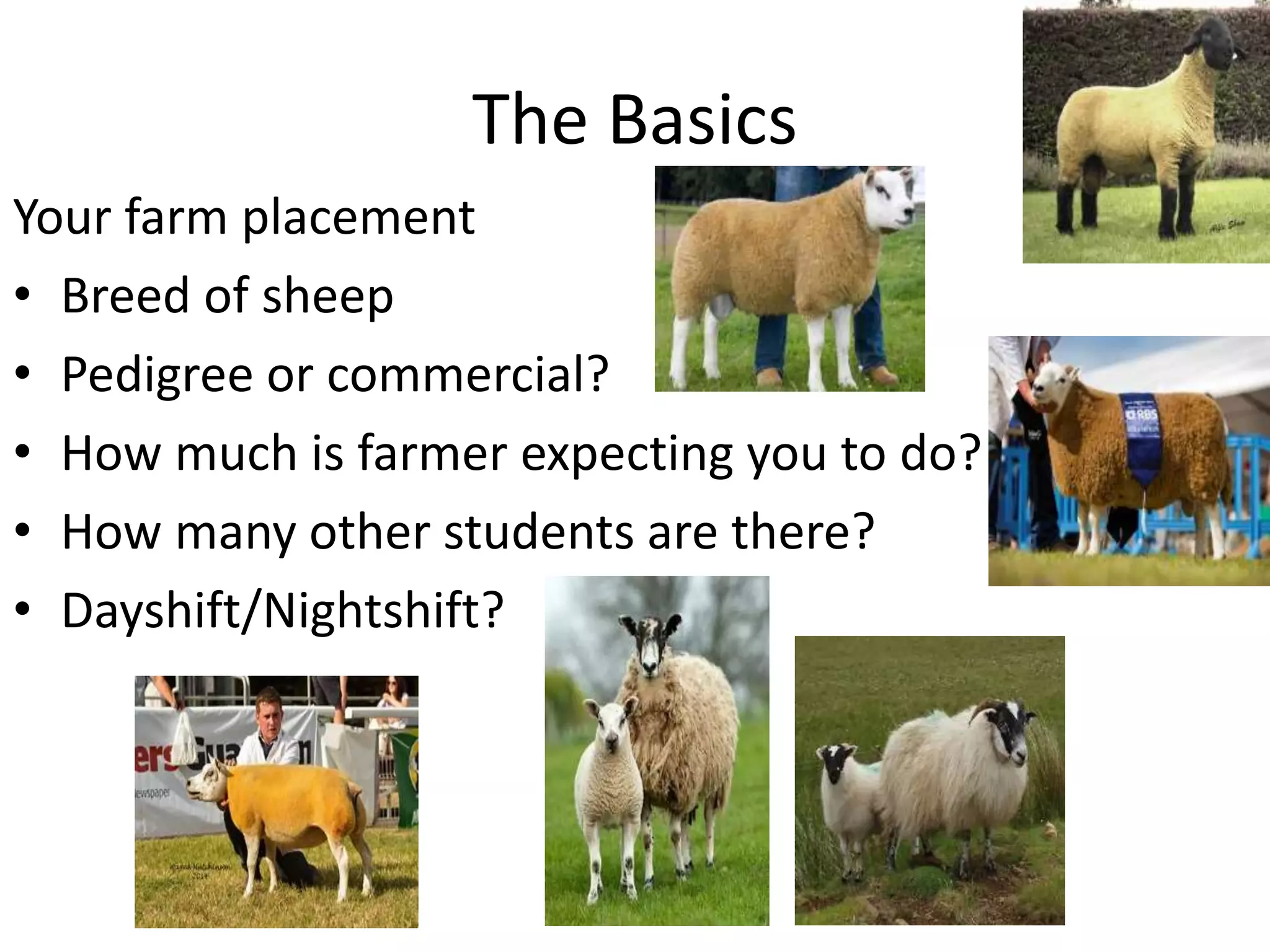
Your farm placement
• Breed of sheep
• Pedigree or commercial?
• How much is farmer expecting you to do?
• How many other students are there?
• Dayshift/Nightshift?
The Basics
The Farmer
• Will want you to be interested in him and his
farm
• Most will want to help teach you things
• Always listen to your farmer, nearly all will have a
lot more experience than you do
• Don’t tell him your confident to be left alone if
your not, he would much rather spend time to
help you than end up with dead lambs.
• He will usually help you if you ask
The Basics
Lambing as a job
• One of my favourite times of
year
• Hard work and long hours
• Stressful
• Great experience for animal
care and farm understanding
• Usually you will be well fed!
• May get paid if you’re good.
Daily Routine
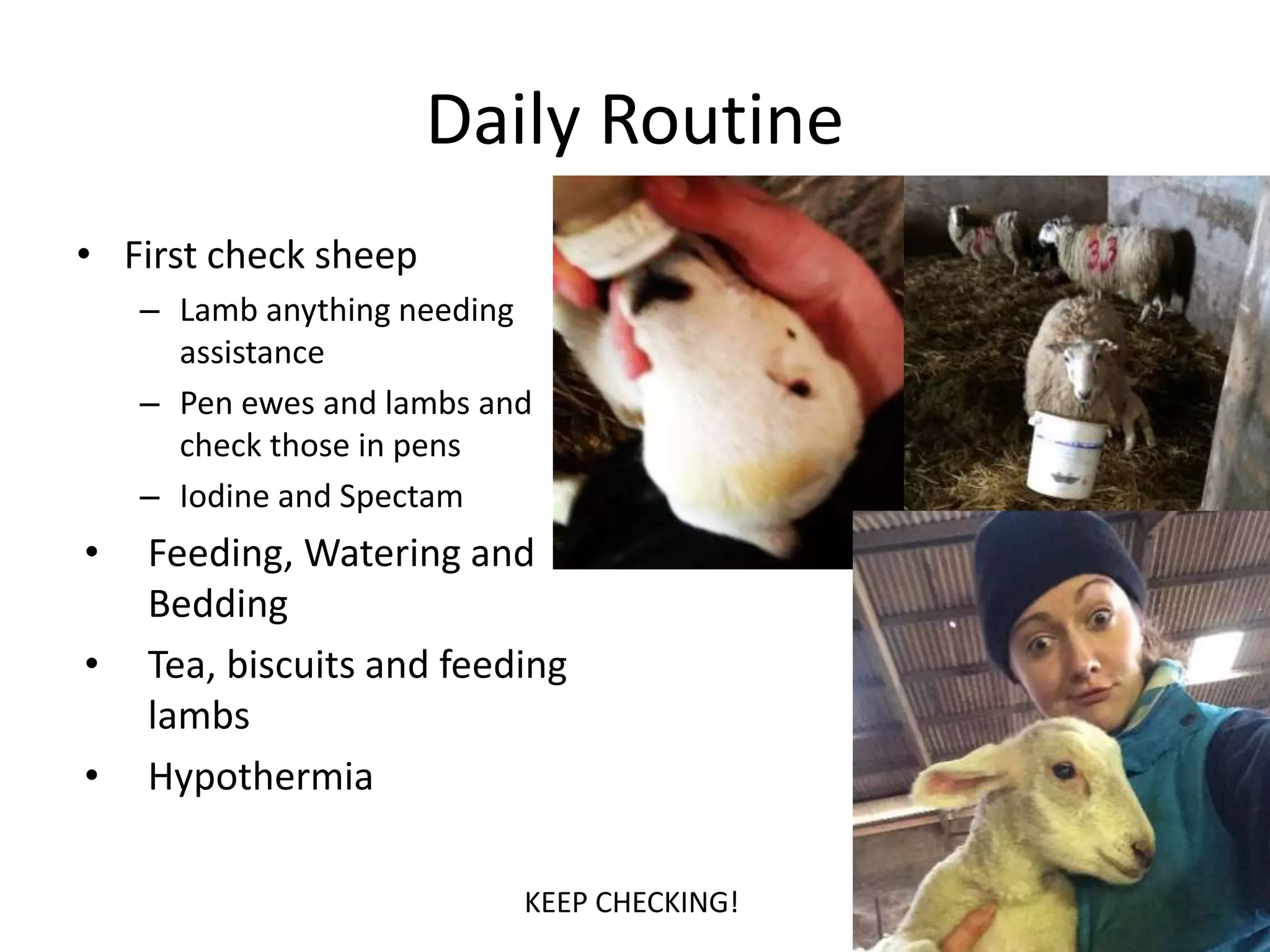
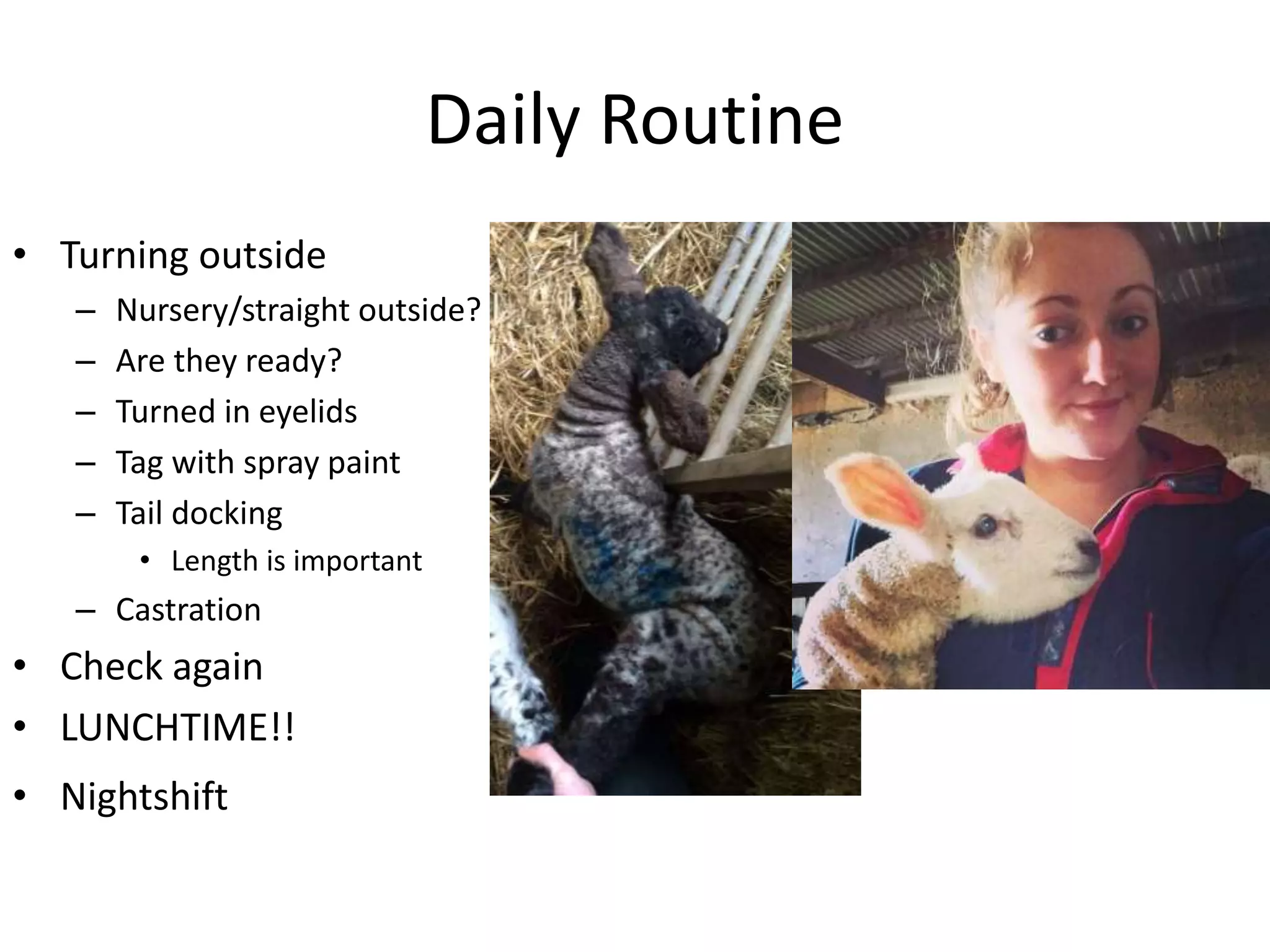
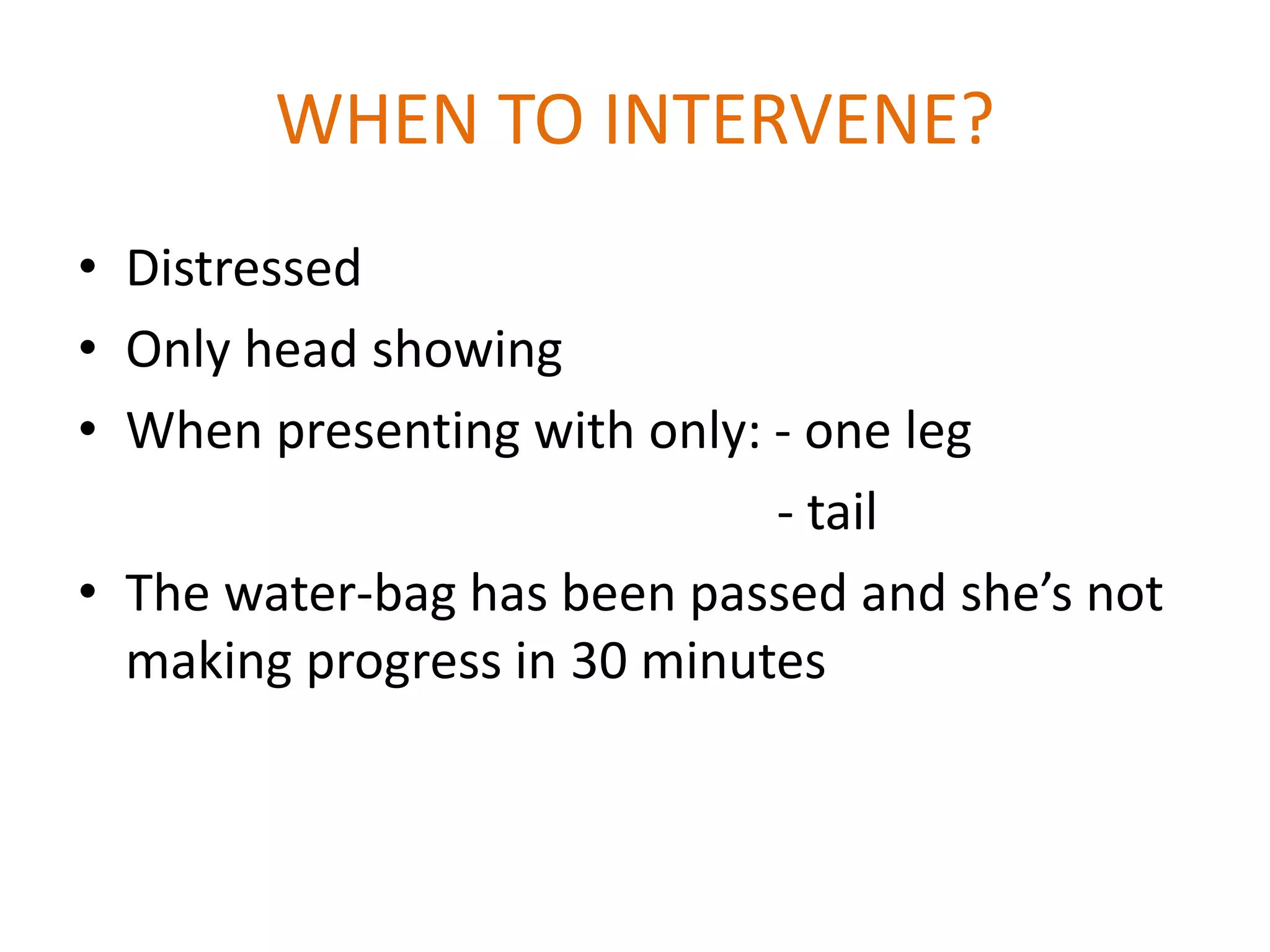
• First check sheep
– Lamb anything needing
assistance
– Pen ewes and lambs and
check those in pens
– Iodine and Spectam
• Feeding, Watering and
Bedding
• Tea, biscuits and feeding
lambs
• Hypothermia
KEEP CHECKING!
Daily Routine
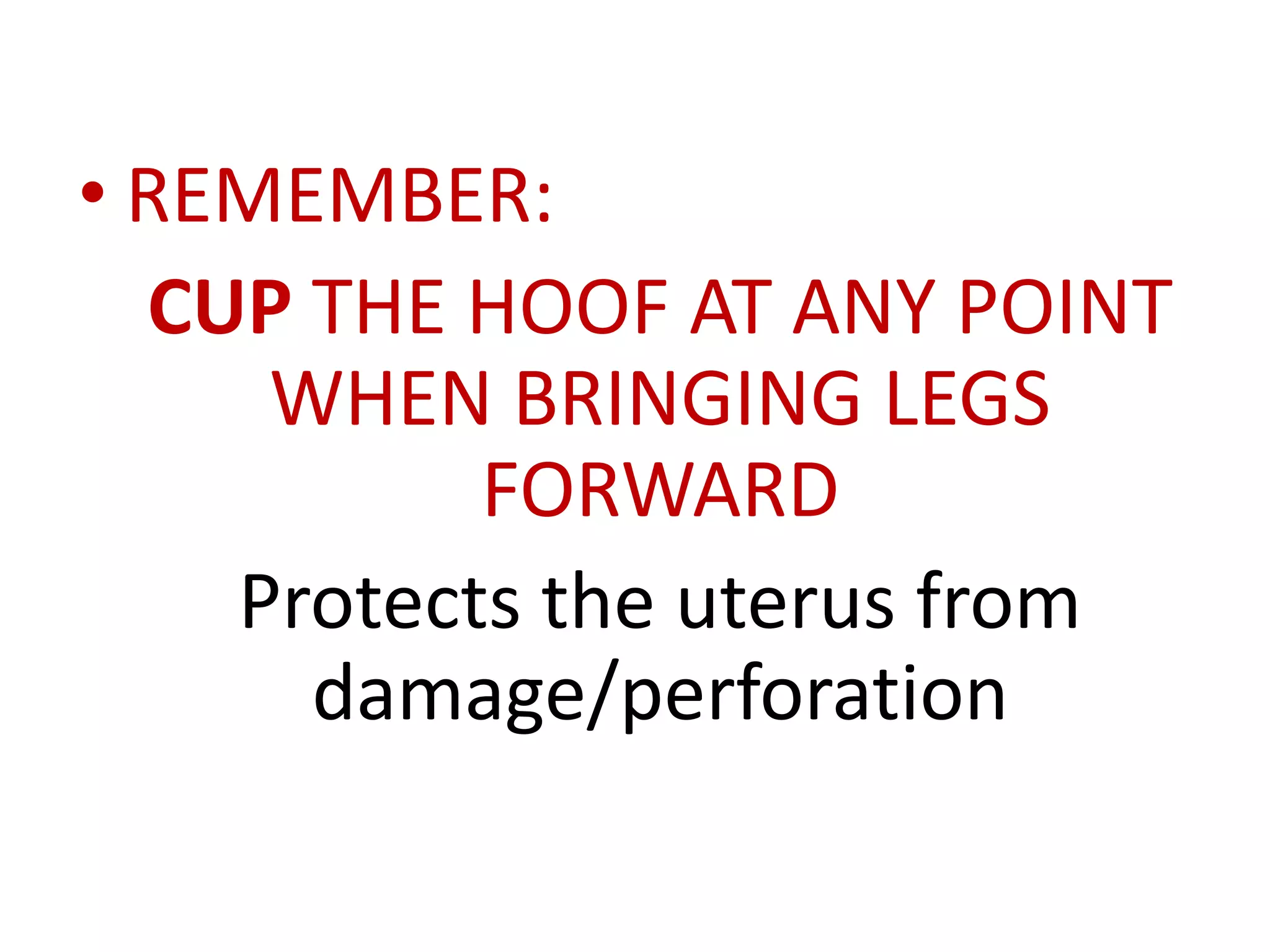
• Turning outside
– Nursery/straight outside?
– Are they ready?
– Turned in eyelids
– Tag with spray paint
– Tail docking
• Length is important
– Castration
• Check again
• LUNCHTIME!!
• Nightshift
GLOVES OR NO
GLOVES?
ANTIBIOTICS??
WHEN TO INTERVENE?
• Distressed
• Only head showing
• When presenting with only: - one leg
- tail
• The water-bag has been passed and she’s not
making progress in 30 minutes
HOW TO CORRECT
MALPRESENTATIONS
• REMEMBER:
CUP THE HOOF AT ANY POINT
WHEN BRINGING LEGS
FORWARD
Protects the uterus from
damage/perforation
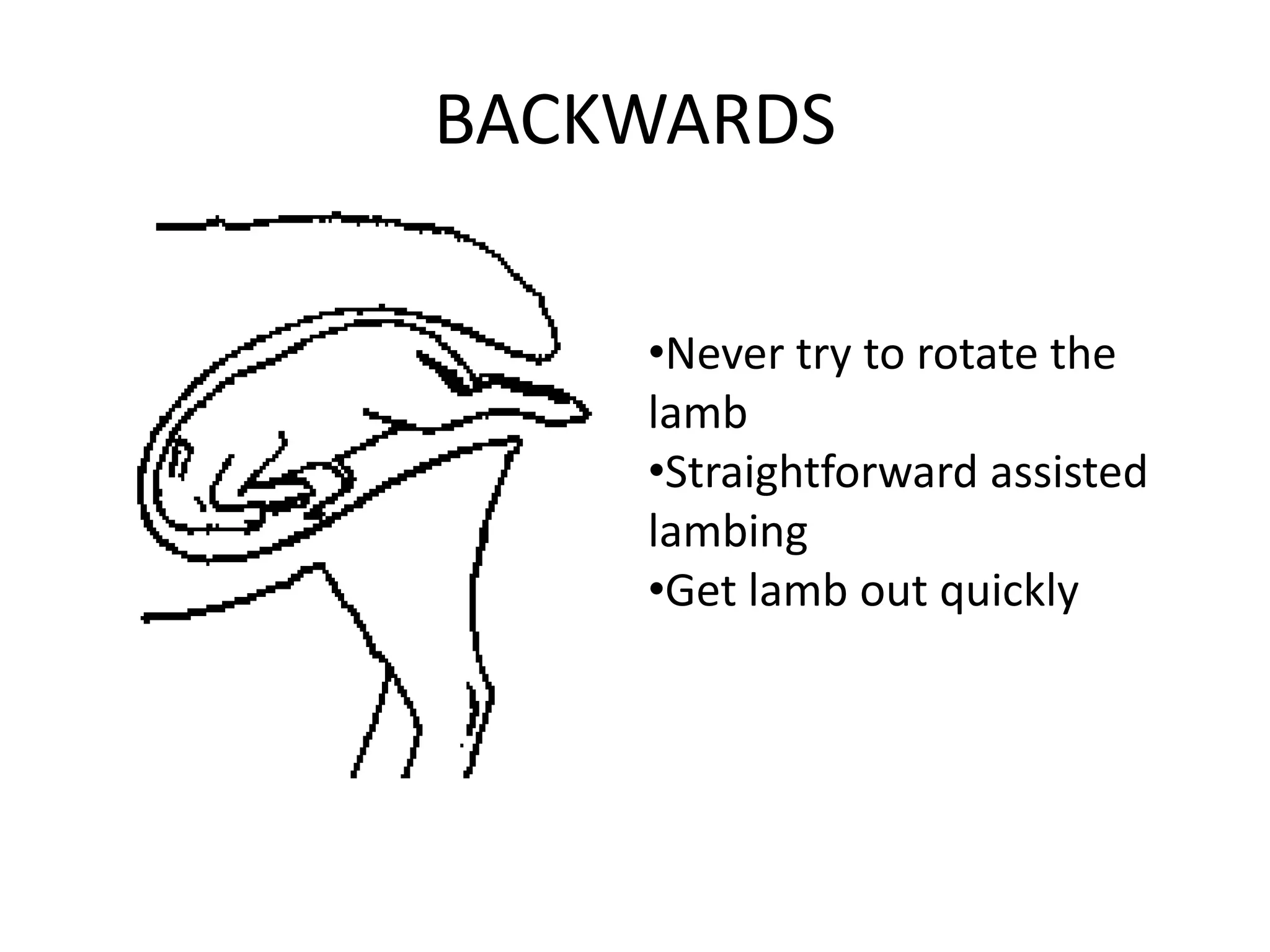
BACKWARDS
•Never try to rotate the
lamb
•Straightforward assisted
lambing
•Get lamb out quickly
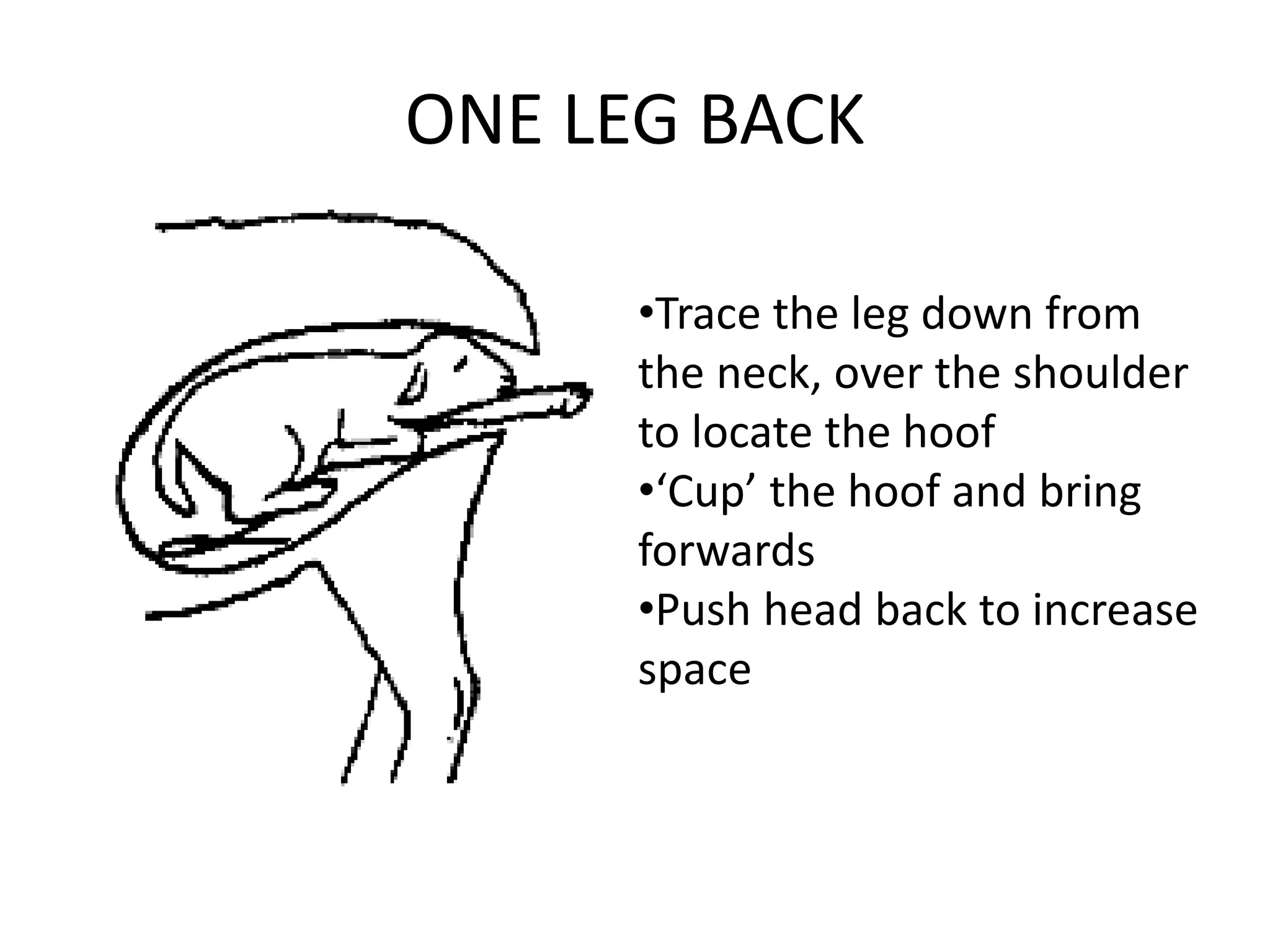
ONE LEG BACK
•Trace the leg down from
the neck, over the shoulder
to locate the hoof
•‘Cup’ the hoof and bring
forwards
•Push head back to increase
space
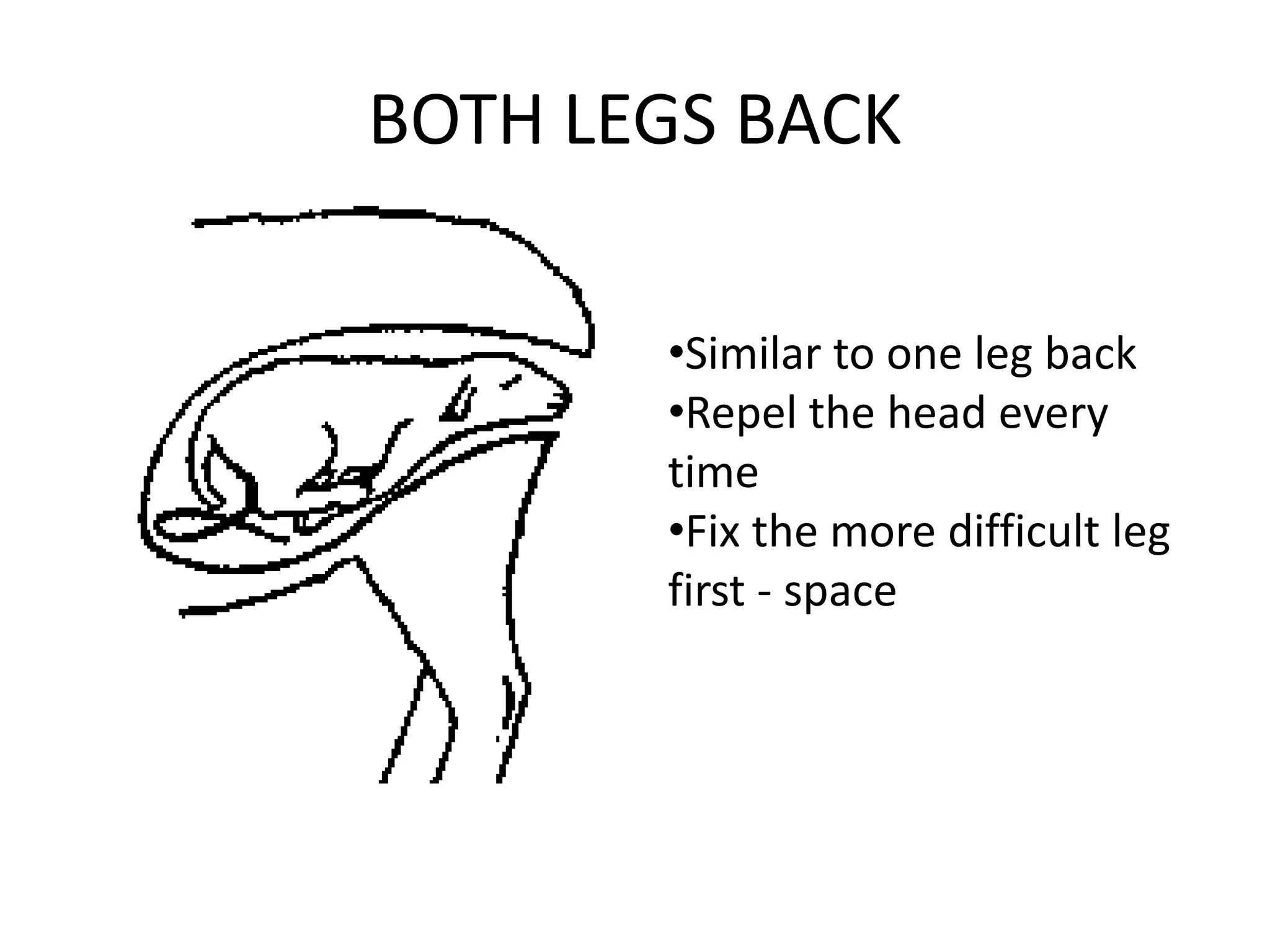
BOTH LEGS BACK
•Similar to one leg back
•Repel the head every
time
•Fix the more difficult leg
first - space
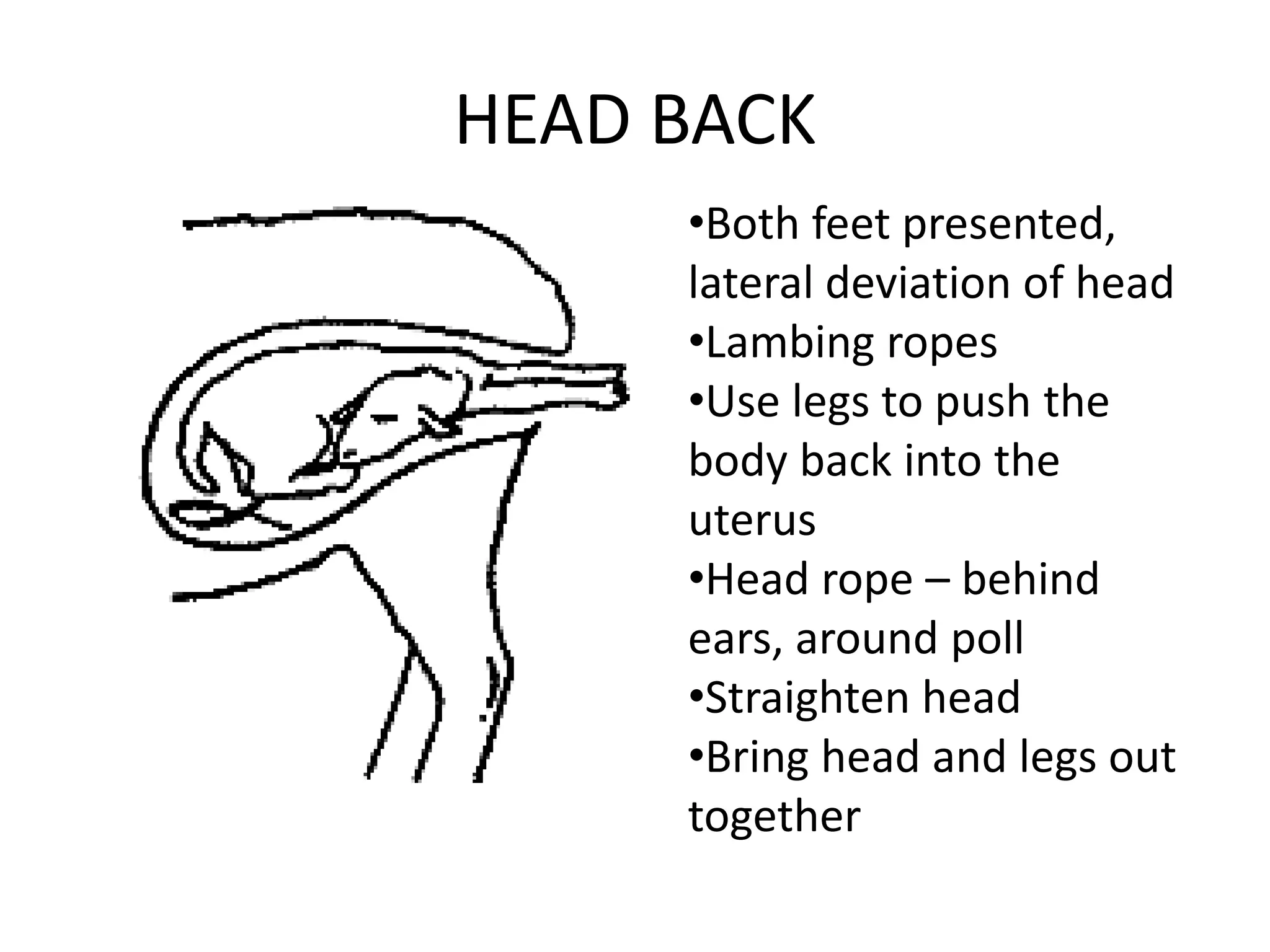
HEAD BACK
•Both feet presented,
lateral deviation of head
•Lambing ropes
•Use legs to push the
body back into the
uterus
•Head rope – behind
ears, around poll
•Straighten head
•Bring head and legs out
together
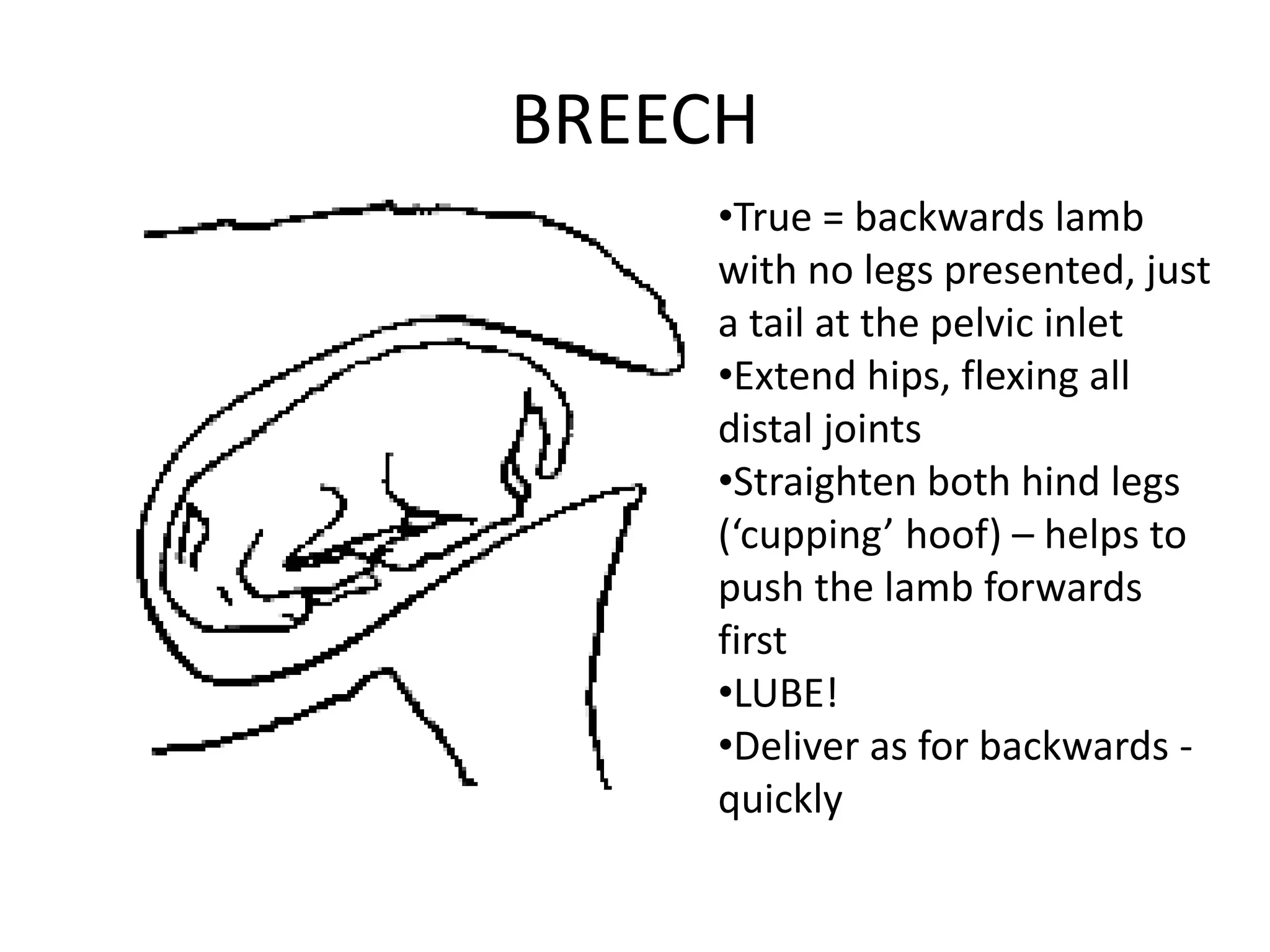
BREECH
•True = backwards lamb
with no legs presented, just
a tail at the pelvic inlet
•Extend hips, flexing all
distal joints
•Straighten both hind legs
(‘cupping’ hoof) – helps to
push the lamb forwards
first
•LUBE!
•Deliver as for backwards -
quickly
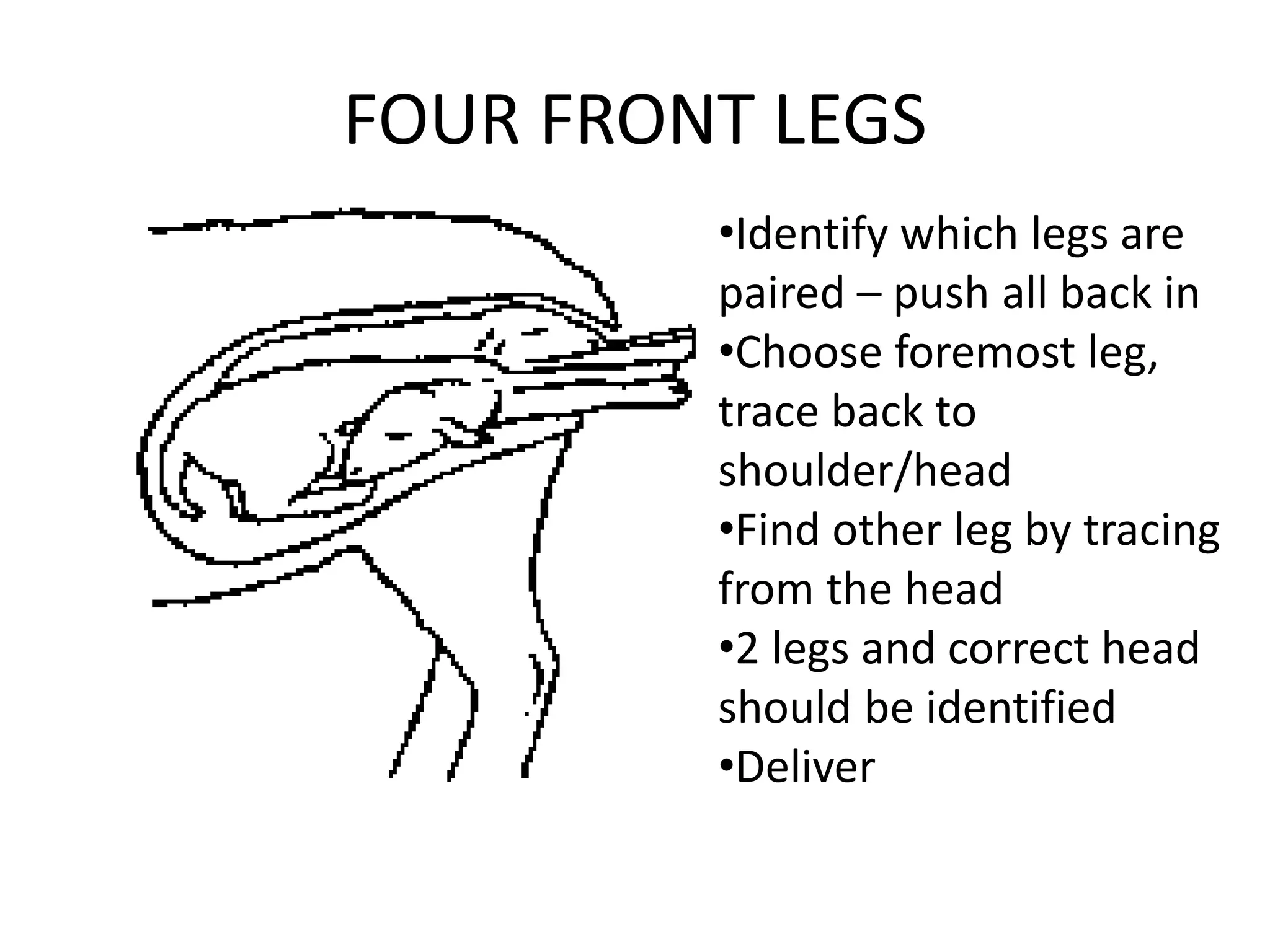
FOUR FRONT LEGS
•Identify which legs are
paired – push all back in
•Choose foremost leg,
trace back to
shoulder/head
•Find other leg by tracing
from the head
•2 legs and correct head
should be identified
•Deliver
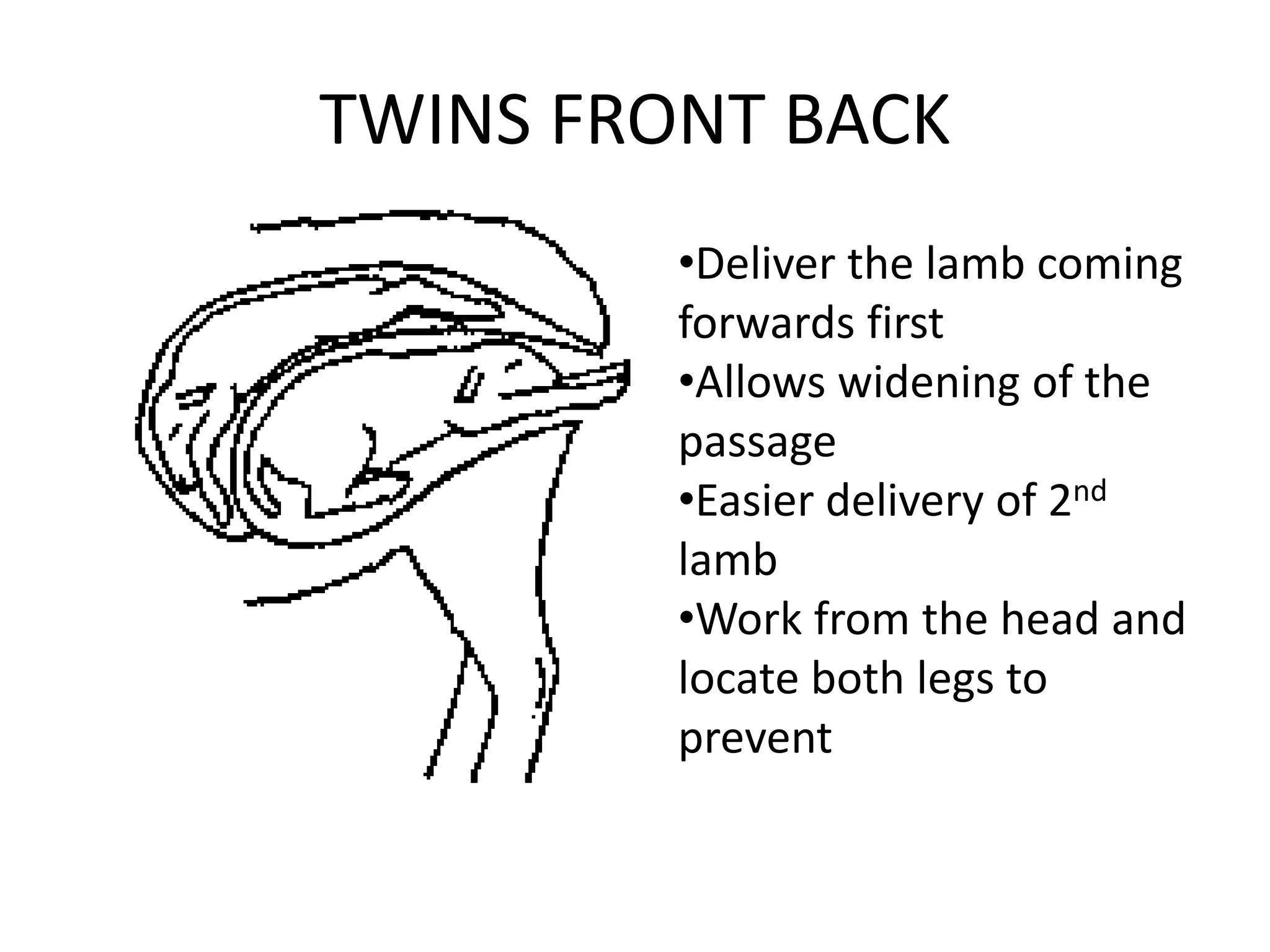
TWINS FRONT BACK
•Deliver the lamb coming
forwards first
•Allows widening of the
passage
•Easier delivery of 2nd
lamb
•Work from the head and
locate both legs to
prevent
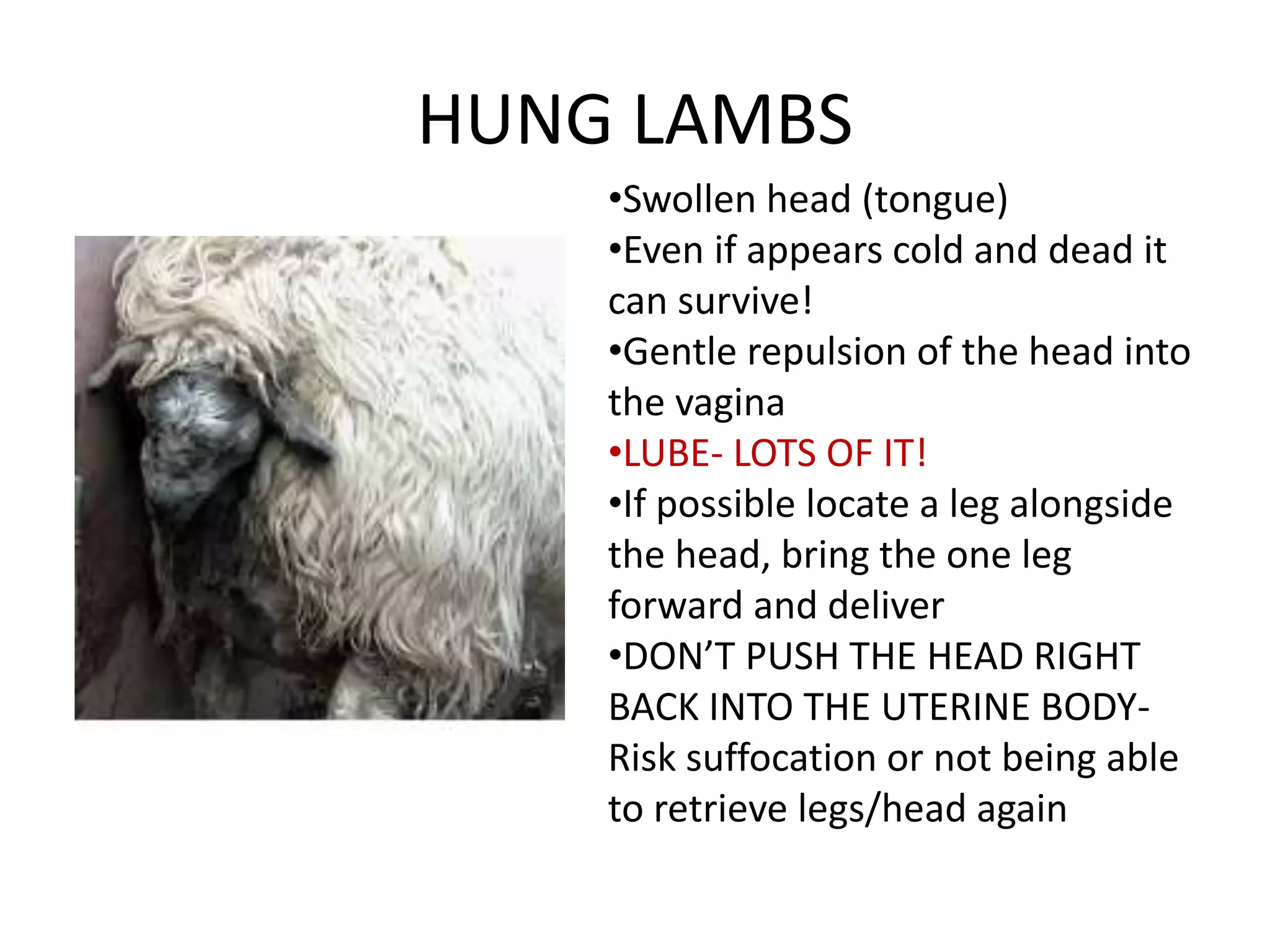
HUNG LAMBS
•Swollen head (tongue)
•Even if appears cold and dead it
can survive!
•Gentle repulsion of the head into
the vagina
•LUBE- LOTS OF IT!
•If possible locate a leg alongside
the head, bring the one leg
forward and deliver
•DON’T PUSH THE HEAD RIGHT
BACK INTO THE UTERINE BODY-
Risk suffocation or not being able
to retrieve legs/head again
TIPS!
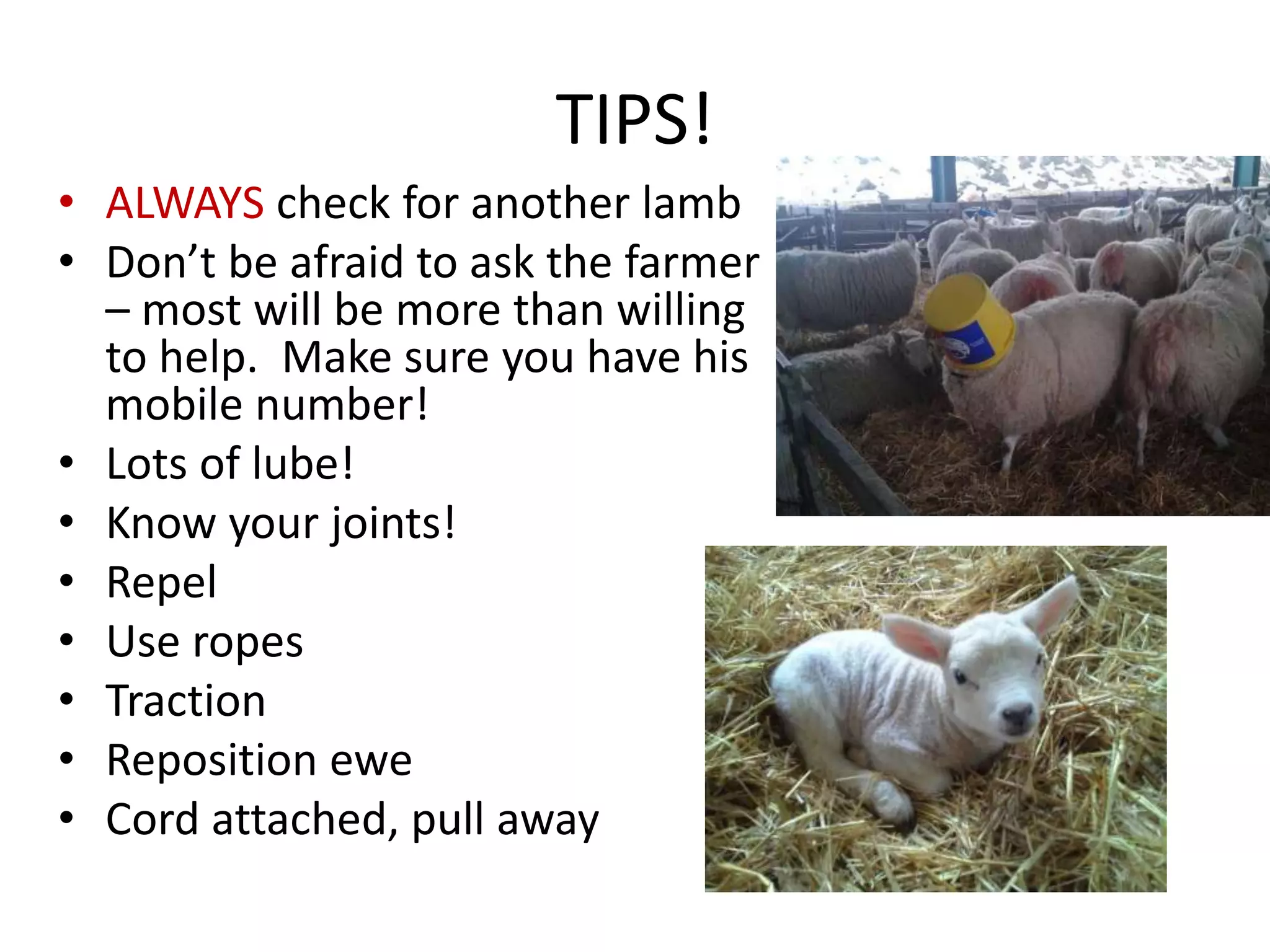
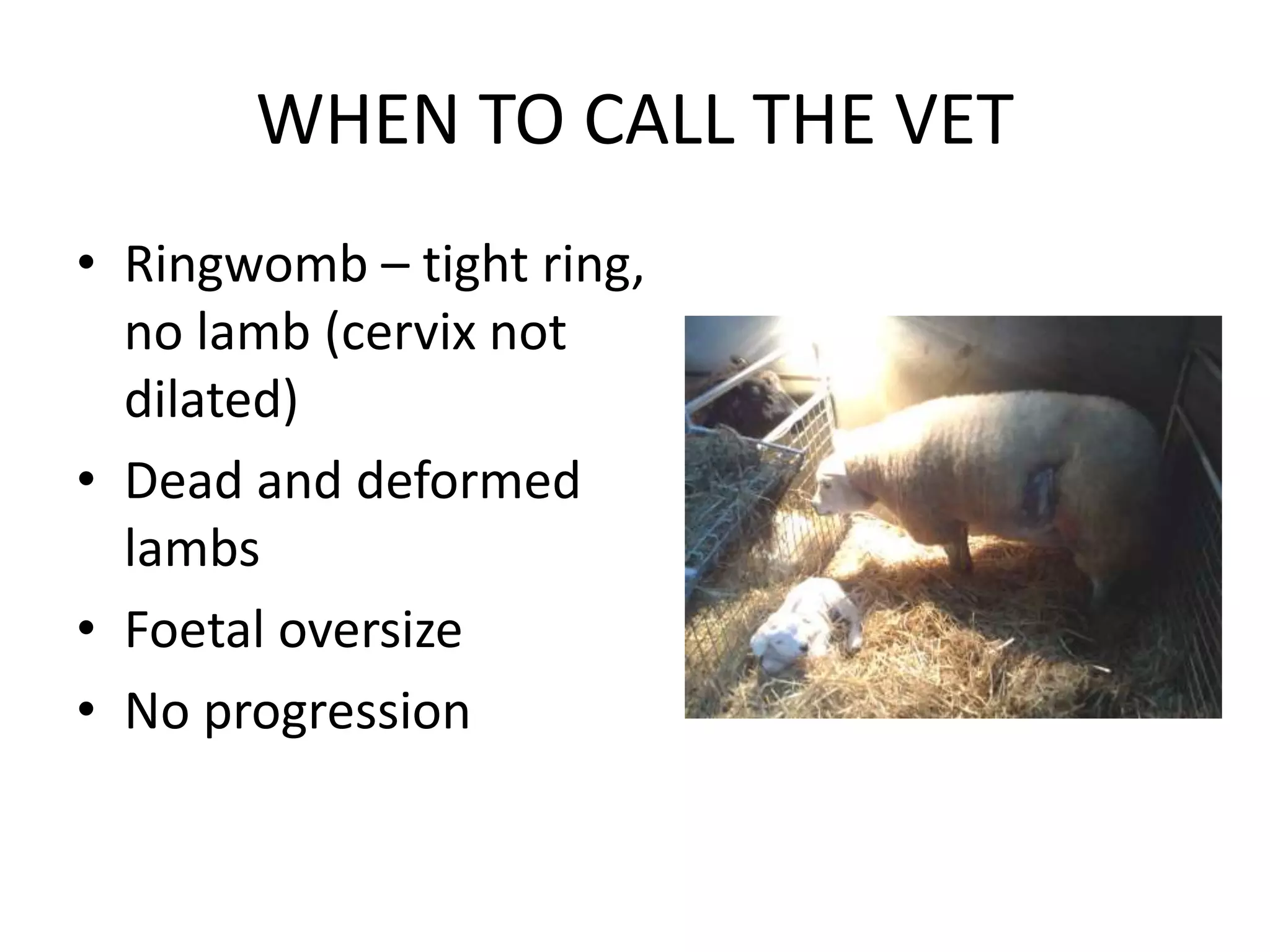
• ALWAYS check for another lamb
• Don’t be afraid to ask the farmer
– most will be more than willing
to help. Make sure you have his
mobile number!
• Lots of lube!
• Know your joints!
• Repel
• Use ropes
• Traction
• Reposition ewe
• Cord attached, pull away
WHEN TO CALL THE VET
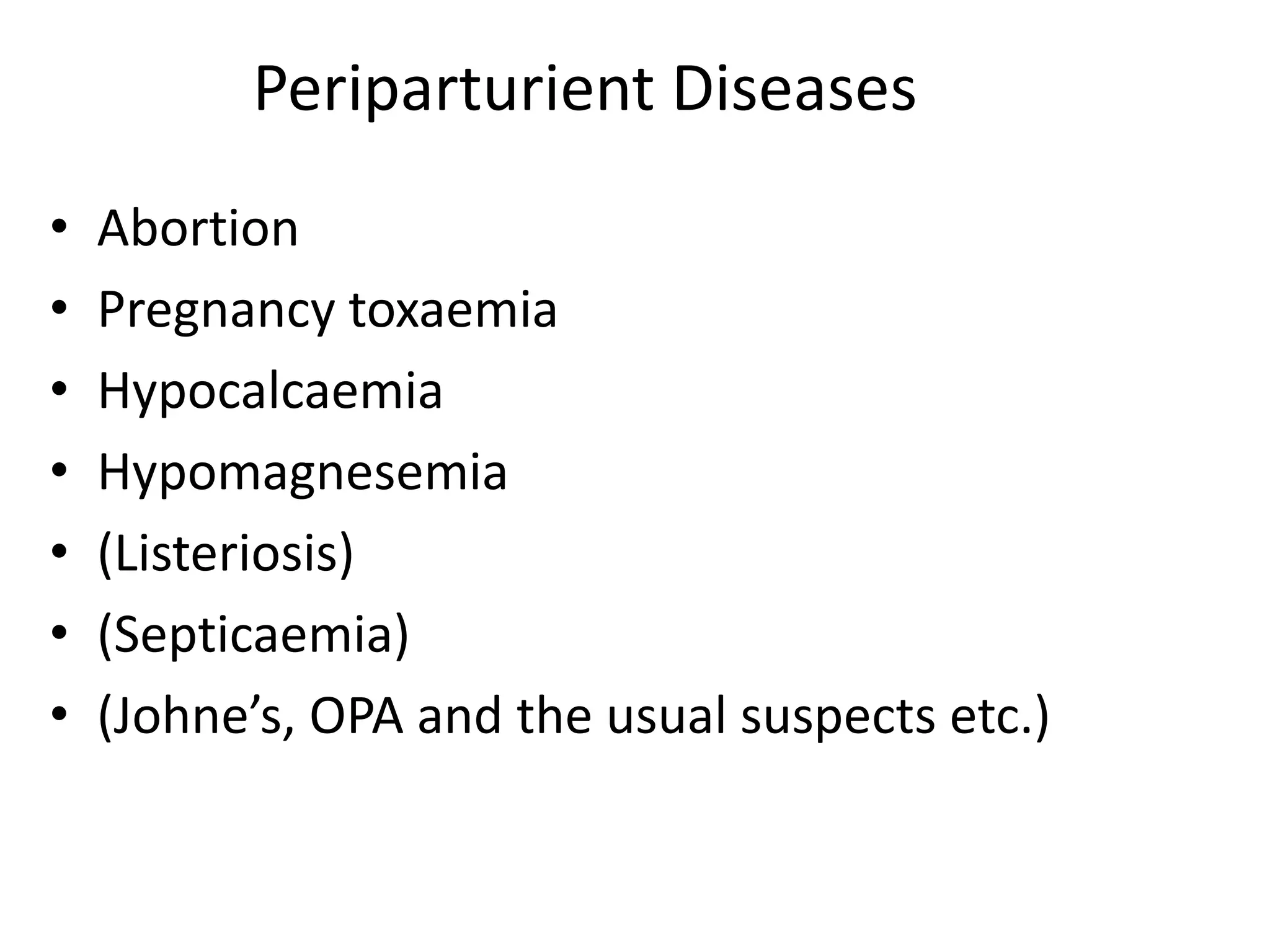
• Ringwomb – tight ring,
no lamb (cervix not
dilated)
• Dead and deformed
lambs
• Foetal oversize
• No progression
Periparturient Diseases
• Abortion
• Pregnancy toxaemia
• Hypocalcaemia
• Hypomagnesemia
• (Listeriosis)
• (Septicaemia)
• (Johne’s, OPA and the usual suspects etc.)
Abortion
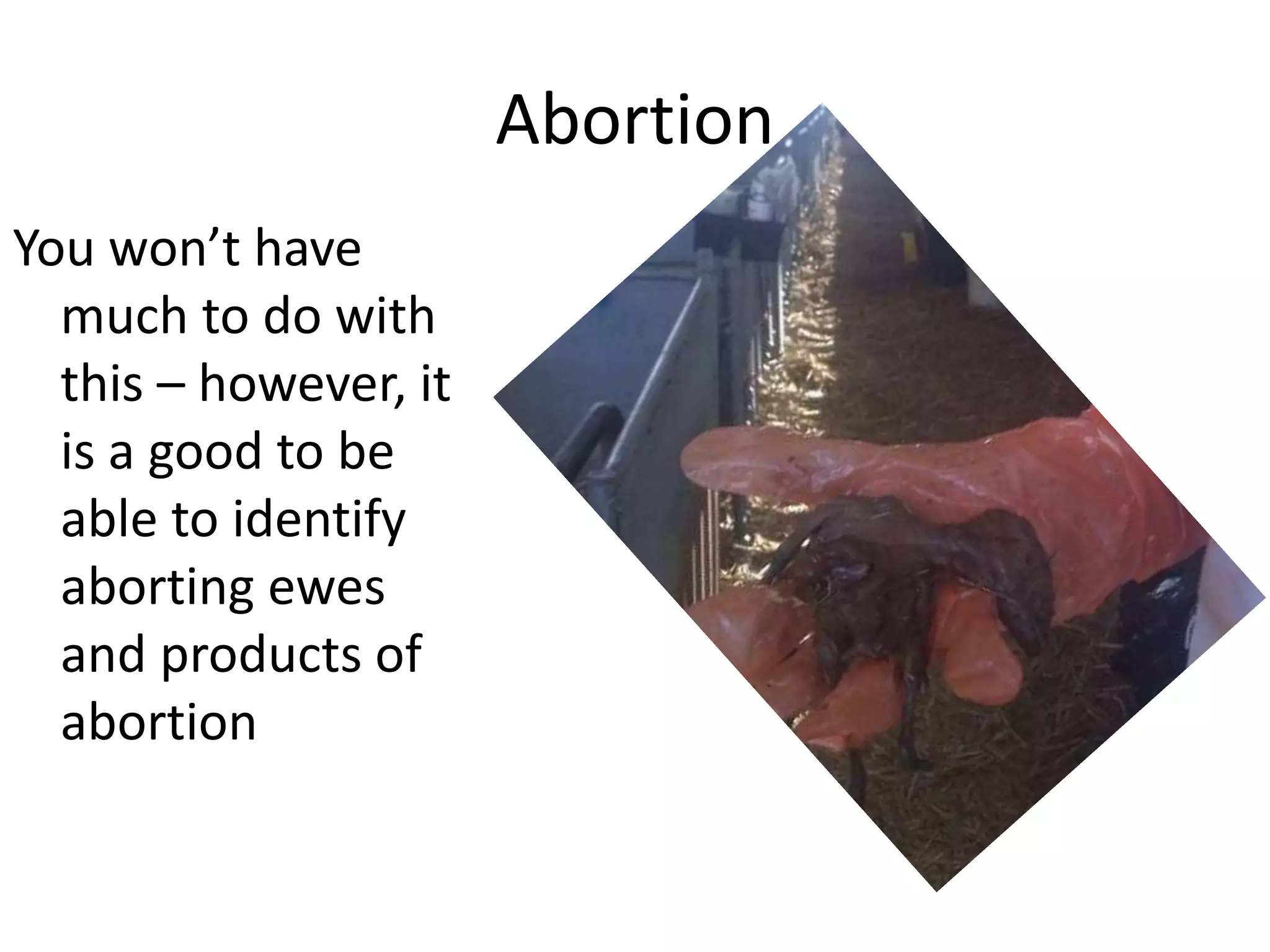
You won’t have
much to do with
this – however, it
is a good to be
able to identify
aborting ewes
and products of
abortion
Hypocalcaemia
Hypomagnesaemia
Preg toxaemia
Lambing 6 weeks6 weeks
28
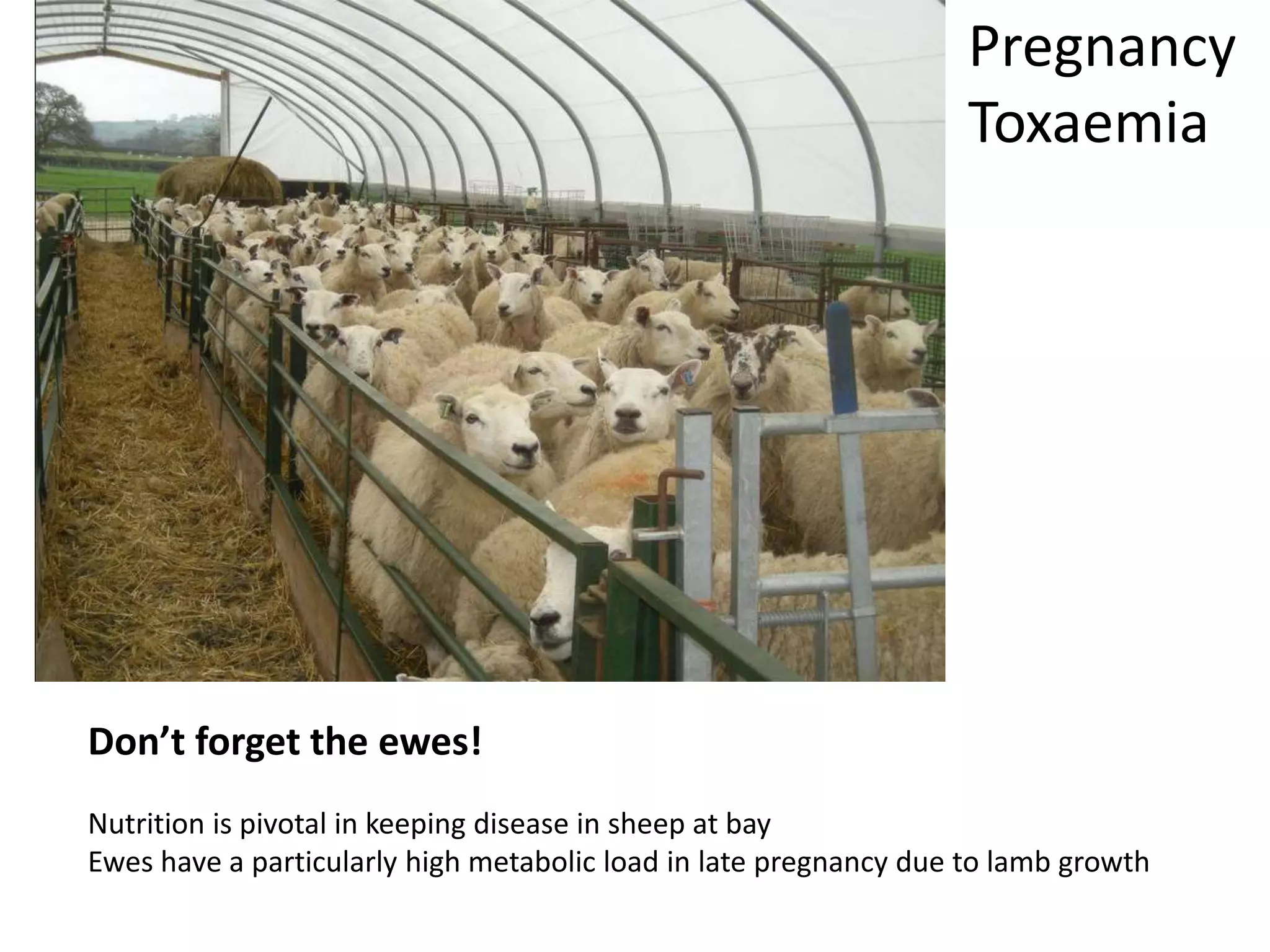
Don’t forget the ewes!
Nutrition is pivotal in keeping disease in sheep at bay
Ewes have a particularly high metabolic load in late pregnancy due to lamb growth
Pregnancy
Toxaemia
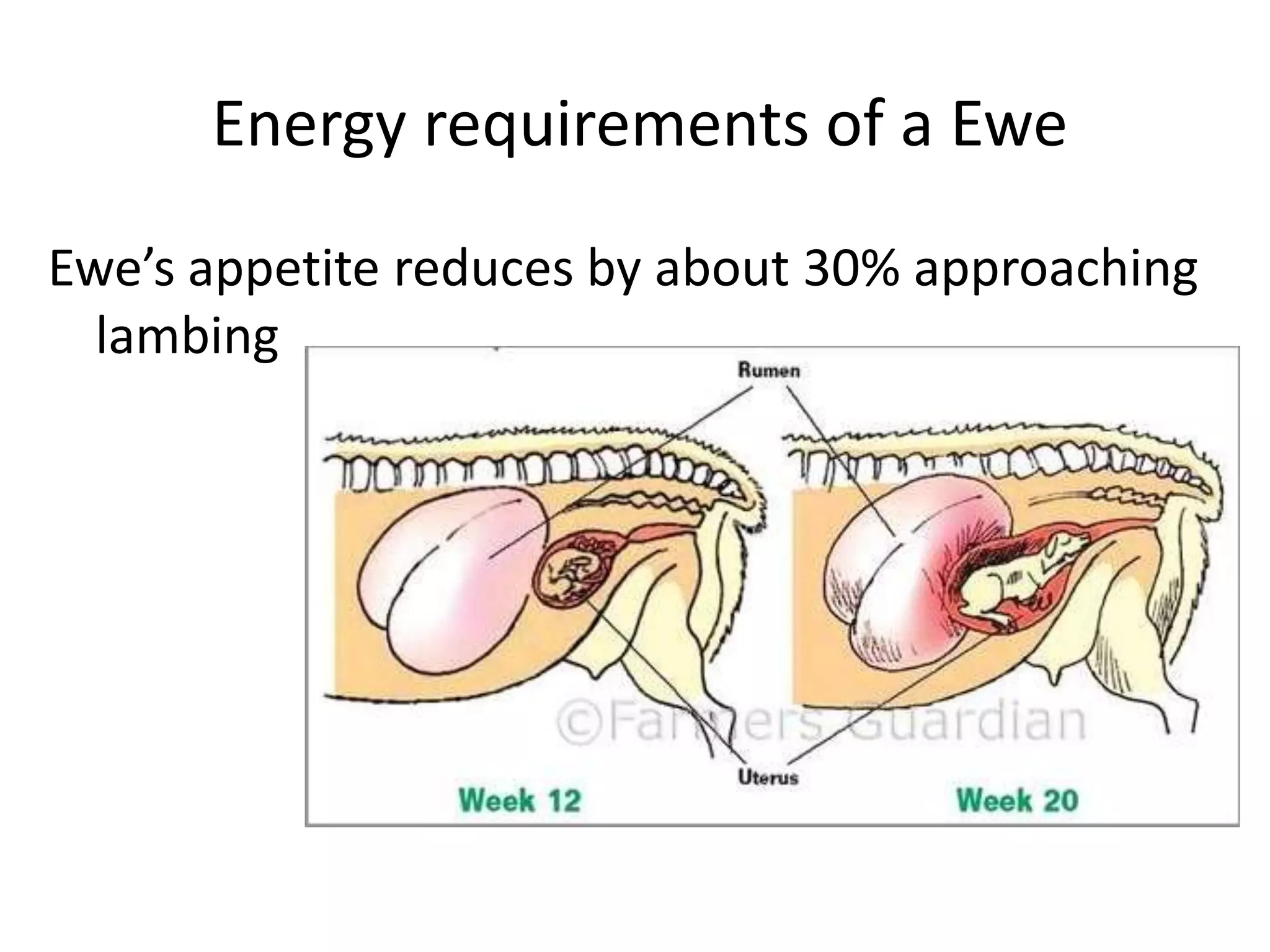
Energy requirements of a Ewe
Ewe’s appetite reduces by about 30% approaching
lambing
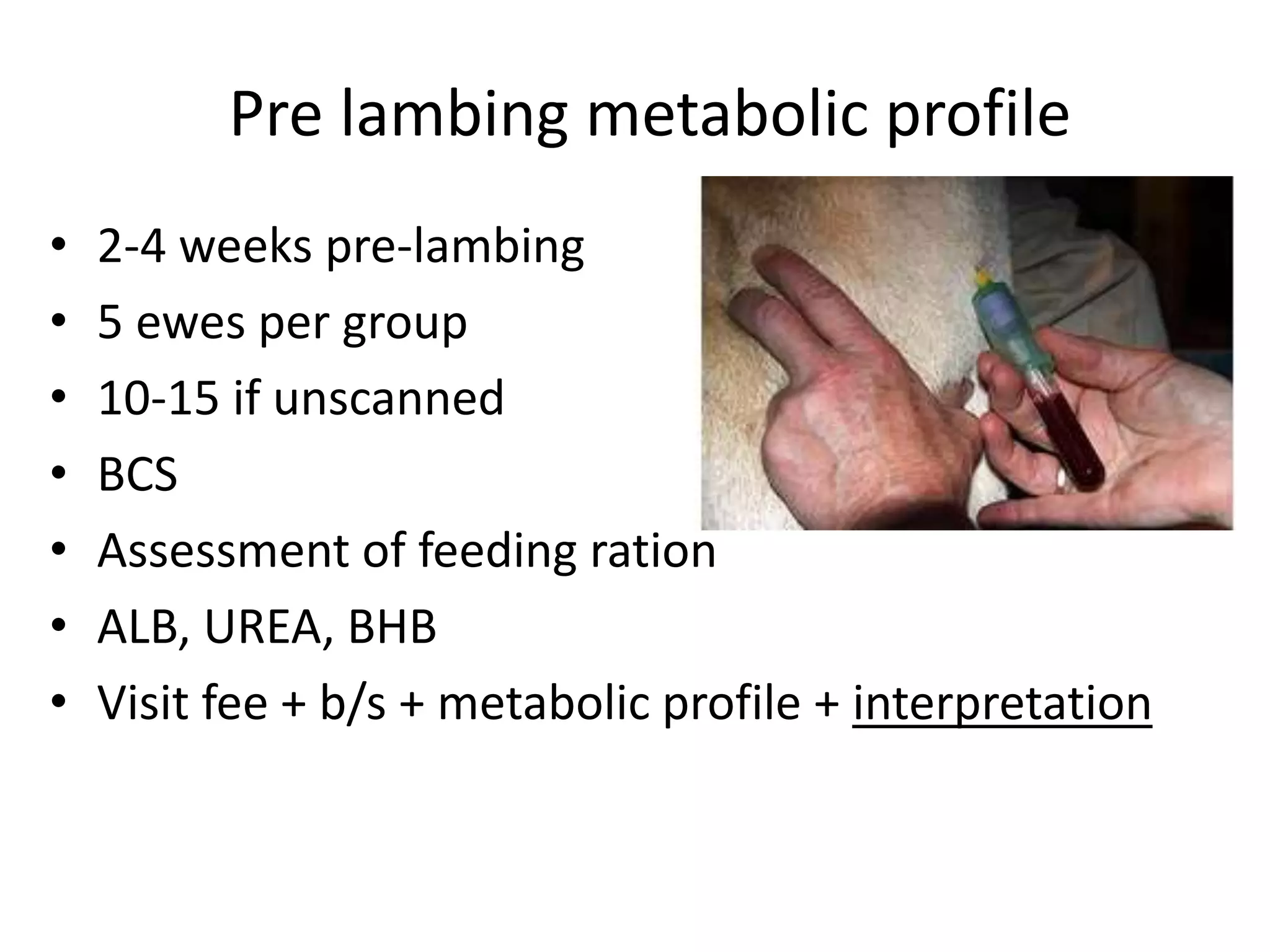
Pre lambing metabolic profile
• 2-4 weeks pre-lambing
• 5 ewes per group
• 10-15 if unscanned
• BCS
• Assessment of feeding ration
• ALB, UREA, BHB
• Visit fee + b/s + metabolic profile + interpretation
Late pregnancy
• In the last eight weeks of pregnancy, 70 per cent of foetal
growth takes place.
• Udder development and colostrum production
• It is vital to manage ewes well at this stage as low lamb
birth-weight and low colostrum intake are major causes of
lamb deaths in the first few days of life.
• During late pregnancy, a ewe’s energy and protein
requirements are increasing rapidly – more than doubling if
they are carrying two lambs.
• However, as the lambs grow, the ewe’s ability to eat bulk
reduces . Therefore, the nutrient density of the ration must
be increased gradually to allow ewes to consume enough to
keep pace with foetal growth.
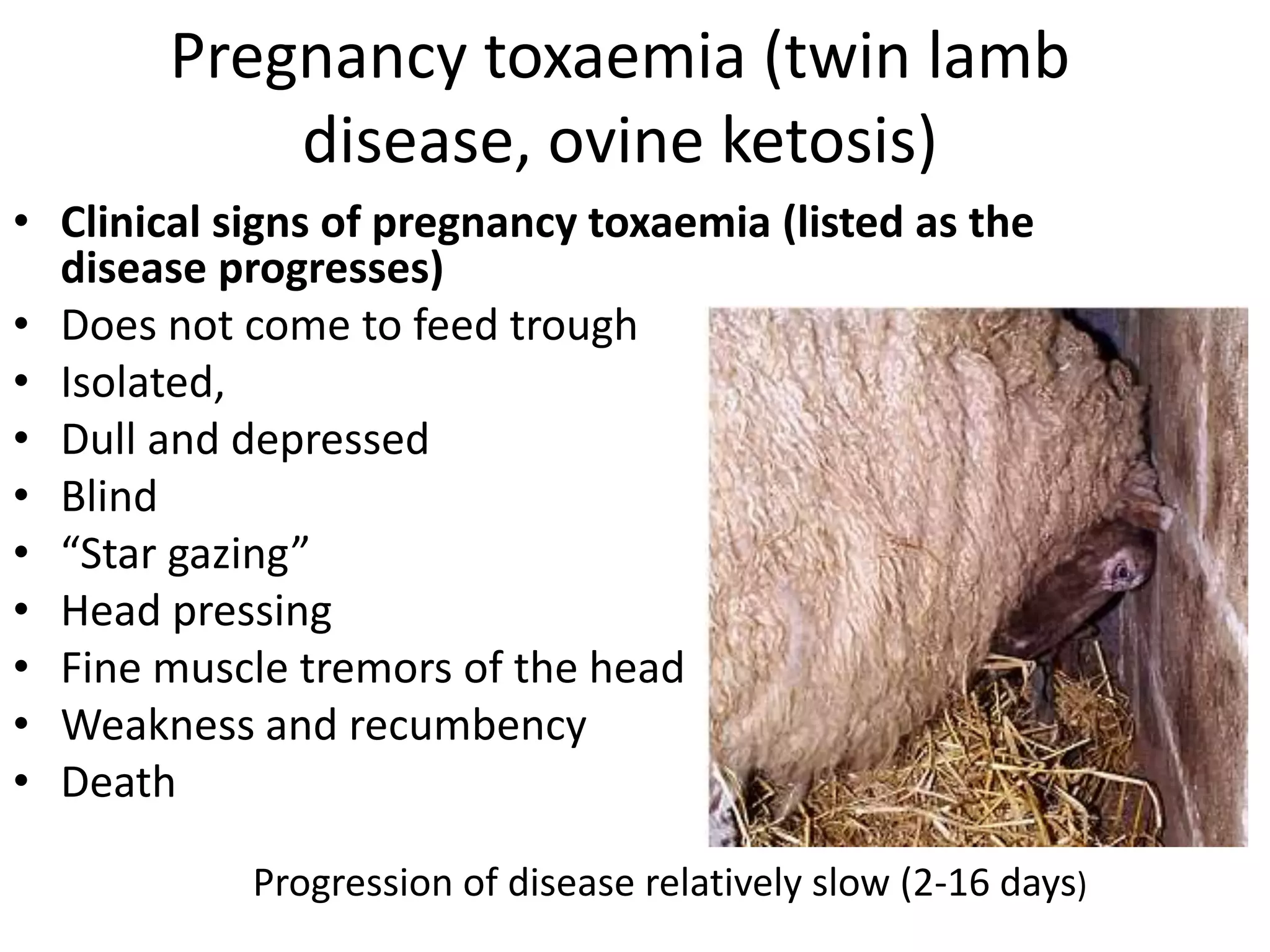
Pregnancy toxaemia (twin lamb
disease, ovine ketosis)
• Clinical signs of pregnancy toxaemia (listed as the
disease progresses)
• Does not come to feed trough
• Isolated,
• Dull and depressed
• Blind
• “Star gazing”
• Head pressing
• Fine muscle tremors of the head
• Weakness and recumbency
• Death
Progression of disease relatively slow (2-16 days)
Treatment?
• Response to treatment is generally poor
• Pen sick ewe separately - offer palatable feeds to
promote appetite, and fresh water
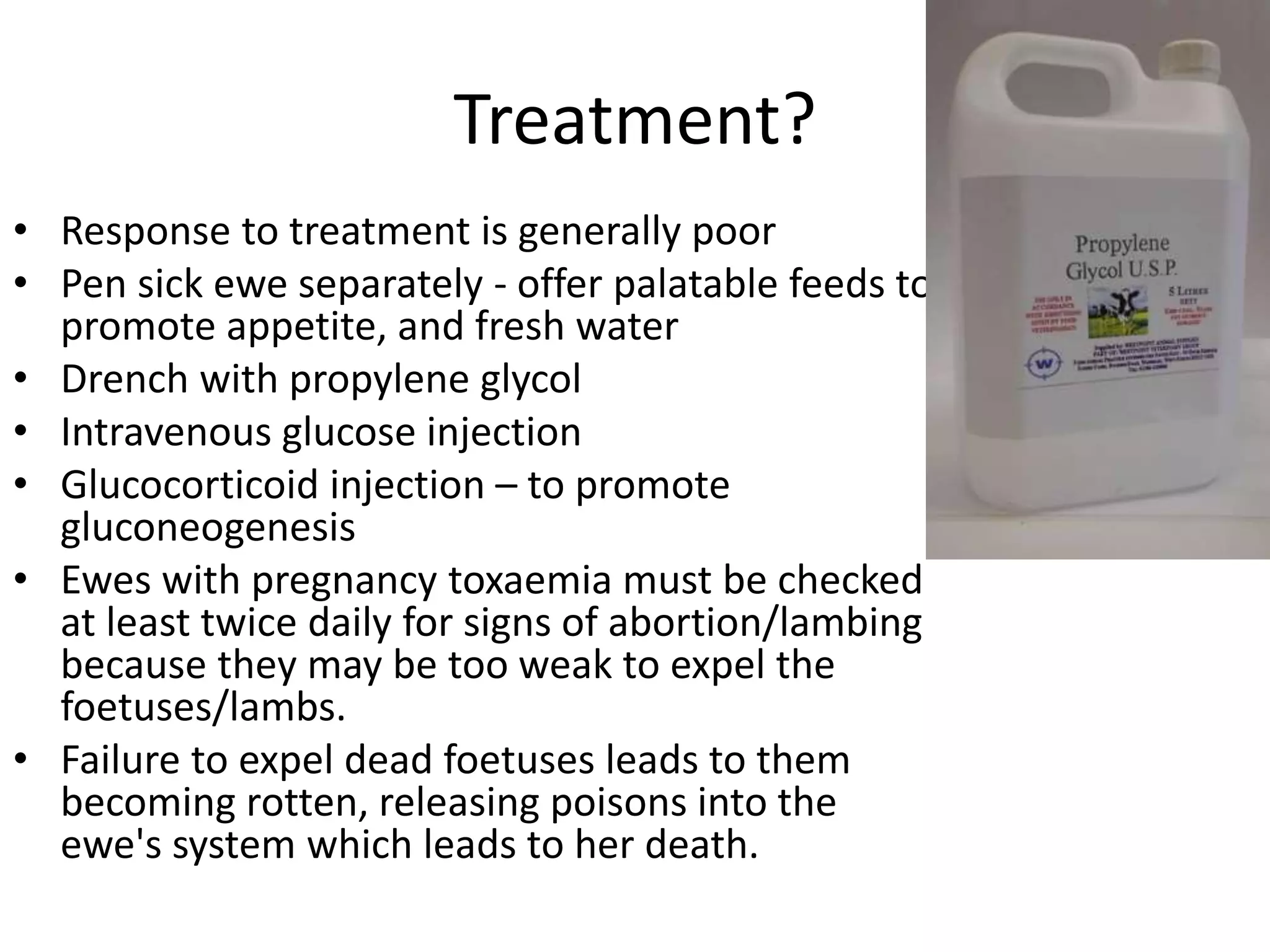
• Drench with propylene glycol
• Intravenous glucose injection
• Glucocorticoid injection – to promote
gluconeogenesis
• Ewes with pregnancy toxaemia must be checked
at least twice daily for signs of abortion/lambing
because they may be too weak to expel the
foetuses/lambs.
• Failure to expel dead foetuses leads to them
becoming rotten, releasing poisons into the
ewe's system which leads to her death.
Pregnancy toxaemia-Ewes At
risk
• Late pregnancy
• Twins/triplets
• Older ewes
• Fat ewes/thin ewes
• Often a group problem
• Concurrent disease
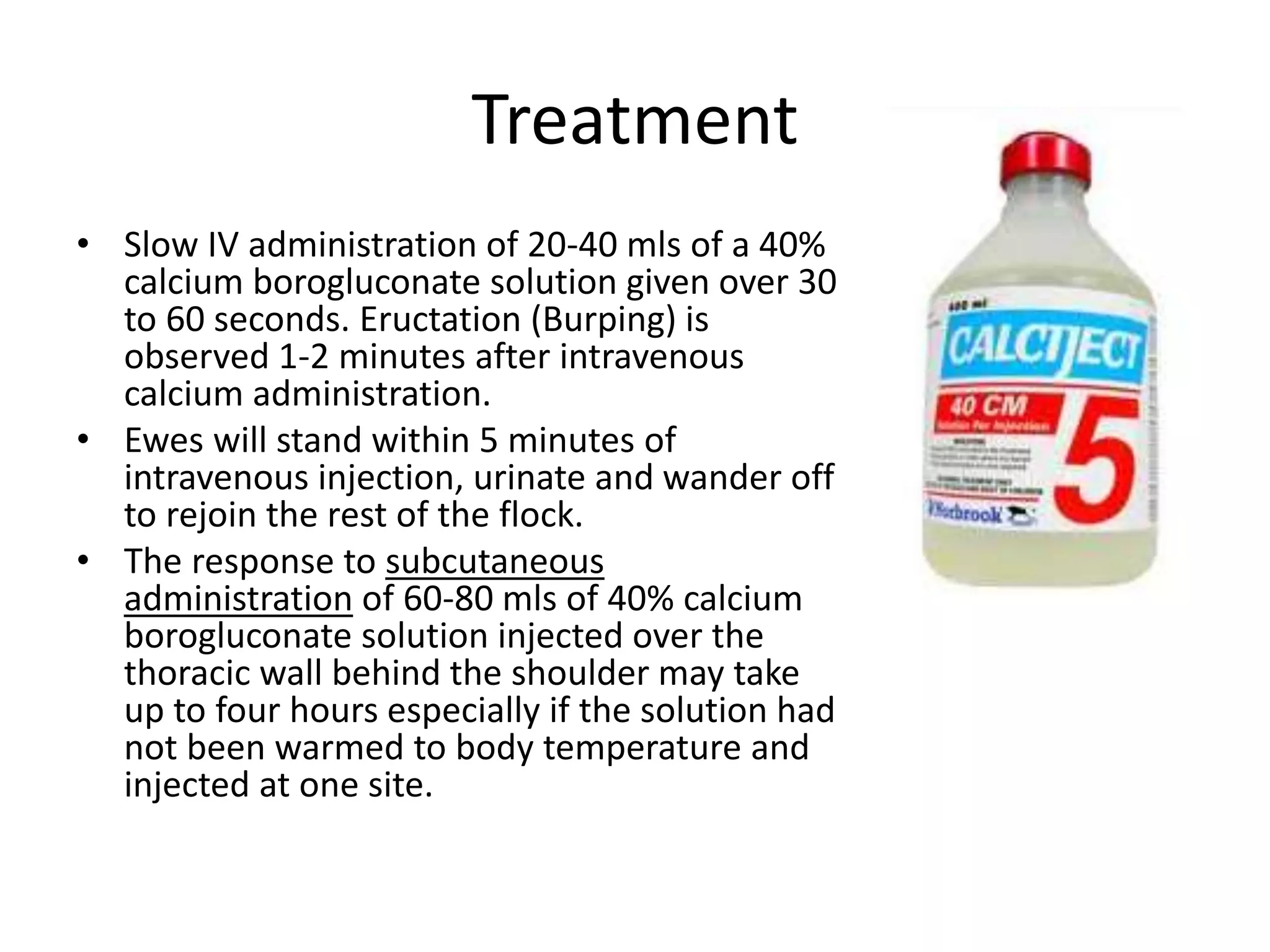
Hypocalcaemia
Demand exceeds supply
Clinical signs:
•Depressed, weak unable to stand
•Rumenal stasis and bloat
•Reflux of ruminal contents with
green fluid around nostrils and
lower jaw
•Coma and death within 48-72 hrs
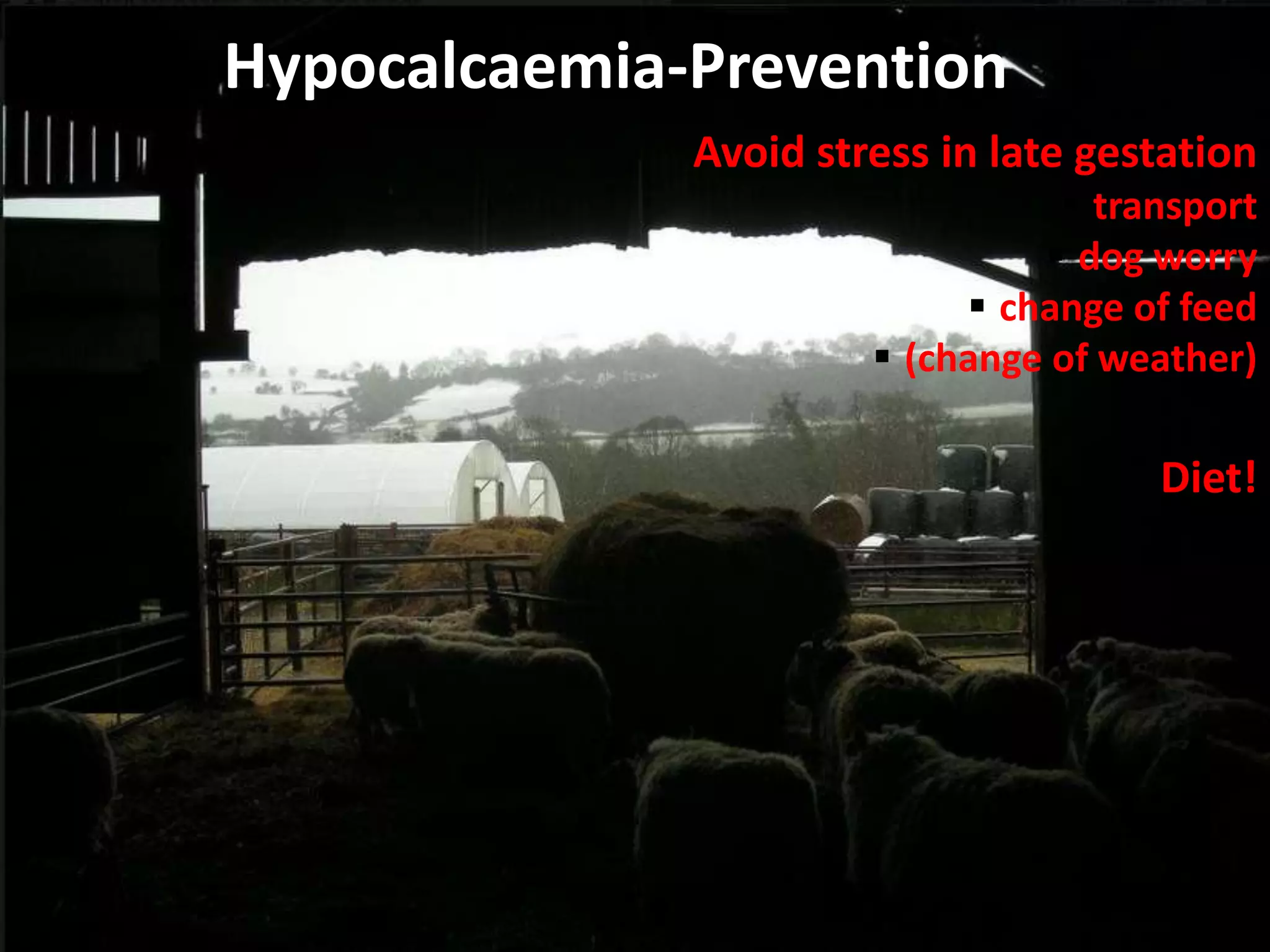
Treatment
• Slow IV administration of 20-40 mls of a 40%
calcium borogluconate solution given over 30
to 60 seconds. Eructation (Burping) is
observed 1-2 minutes after intravenous
calcium administration.
• Ewes will stand within 5 minutes of
intravenous injection, urinate and wander off
to rejoin the rest of the flock.
• The response to subcutaneous
administration of 60-80 mls of 40% calcium
borogluconate solution injected over the
thoracic wall behind the shoulder may take
up to four hours especially if the solution had
not been warmed to body temperature and
injected at one site.
Hypocalcaemia-Prevention
Avoid stress in late gestation
 transport
 dog worry
 change of feed
 (change of weather)
Diet!
Hypomagnesaemia/ Staggers
Risk factors:
• High levels of Potassium in grass
• Rapidly growing grass (gut transit)
• Cold/wet stressful weather
• Lactating ewes with twins
Hypomagnesaemia-Clinical
Signs
Mostly sudden death
• Anxiety, hyperaesthesia/tachycardia
• Unsteady gait, staggering
• Apparent blindness
• Nystagmus
• Recumbency (+ paddling)
• Opisthotonus
• Hypersalivation (frothing at mouth)
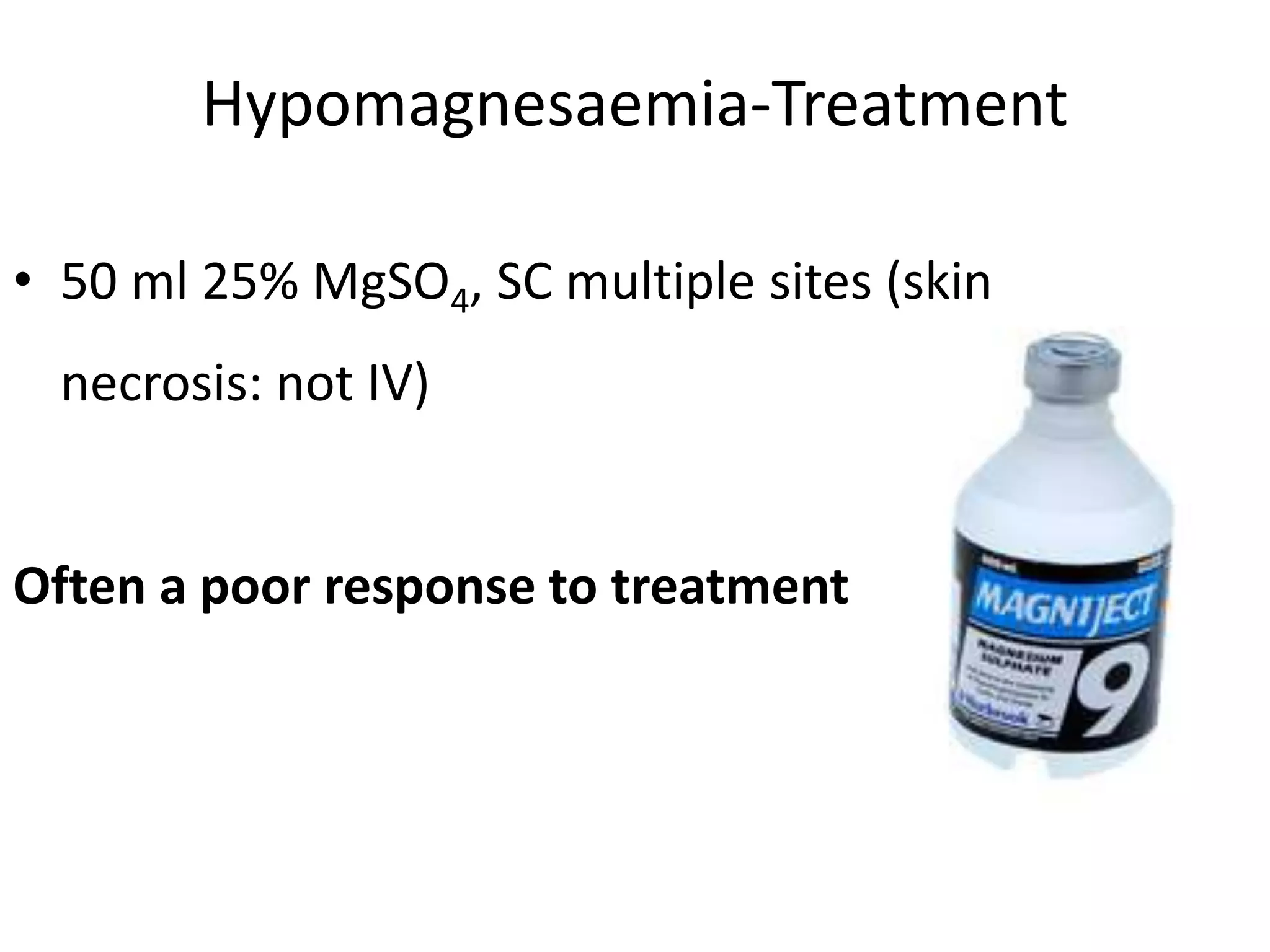
Hypomagnesaemia-Treatment
• 50 ml 25% MgSO4, SC multiple sites (skin
necrosis: not IV)
Often a poor response to treatment
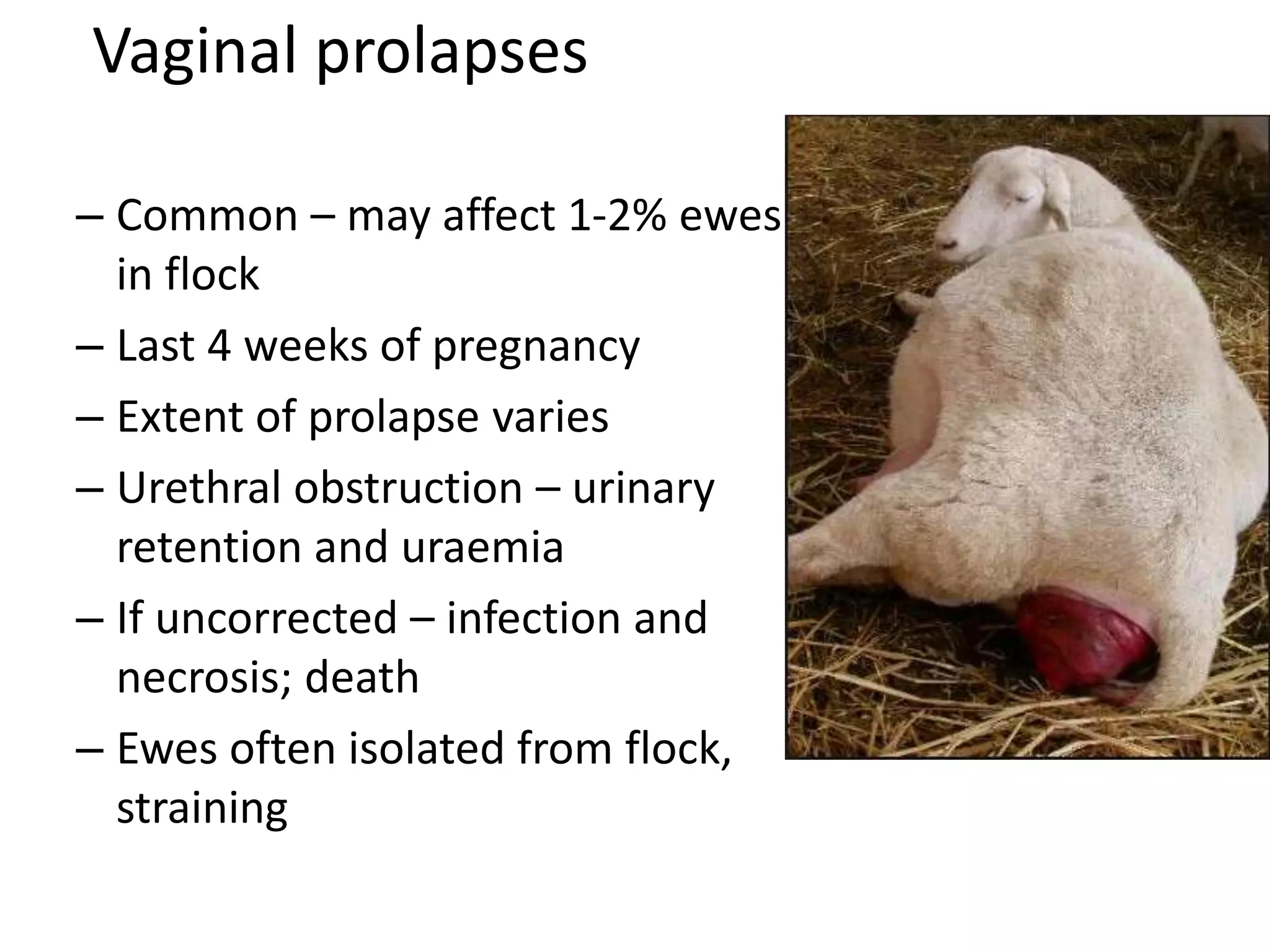
Vaginal prolapses
– Common – may affect 1-2% ewes
in flock
– Last 4 weeks of pregnancy
– Extent of prolapse varies
– Urethral obstruction – urinary
retention and uraemia
– If uncorrected – infection and
necrosis; death
– Ewes often isolated from flock,
straining
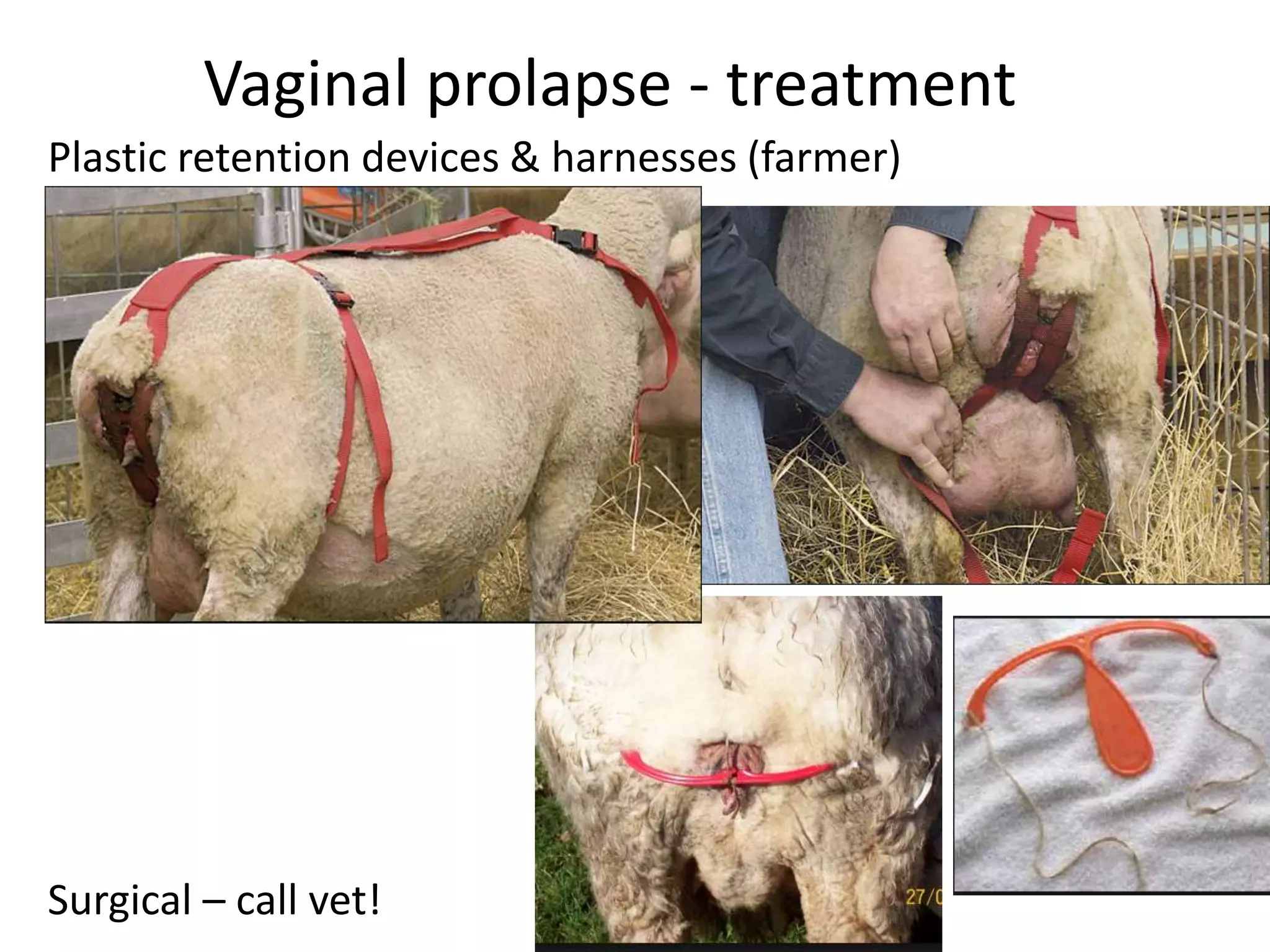
Vaginal prolapse - treatment
Plastic retention devices & harnesses (farmer)
Surgical – call vet!
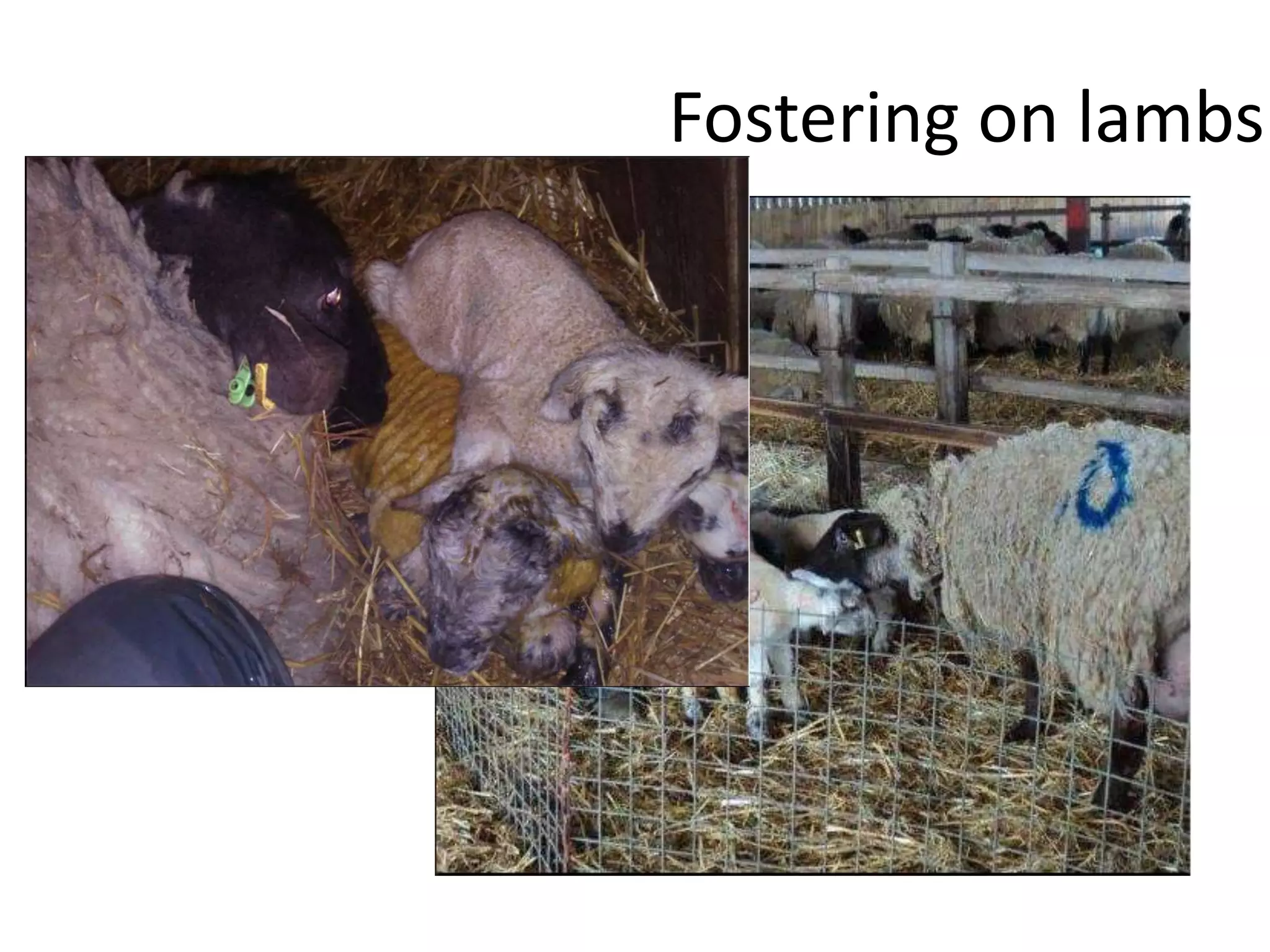
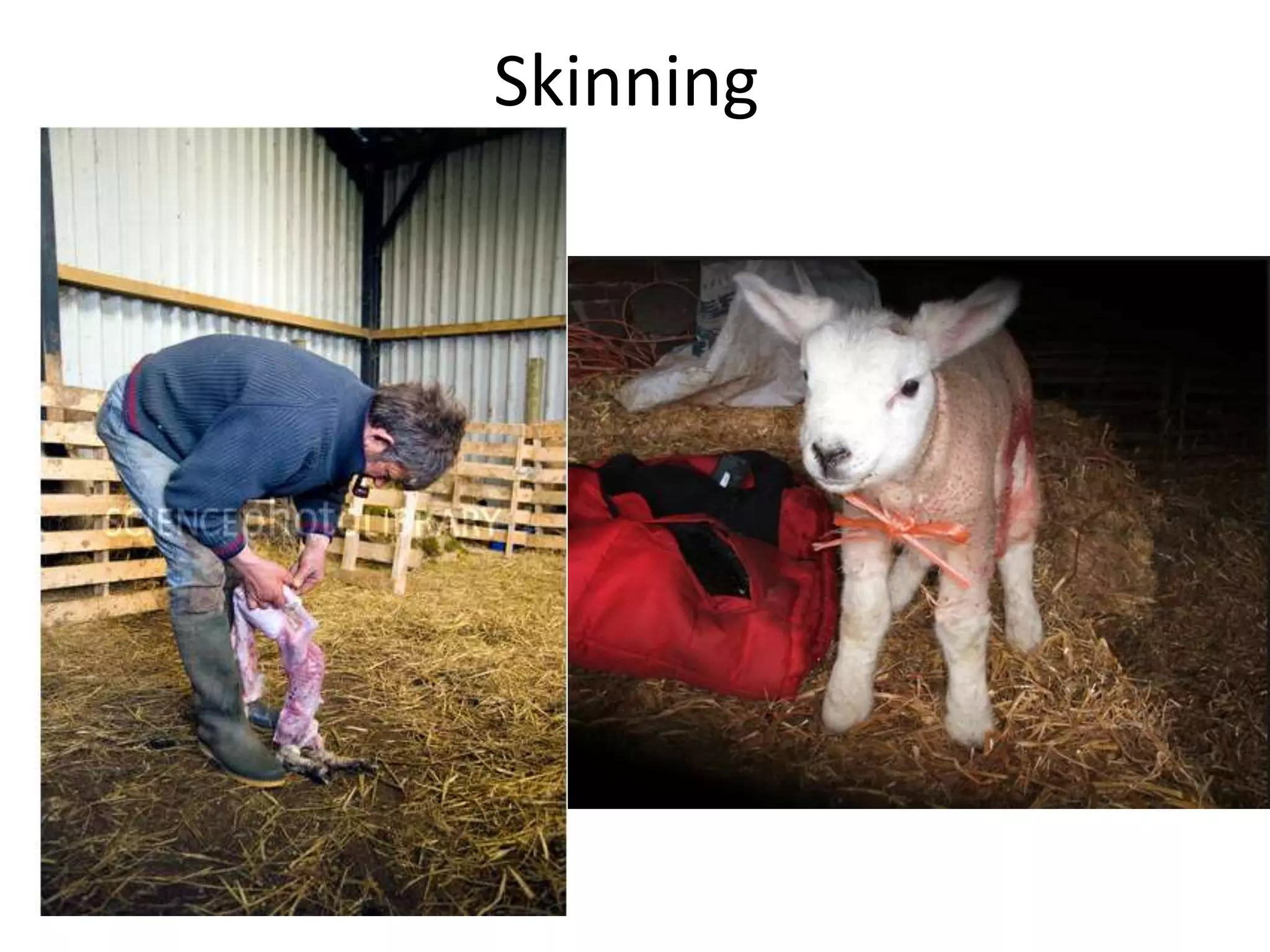
Fostering on lambs
Skinning
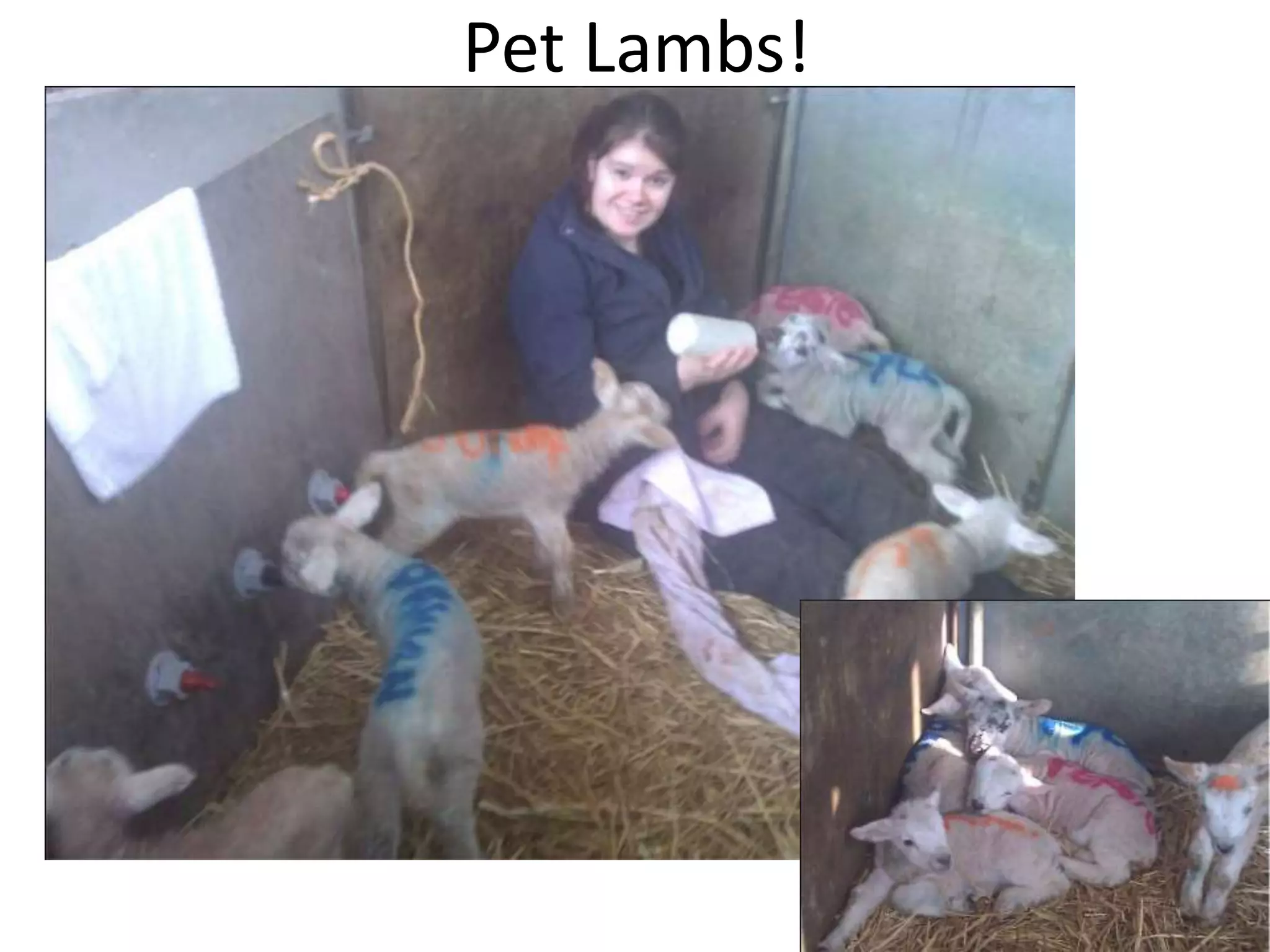
Pet Lambs!
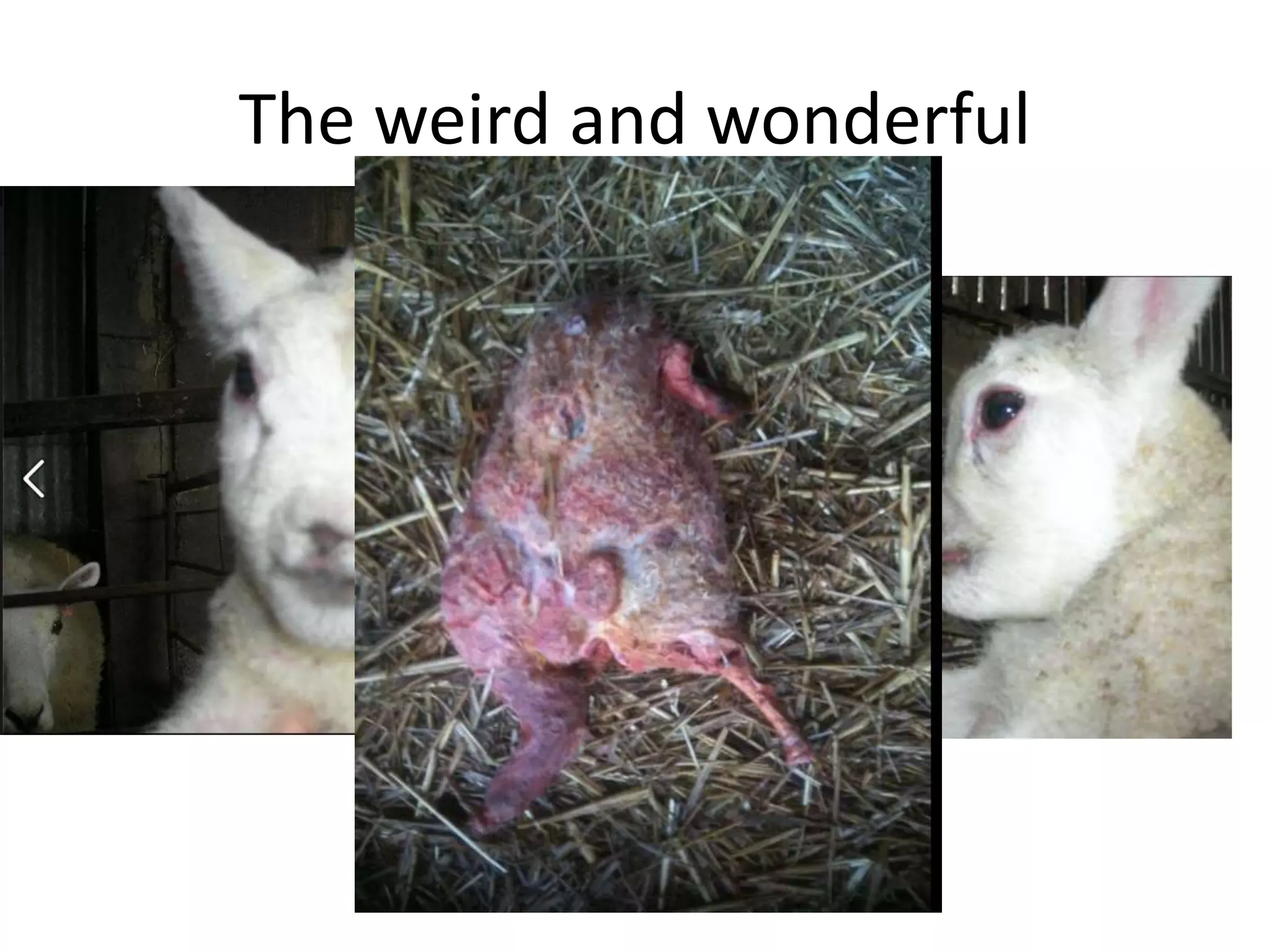
The weird and wonderful
References:
• www.nadis.org.uk
• www.sheep101.info
• Coomefield veterinary hospital
Lambing lunch-GFAVS lecture

Lambing lunch-GFAVS lecture

  • 1.
    LAMBING LUNCH Hannah Pegram,Rachel Davies, Andrew Littlejohn, Amelia Lynch
  • 2.
    Disclaimer We aren’t hereto replace your lectures, more just share our experiences of things we have picked up from our own lambing experience. This is not complete but merely a brief overview of things which may help you when you go lambing We’re also not here to scare/overwhelm you. Lambing is a great experience to go and do and it will help you a lot for husbandry etc.
  • 3.
    Plan • Attitude, appearance,the basics and what to expect • The normal lambing routine • The problem lambings • Ewe care and other odds and ends • Questions
  • 4.
    The Basics Attitude • Firstimpressions last • Tough time of year for farmer • ALWAYS respect your farmers knowledge • Appear enthusiastic even if you’re not • Work hard! (and you might get well paid!)
  • 5.
    The Basics What totake with you • Wellies • Waterproofs • Warm clothes/boilersuit
  • 6.
    The Basics Your farmplacement • Breed of sheep • Pedigree or commercial? • How much is farmer expecting you to do? • How many other students are there? • Dayshift/Nightshift?
  • 7.
    The Basics The Farmer •Will want you to be interested in him and his farm • Most will want to help teach you things • Always listen to your farmer, nearly all will have a lot more experience than you do • Don’t tell him your confident to be left alone if your not, he would much rather spend time to help you than end up with dead lambs. • He will usually help you if you ask
  • 8.
    The Basics Lambing asa job • One of my favourite times of year • Hard work and long hours • Stressful • Great experience for animal care and farm understanding • Usually you will be well fed! • May get paid if you’re good.
  • 9.
    Daily Routine • Firstcheck sheep – Lamb anything needing assistance – Pen ewes and lambs and check those in pens – Iodine and Spectam • Feeding, Watering and Bedding • Tea, biscuits and feeding lambs • Hypothermia KEEP CHECKING!
  • 10.
    Daily Routine • Turningoutside – Nursery/straight outside? – Are they ready? – Turned in eyelids – Tag with spray paint – Tail docking • Length is important – Castration • Check again • LUNCHTIME!! • Nightshift
  • 11.
  • 12.
  • 13.
    WHEN TO INTERVENE? •Distressed • Only head showing • When presenting with only: - one leg - tail • The water-bag has been passed and she’s not making progress in 30 minutes
  • 14.
  • 15.
    • REMEMBER: CUP THEHOOF AT ANY POINT WHEN BRINGING LEGS FORWARD Protects the uterus from damage/perforation
  • 16.
    BACKWARDS •Never try torotate the lamb •Straightforward assisted lambing •Get lamb out quickly
  • 17.
    ONE LEG BACK •Tracethe leg down from the neck, over the shoulder to locate the hoof •‘Cup’ the hoof and bring forwards •Push head back to increase space
  • 18.
    BOTH LEGS BACK •Similarto one leg back •Repel the head every time •Fix the more difficult leg first - space
  • 19.
    HEAD BACK •Both feetpresented, lateral deviation of head •Lambing ropes •Use legs to push the body back into the uterus •Head rope – behind ears, around poll •Straighten head •Bring head and legs out together
  • 20.
    BREECH •True = backwardslamb with no legs presented, just a tail at the pelvic inlet •Extend hips, flexing all distal joints •Straighten both hind legs (‘cupping’ hoof) – helps to push the lamb forwards first •LUBE! •Deliver as for backwards - quickly
  • 21.
    FOUR FRONT LEGS •Identifywhich legs are paired – push all back in •Choose foremost leg, trace back to shoulder/head •Find other leg by tracing from the head •2 legs and correct head should be identified •Deliver
  • 22.
    TWINS FRONT BACK •Deliverthe lamb coming forwards first •Allows widening of the passage •Easier delivery of 2nd lamb •Work from the head and locate both legs to prevent
  • 23.
    HUNG LAMBS •Swollen head(tongue) •Even if appears cold and dead it can survive! •Gentle repulsion of the head into the vagina •LUBE- LOTS OF IT! •If possible locate a leg alongside the head, bring the one leg forward and deliver •DON’T PUSH THE HEAD RIGHT BACK INTO THE UTERINE BODY- Risk suffocation or not being able to retrieve legs/head again
  • 24.
    TIPS! • ALWAYS checkfor another lamb • Don’t be afraid to ask the farmer – most will be more than willing to help. Make sure you have his mobile number! • Lots of lube! • Know your joints! • Repel • Use ropes • Traction • Reposition ewe • Cord attached, pull away
  • 25.
    WHEN TO CALLTHE VET • Ringwomb – tight ring, no lamb (cervix not dilated) • Dead and deformed lambs • Foetal oversize • No progression
  • 26.
    Periparturient Diseases • Abortion •Pregnancy toxaemia • Hypocalcaemia • Hypomagnesemia • (Listeriosis) • (Septicaemia) • (Johne’s, OPA and the usual suspects etc.)
  • 27.
    Abortion You won’t have muchto do with this – however, it is a good to be able to identify aborting ewes and products of abortion
  • 28.
  • 29.
    Don’t forget theewes! Nutrition is pivotal in keeping disease in sheep at bay Ewes have a particularly high metabolic load in late pregnancy due to lamb growth Pregnancy Toxaemia
  • 30.
    Energy requirements ofa Ewe Ewe’s appetite reduces by about 30% approaching lambing
  • 32.
    Pre lambing metabolicprofile • 2-4 weeks pre-lambing • 5 ewes per group • 10-15 if unscanned • BCS • Assessment of feeding ration • ALB, UREA, BHB • Visit fee + b/s + metabolic profile + interpretation
  • 33.
    Late pregnancy • Inthe last eight weeks of pregnancy, 70 per cent of foetal growth takes place. • Udder development and colostrum production • It is vital to manage ewes well at this stage as low lamb birth-weight and low colostrum intake are major causes of lamb deaths in the first few days of life. • During late pregnancy, a ewe’s energy and protein requirements are increasing rapidly – more than doubling if they are carrying two lambs. • However, as the lambs grow, the ewe’s ability to eat bulk reduces . Therefore, the nutrient density of the ration must be increased gradually to allow ewes to consume enough to keep pace with foetal growth.
  • 34.
    Pregnancy toxaemia (twinlamb disease, ovine ketosis) • Clinical signs of pregnancy toxaemia (listed as the disease progresses) • Does not come to feed trough • Isolated, • Dull and depressed • Blind • “Star gazing” • Head pressing • Fine muscle tremors of the head • Weakness and recumbency • Death Progression of disease relatively slow (2-16 days)
  • 35.
    Treatment? • Response totreatment is generally poor • Pen sick ewe separately - offer palatable feeds to promote appetite, and fresh water • Drench with propylene glycol • Intravenous glucose injection • Glucocorticoid injection – to promote gluconeogenesis • Ewes with pregnancy toxaemia must be checked at least twice daily for signs of abortion/lambing because they may be too weak to expel the foetuses/lambs. • Failure to expel dead foetuses leads to them becoming rotten, releasing poisons into the ewe's system which leads to her death.
  • 36.
    Pregnancy toxaemia-Ewes At risk •Late pregnancy • Twins/triplets • Older ewes • Fat ewes/thin ewes • Often a group problem • Concurrent disease
  • 37.
    Hypocalcaemia Demand exceeds supply Clinicalsigns: •Depressed, weak unable to stand •Rumenal stasis and bloat •Reflux of ruminal contents with green fluid around nostrils and lower jaw •Coma and death within 48-72 hrs
  • 38.
    Treatment • Slow IVadministration of 20-40 mls of a 40% calcium borogluconate solution given over 30 to 60 seconds. Eructation (Burping) is observed 1-2 minutes after intravenous calcium administration. • Ewes will stand within 5 minutes of intravenous injection, urinate and wander off to rejoin the rest of the flock. • The response to subcutaneous administration of 60-80 mls of 40% calcium borogluconate solution injected over the thoracic wall behind the shoulder may take up to four hours especially if the solution had not been warmed to body temperature and injected at one site.
  • 39.
    Hypocalcaemia-Prevention Avoid stress inlate gestation  transport  dog worry  change of feed  (change of weather) Diet!
  • 40.
    Hypomagnesaemia/ Staggers Risk factors: •High levels of Potassium in grass • Rapidly growing grass (gut transit) • Cold/wet stressful weather • Lactating ewes with twins
  • 41.
    Hypomagnesaemia-Clinical Signs Mostly sudden death •Anxiety, hyperaesthesia/tachycardia • Unsteady gait, staggering • Apparent blindness • Nystagmus • Recumbency (+ paddling) • Opisthotonus • Hypersalivation (frothing at mouth)
  • 42.
    Hypomagnesaemia-Treatment • 50 ml25% MgSO4, SC multiple sites (skin necrosis: not IV) Often a poor response to treatment
  • 43.
    Vaginal prolapses – Common– may affect 1-2% ewes in flock – Last 4 weeks of pregnancy – Extent of prolapse varies – Urethral obstruction – urinary retention and uraemia – If uncorrected – infection and necrosis; death – Ewes often isolated from flock, straining
  • 44.
    Vaginal prolapse -treatment Plastic retention devices & harnesses (farmer) Surgical – call vet!
  • 45.
  • 46.
  • 47.
  • 48.
    The weird andwonderful
  • 49.

Editor's Notes

  • #28 Enzo: freshly dead lambs, ewe ok Toxo: fresh/mummy lambs, white spot placenta, ewe ok Campy: nothing specific, ewe ok Salmonella: nothing specific, ewe may be ill Listeria: may see nervous signs in ewe
  • #36 Those ewes which do recover from pregnancy toxaemia are rarely able to nurse a single lamb and should generally be culled once they have regained body condition
  • #38 ↑ Demand-foetal bone (no relationship with foetal number) ↓ Availability Peak 1-3wk pre partum Decreased food intake (+oxalates) Frequently associated with stress (eg snow) Can present as a group problem
  • #41 At certain times of the year (particularly April-May) pasture may contain insufficient magnesium to meet the requirements of the grazing animal and so a simple deficiency state may result. However, sheep developing hypomagnesaemia often graze pasture with a magnesium content as high as or higher than that of pasture grazed by sheep which do not develop the disease. The demands of lactation in combination with low pasture levels of magnesium may result in a reduction in the serum magnesium levels. Grass, especially when it is growing rapidly, may contain some factor which interferes with magnesium uptake from the gut. As in cattle, the onset of the clinical disease is often associated with a sudden cold, wet spell.
  • #43 Prevention: Mg supplementation rumen bolus in concentrates Mg licks (variable intake) top dressing pastures with calcined magnesite Drinking water Do not use potash fertilisers in spring
  • #44 Predisposing causes? Certain breeds e.g. Mule (large pelvic inlet) Multiple foetuses Older ewes Bulky feed Excessive body condition Lack of exercise Steep sloping fields Short docking (illegal anyway)
  • #45 Should mark and cull affected ewes Post-parturient vaginal prolapse Occasionally occurs up to 4 weeks after lambing Often follow preparturient prolapse or dystocia/trauma Management – as for preparturient prolapse-but you can use steroid
  • #46 Juices (gross I know) -give mum foster lamb first -WAIT -sheep are very clever.
  • #48 Feeding -training -hard work!!!!
  • #49 Weird deformities “foetal monster”