This document discusses learner autonomy and strategies for developing it. It defines learner autonomy as taking charge of one's own learning. Fostering autonomy is important as it leads students to take more responsibility. Teachers can promote autonomy by shifting responsibility to learners and using learner-centered curricula. Effective learners strategically monitor comprehension, relate new information to prior knowledge, and make inferences. Teaching learning strategies and metacognitive awareness can improve autonomy. Models are provided for strategy instruction involving the teacher diagnosing, modeling, and students practicing, evaluating, and setting goals.
In this document
Powered by AI
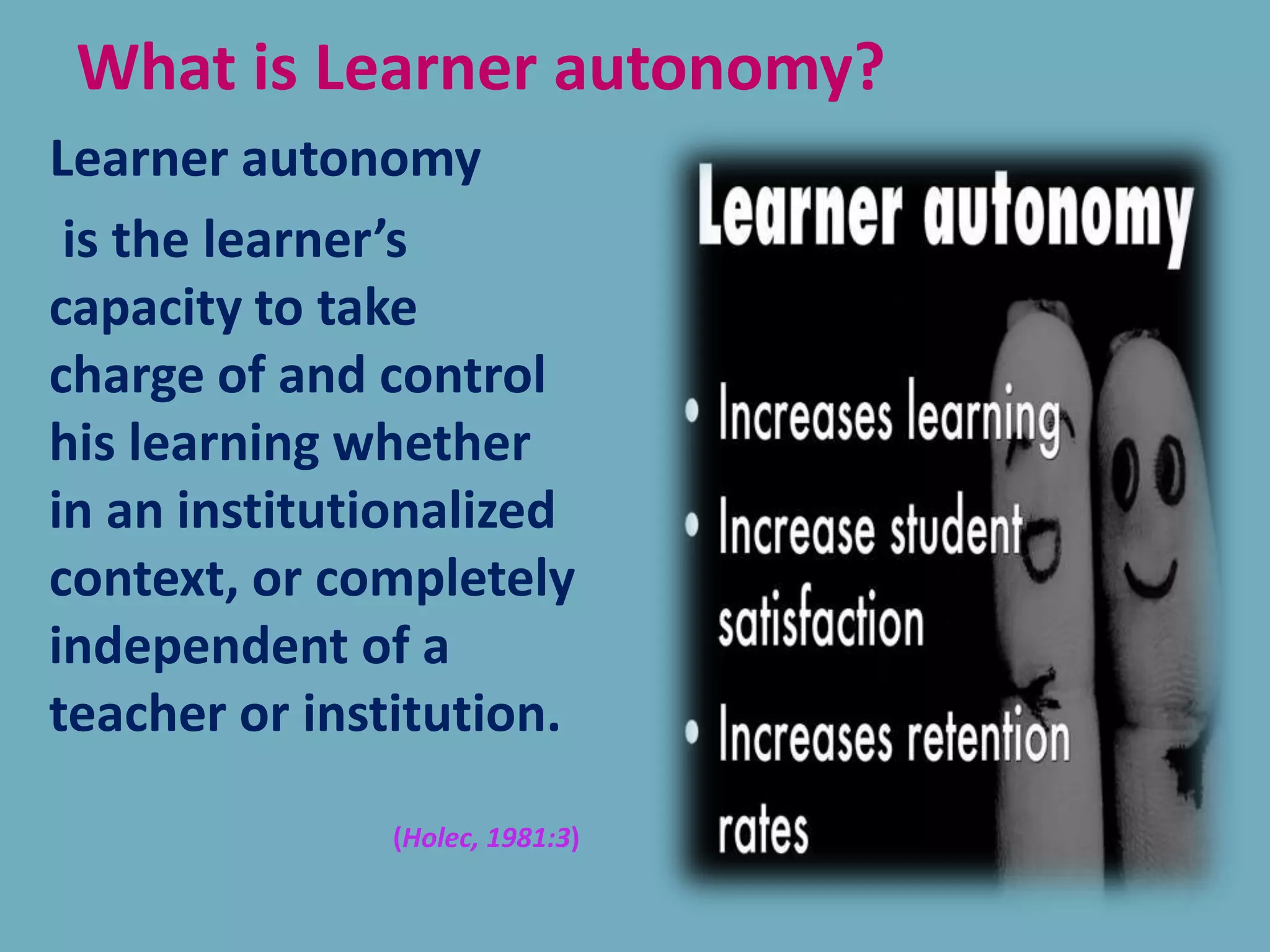
Introduces Learner Autonomy; defined as the capacity to control learning; highlights aspects of autonomy.
Discusses the significance of autonomy in learning processes and the shift towards learner-centered curriculum.
Explores strategies for developing metacognitive awareness and characteristics of autonomous learners.
Presents a study on effective vs. less effective learners; highlights strategic differences in comprehension.
Affirms that autonomy can be taught; introduces various strategies to enhance learner independence.
Describes instructional models for teaching learning strategies; emphasizes the teacher's role in autonomy.
Focuses on the importance of student goal setting and self-assessment in evaluating progress.
Clarifies the teacher's role as a facilitator, supporting autonomy while maintaining authority; includes references.
Encourages audience feedback and provides contact details for further communication.
What is Learnerautonomy?
Learner autonomy
is the learner’s
capacity to take
charge of and control
his learning whether
in an institutionalized
context, or completely
independent of a
teacher or institution.
(Holec, 1981:3)
3.
For situations inwhich learners study entirely
on their own
For a set of skills which can be learned and
applied in self-directed learning
For an inborn capacity which is suppressed
by institutional education
For the exercise of learner’s responsibility
for their own learning
For the right of learners to determine the direction of
their own learning
The term autonomy has come to be used in
at least five ways:
4.
Why is learnerautonomy important today?
When students begin to understand their
own learning processes and can exert some
control over these processes, they tend to
take more responsibility for their own
learning.
This self-knowledge and skill in regulating
one's own learning is a characteristic of
successful learners, including successful
language learners.
5.
How can learnerautonomy be fostered?
The shift of responsibility of the language
learning process from teachers to learners is
supported increasingly by a curriculum which
promotes a learner-centered kind of learning.
Learners, consequently have to assume greater
responsibility and ‘take charge of their own
learning’
(Holec, 1981:3 cited in Benson & Voller, 1997:1)
6.
Rationale for teachinglearning strategies
for effective autonomy
Students who think and work strategically
are more motivated to learn and have a
higher sense of self-efficacy or confidence
in their own learning ability
Students need to be aware of the
strategies which lead to their success
7.
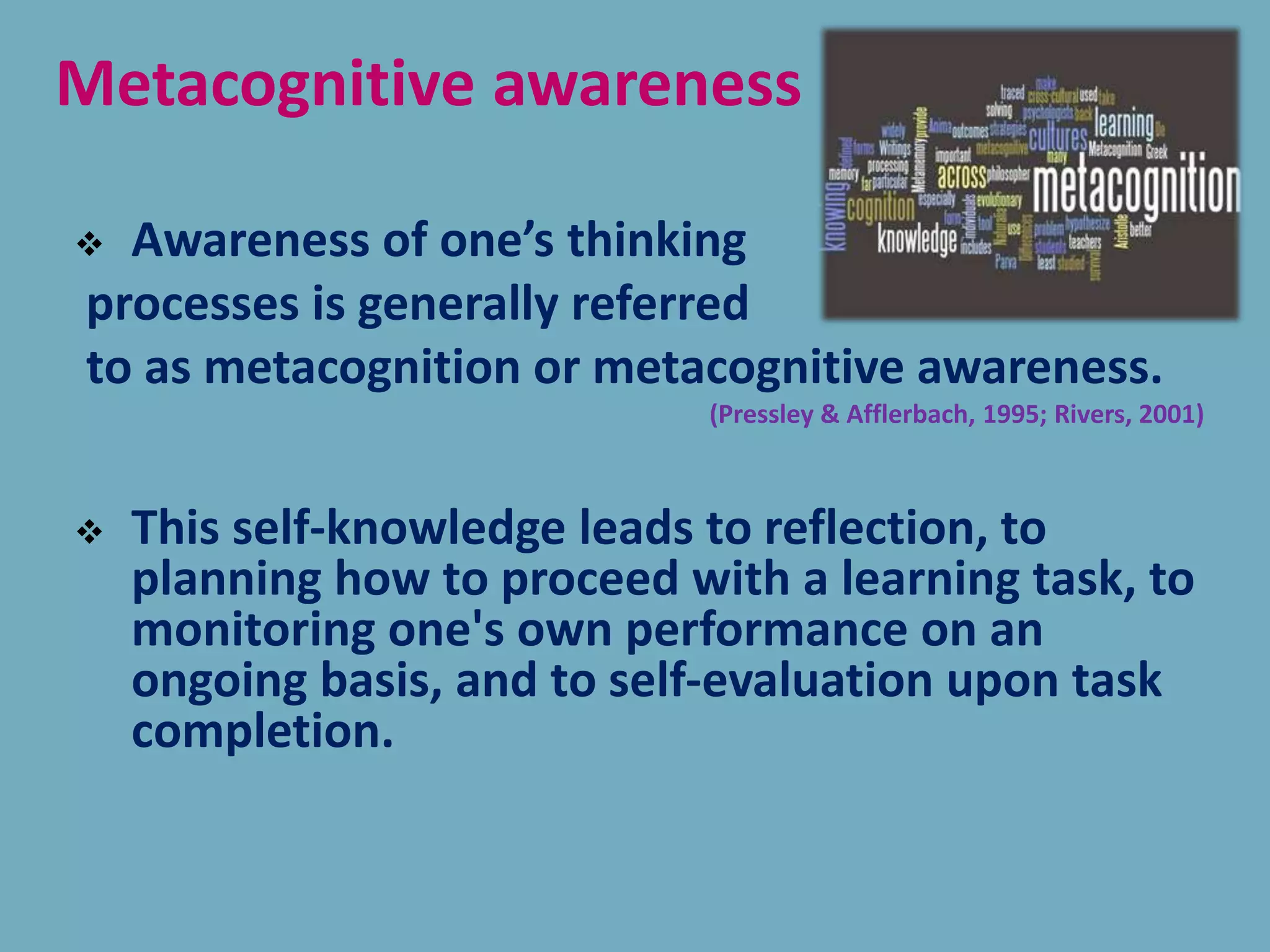
Metacognitive awareness
Awarenessof one’s thinking
processes is generally referred
to as metacognition or metacognitive awareness.
(Pressley & Afflerbach, 1995; Rivers, 2001)
This self-knowledge leads to reflection, to
planning how to proceed with a learning task, to
monitoring one's own performance on an
ongoing basis, and to self-evaluation upon task
completion.
8.
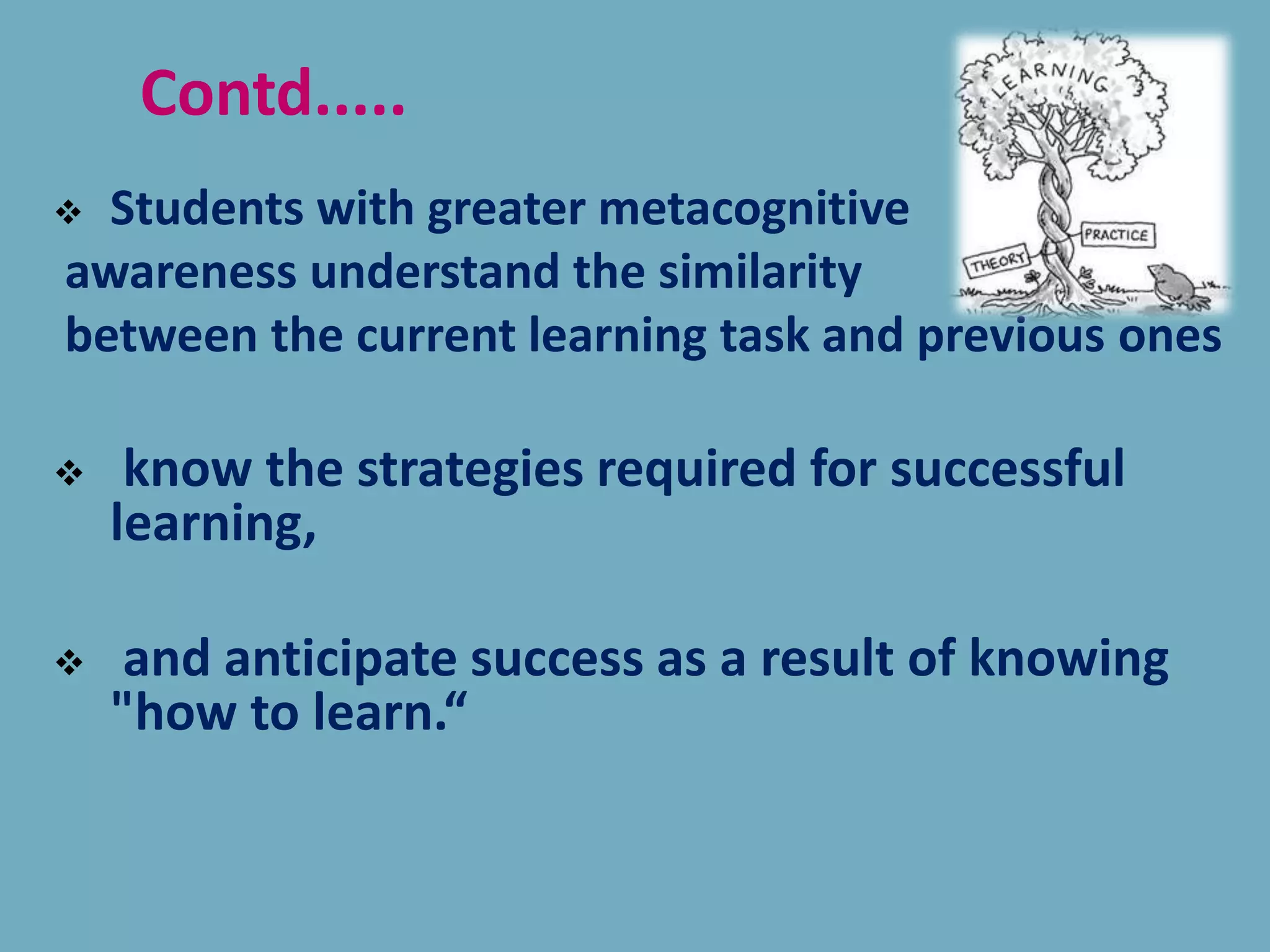
Students withgreater metacognitive
awareness understand the similarity
between the current learning task and previous ones
know the strategies required for successful
learning,
and anticipate success as a result of knowing
"how to learn.“
Contd.....
9.
What are somecharacteristics of
autonomous learners?
Autonomous learners
Have insights into their learning styles and
strategies
Take an active approach to the learning task
at hand
Are willing to take risks, i.e. willing to
communicate in the target language
Develop target language into a separate
reference system.
(Omaggio, 1978, cited in Wenden, 1998: 41-42)
10.
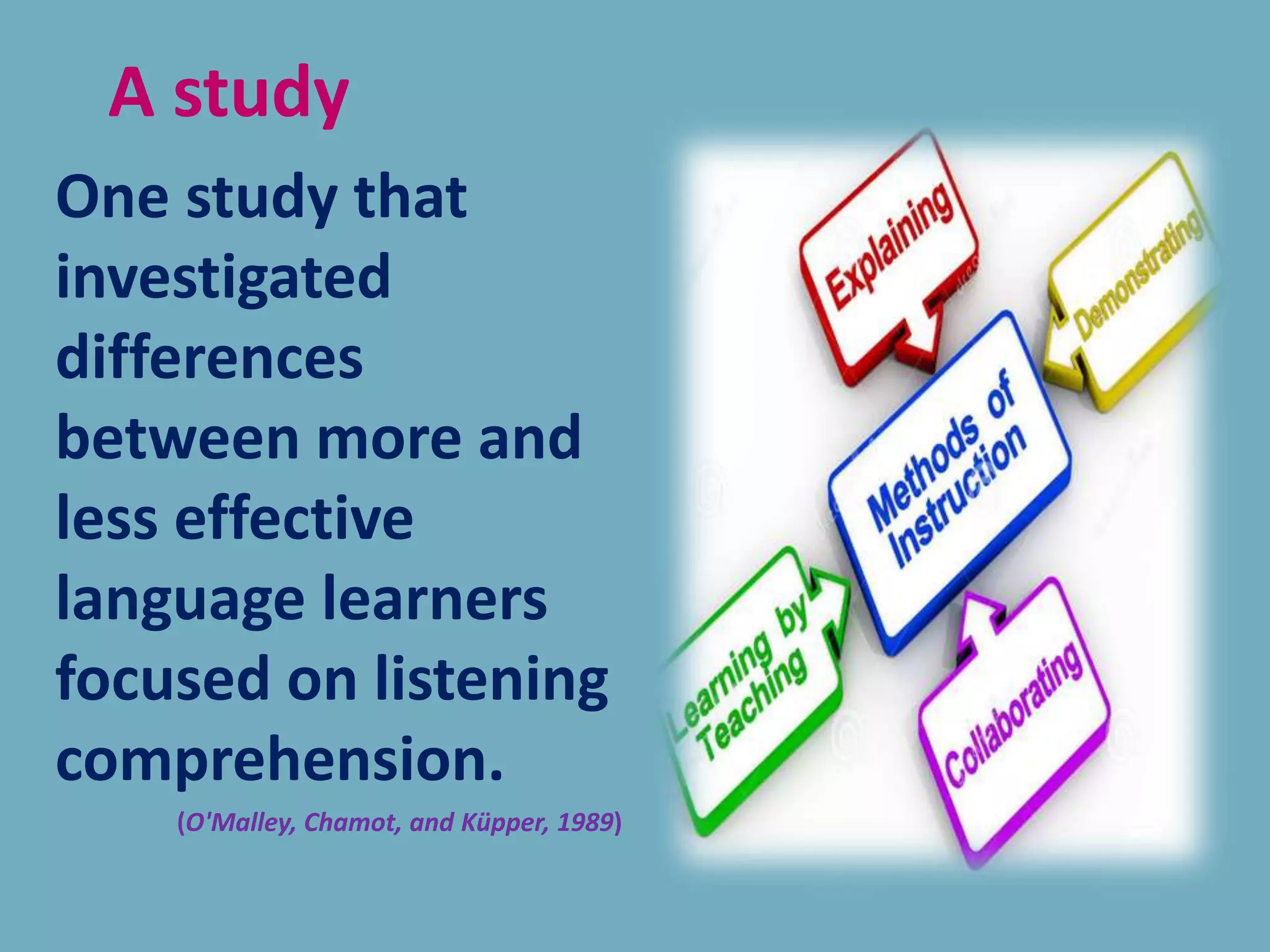
A study
One studythat
investigated
differences
between more and
less effective
language learners
focused on listening
comprehension.
(O'Malley, Chamot, and Küpper, 1989)
11.
Significant differences instrategy use were found
between effective and less effective listeners in three
major areas.
Effective listeners
(1) monitored their comprehension by continually
asking themselves if what they were hearing made
sense;
(2) related new information to their prior knowledge by
recalling relevant personal experiences or things they
had studied; and
(3) made inferences about unknown words or
information.
Results
12.
Implications
The studyindicates that task difficulty and level of
language proficiency have a major effect on the
strategies that students use.
For example, some strategies used by beginning
level effective language learners are used less often
by the same learners when they reach intermediate
level classes, probably because they have had to
develop new strategies to meet the requirements of
more challenging language tasks.
13.
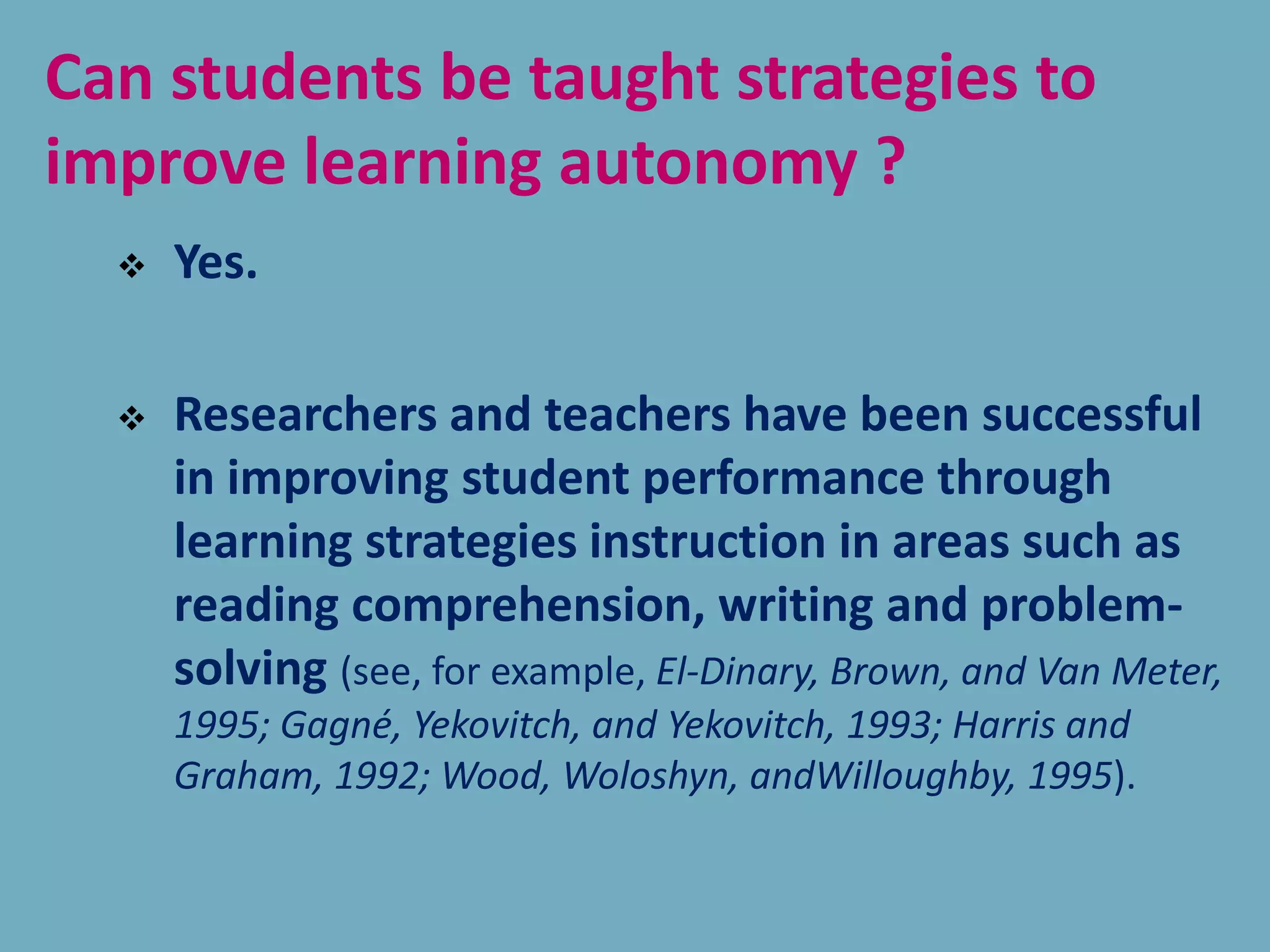
Can students betaught strategies to
improve learning autonomy ?
Yes.
Researchers and teachers have been successful
in improving student performance through
learning strategies instruction in areas such as
reading comprehension, writing and problem-
solving (see, for example, El-Dinary, Brown, and Van Meter,
1995; Gagné, Yekovitch, and Yekovitch, 1993; Harris and
Graham, 1992; Wood, Woloshyn, andWilloughby, 1995).
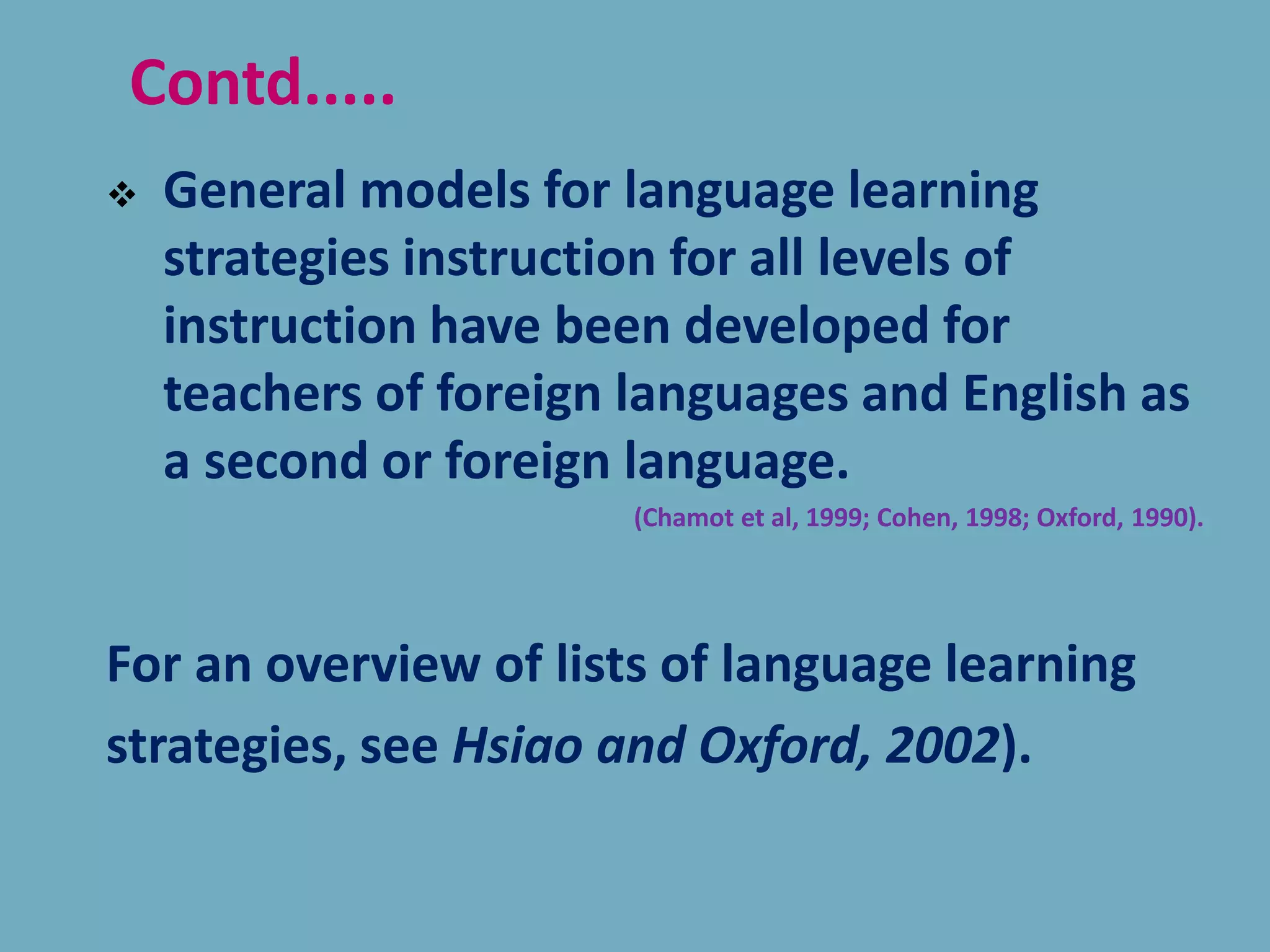
14.
General modelsfor language learning
strategies instruction for all levels of
instruction have been developed for
teachers of foreign languages and English as
a second or foreign language.
(Chamot et al, 1999; Cohen, 1998; Oxford, 1990).
For an overview of lists of language learning
strategies, see Hsiao and Oxford, 2002).
Contd.....
15.
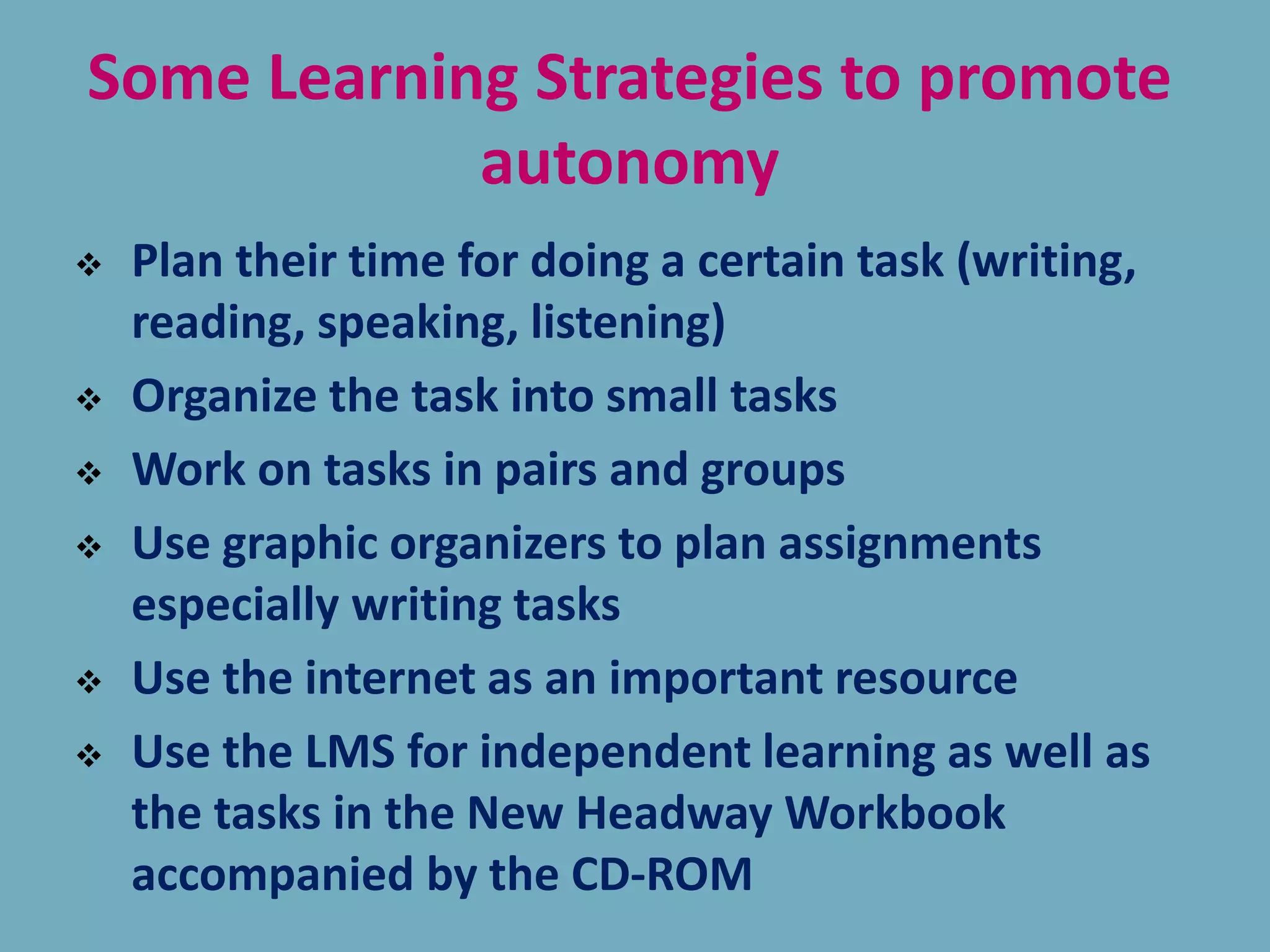
Some Learning Strategiesto promote
autonomy
Plan their time for doing a certain task (writing,
reading, speaking, listening)
Organize the task into small tasks
Work on tasks in pairs and groups
Use graphic organizers to plan assignments
especially writing tasks
Use the internet as an important resource
Use the LMS for independent learning as well as
the tasks in the New Headway Workbook
accompanied by the CD-ROM
16.
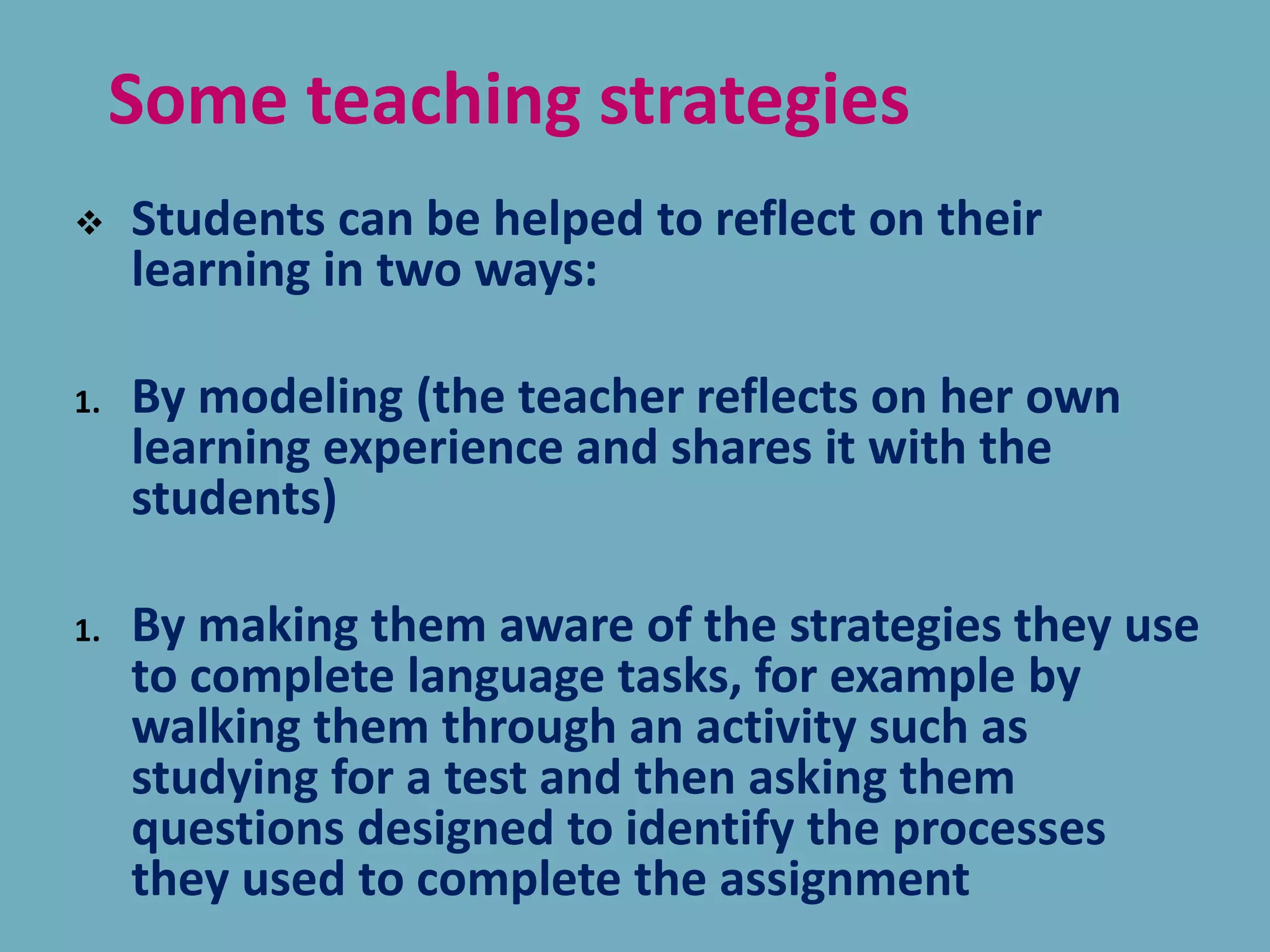
Some teaching strategies
Students can be helped to reflect on their
learning in two ways:
1. By modeling (the teacher reflects on her own
learning experience and shares it with the
students)
1. By making them aware of the strategies they use
to complete language tasks, for example by
walking them through an activity such as
studying for a test and then asking them
questions designed to identify the processes
they used to complete the assignment
17.
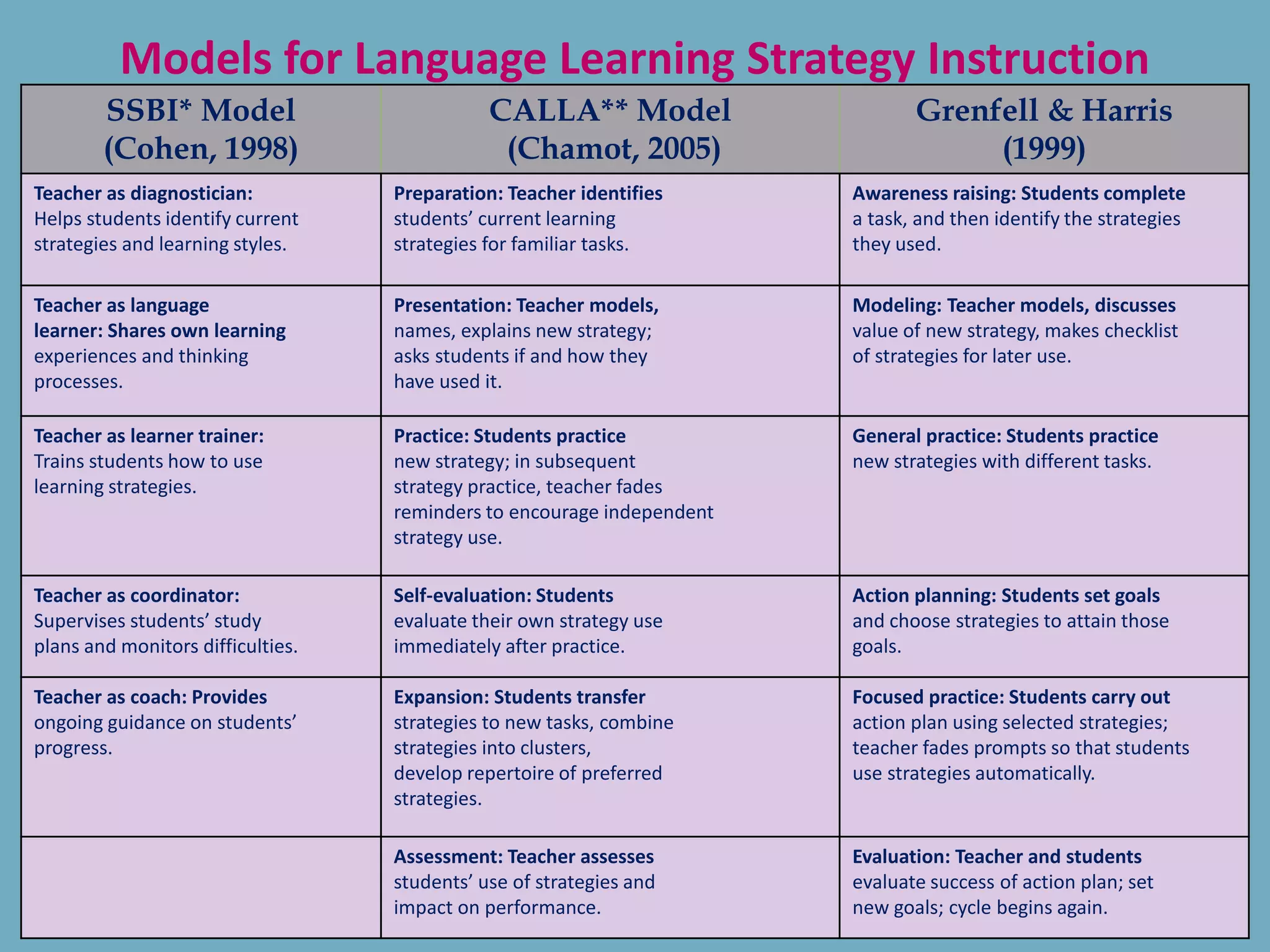
SSBI* Model
(Cohen, 1998)
CALLA**Model
(Chamot, 2005)
Grenfell & Harris
(1999)
Teacher as diagnostician:
Helps students identify current
strategies and learning styles.
Preparation: Teacher identifies
students’ current learning
strategies for familiar tasks.
Awareness raising: Students complete
a task, and then identify the strategies
they used.
Teacher as language
learner: Shares own learning
experiences and thinking
processes.
Presentation: Teacher models,
names, explains new strategy;
asks students if and how they
have used it.
Modeling: Teacher models, discusses
value of new strategy, makes checklist
of strategies for later use.
Teacher as learner trainer:
Trains students how to use
learning strategies.
Practice: Students practice
new strategy; in subsequent
strategy practice, teacher fades
reminders to encourage independent
strategy use.
General practice: Students practice
new strategies with different tasks.
Teacher as coordinator:
Supervises students’ study
plans and monitors difficulties.
Self-evaluation: Students
evaluate their own strategy use
immediately after practice.
Action planning: Students set goals
and choose strategies to attain those
goals.
Teacher as coach: Provides
ongoing guidance on students’
progress.
Expansion: Students transfer
strategies to new tasks, combine
strategies into clusters,
develop repertoire of preferred
strategies.
Focused practice: Students carry out
action plan using selected strategies;
teacher fades prompts so that students
use strategies automatically.
Assessment: Teacher assesses
students’ use of strategies and
impact on performance.
Evaluation: Teacher and students
evaluate success of action plan; set
new goals; cycle begins again.
Models for Language Learning Strategy Instruction
18.
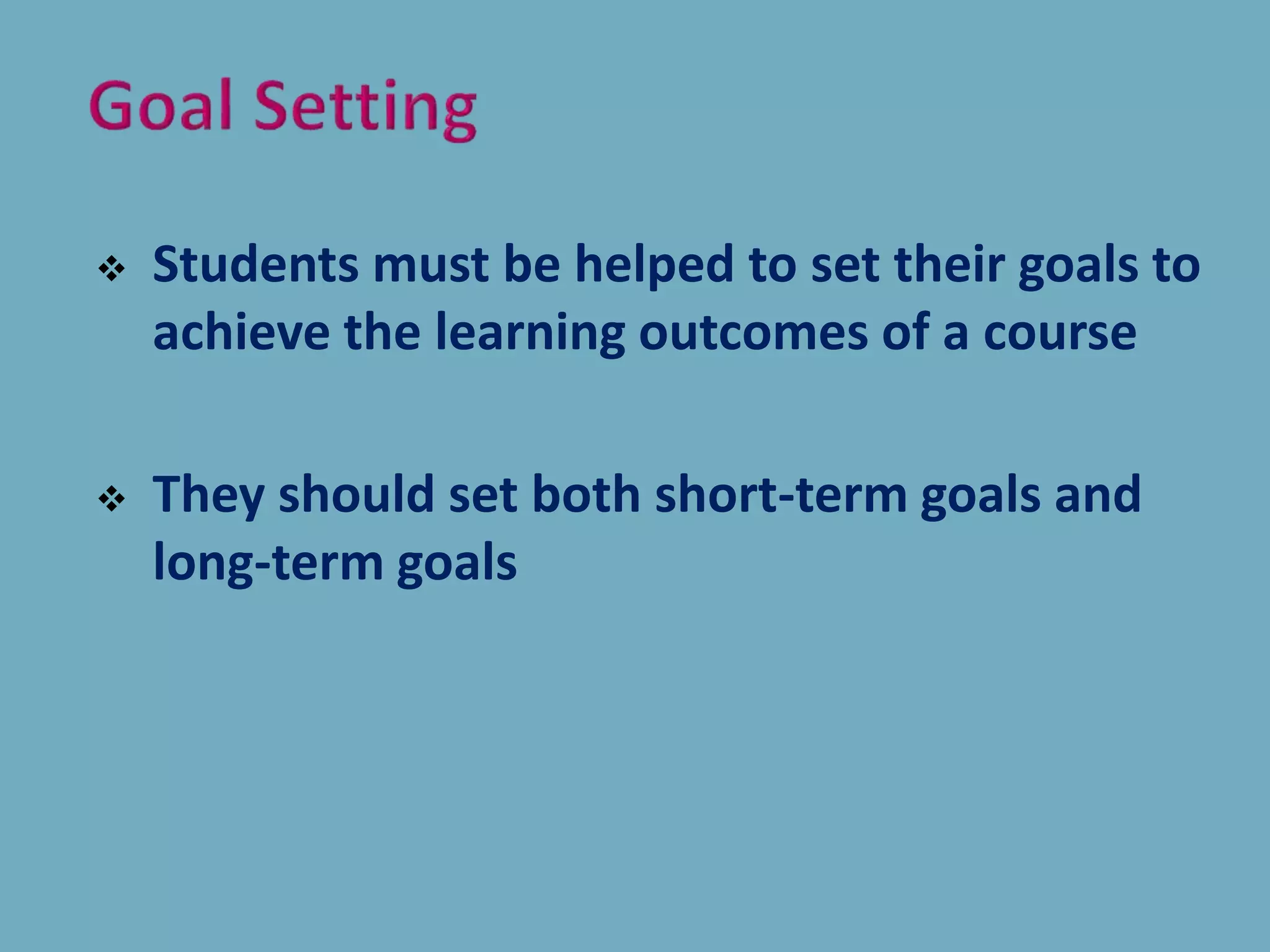
Students mustbe helped to set their goals to
achieve the learning outcomes of a course
They should set both short-term goals and
long-term goals
19.
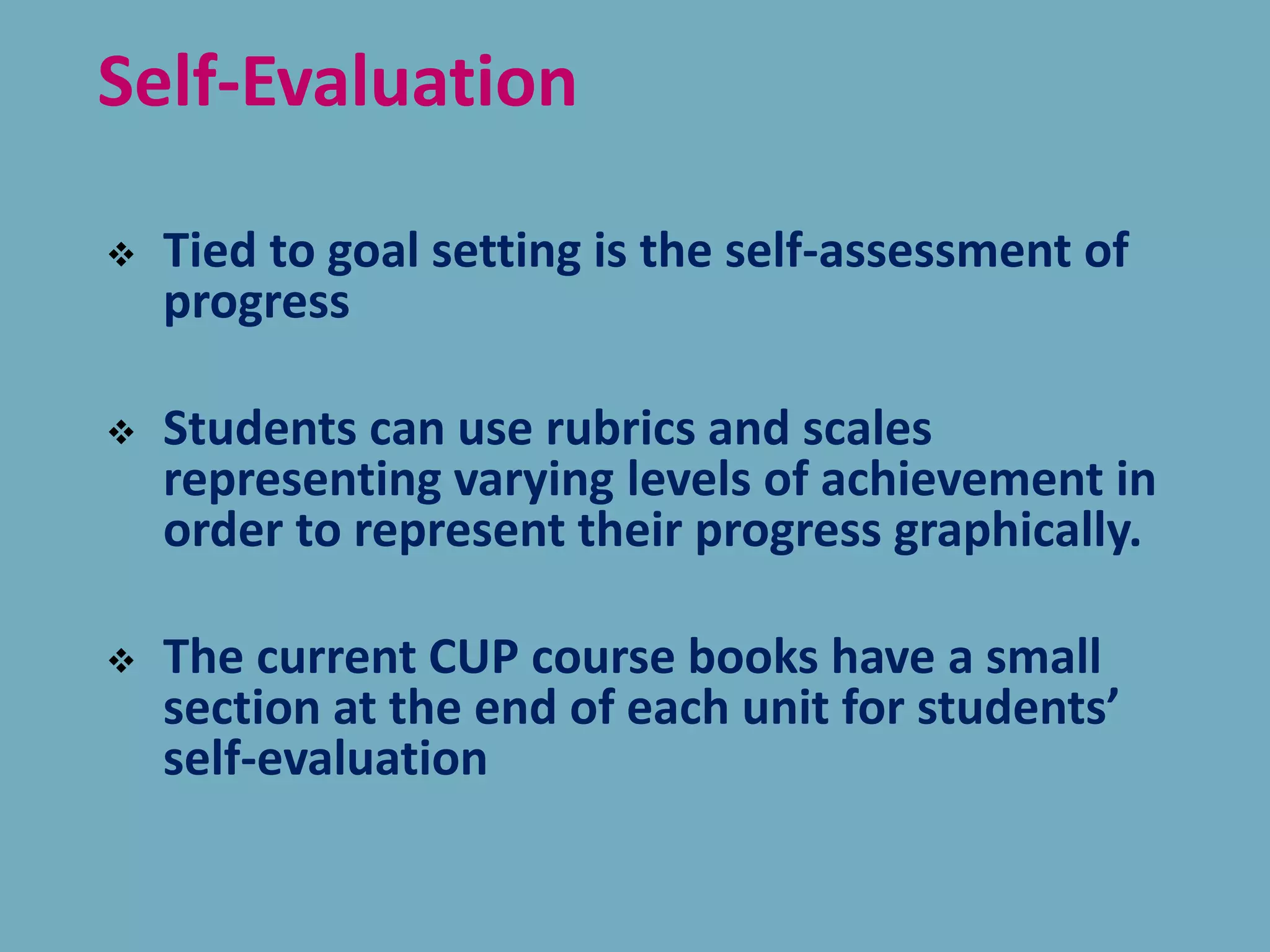
Self-Evaluation
Tied togoal setting is the self-assessment of
progress
Students can use rubrics and scales
representing varying levels of achievement in
order to represent their progress graphically.
The current CUP course books have a small
section at the end of each unit for students’
self-evaluation
20.
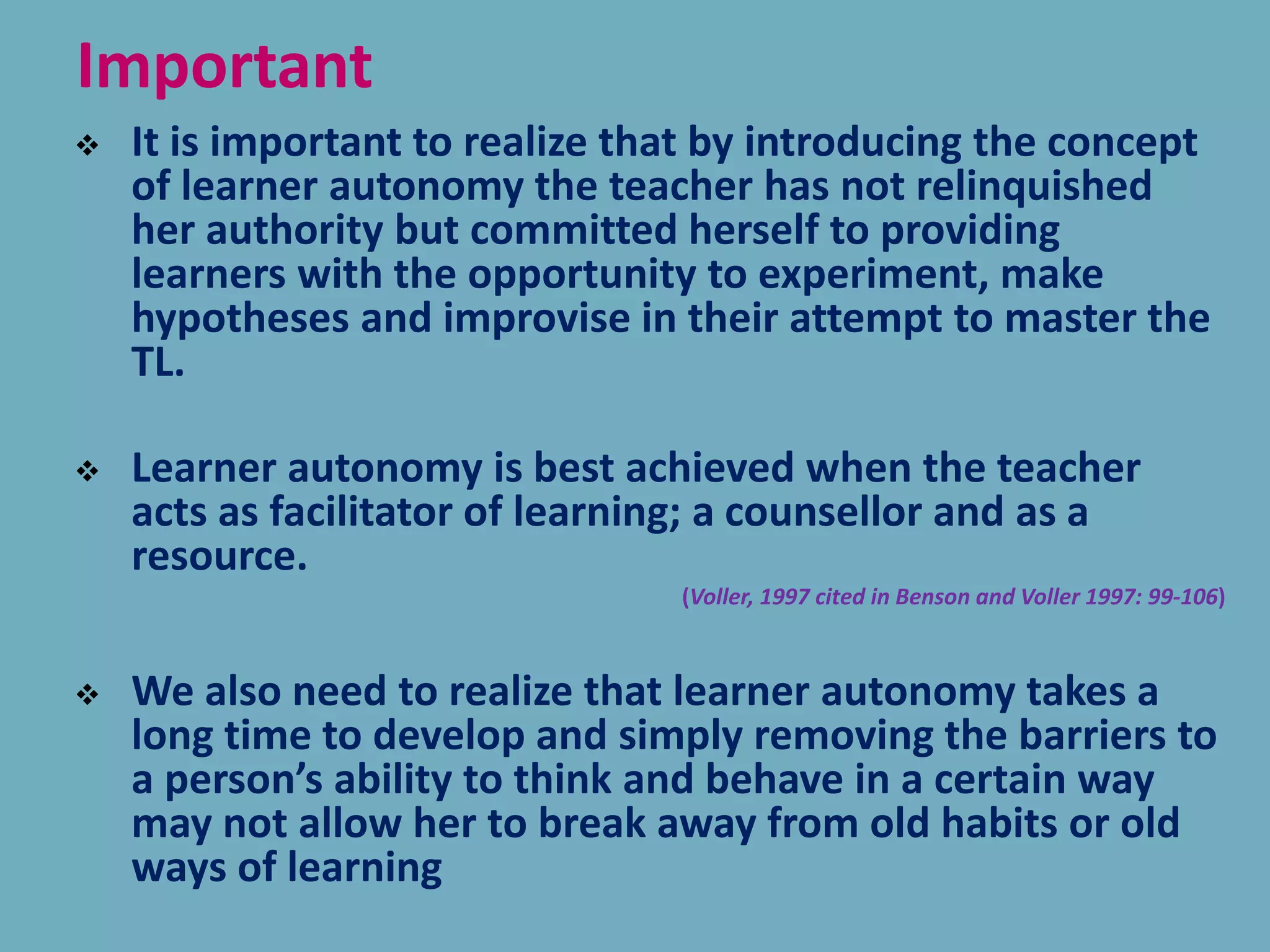
Important
It isimportant to realize that by introducing the concept
of learner autonomy the teacher has not relinquished
her authority but committed herself to providing
learners with the opportunity to experiment, make
hypotheses and improvise in their attempt to master the
TL.
Learner autonomy is best achieved when the teacher
acts as facilitator of learning; a counsellor and as a
resource.
(Voller, 1997 cited in Benson and Voller 1997: 99-106)
We also need to realize that learner autonomy takes a
long time to develop and simply removing the barriers to
a person’s ability to think and behave in a certain way
may not allow her to break away from old habits or old
ways of learning
21.
References
Chamot, A.U.et al, (1999); Cohen, (1998); Oxford, (1990): How children in language immersion
programs use learning strategies.
Cohen, A.D. (1998): Strategies in learning and using a second language. London: Longman.
El-Dinary, Brown & Van Meter, (1995): ‘A Rationale for teaching Learning Strategies
Harris, V. (2003). Adapting classroom-based strategy instruction to a distance learning context. TESL-EJ,
7(2). Retrieved from http://www-writing.berkeley.edu/TESL-EJ/ej26/ a1.html
Holec, H. (1981:3) cited in Benson & Voller: Autonomy in Foreign Language Learning. Oxford: OUP.
Omaggio, A. (1978) cited in Wenden, 1998: 41-42: 'Successful language learners: What do we know
about them?', ERIC / CLL News Bulletin, May, 2-3.
O'Malley, J.M., Chamot, A.U., & Küpper, L. (1989). Listening comprehension strategies in second
language
acquisition. Applied Linguistics, 10(4), 418-437.
Oxford, R.L. (1990). Language learning strategies: What every teacher should know. New York:
Newbury
House.
Presseley & Afflerbach, (1995); Rivers, (2001): Pressley, M., & Afflerbach, P. (1995). Verbal protocols of
reading: The
nature of constructively responsive reading. Hillsdale, NJ: Erlbaum.
Weaver, S.J., & Cohen, A.D. (1997). Strategies-based instruction: A teacher-training manual.
Minneapolis,
MN: Center for Advanced Research on Language Acquisition, University of Minnesota.
Wenden, A. (1998). Learner Strategies for Learner Autonomy. Great Britain: Prentice Hall.
22.
For commentsand suggestions you can write
to:
osiddiqui@kau.edu.sa
Thank you!