Developing Learner AutonomyLearners doing it for themselves
IntroductionIdentify what an autonomous learner is:good learners / bad learnersLook at how that affects teachingExamine what we can do in the classroom to develop and encourage learning
What about Teacher Autonomy?How much opportunity do you have to decide what / how to teach your learners?What is your role as a teacher?
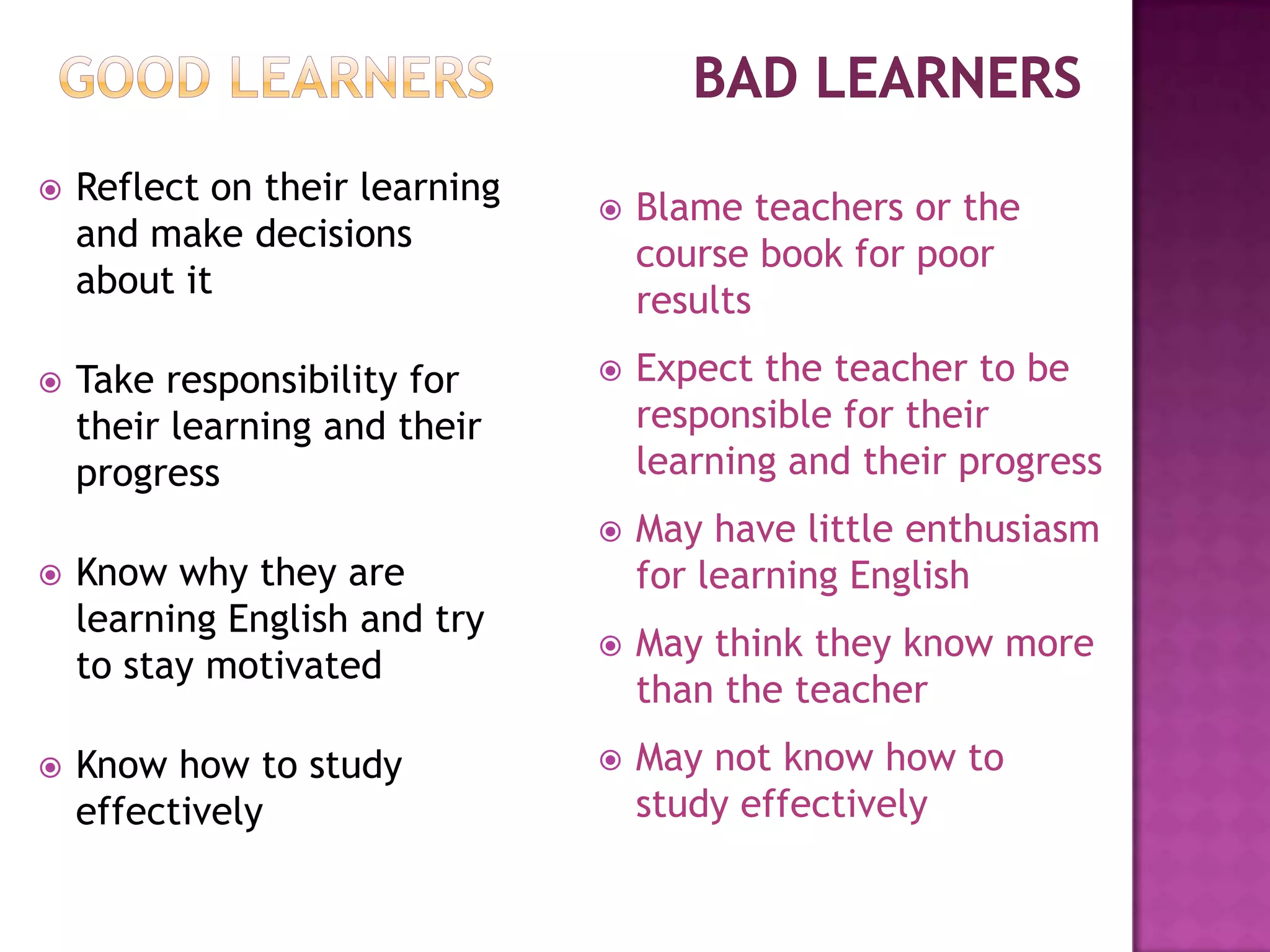
Good Learners		Bad LearnersReflect on their learning and make decisions about itTake responsibility for their learning and their progressKnow why they are learning English and try to stay motivatedKnow how to study effectivelyBlame teachers or the course book for poor results
Expect the teacher to be responsible for their learning and their progress
May have little enthusiasm for learning English
May think they know more than the teacher
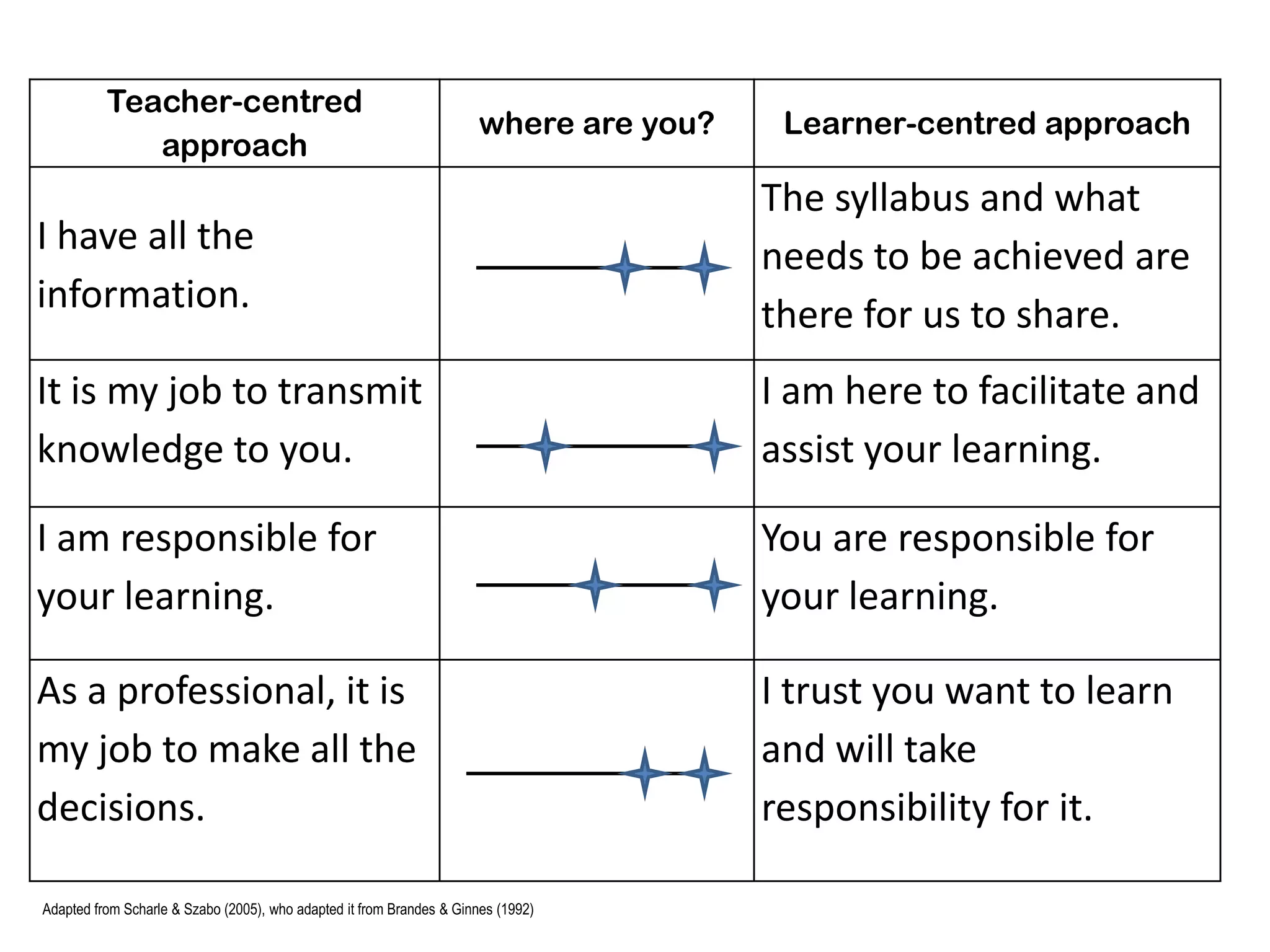
May not know how to study effectivelyAdapted from Scharle & Szabo (2005), who adapted it from Brandes & Ginnes (1992)
Learning StrategiesCognitive Strategies help learners process input, & transform and apply L2 knowledgeAffective Strategieslearners create positive attitudes and stay motivatedSociocultural-interactive Strategieshelp learners with communication, sociocultural contexts and identity.
Meta StrategiesMeaning of meta: metalanguage(from Greek: μετά = "after", "beyond", "with", "adjacent", "self"), is a prefix used in English (and other Greek-owing languages) to indicate a concept which is an abstraction from another concept, used to complete or add to the latter. Metacognition MetaknowledgeMetastrategies
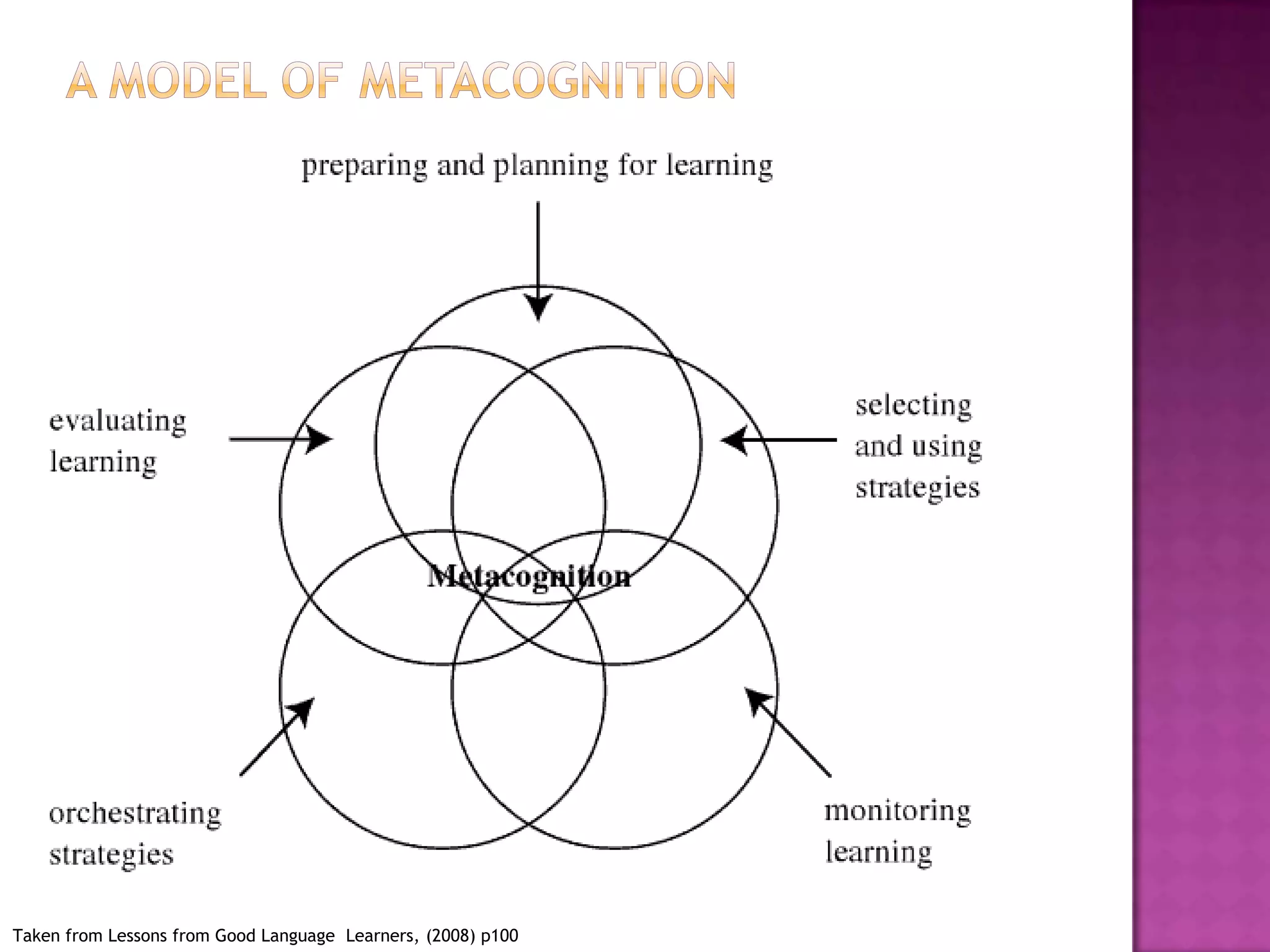
A model of metacognitionTaken from Lessons from Good Language  Learners, (2008) p100

Developing learner autonomy 8.18

  • 1.
  • 2.
    IntroductionIdentify what anautonomous learner is:good learners / bad learnersLook at how that affects teachingExamine what we can do in the classroom to develop and encourage learning
  • 3.
    What about TeacherAutonomy?How much opportunity do you have to decide what / how to teach your learners?What is your role as a teacher?
  • 4.
    Good Learners Bad LearnersReflecton their learning and make decisions about itTake responsibility for their learning and their progressKnow why they are learning English and try to stay motivatedKnow how to study effectivelyBlame teachers or the course book for poor results
  • 5.
    Expect the teacherto be responsible for their learning and their progress
  • 6.
    May have littleenthusiasm for learning English
  • 7.
    May think theyknow more than the teacher
  • 8.
    May not knowhow to study effectivelyAdapted from Scharle & Szabo (2005), who adapted it from Brandes & Ginnes (1992)
  • 9.
    Learning StrategiesCognitive Strategieshelp learners process input, & transform and apply L2 knowledgeAffective Strategieslearners create positive attitudes and stay motivatedSociocultural-interactive Strategieshelp learners with communication, sociocultural contexts and identity.
  • 10.
    Meta StrategiesMeaning ofmeta: metalanguage(from Greek: μετά = "after", "beyond", "with", "adjacent", "self"), is a prefix used in English (and other Greek-owing languages) to indicate a concept which is an abstraction from another concept, used to complete or add to the latter. Metacognition MetaknowledgeMetastrategies
  • 11.
    A model ofmetacognitionTaken from Lessons from Good Language Learners, (2008) p100
  • 12.
    What you cando in the ClassroomClassroom English
  • 13.
  • 14.
    Ask learners toidentify their strengths and weaknesses
  • 15.
  • 16.
    Take yourselfout of the picture
  • 17.
    Be consistentreferencesScharle& Szabo (2005) Learner autonomy: a guide to developing learner responsibilityCarole Griffiths Lessons from Good Language Learners (2008)Rebecca Oxford Teaching and Researching Language Strategies (2011)
  • 18.
    Teachers Say: My students are lazy and they never do their homework. They never remember anything I teach them! We did the present perfect last week but they got it wrong today. I tell them to study hard but they don’t care. I’ll have to give them more tests.

Editor's Notes

  • #10 Classroom English: If learners know how to ask questions and can tell you when they don’t understand, then you have made the very first step to making them responsible for their own learning.Share information: What the course is, what they have to achieve, timescales, what the exam will be about, study skills, rules. Strengths and Weaknesses: Tell them it is their responsibility to learn – you (the teacher) and the course book are there to support their learning but they have to active participants. They have to make time to review / revise / learn.Study skills – suggest different ways to study. Make sure they know they are all different – if one student find it easy to learn vocabulary, it doesn’t mean the others are stupid, they have to develop their own strategies for learning. The teacher facilitates that learning by giving learners ideas about how to learn.Most of the adult learners in my classes have jobs, families and are studying for a master’s. They also have to make time for English. I encourage them to spend a short time every day (if possible) on their English study. 10-15 minutes everyday is better than an hour once a week. Listening to English radio / TV / films / podcasts is a great way to improve listening skills even if you don’t understand much for the first few months. Your ‘ear’ will tune-in eventually. Suggest learners find a study partner or someone you can practice speaking English with . This can be a classmate, another student learning English, a child in the family, anyone that can speak some English. It does not need to be a native speaker. With a study partner,