Developing Generic Tools for Use in Flexible Learning: a Preliminary Progress Report
Teaching methodology Traditional - Didactic lecture/tutorial/textbook model Teachers provide all information to students directly. Students just sit and learn.   New - Constructivism and action learning Teachers act as the facilitators by providing basic guidance. Students take active part in the learning community.  They develop independent self-directed learning. Thus, the Web is used to support meaningful learning because of its functionality, flexibility and capacity to link and connect the learners involved in the learning process.
Impediments to the uptake of ICT in educational settings in the pas t lack of access to appropriate ICT infrastructure lack of ICT literacy among academics and teachers Poor pedagogical understanding and beliefs Insufficient and inadequate ICT-based exemplars and cases Dearth of appropriate instructional materials and software
Aim of the project To assist university teachers to create high quality flexible learning experiences for students by providing various generic resources/tools/templates that make use of ICT.  It also aims to facilitate high quality learning experiences for students.
Learning designs    Learning outcomes Good learning designs can contribute to high quality learning experiences and can be applied generically The design and development of re-usable software and templates are constructed base on the learning designs previously identified Help to develop guidelines for good use or the implementation of the software, templates and examples in new situations.
Evaluation mechanism (1) Evaluation and Redevelopment Framework (ERF) is adopted to assess: Learning designs  - if the designs can support students’ learning experiences at the level of a whole subject, subject component or learning resource High quality learning experiences  - experiences resulting from an environment, which encourages students to seek understanding rather than memorization and which encourage the development of lifelong learning skills. Flexible learning  - an educational approach that meets the diverse needs of students and how ICT can be used to design flexible opportunities for students.
Evaluation mechanism (2) Flexible learning  - an educational approach that meets the diverse needs of students and how ICT can be used to design flexible opportunities for students.
What are high quality learning activities? High quality learning activities should:- Engage learners Acknowledge context Challenge learners Involve practice
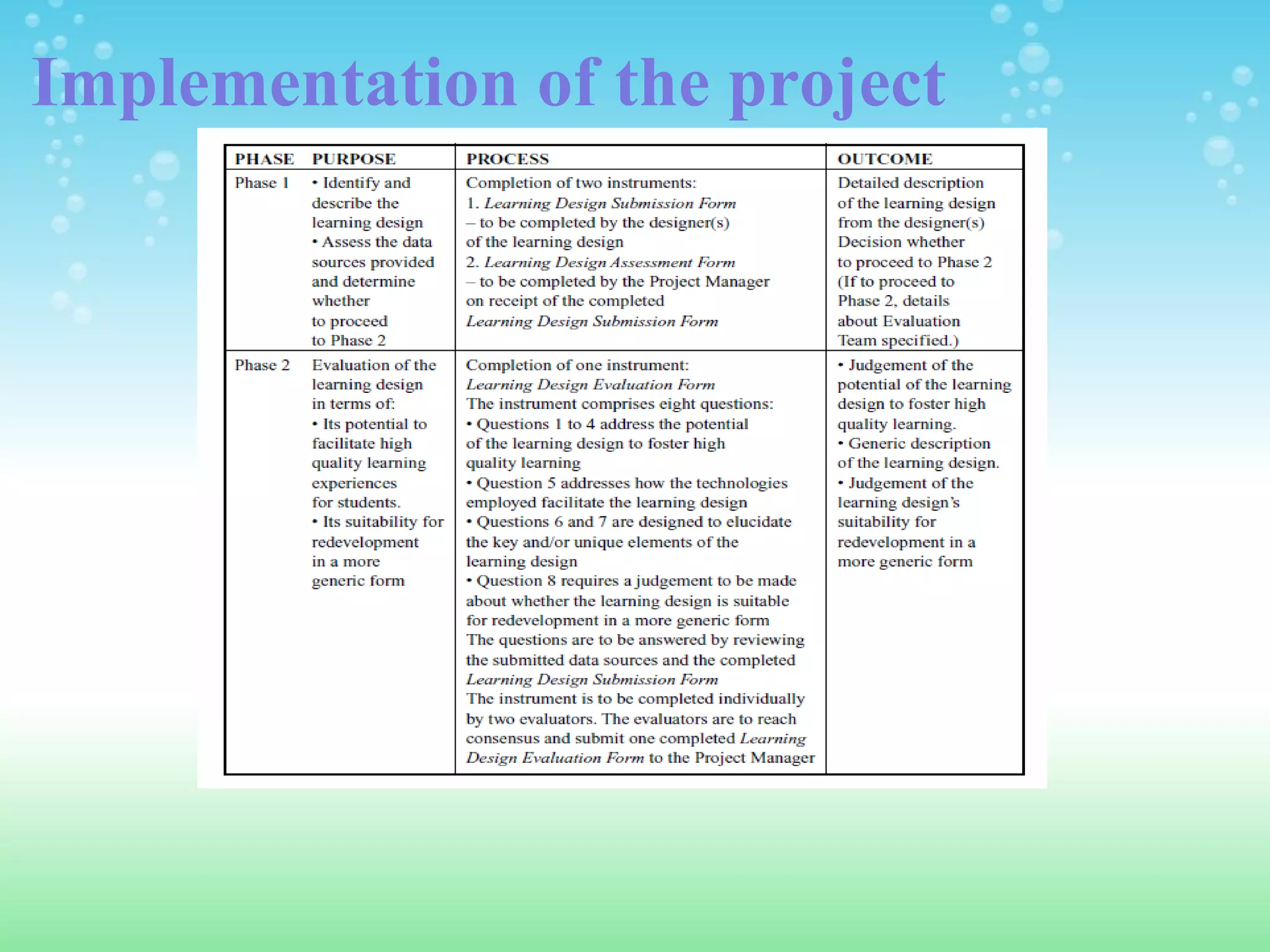
Implementation of the project

Developing Generic Tools for Use in Flexible Learning: a Preliminary Progress Report

  • 1.
    Developing Generic Toolsfor Use in Flexible Learning: a Preliminary Progress Report
  • 2.
    Teaching methodology Traditional- Didactic lecture/tutorial/textbook model Teachers provide all information to students directly. Students just sit and learn.   New - Constructivism and action learning Teachers act as the facilitators by providing basic guidance. Students take active part in the learning community. They develop independent self-directed learning. Thus, the Web is used to support meaningful learning because of its functionality, flexibility and capacity to link and connect the learners involved in the learning process.
  • 3.
    Impediments to theuptake of ICT in educational settings in the pas t lack of access to appropriate ICT infrastructure lack of ICT literacy among academics and teachers Poor pedagogical understanding and beliefs Insufficient and inadequate ICT-based exemplars and cases Dearth of appropriate instructional materials and software
  • 4.
    Aim of theproject To assist university teachers to create high quality flexible learning experiences for students by providing various generic resources/tools/templates that make use of ICT. It also aims to facilitate high quality learning experiences for students.
  • 5.
    Learning designs  Learning outcomes Good learning designs can contribute to high quality learning experiences and can be applied generically The design and development of re-usable software and templates are constructed base on the learning designs previously identified Help to develop guidelines for good use or the implementation of the software, templates and examples in new situations.
  • 6.
    Evaluation mechanism (1)Evaluation and Redevelopment Framework (ERF) is adopted to assess: Learning designs - if the designs can support students’ learning experiences at the level of a whole subject, subject component or learning resource High quality learning experiences - experiences resulting from an environment, which encourages students to seek understanding rather than memorization and which encourage the development of lifelong learning skills. Flexible learning - an educational approach that meets the diverse needs of students and how ICT can be used to design flexible opportunities for students.
  • 7.
    Evaluation mechanism (2)Flexible learning - an educational approach that meets the diverse needs of students and how ICT can be used to design flexible opportunities for students.
  • 8.
    What are highquality learning activities? High quality learning activities should:- Engage learners Acknowledge context Challenge learners Involve practice
  • 9.