Lecturers as Catalysts and Fulcrum of Mobile 
Learning*
• By Prof. Faustin Kamuzora** and Aurelia Kamuzora
• Mzumbe University, Tanzania
*Presentation at the eLearning Innovation Conference, KICD, Nairobi. September 30 – October 2, 2015
**Cost of participation in the conference was paid by the VRIL‐OUS GRE@T Programme
Presentation objectives
• By the end of this presentation, the participants will be able to:
• Appreciate the need of universities to adopt their curricula and 
teaching methodologies to the world of volatility, uncertainty, 
complexity and ambiguity (VUCA)
• Recognise the centrality of the lecturers in the success of the 
adoption of new teaching methodologies including m‐learning
• Be exposed to some of the challenges some universities face in the 
quest of developing their lecturers to be the best in teaching function 
and strategies to overcome the challenges.
Universities in the World of VUCA
• Globalisation and technologies are making universities operate in 
VUCA world
• What is position of the educators? Strengthened or weakened by the 
two forces of globalisation and IT revolution?
• Are best lecturers born or made?
Desired Learning Outcomes for graduates*
• Future citizens who will be critical beings in society. 
• Ability to take charge of their own learning; 
• Ability to function meaningfully with others; 
• Use technology to better their lives, others as well as improving their 
surroundings; 
• Competency and being able to use creativity to sustain themselves. 
• Ability for collaboration across networks and leading by influence; 
*See Msila (2014: pg 214), Turner (2012), and Gerstein (2015) 
Desired Learning Outcomes / 2
• Agility and adaptability;
• Initiative and entrepreneurialism, 
• Effective oral and written communication;
• Accessing and analysing information;
• Empathy and global stewardship curiosity and imagination; 
• and above all the ability to learn new things since the world is 
changing very fast.
Some new forms of teaching, learning and 
assessment in the VUCA world 
• Massive open social learning (cf Community of learners, peer 
review)
• Learning design informed by analytics
• Flipped classroom (several Lecture Capture technologies)
• Bring your own devices (BYOD),  (wear your own device is 
here already – Google glasses, Apple watch, etc) – the IoT
• Learning to learn for the (triple L – Life Long Learning)
New forms of teaching /2
• Dynamic assessment
• Event‐based learning
• Learning through storytelling
• Threshold concepts
• Bricolage (DIY)
Source: Sharples, et al (2014: pg 3‐5)
Centrality of lecturers in teaching function
• Problems facing lecturers in African universities: students’ diversity, 
large class sizes, industry and professional demands – all these call for 
more than academic qualifications to excel in teaching (Omingo, 
2015). 
• Unlike teachers in primary and secondary schools in East Africa, 
lecturers in higher education are not trained to teach. The few who 
are trained were trained to teach in secondary schools and not in the 
universities (Omingo, 2015). 
Teaching and pedagogy as raison d’être of 
universities
• Both teaching and pedagogy are wicked problems (Ellsworth, 2011)
• Teaching is more of acquired skill: it needs to take into consideration 
the students’ background knowledge, the curriculum, the inherent 
diversity of students in a course, the culture of the institution, the 
pedagogy of the discipline, the accreditation process, the learning 
space,  etc by Aziza Ellozy (2015).
• Thus, introduction of technology in education should have a 
pedagogical leaning 
Teaching / 3
• Teaching needs a generalisable, integrated approach that starts from 
the premise that ongoing and meaningful development opportunities 
are not a “nice to have” offering for staff who happen to be interested 
in teaching and willing to invest particular effort, but a matter of 
survival for modern universities in an age when greater access is 
needed not only for individual goals but also for societal and 
economic needs ( Nan Yeld, 2014) 
• The importance  of effective teacher as navigator of knowledge is one 
of the constants
Challenges – resistance to change
• Faculty resistance to change comes from various quarters, but one of 
the prevailing reasons is the age‐old competition between teaching 
and research. In most cases, research is perceived to be more 
important or more prestigious than teaching and instructors are not 
incentivised to develop their skills (Aziza 2014.
Challenge /2
• Experiences from other universities indicate that some lecturers who 
introduce interactive and innovative teaching methods are rated low 
by students
• Such teachers must be protected by the university management
• Since universities are recipient of students from lower education 
systems there is a need of introducing such innovative learning 
techniques from there 
Academic Staff Dev programmes
• Some universities demand teaching qualifications such as 
The Postgraduate Certificate in Higher Education (PGCHE), 
alternatively called the Postgraduate Certificate in Academic Practice 
(PGCAP) before a lecturer is entrusted teaching. 
• Coaching and mentoring from senior staff (efforts to train the 
coachers and mentors)
• The Peer Assisted Teaching Scheme (PATS) provides a structured yet 
flexible approach to reinvigorating teaching practice in a supportive 
and collegial environment.
• Need to formeralise academic developer professionals ( Quinn and 
Vorster, 2014)
Conclusion
• Effective teaching is not just a talent, it is also a skill. The East African 
universities must invest various resources to ensure that their 
academic staff are equipped with the necessary skills to teaching 
effectively.
• The importance  of effective teacher as navigator of knowledge is one 
of the constants in the world of VUCA
• If the teaching is universities’ raison d’être it must be given more 
weight in career progression of academic staff in EA universities
• Blended learning offers a practical way of offering teaching skills and 
qualifications such Postgraduate Certificate in Academic Practice 
(PGCAP). 
Conclusion /2
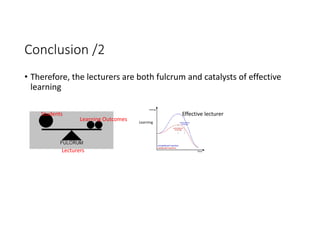
• Therefore, the lecturers are both fulcrum and catalysts of effective 
learning
Learning Outcomes
Students
Lecturers
Learning
Effective lecturer
References
Aziza Ellozy (2015):  Online learning needs a well‐trained faculty
http://www.universityworldnews.com/article.php?story=20150924102823341 accessed on 28/9/2015
Ellesworth, E. (2011). The Wicked Problem of Pedagogy – An Afterword. Available at http://learningthroughdigitalmedia.net/the‐wicked‐problem‐of‐
pedagogy‐an‐afterword Accessed on 28/9/2015
Gerstein, C. (2015). The Other 21st Century Skills: Educator Self‐Assessment. Available at 
https://usergeneratededucation.wordpress.com/2015/01/16/the‐other‐21st‐century‐skills‐educator‐self‐assessment/ Accessed May 2, 2015.
Msila, V. (2014). Heutagogy, Africanisation and Learning: Experiences from an Open and Distance Learning (ODL) Program at the University of South 
Africa. Mediterranean Journal of Social Sciences. Vol 5 No 14, July.
Nan Yeld (2014) “Government's new plan for student success” from http://mg.co.za/article/2014‐07‐11‐governments‐new‐plan‐for‐student‐success  
accessed 28/9/2015)
Omingo, M. (forthcoming).  Systemic Conditions as Prompts in Lecturers’ Learning to Teach Effectively in  Private Universities in Kenya
Quinn, L. & Vorster, J. (2014). Isn’t it time to start thinking about ‘developing’ academic developers in a more systematic way? International Journal for 
Academic Development 19 (3): 255‐258.
Sharples, M., Adams, A., Ferguson, R., Gaved, M., McAndrew, P., Rienties, B., Weller,M., & Whitelock, D. (2014). Innovating Pedagogy 2014: Open 
University Innovation Report 3.
Milton Keynes: The Open University.
Turner, J.R. (2012). Training & Learning Theories: Pedagogy, Andragogy. Heutagogy. Available at http://johnturnerhptresource. 
blogspot.com/2012/07/training‐learning‐theories‐pedagogy.html. Accessed May 5, 2015.

Lecturers as catalysts and fulcrum of mobile  learning