



Developing Effective
Safety Training
An introduction to the 8-Step Course Development and Presentation Process

OR-OSHA 105
0206
Presented by the
Public Education and Conferences Section
Oregon Occupational Safety and Health
Division (OR-OSHA)

1
Goals
Help the student to improve their knowledge, skills
and ability to:
1. Prepare and safety training lesson plan.
2. Present a safety training class;
3. Evaluate training outcomes.

2
Form
Teams

• Introduce yourselves
• Select a team leader

• Appoint spokesperson
• Every team member is a recorder

3
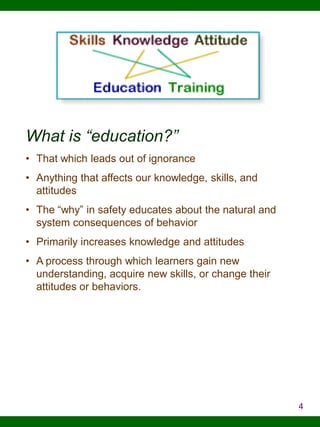
What is “education?”
• That which leads out of ignorance
• Anything that affects our knowledge, skills, and
attitudes
• The “why” in safety educates about the natural and
system consequences of behavior
• Primarily increases knowledge and attitudes
• A process through which learners gain new
understanding, acquire new skills, or change their
attitudes or behaviors.

4
What is “training?”
• One method of education
• The “how” in safety
• Primarily increases knowledge and skills
• A specialized form of education that focuses on
developing or improving skills - the focus on
performance.

What are the natural and system consequences?

What is the outcome when safety training does not
include effective education?

5
Step 1: ASSESS LEARNER
NEEDS

Determine learner needs
Needs assessments will identify gaps,
weaknesses, and limitations in trainees’ skills
and knowledge.
How do we become aware of safety training needs?

6
To get information about the audience:
• Observe workers doing work
• Interview and/or survey workers
• Review employee personnel records

• Determine demographics (age, gender, race)
• Determine experience level
• Determine learning styles
• Determine aptitudes, knowledge

• Determine attitudes toward subject being taught

7
To get information about the tasks
• Observe experts doing the task
• Interview experts about the task

• Review job descriptions, policy statements, reports

To get information about the content of process or
procedures
• Observe the expert of developers of the process or
procedure
• Interview experts, policy makers, mangers
• Review process plans, specifications, rules,
guidelines (make sure they are current)

8
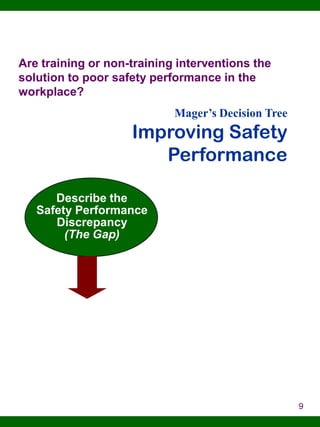
Are training or non-training interventions the
solution to poor safety performance in the
workplace?

Mager’s Decision Tree

Improving Safety
Performance
Describe the
Safety Performance
Discrepancy
(The Gap)

9
Training at GeeWiz Widgets:
Conduct a needs analysis with the supervisor.

Information about the audience:

Information about the course topic:

10
Step 2: SET
GOALS and OBJECTIVES
Goals are easy to write. They're nothing more
than wishes.
• Improve the hazard control program.
• Eat some really great food today.
• Lose some wait today.

Objectives take a little more thought. Well
written objectives should have the following
elements present:
• Starts with an action verb. (Decrease,
increase, improve, etc.)
• Specifies a single key result to be
accomplished.
• Is quantifiable. Uses numbers to measure a
desired change. (i.e., 50% increase)
• Specifies a target date for accomplishment.

11
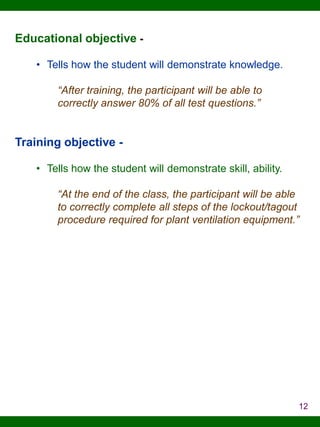
Educational objective • Tells how the student will demonstrate knowledge.
“After training, the participant will be able to
correctly answer 80% of all test questions.”

Training objective • Tells how the student will demonstrate skill, ability.

“At the end of the class, the participant will be able
to correctly complete all steps of the lockout/tagout
procedure required for plant ventilation equipment.”

12
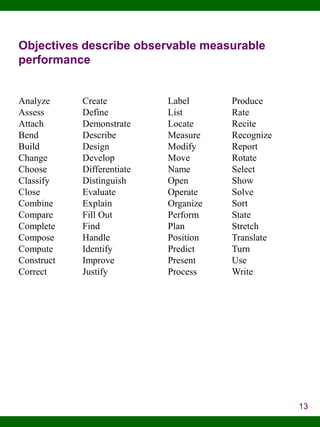
Objectives describe observable measurable
performance

Analyze
Assess
Attach
Bend
Build
Change
Choose
Classify
Close
Combine
Compare
Complete
Compose
Compute
Construct
Correct

Create
Define
Demonstrate
Describe
Design
Develop
Differentiate
Distinguish
Evaluate
Explain
Fill Out
Find
Handle
Identify
Improve
Justify

Label
List
Locate
Measure
Modify
Move
Name
Open
Operate
Organize
Perform
Plan
Position
Predict
Present
Process

Produce
Rate
Recite
Recognize
Report
Rotate
Select
Show
Solve
Sort
State
Stretch
Translate
Turn
Use
Write

13
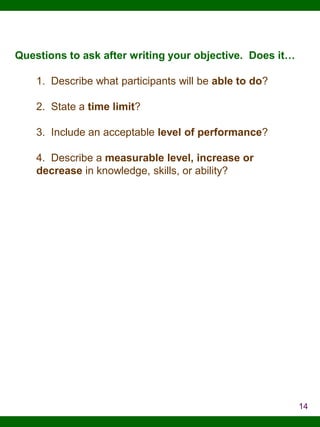
Questions to ask after writing your objective. Does it…
1. Describe what participants will be able to do?
2. State a time limit?
3. Include an acceptable level of performance?
4. Describe a measurable level, increase or
decrease in knowledge, skills, or ability?

14
Training at GeeWiz Widgets:
Develop goals and objectives

15
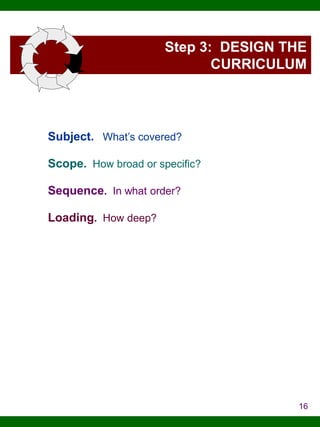
Step 3: DESIGN THE
CURRICULUM

Subject. What’s covered?
Scope. How broad or specific?

Sequence. In what order?
Loading. How deep?

16
Training at GeeWiz Widgets:
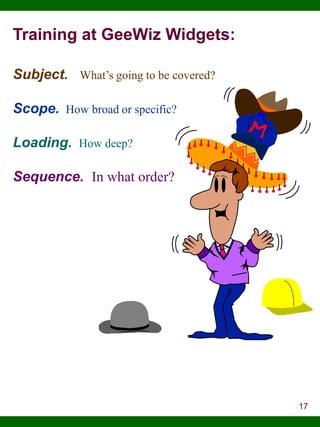
Subject. What’s going to be covered?
Scope. How broad or specific?

Loading. How deep?
Sequence. In what order?

17
Step 4: SELECT
METHODS & MEDIA

Methods:
Case study Lecture Role play

Modeling

Demonstration

Small group Games Stories
Discussion

Survey

Brainstorm

Question

others?

Rank order what you consider to be
the top five training methods that
work for you.

18
Media:
35mm Slide

Handouts

Workbooks

Overheads

Instruments
Videos

Tours

Flip Charts
Others?

19
Training Methods
Rank order what you consider to be the top five
training methods that work for you.
_____
_____
_____
_____
_____
_____
_____
_____
_____
_____
_____

1. CASE STUDY:
2. LECTURE:
3. ROLE PLAY:
4. MODELLING: L
5. SMALL GROUP:
6. GAMES:
7. STORIES:
8. EXERCISES:
9. DISCUSSION:
10.TELL YOUR NEIGHBOR:
11.THINK ABOUT AND WRITE:

20
Training at GeeWiz Widgets:
Determine what methods and materials you will
need for the presentation.

Methods:
Media:

21
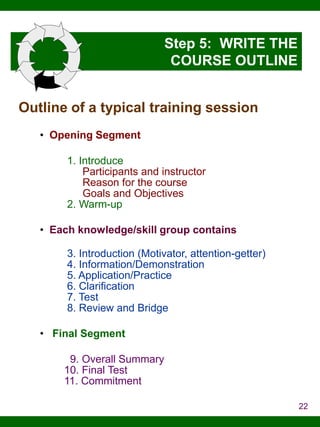
Step 5: WRITE THE
COURSE OUTLINE
Outline of a typical training session
• Opening Segment
1. Introduce
Participants and instructor
Reason for the course
Goals and Objectives
2. Warm-up
• Each knowledge/skill group contains
3. Introduction (Motivator, attention-getter)
4. Information/Demonstration
5. Application/Practice
6. Clarification
7. Test
8. Review and Bridge
• Final Segment
9. Overall Summary
10. Final Test
11. Commitment
22
Training at GeeWiz Widgets:
Briefly describe below how you would accomplish each
element of one module in the course you are developing.
Module Subject: ___________________

3. Introduction (Motivator, attention-getter)
4. Information/Demonstration

5. Application/Practice
6. Clarification
7. Test

8. Review and Bridge

23
Step 6:
COORDINATE LOGISTICS
Determine where and when the training will occur.
What will classroom set up be? Who must be
contacted to coordinate training?

What is generally the best time of day to train? Best
day(s) of the week?

What are some tips to remember about coordinating the
training with others?

What should you consider when setting up a room for
training?

24
Training at GeeWiz Widgets:

Determine the most suitable start time and day
for your training course. Next, draw a sketch of
the room set-up.

25
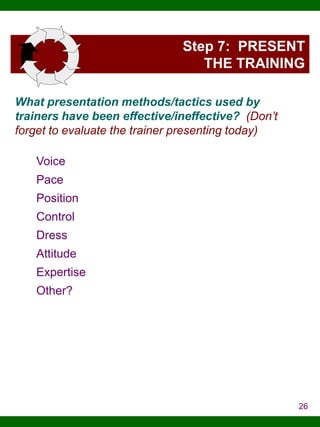
Step 7: PRESENT
THE TRAINING
What presentation methods/tactics used by
trainers have been effective/ineffective? (Don’t
forget to evaluate the trainer presenting today)
Voice
Pace
Position

Control
Dress
Attitude
Expertise

Other?

26
Training at GeeWiz Widgets:

From the information given about the audience you
will be training, what presentation considerations
should you make?

27
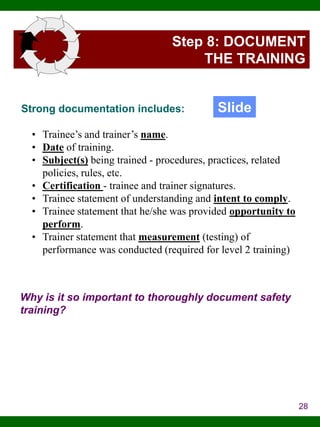
Step 8: DOCUMENT
THE TRAINING

Strong documentation includes:

Slide

• Trainee’s and trainer’s name.
• Date of training.
• Subject(s) being trained - procedures, practices, related
policies, rules, etc.
• Certification - trainee and trainer signatures.
• Trainee statement of understanding and intent to comply.
• Trainee statement that he/she was provided opportunity to
perform.
• Trainer statement that measurement (testing) of
performance was conducted (required for level 2 training)

Why is it so important to thoroughly document safety
training?

28
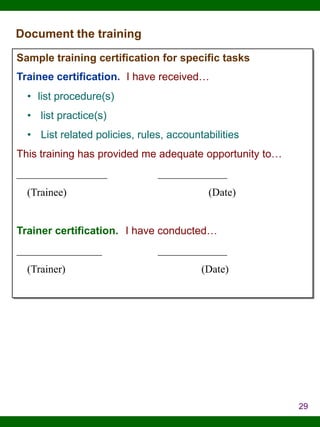
Document the training
Sample training certification for specific tasks
Trainee certification. I have received…
• list procedure(s)
• list practice(s)

• List related policies, rules, accountabilities
This training has provided me adequate opportunity to…
_________________
(Trainee)

_____________
(Date)

Trainer certification. I have conducted…
________________
(Trainer)

_____________
(Date)

29
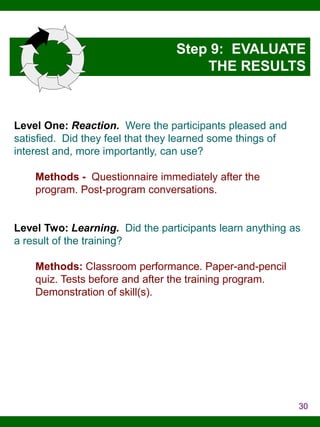
Step 9: EVALUATE
THE RESULTS

Level One: Reaction. Were the participants pleased and
satisfied. Did they feel that they learned some things of
interest and, more importantly, can use?
Methods - Questionnaire immediately after the
program. Post-program conversations.

Level Two: Learning. Did the participants learn anything as
a result of the training?
Methods: Classroom performance. Paper-and-pencil
quiz. Tests before and after the training program.
Demonstration of skill(s).

30
Level Three: Behavior. Did the training lead to improved
on-the-job performance by the participants?
Methods: Before and after comparisons.
Questionnaires. Interviews.

Level Four: Results. Has improved performance on-thejob contributed to increased effectiveness in reaching
workgroup and organizational goals?
Methods: Performance measures. In-depth
interviews. Questionnaires.

31
Training at GeeWiz Widgets:

Which level(s) of evaluation has been requested, or will
be required by the training you have developed and
presented?

What method(s) will you use to evaluate at that level?

32
The
Not-so-final
Exam
1. What might be one of the most important questions to ask
during a needs analysis?
2. What are the three criteria for an operational objective?
3. T F “Loading” refers to the amount of total information
included in training session
4. List two training methods that appeal to adult learners.
5. Describe one advantage of using color in course media.
6. List the three main sections of a traditional training outline.
7. What is the message when a trainer ignores a question
posed by an attendee?

8. What is one method used to evaluate level 2 learning?
9. T F Level three learning is usually evaluated immediately
after training.
33

Developing effective safety training تطوير التدريب في مجال السلامة

  • 1.
    Developing Effective Safety Training Anintroduction to the 8-Step Course Development and Presentation Process OR-OSHA 105 0206 Presented by the Public Education and Conferences Section Oregon Occupational Safety and Health Division (OR-OSHA) 1
  • 2.
    Goals Help the studentto improve their knowledge, skills and ability to: 1. Prepare and safety training lesson plan. 2. Present a safety training class; 3. Evaluate training outcomes. 2
  • 3.
    Form Teams • Introduce yourselves •Select a team leader • Appoint spokesperson • Every team member is a recorder 3
  • 4.
    What is “education?” •That which leads out of ignorance • Anything that affects our knowledge, skills, and attitudes • The “why” in safety educates about the natural and system consequences of behavior • Primarily increases knowledge and attitudes • A process through which learners gain new understanding, acquire new skills, or change their attitudes or behaviors. 4
  • 5.
    What is “training?” •One method of education • The “how” in safety • Primarily increases knowledge and skills • A specialized form of education that focuses on developing or improving skills - the focus on performance. What are the natural and system consequences? What is the outcome when safety training does not include effective education? 5
  • 6.
    Step 1: ASSESSLEARNER NEEDS Determine learner needs Needs assessments will identify gaps, weaknesses, and limitations in trainees’ skills and knowledge. How do we become aware of safety training needs? 6
  • 7.
    To get informationabout the audience: • Observe workers doing work • Interview and/or survey workers • Review employee personnel records • Determine demographics (age, gender, race) • Determine experience level • Determine learning styles • Determine aptitudes, knowledge • Determine attitudes toward subject being taught 7
  • 8.
    To get informationabout the tasks • Observe experts doing the task • Interview experts about the task • Review job descriptions, policy statements, reports To get information about the content of process or procedures • Observe the expert of developers of the process or procedure • Interview experts, policy makers, mangers • Review process plans, specifications, rules, guidelines (make sure they are current) 8
  • 9.
    Are training ornon-training interventions the solution to poor safety performance in the workplace? Mager’s Decision Tree Improving Safety Performance Describe the Safety Performance Discrepancy (The Gap) 9
  • 10.
    Training at GeeWizWidgets: Conduct a needs analysis with the supervisor. Information about the audience: Information about the course topic: 10
  • 11.
    Step 2: SET GOALSand OBJECTIVES Goals are easy to write. They're nothing more than wishes. • Improve the hazard control program. • Eat some really great food today. • Lose some wait today. Objectives take a little more thought. Well written objectives should have the following elements present: • Starts with an action verb. (Decrease, increase, improve, etc.) • Specifies a single key result to be accomplished. • Is quantifiable. Uses numbers to measure a desired change. (i.e., 50% increase) • Specifies a target date for accomplishment. 11
  • 12.
    Educational objective •Tells how the student will demonstrate knowledge. “After training, the participant will be able to correctly answer 80% of all test questions.” Training objective • Tells how the student will demonstrate skill, ability. “At the end of the class, the participant will be able to correctly complete all steps of the lockout/tagout procedure required for plant ventilation equipment.” 12
  • 13.
    Objectives describe observablemeasurable performance Analyze Assess Attach Bend Build Change Choose Classify Close Combine Compare Complete Compose Compute Construct Correct Create Define Demonstrate Describe Design Develop Differentiate Distinguish Evaluate Explain Fill Out Find Handle Identify Improve Justify Label List Locate Measure Modify Move Name Open Operate Organize Perform Plan Position Predict Present Process Produce Rate Recite Recognize Report Rotate Select Show Solve Sort State Stretch Translate Turn Use Write 13
  • 14.
    Questions to askafter writing your objective. Does it… 1. Describe what participants will be able to do? 2. State a time limit? 3. Include an acceptable level of performance? 4. Describe a measurable level, increase or decrease in knowledge, skills, or ability? 14
  • 15.
    Training at GeeWizWidgets: Develop goals and objectives 15
  • 16.
    Step 3: DESIGNTHE CURRICULUM Subject. What’s covered? Scope. How broad or specific? Sequence. In what order? Loading. How deep? 16
  • 17.
    Training at GeeWizWidgets: Subject. What’s going to be covered? Scope. How broad or specific? Loading. How deep? Sequence. In what order? 17
  • 18.
    Step 4: SELECT METHODS& MEDIA Methods: Case study Lecture Role play Modeling Demonstration Small group Games Stories Discussion Survey Brainstorm Question others? Rank order what you consider to be the top five training methods that work for you. 18
  • 19.
  • 20.
    Training Methods Rank orderwhat you consider to be the top five training methods that work for you. _____ _____ _____ _____ _____ _____ _____ _____ _____ _____ _____ 1. CASE STUDY: 2. LECTURE: 3. ROLE PLAY: 4. MODELLING: L 5. SMALL GROUP: 6. GAMES: 7. STORIES: 8. EXERCISES: 9. DISCUSSION: 10.TELL YOUR NEIGHBOR: 11.THINK ABOUT AND WRITE: 20
  • 21.
    Training at GeeWizWidgets: Determine what methods and materials you will need for the presentation. Methods: Media: 21
  • 22.
    Step 5: WRITETHE COURSE OUTLINE Outline of a typical training session • Opening Segment 1. Introduce Participants and instructor Reason for the course Goals and Objectives 2. Warm-up • Each knowledge/skill group contains 3. Introduction (Motivator, attention-getter) 4. Information/Demonstration 5. Application/Practice 6. Clarification 7. Test 8. Review and Bridge • Final Segment 9. Overall Summary 10. Final Test 11. Commitment 22
  • 23.
    Training at GeeWizWidgets: Briefly describe below how you would accomplish each element of one module in the course you are developing. Module Subject: ___________________ 3. Introduction (Motivator, attention-getter) 4. Information/Demonstration 5. Application/Practice 6. Clarification 7. Test 8. Review and Bridge 23
  • 24.
    Step 6: COORDINATE LOGISTICS Determinewhere and when the training will occur. What will classroom set up be? Who must be contacted to coordinate training? What is generally the best time of day to train? Best day(s) of the week? What are some tips to remember about coordinating the training with others? What should you consider when setting up a room for training? 24
  • 25.
    Training at GeeWizWidgets: Determine the most suitable start time and day for your training course. Next, draw a sketch of the room set-up. 25
  • 26.
    Step 7: PRESENT THETRAINING What presentation methods/tactics used by trainers have been effective/ineffective? (Don’t forget to evaluate the trainer presenting today) Voice Pace Position Control Dress Attitude Expertise Other? 26
  • 27.
    Training at GeeWizWidgets: From the information given about the audience you will be training, what presentation considerations should you make? 27
  • 28.
    Step 8: DOCUMENT THETRAINING Strong documentation includes: Slide • Trainee’s and trainer’s name. • Date of training. • Subject(s) being trained - procedures, practices, related policies, rules, etc. • Certification - trainee and trainer signatures. • Trainee statement of understanding and intent to comply. • Trainee statement that he/she was provided opportunity to perform. • Trainer statement that measurement (testing) of performance was conducted (required for level 2 training) Why is it so important to thoroughly document safety training? 28
  • 29.
    Document the training Sampletraining certification for specific tasks Trainee certification. I have received… • list procedure(s) • list practice(s) • List related policies, rules, accountabilities This training has provided me adequate opportunity to… _________________ (Trainee) _____________ (Date) Trainer certification. I have conducted… ________________ (Trainer) _____________ (Date) 29
  • 30.
    Step 9: EVALUATE THERESULTS Level One: Reaction. Were the participants pleased and satisfied. Did they feel that they learned some things of interest and, more importantly, can use? Methods - Questionnaire immediately after the program. Post-program conversations. Level Two: Learning. Did the participants learn anything as a result of the training? Methods: Classroom performance. Paper-and-pencil quiz. Tests before and after the training program. Demonstration of skill(s). 30
  • 31.
    Level Three: Behavior.Did the training lead to improved on-the-job performance by the participants? Methods: Before and after comparisons. Questionnaires. Interviews. Level Four: Results. Has improved performance on-thejob contributed to increased effectiveness in reaching workgroup and organizational goals? Methods: Performance measures. In-depth interviews. Questionnaires. 31
  • 32.
    Training at GeeWizWidgets: Which level(s) of evaluation has been requested, or will be required by the training you have developed and presented? What method(s) will you use to evaluate at that level? 32
  • 33.
    The Not-so-final Exam 1. What mightbe one of the most important questions to ask during a needs analysis? 2. What are the three criteria for an operational objective? 3. T F “Loading” refers to the amount of total information included in training session 4. List two training methods that appeal to adult learners. 5. Describe one advantage of using color in course media. 6. List the three main sections of a traditional training outline. 7. What is the message when a trainer ignores a question posed by an attendee? 8. What is one method used to evaluate level 2 learning? 9. T F Level three learning is usually evaluated immediately after training. 33