
ISD
Instructional Design System
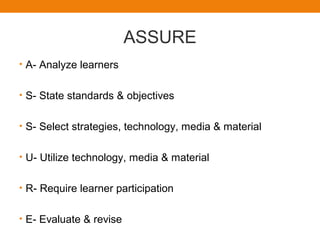
ASSURE
• A- Analyze learners
• S- State standards & objectives
• S- Select strategies, technology, media & material
• U- Utilize technology, media & material
• R- Require learner participation
• E- Evaluate & revise
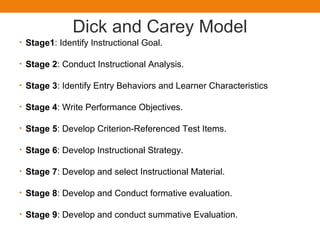
Dick and Carey Model
• Stage1: Identify Instructional Goal.
• Stage 2: Conduct Instructional Analysis.
• Stage 3: Identify Entry Behaviors and Learner Characteristics
• Stage 4: Write Performance Objectives.
• Stage 5: Develop Criterion-Referenced Test Items.
• Stage 6: Develop Instructional Strategy.
• Stage 7: Develop and select Instructional Material.
• Stage 8: Develop and Conduct formative evaluation.
• Stage 9: Develop and conduct summative Evaluation.
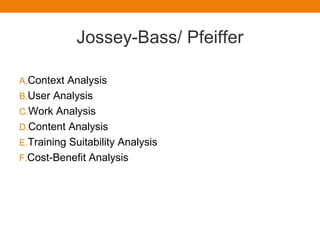
Jossey-Bass/ Pfeiffer
A.Context Analysis
B.User Analysis
C.Work Analysis
D.Content Analysis
E.Training Suitability Analysis
F.Cost-Benefit Analysis
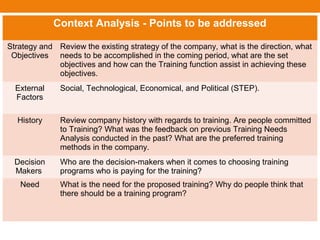
Context Analysis - Points to be addressed
Strategy and
Objectives
Review the existing strategy of the company, what is the direction, what
needs to be accomplished in the coming period, what are the set
objectives and how can the Training function assist in achieving these
objectives.
External
Factors
Social, Technological, Economical, and Political (STEP).
History Review company history with regards to training. Are people committed
to Training? What was the feedback on previous Training Needs
Analysis conducted in the past? What are the preferred training
methods in the company.
Decision
Makers
Who are the decision-makers when it comes to choosing training
programs who is paying for the training?
Need What is the need for the proposed training? Why do people think that
there should be a training program?
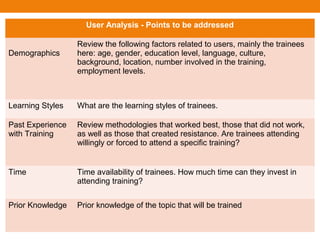
User Analysis - Points to be addressed
Demographics
Review the following factors related to users, mainly the trainees
here: age, gender, education level, language, culture,
background, location, number involved in the training,
employment levels.
Learning Styles What are the learning styles of trainees.
Past Experience
with Training
Review methodologies that worked best, those that did not work,
as well as those that created resistance. Are trainees attending
willingly or forced to attend a specific training?
Time Time availability of trainees. How much time can they invest in
attending training?
Prior Knowledge Prior knowledge of the topic that will be trained
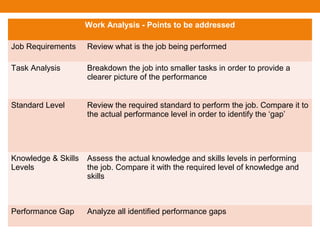
Work Analysis - Points to be addressed
Job Requirements Review what is the job being performed
Task Analysis Breakdown the job into smaller tasks in order to provide a
clearer picture of the performance
Standard Level Review the required standard to perform the job. Compare it to
the actual performance level in order to identify the ā€˜gap’
Knowledge & Skills
Levels
Assess the actual knowledge and skills levels in performing
the job. Compare it with the required level of knowledge and
skills
Performance Gap Analyze all identified performance gaps
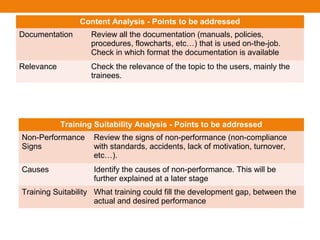
Content Analysis - Points to be addressed
Documentation Review all the documentation (manuals, policies,
procedures, flowcharts, etc…) that is used on-the-job.
Check in which format the documentation is available
Relevance Check the relevance of the topic to the users, mainly the
trainees.
Training Suitability Analysis - Points to be addressed
Non-Performance
Signs
Review the signs of non-performance (non-compliance
with standards, accidents, lack of motivation, turnover,
etc…).
Causes Identify the causes of non-performance. This will be
further explained at a later stage
Training Suitability What training could fill the development gap, between the
actual and desired performance
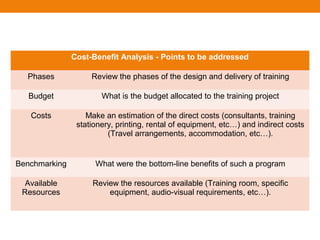
Cost-Benefit Analysis - Points to be addressed
Phases Review the phases of the design and delivery of training
Budget What is the budget allocated to the training project
Costs Make an estimation of the direct costs (consultants, training
stationery, printing, rental of equipment, etc…) and indirect costs
(Travel arrangements, accommodation, etc…).
Benchmarking What were the bottom-line benefits of such a program
Available
Resources
Review the resources available (Training room, specific
equipment, audio-visual requirements, etc…).
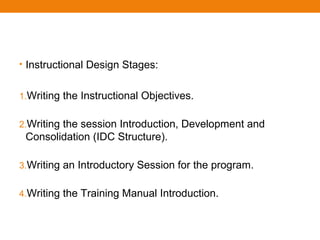
• Instructional Design Stages:
1.Writing the Instructional Objectives.
2.Writing the session Introduction, Development and
Consolidation (IDC Structure).
3.Writing an Introductory Session for the program.
4.Writing the Training Manual Introduction.
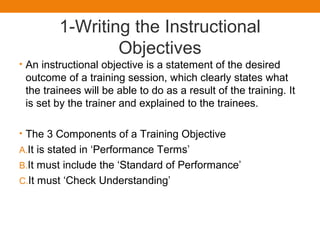
1-Writing the Instructional
Objectives
• An instructional objective is a statement of the desired
outcome of a training session, which clearly states what
the trainees will be able to do as a result of the training. It
is set by the trainer and explained to the trainees.
• The 3 Components of a Training Objective
A.It is stated in ā€˜Performance Terms’
B.It must include the ā€˜Standard of Performance’
C.It must ā€˜Check Understanding’
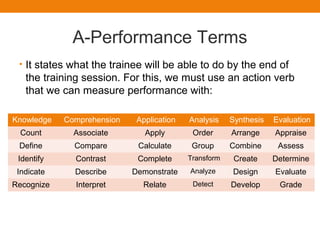
A-Performance Terms
• It states what the trainee will be able to do by the end of
the training session. For this, we must use an action verb
that we can measure performance with:
Knowledge Comprehension Application Analysis Synthesis Evaluation
Count Associate Apply Order Arrange Appraise
Define Compare Calculate Group Combine Assess
Identify Contrast Complete Transform Create Determine
Indicate Describe Demonstrate Analyze Design Evaluate
Recognize Interpret Relate Detect Develop Grade
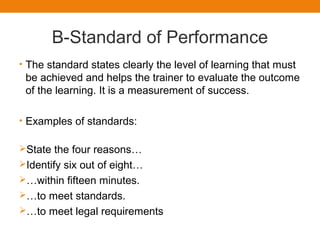
B-Standard of Performance
• The standard states clearly the level of learning that must
be achieved and helps the trainer to evaluate the outcome
of the learning. It is a measurement of success.
• Examples of standards:
State the four reasons…
Identify six out of eight…
ļƒ˜ā€¦within fifteen minutes.
ļƒ˜ā€¦to meet standards.
ļƒ˜ā€¦to meet legal requirements
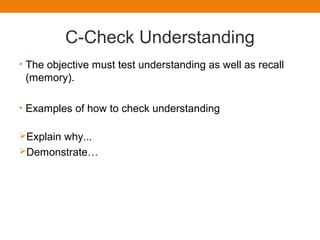
C-Check Understanding
• The objective must test understanding as well as recall
(memory).
• Examples of how to check understanding
Explain why...
Demonstrate…
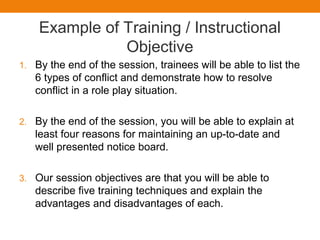
Example of Training / Instructional
Objective
1. By the end of the session, trainees will be able to list the
6 types of conflict and demonstrate how to resolve
conflict in a role play situation.
2. By the end of the session, you will be able to explain at
least four reasons for maintaining an up-to-date and
well presented notice board.
3. Our session objectives are that you will be able to
describe five training techniques and explain the
advantages and disadvantages of each.
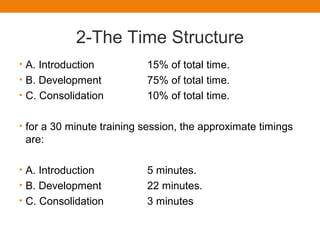
2-The Time Structure
• A. Introduction 15% of total time.
• B. Development 75% of total time.
• C. Consolidation 10% of total time.
• for a 30 minute training session, the approximate timings
are:
• A. Introduction 5 minutes.
• B. Development 22 minutes.
• C. Consolidation 3 minutes
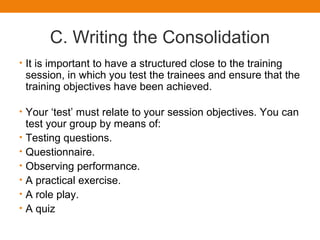
C. Writing the Consolidation
• It is important to have a structured close to the training
session, in which you test the trainees and ensure that the
training objectives have been achieved.
• Your ā€˜test’ must relate to your session objectives. You can
test your group by means of:
• Testing questions.
• Questionnaire.
• Observing performance.
• A practical exercise.
• A role play.
• A quiz
End of Training

Instructional Design System

  • 1.
  • 3.
    ASSURE • A- Analyzelearners • S- State standards & objectives • S- Select strategies, technology, media & material • U- Utilize technology, media & material • R- Require learner participation • E- Evaluate & revise
  • 4.
    Dick and CareyModel • Stage1: Identify Instructional Goal. • Stage 2: Conduct Instructional Analysis. • Stage 3: Identify Entry Behaviors and Learner Characteristics • Stage 4: Write Performance Objectives. • Stage 5: Develop Criterion-Referenced Test Items. • Stage 6: Develop Instructional Strategy. • Stage 7: Develop and select Instructional Material. • Stage 8: Develop and Conduct formative evaluation. • Stage 9: Develop and conduct summative Evaluation.
  • 5.
    Jossey-Bass/ Pfeiffer A.Context Analysis B.UserAnalysis C.Work Analysis D.Content Analysis E.Training Suitability Analysis F.Cost-Benefit Analysis
  • 6.
    Context Analysis -Points to be addressed Strategy and Objectives Review the existing strategy of the company, what is the direction, what needs to be accomplished in the coming period, what are the set objectives and how can the Training function assist in achieving these objectives. External Factors Social, Technological, Economical, and Political (STEP). History Review company history with regards to training. Are people committed to Training? What was the feedback on previous Training Needs Analysis conducted in the past? What are the preferred training methods in the company. Decision Makers Who are the decision-makers when it comes to choosing training programs who is paying for the training? Need What is the need for the proposed training? Why do people think that there should be a training program?
  • 7.
    User Analysis -Points to be addressed Demographics Review the following factors related to users, mainly the trainees here: age, gender, education level, language, culture, background, location, number involved in the training, employment levels. Learning Styles What are the learning styles of trainees. Past Experience with Training Review methodologies that worked best, those that did not work, as well as those that created resistance. Are trainees attending willingly or forced to attend a specific training? Time Time availability of trainees. How much time can they invest in attending training? Prior Knowledge Prior knowledge of the topic that will be trained
  • 8.
    Work Analysis -Points to be addressed Job Requirements Review what is the job being performed Task Analysis Breakdown the job into smaller tasks in order to provide a clearer picture of the performance Standard Level Review the required standard to perform the job. Compare it to the actual performance level in order to identify the ā€˜gap’ Knowledge & Skills Levels Assess the actual knowledge and skills levels in performing the job. Compare it with the required level of knowledge and skills Performance Gap Analyze all identified performance gaps
  • 9.
    Content Analysis -Points to be addressed Documentation Review all the documentation (manuals, policies, procedures, flowcharts, etc…) that is used on-the-job. Check in which format the documentation is available Relevance Check the relevance of the topic to the users, mainly the trainees. Training Suitability Analysis - Points to be addressed Non-Performance Signs Review the signs of non-performance (non-compliance with standards, accidents, lack of motivation, turnover, etc…). Causes Identify the causes of non-performance. This will be further explained at a later stage Training Suitability What training could fill the development gap, between the actual and desired performance
  • 10.
    Cost-Benefit Analysis -Points to be addressed Phases Review the phases of the design and delivery of training Budget What is the budget allocated to the training project Costs Make an estimation of the direct costs (consultants, training stationery, printing, rental of equipment, etc…) and indirect costs (Travel arrangements, accommodation, etc…). Benchmarking What were the bottom-line benefits of such a program Available Resources Review the resources available (Training room, specific equipment, audio-visual requirements, etc…).
  • 11.
    • Instructional DesignStages: 1.Writing the Instructional Objectives. 2.Writing the session Introduction, Development and Consolidation (IDC Structure). 3.Writing an Introductory Session for the program. 4.Writing the Training Manual Introduction.
  • 12.
    1-Writing the Instructional Objectives •An instructional objective is a statement of the desired outcome of a training session, which clearly states what the trainees will be able to do as a result of the training. It is set by the trainer and explained to the trainees. • The 3 Components of a Training Objective A.It is stated in ā€˜Performance Terms’ B.It must include the ā€˜Standard of Performance’ C.It must ā€˜Check Understanding’
  • 13.
    A-Performance Terms • Itstates what the trainee will be able to do by the end of the training session. For this, we must use an action verb that we can measure performance with: Knowledge Comprehension Application Analysis Synthesis Evaluation Count Associate Apply Order Arrange Appraise Define Compare Calculate Group Combine Assess Identify Contrast Complete Transform Create Determine Indicate Describe Demonstrate Analyze Design Evaluate Recognize Interpret Relate Detect Develop Grade
  • 14.
    B-Standard of Performance •The standard states clearly the level of learning that must be achieved and helps the trainer to evaluate the outcome of the learning. It is a measurement of success. • Examples of standards: State the four reasons… Identify six out of eight… ļƒ˜ā€¦within fifteen minutes. ļƒ˜ā€¦to meet standards. ļƒ˜ā€¦to meet legal requirements
  • 15.
    C-Check Understanding • Theobjective must test understanding as well as recall (memory). • Examples of how to check understanding Explain why... Demonstrate…
  • 16.
    Example of Training/ Instructional Objective 1. By the end of the session, trainees will be able to list the 6 types of conflict and demonstrate how to resolve conflict in a role play situation. 2. By the end of the session, you will be able to explain at least four reasons for maintaining an up-to-date and well presented notice board. 3. Our session objectives are that you will be able to describe five training techniques and explain the advantages and disadvantages of each.
  • 17.
    2-The Time Structure •A. Introduction 15% of total time. • B. Development 75% of total time. • C. Consolidation 10% of total time. • for a 30 minute training session, the approximate timings are: • A. Introduction 5 minutes. • B. Development 22 minutes. • C. Consolidation 3 minutes
  • 18.
    C. Writing theConsolidation • It is important to have a structured close to the training session, in which you test the trainees and ensure that the training objectives have been achieved. • Your ā€˜test’ must relate to your session objectives. You can test your group by means of: • Testing questions. • Questionnaire. • Observing performance. • A practical exercise. • A role play. • A quiz
  • 19.