Ethical Dilemmas at
Workplace
 “System of moral principles , rules and
conducts.”
 The ability to distinguish between right and
wrong and to act accordingly.
Ethics is important in communication
Because:
• Creates credibility
• Unites people
• Work Efficiently
• Improves decision making
• Increases interest over shareholders
Ethics brings a sense of right and wrong in organizations.
• When the law fails
• Ethics stops organizations from harming the society.
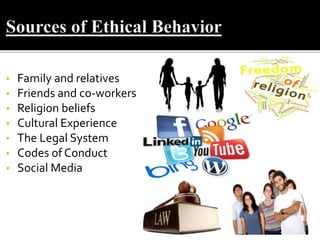
• Family and relatives
• Friends and co-workers
• Religion beliefs
• Cultural Experience
• The Legal System
• Codes of Conduct
• Social Media
Dilemma is a situation where there is no clear easy choice
or answer.
Types of Dilemmas
 Double bind dilemmas
In it victim placed in “No win situation” forced by another.
 Fairness dilemmas
Arise when groups are faced with making decisions about how to
share their resources and rewards.
• Lying to supervisors
• Recording more expenses
• Stealing
• Accepting gifts against company’s policy
• favoritism
• Taking credit for others work
• Whistle blowing
• terminating employees without any reason
• Using company property for personal use
Virtual values into practice
• Principles
• Build trust and credibility
• Respect for the individual
• Building a culture of open and honest
communication
• Sustain the law
• Make tone at the top
Some Essential for Ethical Behavior:
 What does code and conduct means to you
 Treat others with dignity respect
HOW TO OVERCOME ETHICAL
DILEMMAS AT WORKPLACE?
Step1
Developing a workplace policy depends on company’s philosophy, mission
statement and their code of conducts.
Step 2
Give training to employees about workplace ethics. Give instruction methods to
engage employees in learning how to manage and resolve ethical dilemmas or how
to face with ethical issues.
Step3
Consider whether the organization needs an ethics hotline, which is confidential
service for every employee where employees may contact whenever they
encounter workplace dilemmas that put them into uncomfortable or threatening
positions.
Step4
Refrain from making employment decisions, such as terminations, in connection
with whistle blowing or an employee’s right to protected activity under whistle
blowing laws.
Step5
Design the same policies for every employee at workplace. And use the same
business principles in every circumstance.
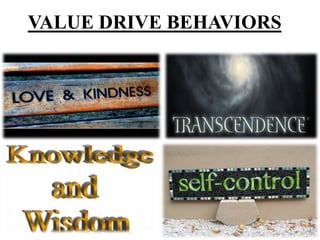
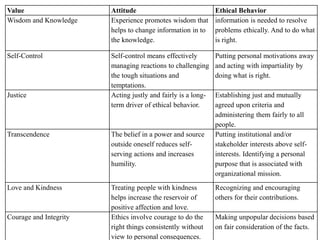
VALUE DRIVE BEHAVIORS
Value Attitude Ethical Behavior
Wisdom and Knowledge Experience promotes wisdom that
helps to change information in to
the knowledge.
information is needed to resolve
problems ethically. And to do what
is right.
Self-Control Self-control means effectively
managing reactions to challenging
the tough situations and
temptations.
Putting personal motivations away
and acting with impartiality by
doing what is right.
Justice Acting justly and fairly is a long-
term driver of ethical behavior.
Establishing just and mutually
agreed upon criteria and
administering them fairly to all
people.
Transcendence The belief in a power and source
outside oneself reduces self-
serving actions and increases
humility.
Putting institutional and/or
stakeholder interests above self-
interests. Identifying a personal
purpose that is associated with
organizational mission.
Love and Kindness Treating people with kindness
helps increase the reservoir of
positive affection and love.
Recognizing and encouraging
others for their contributions.
Courage and Integrity Ethics involve courage to do the
right things consistently without
view to personal consequences.
Making unpopular decisions based
on fair consideration of the facts.
 To be treated with respect and dignity.
 To information that is accessible, accurate,
timely & understandable.
 To be consulted about needs and
preferences, and be involved in decision-
making.
 To have cultural needs respected.
 To have one’s needs met in a professional and
ethical manner
 To receive an efficient and effective service,
delivered in a timely manner.
 For the evaluation there need to be clarity about what will
be considered a quality and ethical evaluation
Checklist:
 Independent: Management should not force limits on the
remarks and recommendations of evaluation reports.
 Intentional :The basis for an evaluation and the decisions
to be based on it must be clear from the start.
 Transparent: important consultation with stakeholders is
necessary for the credibility and utility of the evaluation.
 Ethical: Evaluation must not be a sign of personal or
sectorial interests.
 Impartial: Removing unfairness and maximizing
objectivity are important for the credibility of the
evaluation and its part to knowledge.
 Timely: Evaluations must be planned and completed in
a timely manner so as to make sure the usefulness of
the findings and recommendations.
 Systematic Inquiry: Evaluators carry out systematic,
data-based inquiries about whatever is being evaluated.
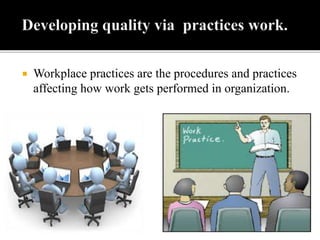
 Workplace practices are the procedures and practices
affecting how work gets performed in organization.
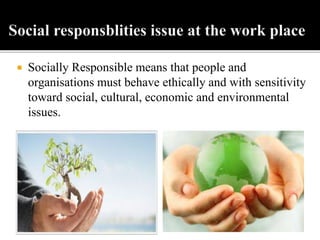
 Socially Responsible means that people and
organisations must behave ethically and with sensitivity
toward social, cultural, economic and environmental
issues.
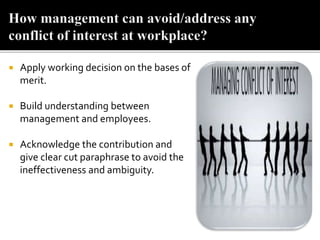
 Apply working decision on the bases of
merit.
 Build understanding between
management and employees.
 Acknowledge the contribution and
give clear cut paraphrase to avoid the
ineffectiveness and ambiguity.
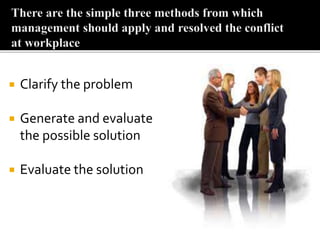
 Clarify the problem
 Generate and evaluate
the possible solution
 Evaluate the solution
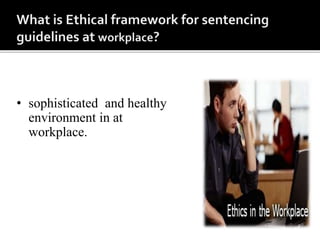
• sophisticated and healthy
environment in at
workplace.
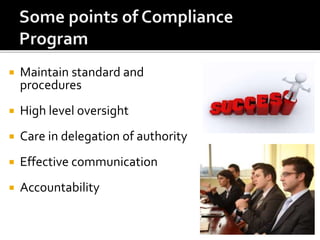
 Maintain standard and
procedures
 High level oversight
 Care in delegation of authority
 Effective communication
 Accountability
Conclusion
•Ethics at workplace is very important for Business.
• It grow and run its operations effectively.
•If any kind of ethical dilemmas occur at the workplace, than It can
be resolve by the effective role of business communication.
Avoid
•Avoid disobeying the rules and regulations of the organization.
•Favoritism should be avoided in at workplace.
•Unethical HR decisions for hiring and firing should be avoided.
Ethics in workplace

Ethics in workplace

  • 1.
  • 2.
     “System ofmoral principles , rules and conducts.”  The ability to distinguish between right and wrong and to act accordingly.
  • 3.
    Ethics is importantin communication Because: • Creates credibility • Unites people • Work Efficiently • Improves decision making • Increases interest over shareholders Ethics brings a sense of right and wrong in organizations. • When the law fails • Ethics stops organizations from harming the society.
  • 4.
    • Family andrelatives • Friends and co-workers • Religion beliefs • Cultural Experience • The Legal System • Codes of Conduct • Social Media
  • 5.
    Dilemma is asituation where there is no clear easy choice or answer. Types of Dilemmas  Double bind dilemmas In it victim placed in “No win situation” forced by another.  Fairness dilemmas Arise when groups are faced with making decisions about how to share their resources and rewards.
  • 6.
    • Lying tosupervisors • Recording more expenses • Stealing • Accepting gifts against company’s policy • favoritism • Taking credit for others work • Whistle blowing • terminating employees without any reason • Using company property for personal use
  • 7.
    Virtual values intopractice • Principles • Build trust and credibility • Respect for the individual • Building a culture of open and honest communication • Sustain the law • Make tone at the top Some Essential for Ethical Behavior:
  • 8.
     What doescode and conduct means to you  Treat others with dignity respect
  • 9.
    HOW TO OVERCOMEETHICAL DILEMMAS AT WORKPLACE?
  • 10.
    Step1 Developing a workplacepolicy depends on company’s philosophy, mission statement and their code of conducts. Step 2 Give training to employees about workplace ethics. Give instruction methods to engage employees in learning how to manage and resolve ethical dilemmas or how to face with ethical issues. Step3 Consider whether the organization needs an ethics hotline, which is confidential service for every employee where employees may contact whenever they encounter workplace dilemmas that put them into uncomfortable or threatening positions.
  • 11.
    Step4 Refrain from makingemployment decisions, such as terminations, in connection with whistle blowing or an employee’s right to protected activity under whistle blowing laws. Step5 Design the same policies for every employee at workplace. And use the same business principles in every circumstance.
  • 12.
  • 13.
    Value Attitude EthicalBehavior Wisdom and Knowledge Experience promotes wisdom that helps to change information in to the knowledge. information is needed to resolve problems ethically. And to do what is right. Self-Control Self-control means effectively managing reactions to challenging the tough situations and temptations. Putting personal motivations away and acting with impartiality by doing what is right. Justice Acting justly and fairly is a long- term driver of ethical behavior. Establishing just and mutually agreed upon criteria and administering them fairly to all people. Transcendence The belief in a power and source outside oneself reduces self- serving actions and increases humility. Putting institutional and/or stakeholder interests above self- interests. Identifying a personal purpose that is associated with organizational mission. Love and Kindness Treating people with kindness helps increase the reservoir of positive affection and love. Recognizing and encouraging others for their contributions. Courage and Integrity Ethics involve courage to do the right things consistently without view to personal consequences. Making unpopular decisions based on fair consideration of the facts.
  • 14.
     To betreated with respect and dignity.  To information that is accessible, accurate, timely & understandable.  To be consulted about needs and preferences, and be involved in decision- making.  To have cultural needs respected.
  • 15.
     To haveone’s needs met in a professional and ethical manner  To receive an efficient and effective service, delivered in a timely manner.
  • 16.
     For theevaluation there need to be clarity about what will be considered a quality and ethical evaluation Checklist:  Independent: Management should not force limits on the remarks and recommendations of evaluation reports.  Intentional :The basis for an evaluation and the decisions to be based on it must be clear from the start.  Transparent: important consultation with stakeholders is necessary for the credibility and utility of the evaluation.
  • 17.
     Ethical: Evaluationmust not be a sign of personal or sectorial interests.  Impartial: Removing unfairness and maximizing objectivity are important for the credibility of the evaluation and its part to knowledge.  Timely: Evaluations must be planned and completed in a timely manner so as to make sure the usefulness of the findings and recommendations.  Systematic Inquiry: Evaluators carry out systematic, data-based inquiries about whatever is being evaluated.
  • 18.
     Workplace practicesare the procedures and practices affecting how work gets performed in organization.
  • 19.
     Socially Responsiblemeans that people and organisations must behave ethically and with sensitivity toward social, cultural, economic and environmental issues.
  • 20.
     Apply workingdecision on the bases of merit.  Build understanding between management and employees.  Acknowledge the contribution and give clear cut paraphrase to avoid the ineffectiveness and ambiguity.
  • 22.
     Clarify theproblem  Generate and evaluate the possible solution  Evaluate the solution
  • 23.
    • sophisticated andhealthy environment in at workplace.
  • 24.
     Maintain standardand procedures  High level oversight  Care in delegation of authority  Effective communication  Accountability
  • 25.
    Conclusion •Ethics at workplaceis very important for Business. • It grow and run its operations effectively. •If any kind of ethical dilemmas occur at the workplace, than It can be resolve by the effective role of business communication. Avoid •Avoid disobeying the rules and regulations of the organization. •Favoritism should be avoided in at workplace. •Unethical HR decisions for hiring and firing should be avoided.