Professional learning and leadership:
An international resource for the art,
   craft, and science of disciplinary
 literacy acquisition and instruction
     Sandra L. Robinson, Susan J. Wegmann, Enrique A. Puig

       2012 International Reading Association Convention
Session objectives:
• Immerse literacy educators in breakthrough resources in
  research and appropriate instructional practices
• Provide on-line high quality materials, programs, and
  professional learning opportunities
• Engage university-based research scholars and school-
  based practitioner scholars in dialogic conversations
• Employ technology to disseminate and collect information
• Respond in a timely manner to ensure professional learning
• Demonstrate materials and access to models of appropriate
  instructional practices
Presenters and point of view:
Sandra L. Robinson – historical perspective
Susan J. Wegmann – programmatic perspective
Enrique A. Puig – theoretical foundation
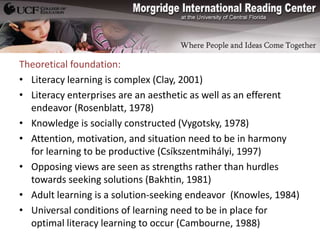
Theoretical foundation:
• Literacy learning is complex (Clay, 2001)
• Literacy enterprises are an aesthetic as well as an efferent
  endeavor (Rosenblatt, 1978)
• Knowledge is socially constructed (Vygotsky, 1978)
• Attention, motivation, and situation need to be in harmony
  for learning to be productive (Csíkszentmihályi, 1997)
• Opposing views are seen as strengths rather than hurdles
  towards seeking solutions (Bakhtin, 1981)
• Adult learning is a solution-seeking endeavor (Knowles, 1984)
• Universal conditions of learning need to be in place for
  optimal literacy learning to occur (Cambourne, 1988)
University-based research scholar/
 School-based practitioner scholar
• Florida Literacy and International Reading (FLaIR)
  Fellows
• International Collaborative Partnerships
• International Society for the Social Studies
• Florida Literacy Coaches Association
• Pre-K – 12 Classroom Teachers
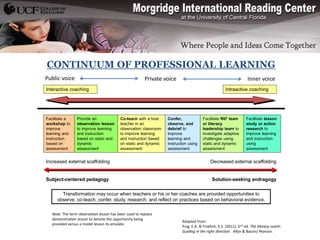
CONTINUUM OF PROFESSIONAL LEARNING
Public voice                                            Private voice                                              Inner voice
Interactive coaching                                                                                 Intraactive coaching


Facilitate a     Provide an               Co-teach with a host    Confer,              Facilitate RtI2 team       Facilitate lesson
workshop to      observation lesson       teacher in an           observe, and         or literacy                study or action
improve          to improve learning      observation classroom   debrief to           leadership team to         research to
learning and     and instruction          to improve learning     improve              investigate adaptive       improve learning
instruction      based on static and      and instruction based   learning and         challenges using           and instruction
based on         dynamic                  on static and dynamic   instruction using    static and dynamic         using
assessment       assessment               assessment              assessment           assessment                 assessment


Increased external scaffolding                                                             Decreased external scaffolding


Subject-centered pedagogy                                                                   Solution-seeking andragogy

       Transformation may occur when teachers or his or her coaches are provided opportunities to
     observe, co-teach, confer, study, research, and reflect on practices based on behavioral evidence.

   Note: The term observation lesson has been used to replace
   demonstration lesson to denote the opportunity being
                                                                          Adapted from:
   provided versus a model lesson to emulate.
                                                                          Puig, E.A. & Froelich, K.S. (2011), 2nd ed. The literacy coach:
                                                                          Guiding in the right direction. Allyn & Bacon/ Pearson.
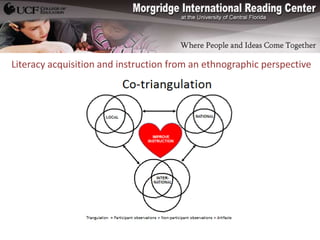
Literacy acquisition and instruction from an ethnographic perspective
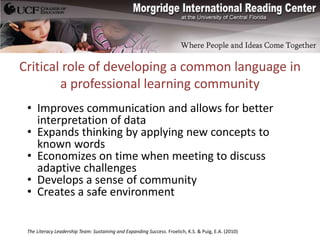
Critical role of developing a common language in
        a professional learning community
 • Improves communication and allows for better
   interpretation of data
 • Expands thinking by applying new concepts to
   known words
 • Economizes on time when meeting to discuss
   adaptive challenges
 • Develops a sense of community
 • Creates a safe environment


 The Literacy Leadership Team: Sustaining and Expanding Success. Froelich, K.S. & Puig, E.A. (2010)
Sandra L. Robinson
• International need for the Morgridge
  International Reading Center

• Importance of a cohesive instructional PK – 20
  plan
An international resource to support
    the professional learning and
leadership necessary to sustain and
      expand success in schools
          Sandra L. Robinson
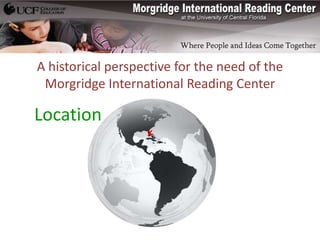
A historical perspective for the need of the
 Morgridge International Reading Center

Location
                   X
A generous gift . . .

        Morgridge Family Foundation
Purpose…
• Collect and disseminate educational
  information based on innovative research.
• House a comprehensive collection of global
  reading initiatives.
• Serve as a hub of connectivity.
• Provide opportunities for professional
  learning.
Holistic PK-20 education

  A holistic PK-20 education consolidates
    established and proven educational
practices with current resources and future
  needs. The creation of a cohesive PK-20
system will better prepare students for the
          jobs of the 21st century.
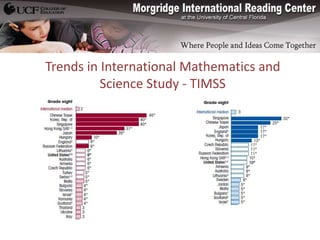
Trends in International Mathematics and
          Science Study - TIMSS
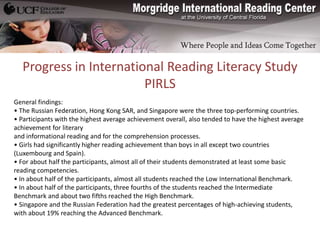
Progress in International Reading Literacy Study
                        PIRLS
General findings:
• The Russian Federation, Hong Kong SAR, and Singapore were the three top-performing countries.
• Participants with the highest average achievement overall, also tended to have the highest average
achievement for literary
and informational reading and for the comprehension processes.
• Girls had significantly higher reading achievement than boys in all except two countries
(Luxembourg and Spain).
• For about half the participants, almost all of their students demonstrated at least some basic
reading competencies.
• In about half of the participants, almost all students reached the Low International Benchmark.
• In about half of the participants, three fourths of the students reached the Intermediate
Benchmark and about two fifths reached the High Benchmark.
• Singapore and the Russian Federation had the greatest percentages of high-achieving students,
with about 19% reaching the Advanced Benchmark.
The importance of a cohesive instructional plan
                    for PK-20
• Cooperation among educational levels has to
  be in place in order to equip and prepare
  students.
• A cohesive PK-20 instructional plan identifies
  strengths and scaffolds students to ensure
  success
• Education is the common denominator
Susan J. Wegmann

21st Century Learning Environment:
  • Learner’s Role
  • Content Knowledge
  • Programmatic perspectives
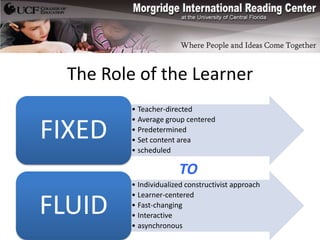
The Role of the Learner
         • Teacher-directed
         • Average group centered

FIXED    • Predetermined
         • Set content area
         • scheduled

                       TO
         • Individualized constructivist approach
         • Learner-centered

FLUID    • Fast-changing
         • Interactive
         • asynchronous
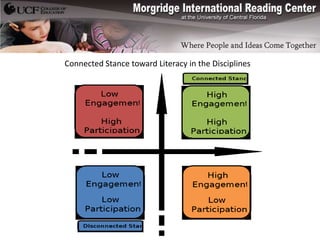
Connected Stance toward Literacy in the Disciplines
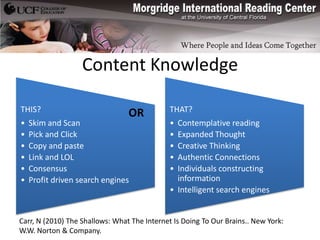
Content Knowledge

THIS?                            OR           THAT?
•   Skim and Scan                             • Contemplative reading
•   Pick and Click                            • Expanded Thought
•   Copy and paste                            • Creative Thinking
•   Link and LOL                              • Authentic Connections
•   Consensus                                 • Individuals constructing
•   Profit driven search engines                information
                                              • Intelligent search engines


Carr, N (2010) The Shallows: What The Internet Is Doing To Our Brains.. New York:
W.W. Norton & Company.
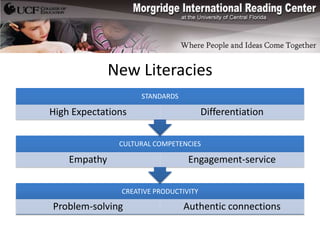
New Literacies
                    STANDARDS

High Expectations                      Differentiation

               CULTURAL COMPETENCIES

    Empathy                      Engagement-service

               CREATIVE PRODUCTIVITY

Problem-solving                 Authentic connections
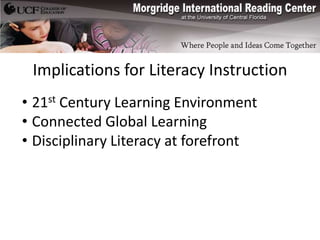
Implications for Literacy Instruction
• 21st Century Learning Environment
• Connected Global Learning
• Disciplinary Literacy at forefront
Questions and Discussion

Sandra L. Robinson – historical perspective
Susan J. Wegmann– programmatic perspective
Enrique A. Puig – theoretical foundation
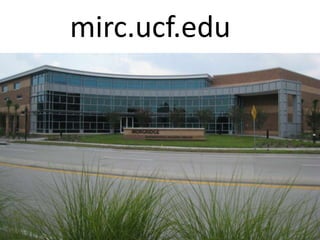
mirc.ucf.edu

IRA 2012 Chicago

  • 1.
    Professional learning andleadership: An international resource for the art, craft, and science of disciplinary literacy acquisition and instruction Sandra L. Robinson, Susan J. Wegmann, Enrique A. Puig 2012 International Reading Association Convention
  • 4.
    Session objectives: • Immerseliteracy educators in breakthrough resources in research and appropriate instructional practices • Provide on-line high quality materials, programs, and professional learning opportunities • Engage university-based research scholars and school- based practitioner scholars in dialogic conversations • Employ technology to disseminate and collect information • Respond in a timely manner to ensure professional learning • Demonstrate materials and access to models of appropriate instructional practices
  • 5.
    Presenters and pointof view: Sandra L. Robinson – historical perspective Susan J. Wegmann – programmatic perspective Enrique A. Puig – theoretical foundation
  • 6.
    Theoretical foundation: • Literacylearning is complex (Clay, 2001) • Literacy enterprises are an aesthetic as well as an efferent endeavor (Rosenblatt, 1978) • Knowledge is socially constructed (Vygotsky, 1978) • Attention, motivation, and situation need to be in harmony for learning to be productive (Csíkszentmihályi, 1997) • Opposing views are seen as strengths rather than hurdles towards seeking solutions (Bakhtin, 1981) • Adult learning is a solution-seeking endeavor (Knowles, 1984) • Universal conditions of learning need to be in place for optimal literacy learning to occur (Cambourne, 1988)
  • 8.
    University-based research scholar/ School-based practitioner scholar • Florida Literacy and International Reading (FLaIR) Fellows • International Collaborative Partnerships • International Society for the Social Studies • Florida Literacy Coaches Association • Pre-K – 12 Classroom Teachers
  • 9.
    CONTINUUM OF PROFESSIONALLEARNING Public voice Private voice Inner voice Interactive coaching Intraactive coaching Facilitate a Provide an Co-teach with a host Confer, Facilitate RtI2 team Facilitate lesson workshop to observation lesson teacher in an observe, and or literacy study or action improve to improve learning observation classroom debrief to leadership team to research to learning and and instruction to improve learning improve investigate adaptive improve learning instruction based on static and and instruction based learning and challenges using and instruction based on dynamic on static and dynamic instruction using static and dynamic using assessment assessment assessment assessment assessment assessment Increased external scaffolding Decreased external scaffolding Subject-centered pedagogy Solution-seeking andragogy Transformation may occur when teachers or his or her coaches are provided opportunities to observe, co-teach, confer, study, research, and reflect on practices based on behavioral evidence. Note: The term observation lesson has been used to replace demonstration lesson to denote the opportunity being Adapted from: provided versus a model lesson to emulate. Puig, E.A. & Froelich, K.S. (2011), 2nd ed. The literacy coach: Guiding in the right direction. Allyn & Bacon/ Pearson.
  • 10.
    Literacy acquisition andinstruction from an ethnographic perspective
  • 11.
    Critical role ofdeveloping a common language in a professional learning community • Improves communication and allows for better interpretation of data • Expands thinking by applying new concepts to known words • Economizes on time when meeting to discuss adaptive challenges • Develops a sense of community • Creates a safe environment The Literacy Leadership Team: Sustaining and Expanding Success. Froelich, K.S. & Puig, E.A. (2010)
  • 12.
    Sandra L. Robinson •International need for the Morgridge International Reading Center • Importance of a cohesive instructional PK – 20 plan
  • 13.
    An international resourceto support the professional learning and leadership necessary to sustain and expand success in schools Sandra L. Robinson
  • 14.
    A historical perspectivefor the need of the Morgridge International Reading Center Location X
  • 15.
    A generous gift. . . Morgridge Family Foundation
  • 16.
    Purpose… • Collect anddisseminate educational information based on innovative research. • House a comprehensive collection of global reading initiatives. • Serve as a hub of connectivity. • Provide opportunities for professional learning.
  • 17.
    Holistic PK-20 education A holistic PK-20 education consolidates established and proven educational practices with current resources and future needs. The creation of a cohesive PK-20 system will better prepare students for the jobs of the 21st century.
  • 18.
    Trends in InternationalMathematics and Science Study - TIMSS
  • 19.
    Progress in InternationalReading Literacy Study PIRLS General findings: • The Russian Federation, Hong Kong SAR, and Singapore were the three top-performing countries. • Participants with the highest average achievement overall, also tended to have the highest average achievement for literary and informational reading and for the comprehension processes. • Girls had significantly higher reading achievement than boys in all except two countries (Luxembourg and Spain). • For about half the participants, almost all of their students demonstrated at least some basic reading competencies. • In about half of the participants, almost all students reached the Low International Benchmark. • In about half of the participants, three fourths of the students reached the Intermediate Benchmark and about two fifths reached the High Benchmark. • Singapore and the Russian Federation had the greatest percentages of high-achieving students, with about 19% reaching the Advanced Benchmark.
  • 20.
    The importance ofa cohesive instructional plan for PK-20 • Cooperation among educational levels has to be in place in order to equip and prepare students. • A cohesive PK-20 instructional plan identifies strengths and scaffolds students to ensure success • Education is the common denominator
  • 21.
    Susan J. Wegmann 21stCentury Learning Environment: • Learner’s Role • Content Knowledge • Programmatic perspectives
  • 22.
    The Role ofthe Learner • Teacher-directed • Average group centered FIXED • Predetermined • Set content area • scheduled TO • Individualized constructivist approach • Learner-centered FLUID • Fast-changing • Interactive • asynchronous
  • 23.
    Connected Stance towardLiteracy in the Disciplines
  • 24.
    Content Knowledge THIS? OR THAT? • Skim and Scan • Contemplative reading • Pick and Click • Expanded Thought • Copy and paste • Creative Thinking • Link and LOL • Authentic Connections • Consensus • Individuals constructing • Profit driven search engines information • Intelligent search engines Carr, N (2010) The Shallows: What The Internet Is Doing To Our Brains.. New York: W.W. Norton & Company.
  • 26.
    New Literacies STANDARDS High Expectations Differentiation CULTURAL COMPETENCIES Empathy Engagement-service CREATIVE PRODUCTIVITY Problem-solving Authentic connections
  • 27.
    Implications for LiteracyInstruction • 21st Century Learning Environment • Connected Global Learning • Disciplinary Literacy at forefront
  • 28.
    Questions and Discussion SandraL. Robinson – historical perspective Susan J. Wegmann– programmatic perspective Enrique A. Puig – theoretical foundation
  • 30.

Editor's Notes

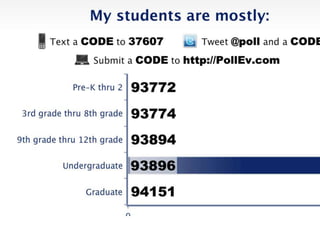
  • #3 Note: you have to go to presentation mode to see the polls initially. They will show up if you are connected to the Internet.POLL Everywhere Text: My students are mostlyPress F5 or enter presentation mode to view the poll\r\nIn an emergency during your presentation, if the poll isn't showing, navigate to this link in your web browser:\r\nhttp://www.polleverywhere.com/multiple_choice_polls/LTE4MDYzOTkxNDgIf you like, you can use this slide as a template for your own voting slides. You might use a slide like this if you feel your audience would benefit from the picture showing a text message on a phone.
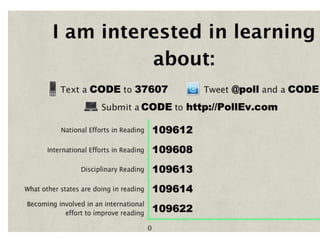
  • #4 Note: you have to go to presentation mode to see the polls initially. They will show up if you are connected to the Internet.POLL Everywhere Text: I am interested in learning about: (multiple choice answers – National efforts in reading; International efforts in reading, Disciplinary reading, What other states are doing in reading; and Becoming involved in an international effort to improve reading)Press F5 or enter presentation mode to view the poll\r\nIn an emergency during your presentation, if the poll isn't showing, navigate to this link in your web browser:\r\nhttp://www.polleverywhere.com/multiple_choice_polls/LTE5ODQ3OTcwMjMIf you like, you can use this slide as a template for your own voting slides. You might use a slide like this if you feel your audience would benefit from the picture showing a text message on a phone.
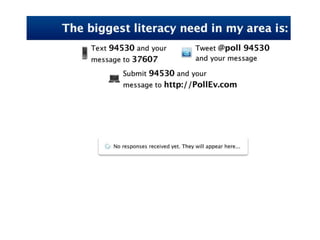
  • #8 Note: you have to go to presentation mode to see the polls initially. They will show up if you are connected to the Internet.POLL Everywhere Text: The biggest literacy need in my area is:Press F5 or enter presentation mode to view the poll\r\nIn an emergency during your presentation, if the poll isn't showing, navigate to this link in your web browser:\r\nhttp://www.polleverywhere.com/free_text_polls/MjI4ODc0Mzk4If you like, you can use this slide as a template for your own voting slides. You might use a slide like this if you feel your audience would benefit from the picture showing a text message on a phone.
  • #13 Transition slide to introduce next speaker
  • #15 The Morgridge International Reading Center is located at the University of Central Florida in Orlando. The University of Central Florida is the second largest university in the United States and the largest university in the state of Florida. Current enrollment for the Fall 2010 term exceeded 56,000 students taught by over 1700 faculty members. The main campus in Orlando is on 1,415 acres. The university provides 183 bachelor’s and master’s degrees, and 29 doctoral programs. Students come from all 50 states in the United States and 140 countries. With the main campus housed in Orlando, Florida, where there are approximately 132 languages and dialects spoken, UCF is a prime location for the Morgridge International Reading Center.
  • #16 The Morgridge Family Foundation is a private foundation whose vision is to become leaders in venture philanthropy so that the neediest of the needy will have greater opportunities to receive quality education.  The foundation also supports several early childhood literacy and health initiatives.
  • #19 Sample of percentage of eighth-grade students who reached the TIMSS advanced international benchmark in mathematics and science, by country: 2007
  • #22 Transitions slide to introduce next speaker.
  • #23 in the global classroom, the role of the learner has transformed from:
  • #24 Students need to assume a “connected stance” in order to learn from technological sources. Connected Stance is at the nexus of high engagement and high participation.
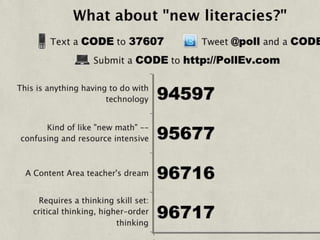
  • #26 Note: you have to go to presentation mode to see the polls initially. They will show up if you are connected to the Internet.POLL Everywhere Text: What about New Literacies? (This is anything having to do with technology, kind of like “new math” – confusing and resource intensive, A content area teacher’s dream; Requires a thinking skill set: critical thinking, higher-order thinking)Press F5 or enter presentation mode to view the poll\r\nIn an emergency during your presentation, if the poll isn't showing, navigate to this link in your web browser:\r\nhttp://www.polleverywhere.com/multiple_choice_polls/LTIxMjQ3OTE2MDQIf you like, you can use this slide as a template for your own voting slides. You might use a slide like this if you feel your audience would benefit from the picture showing a text message on a phone.
  • #30 Note: you have to go to presentation mode to see the polls initially. They will show up if you are connected to the Internet.POLL Everywhere Text: If you would like more information about today’s presentation, please text your name and email address.Press F5 or enter presentation mode to view the poll\r\nIn an emergency during your presentation, if the poll isn't showing, navigate to this link in your web browser:\r\nhttp://www.polleverywhere.com/free_text_polls/Mjc3Nzk5NTE3If you like, you can use this slide as a template for your own voting slides. You might use a slide like this if you feel your audience would benefit from the picture showing a text message on a phone.