COPYRIGHT LITERACY:
FINDINGS FROM A
PHENOMENOGRAPHIC STUDY
@UKCopyrightLit https://copyrightliteracy.org
@cbowiemorrison
c.morrison@kent.ac.uk
LILAC Conference 2017
Jane Secker,
LSE / City University
of London
Chris Morrison,
University of Kent
@jsecker
HOW DOES COPYRIGHT
MAKE YOU FEEL?
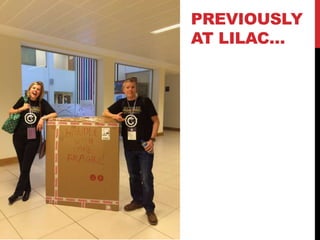
PREVIOUSLY
AT LILAC…
THE UK COPYRIGHT
LITERACY SURVEY
Survey was undertaken in 10
additional countries (around
world)
Undertaken in December 2014
Responses from over 600
professionals
OUR SURVEY SAID….
UK compared
favourably to other
countries in terms of
copyright literacy
57% of UK librarians
moderately or
extremely confident
about copyright
matters
76% thought having
a copyright policy is
important and 63%
have one
64% of institutions
had a copyright
officer (higher in HE)
Copyright was a
source of anxiety
and professional
development
needed
UNDERSTANDING COPYRIGHT
EXPERIENCES
Gathering
additional
qualitative data
Three group
interviews with
academic librarians
Exploring variations
in the way
copyright is
experienced
Implications for
copyright education
and institutional
strategies
PHENOMENOGRAPHY
©
©
PHENOMENOGRAPHY
• A qualitative research method from education
used increasingly in information literacy
research
• Based on Marton’s Variation theory as a way of
underpinning learning
• Asks open questions designed to ask what
people do not why
• Presents categories of description in an
outcome space
©
©
HOW DOES COPYRIGHT MAKE
YOU FEEL?
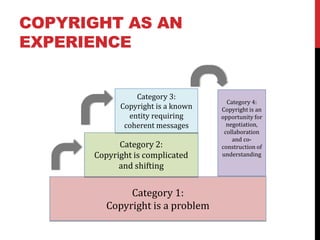
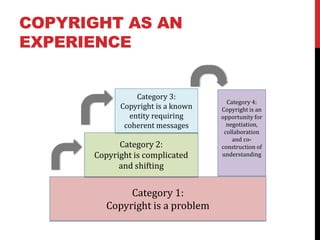
COPYRIGHT AS AN
EXPERIENCE
Category 4:
Copyright is an
opportunity for
negotiation,
collaboration
and co-
construction of
understanding
Category 1:
Copyright is a problem
Category 2:
Copyright is complicated
and shifting
Category 3:
Copyright is a known
entity requiring
coherent messages
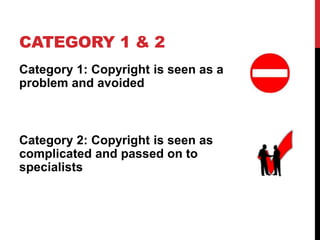
CATEGORY 1 & 2
Category 1: Copyright is seen as a
problem and avoided
Category 2: Copyright is seen as
complicated and passed on to
specialists
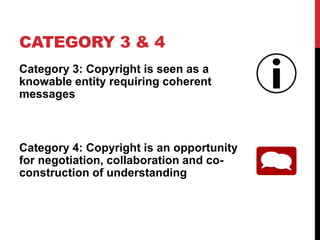
CATEGORY 3 & 4
Category 3: Copyright is seen as a
knowable entity requiring coherent
messages
Category 4: Copyright is an opportunity
for negotiation, collaboration and co-
construction of understanding
COPYRIGHT AS AN
EXPERIENCE
Category 4:
Copyright is an
opportunity for
negotiation,
collaboration
and co-
construction of
understanding
Category 1:
Copyright is a problem
Category 2:
Copyright is complicated
and shifting
Category 3:
Copyright is a known
entity requiring
coherent messages
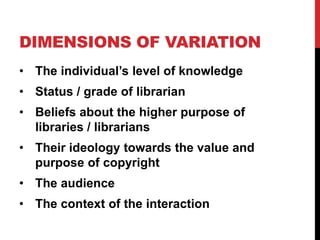
DIMENSIONS OF VARIATION
• The individual’s level of knowledge
• Status / grade of librarian
• Beliefs about the higher purpose of
libraries / librarians
• Their ideology towards the value and
purpose of copyright
• The audience
• The context of the interaction
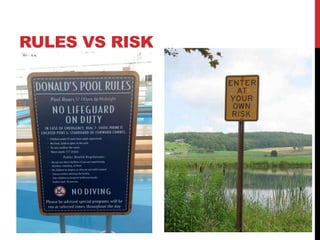
RULES VS RISK
RULES VS RISK
Everyone stand up – sit down if you’ve never done the following:
• Copy and pasted images off the internet for use in a
conference presentation
• Copy and pasted images off the internet for use in a
conference presentation which is being recorded and going
online
• Used a YouTube clip in teaching that was from a questionable
source (and therefore might be infringing)
• Shared an article with a colleague on Dropbox for research
purposes
• Used SciHub or similar ‘unofficial’ academic filesharing site
SO WHAT ARE WE
GOING TO DO?
¯_(ツ)_/¯
RETHINKING COPYRIGHT
EDUCATION FOR LIBRARIANS
• Bridging the gap between a one day course and a PG
Diploma in copyright law
• Focusing on what librarians need to know about copyright
• Focusing on their role a copyright educators
COMMUNITIES OF PRACTICE
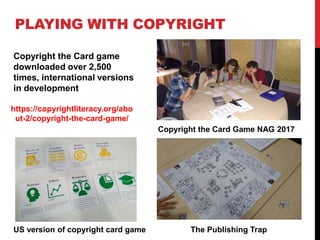
Copyright the Card game
downloaded over 2,500
times, international versions
in development
PLAYING WITH COPYRIGHT
https://copyrightliteracy.org/abo
ut-2/copyright-the-card-game/
The Publishing TrapUS version of copyright card game
Copyright the Card Game NAG 2017
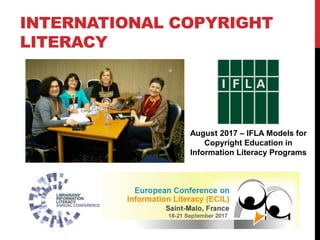
INTERNATIONAL COPYRIGHT
LITERACY
August 2017 – IFLA Models for
Copyright Education in
Information Literacy Programs
FURTHER READING
Morrison, C and Secker J. (2015) Copyright Literacy in the UK: a survey of
librarians and other cultural heritage sector professionals. Library and Information
Research. 39 (121)
http://www.lirgjournal.org.uk/lir/ojs/index.php/lir/article/view/675
Morrison, C and Secker, J (2016) Exceptions for libraries. Copyrightuser.org.
Available online.
Morrison, C and Secker, J. (2016) A Guide to Copyright. Association of University
Administrators.
Rios-Amaya, Juliana, Secker, Jane and Morrison, Chris (2016) Lecture recording in
higher education: risky business or evolving open practice. LSE / University of
Kent, London, UK. http://eprints.lse.ac.uk/68275/
Secker, J and Morrison, C. (2016) Copyright and E-learning: a guide for
practitioners. Facet publishing: London. Chapter 6: Copyright education and
training available online.
Todorova, T., Trencheva, T., Kurbanoğlu, S., Dogan G., & Horvat, A. (2014) A
Multinational Study on Copyright Literacy Competencies of LIS Professionals.
Presentation given at 2nd European Conference on Information Literacy (ECIL) held
in Dubrovnik. October 2014. Retrieved March 13, 2015 from
http://ecil2014.ilconf.org/wp-content/uploads/2014/11/Todorova.pdf
https://copyrightliteracy.org @UKCopyrightLit
CREDITS
Slide 2, 5, 6, 8, 9: Open Clipart (Openclipart.com)
Slide 3: Photo by Claire McAvinia taken at LILAC 2016
Slide 13: Logos from CILIP and Information Literacy Group
Slide 14, 5, 16 & 18 by Jane Secker / Chris Morrison licensed
under CC-BY. Logos copyright of IFLA, ECIL and LILAC

Copyright literacy: findings from a phenomenographic study

  • 1.
    COPYRIGHT LITERACY: FINDINGS FROMA PHENOMENOGRAPHIC STUDY @UKCopyrightLit https://copyrightliteracy.org @cbowiemorrison c.morrison@kent.ac.uk LILAC Conference 2017 Jane Secker, LSE / City University of London Chris Morrison, University of Kent @jsecker
  • 2.
  • 3.
  • 4.
    THE UK COPYRIGHT LITERACYSURVEY Survey was undertaken in 10 additional countries (around world) Undertaken in December 2014 Responses from over 600 professionals
  • 5.
    OUR SURVEY SAID…. UKcompared favourably to other countries in terms of copyright literacy 57% of UK librarians moderately or extremely confident about copyright matters 76% thought having a copyright policy is important and 63% have one 64% of institutions had a copyright officer (higher in HE) Copyright was a source of anxiety and professional development needed
  • 6.
    UNDERSTANDING COPYRIGHT EXPERIENCES Gathering additional qualitative data Threegroup interviews with academic librarians Exploring variations in the way copyright is experienced Implications for copyright education and institutional strategies
  • 7.
  • 8.
    PHENOMENOGRAPHY • A qualitativeresearch method from education used increasingly in information literacy research • Based on Marton’s Variation theory as a way of underpinning learning • Asks open questions designed to ask what people do not why • Presents categories of description in an outcome space © ©
  • 9.
    HOW DOES COPYRIGHTMAKE YOU FEEL?
  • 10.
    COPYRIGHT AS AN EXPERIENCE Category4: Copyright is an opportunity for negotiation, collaboration and co- construction of understanding Category 1: Copyright is a problem Category 2: Copyright is complicated and shifting Category 3: Copyright is a known entity requiring coherent messages
  • 11.
    CATEGORY 1 &2 Category 1: Copyright is seen as a problem and avoided Category 2: Copyright is seen as complicated and passed on to specialists
  • 12.
    CATEGORY 3 &4 Category 3: Copyright is seen as a knowable entity requiring coherent messages Category 4: Copyright is an opportunity for negotiation, collaboration and co- construction of understanding
  • 13.
    COPYRIGHT AS AN EXPERIENCE Category4: Copyright is an opportunity for negotiation, collaboration and co- construction of understanding Category 1: Copyright is a problem Category 2: Copyright is complicated and shifting Category 3: Copyright is a known entity requiring coherent messages
  • 14.
    DIMENSIONS OF VARIATION •The individual’s level of knowledge • Status / grade of librarian • Beliefs about the higher purpose of libraries / librarians • Their ideology towards the value and purpose of copyright • The audience • The context of the interaction
  • 15.
  • 16.
    RULES VS RISK Everyonestand up – sit down if you’ve never done the following: • Copy and pasted images off the internet for use in a conference presentation • Copy and pasted images off the internet for use in a conference presentation which is being recorded and going online • Used a YouTube clip in teaching that was from a questionable source (and therefore might be infringing) • Shared an article with a colleague on Dropbox for research purposes • Used SciHub or similar ‘unofficial’ academic filesharing site
  • 17.
    SO WHAT AREWE GOING TO DO? ¯_(ツ)_/¯
  • 18.
    RETHINKING COPYRIGHT EDUCATION FORLIBRARIANS • Bridging the gap between a one day course and a PG Diploma in copyright law • Focusing on what librarians need to know about copyright • Focusing on their role a copyright educators
  • 19.
  • 20.
    Copyright the Cardgame downloaded over 2,500 times, international versions in development PLAYING WITH COPYRIGHT https://copyrightliteracy.org/abo ut-2/copyright-the-card-game/ The Publishing TrapUS version of copyright card game Copyright the Card Game NAG 2017
  • 21.
    INTERNATIONAL COPYRIGHT LITERACY August 2017– IFLA Models for Copyright Education in Information Literacy Programs
  • 22.
    FURTHER READING Morrison, Cand Secker J. (2015) Copyright Literacy in the UK: a survey of librarians and other cultural heritage sector professionals. Library and Information Research. 39 (121) http://www.lirgjournal.org.uk/lir/ojs/index.php/lir/article/view/675 Morrison, C and Secker, J (2016) Exceptions for libraries. Copyrightuser.org. Available online. Morrison, C and Secker, J. (2016) A Guide to Copyright. Association of University Administrators. Rios-Amaya, Juliana, Secker, Jane and Morrison, Chris (2016) Lecture recording in higher education: risky business or evolving open practice. LSE / University of Kent, London, UK. http://eprints.lse.ac.uk/68275/ Secker, J and Morrison, C. (2016) Copyright and E-learning: a guide for practitioners. Facet publishing: London. Chapter 6: Copyright education and training available online. Todorova, T., Trencheva, T., Kurbanoğlu, S., Dogan G., & Horvat, A. (2014) A Multinational Study on Copyright Literacy Competencies of LIS Professionals. Presentation given at 2nd European Conference on Information Literacy (ECIL) held in Dubrovnik. October 2014. Retrieved March 13, 2015 from http://ecil2014.ilconf.org/wp-content/uploads/2014/11/Todorova.pdf https://copyrightliteracy.org @UKCopyrightLit
  • 23.
    CREDITS Slide 2, 5,6, 8, 9: Open Clipart (Openclipart.com) Slide 3: Photo by Claire McAvinia taken at LILAC 2016 Slide 13: Logos from CILIP and Information Literacy Group Slide 14, 5, 16 & 18 by Jane Secker / Chris Morrison licensed under CC-BY. Logos copyright of IFLA, ECIL and LILAC

Editor's Notes

  • #3 Get image of a paper aeroplane and a scrunched up piece of paper. We can take this ourselves. Chris will run through what we want them to do and potentially give out a prize. Could ask them to draw a picture on one side which will allow identification and on the other saying how it makes them feel.
  • #4 Jane to do recap on the research and what we presented last year.
  • #5 Jane to slide 3 Timings Introduction slides 1-3 Jane – 5 mins Play your cards right slides 4-21 – Chris ( 12 mins?) Survey findings 22-30 – Jane (10 mins) Phenomenography – 31-33 – Jane (5 mins) Phenomenography and parallels to IL – 34-36 – Chris (5 mins) Wrap up with what we are doing – 37-40 Chris and Jane (3 mins)
  • #7 Chris
  • #9 Jane to present the key concepts of what phenomenography is and what it’s purpose is.
  • #10 Chris
  • #11 This are the categories as they are emerging at the moment
  • #14 This are the categories as they are emerging at the moment
  • #21 Picture of Paul’s cards from the US
  • #23 Add lecture recording survey details – if people are interested then we can pull up the presentation.
  • #24 Jane to add something here.