Supporting undergraduates of the future: developing a new curriculum for  information literacy Dr Jane Secker & Dr Emma Coonan
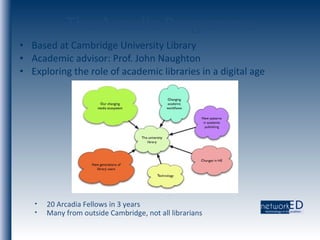
The Arcadia Programme Based at Cambridge University Library Academic advisor: Prof. John Naughton Exploring the role of academic libraries in a digital age 20 Arcadia Fellows in 3 years Many from outside Cambridge, not all librarians
Our research remit: Develop a new, revolutionary curriculum for information literacy in a digital age
Aims: in 10 weeks Understand the needs of undergraduates entering HE over the coming 5 years Map the current landscape of information literacy Develop practical curriculum and supporting resources
Method Modified Delphi study  means of obtaining expert future forecasting consulted widely in the fields of information and education Literature review theoretical overview of the field revealed conflicts in terminology, pedagogic approach, values Expert workshop method, findings and preliminary curriculum presented  curriculum refined in light of feedback
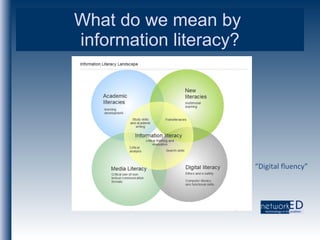
What do we mean by  information literacy? “ Digital fluency”
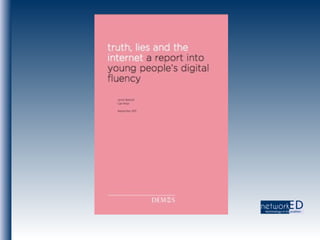
Theoretical background Transition to independent learning ‘ Academic’ vs. ‘support’ elements The cloistered garden and the labyrinth Demos report: ‘Truth, lies and the internet’
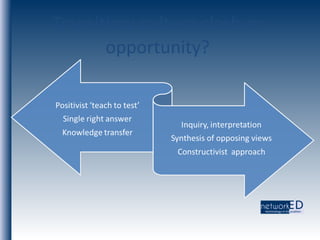
Transition: culture clash or opportunity?
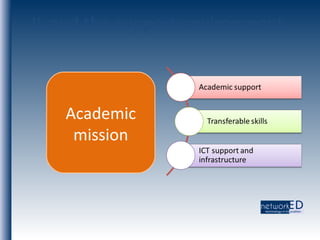
IL and the support environment Academic mission
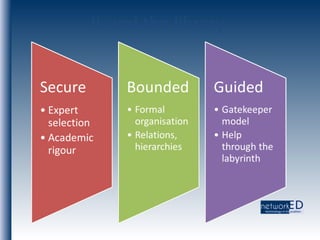
IL and the library
 
Rehabilitating information literacy IL is: a continuum of skills, abilities, values and attitudes around analysing, evaluating, managing and assimilating information fundamental to the ongoing development of the individual, social as well as academic IL is not: seen as part of the mainstream academic mission merely functional/technological skills  the preserve or saviour of the library
“ Information literacy empowers people in all walks of life to seek, evaluate, use and create information effectively to achieve their personal, social, occupational and educational goals.  “ It is a basic human right in a digital world and promotes social inclusion in all nations.”  UNESCO (2005) Alexandria Proclamation
The expert consultation Consulted librarians, researchers, educators, trainee teachers, school librarians How you teach at least as important as what you teach Must be embedded into the academic curriculum and disciplines will vary Must be based on real needs: students are not homogeneous Must be opportunities for reflection
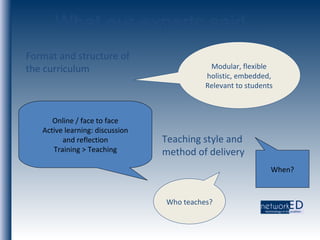
What our experts said… Modular, flexible holistic, embedded, Relevant to students Format and structure of the curriculum Online / face to face Active learning: discussion and reflection Training > Teaching Teaching style and method of delivery Who teaches? When?
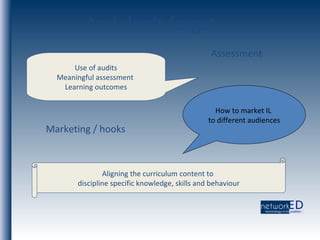
And don’t forget…. Use of audits Meaningful assessment  Learning outcomes How to market IL  to different audiences Assessment Marketing / hooks Aligning the curriculum content to  discipline specific knowledge, skills and behaviour
Technology in the curriculum No need to teach specific tools and software as curriculum needs to evolve but … Assumptions around technology Ownership or access to computers Ownership or access to mobile technology Google generation assumption Greater use of cloud computing Great use of social media - combating the filter bubble
Our key curriculum attributes Holistic – supporting the whole research process Modular – ongoing ‘building blocks’ forming a learning spiral Embedded within the context of the academic discipline Flexible – not tied to a specific staff role Active and assessed – including peer assessment Transitional : Transferable : Transformational
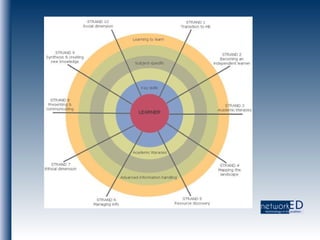
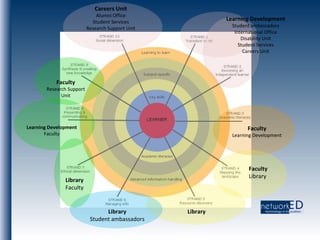
Curriculum strands Transition from school to higher education Becoming an independent learner Developing academic literacies Mapping and evaluating the information landscape  Resource discovery in your discipline  Managing information Ethical dimension of information  Presenting and communicating knowledge  Synthesising information and creating new knowledge Social dimension of information literacy
Using the curriculum The strands cover 5 broad learning categories, from functional skills up to high-level intellectual operations Classes can incorporate multiple strands at the same level Classes should be active, reflective, relevant to student need You could use the curriculum to audit your own (or your department’s) teaching provision
 
Unpacking the curriculum Strand 1:  Transition from school to HE What are the expectations at higher education level in your discipline? What are the conventions around reading, writing and presenting at HE level in your discipline? Reflect on your current and previous information behaviour and consider what’s different Activities might include:  Reviewing HE level work and discussing differences with prior work at school Exploring academic journals and how they differ from more popular publications such as  History Today  or  New Scientist Students identify top 3 current information sources and evaluate fitness for purpose
Strand 6: Managing Information Note-taking Time management and planning Storing information effectively Bibliographic and reference management Push services / alerting / ways of keeping up to date Activities might include:  Listen to short podcast and make 1) a full transcript, and 2) note salient points – reflect on both and when you might use them Create a plan including deadlines and a realistic time frame for your next piece of assessed work Explore cloud storage tools and discuss the merits of remote vs local storage Explore free and paid for reference management software – ideally peer-led
ANCIL outputs, July 2011 Executive summary The curriculum and supporting documents ‘ Teaching learning: perceptions of information literacy‘ (theoretical background) Expert consultation report Free to download at  http:// newcurriculum.wordpress.com /
Next steps, October - December 2011 ‘ Strategies for implementing the  Curriculum for Information Literacy’  Dr Helen Webster & Katy Wrathall Arcadia Fellows, Oct-Dec 2011 http://arcadiaproject.lib.cam.ac.uk/projects/strategies-for-implementation.html
Careers Unit Alumni Office Student Services Research Support Unit Faculty Learning Development Learning Development Student ambassadors International Office Disability Unit Student Services Careers Unit Faculty Library Library Library Student ambassadors Library Faculty Learning Development Faculty Faculty Research Support Unit
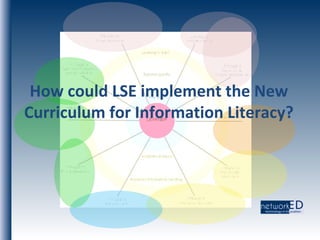
How could LSE implement the New Curriculum for Information Literacy?
Thank you Image:  ‘Tulip staircase at the Queens House, Greenwich’  by  mcginnly, flickr.com

NetworkEd2011

  • 1.
    Supporting undergraduates ofthe future: developing a new curriculum for information literacy Dr Jane Secker & Dr Emma Coonan
  • 2.
    The Arcadia ProgrammeBased at Cambridge University Library Academic advisor: Prof. John Naughton Exploring the role of academic libraries in a digital age 20 Arcadia Fellows in 3 years Many from outside Cambridge, not all librarians
  • 3.
    Our research remit:Develop a new, revolutionary curriculum for information literacy in a digital age
  • 4.
    Aims: in 10weeks Understand the needs of undergraduates entering HE over the coming 5 years Map the current landscape of information literacy Develop practical curriculum and supporting resources
  • 5.
    Method Modified Delphistudy means of obtaining expert future forecasting consulted widely in the fields of information and education Literature review theoretical overview of the field revealed conflicts in terminology, pedagogic approach, values Expert workshop method, findings and preliminary curriculum presented curriculum refined in light of feedback
  • 6.
    What do wemean by information literacy? “ Digital fluency”
  • 7.
    Theoretical background Transitionto independent learning ‘ Academic’ vs. ‘support’ elements The cloistered garden and the labyrinth Demos report: ‘Truth, lies and the internet’
  • 8.
  • 9.
    IL and thesupport environment Academic mission
  • 10.
    IL and thelibrary
  • 11.
  • 12.
    Rehabilitating information literacyIL is: a continuum of skills, abilities, values and attitudes around analysing, evaluating, managing and assimilating information fundamental to the ongoing development of the individual, social as well as academic IL is not: seen as part of the mainstream academic mission merely functional/technological skills the preserve or saviour of the library
  • 13.
    “ Information literacyempowers people in all walks of life to seek, evaluate, use and create information effectively to achieve their personal, social, occupational and educational goals. “ It is a basic human right in a digital world and promotes social inclusion in all nations.” UNESCO (2005) Alexandria Proclamation
  • 14.
    The expert consultationConsulted librarians, researchers, educators, trainee teachers, school librarians How you teach at least as important as what you teach Must be embedded into the academic curriculum and disciplines will vary Must be based on real needs: students are not homogeneous Must be opportunities for reflection
  • 15.
    What our expertssaid… Modular, flexible holistic, embedded, Relevant to students Format and structure of the curriculum Online / face to face Active learning: discussion and reflection Training > Teaching Teaching style and method of delivery Who teaches? When?
  • 16.
    And don’t forget….Use of audits Meaningful assessment Learning outcomes How to market IL to different audiences Assessment Marketing / hooks Aligning the curriculum content to discipline specific knowledge, skills and behaviour
  • 17.
    Technology in thecurriculum No need to teach specific tools and software as curriculum needs to evolve but … Assumptions around technology Ownership or access to computers Ownership or access to mobile technology Google generation assumption Greater use of cloud computing Great use of social media - combating the filter bubble
  • 18.
    Our key curriculumattributes Holistic – supporting the whole research process Modular – ongoing ‘building blocks’ forming a learning spiral Embedded within the context of the academic discipline Flexible – not tied to a specific staff role Active and assessed – including peer assessment Transitional : Transferable : Transformational
  • 19.
    Curriculum strands Transitionfrom school to higher education Becoming an independent learner Developing academic literacies Mapping and evaluating the information landscape Resource discovery in your discipline Managing information Ethical dimension of information Presenting and communicating knowledge Synthesising information and creating new knowledge Social dimension of information literacy
  • 20.
    Using the curriculumThe strands cover 5 broad learning categories, from functional skills up to high-level intellectual operations Classes can incorporate multiple strands at the same level Classes should be active, reflective, relevant to student need You could use the curriculum to audit your own (or your department’s) teaching provision
  • 21.
  • 22.
    Unpacking the curriculumStrand 1: Transition from school to HE What are the expectations at higher education level in your discipline? What are the conventions around reading, writing and presenting at HE level in your discipline? Reflect on your current and previous information behaviour and consider what’s different Activities might include: Reviewing HE level work and discussing differences with prior work at school Exploring academic journals and how they differ from more popular publications such as History Today or New Scientist Students identify top 3 current information sources and evaluate fitness for purpose
  • 23.
    Strand 6: ManagingInformation Note-taking Time management and planning Storing information effectively Bibliographic and reference management Push services / alerting / ways of keeping up to date Activities might include: Listen to short podcast and make 1) a full transcript, and 2) note salient points – reflect on both and when you might use them Create a plan including deadlines and a realistic time frame for your next piece of assessed work Explore cloud storage tools and discuss the merits of remote vs local storage Explore free and paid for reference management software – ideally peer-led
  • 24.
    ANCIL outputs, July2011 Executive summary The curriculum and supporting documents ‘ Teaching learning: perceptions of information literacy‘ (theoretical background) Expert consultation report Free to download at http:// newcurriculum.wordpress.com /
  • 25.
    Next steps, October- December 2011 ‘ Strategies for implementing the Curriculum for Information Literacy’ Dr Helen Webster & Katy Wrathall Arcadia Fellows, Oct-Dec 2011 http://arcadiaproject.lib.cam.ac.uk/projects/strategies-for-implementation.html
  • 26.
    Careers Unit AlumniOffice Student Services Research Support Unit Faculty Learning Development Learning Development Student ambassadors International Office Disability Unit Student Services Careers Unit Faculty Library Library Library Student ambassadors Library Faculty Learning Development Faculty Faculty Research Support Unit
  • 27.
    How could LSEimplement the New Curriculum for Information Literacy?
  • 28.
    Thank you Image: ‘Tulip staircase at the Queens House, Greenwich’ by mcginnly, flickr.com

Editor's Notes

  • #3 Jane
  • #4 Jane
  • #5 Jane
  • #6 Jane Modified Delphi approach (used in forecasting the future) - consultation with experts in the education and information fields via e-mail questionnaire and interviews Including trainee teachers, school librarians, academic librarians, educational technologists and others Literature review Developing a curriculum plus various supporting resources Examples of best practice Evidence toolkit Mapping of curriculum to SCONUL 7 pillars Preliminary findings presented at workshop
  • #9 Students entering HE often confront a radical change of learning culture and one which is not always explicitly explained or supported. Many will have experienced school learning as discrete chunks of information communicated by instruction and tested by means of memorisation and repetition, rewarding rote answers – and ‘right’ answers. Suddenly the goalposts have changed and they are in an environment that rewards a totally different approach – one that is interpretative, questioning, analytical and which places value and emphasis on qualities like ‘finding one’s voice’ and ‘critical analysis’. Solutions are too often directed *outside* of mainstream academic practice – to ‘support services’ like learning development or study skills, or when it goes really wrong, to counselling. This incredibly rich opportunity to help our students discover how they learn and give them a chance to reflect on their own academic practice is thrown away – instead it is made into a ‘problem’ with the student that needs to be ‘fixed’. What could be reflective is made remedial.
  • #10 Scattered provision: where does IL ‘sit’, and what happens when it is placed in the ‘support’ environment? Confusion between IL and ICT is often bolstered by institutions with converged services which place IL provision in this arena. This reduces IL to merely accessing and organising information, and emphases tool and skill mastery (replication) rather than learner-developed transferable strategies (iterative and evolving). It’s important to stress that for us, digital literacy or fluency is a component of information literacy. ACRL 2000 – IL abilities “use technologies but are ultimately independent of them”. Linking IL with transferable skills for graduate employability and with academic support services such as Disability Unit, Counselling, even Learning Development, can on one hand give IL greater visibility – but it runs the risk of producing a generic and extraneous focus and being seen as separate from or supplementary to the academic mission.
  • #11 The academic perception of information handling hinges on individual endeavour and insight. Working with knowledge is conceived as an intellectual operation. In contrast the library perception of information is predominantly systematic – scholarly knowledge is seen as a corpus of data to be stored, ordered, retrieved and filtered and in this way made manageable and meaningful. It’s therefore also bounded: selected and curated by professionals according to professional principles. These principles can be difficult for outsiders (even in academia) to grasp, so we are here to guide them through. The library in the digital age is a kind of cloistered, secure garden – but an information literate approach will probably not restrict itself to resources available via the library. Yet the debate around reliability and trust has tended to polarise around the opposition of library vs. open web sources. Put this together with the focus on system – which gives rise to an emphasis on interfaces and products, and it results in a mistaken identification of IL with the preselected library tools and resources. “They don’t know how to use that database properly so they can’t be information literate” – Moira Bent, 2008. IL is not the same as bibliographic instruction, nor the same as ‘library instruction’. Another issue is that library models and theories of library instruction tend to place a major emphasis on searching, remaining aloof from higher-order intellectual operations involved in the research process – for example, evaluation, hypothesis formulation, academic writing and presentation, synthesis. But the researcher doesn’t make this distinction. It’s about completing a task in a given context and being equipped with the necessary competences, attitudes, and discipline-specific strengths to perform an interative exploratory activity that both informs and is informed by the learner’s perception of the topic at any given point. Breaking down the dynamic evolution of the search and research process imposes a distorted and linear-sequential perception of the activity. By conflating IL with the functional skill of searching (without evaluating) it also reinforces the perception of IL as a separate, supplementary, bolt-on skillset that can be taught outside the academic curriculum. Ultimately, my belief is that HE librarians are not here to try to give students and researchers directions out of the labyrinth, or indeed ‘answers’ of any kind, but to encourage the generation of questions that challenge and expand existing knowledge and our existing knowledge structures.
  • #12 The 2011 Demos report argues that helping young people navigate hugely variable Internet sources should be achieved not by tighter controls but by ensuring they can make informed judgements (4). The digital world is not alien – offline critical thinking skills remain relevant in the online setting (9). The move towards independent learning is again key not just to our practices but in our thinking – we should think less about the internet causing harm (passive learning model) and instead focus on what young people bring to the technologies – helping them equip and empower themselves with an understanding of how to apply critical judgement. The Demos report also touches on a general human issue around information – its emotional impact and its close links with our identities. We tend to search for evidence that supports our beliefs, not refutes them; we notice more flaws in studies that conflict with our beliefs (23). This is the rationale behind our strand 10, which reaches beyond the higher education arena into the social dimension of information literacy.
  • #13 Emma
  • #14 Emma
  • #16 Jane
  • #17 Jane
  • #18 Jane
  • #19 Emma holistic: supporting the whole process of researching and writing rather than just teaching traditional library skills modular: ongoing classes to meet the developing needs of students during their whole academic career, not just one-shot sessions embedded and flexible: can be implemented and taught not only by librarians but by study skills advisors, learning developers, supervisors and lecturers (depending on the needs and structure of the institution) active and assessed: containing a significant element of active and reflective learning, including peer assessment elements, in order to help students develop into informed and autonomous learners Transitional Transferable Transformational Transition occurs in learners, who enter university from a wide variety of backgrounds, but often need to make the transition from school to higher education. They also have to make the transition from dependent to autonomous learning. The curriculum content needs to be transferable, forming a part of education, not simply ‘library training.’ Information literacy fosters and develops appropriatebehaviour, approaches, cognitive functions and skills surrounding the use of information. In essence information literacy equips students with the capacity to generate their own strategies for dealing with new information contexts, for example when they leave higher education and enter the workplace. Finally, information literacy should be transformational for the learner, changing their attitude, behaviour, outlook and even their world-view. Therefore this curriculum has the potential to change lives and make a real difference to society.
  • #20 Emma The strands reflect the areas identified by our expert panelists and that arose in our own discussions and research. These are the themes that we believe constitute information literacy in its proper sense, as the foundation of lifelong learning as well as the ability to discern and evaluate in specific contexts such as academic scholarship.
  • #21 Emma
  • #22 Emma
  • #23 Jane?
  • #24 Jane?
  • #27 How MIGHT it work – in a fictional HEI?
  • #28 And how might it work at LSE or your institution?