Creative and Collaborative
Approaches to Copyright Literacy:
experiences from the UK
Jane Secker and Chris Morrison
City, University of London
& University of Kent
ECIL 2017: 18-22 September, St Malo, France
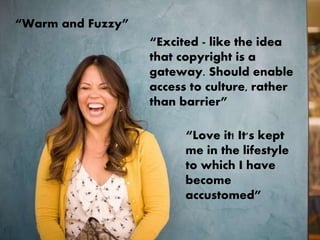
“Excited - like the idea
that copyright is a
gateway. Should enable
access to culture, rather
than barrier”
“Warm and Fuzzy”
“Love it! It's kept
me in the lifestyle
to which I have
become
accustomed”
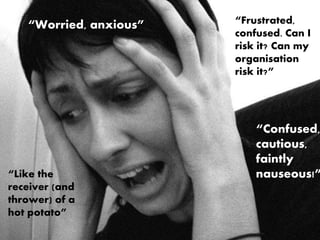
“Confused,
cautious,
faintly
nauseous!”
“Frustrated,
confused. Can I
risk it? Can my
organisation
risk it?”
“Worried, anxious”
“Like the
receiver (and
thrower) of a
hot potato”
Copyright literacy is….
“acquiring and demonstrating the
appropriate knowledge, skills and
behaviours to enable the ethical
creation and use of copyright
material.”
Secker and Morrison, 2016, p.211
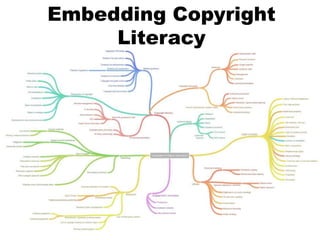
• Slide to illustrate the key is embedding
copyright literacy throughout our institutions
• Institution logo from the Publishing Trap with
copyright literacy logo?
Embedding Copyright
Literacy
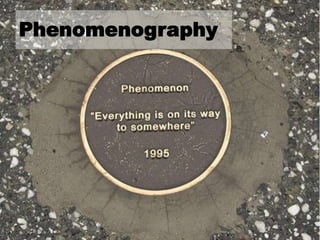
Phenomenography
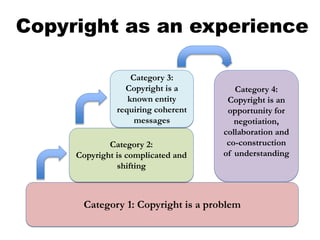
Copyright as an experience
Category 4:
Copyright is an
opportunity for
negotiation,
collaboration and
co-construction
of understanding
Category 1: Copyright is a problem
Category 2:
Copyright is complicated and
shifting
Category 3:
Copyright is a
known entity
requiring coherent
messages
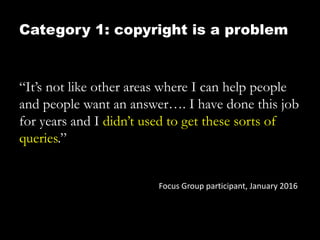
Category 1: copyright is a problem
“It’s not like other areas where I can help people
and people want an answer…. I have done this job
for years and I didn’t used to get these sorts of
queries.”
Focus Group participant, January 2016
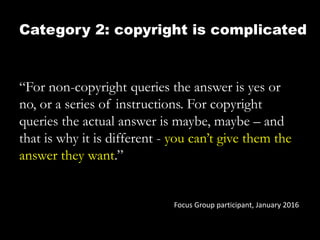
Category 2: copyright is complicated
“For non-copyright queries the answer is yes or
no, or a series of instructions. For copyright
queries the actual answer is maybe, maybe – and
that is why it is different - you can’t give them the
answer they want.”
Focus Group participant, January 2016
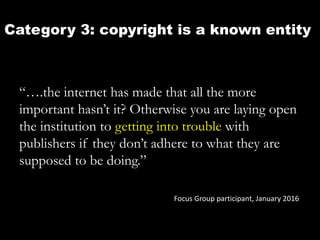
Category 3: copyright is a known entity
“….the internet has made that all the more
important hasn’t it? Otherwise you are laying open
the institution to getting into trouble with
publishers if they don’t adhere to what they are
supposed to be doing.”
Focus Group participant, January 2016
Category 4: copyright is an opportunity
“I always think when I am explaining [copyright]
to people I would like to be more aggressive … in
terms of these are our collections and we manage
them properly and in so doing so we might make
them openly available because it is within our gift
to do and no one is being affected if we put 100
year old census data online.”
Focus Group participant, January 2016
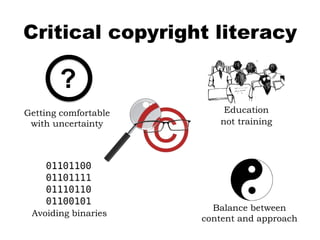
Critical copyright literacy
Education
not training
Balance between
content and approach
Getting comfortable
with uncertainty
Avoiding binaries
?
The role of the
copyright officer
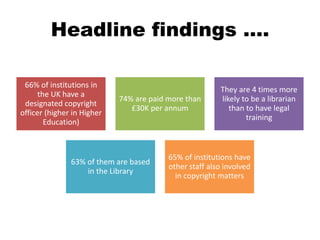
Headline findings ….
66% of institutions in
the UK have a
designated copyright
officer (higher in Higher
Education)
74% are paid more than
£30K per annum
They are 4 times more
likely to be a librarian
than to have legal
training
63% of them are based
in the Library
65% of institutions have
other staff also involved
in copyright matters
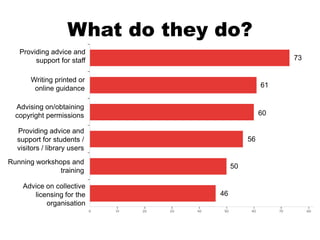
What do they do?
Providing advice and
support for staff
Writing printed or
online guidance
Advising on/obtaining
copyright permissions
Providing advice and
support for students /
visitors / library users
Running workshops and
training
Advice on collective
licensing for the
organisation
73
61
60
56
50
46
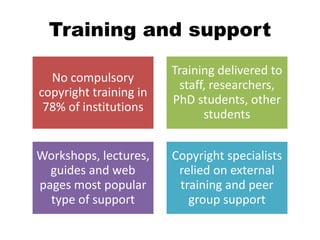
Training and support
No compulsory
copyright training in
78% of institutions
Training delivered to
staff, researchers,
PhD students, other
students
Workshops, lectures,
guides and web
pages most popular
type of support
Copyright specialists
relied on external
training and peer
group support
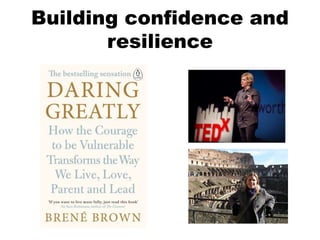
Building confidence and
resilience
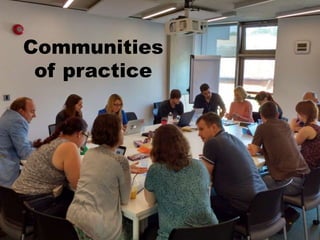
Communities
of practice
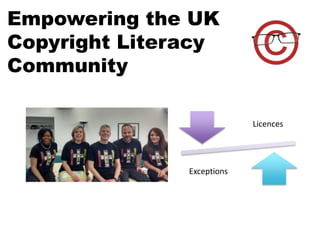
Empowering the UK
Copyright Literacy
Community
Licences
Exceptions
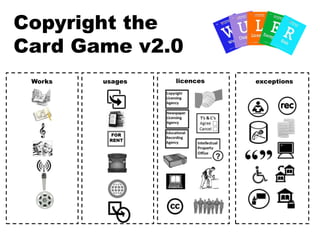
Copyright the
Card Game v2.0
Works usages licences exceptions
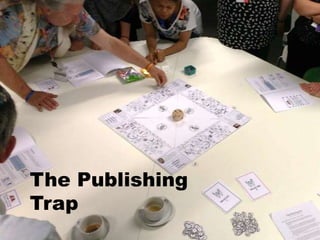
The Publishing
Trap
Further reading
Morrison, C and Secker J. (2015) Copyright Literacy in the UK: a survey of
librarians and other cultural heritage sector professionals. Library and
Information Research. 39 (121)
http://www.lirgjournal.org.uk/lir/ojs/index.php/lir/article/view/675
Morrison, C & Secker, J. (2017). Understanding librarians’ experiences of
copyright: findings from a phenomenographic study of UK information
professionals. Library Management, 38 (6/)
Secker, J and Morrison, C. (2016) Copyright and E-learning: a guide for practitioners.
Facet publishing: London. Chapter 6: Copyright education and training
available online.
Todorova, Tania et. al. (2017) Information Professionals and Copyright
Literacy: A Multinational Study. Library Management, 38 (6/7).
Todorova, T., Trencheva, T., Kurbanoğlu, S., Dogan G., & Horvat, A. (2014)
A Multinational Study on Copyright Literacy Competencies of LIS
Professionals. Presentation given at 2nd European Conference on Information
Literacy (ECIL) held in Dubrovnik. October 2014. Retrieved March 13, 2015
from http://ecil2014.ilconf.org/wp-content/uploads/2014/11/Todorova.pdf
https://copyrightliteracy.org @UKCopyrightLit
Image Credits
Slide 1, 2,, 19, 20, 23: Taken by Jane Secker / Chris Morrison CC-BY
Slide 3: Photo by Amber Litzinger https://flic.kr/p/bEXT6H CC-BY
Slide 4: Panic by Nate Stelner https://flic.kr/p/us2aa Public Domain
Slide 7: Phenomena by Nick Ares https://flic.kr/p/6m6uYA CC-BY
Slide 13: Critical Copyright Literacy: images from Open clipart
Slide 14: Lego police officer by Martin @pokipsie Rechsteiner
https://flic.kr/p/qmMDmS CC-BY
Slide 18: Brene Brown book cover / You Tube image all rights reserved. Photo of Jane
Secker in the Coliseum CC-BY
Slide 22: Copyright the Card Game at CILIP Wales Conference © Whole Picture used
with permission
Slide 24: Kitchener Wants You by Alfred Leete, modified by Chris Morrison

Creative and collaborative approaches to copyright education

  • 1.
    Creative and Collaborative Approachesto Copyright Literacy: experiences from the UK Jane Secker and Chris Morrison City, University of London & University of Kent ECIL 2017: 18-22 September, St Malo, France
  • 3.
    “Excited - likethe idea that copyright is a gateway. Should enable access to culture, rather than barrier” “Warm and Fuzzy” “Love it! It's kept me in the lifestyle to which I have become accustomed”
  • 4.
    “Confused, cautious, faintly nauseous!” “Frustrated, confused. Can I riskit? Can my organisation risk it?” “Worried, anxious” “Like the receiver (and thrower) of a hot potato”
  • 5.
    Copyright literacy is…. “acquiringand demonstrating the appropriate knowledge, skills and behaviours to enable the ethical creation and use of copyright material.” Secker and Morrison, 2016, p.211
  • 6.
    • Slide toillustrate the key is embedding copyright literacy throughout our institutions • Institution logo from the Publishing Trap with copyright literacy logo? Embedding Copyright Literacy
  • 7.
  • 8.
    Copyright as anexperience Category 4: Copyright is an opportunity for negotiation, collaboration and co-construction of understanding Category 1: Copyright is a problem Category 2: Copyright is complicated and shifting Category 3: Copyright is a known entity requiring coherent messages
  • 9.
    Category 1: copyrightis a problem “It’s not like other areas where I can help people and people want an answer…. I have done this job for years and I didn’t used to get these sorts of queries.” Focus Group participant, January 2016
  • 10.
    Category 2: copyrightis complicated “For non-copyright queries the answer is yes or no, or a series of instructions. For copyright queries the actual answer is maybe, maybe – and that is why it is different - you can’t give them the answer they want.” Focus Group participant, January 2016
  • 11.
    Category 3: copyrightis a known entity “….the internet has made that all the more important hasn’t it? Otherwise you are laying open the institution to getting into trouble with publishers if they don’t adhere to what they are supposed to be doing.” Focus Group participant, January 2016
  • 12.
    Category 4: copyrightis an opportunity “I always think when I am explaining [copyright] to people I would like to be more aggressive … in terms of these are our collections and we manage them properly and in so doing so we might make them openly available because it is within our gift to do and no one is being affected if we put 100 year old census data online.” Focus Group participant, January 2016
  • 13.
    Critical copyright literacy Education nottraining Balance between content and approach Getting comfortable with uncertainty Avoiding binaries ?
  • 14.
    The role ofthe copyright officer
  • 15.
    Headline findings …. 66%of institutions in the UK have a designated copyright officer (higher in Higher Education) 74% are paid more than £30K per annum They are 4 times more likely to be a librarian than to have legal training 63% of them are based in the Library 65% of institutions have other staff also involved in copyright matters
  • 16.
    What do theydo? Providing advice and support for staff Writing printed or online guidance Advising on/obtaining copyright permissions Providing advice and support for students / visitors / library users Running workshops and training Advice on collective licensing for the organisation 73 61 60 56 50 46
  • 17.
    Training and support Nocompulsory copyright training in 78% of institutions Training delivered to staff, researchers, PhD students, other students Workshops, lectures, guides and web pages most popular type of support Copyright specialists relied on external training and peer group support
  • 18.
  • 19.
  • 20.
    Empowering the UK CopyrightLiteracy Community Licences Exceptions
  • 21.
    Copyright the Card Gamev2.0 Works usages licences exceptions
  • 23.
  • 25.
    Further reading Morrison, Cand Secker J. (2015) Copyright Literacy in the UK: a survey of librarians and other cultural heritage sector professionals. Library and Information Research. 39 (121) http://www.lirgjournal.org.uk/lir/ojs/index.php/lir/article/view/675 Morrison, C & Secker, J. (2017). Understanding librarians’ experiences of copyright: findings from a phenomenographic study of UK information professionals. Library Management, 38 (6/) Secker, J and Morrison, C. (2016) Copyright and E-learning: a guide for practitioners. Facet publishing: London. Chapter 6: Copyright education and training available online. Todorova, Tania et. al. (2017) Information Professionals and Copyright Literacy: A Multinational Study. Library Management, 38 (6/7). Todorova, T., Trencheva, T., Kurbanoğlu, S., Dogan G., & Horvat, A. (2014) A Multinational Study on Copyright Literacy Competencies of LIS Professionals. Presentation given at 2nd European Conference on Information Literacy (ECIL) held in Dubrovnik. October 2014. Retrieved March 13, 2015 from http://ecil2014.ilconf.org/wp-content/uploads/2014/11/Todorova.pdf https://copyrightliteracy.org @UKCopyrightLit
  • 26.
    Image Credits Slide 1,2,, 19, 20, 23: Taken by Jane Secker / Chris Morrison CC-BY Slide 3: Photo by Amber Litzinger https://flic.kr/p/bEXT6H CC-BY Slide 4: Panic by Nate Stelner https://flic.kr/p/us2aa Public Domain Slide 7: Phenomena by Nick Ares https://flic.kr/p/6m6uYA CC-BY Slide 13: Critical Copyright Literacy: images from Open clipart Slide 14: Lego police officer by Martin @pokipsie Rechsteiner https://flic.kr/p/qmMDmS CC-BY Slide 18: Brene Brown book cover / You Tube image all rights reserved. Photo of Jane Secker in the Coliseum CC-BY Slide 22: Copyright the Card Game at CILIP Wales Conference © Whole Picture used with permission Slide 24: Kitchener Wants You by Alfred Leete, modified by Chris Morrison

Editor's Notes

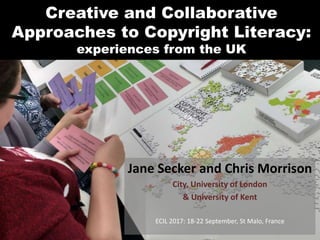
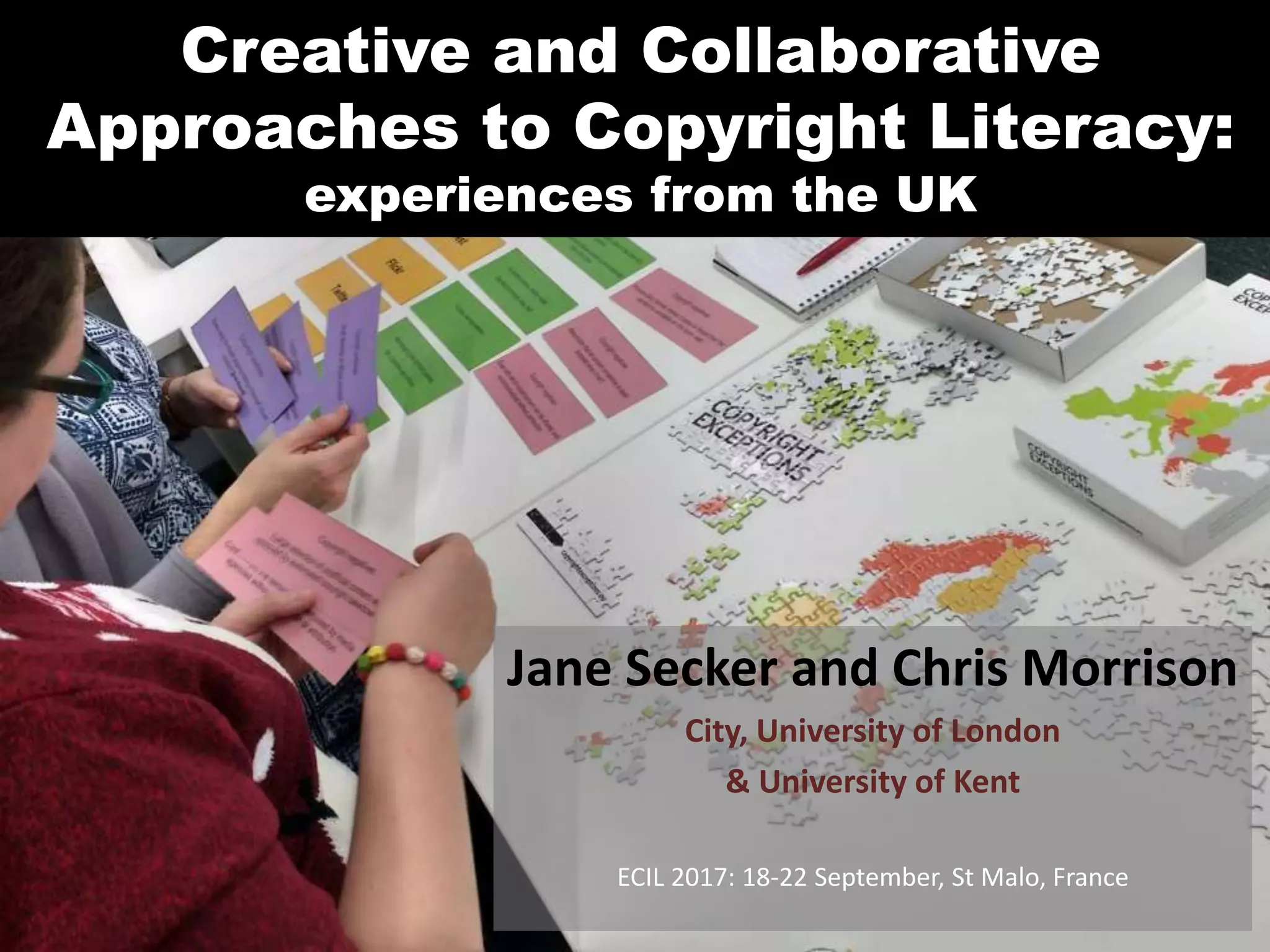
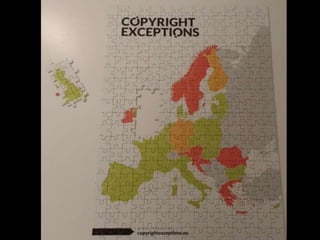
  • #3 Jigsaw photo to illustrate that the UK is not an island despite Brexit We do believe in collaborative approaches And with that in mind we British have been getting in touch with our feelings and asking people about copyright
  • #4 Chris
  • #5 Chris
  • #6 Why it is part of information literacy Why it is not simply a compliance issue Why it’s not just a ‘skill’ and following a set of rules Acquiring – it doesn’t come naturally Demonstrating – it’s about practice and communicating what you are doing Appropriate – you don’t need to be an expert, it’s contextual, there is not one simple answer, formulaic answers don’t always work, it’s an overall sense of what is right and wrong Knowledge (there is a background of stuff you need to learn, sources of authority but you have to question them), Skills – way beyond the ability of legal analysis, listening and empathy, assertiveness, negotiation Behaviours – getting comfortable with ambiguity, communication, (linked to values) transparency and openness All together = literacy Enable – it’s enabling, empowering, not restrictive, what’s it for is to reach copyright’s ultimate aims – to try and make things work in an imperfect world whilst never losing site of humanity’s potential – enlightenment Ethical – doesn’t prescribe one ethical view, relies on general enlightenment a fertile ground for constructive debate – there is common ground, giving people respect and attribution Creation and use – recognise that we are all producers and consumers of content – doesn’t favour one particular body as copyright has been imposed on the whole of humanity Material – the most embracing catch all term we can think of to cover the whole of humanities expression of creative outputs (content is not the word) The common ground is that those involved in the critical copyright literacy movement want people to have access to information and be discerning and be critical.
  • #7 It cuts across different library and cultural heritage sectors It’s relevant to loads of people’s jobs - needs to be embedded in an institution
  • #8 Jane – variation in experience 3 groups interviews Academic libraries Rigorous data analysis – read the article
  • #9 Chris
  • #10 Jane
  • #11 Jane
  • #12 Chris
  • #13 Chris
  • #14 Jane
  • #15 High numbers of institutions have copyright specialists – what should they be called? What is their role? What are the implications – does it mean all the copyright knowledge remains in a silo? Survey of UK copyright specialists – March 2017
  • #16 CLS showed 64% had copyright officers (75% in universities)
  • #17 Chris to re-order the chart and filter only the top 5 from Qualtrics and make them legible.
  • #19 I’m almost tempted to use a photo of Brene here or some covers of her book! Going into arena? Jane in the Coliseum. Model that shows that confidence is built on knowledge and surrounded by support from the community
  • #20 Institutional, regional, national, international
  • #21 The event in 20th June Community to talk together and empower each other: Key topics – image in teaching (and recording them), online thesis and 3rd party content, use of copyright content in student creative work. Regional copyright community of practice in London – Sherlock
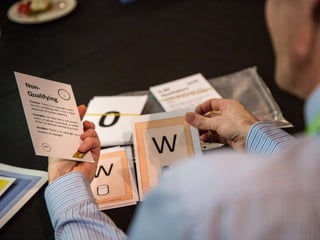
  • #22 Card game
  • #23 Chris and Jane conversation
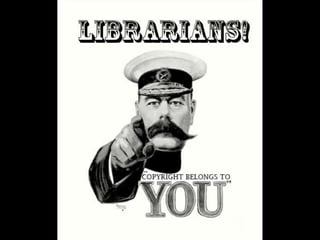
  • #25 Main message – copyright is not something to be scared of, it belongs to everyone, it’s not something outside of librarianship, librarians need to take collective responsibility and have a practical, pragmatic and enlightened approach to copyright.
  • #26 Add lecture recording survey details – if people are interested then we can pull up the presentation.
  • #27 Jane to check that the credits are up to date and send the slides on (remembering to remove the one about risk).