CREATIVE APPROACHES TO
COPYRIGHT EDUCATION: A WORKSHOP
https://copyrightliteracy.org @UKCopyrightLit
LILAC Conference:10-12 April 2017, University of Swansea
Chris Morrison, University of Kent
Jane Secker, LSE / City, University of London
@cbowiemorrison c.morrison@kent.ac.uk
@jsecker j.secker@lse.ac.uk
CREATIVITY AND COPYRIGHT
**DOWNLOAD THE FULL COPYRIGHT
CARD GAME RESOURCES HERE**
*Free as in beer, and free as in speech
FREE* STUFF!!!
COPYRIGHT LITERACY
@cbowiemorrison
@jsecker
@ukcopyrightlit
Why copyright education is a fundamental part of
digital and information literacy [blog post]
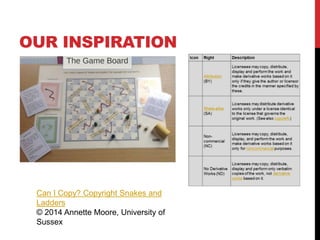
OUR INSPIRATION
Can I Copy? Copyright Snakes and
Ladders
© 2014 Annette Moore, University of
Sussex
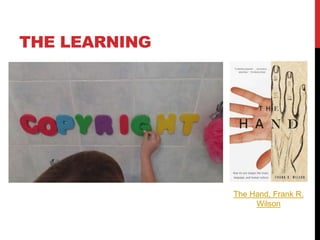
THE LEARNING
The Hand, Frank R.
Wilson
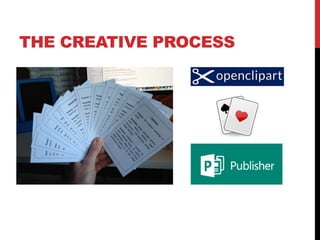
THE CREATIVE PROCESS
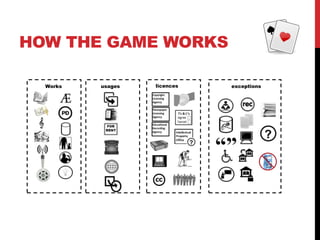
HOW THE GAME WORKS
Works usages licences exceptions
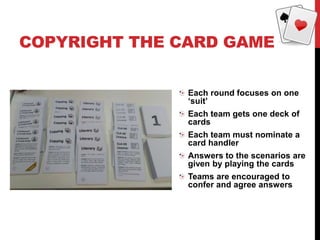
COPYRIGHT THE CARD GAME
Each round focuses on one
‘suit’
Each team gets one deck of
cards
Each team must nominate a
card handler
Answers to the scenarios are
given by playing the cards
Teams are encouraged to
confer and agree answers
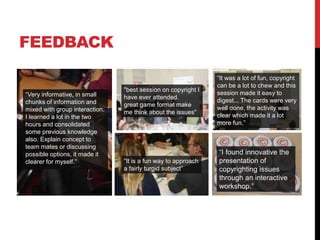
FEEDBACK
"best session on copyright I
have ever attended.
great game format make
me think about the issues"
“Very informative, in small
chunks of information and
mixed with group interaction.
I learned a lot in the two
hours and consolidated
some previous knowledge
also. Explain concept to
team mates or discussing
possible options, it made it
clearer for myself.” “It is a fun way to approach
a fairly turgid subject”
“It was a lot of fun, copyright
can be a lot to chew and this
session made it easy to
digest... The cards were very
well done, the activity was
clear which made it a lot
more fun.”
“I found innovative the
presentation of
copyrighting issues
through an interactive
workshop.”
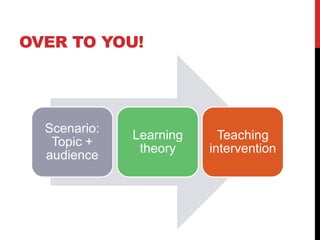
OVER TO YOU!
Scenario:
Topic +
audience
Learning
theory
Teaching
intervention
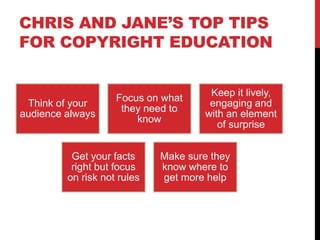
CHRIS AND JANE’S TOP TIPS
FOR COPYRIGHT EDUCATION
Think of your
audience always
Focus on what
they need to
know
Keep it lively,
engaging and
with an element
of surprise
Get your facts
right but focus
on risk not rules
Make sure they
know where to
get more help
FURTHER READING
Csíkszentmihályi, M (1996) Creativity: Flow and the Psychology of Discovery and
Invention. London: Harper Perennial
Morrison, C and Secker, J (2016) Exceptions for libraries. Copyrightuser.org. Available
online.
Morrison, C and Secker, J. (2016) A Guide to Copyright. Association of University
Administrators.
Robinson, K (2015) Creativity at University. RSA Spotlight:
https://www.thersa.org/discover/videos/event-videos/2015/07/ken-robinson-on-
creativity-at-university
Secker, J and Morrison, C. (2016) Copyright and E-learning: a guide for practitioners.
Facet publishing: London. Chapter 6: Copyright education and training available online.
Secker, J and Morrison, C. (2015) Why copyright is a fundamental part of digital and
information literacy. CILIP Blog post. Available at: http://www.cilip.org.uk/blog/why-
copyright-education-fundamental-part-digital-information-literacy
Wilson, F. R. (2000) The Hand: how it’s use shapes the brain, language and culture.
London: Vintage Books
IMAGE CREDITS
Slide 1, 2, 3 & 7: Open clip art
Slide 4: UNESCO IL logo licensed under CC-BY
Slide 5: Image from Annette Moore
Slide 6 & 9: Images by Chris Morrison CC-BY
Image 10: Images by Jane Secker / Chris Morrison CC-BY
Slide 15-19: Clip art
SCENARIO 1
You have been contacted by the
Head of Research who wants a
session for PhD students in their
first year in the Engineering
Department. They need to
understand about using images,
figures and data in their thesis in
light of the new policy to deposit all
PhD theses in the university’s open
access repository.
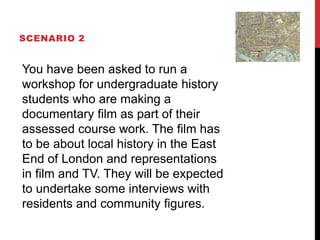
SCENARIO 2
You have been asked to run a
workshop for undergraduate history
students who are making a
documentary film as part of their
assessed course work. The film has
to be about local history in the East
End of London and representations
in film and TV. They will be expected
to undertake some interviews with
residents and community figures.
SCENARIO 3
You have been asked to run an
introductory session for new
teaching staff in the School of
Architecture. How do they make
sure they don't infringe copyright in
images, particularly in light of a new
lecture recording policy that says by
default lectures will be recorded.
SCENARIO 4
You have been asked by the Faculty
of Humanities to explain the
publishing choices they have in light
of changing funding mandates and
the REF requirements for open
access. You are aware that a
number of academics are concerned
about funding models for books and
scholarly monographs and their own
creative control.
SCENARIO 5
Your institution has just been
audited by the Copyright Licensing
Agency (CLA) who have advised
that academics and administrative
staff in the School of Law should
receive training about the terms of
the CLA licence and the use of
published extracts on the VLE.
SCENARIO 6
You have been asked to deliver a
joint training session with the new
Head of Innovation and
Commercialisation to explain to
Biosciences post-doctoral
researchers the intellectual property
implications of new research and its
wider communication.
SCENARIO 7
You have been asked to teach first
year language students studying a
module on English for Academic
Purposes about how to write
engaging blog posts for other new
international students. You need to
incorporate some aspects of
copyright and protecting their own
and other people’s rights. They are
likely to include images to illustrate
their blog posts.
SCENARIO 8
You have been asked to run a
session for Fine Art and Design
students about using other people’s
ideas and work in their own creative
outputs. Their tutor is particularly
interested in remix culture and using
digital resources and would like you
to cover how they can avoid
allegations of copyright
infringement.

Creative approaches to copyright education

  • 1.
    CREATIVE APPROACHES TO COPYRIGHTEDUCATION: A WORKSHOP https://copyrightliteracy.org @UKCopyrightLit LILAC Conference:10-12 April 2017, University of Swansea Chris Morrison, University of Kent Jane Secker, LSE / City, University of London @cbowiemorrison c.morrison@kent.ac.uk @jsecker j.secker@lse.ac.uk
  • 2.
  • 3.
    **DOWNLOAD THE FULLCOPYRIGHT CARD GAME RESOURCES HERE** *Free as in beer, and free as in speech FREE* STUFF!!!
  • 4.
    COPYRIGHT LITERACY @cbowiemorrison @jsecker @ukcopyrightlit Why copyrighteducation is a fundamental part of digital and information literacy [blog post]
  • 5.
    OUR INSPIRATION Can ICopy? Copyright Snakes and Ladders © 2014 Annette Moore, University of Sussex
  • 6.
    THE LEARNING The Hand,Frank R. Wilson
  • 7.
  • 8.
    HOW THE GAMEWORKS Works usages licences exceptions
  • 9.
    COPYRIGHT THE CARDGAME Each round focuses on one ‘suit’ Each team gets one deck of cards Each team must nominate a card handler Answers to the scenarios are given by playing the cards Teams are encouraged to confer and agree answers
  • 10.
    FEEDBACK "best session oncopyright I have ever attended. great game format make me think about the issues" “Very informative, in small chunks of information and mixed with group interaction. I learned a lot in the two hours and consolidated some previous knowledge also. Explain concept to team mates or discussing possible options, it made it clearer for myself.” “It is a fun way to approach a fairly turgid subject” “It was a lot of fun, copyright can be a lot to chew and this session made it easy to digest... The cards were very well done, the activity was clear which made it a lot more fun.” “I found innovative the presentation of copyrighting issues through an interactive workshop.”
  • 11.
    OVER TO YOU! Scenario: Topic+ audience Learning theory Teaching intervention
  • 12.
    CHRIS AND JANE’STOP TIPS FOR COPYRIGHT EDUCATION Think of your audience always Focus on what they need to know Keep it lively, engaging and with an element of surprise Get your facts right but focus on risk not rules Make sure they know where to get more help
  • 13.
    FURTHER READING Csíkszentmihályi, M(1996) Creativity: Flow and the Psychology of Discovery and Invention. London: Harper Perennial Morrison, C and Secker, J (2016) Exceptions for libraries. Copyrightuser.org. Available online. Morrison, C and Secker, J. (2016) A Guide to Copyright. Association of University Administrators. Robinson, K (2015) Creativity at University. RSA Spotlight: https://www.thersa.org/discover/videos/event-videos/2015/07/ken-robinson-on- creativity-at-university Secker, J and Morrison, C. (2016) Copyright and E-learning: a guide for practitioners. Facet publishing: London. Chapter 6: Copyright education and training available online. Secker, J and Morrison, C. (2015) Why copyright is a fundamental part of digital and information literacy. CILIP Blog post. Available at: http://www.cilip.org.uk/blog/why- copyright-education-fundamental-part-digital-information-literacy Wilson, F. R. (2000) The Hand: how it’s use shapes the brain, language and culture. London: Vintage Books
  • 14.
    IMAGE CREDITS Slide 1,2, 3 & 7: Open clip art Slide 4: UNESCO IL logo licensed under CC-BY Slide 5: Image from Annette Moore Slide 6 & 9: Images by Chris Morrison CC-BY Image 10: Images by Jane Secker / Chris Morrison CC-BY Slide 15-19: Clip art
  • 15.
    SCENARIO 1 You havebeen contacted by the Head of Research who wants a session for PhD students in their first year in the Engineering Department. They need to understand about using images, figures and data in their thesis in light of the new policy to deposit all PhD theses in the university’s open access repository.
  • 16.
    SCENARIO 2 You havebeen asked to run a workshop for undergraduate history students who are making a documentary film as part of their assessed course work. The film has to be about local history in the East End of London and representations in film and TV. They will be expected to undertake some interviews with residents and community figures.
  • 17.
    SCENARIO 3 You havebeen asked to run an introductory session for new teaching staff in the School of Architecture. How do they make sure they don't infringe copyright in images, particularly in light of a new lecture recording policy that says by default lectures will be recorded.
  • 18.
    SCENARIO 4 You havebeen asked by the Faculty of Humanities to explain the publishing choices they have in light of changing funding mandates and the REF requirements for open access. You are aware that a number of academics are concerned about funding models for books and scholarly monographs and their own creative control.
  • 19.
    SCENARIO 5 Your institutionhas just been audited by the Copyright Licensing Agency (CLA) who have advised that academics and administrative staff in the School of Law should receive training about the terms of the CLA licence and the use of published extracts on the VLE.
  • 20.
    SCENARIO 6 You havebeen asked to deliver a joint training session with the new Head of Innovation and Commercialisation to explain to Biosciences post-doctoral researchers the intellectual property implications of new research and its wider communication.
  • 21.
    SCENARIO 7 You havebeen asked to teach first year language students studying a module on English for Academic Purposes about how to write engaging blog posts for other new international students. You need to incorporate some aspects of copyright and protecting their own and other people’s rights. They are likely to include images to illustrate their blog posts.
  • 22.
    SCENARIO 8 You havebeen asked to run a session for Fine Art and Design students about using other people’s ideas and work in their own creative outputs. Their tutor is particularly interested in remix culture and using digital resources and would like you to cover how they can avoid allegations of copyright infringement.

Editor's Notes

  • #12 Suggest this slide should be moved until after the card game stuff.