Disclosure
Joseph Zygmunt, Jr., RVT, RPhS
I disclose the following financial relationship(s):
•Employment: Covidien Inc.
Detecting Deep Venous Disease
with Duplex Ultrasound
Joseph Zygmunt, Jr. RVT, RPhS
IVC 2011
“Duplex Ultrasound has become the reference standard in
assessing the morphology and hemodynamics of the
lower limb veins”
 Coleridge-Smith et al. Duplex Ultrasound Investigation of the
Veins in Chronic Venous Disease of the Lower Limbs – UIP
Consensus Document. Part I Basic Principles. Eur J Vasc
Endovasc Surg 2006.
 Cavezzi et al. Duplex Ultrasound Investigation of the Veins in
Chronic Venous Disease of the Lower Limbs – UIP Consensus
Document. Part II Anatomy. Eur J Vasc Endovasc Surg, 2006
“Duplex Ultrasound is the most significant contribution
made to Phlebology in the last ten years”
~Dr. Hugo Partsch 2004
Deep Veins …….Some ask: Why Bother?
Deep Venous System
 Examination of the deep venous system is considered an
essential step in the evaluation of ANY phlebology patient
 Primary system for venous return to the heart
 Examination the superficial system only is inadequate
 Evaluate for DVT – ( acute, sub-acute and chronic)
 Evaluate for insufficiency (axial or segmental deep)
Change in Dogma -
 Deep disease is no longer the “kiss of death”
 Early intervention and clot load removal
IVUS
 Iliac vein obstruction ubiquitous and often silent
in general population
 C3-C6 patients with primary and postthrombotic
CVI - >90% with IVUS
 Early restoration of iliac vein patency in the
acute phase is becoming the norm to prevent
post thrombotic syndrome
Lurie et al, Invasive treatment of deep venous disease,
a UIP consensus; Int Angiol 2010; 29:199-204
Anatomy : Deep System
 Tibial
–Anterior
–Posterior
 Peroneal
 Gastrocnemius
 Popliteal
Anatomy : Deep System
 Popliteal
 Femoral Vein (of the thigh)
– NOT SFV
 Deep (profunda)Femoris
 Common Femoral Vein
 External Iliac
 Duplications in the FV and POP
can result in missed DVT
Patient Position
 Hip slightly rotated
 Supine (slight tilt on
table)
 Incorrect positioning
can lead to inaccurate
assessment
 Consider: ergonomics!
Deep System Diagnostic Criteria
Three complementary modes
Common Femoral Vein
Normal Findings – good compressibility
Split screen documentation
Femoral Vein
not superficial femoral vein
Popliteal Vein
Note: vessel orientation
Post. Tibial and
Peroneal Veins
Paired in calf
Anterior Tibial: omitted routinely
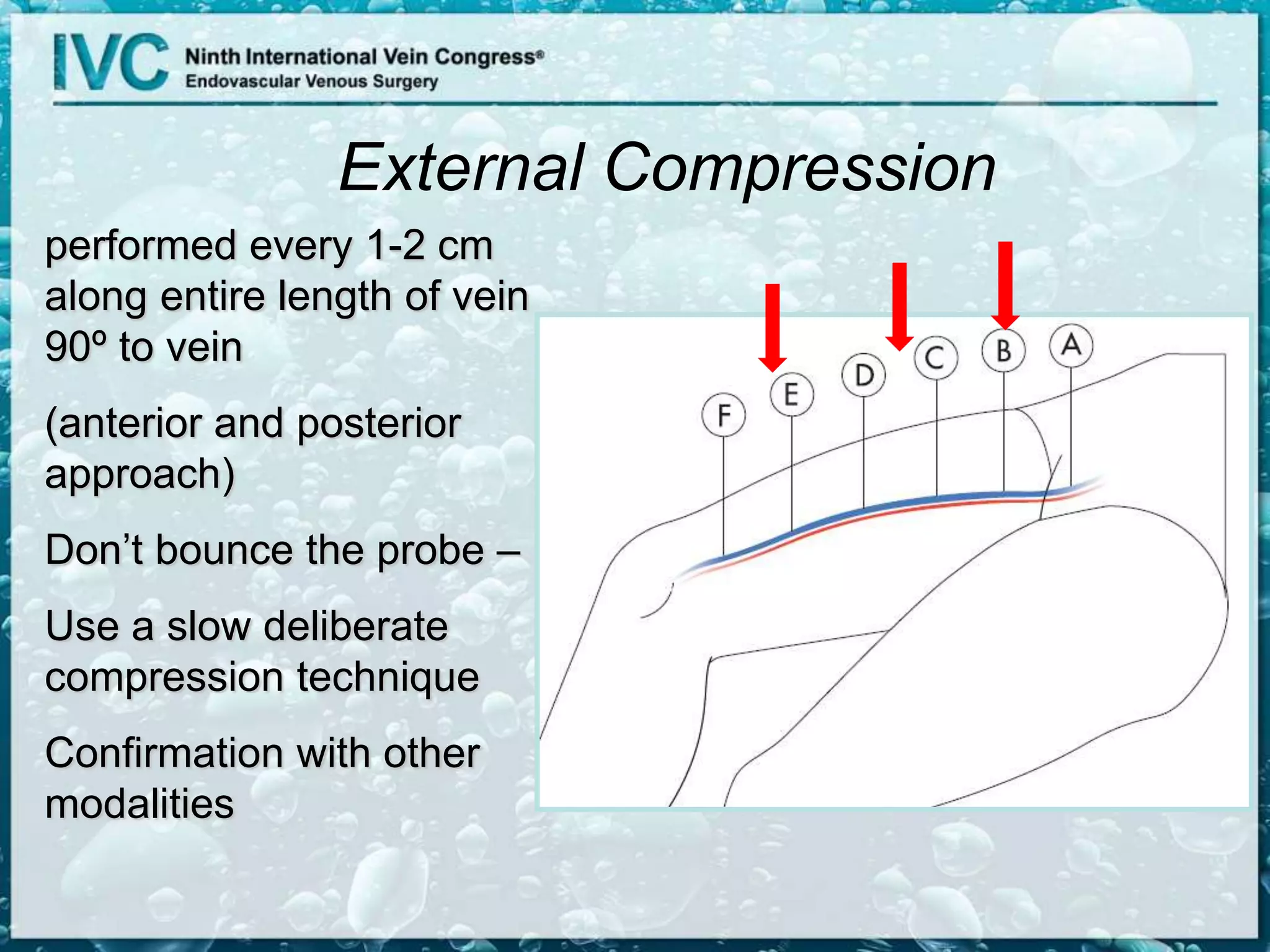
External Compression
performed every 1-2 cm
along entire length of vein
90º to vein
(anterior and posterior
approach)
Don’t bounce the probe –
Use a slow deliberate
compression technique
Confirmation with other
modalities
Multiple Views to fully understand the pathology
DVT RT CFV
Spectral Doppler
 Spectral Doppler
 Spontaneous flow
 Phasic flow with respiration (large veins)
cease with deep breath inspiration
 Flow also ceases with the Valsalva
maneuver
 Flow augmentation with distal compression
 Unidirectional flow (toward the heart)
 Non-pulsatile
 Importance of contralateral CFV analysis
Valsalva:
“ a well performed Valsalva maneuver detects significant reflux
in major veins until a competent valve is detected.….
Like descending venography, detection of reflux distal to
competent valves may not be detected with these
techniques”
Talbot, S Vascular Ultrasound Today 9(1): 1-28, 2004
 A continuous venous waveform is abnormal –
recommend study of proximal veins
Normal
phasic
Normal Color Doppler
Femoral Vein
thigh
Venous Confluence
Color images in long axis to document patency of vein
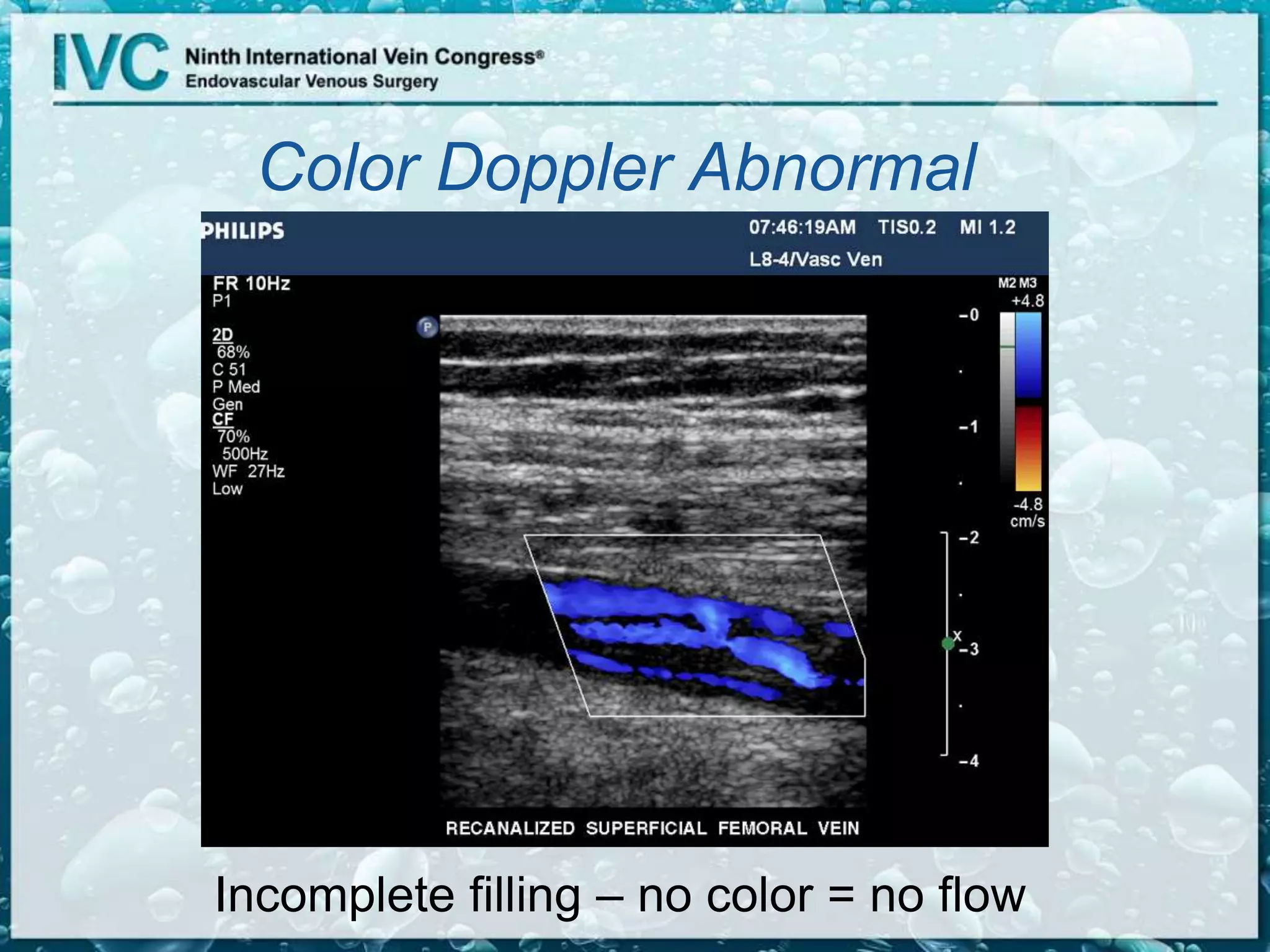
Color Doppler Abnormal
Incomplete filling – no color = no flow
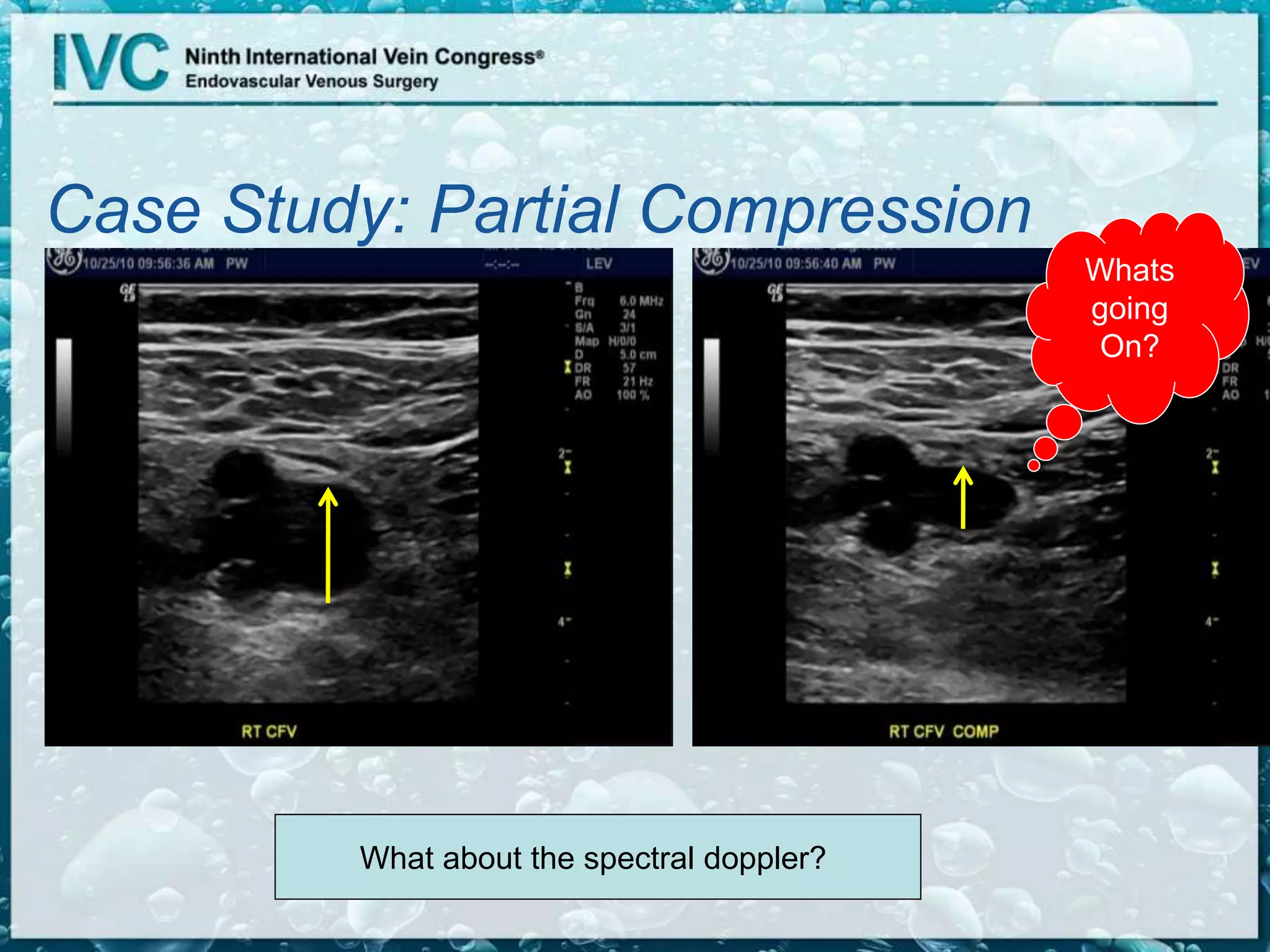
Case Study: Partial Compression
What about the spectral doppler?
Whats
going
On?
Rt CFV Continuous Flow
Walking Doppler
Venous Stenosis
Contralateral Comparison
infra inguinal clues
Full Easy Compression Contralaterally
Report: What to document
Transverse Gray Scale Spectral Wave Forms
CFV, SFJ Right and Left CFV
Prox, Mid, and Distal FV
Pop V Pop V
Post Tib V
Peroneal V
additional images as needed
additional as per protocol additional as per protocol
*iliacs, GSV, SSV, prox Profunda, gastrocs, soleals, ant tibs,
Perfs
ICAVL Imaging Standards 2010
Protocol: DVT
Deep Reflux vs Siphon affect?
Is deep reflux segmental or axial?
Thank You For Your Attention
joseph.zygmunt@covidien.com

Detecting Deep Venous Disease with Duplex Ultrasound

  • 1.
    Disclosure Joseph Zygmunt, Jr.,RVT, RPhS I disclose the following financial relationship(s): •Employment: Covidien Inc.
  • 2.
    Detecting Deep VenousDisease with Duplex Ultrasound Joseph Zygmunt, Jr. RVT, RPhS IVC 2011
  • 3.
    “Duplex Ultrasound hasbecome the reference standard in assessing the morphology and hemodynamics of the lower limb veins”  Coleridge-Smith et al. Duplex Ultrasound Investigation of the Veins in Chronic Venous Disease of the Lower Limbs – UIP Consensus Document. Part I Basic Principles. Eur J Vasc Endovasc Surg 2006.  Cavezzi et al. Duplex Ultrasound Investigation of the Veins in Chronic Venous Disease of the Lower Limbs – UIP Consensus Document. Part II Anatomy. Eur J Vasc Endovasc Surg, 2006 “Duplex Ultrasound is the most significant contribution made to Phlebology in the last ten years” ~Dr. Hugo Partsch 2004 Deep Veins …….Some ask: Why Bother?
  • 5.
    Deep Venous System Examination of the deep venous system is considered an essential step in the evaluation of ANY phlebology patient  Primary system for venous return to the heart  Examination the superficial system only is inadequate  Evaluate for DVT – ( acute, sub-acute and chronic)  Evaluate for insufficiency (axial or segmental deep) Change in Dogma -  Deep disease is no longer the “kiss of death”  Early intervention and clot load removal
  • 6.
    IVUS  Iliac veinobstruction ubiquitous and often silent in general population  C3-C6 patients with primary and postthrombotic CVI - >90% with IVUS  Early restoration of iliac vein patency in the acute phase is becoming the norm to prevent post thrombotic syndrome Lurie et al, Invasive treatment of deep venous disease, a UIP consensus; Int Angiol 2010; 29:199-204
  • 7.
    Anatomy : DeepSystem  Tibial –Anterior –Posterior  Peroneal  Gastrocnemius  Popliteal
  • 8.
    Anatomy : DeepSystem  Popliteal  Femoral Vein (of the thigh) – NOT SFV  Deep (profunda)Femoris  Common Femoral Vein  External Iliac  Duplications in the FV and POP can result in missed DVT
  • 9.
    Patient Position  Hipslightly rotated  Supine (slight tilt on table)  Incorrect positioning can lead to inaccurate assessment  Consider: ergonomics!
  • 10.
    Deep System DiagnosticCriteria Three complementary modes
  • 11.
    Common Femoral Vein NormalFindings – good compressibility Split screen documentation
  • 12.
  • 13.
  • 14.
    Post. Tibial and PeronealVeins Paired in calf Anterior Tibial: omitted routinely
  • 15.
    External Compression performed every1-2 cm along entire length of vein 90º to vein (anterior and posterior approach) Don’t bounce the probe – Use a slow deliberate compression technique Confirmation with other modalities
  • 16.
    Multiple Views tofully understand the pathology
  • 17.
  • 18.
    Spectral Doppler  SpectralDoppler  Spontaneous flow  Phasic flow with respiration (large veins) cease with deep breath inspiration  Flow also ceases with the Valsalva maneuver  Flow augmentation with distal compression  Unidirectional flow (toward the heart)  Non-pulsatile  Importance of contralateral CFV analysis
  • 19.
    Valsalva: “ a wellperformed Valsalva maneuver detects significant reflux in major veins until a competent valve is detected.…. Like descending venography, detection of reflux distal to competent valves may not be detected with these techniques” Talbot, S Vascular Ultrasound Today 9(1): 1-28, 2004
  • 20.
     A continuousvenous waveform is abnormal – recommend study of proximal veins Normal phasic
  • 21.
    Normal Color Doppler FemoralVein thigh Venous Confluence Color images in long axis to document patency of vein
  • 22.
    Color Doppler Abnormal Incompletefilling – no color = no flow
  • 23.
    Case Study: PartialCompression What about the spectral doppler? Whats going On?
  • 24.
  • 25.
  • 26.
    Contralateral Comparison infra inguinalclues Full Easy Compression Contralaterally
  • 27.
    Report: What todocument Transverse Gray Scale Spectral Wave Forms CFV, SFJ Right and Left CFV Prox, Mid, and Distal FV Pop V Pop V Post Tib V Peroneal V additional images as needed additional as per protocol additional as per protocol *iliacs, GSV, SSV, prox Profunda, gastrocs, soleals, ant tibs, Perfs ICAVL Imaging Standards 2010 Protocol: DVT
  • 28.
    Deep Reflux vsSiphon affect? Is deep reflux segmental or axial?
  • 29.
    Thank You ForYour Attention joseph.zygmunt@covidien.com