Who needs more testing beyond
venous duplex?
IVC 2014 Miami Beach FL
William Marston MD
Professor and Chief, Division of
Vascular Surgery
University of N. Carolina Hospitals
Disclosures
• Scientific Consultant
– Veniti
– Volcano
– Organogenesis
• Clinical Trial Investigator
– Smith and Nephew/Healthpoint
Deriving maximum information
from duplex ultrasound
• Venous duplex report
– No acute DVT
– Reflux in GSV
– No deep reflux
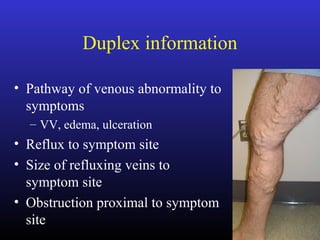
Duplex information
• Pathway of venous abnormality to
symptoms
– VV, edema, ulceration
• Reflux to symptom site
• Size of refluxing veins to
symptom site
• Obstruction proximal to symptom
site
Informative venous duplex report
• Abnormal pathways
– SSV to pop and/or vein of Giacomini
– Duplicate GSV
– Hypoplastic femoral system
– Pelvic or other collaterals to labia
• Sites of reflux and size of refluxing segments
– Deep, superficial, perforator
• Obstruction in all segments including iliac
and IVC
Duplex limitations - anatomic
• Operator dependent
– Nicos vs the rest of
the world
Duplex limitations - physiologic
• Duplex can provide:
– Direction of flow
– Velocity of flow
– Caliber of conduit
– Cannot directly infer venous hypertension or
other measure of severity of venous
insufficiency
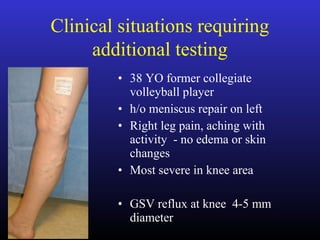
Clinical situations requiring
additional testing
• 38 YO former collegiate
volleyball player
• h/o meniscus repair on left
• Right leg pain, aching with
activity - no edema or skin
changes
• Most severe in knee area
• GSV reflux at knee 4-5 mm
diameter
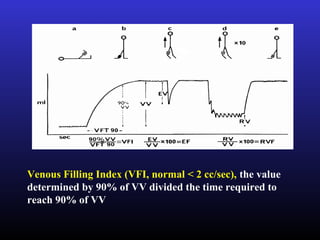
Plethysmography
Venous Filling Index (VFI, normal < 2 cc/sec), the value
determined by 90% of VV divided the time required to
reach 90% of VV
Additional Testing
• 47 YO female with h/o leg
pain, aching after walking
• Mild/moderate edema late
in day
• s/p GSV ablation, 5
sessions of scleroRx
• Continued leg aching w
minimal improvement
CT venogram and APG
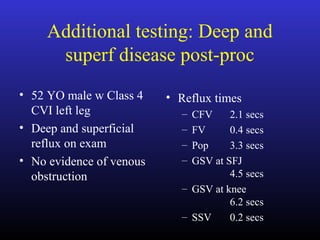
Additional testing: Deep and
superf disease post-proc
• 52 YO male w Class 4
CVI left leg
• Deep and superficial
reflux on exam
• No evidence of venous
obstruction
• Reflux times
– CFV 2.1 secs
– FV 0.4 secs
– Pop 3.3 secs
– GSV at SFJ
4.5 secs
– GSV at knee
6.2 secs
– SSV 0.2 secs
S/p GSV ablation
• How much will
symptoms improve
with superficial
correction alone?
• Does patient still need
to use compression?
• Repeat duplex to see if
deep reflux corrects
• VFI improvement to
normal range suggests
correction of primary
cause of CVI
Additional testing: pelvic
symptoms, groin VV
• Labial VV
• Pelvic congestion
symptoms
• Nutcracker syndrome
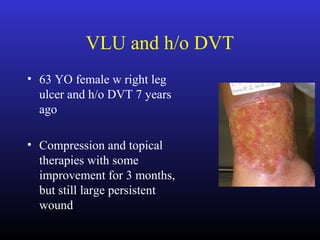
VLU and h/o DVT
• 63 YO female w right leg
ulcer and h/o DVT 7 years
ago
• Compression and topical
therapies with some
improvement for 3 months,
but still large persistent
wound
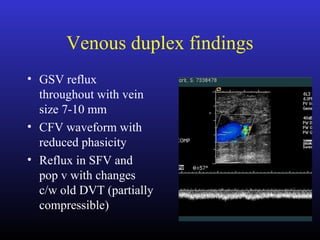
Venous duplex findings
• GSV reflux
throughout with vein
size 7-10 mm
• CFV waveform with
reduced phasicity
• Reflux in SFV and
pop v with changes
c/w old DVT (partially
compressible)
CT/MR venogram
• Determine presence and
severity of ilio-caval
outflow obstruction
– Could you stent at same
setting as GSV ablation?
– Further evaluate severity of
pop and fem v obstruction
• Femoral venoplasty?
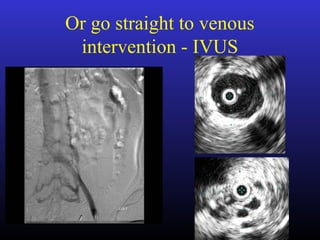
Or go straight to venous
intervention - IVUS
When are further diagnostic tests
necessary?
• Not often for infrainguinal
questions
– If symptoms don’t match duplex
findings
– If patients don’t improve after
appropriate intervention
• Venous outflow obstruction
• Abd/Pelvic symptoms or source
• At the time of therapeutic venous
intervention
600-0003.42/001
20

Who Needs More Testing Beyond Venous Duplex?

  • 1.
    Who needs moretesting beyond venous duplex? IVC 2014 Miami Beach FL William Marston MD Professor and Chief, Division of Vascular Surgery University of N. Carolina Hospitals
  • 2.
    Disclosures • Scientific Consultant –Veniti – Volcano – Organogenesis • Clinical Trial Investigator – Smith and Nephew/Healthpoint
  • 3.
    Deriving maximum information fromduplex ultrasound • Venous duplex report – No acute DVT – Reflux in GSV – No deep reflux
  • 4.
    Duplex information • Pathwayof venous abnormality to symptoms – VV, edema, ulceration • Reflux to symptom site • Size of refluxing veins to symptom site • Obstruction proximal to symptom site
  • 5.
    Informative venous duplexreport • Abnormal pathways – SSV to pop and/or vein of Giacomini – Duplicate GSV – Hypoplastic femoral system – Pelvic or other collaterals to labia • Sites of reflux and size of refluxing segments – Deep, superficial, perforator • Obstruction in all segments including iliac and IVC
  • 6.
    Duplex limitations -anatomic • Operator dependent – Nicos vs the rest of the world
  • 7.
    Duplex limitations -physiologic • Duplex can provide: – Direction of flow – Velocity of flow – Caliber of conduit – Cannot directly infer venous hypertension or other measure of severity of venous insufficiency
  • 8.
    Clinical situations requiring additionaltesting • 38 YO former collegiate volleyball player • h/o meniscus repair on left • Right leg pain, aching with activity - no edema or skin changes • Most severe in knee area • GSV reflux at knee 4-5 mm diameter
  • 9.
  • 10.
    Venous Filling Index(VFI, normal < 2 cc/sec), the value determined by 90% of VV divided the time required to reach 90% of VV
  • 11.
    Additional Testing • 47YO female with h/o leg pain, aching after walking • Mild/moderate edema late in day • s/p GSV ablation, 5 sessions of scleroRx • Continued leg aching w minimal improvement
  • 12.
  • 13.
    Additional testing: Deepand superf disease post-proc • 52 YO male w Class 4 CVI left leg • Deep and superficial reflux on exam • No evidence of venous obstruction • Reflux times – CFV 2.1 secs – FV 0.4 secs – Pop 3.3 secs – GSV at SFJ 4.5 secs – GSV at knee 6.2 secs – SSV 0.2 secs
  • 14.
    S/p GSV ablation •How much will symptoms improve with superficial correction alone? • Does patient still need to use compression? • Repeat duplex to see if deep reflux corrects • VFI improvement to normal range suggests correction of primary cause of CVI
  • 15.
    Additional testing: pelvic symptoms,groin VV • Labial VV • Pelvic congestion symptoms • Nutcracker syndrome
  • 16.
    VLU and h/oDVT • 63 YO female w right leg ulcer and h/o DVT 7 years ago • Compression and topical therapies with some improvement for 3 months, but still large persistent wound
  • 17.
    Venous duplex findings •GSV reflux throughout with vein size 7-10 mm • CFV waveform with reduced phasicity • Reflux in SFV and pop v with changes c/w old DVT (partially compressible)
  • 18.
    CT/MR venogram • Determinepresence and severity of ilio-caval outflow obstruction – Could you stent at same setting as GSV ablation? – Further evaluate severity of pop and fem v obstruction • Femoral venoplasty?
  • 19.
    Or go straightto venous intervention - IVUS
  • 20.
    When are furtherdiagnostic tests necessary? • Not often for infrainguinal questions – If symptoms don’t match duplex findings – If patients don’t improve after appropriate intervention • Venous outflow obstruction • Abd/Pelvic symptoms or source • At the time of therapeutic venous intervention 600-0003.42/001 20