Disclosure
Joseph Zygmunt, Jr., RVT, RPhS
I disclose the following financial relationship(s):
•Employment: Covidien Inc.
DUPLEX FOR SUPERFICIAL
VENOUS DISEASE
Joseph A. Zygmunt, Jr., RVT, RPhS
IVC 2011
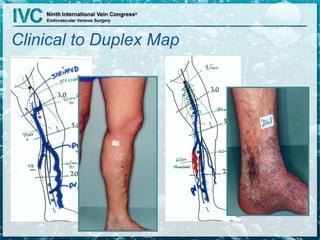
Clinical to Duplex Map
Key Technique References – Duplex
 Meissner M, et al: The Hemodynamics and diagnosis of venous disease. J
Vasc Surg 2007; 46:4S-24S.
 Coleridge-Smith P, et al Duplex Investigation of the Veins in Chronic Venous
Disease of the Lower Limbs-UIP Consensus Document Part I Basic Principles.
Eur J Vasc Endovasc Surg 2006;31:83-92
 Cavezzi, A et al: Duplex Investigation of the Veins in Chronic Venous Disease
of the Lower Limbs-UIP Consensus Document. Part II Anatomy. Eur J Vasc
Endovasc Surg 2006; 31:288-299
 Labropoulos, N, et al: Definition of venous reflux in lower extremity veins. J
Vasc Surg 2003; 38:793-8
 Labropoulos, N, et al: Study of venous reflux progression. J Vasc Surg 2005;
41:291-5
 Foldes, M et al: Standing Versus Supine Positioning in Venous Reflux
Evaluation:Journal of Vasc Tech 1991;15(6):321-24. * 70%
 Zygmunt, J : What’s New in Duplex Scanning of the Venous System.
Perspectives in Vasc Surg and Endovasc Therapy 21(2):2009 94-104
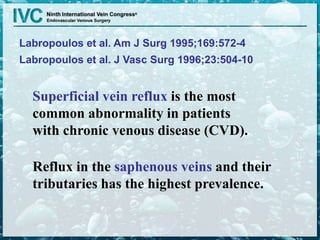
Superficial vein reflux is the most
common abnormality in patients
with chronic venous disease (CVD).
Reflux in the saphenous veins and their
tributaries has the highest prevalence.
Labropoulos et al. Am J Surg 1995;169:572-4
Labropoulos et al. J Vasc Surg 1996;23:504-10
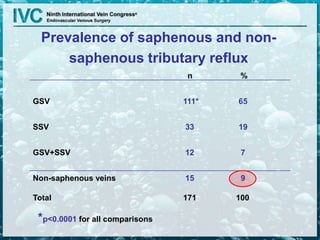
Prevalence of saphenous and non-
saphenous tributary reflux
n %
GSV 111* 65
SSV 33 19
GSV+SSV 12 7
Non-saphenous veins 15 9
Total 171 100
*p<0.0001 for all comparisons
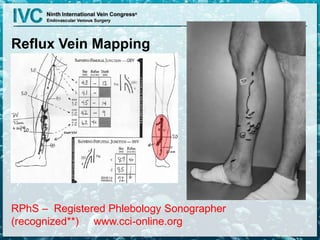
Reflux Vein Mapping
RPhS – Registered Phlebology Sonographer
(recognized**) www.cci-online.org
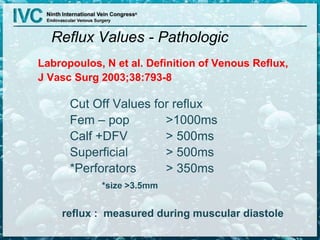
Reflux Values - Pathologic
Labropoulos, N et al. Definition of Venous Reflux,
J Vasc Surg 2003;38:793-8
Cut Off Values for reflux
Fem – pop >1000ms
Calf +DFV > 500ms
Superficial > 500ms
*Perforators > 350ms
*size >3.5mm
reflux : measured during muscular diastole
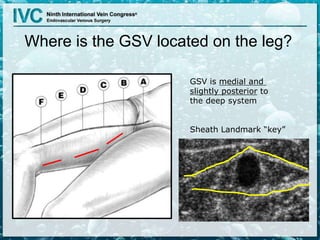
GSV is medial and
slightly posterior to
the deep system
Sheath Landmark “key”
Where is the GSV located on the leg?
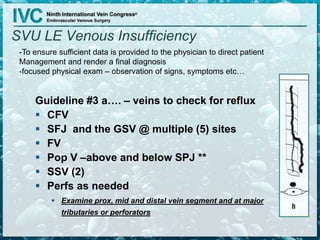
SVU LE Venous Insufficiency
Guideline #3 a…. – veins to check for reflux
 CFV
 SFJ and the GSV @ multiple (5) sites
 FV
 Pop V –above and below SPJ **
 SSV (2)
 Perfs as needed
 Examine prox, mid and distal vein segment and at major
tributaries or perforators
-To ensure sufficient data is provided to the physician to direct patient
Management and render a final diagnosis
-focused physical exam – observation of signs, symptoms etc…
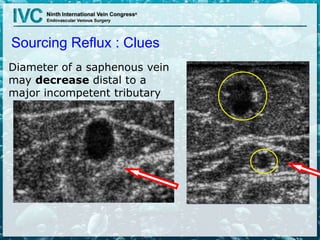
Diameter of a saphenous vein
may decrease distal to a
major incompetent tributary
Sourcing Reflux : Clues
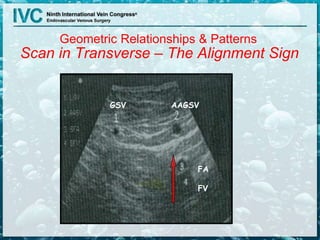
Scan in Transverse – The Alignment Sign
AAGSVGSV
FA
FV
Geometric Relationships & Patterns
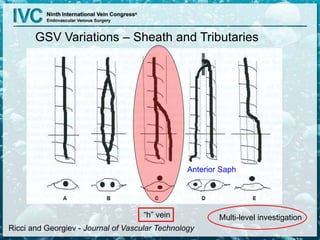
GSV Variations – Sheath and Tributaries
Ricci and Georgiev - Journal of Vascular Technology
“h” vein
Anterior Saph
Multi-level investigation
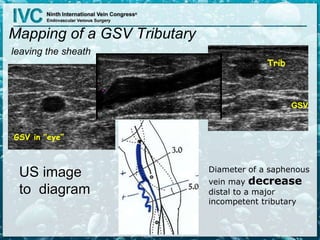
Mapping of a GSV Tributary
leaving the sheath
GSV
Trib
GSV in “eye”
US image
to diagram
Diameter of a saphenous
vein may decrease
distal to a major
incompetent tributary
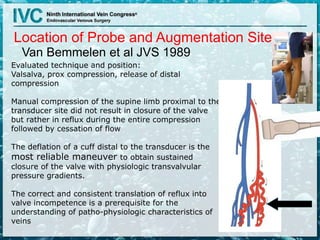
Location of Probe and Augmentation Site
Van Bemmelen et al JVS 1989
Evaluated technique and position:
Valsalva, prox compression, release of distal
compression
Manual compression of the supine limb proximal to the
transducer site did not result in closure of the valve
but rather in reflux during the entire compression
followed by cessation of flow
The deflation of a cuff distal to the transducer is the
most reliable maneuver to obtain sustained
closure of the valve with physiologic transvalvular
pressure gradients.
The correct and consistent translation of reflux into
valve incompetence is a prerequisite for the
understanding of patho-physiologic characteristics of
veins
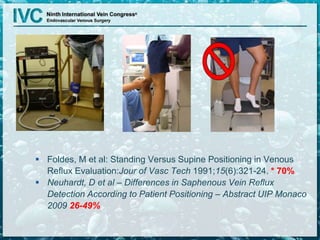
 Foldes, M et al: Standing Versus Supine Positioning in Venous
Reflux Evaluation:Jour of Vasc Tech 1991;15(6):321-24. * 70%
 Neuhardt, D et al – Differences in Saphenous Vein Reflux
Detection According to Patient Positioning – Abstract UIP Monaco
2009 26-49%
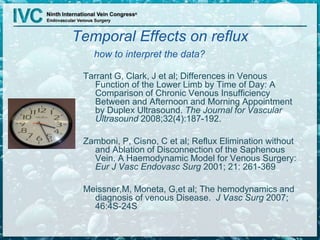
Temporal Effects on reflux
how to interpret the data?
Tarrant G, Clark, J et al; Differences in Venous
Function of the Lower Limb by Time of Day: A
Comparison of Chronic Venous Insufficiency
Between and Afternoon and Morning Appointment
by Duplex Ultrasound. The Journal for Vascular
Ultrasound 2008;32(4):187-192.
Zamboni, P, Cisno, C et al; Reflux Elimination without
and Ablation of Disconnection of the Saphenous
Vein. A Haemodynamic Model for Venous Surgery:
Eur J Vasc Endovasc Surg 2001; 21: 261-369
Meissner,M, Moneta, G,et al; The hemodynamics and
diagnosis of venous Disease. J Vasc Surg 2007;
46:4S-24S
Shape of the reflux curve….
0.5 sec = pathologic
VCTs poor correlation to CEAP
Varicose Reservoir Capacitance
Rodriguez JVS 1996 –
VCTs do not accurately
reflect the magnitude of
refluxed volume
Iafarati JVS 1994 -
Reflux time does not
discriminate severity [C0-
C6]
Vasdekis 1989 –
Peak flow volume – non
discriminatory
Large refluxing vein empties into small capacitor
– peak velocity is high and duration short
Small refluxing vein empties into a large
capacitor – velocity is low and duration long
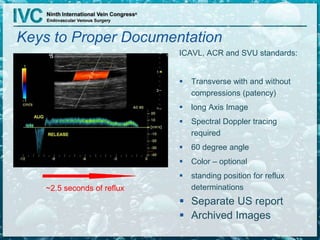
Keys to Proper Documentation
ICAVL, ACR and SVU standards:
 Transverse with and without
compressions (patency)
 long Axis Image
 Spectral Doppler tracing
required
 60 degree angle
 Color – optional
 standing position for reflux
determinations
 Separate US report
 Archived Images
~2.5 seconds of reflux
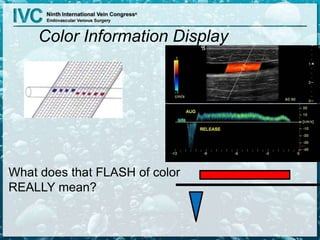
Color Information Display
What does that FLASH of color
REALLY mean?
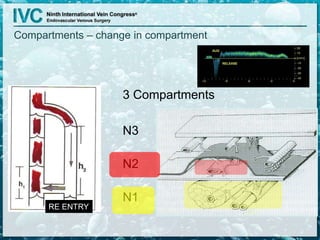
Compartments – change in compartment
 3 Compartments
 N3
 N2
 N1
EXIT
RE ENTRY
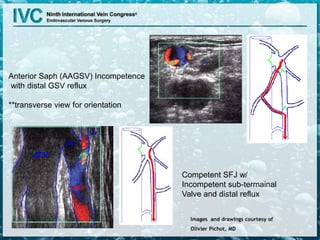
Images and drawings courtesy of
Olivier Pichot, MD
Competent SFJ w/
Incompetent sub-termainal
Valve and distal reflux
Anterior Saph (AAGSV) Incompetence
with distal GSV reflux
**transverse view for orientation
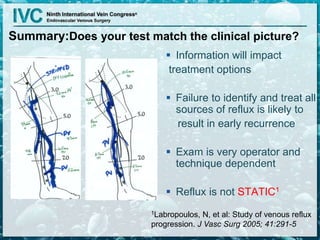
Summary:Does your test match the clinical picture?
 Information will impact
treatment options
 Failure to identify and treat all
sources of reflux is likely to
result in early recurrence
 Exam is very operator and
technique dependent
 Reflux is not STATIC1
1Labropoulos, N, et al: Study of venous reflux
progression. J Vasc Surg 2005; 41:291-5
CONCLUSIONS
Color duplex ultrasound should be performed
to understand the pathology and plan
treatment for CVI patients.
This will tailor the treatment to the patients’
needs and misdirected treatment can be
prevented.
Be Curious - look for the source - does it
match the clinical picture
Joseph.Zygmunt@covidien.com
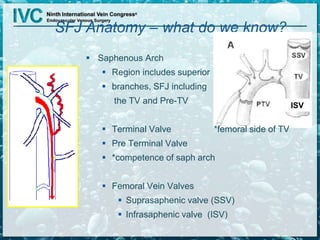
SFJ Anatomy – what do we know?
 Saphenous Arch
 Region includes superior
 branches, SFJ including
the TV and Pre-TV
 Terminal Valve *femoral side of TV
 Pre Terminal Valve
 *competence of saph arch
 Femoral Vein Valves
 Suprasaphenic valve (SSV)
 Infrasaphenic valve (ISV)
ISV

Duplex for Superficial Venous Disease

  • 1.
    Disclosure Joseph Zygmunt, Jr.,RVT, RPhS I disclose the following financial relationship(s): •Employment: Covidien Inc.
  • 2.
    DUPLEX FOR SUPERFICIAL VENOUSDISEASE Joseph A. Zygmunt, Jr., RVT, RPhS IVC 2011
  • 3.
  • 4.
    Key Technique References– Duplex  Meissner M, et al: The Hemodynamics and diagnosis of venous disease. J Vasc Surg 2007; 46:4S-24S.  Coleridge-Smith P, et al Duplex Investigation of the Veins in Chronic Venous Disease of the Lower Limbs-UIP Consensus Document Part I Basic Principles. Eur J Vasc Endovasc Surg 2006;31:83-92  Cavezzi, A et al: Duplex Investigation of the Veins in Chronic Venous Disease of the Lower Limbs-UIP Consensus Document. Part II Anatomy. Eur J Vasc Endovasc Surg 2006; 31:288-299  Labropoulos, N, et al: Definition of venous reflux in lower extremity veins. J Vasc Surg 2003; 38:793-8  Labropoulos, N, et al: Study of venous reflux progression. J Vasc Surg 2005; 41:291-5  Foldes, M et al: Standing Versus Supine Positioning in Venous Reflux Evaluation:Journal of Vasc Tech 1991;15(6):321-24. * 70%  Zygmunt, J : What’s New in Duplex Scanning of the Venous System. Perspectives in Vasc Surg and Endovasc Therapy 21(2):2009 94-104
  • 5.
    Superficial vein refluxis the most common abnormality in patients with chronic venous disease (CVD). Reflux in the saphenous veins and their tributaries has the highest prevalence. Labropoulos et al. Am J Surg 1995;169:572-4 Labropoulos et al. J Vasc Surg 1996;23:504-10
  • 6.
    Prevalence of saphenousand non- saphenous tributary reflux n % GSV 111* 65 SSV 33 19 GSV+SSV 12 7 Non-saphenous veins 15 9 Total 171 100 *p<0.0001 for all comparisons
  • 7.
    Reflux Vein Mapping RPhS– Registered Phlebology Sonographer (recognized**) www.cci-online.org
  • 8.
    Reflux Values -Pathologic Labropoulos, N et al. Definition of Venous Reflux, J Vasc Surg 2003;38:793-8 Cut Off Values for reflux Fem – pop >1000ms Calf +DFV > 500ms Superficial > 500ms *Perforators > 350ms *size >3.5mm reflux : measured during muscular diastole
  • 9.
    GSV is medialand slightly posterior to the deep system Sheath Landmark “key” Where is the GSV located on the leg?
  • 10.
    SVU LE VenousInsufficiency Guideline #3 a…. – veins to check for reflux  CFV  SFJ and the GSV @ multiple (5) sites  FV  Pop V –above and below SPJ **  SSV (2)  Perfs as needed  Examine prox, mid and distal vein segment and at major tributaries or perforators -To ensure sufficient data is provided to the physician to direct patient Management and render a final diagnosis -focused physical exam – observation of signs, symptoms etc…
  • 11.
    Diameter of asaphenous vein may decrease distal to a major incompetent tributary Sourcing Reflux : Clues
  • 12.
    Scan in Transverse– The Alignment Sign AAGSVGSV FA FV Geometric Relationships & Patterns
  • 13.
    GSV Variations –Sheath and Tributaries Ricci and Georgiev - Journal of Vascular Technology “h” vein Anterior Saph Multi-level investigation
  • 14.
    Mapping of aGSV Tributary leaving the sheath GSV Trib GSV in “eye” US image to diagram Diameter of a saphenous vein may decrease distal to a major incompetent tributary
  • 15.
    Location of Probeand Augmentation Site Van Bemmelen et al JVS 1989 Evaluated technique and position: Valsalva, prox compression, release of distal compression Manual compression of the supine limb proximal to the transducer site did not result in closure of the valve but rather in reflux during the entire compression followed by cessation of flow The deflation of a cuff distal to the transducer is the most reliable maneuver to obtain sustained closure of the valve with physiologic transvalvular pressure gradients. The correct and consistent translation of reflux into valve incompetence is a prerequisite for the understanding of patho-physiologic characteristics of veins
  • 16.
     Foldes, Met al: Standing Versus Supine Positioning in Venous Reflux Evaluation:Jour of Vasc Tech 1991;15(6):321-24. * 70%  Neuhardt, D et al – Differences in Saphenous Vein Reflux Detection According to Patient Positioning – Abstract UIP Monaco 2009 26-49%
  • 17.
    Temporal Effects onreflux how to interpret the data? Tarrant G, Clark, J et al; Differences in Venous Function of the Lower Limb by Time of Day: A Comparison of Chronic Venous Insufficiency Between and Afternoon and Morning Appointment by Duplex Ultrasound. The Journal for Vascular Ultrasound 2008;32(4):187-192. Zamboni, P, Cisno, C et al; Reflux Elimination without and Ablation of Disconnection of the Saphenous Vein. A Haemodynamic Model for Venous Surgery: Eur J Vasc Endovasc Surg 2001; 21: 261-369 Meissner,M, Moneta, G,et al; The hemodynamics and diagnosis of venous Disease. J Vasc Surg 2007; 46:4S-24S
  • 18.
    Shape of thereflux curve…. 0.5 sec = pathologic VCTs poor correlation to CEAP Varicose Reservoir Capacitance Rodriguez JVS 1996 – VCTs do not accurately reflect the magnitude of refluxed volume Iafarati JVS 1994 - Reflux time does not discriminate severity [C0- C6] Vasdekis 1989 – Peak flow volume – non discriminatory Large refluxing vein empties into small capacitor – peak velocity is high and duration short Small refluxing vein empties into a large capacitor – velocity is low and duration long
  • 19.
    Keys to ProperDocumentation ICAVL, ACR and SVU standards:  Transverse with and without compressions (patency)  long Axis Image  Spectral Doppler tracing required  60 degree angle  Color – optional  standing position for reflux determinations  Separate US report  Archived Images ~2.5 seconds of reflux
  • 20.
    Color Information Display Whatdoes that FLASH of color REALLY mean?
  • 21.
    Compartments – changein compartment  3 Compartments  N3  N2  N1 EXIT RE ENTRY
  • 22.
    Images and drawingscourtesy of Olivier Pichot, MD Competent SFJ w/ Incompetent sub-termainal Valve and distal reflux Anterior Saph (AAGSV) Incompetence with distal GSV reflux **transverse view for orientation
  • 23.
    Summary:Does your testmatch the clinical picture?  Information will impact treatment options  Failure to identify and treat all sources of reflux is likely to result in early recurrence  Exam is very operator and technique dependent  Reflux is not STATIC1 1Labropoulos, N, et al: Study of venous reflux progression. J Vasc Surg 2005; 41:291-5
  • 24.
    CONCLUSIONS Color duplex ultrasoundshould be performed to understand the pathology and plan treatment for CVI patients. This will tailor the treatment to the patients’ needs and misdirected treatment can be prevented. Be Curious - look for the source - does it match the clinical picture Joseph.Zygmunt@covidien.com
  • 25.
    SFJ Anatomy –what do we know?  Saphenous Arch  Region includes superior  branches, SFJ including the TV and Pre-TV  Terminal Valve *femoral side of TV  Pre Terminal Valve  *competence of saph arch  Femoral Vein Valves  Suprasaphenic valve (SSV)  Infrasaphenic valve (ISV) ISV