Deep Vein Thrombosis
Hossam Bahy, MD
Venous ThromboEbolismDeep Vein Thrombosis & Pulmonary Embolism
Venous Thrombo-Embolism
• Clinical entity, lethal, recurrent.
• Hospitalized and non hospitalized persons.
• Long term complication:
a. Chronic thrombo-embolic pulmonary
hypertension
b. Post thrombotic syndrome
Pulmonary Hypertension
• Group I no known cause or inherited.
• Group II with left heart disease.
• Group III associated with lung diseases.
• Group IV thrombo-embolic
• Group V by various other diseases
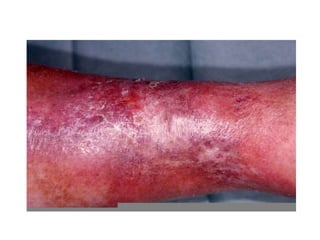
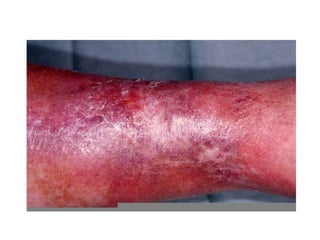
Post thrombotic syndrome
• Due to damage of venous valves and venous
hypertension.
• Leg edema, skin changes( hyperpigmentation
lipodermatosclerosis), pain and stasis ulcer
• Compressing stocking for two years.
• Early ambulation.
Incidence of TVE
• 10-20 % in medical hospitalized patients.
• 15-40 % in surgical hospitalized patients.
3rd most common cuase of
hospital related death in USA
DVT
• Aim of management is to prevent PE & PTS.
• Popliteal vein and above 50 % estimated risk.
• Below(calf vein) 25 %
Virchow's Triad
• Stasis.
• Hyper-coagulability.
• Injury to vessel wall.
Inherited Hyper-coagulability.
• Factor V leiden
• Prothrombin gene mutation (G20210A)
• Protein C and protein S deficiency
• Anti thrombin deficiency
• Hyperhomocysteinemia
• Elevated factor VIII
Aquired Hyper-coagulability.
• Immobilization
• Surgery
• Trauma
• Pregnancy
• OCP & HRT
• Malignancy
• Antiphospholipid
syndrome (lupus
anticoagulant &
anticardiolipin antibodies).
• HIT
• Myeloproliferative
disorders
• Smoking
• Obesity
• Inflammatory bowel
disease
• CVP and pacemakers
• Nephrotic syndrome.
Clinical manifestation
Symptoms of DVT
• Pain
• Swelling
Signs of DVT
• Increased warmth
• Tenderness
• Edema
• Presence of dilated veins
• Erythema
• Cyanosis/gangrene
Various signs
• Homan’s sign
• Louvel’s sign
• Lowenberg’s sign
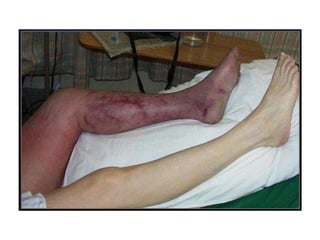
Phlegmasia cerulea dolens
• Complete occlusion of venous outflow.
• Malignancy, HIT, hypercoagulable state.
• Capillary bed hypertension (massive limb swelling).
• Ischemia and necrosis.
• Vascular emergency.
Phlegmasia cerulea dolens
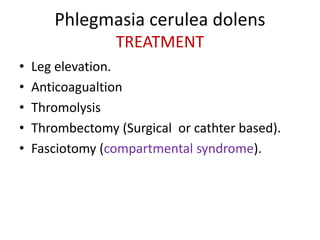
TREATMENT
• Leg elevation.
• Anticoagualtion
• Thromolysis
• Thrombectomy (Surgical or cathter based).
• Fasciotomy (compartmental syndrome).
DVT diagnosis
• Clinical.
• Pretest probability (Wells score).
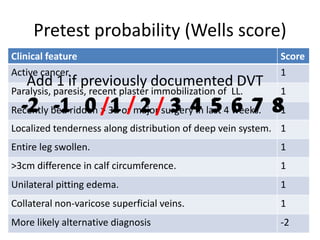
Pretest probability (Wells score)
Clinical feature Score
Active cancer. 1
Paralysis, paresis, recent plaster immobilization of LL. 1
Recently bed ridden > 3d or major surgery in last 4 weeks. 1
Localized tenderness along distribution of deep vein system. 1
Entire leg swollen. 1
>3cm difference in calf circumference. 1
Unilateral pitting edema. 1
Collateral non-varicose superficial veins. 1
More likely alternative diagnosis -2
-2 -1 0 /1 2 / 3 4 5 6 7 8
Add 1 if previously documented DVT
-2 -1 0 1 / 2 3 4 5 6 7 8
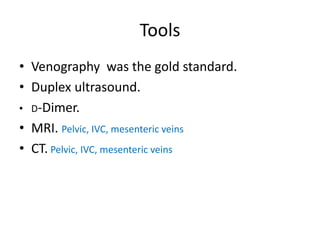
Tools
• Venography was the gold standard.
• Duplex ultrasound.
• D-Dimer.
• MRI. Pelvic, IVC, mesenteric veins
• CT. Pelvic, IVC, mesenteric veins
Venography
• Was/ has been/ used to be …… gold standard.
• Filling defects intra-luminal.
• Abrupt cutoff
• Non filling of the deep system
• Collaterals.
• Contrast /radiology hazards
Duplex ultrasound
• 95 % sensitivity and 98 % specificity.
• Non-compressibility is diagnostic but difficult
in iliac and abductor canal.
• Venous distension, decreased or absent
spontaneous flow.
• Difficult with recurrent DVT.
• Pelvic mass cause non-compressibility of
common femoral vein
Treatment
• Goal: relief symptoms
• Prevent PE, CTPH, PTS.
• Start anticoagulation at once
• Heparin 80 IU/Kg bolus> 18 U/kg/h IVI
• LMWH
• Fondaparinux.
• Oral anticoagulation.
Fondaparinux
• Indirect Xa inhibitor
• FDA approved for DVT prophylaxis.
• 2.5 mg prophylactic.
• Once daily subcutaneous injection.
• Contraindicated in less than 50 kg in
prophylaxis @ orthopedic and abdominal
surgery.
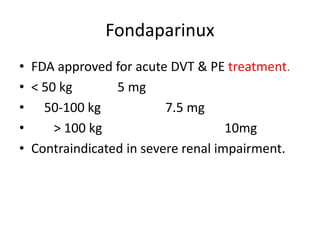
Fondaparinux
• FDA approved for acute DVT & PE treatment.
• < 50 kg 5 mg
• 50-100 kg 7.5 mg
• > 100 kg 10mg
• Contraindicated in severe renal impairment.
Thrombolytic therapy
• In only elected cases (threatened limb)
• Preferably locally via catheter.
• May be for extensive acute proximal DVT.
Vena caval interruption
IVC filter insertion is indicated if
 Contraindicated anticoagulation.
 Complication from anticoagulation.
 Recurrent thrombo-embolization despite
proper anticoagulation.
Vena caval interruption
IVC filter insertion may be indicated if
• Massive pulmonary embolism
• Ileocaval DVT.
• Free floating proximal DVT.
• Cardiac or pulmonary insufficiency.
• High risk anticoagulation as in frequent fall.
• Poor compliance.
Duration of treatment
Dependant on the risk of recurrence.
• Idiopathic DVT
• Hypercoagulable state.
• malignancy.
Duration of treatment
Dependant on the risk of recurrence.
• Old age
• Male sex
• obese
• Elevted D-dimer levels.
• Permanent IVC filter placement.
Duration of treatment
• 3 months of INR 2-3 for 1st DVT due to
transient cause.
• 6-12 months of INR 2-3 for 1st idiopathic DVT.
• For life if recurrent unexplained DVT.
• For life with active malignancy or gene
mutation.
Upper limb DVT
• Often related to CVP and pacemaker insertion.
• Thoracic outlet syndrome.
• Hyper-coagulant states including malignancy.
• Same anticoagulation duration.
• Thrombolysis for younger patients with effort
thrombosis.
Superficial venous thrombosis
• Frequently after IV line in upper limb.
• May occur spontaneously.
• Generally no anticoagulation.
• Unless propagated to deep system or
spontaneous.
• Heparin/ LMWH/Fondaparinux/ VKA
• Four weeks.
Post thrombotic syndrome
• Due to damage of venous valves and venous
hypertension.
• Leg edema, skin changes( hyperpigmentation
lipodermatosclerosis), pain and stasis ulcer
• Compressing stocking for two years.
• Early ambulation.
Heparin induced thrombocytopenia
• 3-5 % unfractionated heparin.
• < 1 % LMWH.
• Immunoglobulin G antibody to heparin.
platelet factor 4 complex.
• 5-14 day after exposure to heparin.
• Isolated or thrombotic.
• Stop any heparin
Deep vein thrombosis1

Deep vein thrombosis1

  • 2.
    Deep Vein Thrombosis HossamBahy, MD Venous ThromboEbolismDeep Vein Thrombosis & Pulmonary Embolism
  • 3.
    Venous Thrombo-Embolism • Clinicalentity, lethal, recurrent. • Hospitalized and non hospitalized persons. • Long term complication: a. Chronic thrombo-embolic pulmonary hypertension b. Post thrombotic syndrome
  • 4.
    Pulmonary Hypertension • GroupI no known cause or inherited. • Group II with left heart disease. • Group III associated with lung diseases. • Group IV thrombo-embolic • Group V by various other diseases
  • 5.
    Post thrombotic syndrome •Due to damage of venous valves and venous hypertension. • Leg edema, skin changes( hyperpigmentation lipodermatosclerosis), pain and stasis ulcer • Compressing stocking for two years. • Early ambulation.
  • 7.
    Incidence of TVE •10-20 % in medical hospitalized patients. • 15-40 % in surgical hospitalized patients. 3rd most common cuase of hospital related death in USA
  • 8.
    DVT • Aim ofmanagement is to prevent PE & PTS. • Popliteal vein and above 50 % estimated risk. • Below(calf vein) 25 %
  • 9.
    Virchow's Triad • Stasis. •Hyper-coagulability. • Injury to vessel wall.
  • 11.
    Inherited Hyper-coagulability. • FactorV leiden • Prothrombin gene mutation (G20210A) • Protein C and protein S deficiency • Anti thrombin deficiency • Hyperhomocysteinemia • Elevated factor VIII
  • 12.
    Aquired Hyper-coagulability. • Immobilization •Surgery • Trauma • Pregnancy • OCP & HRT • Malignancy • Antiphospholipid syndrome (lupus anticoagulant & anticardiolipin antibodies). • HIT • Myeloproliferative disorders • Smoking • Obesity • Inflammatory bowel disease • CVP and pacemakers • Nephrotic syndrome.
  • 13.
  • 14.
    Symptoms of DVT •Pain • Swelling
  • 15.
    Signs of DVT •Increased warmth • Tenderness • Edema • Presence of dilated veins • Erythema • Cyanosis/gangrene
  • 16.
    Various signs • Homan’ssign • Louvel’s sign • Lowenberg’s sign
  • 17.
    Phlegmasia cerulea dolens •Complete occlusion of venous outflow. • Malignancy, HIT, hypercoagulable state. • Capillary bed hypertension (massive limb swelling). • Ischemia and necrosis. • Vascular emergency.
  • 19.
    Phlegmasia cerulea dolens TREATMENT •Leg elevation. • Anticoagualtion • Thromolysis • Thrombectomy (Surgical or cathter based). • Fasciotomy (compartmental syndrome).
  • 20.
    DVT diagnosis • Clinical. •Pretest probability (Wells score).
  • 21.
    Pretest probability (Wellsscore) Clinical feature Score Active cancer. 1 Paralysis, paresis, recent plaster immobilization of LL. 1 Recently bed ridden > 3d or major surgery in last 4 weeks. 1 Localized tenderness along distribution of deep vein system. 1 Entire leg swollen. 1 >3cm difference in calf circumference. 1 Unilateral pitting edema. 1 Collateral non-varicose superficial veins. 1 More likely alternative diagnosis -2 -2 -1 0 /1 2 / 3 4 5 6 7 8 Add 1 if previously documented DVT -2 -1 0 1 / 2 3 4 5 6 7 8
  • 22.
    Tools • Venography wasthe gold standard. • Duplex ultrasound. • D-Dimer. • MRI. Pelvic, IVC, mesenteric veins • CT. Pelvic, IVC, mesenteric veins
  • 23.
    Venography • Was/ hasbeen/ used to be …… gold standard. • Filling defects intra-luminal. • Abrupt cutoff • Non filling of the deep system • Collaterals. • Contrast /radiology hazards
  • 24.
    Duplex ultrasound • 95% sensitivity and 98 % specificity. • Non-compressibility is diagnostic but difficult in iliac and abductor canal. • Venous distension, decreased or absent spontaneous flow. • Difficult with recurrent DVT. • Pelvic mass cause non-compressibility of common femoral vein
  • 25.
    Treatment • Goal: reliefsymptoms • Prevent PE, CTPH, PTS. • Start anticoagulation at once • Heparin 80 IU/Kg bolus> 18 U/kg/h IVI • LMWH • Fondaparinux. • Oral anticoagulation.
  • 26.
    Fondaparinux • Indirect Xainhibitor • FDA approved for DVT prophylaxis. • 2.5 mg prophylactic. • Once daily subcutaneous injection. • Contraindicated in less than 50 kg in prophylaxis @ orthopedic and abdominal surgery.
  • 27.
    Fondaparinux • FDA approvedfor acute DVT & PE treatment. • < 50 kg 5 mg • 50-100 kg 7.5 mg • > 100 kg 10mg • Contraindicated in severe renal impairment.
  • 28.
    Thrombolytic therapy • Inonly elected cases (threatened limb) • Preferably locally via catheter. • May be for extensive acute proximal DVT.
  • 29.
    Vena caval interruption IVCfilter insertion is indicated if  Contraindicated anticoagulation.  Complication from anticoagulation.  Recurrent thrombo-embolization despite proper anticoagulation.
  • 30.
    Vena caval interruption IVCfilter insertion may be indicated if • Massive pulmonary embolism • Ileocaval DVT. • Free floating proximal DVT. • Cardiac or pulmonary insufficiency. • High risk anticoagulation as in frequent fall. • Poor compliance.
  • 31.
    Duration of treatment Dependanton the risk of recurrence. • Idiopathic DVT • Hypercoagulable state. • malignancy.
  • 32.
    Duration of treatment Dependanton the risk of recurrence. • Old age • Male sex • obese • Elevted D-dimer levels. • Permanent IVC filter placement.
  • 33.
    Duration of treatment •3 months of INR 2-3 for 1st DVT due to transient cause. • 6-12 months of INR 2-3 for 1st idiopathic DVT. • For life if recurrent unexplained DVT. • For life with active malignancy or gene mutation.
  • 34.
    Upper limb DVT •Often related to CVP and pacemaker insertion. • Thoracic outlet syndrome. • Hyper-coagulant states including malignancy. • Same anticoagulation duration. • Thrombolysis for younger patients with effort thrombosis.
  • 35.
    Superficial venous thrombosis •Frequently after IV line in upper limb. • May occur spontaneously. • Generally no anticoagulation. • Unless propagated to deep system or spontaneous. • Heparin/ LMWH/Fondaparinux/ VKA • Four weeks.
  • 36.
    Post thrombotic syndrome •Due to damage of venous valves and venous hypertension. • Leg edema, skin changes( hyperpigmentation lipodermatosclerosis), pain and stasis ulcer • Compressing stocking for two years. • Early ambulation.
  • 38.
    Heparin induced thrombocytopenia •3-5 % unfractionated heparin. • < 1 % LMWH. • Immunoglobulin G antibody to heparin. platelet factor 4 complex. • 5-14 day after exposure to heparin. • Isolated or thrombotic. • Stop any heparin