DESTINATIONS
(updated January 2015)
Sourced from the Lesson Plan for Principles of Tourism II
OBJECTIVES
 Explain the nature and roles of destinations in
the wider tourism industry
 Identify the range of destinations that exist
 Discuss a number of forces in the external
environment impacting on their future.
 Discuss the means by which destinations are
managed and marketed
UNIT TOPICS
 The Nature and Role of Destinations
 Destination Types
-(Coastal destinations, Urban destinations, Rural destinations)
 The Key Features of a Tourist Destinations
 Destination Competitiveness
 Destination Management and Marketing
(Destination collaboration, Destination management, organization (DMO’s))
DEFINITION OF TERMS
DESTINATIONS
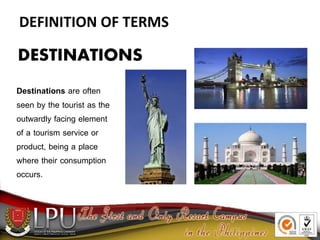
Destinations are often
seen by the tourist as the
outwardly facing element
of a tourism service or
product, being a place
where their consumption
occurs.
DEFINITION OF DESTINATION
Destination (main destination) of a trip
The main destination of a tourism trip is
defined as the place visited that is central to
the decision to take the trip. See also purpose
of a tourism trip.
Sourced from
http://media.unwto.org/en/content/understanding-
tourism-basic-glossary
11/14/12
Bierman (2003, P.2) defines a destination
as a “country, state, region, city or town
which is marketed or markets itself as a
place for tourists to visit.”
Destinations are naturally formed or or can
be constructed.
Source: http://wikieducator.org/Tourtist_Destinations
11/14/12
DEFINITION OF DESTINATION
THE NATURE AND ROLE OF DESTINATIONS
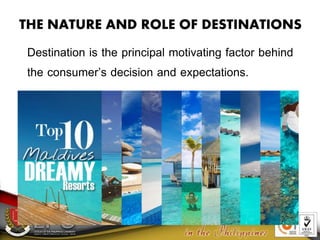
Destination is the principal motivating factor behind
the consumer’s decision and expectations.
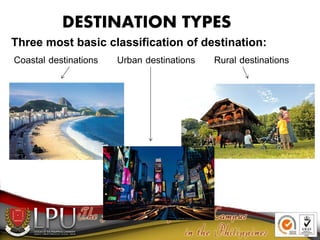
DESTINATION TYPES
Three most basic classification of destination:
Coastal destinations Urban destinations Rural destinations
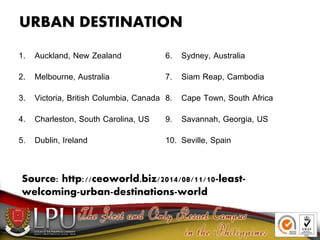
URBAN DESTINATION
1. Auckland, New Zealand
2. Melbourne, Australia
3. Victoria, British Columbia, Canada
4. Charleston, South Carolina, US
5. Dublin, Ireland
6. Sydney, Australia
7. Siam Reap, Cambodia
8. Cape Town, South Africa
9. Savannah, Georgia, US
10. Seville, Spain
Source: http://ceoworld.biz/2014/08/11/10-least-
welcoming-urban-destinations-world
PHILIPPINE URBAN DESTINATION
1. Cebu City (Queen City of the South)
2. National Capital Region (Makati City, Manila City, Taguig City,
Ortigas Area, Eastwood, etc)
3. San Fernando City, La Union
4. Davao City, Davao
5. Bacolod, Negros Occidental
6. Subic Bay Freeport
7. Baguio City
8. Laoag City, Ilocos Norte
9. Dumaguete City, Negros Oriental
RURAL DESTINATIONS
http://www.hotelclub.com/blog/top-7-rural-destinations-in-the-world/
7. Austria
6. Florina, West Macedonia
5. Durbuy, Belgium, (Known for a long time as the
smallest city in the world)
4. New Zealand
3. Essaouira (Located on the Atlantic coast of
Morocco)
2. An enchanting little village in Latvia, Kuldiga
1. the villages of Romania are probably the uncovered
jewels of Eastern Europe
PHILIPPINE RURAL DESTINATIONS
http://en.wikipilipinas.org/index.php/Top_10_Travel_Destinations/
1. Coron Island, Palawan
2. Camsur Watersports Complex, Camarines Sur
3. Anawagin Cove, Zambales
4. Baler, Aurora
5. El Nido, Palawan
6. 8 Waves Water Park, Bulacan
7. Cebu
8. Davao
9. Ilocos
10. Bohol
11. Dongsol, Sorsogon
KEY FEATURES OF TOURIST DESTINATIONS
Logical geographical unit recognized by visitors
Containing significant visitor attractions
Access or possible provision of access
Internal transport network
Tourist infrastructure and superstructure are
present or can be developed
Administratively possible to plan and manage
DESTINATION COMPETITIVENESS
 The competitiveness of a destination refers to ‘its ability to
complete effectively and profitability in the marketplace, while the
successful management of a destination involves a balance with
an increasing need for sensitive environmental management
capabilities.
 The comparative advantage of a destination refers to a
destination’s ability to manage its natural and man-made
resources effectively over the long term.
 Destinations need to be aware of both demand and supply
factors in order to remain competitive.
DESTINATION MANAGEMENT
AND MARKETING
Destination collaboration
Fyall and Garrod (2005) highlight a number of advantages that
exist with respect to collaboration within among destination.
These include:
 Reduction of risk through strength in numbers and interconnectedness
within and across destination
 Efficient and effective exchange of resources for perceived mutual
benefit
 The generation of increased visitor flows and positive economic
impacts
 The potential for collaborative initiatives to counter
the threat of channel intermediary powers
 In peripheral locations, collaboration serving as a
significant vehicle o broaden the destination domain
 The potential to develop destination-wide reservation
systems and two-way dialogue with customers
through technology collaboration
 Collaboration on the internet
Destination collaboration, continued
DESTINATION MANAGEMENT ORGANIZATIONS
A destination management organization or company (DMC or
DMO) is a term for a professional services company possessing
extensive local knowledge, expertise, and resources
specializing in the design and implementation of events,
activities, tours, transportation and program logistics.
These services can be transportation, hotel accommodation,
restaurants, activities, excursions, conference venues, themed
events, incentive schemes as well helping with overcoming
language barriers.
DMC’s or DMOs may operate in one or more locations. Some will focus only a
single city, state or country while others cover a wide range of geographical
locations.
11/14/12
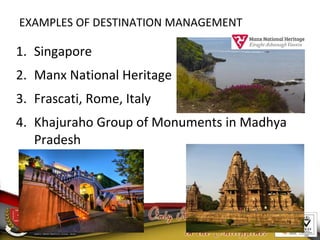
EXAMPLES OF DESTINATION MANAGEMENT
1. Singapore
2. Manx National Heritage
3. Frascati, Rome, Italy
4. Khajuraho Group of Monuments in Madhya
Pradesh
11/14/12
BRIEF HISTORY OF DMO OR DMC
Sourced from: http://pdf.usaid.gov/pdf_docs/PNADL944.pdf
During the 1970’s, as a response to meeting and convention planners’ desire
for custom group leisure activities during their programs, a new business
was born. They are initially referred to as ‘Ground Operators,’ and the first
small entrepreneurial enterprises operated in a single destination. These
local companies offered basic services including airport meet-and-greet,
transportation, tours, and recreational activities for groups. Soon after,
numerous other companies added custom parties and themed events, as
well as spouse and guest programs to their list of services. The term
“Destination Management Company” or DMC was coined to describe the
expanded role these companies played as local experts. Leading DMC
pioneers formed alliances to provide networking and referrals within an
exclusive group.
11/14/12
WHO ARE THEIR CLIENTS?
A DMC’S preferred route is to become an expert in
serving the needs of one of the market niches listed
below:
• Tour Programs • Foreign Independent Tours (FITs)
• Cruise/River Boats and Barge Ship excursions
• Association meetings • Incentive Programs
• Meeting Planning • Theme Parties/Event production
• Religious programs • The Film industry/rock stars
• Government Agencies (NGOs)/Embassies
11/14/12
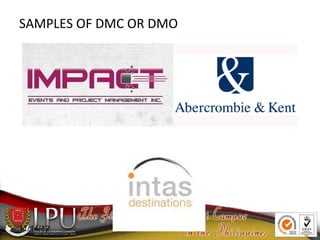
SAMPLES OF DMC OR DMO
11/14/12
DESTINATION MANAGEMENT ORGANIZATION (DMOs)
Ritchie and Crouch (2003) advocates that DMO are constituted in a manner
that provides them with the following characteristics:
 be clearly identifiable as the organization responsible or coordinating and directing the
efforts of the many parts of the diverse and complex tourism system
 Command the support of all important sectors and all major actors in the tourism
system
 Be capable of influencing the decisions and actions of the many public sector
agencies/departments and private firms that directly determine the nature and quality
of the tourism experience provided to visitors
 Possess the tools necessary to stimulate and encourage the type and amount of
supply development that is required by the overall tourism megapolicy
 Be sufficiently independent and flexible to develop innovative strategies that can be
implemented in a timely manner in response to rapidly evolving market and
environmental conditions.
ROLES of Destination management organizations
1. Strategy and planning/policy;
2. Representation of interest
3. Product development;
4. Marketing
5. Skills/training
6. Infrastructure development
7. Collection and management of information and research;
8. Sustainability;
9. Business support and advice;
10. Coherence, communication and the management of quality; and
11. The creation of a strong unified voice for the local industry.
Poetschk (1995) identifies four critical factors for success
with regard to the governance of Destination Management
Organization of globally competitive destinations:
1. A significant level of private sector control over spending;
2. Understanding of the need to incorporate public sector objectives
to achieve a balance between marketing and new product
development;
3. A dedicated revenue stream that is not subject to annual
government control; and
4. A broad integrated mandate encompassing a function critical to
developing a strong tourism industry, such as marketing
education, research and infrastructure development.

Destinations

  • 1.
    DESTINATIONS (updated January 2015) Sourcedfrom the Lesson Plan for Principles of Tourism II
  • 2.
    OBJECTIVES  Explain thenature and roles of destinations in the wider tourism industry  Identify the range of destinations that exist  Discuss a number of forces in the external environment impacting on their future.  Discuss the means by which destinations are managed and marketed
  • 3.
    UNIT TOPICS  TheNature and Role of Destinations  Destination Types -(Coastal destinations, Urban destinations, Rural destinations)  The Key Features of a Tourist Destinations  Destination Competitiveness  Destination Management and Marketing (Destination collaboration, Destination management, organization (DMO’s))
  • 4.
    DEFINITION OF TERMS DESTINATIONS Destinationsare often seen by the tourist as the outwardly facing element of a tourism service or product, being a place where their consumption occurs.
  • 5.
    DEFINITION OF DESTINATION Destination(main destination) of a trip The main destination of a tourism trip is defined as the place visited that is central to the decision to take the trip. See also purpose of a tourism trip. Sourced from http://media.unwto.org/en/content/understanding- tourism-basic-glossary 11/14/12
  • 6.
    Bierman (2003, P.2)defines a destination as a “country, state, region, city or town which is marketed or markets itself as a place for tourists to visit.” Destinations are naturally formed or or can be constructed. Source: http://wikieducator.org/Tourtist_Destinations 11/14/12 DEFINITION OF DESTINATION
  • 7.
    THE NATURE ANDROLE OF DESTINATIONS Destination is the principal motivating factor behind the consumer’s decision and expectations.
  • 8.
    DESTINATION TYPES Three mostbasic classification of destination: Coastal destinations Urban destinations Rural destinations
  • 9.
    URBAN DESTINATION 1. Auckland,New Zealand 2. Melbourne, Australia 3. Victoria, British Columbia, Canada 4. Charleston, South Carolina, US 5. Dublin, Ireland 6. Sydney, Australia 7. Siam Reap, Cambodia 8. Cape Town, South Africa 9. Savannah, Georgia, US 10. Seville, Spain Source: http://ceoworld.biz/2014/08/11/10-least- welcoming-urban-destinations-world
  • 10.
    PHILIPPINE URBAN DESTINATION 1.Cebu City (Queen City of the South) 2. National Capital Region (Makati City, Manila City, Taguig City, Ortigas Area, Eastwood, etc) 3. San Fernando City, La Union 4. Davao City, Davao 5. Bacolod, Negros Occidental 6. Subic Bay Freeport 7. Baguio City 8. Laoag City, Ilocos Norte 9. Dumaguete City, Negros Oriental
  • 11.
    RURAL DESTINATIONS http://www.hotelclub.com/blog/top-7-rural-destinations-in-the-world/ 7. Austria 6.Florina, West Macedonia 5. Durbuy, Belgium, (Known for a long time as the smallest city in the world) 4. New Zealand 3. Essaouira (Located on the Atlantic coast of Morocco) 2. An enchanting little village in Latvia, Kuldiga 1. the villages of Romania are probably the uncovered jewels of Eastern Europe
  • 12.
    PHILIPPINE RURAL DESTINATIONS http://en.wikipilipinas.org/index.php/Top_10_Travel_Destinations/ 1.Coron Island, Palawan 2. Camsur Watersports Complex, Camarines Sur 3. Anawagin Cove, Zambales 4. Baler, Aurora 5. El Nido, Palawan 6. 8 Waves Water Park, Bulacan 7. Cebu 8. Davao 9. Ilocos 10. Bohol 11. Dongsol, Sorsogon
  • 13.
    KEY FEATURES OFTOURIST DESTINATIONS Logical geographical unit recognized by visitors Containing significant visitor attractions Access or possible provision of access Internal transport network Tourist infrastructure and superstructure are present or can be developed Administratively possible to plan and manage
  • 14.
    DESTINATION COMPETITIVENESS  Thecompetitiveness of a destination refers to ‘its ability to complete effectively and profitability in the marketplace, while the successful management of a destination involves a balance with an increasing need for sensitive environmental management capabilities.  The comparative advantage of a destination refers to a destination’s ability to manage its natural and man-made resources effectively over the long term.  Destinations need to be aware of both demand and supply factors in order to remain competitive.
  • 15.
    DESTINATION MANAGEMENT AND MARKETING Destinationcollaboration Fyall and Garrod (2005) highlight a number of advantages that exist with respect to collaboration within among destination. These include:  Reduction of risk through strength in numbers and interconnectedness within and across destination  Efficient and effective exchange of resources for perceived mutual benefit  The generation of increased visitor flows and positive economic impacts
  • 16.
     The potentialfor collaborative initiatives to counter the threat of channel intermediary powers  In peripheral locations, collaboration serving as a significant vehicle o broaden the destination domain  The potential to develop destination-wide reservation systems and two-way dialogue with customers through technology collaboration  Collaboration on the internet Destination collaboration, continued
  • 17.
    DESTINATION MANAGEMENT ORGANIZATIONS Adestination management organization or company (DMC or DMO) is a term for a professional services company possessing extensive local knowledge, expertise, and resources specializing in the design and implementation of events, activities, tours, transportation and program logistics. These services can be transportation, hotel accommodation, restaurants, activities, excursions, conference venues, themed events, incentive schemes as well helping with overcoming language barriers. DMC’s or DMOs may operate in one or more locations. Some will focus only a single city, state or country while others cover a wide range of geographical locations. 11/14/12
  • 18.
    EXAMPLES OF DESTINATIONMANAGEMENT 1. Singapore 2. Manx National Heritage 3. Frascati, Rome, Italy 4. Khajuraho Group of Monuments in Madhya Pradesh 11/14/12
  • 19.
    BRIEF HISTORY OFDMO OR DMC Sourced from: http://pdf.usaid.gov/pdf_docs/PNADL944.pdf During the 1970’s, as a response to meeting and convention planners’ desire for custom group leisure activities during their programs, a new business was born. They are initially referred to as ‘Ground Operators,’ and the first small entrepreneurial enterprises operated in a single destination. These local companies offered basic services including airport meet-and-greet, transportation, tours, and recreational activities for groups. Soon after, numerous other companies added custom parties and themed events, as well as spouse and guest programs to their list of services. The term “Destination Management Company” or DMC was coined to describe the expanded role these companies played as local experts. Leading DMC pioneers formed alliances to provide networking and referrals within an exclusive group. 11/14/12
  • 20.
    WHO ARE THEIRCLIENTS? A DMC’S preferred route is to become an expert in serving the needs of one of the market niches listed below: • Tour Programs • Foreign Independent Tours (FITs) • Cruise/River Boats and Barge Ship excursions • Association meetings • Incentive Programs • Meeting Planning • Theme Parties/Event production • Religious programs • The Film industry/rock stars • Government Agencies (NGOs)/Embassies 11/14/12
  • 21.
    SAMPLES OF DMCOR DMO 11/14/12
  • 23.
    DESTINATION MANAGEMENT ORGANIZATION(DMOs) Ritchie and Crouch (2003) advocates that DMO are constituted in a manner that provides them with the following characteristics:  be clearly identifiable as the organization responsible or coordinating and directing the efforts of the many parts of the diverse and complex tourism system  Command the support of all important sectors and all major actors in the tourism system  Be capable of influencing the decisions and actions of the many public sector agencies/departments and private firms that directly determine the nature and quality of the tourism experience provided to visitors  Possess the tools necessary to stimulate and encourage the type and amount of supply development that is required by the overall tourism megapolicy  Be sufficiently independent and flexible to develop innovative strategies that can be implemented in a timely manner in response to rapidly evolving market and environmental conditions.
  • 24.
    ROLES of Destinationmanagement organizations 1. Strategy and planning/policy; 2. Representation of interest 3. Product development; 4. Marketing 5. Skills/training 6. Infrastructure development 7. Collection and management of information and research; 8. Sustainability; 9. Business support and advice; 10. Coherence, communication and the management of quality; and 11. The creation of a strong unified voice for the local industry.
  • 25.
    Poetschk (1995) identifiesfour critical factors for success with regard to the governance of Destination Management Organization of globally competitive destinations: 1. A significant level of private sector control over spending; 2. Understanding of the need to incorporate public sector objectives to achieve a balance between marketing and new product development; 3. A dedicated revenue stream that is not subject to annual government control; and 4. A broad integrated mandate encompassing a function critical to developing a strong tourism industry, such as marketing education, research and infrastructure development.