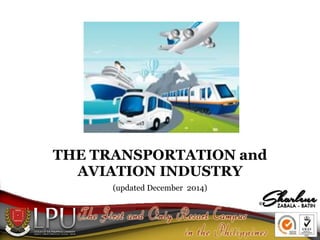
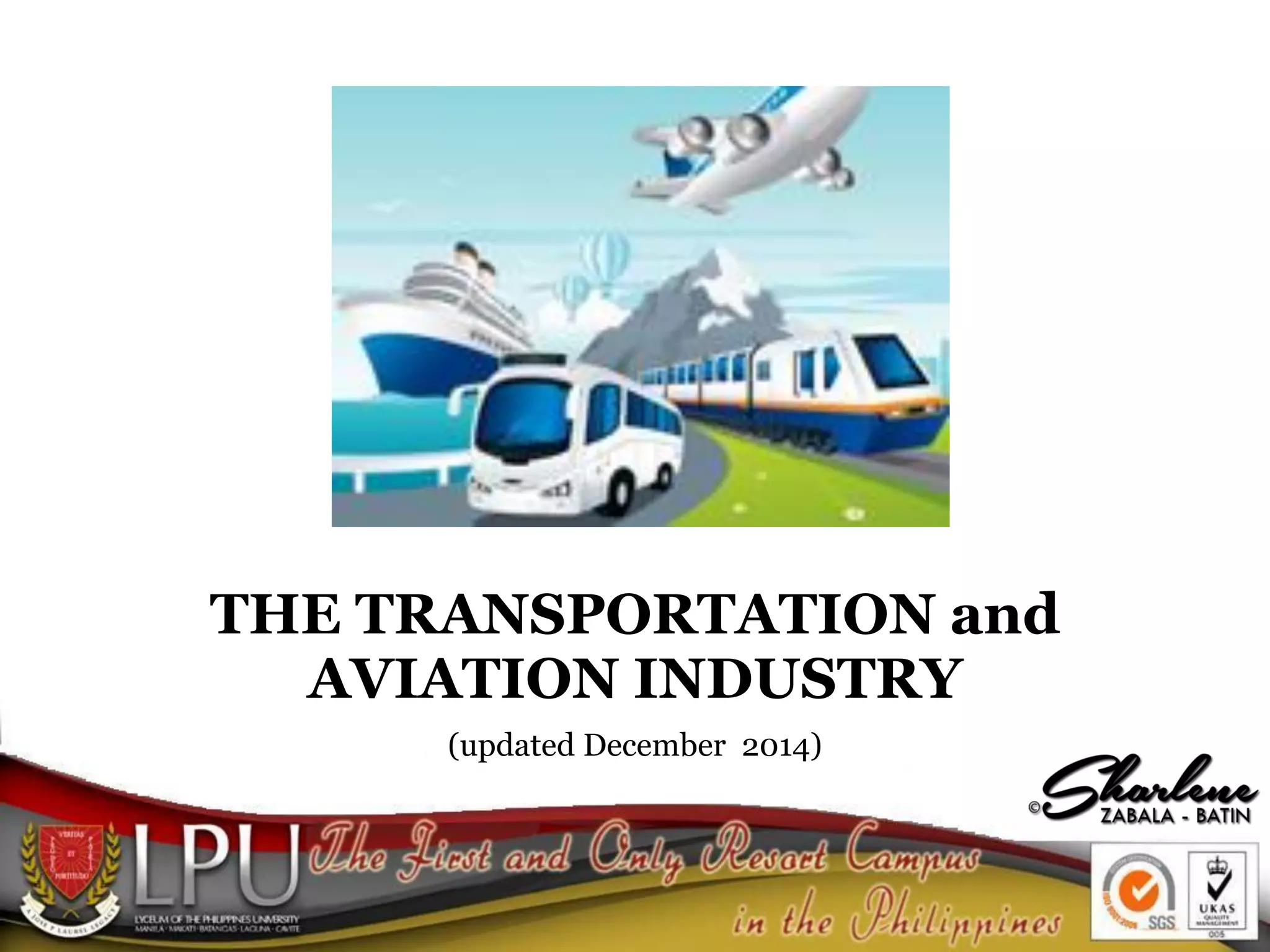
THE TRANSPORTATION and
AVIATION INDUSTRY
(updated December 2014)
UNIT OBJECTIVES:
1. Identify the major modes of transportation for
tourism.
2. Identify the influences of government
regulations or political positions on
transportation for tourism.
3. Analyze the issues and trends that will have
impacts upon transportation for tourism.
TOPICS:
1. Conceptual Framework
2. Land-based Transport
3. Water-based Transport
4. Air Transport
5. Government regulations or political
influences on transport for tourism
6. Future Trends
TRANSPORTATION: DEFINITION
Transportation is a pre-condition for travel. It is
a fundamental component of the tourism
industry.
Transport if frequently neglected in the analysis
of tourism, often being relegated to a passive
element of the tourist experience.
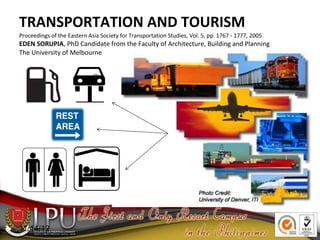
TRANSPORTATION AND TOURISM
Proceedings of the Eastern Asia Society for Transportation Studies, Vol. 5, pp. 1767 - 1777, 2005
EDEN SORUPIA, PhD Candidate from the Faculty of Architecture, Building and Planning
The University of Melbourne
Transportation links the various
destinations and ferries people, goods,
and services.
Tourism is all about travel; and the role of
transportation in its operation is vital.
TRANSPORTATION AND TOURISM
Proceedings of the Eastern Asia Society for Transportation Studies, Vol. 5, pp. 1767 - 1777, 2005
EDEN SORUPIA, PhD Candidate from the Faculty of Architecture, Building and Planning
The University of Melbourne
Transportation is an integral part of the
tourism industry.
It is largely due to the improvement of
transportation that tourism has
expanded.
TRANSPORTATION AND TOURISM
Proceedings of the Eastern Asia Society for Transportation Studies, Vol. 5, pp. 1767 - 1777, 2005
EDEN SORUPIA, PhD Candidate from the Faculty of Architecture, Building and Planning
The University of Melbourne
The advent of flight has shrunk the world, and
the motor vehicle has made travel to
anywhere possible. This reality coupled with
changing work patterns and innovative
marketing has driven international mass
tourism through the years.
11/14/12
TRANSPORTATION AND TOURISM
Proceedings of the Eastern Asia Society for Transportation Studies, Vol. 5, pp. 1767 - 1777, 2005
EDEN SORUPIA, PhD Candidate from the Faculty of Architecture, Building and Planning
The University of Melbourne
11/14/12
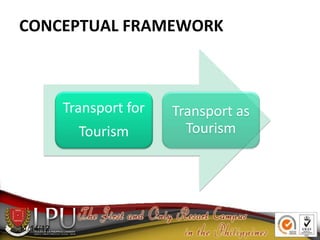
CONCEPTUAL FRAMEWORK
Transport for
Tourism
Transport as
Tourism
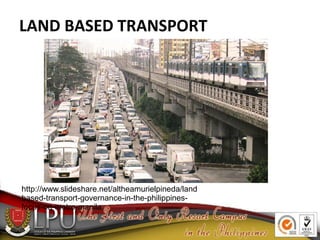
LAND BASED TRANSPORT
http://www.slideshare.net/altheamurielpineda/land
based-transport-governance-in-the-philippines-
focus-on-metro-manila
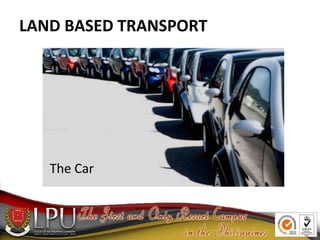
LAND BASED TRANSPORT
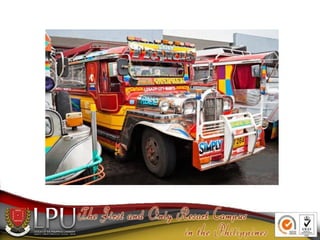
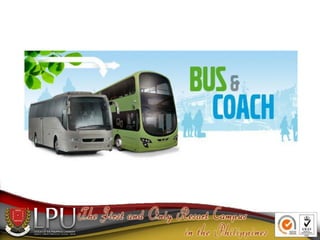
The Car
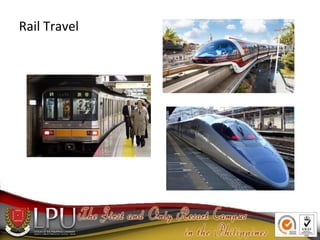
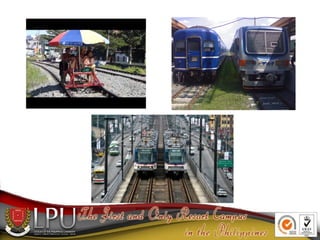
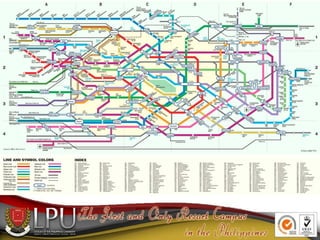
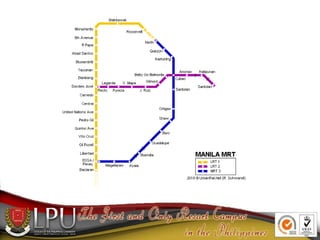
Rail Travel
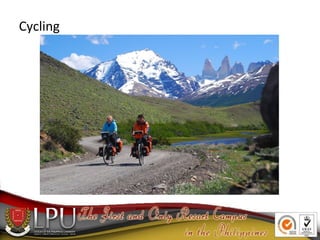
Cycling
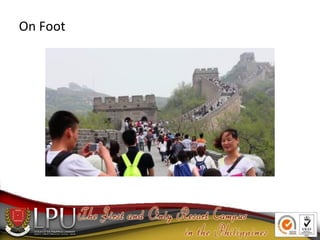
On Foot
Other References:
1. Land based Transport
http://www.slideshare.net/altheamurielpineda/landbased-
transport-governance-in-the-philippines-focus-on-metro-
manila
2. Railways
http://www.mb.com.ph/government-readies-plan-for-6-b-
north-south-commuter-rail-project/Rail system
http://www.mb.com.ph/government-readies-plan-for-6-b-
north-south-commuter-rail-project/
http://www.urbanrail.net/as/mani/manila.htm
http://www.pnr.gov.ph/
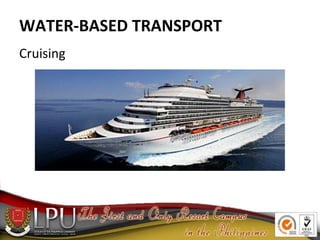
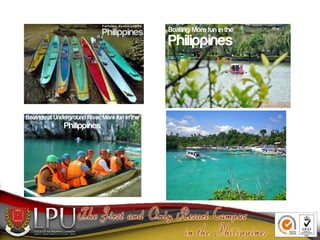
WATER-BASED TRANSPORT
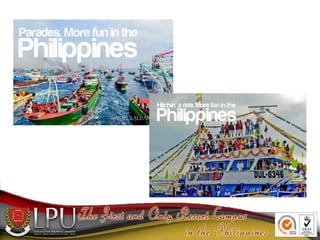
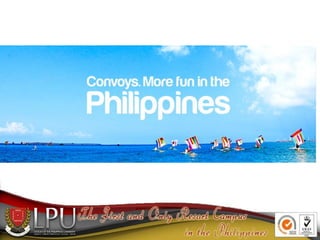
Cruising
Ferries
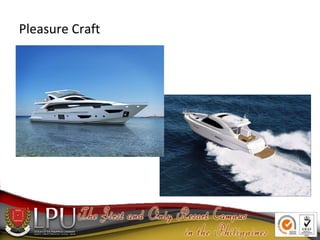
Pleasure Craft
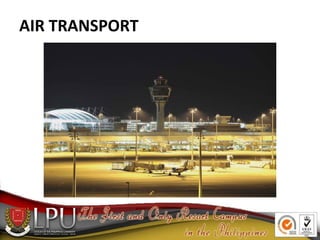
AIR TRANSPORT
Scheduled airlines offer a safe, convenient, reliable,
frequent and relatively consumer oriented product.
Airlines attract business travelers who appreciate
the speed and flexibility between various flights,
especially on popular routes as well as leisure
passengers who enjoy the ability or arrive quickly
and without spending time and money en route.
AIR TRANSPORT
11/14/12
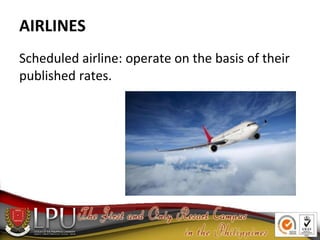
AIRLINES
Scheduled airline: operate on the basis of their
published rates.
11/14/12
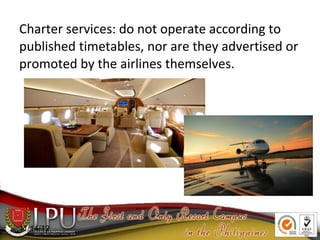
Charter services: do not operate according to
published timetables, nor are they advertised or
promoted by the airlines themselves.
11/14/12
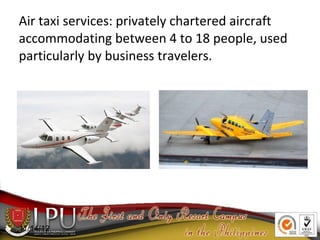
Air taxi services: privately chartered aircraft
accommodating between 4 to 18 people, used
particularly by business travelers.
THE SUCCESS OF LOW COST CARRIERS
• Operation from secondary airports at major
cities or from regional airports
• Standardized fleet, initially of one aircraft
type
• Maximized aircraft capacity
• Minimized in-flight costs
• Reduce sales and distribution cost
11/14/12
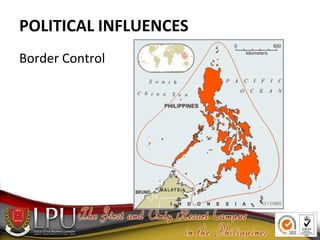
POLITICAL INFLUENCES
Border Control
11/14/12
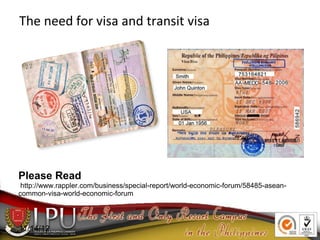
The need for visa and transit visa
Please Read
http://www.rappler.com/business/special-report/world-economic-forum/58485-asean-
common-visa-world-economic-forum
11/14/12
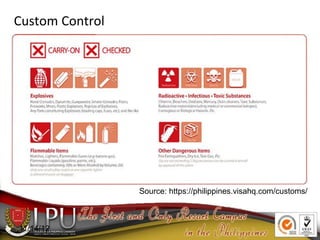
Custom Control
Source: https://philippines.visahq.com/customs/
11/14/12
11/14/12
The Philippines is using e-passport now because we want to
keep up with the world standards of travel documents. Unlike
the MRP which only has the minimum ICAO standards in travel
documents, the ePassport is the world standard in travel
documents. As an ICAO member, the Philippines is obligated
to improve the security of its travel documents.
By issuing of e-passports, the Philippines is giving its citizens a
world-class consular service. Other countries will also honor
and accept this kind of passport because of the biometric
technology. More than 60 countries all over the world are
already using e-passports.
Government Regulations
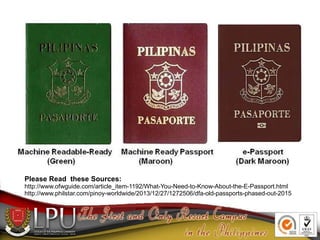
Please Read these Sources:
http://www.ofwguide.com/article_item-1192/What-You-Need-to-Know-About-the-E-Passport.html
http://www.philstar.com/pinoy-worldwide/2013/12/27/1272506/dfa-old-passports-phased-out-2015
GOVERNMENT INTERVENTION OF PNOY:
NEDA identified the following measures to improve the
country’s market access and connectivity:
1. Renegotiate air service agreements
2. Reduce foreign carrier operation costs in the Phils.
3. Simplify border formalities / procedures for key
growth markets
4. Upgrade secondary international airports; and
5. Improve sea and road transportation services
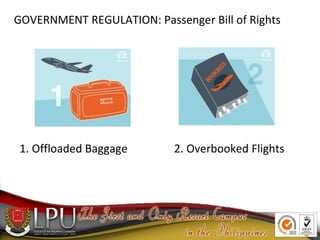
GOVERNMENT REGULATION: Passenger Bill of Rights
1. Offloaded Baggage 2. Overbooked Flights
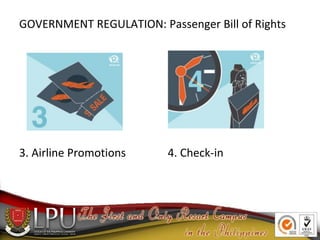
GOVERNMENT REGULATION: Passenger Bill of Rights
3. Airline Promotions 4. Check-in
Please check out these other sources:
http://www.gov.ph/summary-of-the-rights-of-air-passengers/
http://www.rappler.com/business/17691-air-passenger-right-bill-out-in-time-for-
christmas-traffic
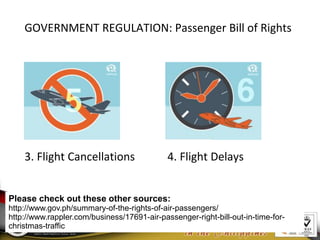
GOVERNMENT REGULATION: Passenger Bill of Rights
3. Flight Cancellations 4. Flight Delays
FUTURE TRENDS
• Efficiency
• Globalization and integration
• Environment policies
11/14/12
11/14/12
Climate change and alternative future transport
When thinking of the warming of the planet, the erratic weather patterns and
the natural disasters that will likely occur and are occurring already, we can
describe global climate change as one of the worst disasters to hit the
humanity.
Furthermore, destinations should expect climate change to have an impact on
tourists’ purchasing trends. We will gradually see new means of transport
gaining ground to the detriment of air traffic: Will tourists be willing to fly
across the ocean if they consider the carbon footprint of their flights?
Travelers may opt for journeys made by train, boat or coaches especially that
these modes are nowadays offering more comfort, great web accessibility
and timetables suitability. In addition, shorter trips within the same
continent or the same geographical region will more likely outweigh the
long ones.
Please Read
1. About airline deregulation in Asia found in “The
Heavens Are Not Free” Chapter 3 ASEAN Coming
Together in the Skies page 58 – 73
SOURCE: http://www.helvidius.org/wp-
content/uploads/2014/06/Airline-Deregulation.pdf
2. Air traffic/service agreements
http://www.infrastructure.gov.au/aviation/international/bil
ateral_system.aspx
http://www.routesonline.com/news/29/breaking-
news/240567/revised-air-service-agreement-opens-
door-to-more-flights-between-japan-and-philippines/
3. On Rethinking the Role of Transportation in Tourism
http://www.easts.info/on-line/proceedings_05/1767.pdf
/#.VIZpbjGUdqV
Please Read
5. On unique Filipino modes of transportation
http://www.tripsiders.com/blog/10-unique-modes-
transportation-philippines/#.VIZpbjGUdqV
6. On sustainable tourism transportation
http://books.google.com.ph/books?id=st-
PAgAAQBAJ&pg=PA269&lpg=PA269&dq=sustainable+tourism+transportat
ion&source=bl&ots=l0KI1Js__1&sig=L5Hk8JkTlcBwDCweVQwqHdE9zyg&
hl=en&sa=X&ei=KRKDVO6LCcPVoATQwoJQ&ved=0CGwQ6AEwCTgK#v
=onepage&q=sustainable%20tourism%20transportation&f=false
http://www.sewta.gov.uk/uploads/documents/107/original/Sustainable_Tran
sport_within_Tourism_-_July_2012.pdf?1349968257
7. On Bike Tourism
http://bicycletouringpro.com/blog/history-of-bicycle-
touring/
11/14/12
Please Read
8. On Defunct Airlines in the Philippines
https://airlinenewsphilippines.wordpress.com/defunct-airlines-in-
ph/
9. List of airports
https://airlinenewsphilippines.wordpress.com/xxx/
10. The government’s economic policy under PNOy
http://www.iiss.org/en/events/events/archive/2014-0f13/february-
e91c/fullerton-lecture-purisima-3d1d
AIR-BASED TRANSPORTATION SOURCES:
COMMERCIAL FLIGHT HISTORY: http://www.space.com/16657-
worlds-first-commercial-airline-the-greatest-moments-in-
flight.html
COMMERCIAL FLIGHT TIMELINE:
http://www.burnsmcd.com/Aviation-Special-
Report/Article/Timeline-of-Commercial-Aviation
ICAO LIST OF AIRLINES AND THEIR OWNERSHIP
http://www.icao.int/sustainability/Documents/PrivatizedAirlines.
pdf

The Transportation & Aviation Industry

  • 1.
    THE TRANSPORTATION and AVIATIONINDUSTRY (updated December 2014)
  • 2.
    UNIT OBJECTIVES: 1. Identifythe major modes of transportation for tourism. 2. Identify the influences of government regulations or political positions on transportation for tourism. 3. Analyze the issues and trends that will have impacts upon transportation for tourism.
  • 3.
    TOPICS: 1. Conceptual Framework 2.Land-based Transport 3. Water-based Transport 4. Air Transport 5. Government regulations or political influences on transport for tourism 6. Future Trends
  • 4.
    TRANSPORTATION: DEFINITION Transportation isa pre-condition for travel. It is a fundamental component of the tourism industry. Transport if frequently neglected in the analysis of tourism, often being relegated to a passive element of the tourist experience.
  • 5.
    TRANSPORTATION AND TOURISM Proceedingsof the Eastern Asia Society for Transportation Studies, Vol. 5, pp. 1767 - 1777, 2005 EDEN SORUPIA, PhD Candidate from the Faculty of Architecture, Building and Planning The University of Melbourne Transportation links the various destinations and ferries people, goods, and services. Tourism is all about travel; and the role of transportation in its operation is vital.
  • 6.
    TRANSPORTATION AND TOURISM Proceedingsof the Eastern Asia Society for Transportation Studies, Vol. 5, pp. 1767 - 1777, 2005 EDEN SORUPIA, PhD Candidate from the Faculty of Architecture, Building and Planning The University of Melbourne Transportation is an integral part of the tourism industry. It is largely due to the improvement of transportation that tourism has expanded.
  • 7.
    TRANSPORTATION AND TOURISM Proceedingsof the Eastern Asia Society for Transportation Studies, Vol. 5, pp. 1767 - 1777, 2005 EDEN SORUPIA, PhD Candidate from the Faculty of Architecture, Building and Planning The University of Melbourne The advent of flight has shrunk the world, and the motor vehicle has made travel to anywhere possible. This reality coupled with changing work patterns and innovative marketing has driven international mass tourism through the years.
  • 8.
    11/14/12 TRANSPORTATION AND TOURISM Proceedingsof the Eastern Asia Society for Transportation Studies, Vol. 5, pp. 1767 - 1777, 2005 EDEN SORUPIA, PhD Candidate from the Faculty of Architecture, Building and Planning The University of Melbourne
  • 9.
  • 10.
  • 11.
  • 14.
  • 18.
  • 19.
  • 20.
    Other References: 1. Landbased Transport http://www.slideshare.net/altheamurielpineda/landbased- transport-governance-in-the-philippines-focus-on-metro- manila 2. Railways http://www.mb.com.ph/government-readies-plan-for-6-b- north-south-commuter-rail-project/Rail system http://www.mb.com.ph/government-readies-plan-for-6-b- north-south-commuter-rail-project/ http://www.urbanrail.net/as/mani/manila.htm http://www.pnr.gov.ph/
  • 21.
  • 22.
  • 23.
  • 27.
    AIR TRANSPORT Scheduled airlinesoffer a safe, convenient, reliable, frequent and relatively consumer oriented product. Airlines attract business travelers who appreciate the speed and flexibility between various flights, especially on popular routes as well as leisure passengers who enjoy the ability or arrive quickly and without spending time and money en route.
  • 28.
  • 29.
  • 30.
    AIRLINES Scheduled airline: operateon the basis of their published rates.
  • 31.
    11/14/12 Charter services: donot operate according to published timetables, nor are they advertised or promoted by the airlines themselves.
  • 32.
    11/14/12 Air taxi services:privately chartered aircraft accommodating between 4 to 18 people, used particularly by business travelers.
  • 33.
    THE SUCCESS OFLOW COST CARRIERS • Operation from secondary airports at major cities or from regional airports • Standardized fleet, initially of one aircraft type • Maximized aircraft capacity • Minimized in-flight costs • Reduce sales and distribution cost
  • 34.
  • 35.
  • 36.
    11/14/12 The need forvisa and transit visa Please Read http://www.rappler.com/business/special-report/world-economic-forum/58485-asean- common-visa-world-economic-forum
  • 37.
  • 38.
  • 39.
    11/14/12 The Philippines isusing e-passport now because we want to keep up with the world standards of travel documents. Unlike the MRP which only has the minimum ICAO standards in travel documents, the ePassport is the world standard in travel documents. As an ICAO member, the Philippines is obligated to improve the security of its travel documents. By issuing of e-passports, the Philippines is giving its citizens a world-class consular service. Other countries will also honor and accept this kind of passport because of the biometric technology. More than 60 countries all over the world are already using e-passports. Government Regulations
  • 40.
    Please Read theseSources: http://www.ofwguide.com/article_item-1192/What-You-Need-to-Know-About-the-E-Passport.html http://www.philstar.com/pinoy-worldwide/2013/12/27/1272506/dfa-old-passports-phased-out-2015
  • 41.
    GOVERNMENT INTERVENTION OFPNOY: NEDA identified the following measures to improve the country’s market access and connectivity: 1. Renegotiate air service agreements 2. Reduce foreign carrier operation costs in the Phils. 3. Simplify border formalities / procedures for key growth markets 4. Upgrade secondary international airports; and 5. Improve sea and road transportation services
  • 42.
    GOVERNMENT REGULATION: PassengerBill of Rights 1. Offloaded Baggage 2. Overbooked Flights
  • 43.
    GOVERNMENT REGULATION: PassengerBill of Rights 3. Airline Promotions 4. Check-in
  • 44.
    Please check outthese other sources: http://www.gov.ph/summary-of-the-rights-of-air-passengers/ http://www.rappler.com/business/17691-air-passenger-right-bill-out-in-time-for- christmas-traffic GOVERNMENT REGULATION: Passenger Bill of Rights 3. Flight Cancellations 4. Flight Delays
  • 45.
    FUTURE TRENDS • Efficiency •Globalization and integration • Environment policies
  • 46.
  • 47.
  • 48.
    Climate change andalternative future transport When thinking of the warming of the planet, the erratic weather patterns and the natural disasters that will likely occur and are occurring already, we can describe global climate change as one of the worst disasters to hit the humanity. Furthermore, destinations should expect climate change to have an impact on tourists’ purchasing trends. We will gradually see new means of transport gaining ground to the detriment of air traffic: Will tourists be willing to fly across the ocean if they consider the carbon footprint of their flights? Travelers may opt for journeys made by train, boat or coaches especially that these modes are nowadays offering more comfort, great web accessibility and timetables suitability. In addition, shorter trips within the same continent or the same geographical region will more likely outweigh the long ones.
  • 49.
    Please Read 1. Aboutairline deregulation in Asia found in “The Heavens Are Not Free” Chapter 3 ASEAN Coming Together in the Skies page 58 – 73 SOURCE: http://www.helvidius.org/wp- content/uploads/2014/06/Airline-Deregulation.pdf 2. Air traffic/service agreements http://www.infrastructure.gov.au/aviation/international/bil ateral_system.aspx http://www.routesonline.com/news/29/breaking- news/240567/revised-air-service-agreement-opens- door-to-more-flights-between-japan-and-philippines/ 3. On Rethinking the Role of Transportation in Tourism http://www.easts.info/on-line/proceedings_05/1767.pdf /#.VIZpbjGUdqV
  • 50.
    Please Read 5. Onunique Filipino modes of transportation http://www.tripsiders.com/blog/10-unique-modes- transportation-philippines/#.VIZpbjGUdqV 6. On sustainable tourism transportation http://books.google.com.ph/books?id=st- PAgAAQBAJ&pg=PA269&lpg=PA269&dq=sustainable+tourism+transportat ion&source=bl&ots=l0KI1Js__1&sig=L5Hk8JkTlcBwDCweVQwqHdE9zyg& hl=en&sa=X&ei=KRKDVO6LCcPVoATQwoJQ&ved=0CGwQ6AEwCTgK#v =onepage&q=sustainable%20tourism%20transportation&f=false http://www.sewta.gov.uk/uploads/documents/107/original/Sustainable_Tran sport_within_Tourism_-_July_2012.pdf?1349968257 7. On Bike Tourism http://bicycletouringpro.com/blog/history-of-bicycle- touring/
  • 51.
    11/14/12 Please Read 8. OnDefunct Airlines in the Philippines https://airlinenewsphilippines.wordpress.com/defunct-airlines-in- ph/ 9. List of airports https://airlinenewsphilippines.wordpress.com/xxx/ 10. The government’s economic policy under PNOy http://www.iiss.org/en/events/events/archive/2014-0f13/february- e91c/fullerton-lecture-purisima-3d1d
  • 52.
    AIR-BASED TRANSPORTATION SOURCES: COMMERCIALFLIGHT HISTORY: http://www.space.com/16657- worlds-first-commercial-airline-the-greatest-moments-in- flight.html COMMERCIAL FLIGHT TIMELINE: http://www.burnsmcd.com/Aviation-Special- Report/Article/Timeline-of-Commercial-Aviation ICAO LIST OF AIRLINES AND THEIR OWNERSHIP http://www.icao.int/sustainability/Documents/PrivatizedAirlines. pdf