ATTRACTIONS

PREPARED BY: MA'AM
L








where the main purpose is sightseeing
A
permanent
established
excursion
destination
Primary purpose is to allow access for
entertainment, interest or education
Must be open to the public without prior booking
Capable of attracting day visitors or tourists as
well as the local residents
Acc to PEARCE (1991)
“a tourist attraction is a named site with
specific human or natural feature which is
the focus of visitor and management
attention”
Acc to SWARBROOKE (2002)
“attractions are generally single units based on
a single key feature... destination are larger
areas that include a number of individual
attractions”
CLASSIFICATION
OF
ATTRACTIONS
TYPE










Historical house
Museums and galleries
Wildlife attractions
Castles
Gardens
Steam railways
Visitor centers
Country parks
Leisure parks
PHYSICAL ENVIRONMENT





Natural environment
Built made and adapted but not originally
designed for visitor purposes
Built environment and designed for visitor
purpose
OWNERSHIP




Attraction are owned and managed by a range of
organizations, trusts and individuals, working in
the public, private and not-for profit sectors.
A high level of state involvement in attraction
funding is evident across Europe and in other
parts of the world like Canada and Singapore.
PERCEPTION


Some visitors may perceive an attraction as an
atttraction but others may not.

Acc to MILLAR (1999)
-what undeniably turns a tract of land, monument,
park, historic house or coastline into a heritage
attraction is often the attitude of the public-
ADMISSION POLICY




Attractions operated by membership subscription
organizations allow members in for no charge.
Other attractions operate friends' schemes, which
allow subscribers free entry. Voluntary donations
are requested in other attractions.
APPEAL




The market appeal of attractions can be viewed
at a geographic level, where attractions might
appeal: just to local market, regionally, nationally
or internationally.
Certain attractions may only appeal to niche
markets, or particular market segments
SIZE AND CAPACITY




Attractions vary in land coverage, with some
housed in tiny buildings and others covering
several hectares.
Understanding the capacity of sites is important in
terms of management and marketing, as well as
protection of the resource base, which may be
damaged as a result of poor visitor management.






ENVIRONMENTAL – physical space and no.
of people in a particular space
ECOLOGICAL – threshold measure, which if
exceeded will lead to actual damage of habitat
PERCEPTUAL – level of crowding that a
tourist is willing to tolerate before deciding to go
elsewhere.
COMPOSITION




Many attractions are nodal in character, located at
or around a specific point or feature
Events may also be nodal, fixed in one venue, or
may occur at a variety of locations as part of a
festival.
DEGREE OF PERFORMANCE




In case of events and festivals, a short duration is
expected and temporary sites, buildings or a
mobile infrastucture are often used.
Sporadic non-permanent natural events, which are
neither designed nor staged for visitors can also
attract substantial visitor interest.
INFLUENCES
DETERMINING
THE SUCCESS OF
VISITOR
ATTRACTIONS









Professional management skills and the
operator's available resources
Type of attraction or product offering
Market demand for the product
Ease of access from major routes and centers of
tourist and resident populations
Appropriate hours of opening
Value for money








Provision and quality of on-site amenities –
parking, visitor centers, signs and labels, shops,
guides, refreshments, toilets, litter bins, seating
and disabled provision
Proximity to and quality of near-site amenities,
such as signposting, local accommodation, local
services and other attractions
Quality of service, including staff appearance,
attitude, behavior and competence
The mood, expectation, behavior and attitude of
visitors
THEMES AND
ISSUES IN THE
MANAGEMENT OF
VISITOR
ATTRACTIONS
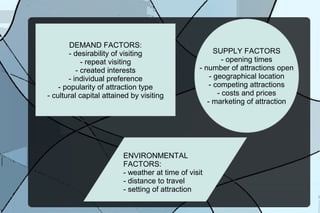
DEMAND FACTORS:
- desirability of visiting
- repeat visiting
- created interests
- individual preference
- popularity of attraction type
- cultural capital attained by visiting

SUPPLY FACTORS
- opening times
- number of attractions open
- geographical location
- competing attractions
- costs and prices
- marketing of attraction

ENVIRONMENTAL
FACTORS:
- weather at time of visit
- distance to travel
- setting of attraction
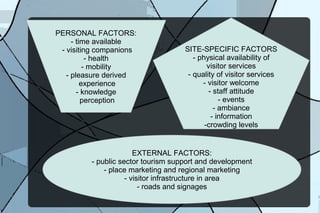
PERSONAL FACTORS:
- time available
- visiting companions
- health
- mobility
- pleasure derived
experience
- knowledge
perception

SITE-SPECIFIC FACTORS
- physical availability of
visitor services
- quality of visitor services
- visitor welcome
- staff attitude
- events
- ambiance
- information
-crowding levels

EXTERNAL FACTORS:
- public sector tourism support and development
- place marketing and regional marketing
- visitor infrastructure in area
- roads and signages
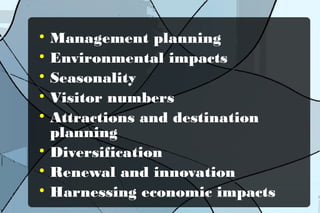
Management planning

Environmental impacts

Seasonality

Visitor numbers

Attractions and destination
planning

Diversification

Renewal and innovation

Harnessing economic impacts

FUTURE OF
VISITOR
ATTRACTIONS
Management: revenue
generation

Marketing

Product development: creating
world class destinations

Interpretation and
communication

MOVING
TOWARDS
TECHNOLOGYBASED ELEMENTS
OF ATTRACTIONS
Creating a unique product

Enhancing the visitor experience

Competition

Managing visitors

Systems management


Attractions

  • 1.
  • 2.
         where the mainpurpose is sightseeing A permanent established excursion destination Primary purpose is to allow access for entertainment, interest or education Must be open to the public without prior booking Capable of attracting day visitors or tourists as well as the local residents
  • 3.
    Acc to PEARCE(1991) “a tourist attraction is a named site with specific human or natural feature which is the focus of visitor and management attention” Acc to SWARBROOKE (2002) “attractions are generally single units based on a single key feature... destination are larger areas that include a number of individual attractions”
  • 4.
  • 5.
    TYPE          Historical house Museums andgalleries Wildlife attractions Castles Gardens Steam railways Visitor centers Country parks Leisure parks
  • 6.
    PHYSICAL ENVIRONMENT    Natural environment Builtmade and adapted but not originally designed for visitor purposes Built environment and designed for visitor purpose
  • 7.
    OWNERSHIP   Attraction are ownedand managed by a range of organizations, trusts and individuals, working in the public, private and not-for profit sectors. A high level of state involvement in attraction funding is evident across Europe and in other parts of the world like Canada and Singapore.
  • 8.
    PERCEPTION  Some visitors mayperceive an attraction as an atttraction but others may not. Acc to MILLAR (1999) -what undeniably turns a tract of land, monument, park, historic house or coastline into a heritage attraction is often the attitude of the public-
  • 9.
    ADMISSION POLICY   Attractions operatedby membership subscription organizations allow members in for no charge. Other attractions operate friends' schemes, which allow subscribers free entry. Voluntary donations are requested in other attractions.
  • 10.
    APPEAL   The market appealof attractions can be viewed at a geographic level, where attractions might appeal: just to local market, regionally, nationally or internationally. Certain attractions may only appeal to niche markets, or particular market segments
  • 11.
    SIZE AND CAPACITY   Attractionsvary in land coverage, with some housed in tiny buildings and others covering several hectares. Understanding the capacity of sites is important in terms of management and marketing, as well as protection of the resource base, which may be damaged as a result of poor visitor management.
  • 12.
       ENVIRONMENTAL – physicalspace and no. of people in a particular space ECOLOGICAL – threshold measure, which if exceeded will lead to actual damage of habitat PERCEPTUAL – level of crowding that a tourist is willing to tolerate before deciding to go elsewhere.
  • 13.
    COMPOSITION   Many attractions arenodal in character, located at or around a specific point or feature Events may also be nodal, fixed in one venue, or may occur at a variety of locations as part of a festival.
  • 14.
    DEGREE OF PERFORMANCE   Incase of events and festivals, a short duration is expected and temporary sites, buildings or a mobile infrastucture are often used. Sporadic non-permanent natural events, which are neither designed nor staged for visitors can also attract substantial visitor interest.
  • 15.
  • 16.
          Professional management skillsand the operator's available resources Type of attraction or product offering Market demand for the product Ease of access from major routes and centers of tourist and resident populations Appropriate hours of opening Value for money
  • 17.
        Provision and qualityof on-site amenities – parking, visitor centers, signs and labels, shops, guides, refreshments, toilets, litter bins, seating and disabled provision Proximity to and quality of near-site amenities, such as signposting, local accommodation, local services and other attractions Quality of service, including staff appearance, attitude, behavior and competence The mood, expectation, behavior and attitude of visitors
  • 18.
    THEMES AND ISSUES INTHE MANAGEMENT OF VISITOR ATTRACTIONS
  • 19.
    DEMAND FACTORS: - desirabilityof visiting - repeat visiting - created interests - individual preference - popularity of attraction type - cultural capital attained by visiting SUPPLY FACTORS - opening times - number of attractions open - geographical location - competing attractions - costs and prices - marketing of attraction ENVIRONMENTAL FACTORS: - weather at time of visit - distance to travel - setting of attraction
  • 20.
    PERSONAL FACTORS: - timeavailable - visiting companions - health - mobility - pleasure derived experience - knowledge perception SITE-SPECIFIC FACTORS - physical availability of visitor services - quality of visitor services - visitor welcome - staff attitude - events - ambiance - information -crowding levels EXTERNAL FACTORS: - public sector tourism support and development - place marketing and regional marketing - visitor infrastructure in area - roads and signages
  • 21.
    Management planning  Environmental impacts  Seasonality  Visitornumbers  Attractions and destination planning  Diversification  Renewal and innovation  Harnessing economic impacts 
  • 22.
  • 23.
    Management: revenue generation  Marketing  Product development:creating world class destinations  Interpretation and communication 
  • 24.
  • 25.
    Creating a uniqueproduct  Enhancing the visitor experience  Competition  Managing visitors  Systems management 