DEFINITION
The activities and definition of a tour operator in the
License (Tour Operator and Travel Agent)
Regulations are as follows:
Tour operator means a person who, on a
commercial basis –
(a) makes, directly or indirectly, arrangements for
the carriage of tourists, or the carriage of their
baggage or goods by any means whatsoever; or
(b) makes arrangements for lodging, transport or
other services relating to travel of persons within
Seychelles or who arranges entertainment, sight-
seeing excursions or guide services, whether such
arrangements are made on the basis of
comprehensive, all inclusive, rate or on the basis of
separate charges in respect of each service
provided.
A tour operator is generally a for-profit business that designs,
develops, markets and operates trips. Tour operators sell through
travel agents, corporations, non-profit institutions and/or directly
to consumers.
4
Sponsors Operational
group
Passangers
Tour Operators:
INTERACTION
TourOperatorsandYou • Tour operators develop and design itineraries with sponsor that:
 Are consistent with their mission.
 Incorporate study leader input.
 Provide services at quality and price levels desired by sponsors.
• Tour operators assist Sponsor in marketing trips by:
 Creating and distributing brochures, postcards, e-mails and promotional material
to sponsor’s mailing list.
 Providing material for web pages.
 Attending promoted events
• Tour operators work with the sponsor’s office on administrative issues such as:
 Transferring deposits and reservation application.
 Updating status of participant list.
 Answering passenger concerns or discrepancies.
 VIPs
• Tour operators pay accruals and commissions.
ADVANTAGES
Arrange special
access and facilitate
cultural contacts
Provide ancillary
services for traveler
including:
Travel insurance.
Private transfers.
Extra hotel nights.
Air arrangements.
Provide ancillary
services for traveler
including:
Travel insurance.
Private transfers.
Extra hotel nights.
Air arrangements.
.
6
DISADVANTAGES
May be more costly.
May have terms and
conditions
disagreeable to the
travelers.
May be more costly.
May have terms and
conditions
disagreeable to the
travelers.
Have to coordinate
and communicate
with a third party.
May go bankrupt or
be unethical.
.
7
8
10
TYPES
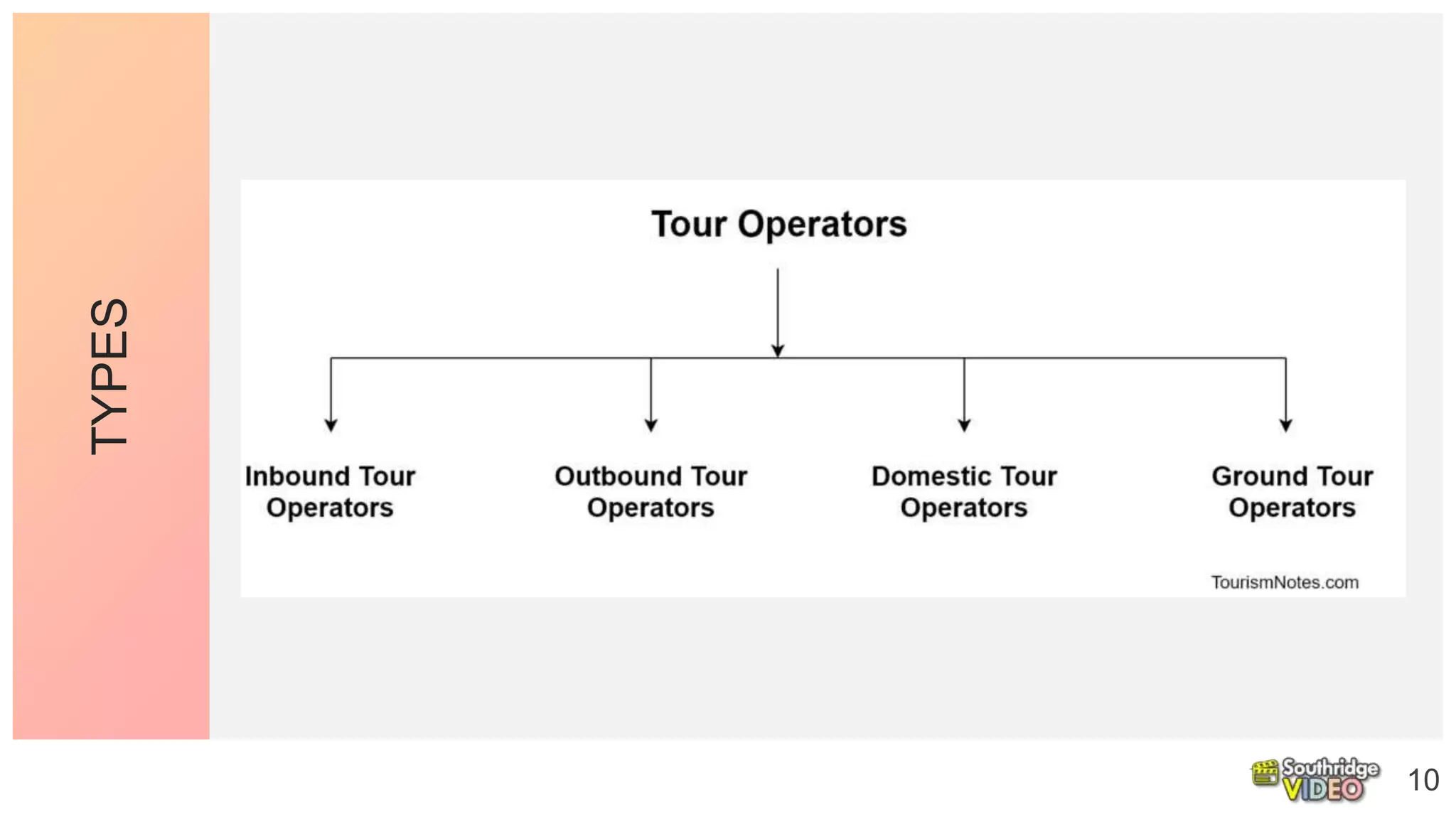
These are also known as incoming tour operators.
Technically, the operators who receive guests,
clients/tourists and handle arrangements in the host
country are called inbound tour operators. For
example, a group of American Tourists is coming
through TCI Ltd. to India and the company makes
arrangements and handles the group in India then TCI
is called an inbound tour operator.
Incidentally, the inbound traffic to the country for the
last two decades has been decreasing. Essentially the
tour operators need to adopt innovative marketing
strategies and should introduce a special interest tour
to cater the special needs of Japanese, Americans,
French and British people.
Tour operator who promote tours for foreign
destinations, maybe business tour or leisure tour
is called outbound tour operators. For example a
group of American tourists going to a trip of India
and Thomas Cook handle arrangement in
America like as ticket reservation, hotel booking
etc. then Thomas Cook is called Outbound Tour
operators in the context of America.
Domestic Tour operators are those who
assemble, combine tourist components into
inclusive tours and sell it to the domestic
travelers. In general, these tour operators provide
travel services within the tourist’s native country.
The domestic tour operators operate within the
boundary of the home country and offer package
tour to the travelers viz. Domestic inclusive tours
or independent tours.
These are commonly known as handling agencies and their
main function is to organize tour arrangements for incoming
tourists on the behalf of overseas operators. Let us take the
case of India as a destination that – has a varied culture.
When a tour operator himself promotes beach holidays, wildlife
holidays, adventure tours, heritage tours at the different
places, the difficulty arises. It is the ground operator then who
by handling the incoming travelers in the same season but at
different places ensures that the entire operation is according
to the package tours or agreements.
Sometime when a handling agency is at a prominent tourist
place i.e., Delhi and it has to make arrangements to Goa, then
it contracts (If it has no office of its own) with a local operator
(known as excursion agent) to handle the arrangement on his
behalf.
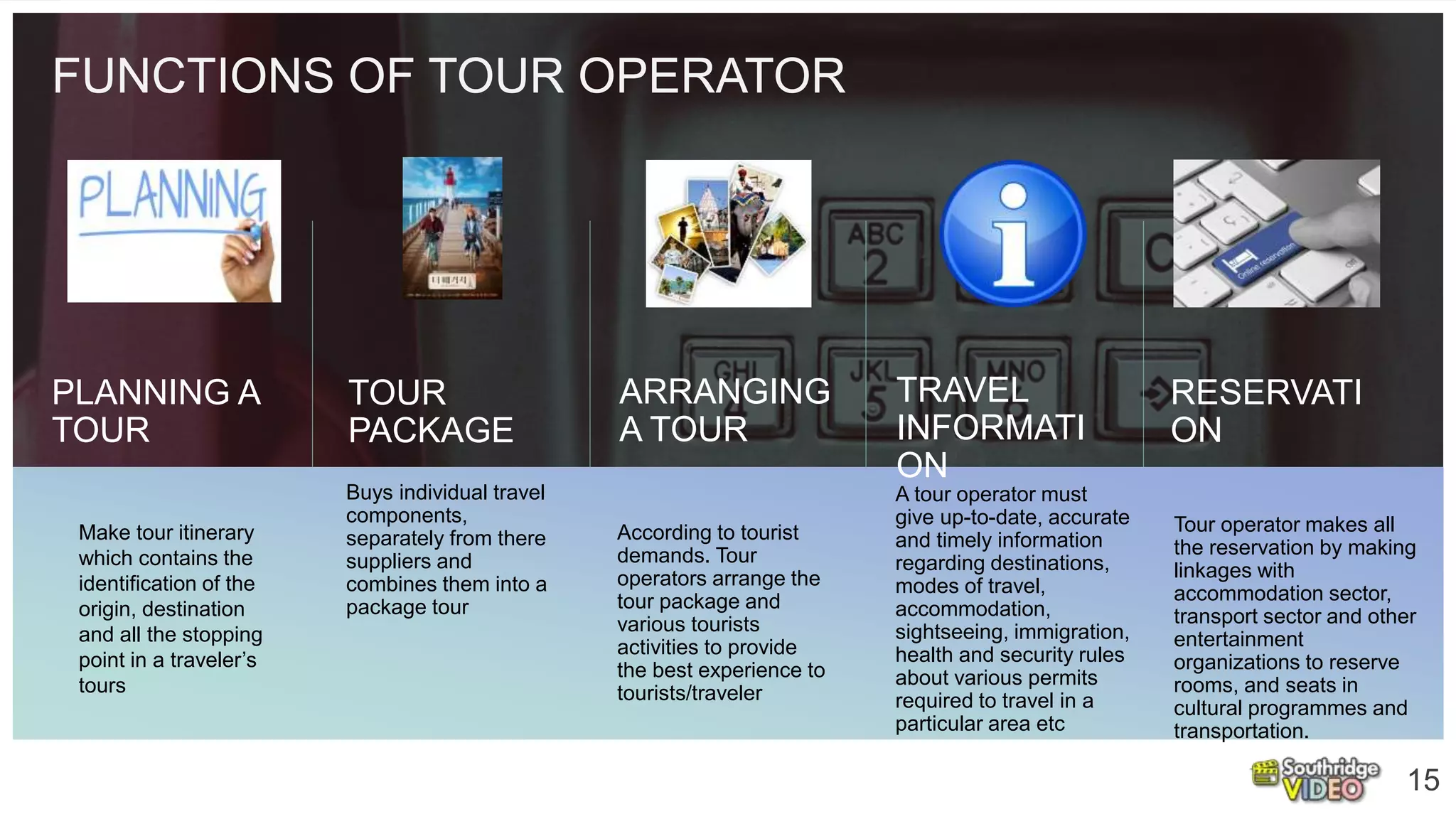
FUNCTIONS OF TOUR OPERATOR
15
PLANNING A
TOUR
TOUR
PACKAGE
Buys individual travel
components,
separately from there
suppliers and
combines them into a
package tour
ARRANGING
A TOUR
According to tourist
demands. Tour
operators arrange the
tour package and
various tourists
activities to provide
the best experience to
tourists/traveler
TRAVEL
INFORMATI
ON
A tour operator must
give up-to-date, accurate
and timely information
regarding destinations,
modes of travel,
accommodation,
sightseeing, immigration,
health and security rules
about various permits
required to travel in a
particular area etc
RESERVATI
ON
Tour operator makes all
the reservation by making
linkages with
accommodation sector,
transport sector and other
entertainment
organizations to reserve
rooms, and seats in
cultural programmes and
transportation.
Make tour itinerary
which contains the
identification of the
origin, destination
and all the stopping
point in a traveler’s
tours
DIFFERENCES BETWEEN A TOUR OPERATOR AND A
TRAVEL AGENT
16
17
• A travel agent is a person who has a full knowledge of tourist product – destinations,
modes of travel, climate, accommodation and other areas of the service sector. He
acts on the behalf of the product providers/principals and in return get a commission.
• Tour operator is an organization, firm or company who buys individual travel
components, separately from their suppliers and combines them into a package tour,
which is sold with their own price tag to the public directly or through middlemen.
• Tour operators are like wholesalers and travel agents are the retailers.
• A tour operator makes the package holidays up and the travel agents sell them on.
• Tour operator taking up the bulk of the responsibilities and his fee is obviously much
greater than a travel agent.
• A tour operator has the responsibilities to look after the finer details of a vacation or
tour such as hotel, accommodation, meals, conveyance etc.

Tour operator work

  • 2.
    DEFINITION The activities anddefinition of a tour operator in the License (Tour Operator and Travel Agent) Regulations are as follows: Tour operator means a person who, on a commercial basis – (a) makes, directly or indirectly, arrangements for the carriage of tourists, or the carriage of their baggage or goods by any means whatsoever; or (b) makes arrangements for lodging, transport or other services relating to travel of persons within Seychelles or who arranges entertainment, sight- seeing excursions or guide services, whether such arrangements are made on the basis of comprehensive, all inclusive, rate or on the basis of separate charges in respect of each service provided.
  • 3.
    A tour operatoris generally a for-profit business that designs, develops, markets and operates trips. Tour operators sell through travel agents, corporations, non-profit institutions and/or directly to consumers.
  • 4.
  • 5.
    TourOperatorsandYou • Touroperators develop and design itineraries with sponsor that:  Are consistent with their mission.  Incorporate study leader input.  Provide services at quality and price levels desired by sponsors. • Tour operators assist Sponsor in marketing trips by:  Creating and distributing brochures, postcards, e-mails and promotional material to sponsor’s mailing list.  Providing material for web pages.  Attending promoted events • Tour operators work with the sponsor’s office on administrative issues such as:  Transferring deposits and reservation application.  Updating status of participant list.  Answering passenger concerns or discrepancies.  VIPs • Tour operators pay accruals and commissions.
  • 6.
    ADVANTAGES Arrange special access andfacilitate cultural contacts Provide ancillary services for traveler including: Travel insurance. Private transfers. Extra hotel nights. Air arrangements. Provide ancillary services for traveler including: Travel insurance. Private transfers. Extra hotel nights. Air arrangements. . 6
  • 7.
    DISADVANTAGES May be morecostly. May have terms and conditions disagreeable to the travelers. May be more costly. May have terms and conditions disagreeable to the travelers. Have to coordinate and communicate with a third party. May go bankrupt or be unethical. . 7
  • 8.
  • 10.
  • 11.
    These are alsoknown as incoming tour operators. Technically, the operators who receive guests, clients/tourists and handle arrangements in the host country are called inbound tour operators. For example, a group of American Tourists is coming through TCI Ltd. to India and the company makes arrangements and handles the group in India then TCI is called an inbound tour operator. Incidentally, the inbound traffic to the country for the last two decades has been decreasing. Essentially the tour operators need to adopt innovative marketing strategies and should introduce a special interest tour to cater the special needs of Japanese, Americans, French and British people.
  • 12.
    Tour operator whopromote tours for foreign destinations, maybe business tour or leisure tour is called outbound tour operators. For example a group of American tourists going to a trip of India and Thomas Cook handle arrangement in America like as ticket reservation, hotel booking etc. then Thomas Cook is called Outbound Tour operators in the context of America.
  • 13.
    Domestic Tour operatorsare those who assemble, combine tourist components into inclusive tours and sell it to the domestic travelers. In general, these tour operators provide travel services within the tourist’s native country. The domestic tour operators operate within the boundary of the home country and offer package tour to the travelers viz. Domestic inclusive tours or independent tours.
  • 14.
    These are commonlyknown as handling agencies and their main function is to organize tour arrangements for incoming tourists on the behalf of overseas operators. Let us take the case of India as a destination that – has a varied culture. When a tour operator himself promotes beach holidays, wildlife holidays, adventure tours, heritage tours at the different places, the difficulty arises. It is the ground operator then who by handling the incoming travelers in the same season but at different places ensures that the entire operation is according to the package tours or agreements. Sometime when a handling agency is at a prominent tourist place i.e., Delhi and it has to make arrangements to Goa, then it contracts (If it has no office of its own) with a local operator (known as excursion agent) to handle the arrangement on his behalf.
  • 15.
    FUNCTIONS OF TOUROPERATOR 15 PLANNING A TOUR TOUR PACKAGE Buys individual travel components, separately from there suppliers and combines them into a package tour ARRANGING A TOUR According to tourist demands. Tour operators arrange the tour package and various tourists activities to provide the best experience to tourists/traveler TRAVEL INFORMATI ON A tour operator must give up-to-date, accurate and timely information regarding destinations, modes of travel, accommodation, sightseeing, immigration, health and security rules about various permits required to travel in a particular area etc RESERVATI ON Tour operator makes all the reservation by making linkages with accommodation sector, transport sector and other entertainment organizations to reserve rooms, and seats in cultural programmes and transportation. Make tour itinerary which contains the identification of the origin, destination and all the stopping point in a traveler’s tours
  • 16.
    DIFFERENCES BETWEEN ATOUR OPERATOR AND A TRAVEL AGENT 16
  • 17.
    17 • A travelagent is a person who has a full knowledge of tourist product – destinations, modes of travel, climate, accommodation and other areas of the service sector. He acts on the behalf of the product providers/principals and in return get a commission. • Tour operator is an organization, firm or company who buys individual travel components, separately from their suppliers and combines them into a package tour, which is sold with their own price tag to the public directly or through middlemen. • Tour operators are like wholesalers and travel agents are the retailers. • A tour operator makes the package holidays up and the travel agents sell them on. • Tour operator taking up the bulk of the responsibilities and his fee is obviously much greater than a travel agent. • A tour operator has the responsibilities to look after the finer details of a vacation or tour such as hotel, accommodation, meals, conveyance etc.