Scaffolding Student
Research:
Collaborating with Public Health
Faculty on Embedded
Instruction
John Pell
Hunter College
Libraries
CONTENTS
• Introduction
• Research Questions
• Methods
• Results
• Discussion
INTRODUCTION
What is our instructional Context?
INTRODUCTION
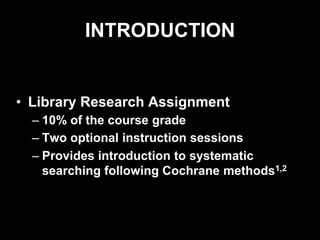
• Library Research Assignment
– 10% of the course grade
– Two optional instruction sessions
– Provides introduction to systematic
searching following Cochrane methods1,2
INTRODUCTION
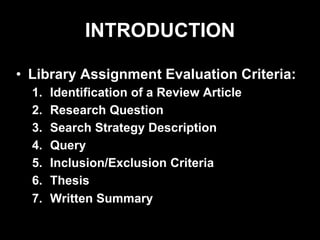
• Library Assignment Evaluation Criteria:
1. Identification of a Review Article
2. Research Question
3. Search Strategy Description
4. Query
5. Inclusion/Exclusion Criteria
6. Thesis
7. Written Summary
RESEARCH QUESTIONS
What did we want to know about our instruction?
RESEARCH QUESTIONS
• Are library research assignment grades
correlated with other individual
assignment grades?
RESEARCH QUESTIONS
• Is attendance at library instruction
sessions associated with better
individual assignment grades?
RESEARCH QUESTIONS
• What assignment characteristics are
associated with attendance at
instruction sessions?
METHODS
How did we investigate our questions?
METHODS
• Collected grades and Attendance for all
students (n = 68) from all Instructors.
• SPSS for Pearson Correlation and
Cross-tabs
* Defined “higher grade” as above the
median.
RESULTS
What did we find out?
RESULTS
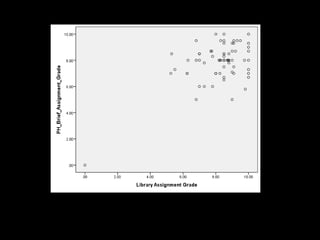
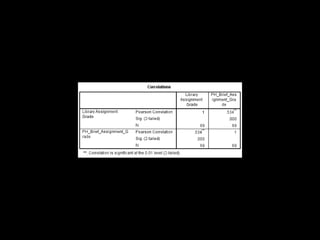
• Library research assignment grades are
substantially3 (r = .534) and significantly
(p<.01) correlated to Public Health Brief
individual assignment grades.
RESULTS
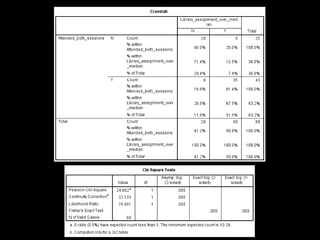
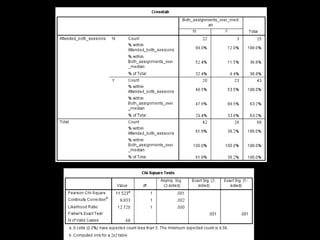
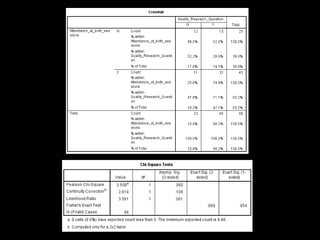
• Attending both library instruction
sessions is significantly associated with
a higher library assignment grade
(p<.01).
RESULTS
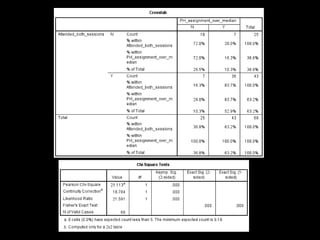
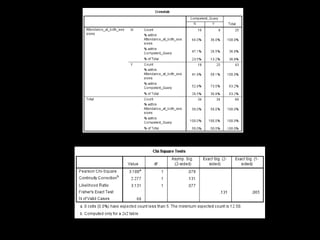
• Attending both library instruction
sessions is significantly associated with
a higher Public Health Brief individual
assignment grade (p<.01).
RESULTS
• Attending both library instruction
sessions is significantly associated with
having both a higher Library
Assignment grade and a higher Public
Health Brief individual assignment grade
(p<.01).
RESULTS
• Assignment characteristics significantly
associated with instruction session
attendance:
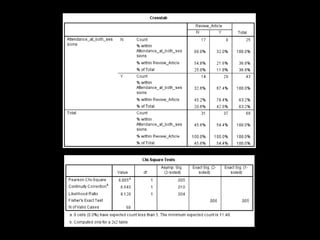
+ Correct identification of a literature review
[67.4% (n = 29/14) of students attending
both sessions (p = 0.005)]
RESULTS
• Assignment characteristics significantly
associated with instruction session
attendance:
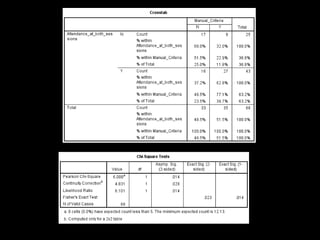
+ Clear statements of inclusion and exclusion
criteria that don’t confuse manual and
automated search processes [62.8%
(n=27/16) of students attending both
sessions (p = 0.01)]
RESULTS
• Assignment characteristics significantly
associated with instruction session
attendance:
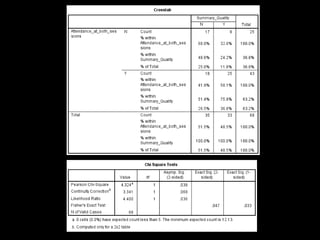
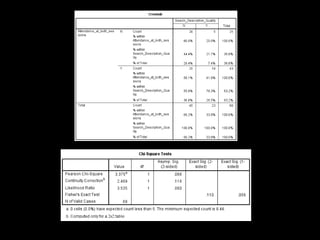
+ Accurate summary of primary sources and
correct use of AMA citation style [58.1%
(n=25/18) of students attending both
sessions (p = 0.03)]
RESULTS
• Assignment characteristics associated
with instruction session attendance:
+ Better, PICOT structured research
questions [74.4% (n=32/11) of students
attending both sessions (p = 0.06)]
RESULTS
• Assignment characteristics associated
with instruction session attendance:
+ Use of controlled vocabulary and Boolean
logic [58.1% (n = 25/18) of students
attending both sessions, compare to 36% (n
= 9/16) of students who missed a session (p
= 0.07)]
RESULTS
• Assignment characteristics associated
with instruction session attendance:
+ Coherent description of search strategy
[41.9% (n = 18/25) of students attending
both sessions, compare to 20% (n = 5/20 of
students who missed a session (p = 0.06)]
RESULTS
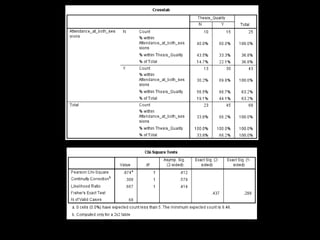
• Assignment characteristics not
associated with instruction session
attendance:
+ Statement of a thesis
DISCUSSION
What are the limitations and future directions of this?
DISCUSSION
• Limitations?
– No certainty that the instruction sessions
caused anything
DISCUSSION
• Future directions?
– No search strategy descriptions
– Less systematic search strategies
– Fully online instruction
– Student focus group
REFERENCES
1. Pell J. PH 755: Urban Health and Society Library
Research Assignment. Hunter College Libraries. May
2015. http://libguides.library.hunter.cuny.edu/ph755.
Accessed May 8, 2015.
2. Higgins J, Green S, eds. Cochrane Handbook for
Systematic Reviews of Interventions. Vol Version 5.1.0.
The Cochrane Collaboration; 2011. www.cochrane-
handbook.org.
3. CPH SPKS, MPH EKP. Munro’s Statistical Methods for
Health Care Research. Vol Sixth, Revised Reprint
edition. Philadelphia: LWW; 2012.
CROSSTABS, SCATTER
PLOTS, & TABLES
Appendix:
Library Instruction Attendance Correlates with Better Assignment Grades, Better Assignment Quality

Library Instruction Attendance Correlates with Better Assignment Grades, Better Assignment Quality

  • 1.
    Scaffolding Student Research: Collaborating withPublic Health Faculty on Embedded Instruction John Pell Hunter College Libraries
  • 2.
    CONTENTS • Introduction • ResearchQuestions • Methods • Results • Discussion
  • 3.
    INTRODUCTION What is ourinstructional Context?
  • 4.
    INTRODUCTION • Library ResearchAssignment – 10% of the course grade – Two optional instruction sessions – Provides introduction to systematic searching following Cochrane methods1,2
  • 5.
    INTRODUCTION • Library AssignmentEvaluation Criteria: 1. Identification of a Review Article 2. Research Question 3. Search Strategy Description 4. Query 5. Inclusion/Exclusion Criteria 6. Thesis 7. Written Summary
  • 6.
    RESEARCH QUESTIONS What didwe want to know about our instruction?
  • 7.
    RESEARCH QUESTIONS • Arelibrary research assignment grades correlated with other individual assignment grades?
  • 8.
    RESEARCH QUESTIONS • Isattendance at library instruction sessions associated with better individual assignment grades?
  • 9.
    RESEARCH QUESTIONS • Whatassignment characteristics are associated with attendance at instruction sessions?
  • 10.
    METHODS How did weinvestigate our questions?
  • 11.
    METHODS • Collected gradesand Attendance for all students (n = 68) from all Instructors. • SPSS for Pearson Correlation and Cross-tabs * Defined “higher grade” as above the median.
  • 12.
  • 13.
    RESULTS • Library researchassignment grades are substantially3 (r = .534) and significantly (p<.01) correlated to Public Health Brief individual assignment grades.
  • 14.
    RESULTS • Attending bothlibrary instruction sessions is significantly associated with a higher library assignment grade (p<.01).
  • 15.
    RESULTS • Attending bothlibrary instruction sessions is significantly associated with a higher Public Health Brief individual assignment grade (p<.01).
  • 16.
    RESULTS • Attending bothlibrary instruction sessions is significantly associated with having both a higher Library Assignment grade and a higher Public Health Brief individual assignment grade (p<.01).
  • 17.
    RESULTS • Assignment characteristicssignificantly associated with instruction session attendance: + Correct identification of a literature review [67.4% (n = 29/14) of students attending both sessions (p = 0.005)]
  • 18.
    RESULTS • Assignment characteristicssignificantly associated with instruction session attendance: + Clear statements of inclusion and exclusion criteria that don’t confuse manual and automated search processes [62.8% (n=27/16) of students attending both sessions (p = 0.01)]
  • 19.
    RESULTS • Assignment characteristicssignificantly associated with instruction session attendance: + Accurate summary of primary sources and correct use of AMA citation style [58.1% (n=25/18) of students attending both sessions (p = 0.03)]
  • 20.
    RESULTS • Assignment characteristicsassociated with instruction session attendance: + Better, PICOT structured research questions [74.4% (n=32/11) of students attending both sessions (p = 0.06)]
  • 21.
    RESULTS • Assignment characteristicsassociated with instruction session attendance: + Use of controlled vocabulary and Boolean logic [58.1% (n = 25/18) of students attending both sessions, compare to 36% (n = 9/16) of students who missed a session (p = 0.07)]
  • 22.
    RESULTS • Assignment characteristicsassociated with instruction session attendance: + Coherent description of search strategy [41.9% (n = 18/25) of students attending both sessions, compare to 20% (n = 5/20 of students who missed a session (p = 0.06)]
  • 23.
    RESULTS • Assignment characteristicsnot associated with instruction session attendance: + Statement of a thesis
  • 24.
    DISCUSSION What are thelimitations and future directions of this?
  • 25.
    DISCUSSION • Limitations? – Nocertainty that the instruction sessions caused anything
  • 26.
    DISCUSSION • Future directions? –No search strategy descriptions – Less systematic search strategies – Fully online instruction – Student focus group
  • 27.
    REFERENCES 1. Pell J.PH 755: Urban Health and Society Library Research Assignment. Hunter College Libraries. May 2015. http://libguides.library.hunter.cuny.edu/ph755. Accessed May 8, 2015. 2. Higgins J, Green S, eds. Cochrane Handbook for Systematic Reviews of Interventions. Vol Version 5.1.0. The Cochrane Collaboration; 2011. www.cochrane- handbook.org. 3. CPH SPKS, MPH EKP. Munro’s Statistical Methods for Health Care Research. Vol Sixth, Revised Reprint edition. Philadelphia: LWW; 2012.
  • 28.