
Ahead of the curve  The Power of Assessment to Transform Teaching and Learning synopsis created by Krista Rundell
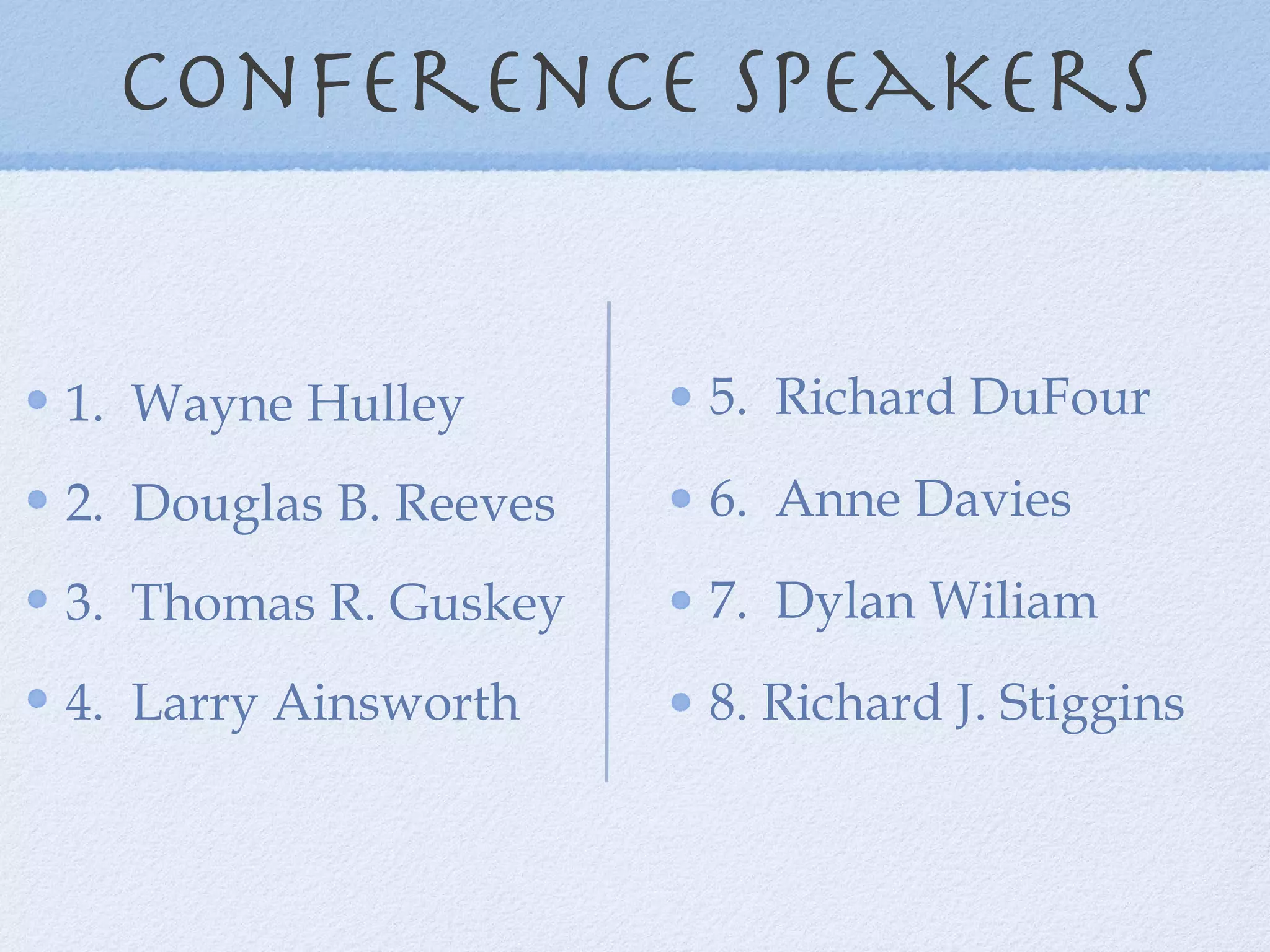
conference SPeakers 5.  Richard DuFour 6.  Anne Davies 7.  Dylan Wiliam 8. Richard J. Stiggins 1.  Wayne Hulley 2.  Douglas B. Reeves 3.  Thomas R. Guskey 4.  Larry Ainsworth
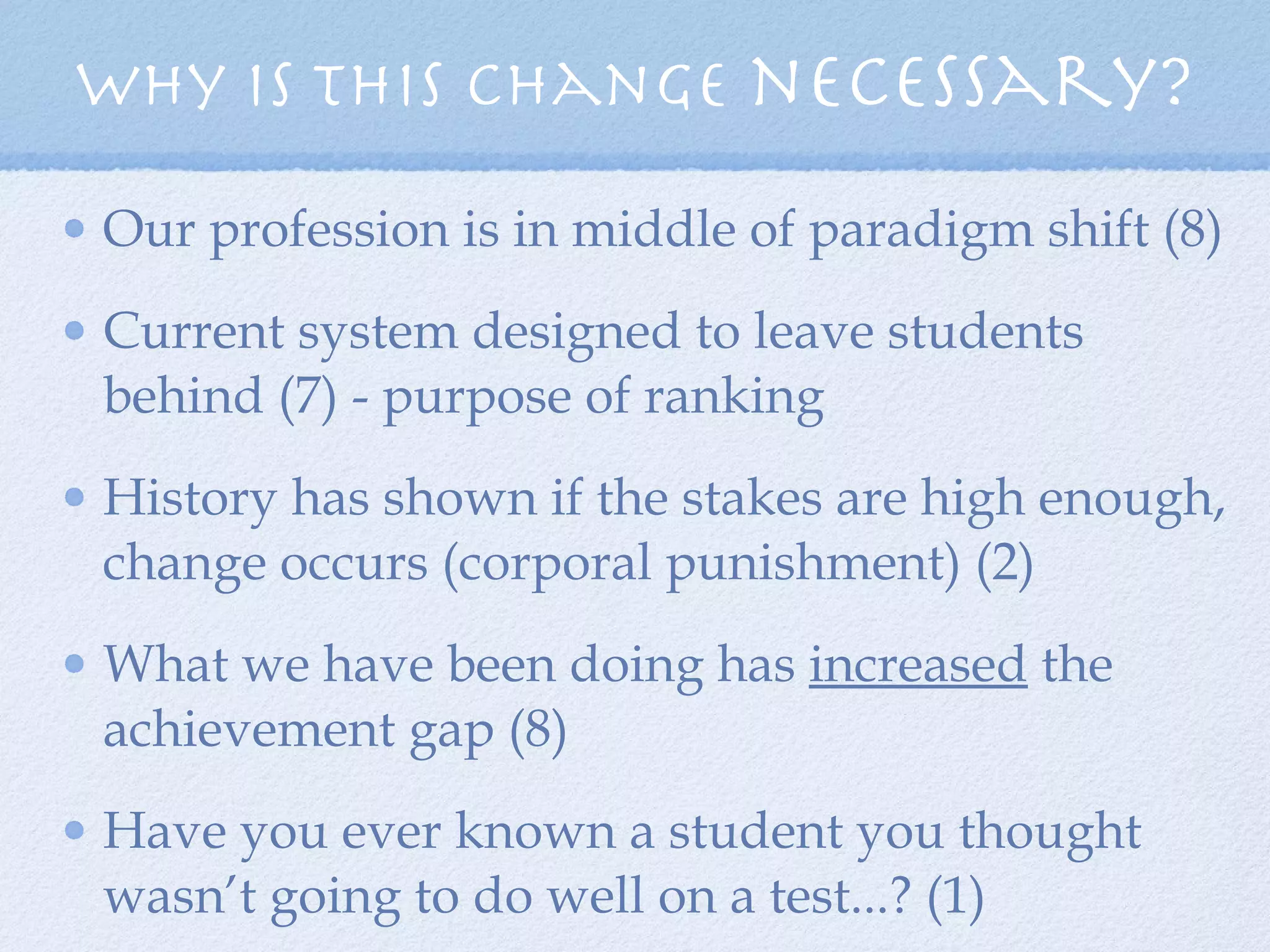
Why is this change  necessary? Our profession is in middle of paradigm shift (8) Current system designed to leave students behind (7) - purpose of ranking History has shown if the stakes are high enough, change occurs (corporal punishment) (2) What we have been doing has  increased  the achievement gap (8) Have you ever known a student you thought wasn’t going to do well on a test...? (1)
men in black - exam scene Movie Clip
men in black - exam scene Wouldn’t it be nice if every student had a Tommy Lee Jones backing him up?
W. Edwards deming It’s not enough to do your best; you must know what to do, and then do your best.
Dylan wiliam The hard thing is stopping people from doing good things in order to get them to do better things.
raising achievement matters One year of schooling adds 1.7 years of life. (7) Students use assessment to form ideas of themselves as a learner  -  and sense of self as successful...  ... what if you were wrong about your assessment of student work and performance? (8) Why is this change  necessary?
Strong evidence exists that formative assessment is the most successful strategy to increase student achievement. (5)  “ There is nothing else we can be doing that is more effective than assessment”. (7) Assessment can be controlled by the teacher - teacher quality is of the utmost importance. (7) Effective assessment is a powerful tool for informing teachers of learning and improving their teaching process. (5) Why is this change  necessary?
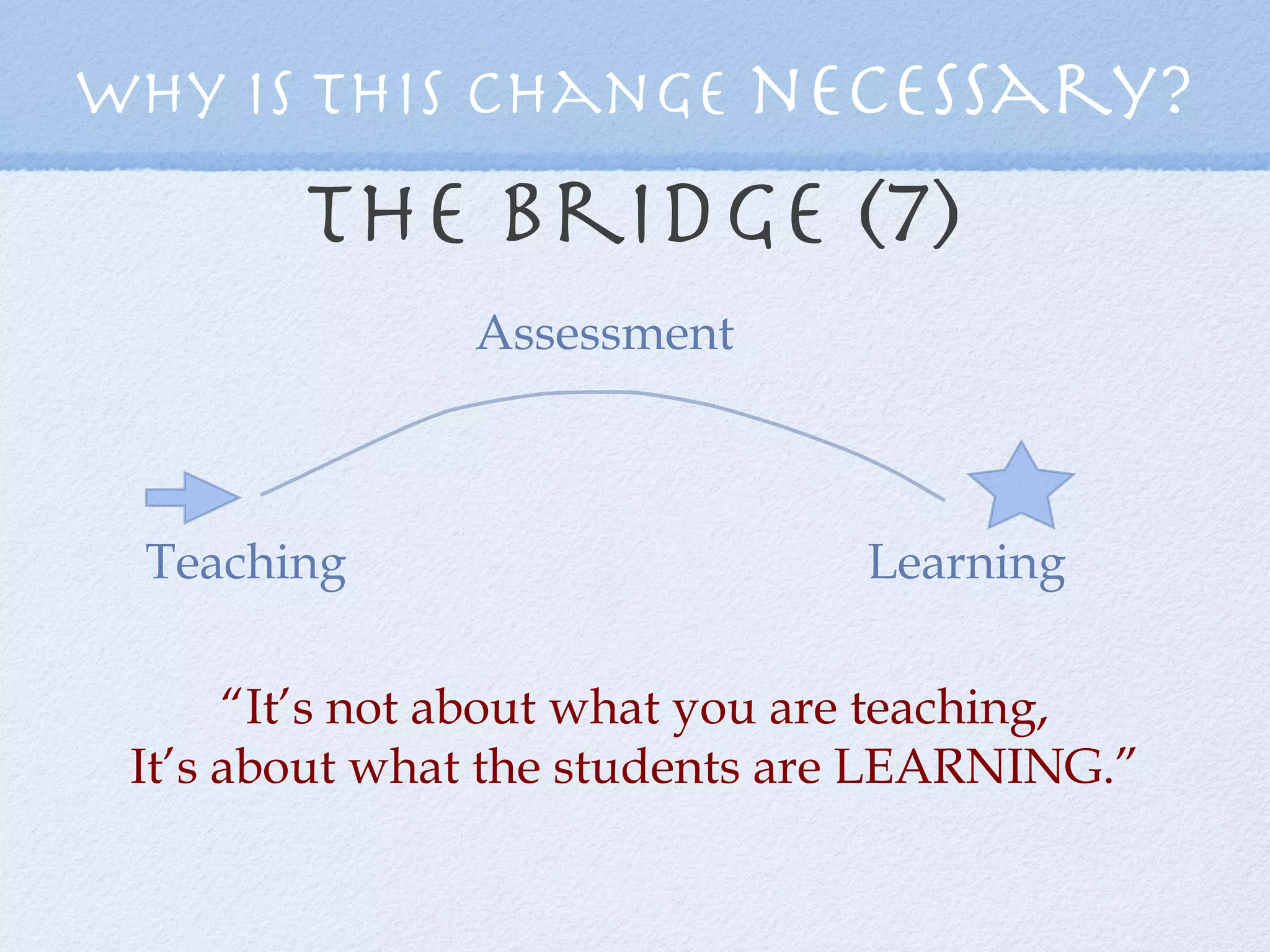
The Bridge (7) Assessment Teaching Learning “ It’s not about what you are teaching, It’s about what the students are LEARNING.” Why is this change  necessary?
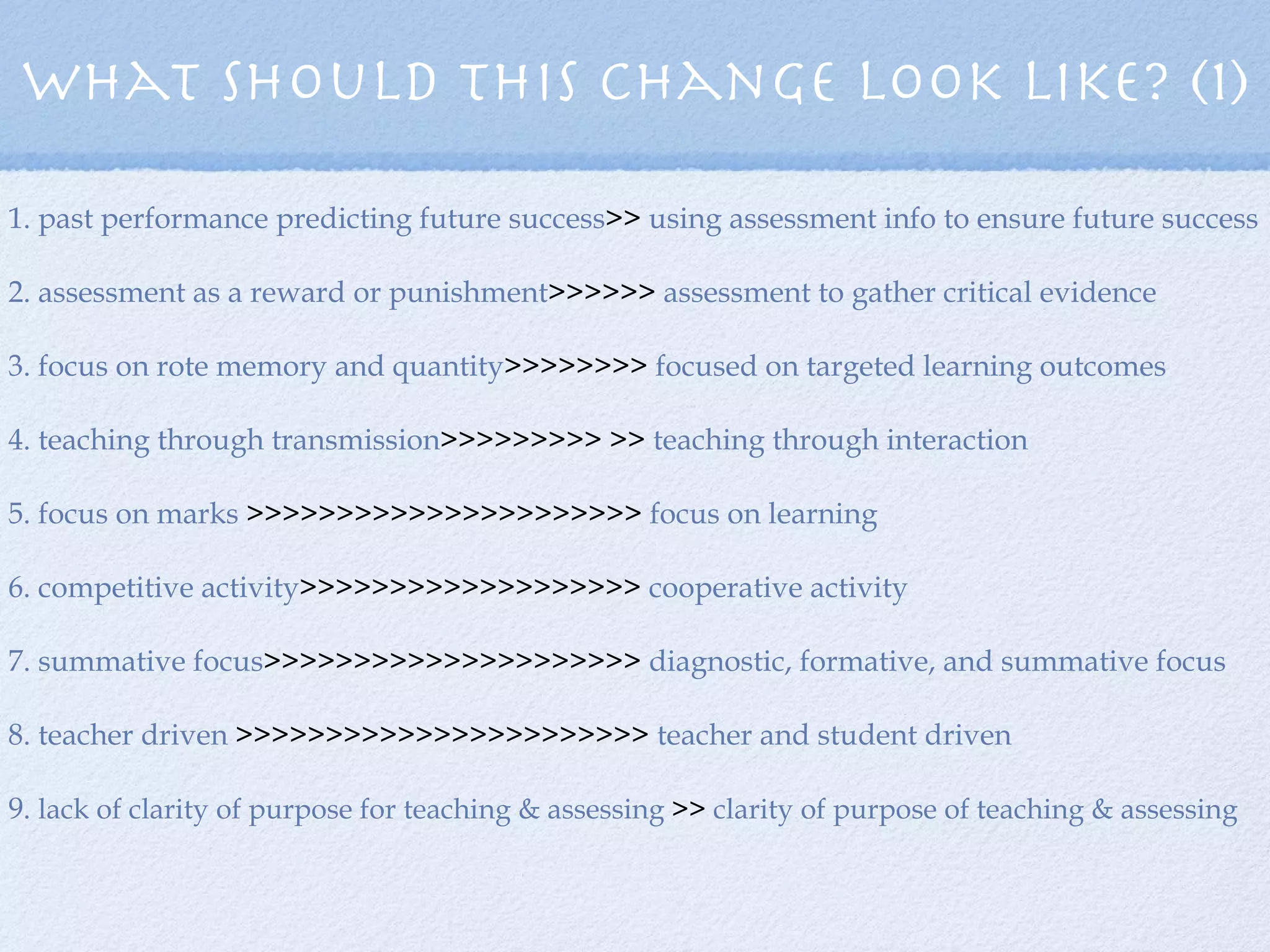
What should this change look like? (1) 1. past performance predicting future success >>  using assessment info to ensure future success 2. assessment as a reward or punishment >>>>>>  assessment to gather critical evidence 3. focus on rote memory and quantity >>>>>>>>  focused on targeted learning outcomes 4. teaching through transmission >>>>>>>>> >>  teaching through interaction 5. focus on marks  >>>>>>>>>>>>>>>>>>>>>>  focus on learning 6. competitive activity >>>>>>>>>>>>>>>>>>>  cooperative activity 7. summative focus >>>>>>>>>>>>>>>>>>>>>  diagnostic, formative, and summative focus 8. teacher driven  >>>>>>>>>>>>>>>>>>>>>>>  teacher and student driven 9.  lack of clarity of purpose for teaching & assessing  >>  clarity of purpose of teaching & assessing
FORMATive assessments Assessment FOR learning (1) showing process towards the learning target “ Evidence about student achievement elicited by assessment is interpreted and used to make decisions about the next steps in instruction that are likely to be better... than the decisions taken in the absence of that evidence.” (7)
why cFas? (5) huge positive impact on professional practice are time-efficient provide educational equity for students informs of individual teacher practice builds team capacity allows for collective response  results in increased student achievement
Professional Learning Communities (PLC) Side Note on:
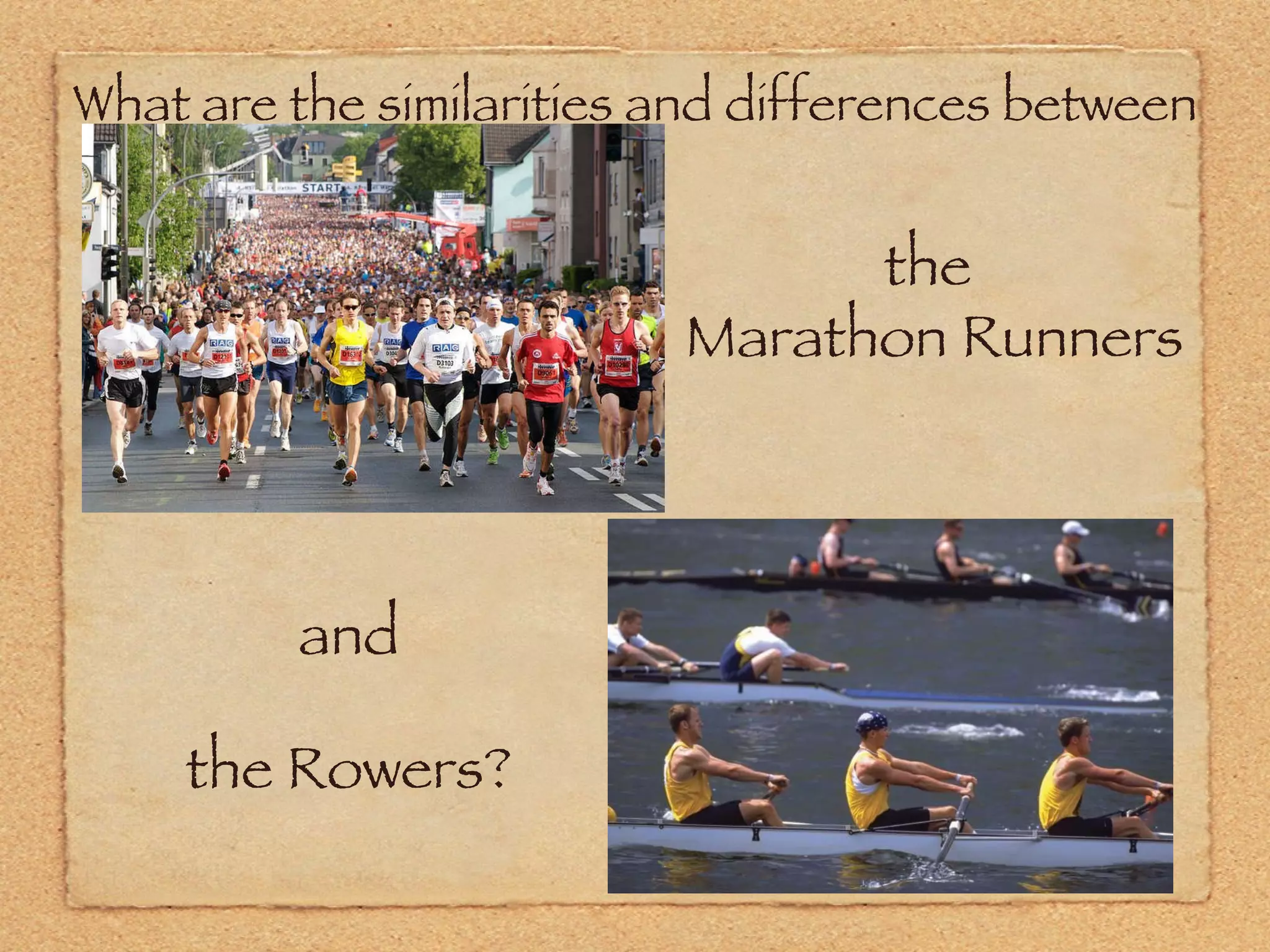
the  Marathon Runners What are the similarities and differences between and the Rowers?
What are PLCs? a collaborative culture within a school wherein all teachers take mutual responsibility for student learning and achievement (5) PLC team seeks relevant data and uses that information to create an improvement plan (5) and determine individual student needs (4)
PLC & Common Assessment Breaks teachers out of “working in isolation” mentality (5) Creates a shared purpose for student learning (5) Team develops and analyzes assessments (4) Provides teachers with a support group (6) Plays to teachers’ strengths and works collectively to improve other areas (7)
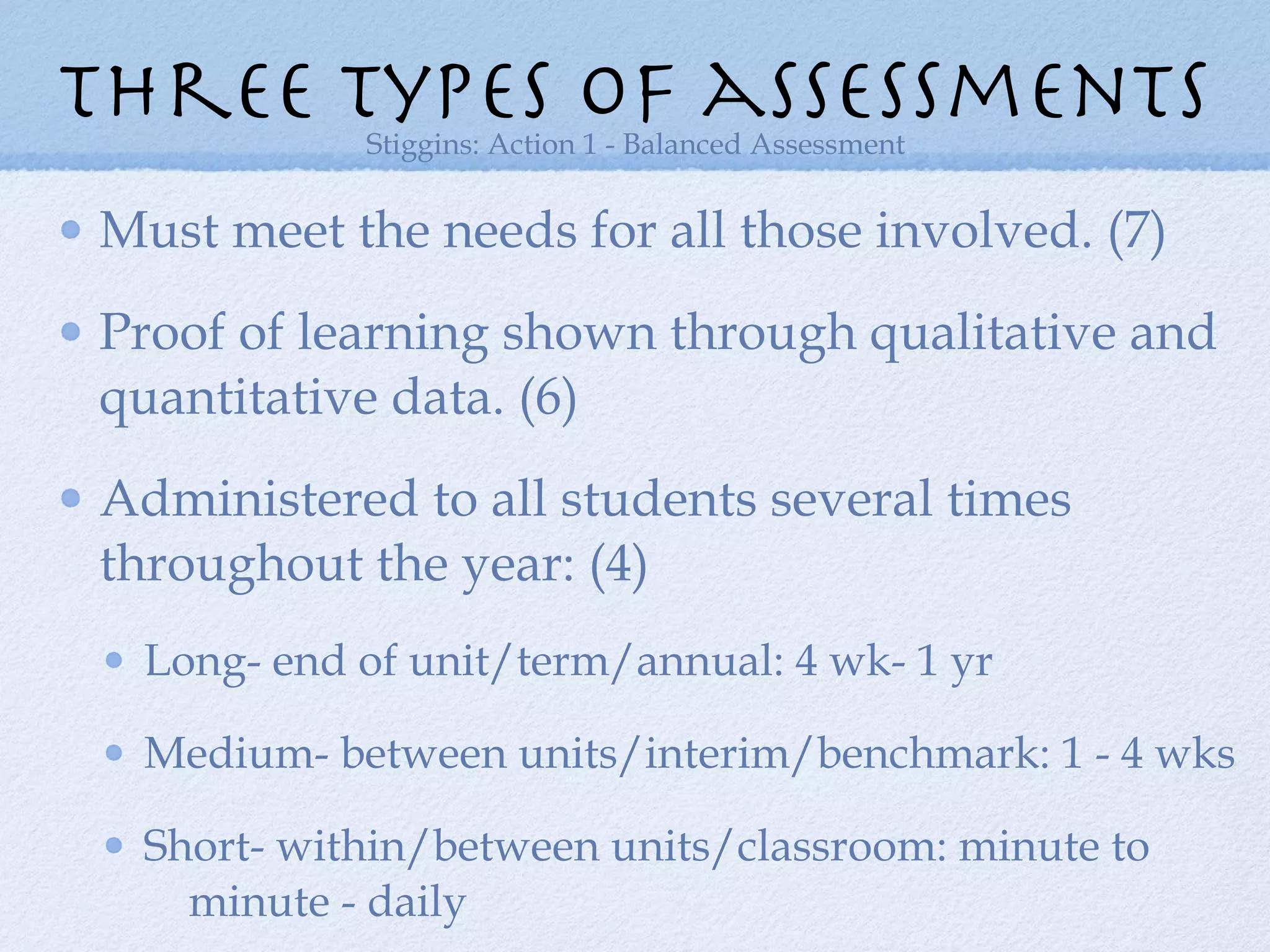
Must meet the needs for all those involved. (7) Proof of learning shown through qualitative and quantitative data. (6) Administered to all students several times throughout the year: (4) Long- end of unit/term/annual: 4 wk- 1 yr  Medium- between units/interim/benchmark: 1 - 4 wks Short- within/between units/classroom: minute to  minute - daily  Stiggins: Action 1 - Balanced Assessment three types of assessments
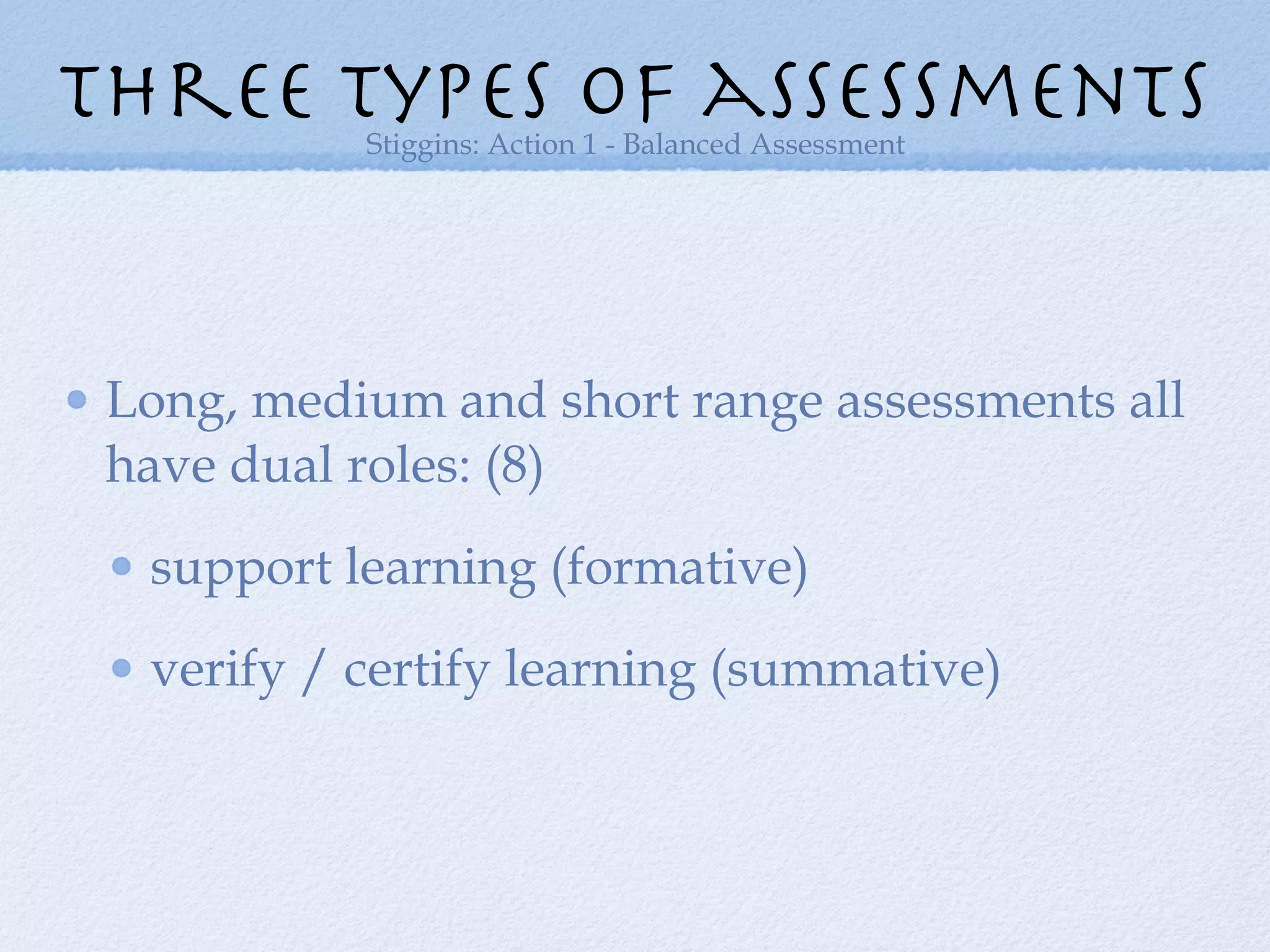
Long, medium and short range assessments all have dual roles: (8) support learning (formative) verify / certify learning (summative) three types of assessments Stiggins: Action 1 - Balanced Assessment
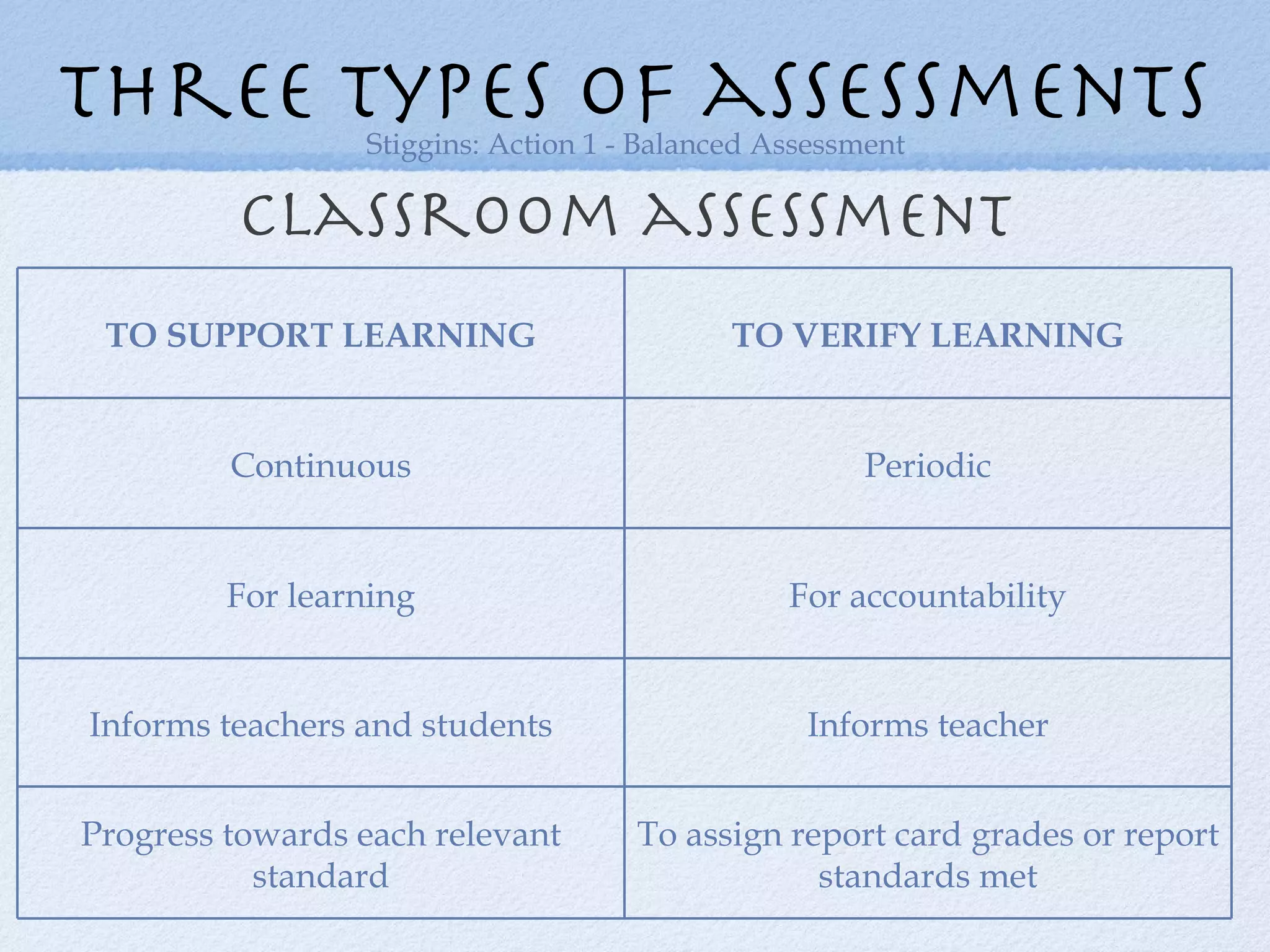
Classroom assessment three types of assessments Stiggins: Action 1 - Balanced Assessment TO SUPPORT LEARNING TO VERIFY LEARNING Continuous Periodic For learning For accountability Informs teachers and students Informs teacher Progress towards each relevant standard To assign report card grades or report standards met
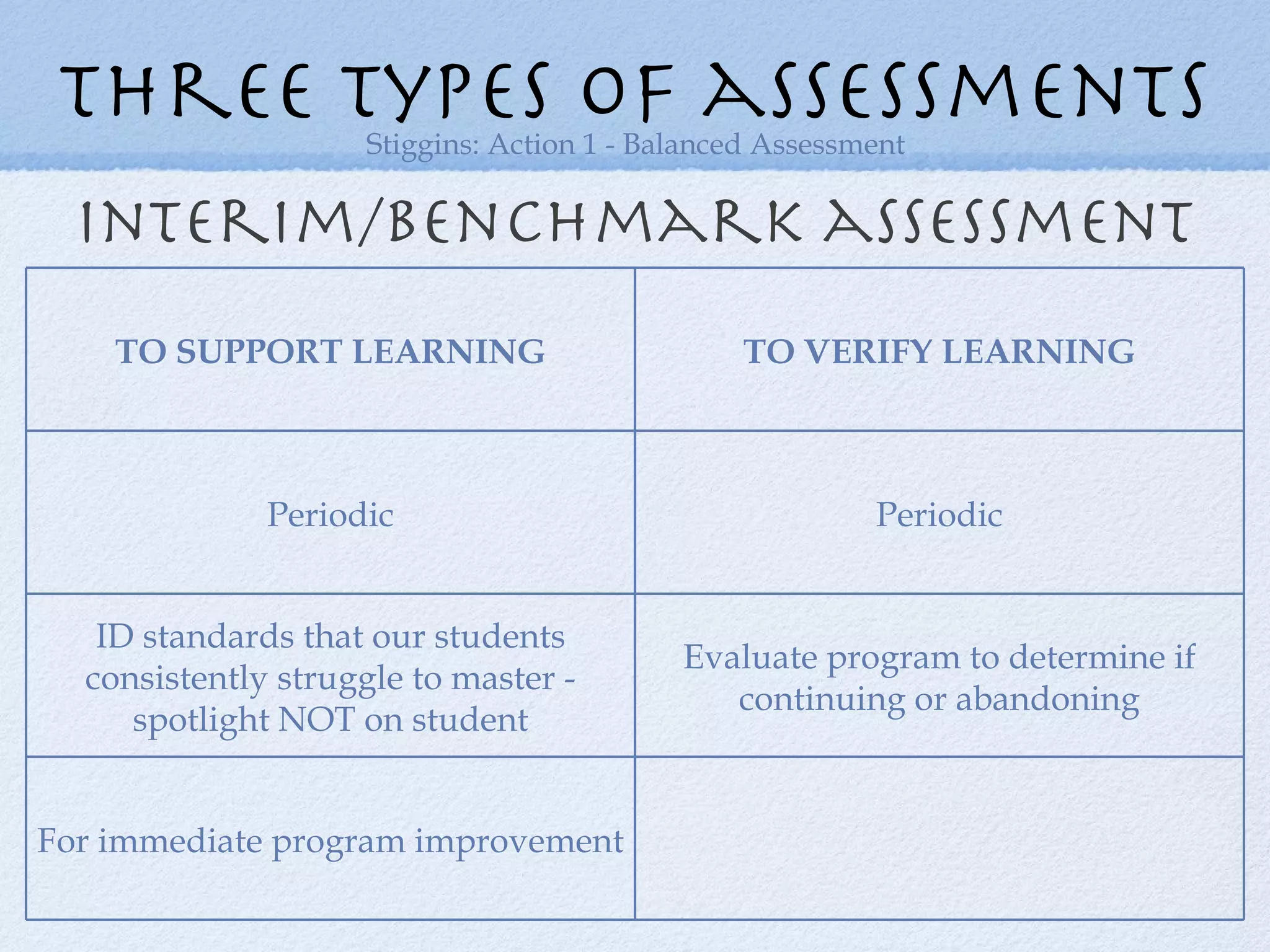
interim/benchmark assessment three types of assessments Stiggins: Action 1 - Balanced Assessment TO SUPPORT LEARNING TO VERIFY LEARNING Periodic Periodic ID standards that our students consistently struggle to master - spotlight NOT on student Evaluate program to determine if continuing or abandoning For immediate program improvement
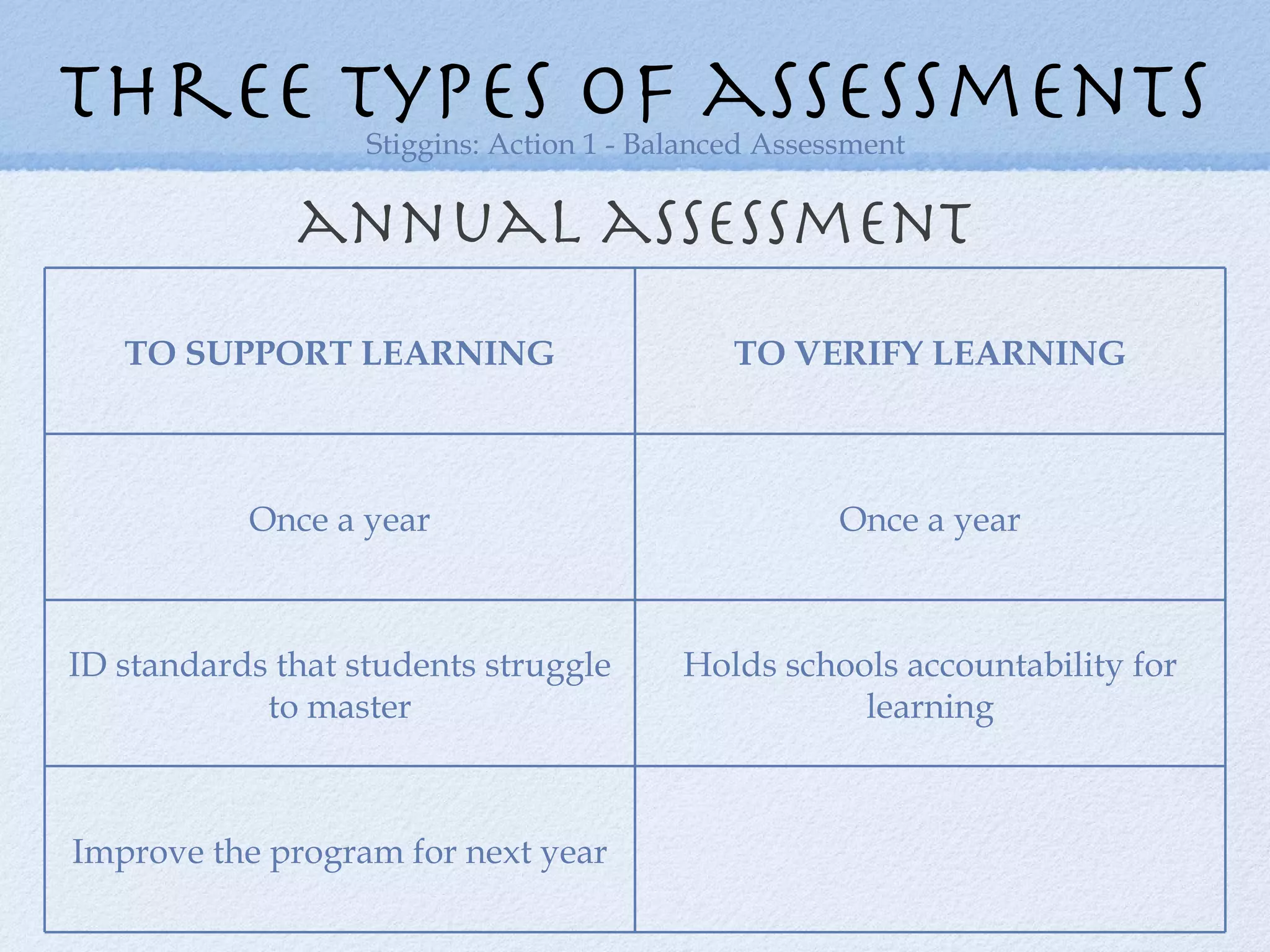
annual assessment three types of assessments Stiggins: Action 1 - Balanced Assessment TO SUPPORT LEARNING TO VERIFY LEARNING Once a year Once a year ID standards that students struggle to master Holds schools accountability for learning Improve the program for next year
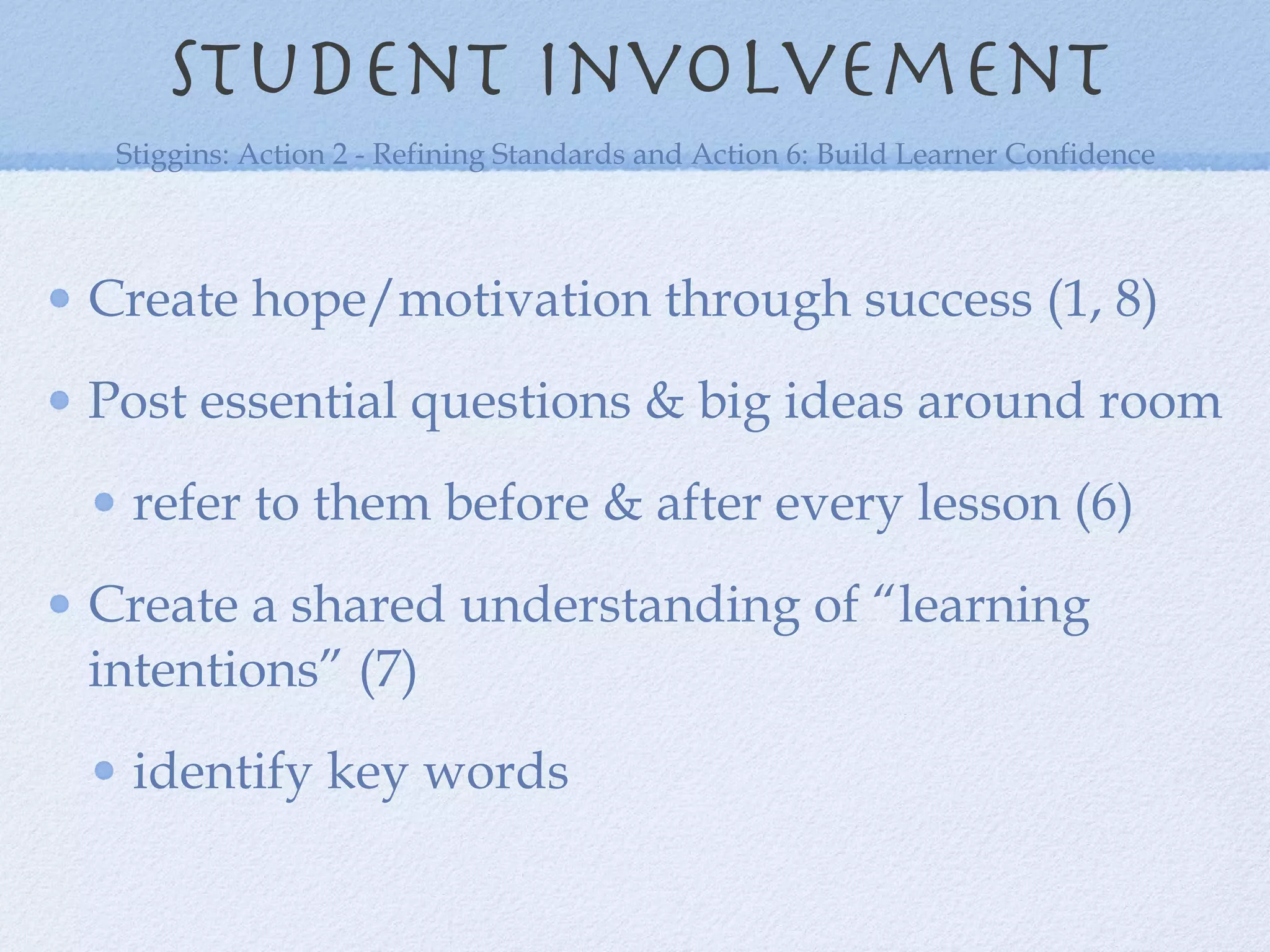
Student involvement Create hope/motivation through success (1, 8) Post essential questions & big ideas around room refer to them before & after every lesson (6) Create a shared understanding of “learning intentions” (7) identify key words  Stiggins: Action 2 - Refining Standards and Action 6: Build Learner Confidence
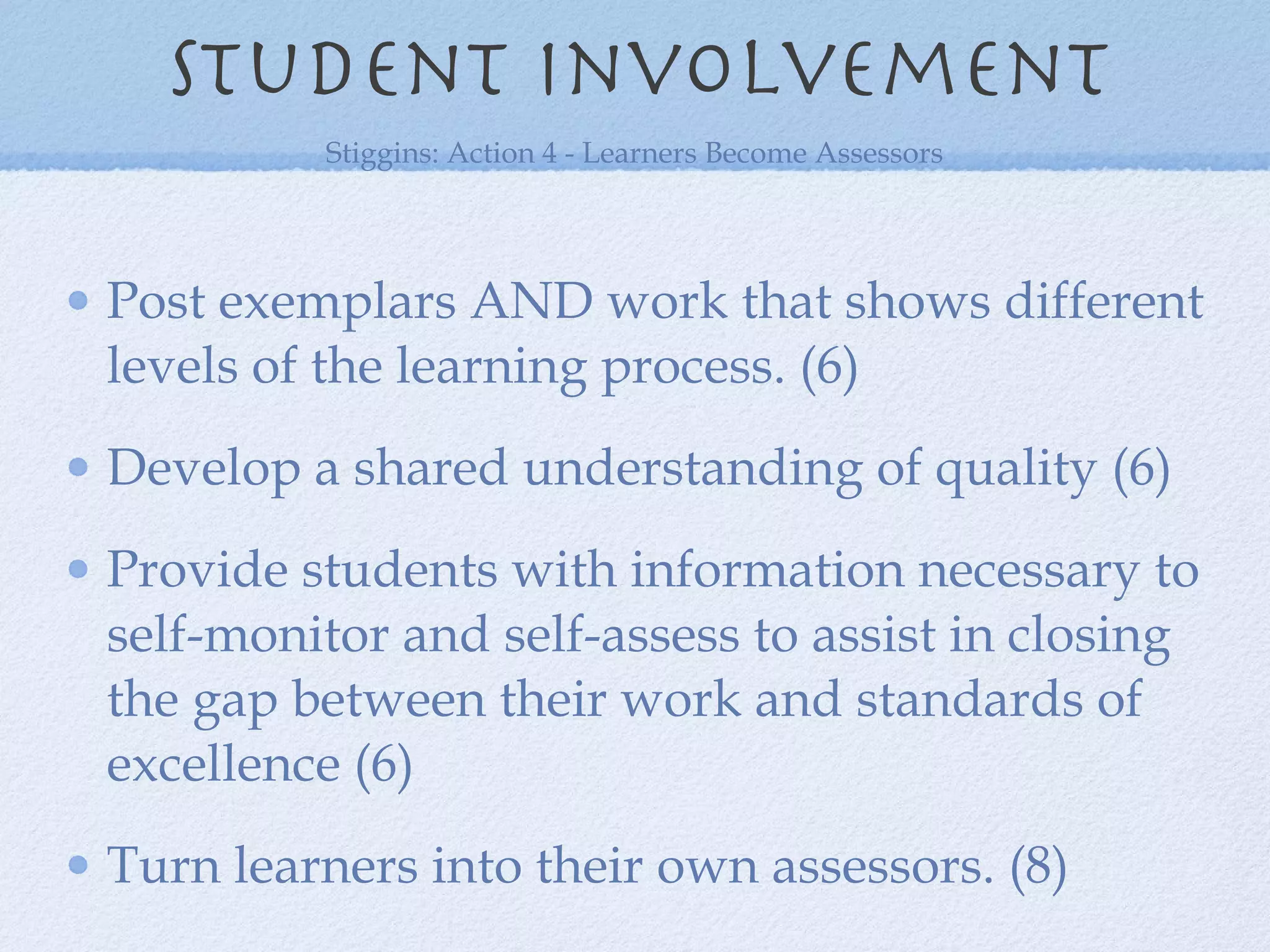
Post exemplars AND work that shows different levels of the learning process. (6) Develop a shared understanding of quality (6) Provide students with information necessary to self-monitor and self-assess to assist in closing the gap between their work and standards of excellence (6) Turn learners into their own assessors. (8) Student involvement Stiggins: Action 4 - Learners Become Assessors
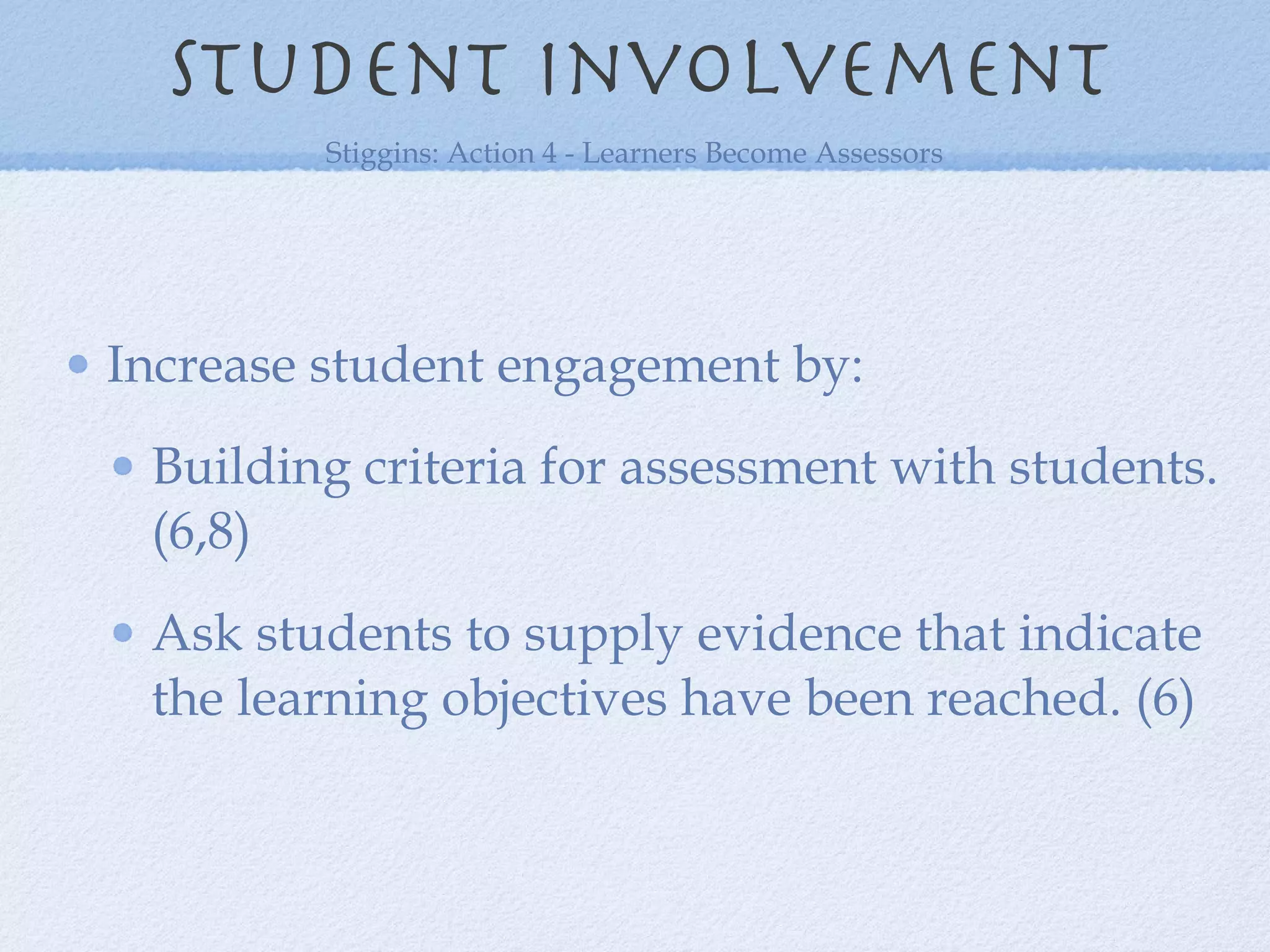
Increase student engagement by: Building criteria for assessment with students. (6,8) Ask students to supply evidence that indicate the learning objectives have been reached. (6) Student involvement Stiggins: Action 4 - Learners Become Assessors
Creating quality assessments Balance of classroom, interim and annual assessments (4,8) Aligned to standards, big ideas, and essential questions (4,8) Includes pre- and post-assessments  (I.D. DI needs) Addresses different levels of Bloom’s Taxonomy (4) Represents an accurate assessment of student learning - provides valid & reliable data (4,8) Stiggins: Action 3 - Creating Quality Classroom Assessment
Creating quality assessments Blend of appropriately-selected item types: (4,8) selected response (T/F, MC) constructed response (short answer/essay) performance-based (projects w/ rubrics) personal communications (Q&A) Provides a range of student work from beginning stages to exemplary pieces (6,8) Stiggins: Action 3 - Creating Quality Classroom Assessment
BEST PRACTICES IN FORMATIVE ASSESSMENT  Feedback is crucial to learning process: helps with the largest gains in student achievement. (8) Should open communication lines between students and teachers (7) Should balance the reporting needs of assessments with instructional purposes (3) Should “promote and organize collective inquiry into and discussion of student progress and achievement” within PLC (J. Little as cited by 5) Stiggins: Action 5 - Provide Descriptive Feedback
BEST PRACTICES IN  FORMATIVE ASSESSMENT  Takes many forms (written, oral, project-based) Written and project-based feedback does not need to be evaluative; can just include comments (6) Oral feedback should include numerous class members, not a volley back and forth between student and teacher  Can determine the DI needs of students (8) Stiggins: Action 5 - Provide Descriptive Feedback
BEST PRACTICES IN  FORMATIVE ASSESSMENT  Feedback should: be immediate  be continuous be specific - identifies what student needs to do more of, do less of or do differently (8) be descriptive - details strengths upon which further learning can build (6) Stiggins: Action 5 - Provide Descriptive Feedback

Assessment Conference

  • 1.
    Ahead of thecurve The Power of Assessment to Transform Teaching and Learning synopsis created by Krista Rundell
  • 2.
    conference SPeakers 5. Richard DuFour 6. Anne Davies 7. Dylan Wiliam 8. Richard J. Stiggins 1. Wayne Hulley 2. Douglas B. Reeves 3. Thomas R. Guskey 4. Larry Ainsworth
  • 3.
    Why is thischange necessary? Our profession is in middle of paradigm shift (8) Current system designed to leave students behind (7) - purpose of ranking History has shown if the stakes are high enough, change occurs (corporal punishment) (2) What we have been doing has increased the achievement gap (8) Have you ever known a student you thought wasn’t going to do well on a test...? (1)
  • 4.
    men in black- exam scene Movie Clip
  • 5.
    men in black- exam scene Wouldn’t it be nice if every student had a Tommy Lee Jones backing him up?
  • 6.
    W. Edwards demingIt’s not enough to do your best; you must know what to do, and then do your best.
  • 7.
    Dylan wiliam Thehard thing is stopping people from doing good things in order to get them to do better things.
  • 8.
    raising achievement mattersOne year of schooling adds 1.7 years of life. (7) Students use assessment to form ideas of themselves as a learner - and sense of self as successful... ... what if you were wrong about your assessment of student work and performance? (8) Why is this change necessary?
  • 9.
    Strong evidence existsthat formative assessment is the most successful strategy to increase student achievement. (5) “ There is nothing else we can be doing that is more effective than assessment”. (7) Assessment can be controlled by the teacher - teacher quality is of the utmost importance. (7) Effective assessment is a powerful tool for informing teachers of learning and improving their teaching process. (5) Why is this change necessary?
  • 10.
    The Bridge (7)Assessment Teaching Learning “ It’s not about what you are teaching, It’s about what the students are LEARNING.” Why is this change necessary?
  • 11.
    What should thischange look like? (1) 1. past performance predicting future success >> using assessment info to ensure future success 2. assessment as a reward or punishment >>>>>> assessment to gather critical evidence 3. focus on rote memory and quantity >>>>>>>> focused on targeted learning outcomes 4. teaching through transmission >>>>>>>>> >> teaching through interaction 5. focus on marks >>>>>>>>>>>>>>>>>>>>>> focus on learning 6. competitive activity >>>>>>>>>>>>>>>>>>> cooperative activity 7. summative focus >>>>>>>>>>>>>>>>>>>>> diagnostic, formative, and summative focus 8. teacher driven >>>>>>>>>>>>>>>>>>>>>>> teacher and student driven 9. lack of clarity of purpose for teaching & assessing >> clarity of purpose of teaching & assessing
  • 12.
    FORMATive assessments AssessmentFOR learning (1) showing process towards the learning target “ Evidence about student achievement elicited by assessment is interpreted and used to make decisions about the next steps in instruction that are likely to be better... than the decisions taken in the absence of that evidence.” (7)
  • 13.
    why cFas? (5)huge positive impact on professional practice are time-efficient provide educational equity for students informs of individual teacher practice builds team capacity allows for collective response results in increased student achievement
  • 14.
  • 15.
    the MarathonRunners What are the similarities and differences between and the Rowers?
  • 16.
    What are PLCs?a collaborative culture within a school wherein all teachers take mutual responsibility for student learning and achievement (5) PLC team seeks relevant data and uses that information to create an improvement plan (5) and determine individual student needs (4)
  • 17.
    PLC & CommonAssessment Breaks teachers out of “working in isolation” mentality (5) Creates a shared purpose for student learning (5) Team develops and analyzes assessments (4) Provides teachers with a support group (6) Plays to teachers’ strengths and works collectively to improve other areas (7)
  • 18.
    Must meet theneeds for all those involved. (7) Proof of learning shown through qualitative and quantitative data. (6) Administered to all students several times throughout the year: (4) Long- end of unit/term/annual: 4 wk- 1 yr Medium- between units/interim/benchmark: 1 - 4 wks Short- within/between units/classroom: minute to minute - daily Stiggins: Action 1 - Balanced Assessment three types of assessments
  • 19.
    Long, medium andshort range assessments all have dual roles: (8) support learning (formative) verify / certify learning (summative) three types of assessments Stiggins: Action 1 - Balanced Assessment
  • 20.
    Classroom assessment threetypes of assessments Stiggins: Action 1 - Balanced Assessment TO SUPPORT LEARNING TO VERIFY LEARNING Continuous Periodic For learning For accountability Informs teachers and students Informs teacher Progress towards each relevant standard To assign report card grades or report standards met
  • 21.
    interim/benchmark assessment threetypes of assessments Stiggins: Action 1 - Balanced Assessment TO SUPPORT LEARNING TO VERIFY LEARNING Periodic Periodic ID standards that our students consistently struggle to master - spotlight NOT on student Evaluate program to determine if continuing or abandoning For immediate program improvement
  • 22.
    annual assessment threetypes of assessments Stiggins: Action 1 - Balanced Assessment TO SUPPORT LEARNING TO VERIFY LEARNING Once a year Once a year ID standards that students struggle to master Holds schools accountability for learning Improve the program for next year
  • 23.
    Student involvement Createhope/motivation through success (1, 8) Post essential questions & big ideas around room refer to them before & after every lesson (6) Create a shared understanding of “learning intentions” (7) identify key words Stiggins: Action 2 - Refining Standards and Action 6: Build Learner Confidence
  • 24.
    Post exemplars ANDwork that shows different levels of the learning process. (6) Develop a shared understanding of quality (6) Provide students with information necessary to self-monitor and self-assess to assist in closing the gap between their work and standards of excellence (6) Turn learners into their own assessors. (8) Student involvement Stiggins: Action 4 - Learners Become Assessors
  • 25.
    Increase student engagementby: Building criteria for assessment with students. (6,8) Ask students to supply evidence that indicate the learning objectives have been reached. (6) Student involvement Stiggins: Action 4 - Learners Become Assessors
  • 26.
    Creating quality assessmentsBalance of classroom, interim and annual assessments (4,8) Aligned to standards, big ideas, and essential questions (4,8) Includes pre- and post-assessments (I.D. DI needs) Addresses different levels of Bloom’s Taxonomy (4) Represents an accurate assessment of student learning - provides valid & reliable data (4,8) Stiggins: Action 3 - Creating Quality Classroom Assessment
  • 27.
    Creating quality assessmentsBlend of appropriately-selected item types: (4,8) selected response (T/F, MC) constructed response (short answer/essay) performance-based (projects w/ rubrics) personal communications (Q&A) Provides a range of student work from beginning stages to exemplary pieces (6,8) Stiggins: Action 3 - Creating Quality Classroom Assessment
  • 28.
    BEST PRACTICES INFORMATIVE ASSESSMENT Feedback is crucial to learning process: helps with the largest gains in student achievement. (8) Should open communication lines between students and teachers (7) Should balance the reporting needs of assessments with instructional purposes (3) Should “promote and organize collective inquiry into and discussion of student progress and achievement” within PLC (J. Little as cited by 5) Stiggins: Action 5 - Provide Descriptive Feedback
  • 29.
    BEST PRACTICES IN FORMATIVE ASSESSMENT Takes many forms (written, oral, project-based) Written and project-based feedback does not need to be evaluative; can just include comments (6) Oral feedback should include numerous class members, not a volley back and forth between student and teacher Can determine the DI needs of students (8) Stiggins: Action 5 - Provide Descriptive Feedback
  • 30.
    BEST PRACTICES IN FORMATIVE ASSESSMENT Feedback should: be immediate be continuous be specific - identifies what student needs to do more of, do less of or do differently (8) be descriptive - details strengths upon which further learning can build (6) Stiggins: Action 5 - Provide Descriptive Feedback