Designing Blended
Learning
Nurbiha A Shukor
Center for Teaching & Learning, UTMLead
Universiti Teknologi Malaysia
OUTLINE
▹ What is Blended Learning?
▹ Models of Blended Learning
▹ Designing Blended Learning
2
Yes? No?
Ali uses online interactive board to teach Maths in a more
engaging way
3
Yes? No?
Siti take online classes and occasionally she meets her
lecturer face-to-face to discuss about the learning
materials
4
Yes? No?
Ravi asks his students to use Clickers to answer questions
online
5
What is Blended Learning?
▹ Formal education
▹ Learn in part through online learning
▹ Students’ control over time, place, path or
pace
▹ The experience is integrated with brick &
mortar to represent learning (Staker & Horn,
2012)
6
Why Blended Learning?7
Improved pedagogy, easy access to knowledge, more
interaction among learners, personal presence, cost
effectiveness, and ease of revision of learning content
(Osguthorpe & Graham, 2003)
Customized; competency-based; anytime anywhere
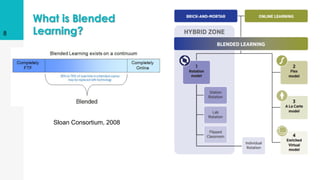
What is Blended
Learning?8
Sloan Consortium, 2008
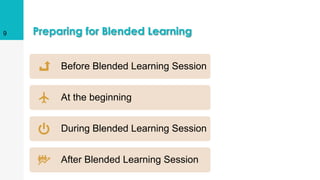
Preparing for Blended Learning9
Before Blended Learning Session
At the beginning
During Blended Learning Session
After Blended Learning Session
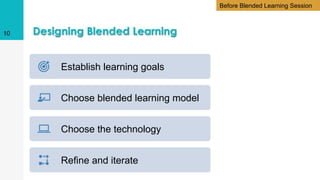
Designing Blended Learning10
Establish learning goals
Choose blended learning model
Choose the technology
Refine and iterate
Before Blended Learning Session
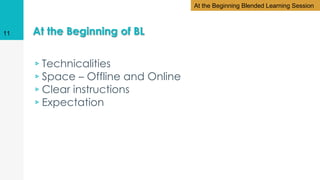
At the Beginning of BL
▹Technicalities
▹Space – Offline and Online
▹Clear instructions
▹Expectation
11
At the Beginning Blended Learning Session
During Blended Learning
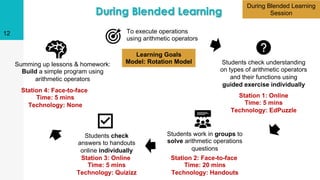
12 • To execute operations
using arithmetic operators
Station 1: Online
Time: 5 mins
Technology: EdPuzzle
Students check understanding
on types of arithmetic operators
and their functions using
guided exercise individually
Station 2: Face-to-face
Time: 20 mins
Technology: Handouts
Students work in groups to
solve arithmetic operations
questions
Station 3: Online
Time: 5 mins
Technology: Quizizz
Students check
answers to handouts
online individually
Learning Goals
Model: Rotation Model
Station 4: Face-to-face
Time: 5 mins
Technology: None
Summing up lessons & homework:
Build a simple program using
arithmetic operators
During Blended Learning
Session
During Blended Learning
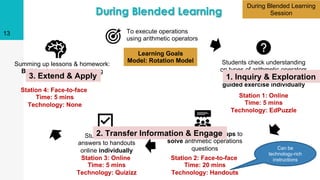
13 • To execute operations
using arithmetic operators
Station 1: Online
Time: 5 mins
Technology: EdPuzzle
Students check understanding
on types of arithmetic operators
and their functions using
guided exercise individually
Station 2: Face-to-face
Time: 20 mins
Technology: Handouts
Students work in groups to
solve arithmetic operations
questions
Station 3: Online
Time: 5 mins
Technology: Quizizz
Students check
answers to handouts
online individually
Station 4: Face-to-face
Time: 5 mins
Technology: None
Summing up lessons & homework:
Build a simple program using
arithmetic operators
Learning Goals
Model: Rotation Model
1. Inquiry & Exploration
2. Transfer Information & Engage
3. Extend & Apply
Can be
technology-rich
instructions
During Blended Learning
Session
Reflection
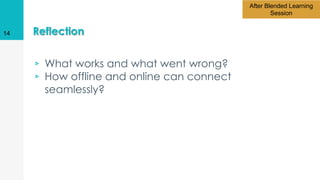
▹ What works and what went wrong?
▹ How offline and online can connect
seamlessly?
14
After Blended Learning
Session
Taking Blended Learning to Extra Miles15
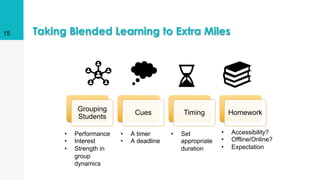
Grouping
Students
Cues Timing Homework
• Performance
• Interest
• Strength in
group
dynamics
• A timer
• A deadline
• Set
appropriate
duration
• Accessibility?
• Offline/Online?
• Expectation
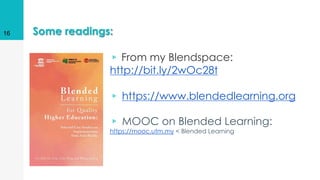
Some readings:
▹ From my Blendspace:
http://bit.ly/2wOc28t
▹ https://www.blendedlearning.org
▹ MOOC on Blended Learning:
https://mooc.utm.my < Blended Learning
16
THANKS!
Any questions?
You can find me at
▹ educ.utm.my/nurbiha
▹ nurbiha@utm.my
17

Designing Blended Learning

  • 1.
    Designing Blended Learning Nurbiha AShukor Center for Teaching & Learning, UTMLead Universiti Teknologi Malaysia
  • 2.
    OUTLINE ▹ What isBlended Learning? ▹ Models of Blended Learning ▹ Designing Blended Learning 2
  • 3.
    Yes? No? Ali usesonline interactive board to teach Maths in a more engaging way 3
  • 4.
    Yes? No? Siti takeonline classes and occasionally she meets her lecturer face-to-face to discuss about the learning materials 4
  • 5.
    Yes? No? Ravi askshis students to use Clickers to answer questions online 5
  • 6.
    What is BlendedLearning? ▹ Formal education ▹ Learn in part through online learning ▹ Students’ control over time, place, path or pace ▹ The experience is integrated with brick & mortar to represent learning (Staker & Horn, 2012) 6
  • 7.
    Why Blended Learning?7 Improvedpedagogy, easy access to knowledge, more interaction among learners, personal presence, cost effectiveness, and ease of revision of learning content (Osguthorpe & Graham, 2003) Customized; competency-based; anytime anywhere
  • 8.
  • 9.
    Preparing for BlendedLearning9 Before Blended Learning Session At the beginning During Blended Learning Session After Blended Learning Session
  • 10.
    Designing Blended Learning10 Establishlearning goals Choose blended learning model Choose the technology Refine and iterate Before Blended Learning Session
  • 11.
    At the Beginningof BL ▹Technicalities ▹Space – Offline and Online ▹Clear instructions ▹Expectation 11 At the Beginning Blended Learning Session
  • 12.
    During Blended Learning 12• To execute operations using arithmetic operators Station 1: Online Time: 5 mins Technology: EdPuzzle Students check understanding on types of arithmetic operators and their functions using guided exercise individually Station 2: Face-to-face Time: 20 mins Technology: Handouts Students work in groups to solve arithmetic operations questions Station 3: Online Time: 5 mins Technology: Quizizz Students check answers to handouts online individually Learning Goals Model: Rotation Model Station 4: Face-to-face Time: 5 mins Technology: None Summing up lessons & homework: Build a simple program using arithmetic operators During Blended Learning Session
  • 13.
    During Blended Learning 13• To execute operations using arithmetic operators Station 1: Online Time: 5 mins Technology: EdPuzzle Students check understanding on types of arithmetic operators and their functions using guided exercise individually Station 2: Face-to-face Time: 20 mins Technology: Handouts Students work in groups to solve arithmetic operations questions Station 3: Online Time: 5 mins Technology: Quizizz Students check answers to handouts online individually Station 4: Face-to-face Time: 5 mins Technology: None Summing up lessons & homework: Build a simple program using arithmetic operators Learning Goals Model: Rotation Model 1. Inquiry & Exploration 2. Transfer Information & Engage 3. Extend & Apply Can be technology-rich instructions During Blended Learning Session
  • 14.
    Reflection ▹ What worksand what went wrong? ▹ How offline and online can connect seamlessly? 14 After Blended Learning Session
  • 15.
    Taking Blended Learningto Extra Miles15 Grouping Students Cues Timing Homework • Performance • Interest • Strength in group dynamics • A timer • A deadline • Set appropriate duration • Accessibility? • Offline/Online? • Expectation
  • 16.
    Some readings: ▹ Frommy Blendspace: http://bit.ly/2wOc28t ▹ https://www.blendedlearning.org ▹ MOOC on Blended Learning: https://mooc.utm.my < Blended Learning 16
  • 17.
    THANKS! Any questions? You canfind me at ▹ educ.utm.my/nurbiha ▹ nurbiha@utm.my 17