
THE 4th INDUSTRIAL REVOLUTION
B O O K R E V I E W
K . S C H W A B , W O R L D E C O N O M I C F O R U M
K. Schwab
Founder and Executive Chairman, World Economic Forum
“We are at the beginning of a revolution
that is fundamentally changing the way
we live, work and relate to one another”
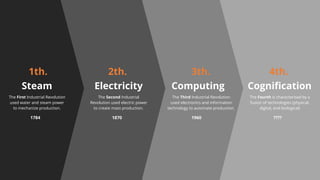
Steam Electricity Computing Cognification
The First Industrial Revolution
used water and steam power
to mechanize production.
The Second Industrial
Revolution used electric power
to create mass production.
The Third Industrial Revolution
used electronics and information
technology to automate production.
The Fourth is characterised by a
fusion of technologies (physical,
digital, and biological)
1th. 2th. 3th. 4th.
1784 1870 1960 ????
MEGATRENDS
Physical
Digital
Biological
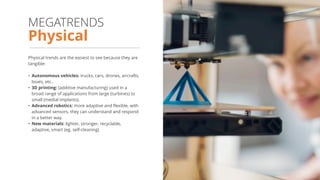
Physical trends are the easiest to see because they are
tangible:
• Autonomous vehicles: trucks, cars, drones, aircrafts,
boats, etc..
• 3D printing: (additive manufacturing) used in a
broad range of applications from large (turbines) to
small (medial implants).
• Advanced robotics: more adaptive and flexible, with
advanced sensors, they can understand and respond
in a better way.
• New materials: lighter, stronger, recyclable,
adaptive, smart (eg. self-cleaning)
Physical
MEGATRENDS
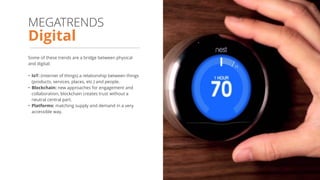
Some of these trends are a bridge between physical
and digital:
• IoT: (internet of things) a relationship between things
(products, services, places, etc.) and people.
• Blockchain: new approaches for engagement and
collaboration, blockchain creates trust without a
neutral central part.
• Platforms: matching supply and demand in a very
accessible way.
Digital
MEGATRENDS
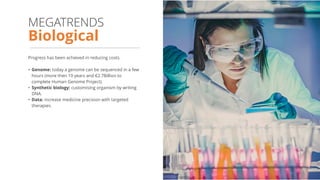
Progress has been achieved in reducing costs.
• Genome: today a genome can be sequenced in a few
hours (more then 10 years and €2.7Billion to
complete Human Genome Project).
• Synthetic biology: customising organism by writing
DNA.
• Data: increase medicine precision with targeted
therapies.
Biological
MEGATRENDS
Economy
Business
National
Society
Individual
01.
02.
03.
04.
05.
IMPACT
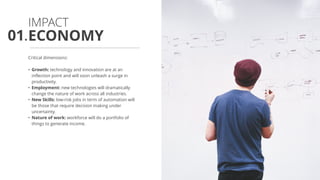
Critical dimensions:
• Growth: technology and innovation are at an
inflection point and will soon unleash a surge in
productivity.
• Employment: new technologies will dramatically
change the nature of work across all industries.
• New Skills: low-risk jobs in term of automation will
be those that require decision making under
uncertainty.
• Nature of work: workforce will do a portfolio of
things to generate income.
ECONOMY
IMPACT
01.
“The velocity of disruption and the
acceleration of innovation are hard
to comprehend or anticipate”
K. Schwab
Founder and Executive Chairman, World Economic Forum
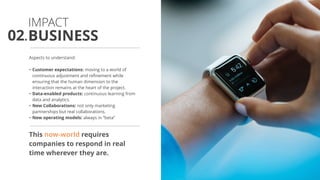
Aspects to understand:
• Customer expectations: moving to a world of
continuous adjustment and refinement while
ensuring that the human dimension to the
interaction remains at the heart of the project.
• Data-enabled products: continuous learning from
data and analytics.
• New Collaborations: not only marketing
partnerships but real collaborations.
• New operating models: always in “beta”
This now-world requires
companies to respond in real
time wherever they are.
BUSINESS
IMPACT
02.
“Businesses, industries and
corporations will face continuous
Darwinian pressures and as such, the
philosophy of “always in beta” (always
evolving) will become more prevalent.”
K. Schwab
Founder and Executive Chairman, World Economic Forum
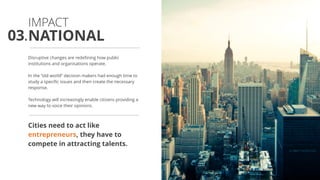
Disruptive changes are redefining how public
institutions and organisations operate.
In the “old world” decision makers had enough time to
study a specific issues and then create the necessary
response.
Technology will increasingly enable citizens providing a
new way to voice their opinions.
Cities need to act like
entrepreneurs, they have to
compete in attracting talents.
NATIONAL
IMPACT
03.
“Governments should be essential
partners in shaping the transition
to new scientific, technological,
economic and societal frameworks”
K. Schwab
Founder and Executive Chairman, World Economic Forum
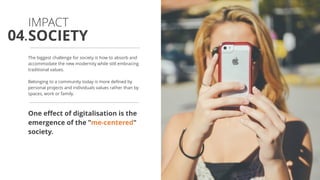
The biggest challenge for society is how to absorb and
accommodate the new modernity while still embracing
traditional values.
Belonging to a community today is more defined by
personal projects and individuals values rather than by
spaces, work or family.
One effect of digitalisation is the
emergence of the ”me-centered"
society.
SOCIETY
IMPACT
04.
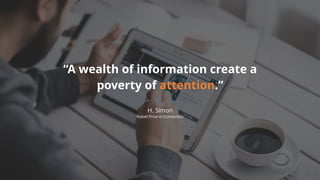
H. Simon
Nobel Prize in Economics
“A wealth of information create a
poverty of attention.”
The fourth industrial revolution is not only changing
what we do but also who we are.
It will change our identity in many aspects:
• behaviours
• privacy
• ownership
• consumptions
• time for work
• time for leisure
• etc.
INDIVIDUAL
IMPACT
ARTIFICIAL POWER
05.
“In an age of acceleration, nothing can
be more exhilarating than going slow.
And in an age of distraction, nothing is
so luxurious as paying attention”
P. Iyer
Global author
World Economic Forum - Official website
https://www.weforum.org
SOURCES
Why Everyone Must Get Ready For The 4th Industrial Revolution
http://www.forbes.com/sites/bernardmarr/2016/04/05/why-everyone-must-get-ready-for-4th-industrial-revolution/#73225f6d79c9
The Fourth Industrial revolution - Book
https://www.weforum.org/about/the-fourth-industrial-revolution-by-klaus-schwab
The Fourth Industrial revolution - Documentary
https://www.youtube.com/watch?v=kpW9JcWxKq0
T H A N K Y O U
@lameraluca
lucalamera

The Fourth Industrial Revolution

  • 1.
    THE 4th INDUSTRIALREVOLUTION B O O K R E V I E W K . S C H W A B , W O R L D E C O N O M I C F O R U M
  • 2.
    K. Schwab Founder andExecutive Chairman, World Economic Forum “We are at the beginning of a revolution that is fundamentally changing the way we live, work and relate to one another”
  • 3.
    Steam Electricity ComputingCognification The First Industrial Revolution used water and steam power to mechanize production. The Second Industrial Revolution used electric power to create mass production. The Third Industrial Revolution used electronics and information technology to automate production. The Fourth is characterised by a fusion of technologies (physical, digital, and biological) 1th. 2th. 3th. 4th. 1784 1870 1960 ????
  • 4.
  • 5.
    Physical trends arethe easiest to see because they are tangible: • Autonomous vehicles: trucks, cars, drones, aircrafts, boats, etc.. • 3D printing: (additive manufacturing) used in a broad range of applications from large (turbines) to small (medial implants). • Advanced robotics: more adaptive and flexible, with advanced sensors, they can understand and respond in a better way. • New materials: lighter, stronger, recyclable, adaptive, smart (eg. self-cleaning) Physical MEGATRENDS
  • 6.
    Some of thesetrends are a bridge between physical and digital: • IoT: (internet of things) a relationship between things (products, services, places, etc.) and people. • Blockchain: new approaches for engagement and collaboration, blockchain creates trust without a neutral central part. • Platforms: matching supply and demand in a very accessible way. Digital MEGATRENDS
  • 7.
    Progress has beenachieved in reducing costs. • Genome: today a genome can be sequenced in a few hours (more then 10 years and €2.7Billion to complete Human Genome Project). • Synthetic biology: customising organism by writing DNA. • Data: increase medicine precision with targeted therapies. Biological MEGATRENDS
  • 8.
  • 9.
    Critical dimensions: • Growth:technology and innovation are at an inflection point and will soon unleash a surge in productivity. • Employment: new technologies will dramatically change the nature of work across all industries. • New Skills: low-risk jobs in term of automation will be those that require decision making under uncertainty. • Nature of work: workforce will do a portfolio of things to generate income. ECONOMY IMPACT 01.
  • 10.
    “The velocity ofdisruption and the acceleration of innovation are hard to comprehend or anticipate” K. Schwab Founder and Executive Chairman, World Economic Forum
  • 11.
    Aspects to understand: •Customer expectations: moving to a world of continuous adjustment and refinement while ensuring that the human dimension to the interaction remains at the heart of the project. • Data-enabled products: continuous learning from data and analytics. • New Collaborations: not only marketing partnerships but real collaborations. • New operating models: always in “beta” This now-world requires companies to respond in real time wherever they are. BUSINESS IMPACT 02.
  • 12.
    “Businesses, industries and corporationswill face continuous Darwinian pressures and as such, the philosophy of “always in beta” (always evolving) will become more prevalent.” K. Schwab Founder and Executive Chairman, World Economic Forum
  • 13.
    Disruptive changes areredefining how public institutions and organisations operate. In the “old world” decision makers had enough time to study a specific issues and then create the necessary response. Technology will increasingly enable citizens providing a new way to voice their opinions. Cities need to act like entrepreneurs, they have to compete in attracting talents. NATIONAL IMPACT 03.
  • 14.
    “Governments should beessential partners in shaping the transition to new scientific, technological, economic and societal frameworks” K. Schwab Founder and Executive Chairman, World Economic Forum
  • 15.
    The biggest challengefor society is how to absorb and accommodate the new modernity while still embracing traditional values. Belonging to a community today is more defined by personal projects and individuals values rather than by spaces, work or family. One effect of digitalisation is the emergence of the ”me-centered" society. SOCIETY IMPACT 04.
  • 16.
    H. Simon Nobel Prizein Economics “A wealth of information create a poverty of attention.”
  • 17.
    The fourth industrialrevolution is not only changing what we do but also who we are. It will change our identity in many aspects: • behaviours • privacy • ownership • consumptions • time for work • time for leisure • etc. INDIVIDUAL IMPACT ARTIFICIAL POWER 05.
  • 18.
    “In an ageof acceleration, nothing can be more exhilarating than going slow. And in an age of distraction, nothing is so luxurious as paying attention” P. Iyer Global author
  • 19.
    World Economic Forum- Official website https://www.weforum.org SOURCES Why Everyone Must Get Ready For The 4th Industrial Revolution http://www.forbes.com/sites/bernardmarr/2016/04/05/why-everyone-must-get-ready-for-4th-industrial-revolution/#73225f6d79c9 The Fourth Industrial revolution - Book https://www.weforum.org/about/the-fourth-industrial-revolution-by-klaus-schwab The Fourth Industrial revolution - Documentary https://www.youtube.com/watch?v=kpW9JcWxKq0
  • 20.
    T H AN K Y O U @lameraluca lucalamera