

SMART HOME EVOLUTION
O V E R V I E W
T H E F U T U R E O F C O N N E C T E D P R O D U C T S
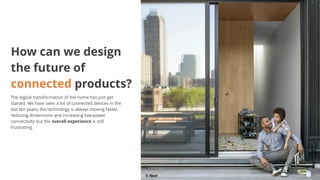
How can we design
the future of
connected products?
The digital transformation of the home has just get
started. We have seen a lot of connected devices in the
last ten years, the technology is always moving faster,
reducing dimensions and increasing low-power
connectivity but the overall experience is still
frustrating.
© Next
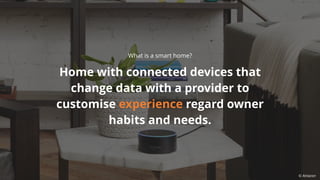
What is a smart home?
Home with connected devices that
change data with a provider to
customise experience regard owner
habits and needs.
© Amazon
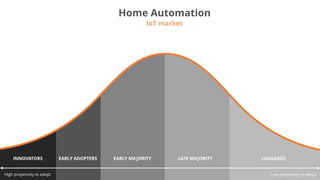
IoT market
Home Automation
INNOVATORS EARLY ADOPTERS EARLY MAJORITY LATE MAJORITY LAGGARDS
High propensity to adopt Low propensity to adopt
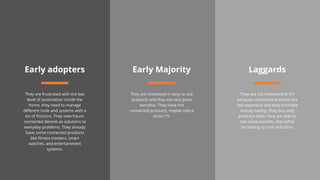
Early adopters Early Majority Laggards
They are frustrated with the low
level of automation inside the
home, they need to manage
different tools and systems with a
lot of frictions. They view future
connected devices as solutions to
everyday problems. They already
have some connected products
like fitness trackers, smart
watches, and entertainment
systems.
They are interested in easy to use
products and they are very price
sensitive. They have not
connected products, maybe only a
smart TV.
They are not interested in IoT
because connected products are
too expensive and they prioritize
money-saving. They buy only
products when they are able to
see some benefits, like safety
increasing or cost reduction.
Products that can improve quality of life like fitness
bands or sleep trackers.
E.g.: Beddit disappears inside the bedroom measuring
temperature, heart rate, breathing and other types of
data without being noticed, Beddit also gives
suggestions to improve sleep quality.
Products that help users to control consumption and
save money.
E.g.: Well, is a smart shower connected with a network
that help users to manage and preserve water.
Key Values
Health
Energy saving
© Beddit — www.beddit.com
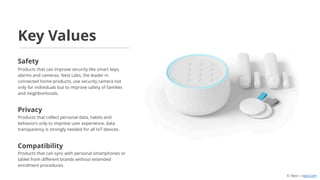
Products that can improve security like smart keys,
alarms and cameras. Nest Labs, the leader in
connected home products, use security camera not
only for individuals but to improve safety of families
and neighborhoods.
Products that collect personal data, habits and
behaviors only to improve user experience, data
transparency is strongly needed for all IoT devices.
Products that can sync with personal smartphones or
tablet from different brands without extended
enrolment procedures.
Key Values
Safety
Privacy
Compatibility
© Nest — nest.com
Omni connections
Seamless management
Adaptive ecosystems
Enlightenment
Routine
01.
02.
03.
04.
05.
New
Dynamics
OMNI
CONNECTIONS
Information and data flow from the house to the
smartphone in a continuous way.
Users can be far away from home and still have
complete control, like checking security cameras or
ambient temperature.
01.
© Nest Labs — nest.com/cameras/
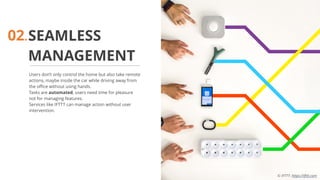
SEAMLESS
MANAGEMENT
Users don’t only control the home but also take remote
actions, maybe inside the car while driving away from
the office without using hands.
Tasks are automated, users need time for pleasure
not for managing features.
Services like IFTTT can manage action without user
intervention.
02.
© IFTTT- https://ifttt.com
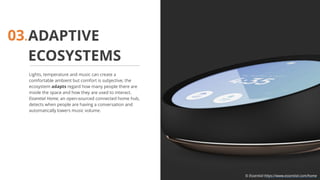
ADAPTIVE
ECOSYSTEMS
Lights, temperature and music can create a
comfortable ambient but comfort is subjective, the
ecosystem adapts regard how many people there are
inside the space and how they are used to interact.
Essential Home, an open-sourced connected home hub,
detects when people are having a conversation and
automatically lowers music volume.
03.
© Essential https://www.essential.com/home
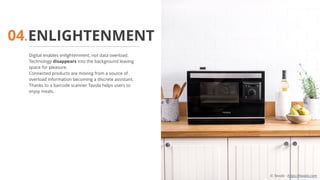
ENLIGHTENMENT
Digital enables enlightenment, not data overload.
Technology disappears into the background leaving
space for pleasure.
Connected products are moving from a source of
overload information becoming a discrete assistant.
Thanks to a barcode scanner Tavola helps users to
enjoy meals.
04.
© Tavola - https://tovala.com
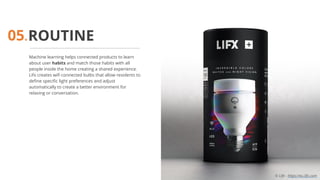
ROUTINE
Machine learning helps connected products to learn
about user habits and match those habits with all
people inside the home creating a shared experience.
Lifx creates wifi connected bulbs that allow residents to
define specific light preferences and adjust
automatically to create a better environment for
relaxing or conversation.
05.
© Life - https://eu.lifx.com
Goal for Designers:
Make the next generation
of connected products
more human.
The State of IoT in the Home, Altimeter, 2017
http://www2.prophet.com/The-Digital-Transformation-of-the-Home
SOURCES
Home Debrief, PSFK, 2017
https://www.psfk.com/report/home-debrief
Designing for the Internet of Things, O’Reilly Media, 2016
http://www.oreilly.com/design/free/designing-for-the-internet-of-things.csp
Laura Klein, Design for voice interface, O’Reilly Media, 2016
http://www.oreilly.com/design/free/design-for-voice-interfaces.csp
T H A N K Y O U
@lameraluca
lucalamera

Smart Home Evolution

  • 1.
    SMART HOME EVOLUTION OV E R V I E W T H E F U T U R E O F C O N N E C T E D P R O D U C T S
  • 2.
    How can wedesign the future of connected products? The digital transformation of the home has just get started. We have seen a lot of connected devices in the last ten years, the technology is always moving faster, reducing dimensions and increasing low-power connectivity but the overall experience is still frustrating. © Next
  • 3.
    What is asmart home? Home with connected devices that change data with a provider to customise experience regard owner habits and needs. © Amazon
  • 4.
    IoT market Home Automation INNOVATORSEARLY ADOPTERS EARLY MAJORITY LATE MAJORITY LAGGARDS High propensity to adopt Low propensity to adopt
  • 5.
    Early adopters EarlyMajority Laggards They are frustrated with the low level of automation inside the home, they need to manage different tools and systems with a lot of frictions. They view future connected devices as solutions to everyday problems. They already have some connected products like fitness trackers, smart watches, and entertainment systems. They are interested in easy to use products and they are very price sensitive. They have not connected products, maybe only a smart TV. They are not interested in IoT because connected products are too expensive and they prioritize money-saving. They buy only products when they are able to see some benefits, like safety increasing or cost reduction.
  • 6.
    Products that canimprove quality of life like fitness bands or sleep trackers. E.g.: Beddit disappears inside the bedroom measuring temperature, heart rate, breathing and other types of data without being noticed, Beddit also gives suggestions to improve sleep quality. Products that help users to control consumption and save money. E.g.: Well, is a smart shower connected with a network that help users to manage and preserve water. Key Values Health Energy saving © Beddit — www.beddit.com
  • 7.
    Products that canimprove security like smart keys, alarms and cameras. Nest Labs, the leader in connected home products, use security camera not only for individuals but to improve safety of families and neighborhoods. Products that collect personal data, habits and behaviors only to improve user experience, data transparency is strongly needed for all IoT devices. Products that can sync with personal smartphones or tablet from different brands without extended enrolment procedures. Key Values Safety Privacy Compatibility © Nest — nest.com
  • 8.
    Omni connections Seamless management Adaptiveecosystems Enlightenment Routine 01. 02. 03. 04. 05. New Dynamics
  • 9.
    OMNI CONNECTIONS Information and dataflow from the house to the smartphone in a continuous way. Users can be far away from home and still have complete control, like checking security cameras or ambient temperature. 01. © Nest Labs — nest.com/cameras/
  • 10.
    SEAMLESS MANAGEMENT Users don’t onlycontrol the home but also take remote actions, maybe inside the car while driving away from the office without using hands. Tasks are automated, users need time for pleasure not for managing features. Services like IFTTT can manage action without user intervention. 02. © IFTTT- https://ifttt.com
  • 11.
    ADAPTIVE ECOSYSTEMS Lights, temperature andmusic can create a comfortable ambient but comfort is subjective, the ecosystem adapts regard how many people there are inside the space and how they are used to interact. Essential Home, an open-sourced connected home hub, detects when people are having a conversation and automatically lowers music volume. 03. © Essential https://www.essential.com/home
  • 12.
    ENLIGHTENMENT Digital enables enlightenment,not data overload. Technology disappears into the background leaving space for pleasure. Connected products are moving from a source of overload information becoming a discrete assistant. Thanks to a barcode scanner Tavola helps users to enjoy meals. 04. © Tavola - https://tovala.com
  • 13.
    ROUTINE Machine learning helpsconnected products to learn about user habits and match those habits with all people inside the home creating a shared experience. Lifx creates wifi connected bulbs that allow residents to define specific light preferences and adjust automatically to create a better environment for relaxing or conversation. 05. © Life - https://eu.lifx.com
  • 14.
    Goal for Designers: Makethe next generation of connected products more human.
  • 15.
    The State ofIoT in the Home, Altimeter, 2017 http://www2.prophet.com/The-Digital-Transformation-of-the-Home SOURCES Home Debrief, PSFK, 2017 https://www.psfk.com/report/home-debrief Designing for the Internet of Things, O’Reilly Media, 2016 http://www.oreilly.com/design/free/designing-for-the-internet-of-things.csp Laura Klein, Design for voice interface, O’Reilly Media, 2016 http://www.oreilly.com/design/free/design-for-voice-interfaces.csp
  • 16.
    T H AN K Y O U @lameraluca lucalamera