Design Thinking Concepts
Cindy Royal, Ph.D
Associate Professor
Texas State University
School of Journalism
and Mass Communication
croyal@txstate.edu
cindyroyal.com
@cindyroyal
slideshare.net/cindyroyal
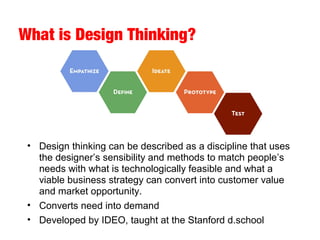
What is Design Thinking?
• Design thinking can be described as a discipline that uses
the designer’s sensibility and methods to match people’s
needs with what is technologically feasible and what a
viable business strategy can convert into customer value
and market opportunity.
• Converts need into demand
• Developed by IDEO, taught at the Stanford d.school
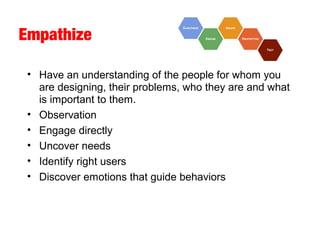
Empathize
• Have an understanding of the people for whom you
are designing, their problems, who they are and what
is important to them.
• Observation
• Engage directly
• Uncover needs
• Identify right users
• Discover emotions that guide behaviors
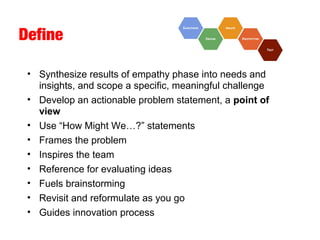
Define
• Synthesize results of empathy phase into needs and
insights, and scope a specific, meaningful challenge
• Develop an actionable problem statement, a point of
view
• Use “How Might We…?” statements
• Frames the problem
• Inspires the team
• Reference for evaluating ideas
• Fuels brainstorming
• Revisit and reformulate as you go
• Guides innovation process
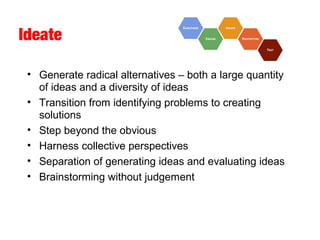
Ideate
• Generate radical alternatives – both a large quantity
of ideas and a diversity of ideas
• Transition from identifying problems to creating
solutions
• Step beyond the obvious
• Harness collective perspectives
• Separation of generating ideas and evaluating ideas
• Brainstorming without judgement
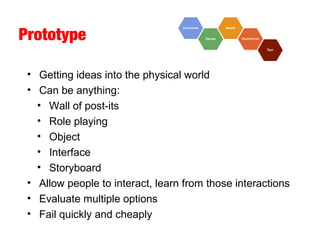
Prototype
• Getting ideas into the physical world
• Can be anything:
• Wall of post-its
• Role playing
• Object
• Interface
• Storyboard
• Allow people to interact, learn from those interactions
• Evaluate multiple options
• Fail quickly and cheaply
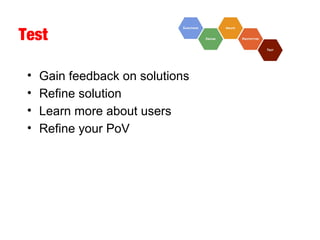
Test
• Gain feedback on solutions
• Refine solution
• Learn more about users
• Refine your PoV
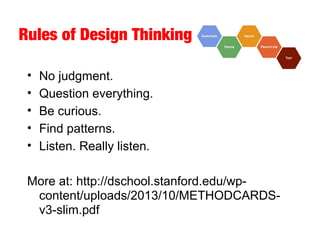
Rules of Design Thinking
• No judgment.
• Question everything.
• Be curious.
• Find patterns.
• Listen. Really listen.
More at: http://dschool.stanford.edu/wp-
content/uploads/2013/10/METHODCARDS-
v3-slim.pdf
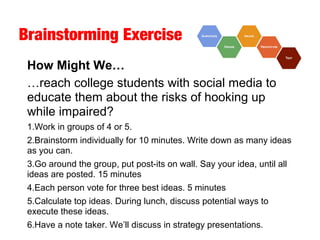
Brainstorming Exercise
How Might We…
…reach college students with social media to
educate them about the risks of hooking up
while impaired?
1.Work in groups of 4 or 5.
2.Brainstorm individually for 10 minutes. Write down as many ideas
as you can.
3.Go around the group, put post-its on wall. Say your idea, until all
ideas are posted. 15 minutes
4.Each person vote for three best ideas. 5 minutes
5.Calculate top ideas. During lunch, discuss potential ways to
execute these ideas.
6.Have a note taker. We’ll discuss in strategy presentations.
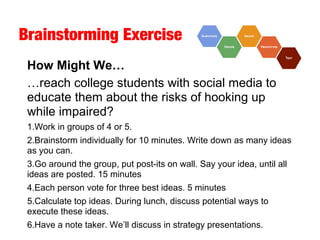
Brainstorming Exercise
How Might We…
…reach college students with social media to
educate them about the risks of hooking up
while impaired?
1.Work in groups of 4 or 5.
2.Brainstorm individually for 10 minutes. Write down as many ideas
as you can.
3.Go around the group, put post-its on wall. Say your idea, until all
ideas are posted. 15 minutes
4.Each person vote for three best ideas. 5 minutes
5.Calculate top ideas. During lunch, discuss potential ways to
execute these ideas.
6.Have a note taker. We’ll discuss in strategy presentations.

Design Thinking for Bienestar Coalition

  • 1.
    Design Thinking Concepts CindyRoyal, Ph.D Associate Professor Texas State University School of Journalism and Mass Communication croyal@txstate.edu cindyroyal.com @cindyroyal slideshare.net/cindyroyal
  • 2.
    What is DesignThinking? • Design thinking can be described as a discipline that uses the designer’s sensibility and methods to match people’s needs with what is technologically feasible and what a viable business strategy can convert into customer value and market opportunity. • Converts need into demand • Developed by IDEO, taught at the Stanford d.school
  • 3.
    Empathize • Have anunderstanding of the people for whom you are designing, their problems, who they are and what is important to them. • Observation • Engage directly • Uncover needs • Identify right users • Discover emotions that guide behaviors
  • 4.
    Define • Synthesize resultsof empathy phase into needs and insights, and scope a specific, meaningful challenge • Develop an actionable problem statement, a point of view • Use “How Might We…?” statements • Frames the problem • Inspires the team • Reference for evaluating ideas • Fuels brainstorming • Revisit and reformulate as you go • Guides innovation process
  • 5.
    Ideate • Generate radicalalternatives – both a large quantity of ideas and a diversity of ideas • Transition from identifying problems to creating solutions • Step beyond the obvious • Harness collective perspectives • Separation of generating ideas and evaluating ideas • Brainstorming without judgement
  • 6.
    Prototype • Getting ideasinto the physical world • Can be anything: • Wall of post-its • Role playing • Object • Interface • Storyboard • Allow people to interact, learn from those interactions • Evaluate multiple options • Fail quickly and cheaply
  • 7.
    Test • Gain feedbackon solutions • Refine solution • Learn more about users • Refine your PoV
  • 8.
    Rules of DesignThinking • No judgment. • Question everything. • Be curious. • Find patterns. • Listen. Really listen. More at: http://dschool.stanford.edu/wp- content/uploads/2013/10/METHODCARDS- v3-slim.pdf
  • 9.
    Brainstorming Exercise How MightWe… …reach college students with social media to educate them about the risks of hooking up while impaired? 1.Work in groups of 4 or 5. 2.Brainstorm individually for 10 minutes. Write down as many ideas as you can. 3.Go around the group, put post-its on wall. Say your idea, until all ideas are posted. 15 minutes 4.Each person vote for three best ideas. 5 minutes 5.Calculate top ideas. During lunch, discuss potential ways to execute these ideas. 6.Have a note taker. We’ll discuss in strategy presentations.
  • 10.
    Brainstorming Exercise How MightWe… …reach college students with social media to educate them about the risks of hooking up while impaired? 1.Work in groups of 4 or 5. 2.Brainstorm individually for 10 minutes. Write down as many ideas as you can. 3.Go around the group, put post-its on wall. Say your idea, until all ideas are posted. 15 minutes 4.Each person vote for three best ideas. 5 minutes 5.Calculate top ideas. During lunch, discuss potential ways to execute these ideas. 6.Have a note taker. We’ll discuss in strategy presentations.

Editor's Notes

  • #2 Teach Web design and online journalism Dramatic, unpredictable changes over the past decade Blogs, podcasts, social media Online audio, video, slideshows, animated graphics Wikipedia, Craigslist, MySpace, YouTube, Flickr, Google Maps, Second Life