The first ever!!!!
Design
Sprint School
Pre-meeting
February 15, 2018
9-10 am MT
www.d4ahs.com
Sprint School Faculty
Design Sprint School
OBJECTIVES
• Describe a sprint
• Understand what kind of problems can be
addressed in a sprint
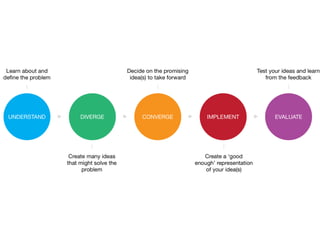
• Know the 5 phases of a design sprint
• Be familiar with some of the methods/tools
used in each phase
• Know how to prepare for a sprint
• Be able to run a sprint or co-facilitate one
with a more experienced sprint master
www.ideo.com
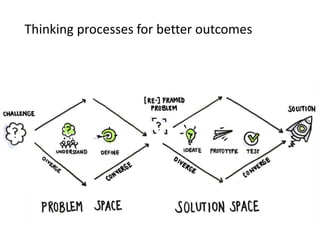
Thinking processes for better outcomes
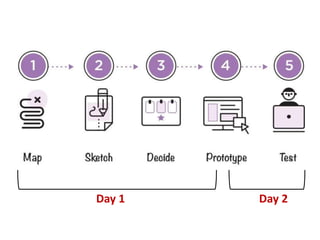
Day 1 Day 2
What a sprint is NOT
It is not a way to create buy in to an already
canned solution
It is not a strategic planning session
It is not focused on building a policy
It is not about finding a standardized way to
solve this problem
What are sprint questions you are
thinking about?
(IM)
When do you use a sprint?
• Complex problem
• High stakes
• Multiple stakeholders
• No clear answer
• Not enough time
• Just plain stuck
Problems that have been sprinted
on so far?
At the beginning anyway …
• Inpatient transfers from acute care to inpatient
units is not going smoothly
• Our inpatient unit does not feel patient and
family centred
• Patients waiting in hospital for appropriate level
of care
• Front line staff do not feel confident making
privacy decisions
• Physicians are not signing up to the Blended
Capitation Model
Reframing
Design Thinking
Sprint Readiness Checklist
• The problem
• The Decider is key!
• Who are the participants
• Post sprint considerations
Sprint School
Clinical staff don't receive timely feedback
from patients.
• Planning
• Understanding
• Diverge
• Define
• Prototype
• Test
Homework!
Sprint book
Google Ventures Design Sprint Kit
90 second overview youtube
#sprintschool
@Design4AHS
Face-to-face session:
Wednesday February 21st
9 am - 4 pm
The location for the face-to-face session is:
Solarium 4th Floor
Richmond Road Diagnostic & Treatment Centre
1820 Richmond Rd SW, Calgary, AB T2T 5C7
Light Lunch
COFFEEEE

Design Sprint School for AHS: Pre School Primer

  • 1.
    The first ever!!!! Design SprintSchool Pre-meeting February 15, 2018 9-10 am MT
  • 2.
  • 3.
  • 4.
    Design Sprint School OBJECTIVES •Describe a sprint • Understand what kind of problems can be addressed in a sprint • Know the 5 phases of a design sprint • Be familiar with some of the methods/tools used in each phase • Know how to prepare for a sprint • Be able to run a sprint or co-facilitate one with a more experienced sprint master
  • 8.
  • 11.
    Thinking processes forbetter outcomes
  • 19.
  • 21.
    What a sprintis NOT It is not a way to create buy in to an already canned solution It is not a strategic planning session It is not focused on building a policy It is not about finding a standardized way to solve this problem
  • 22.
    What are sprintquestions you are thinking about? (IM)
  • 23.
    When do youuse a sprint? • Complex problem • High stakes • Multiple stakeholders • No clear answer • Not enough time • Just plain stuck
  • 24.
    Problems that havebeen sprinted on so far? At the beginning anyway … • Inpatient transfers from acute care to inpatient units is not going smoothly • Our inpatient unit does not feel patient and family centred • Patients waiting in hospital for appropriate level of care • Front line staff do not feel confident making privacy decisions • Physicians are not signing up to the Blended Capitation Model
  • 25.
  • 26.
    Sprint Readiness Checklist •The problem • The Decider is key! • Who are the participants • Post sprint considerations
  • 27.
    Sprint School Clinical staffdon't receive timely feedback from patients. • Planning • Understanding • Diverge • Define • Prototype • Test
  • 28.
    Homework! Sprint book Google VenturesDesign Sprint Kit 90 second overview youtube #sprintschool @Design4AHS
  • 29.
    Face-to-face session: Wednesday February21st 9 am - 4 pm The location for the face-to-face session is: Solarium 4th Floor Richmond Road Diagnostic & Treatment Centre 1820 Richmond Rd SW, Calgary, AB T2T 5C7 Light Lunch COFFEEEE

Editor's Notes

  • #2 MVD
  • #3 MVD
  • #4 MVD
  • #5 MvD
  • #6 Curious - Marlies
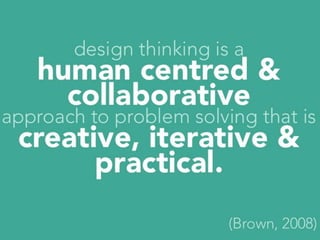
  • #7 In order to understand a design sprint, you must be versed in its genesis, which is design thinking.
  • #8 Human centred design. Solution-finding process. Applies scientific method to the creative process.
  • #9 -Started with d.school at Stanford, became mainstream in the 90s when IDEO was formed. -David Kelley is the father of modern design thinking
  • #10 Has many different interpretations and applications, but always starts with EMPATHY. is measured by how well it fulfills the user’s needs, and it prioritizes rapid experimentation and testing.
  • #11 E – Many problem solving methods tend to start with solutions after assuming the problem is the right one. Taking action depends on having the right solution. Why do we need a different way to solve problems? Analysis paralysis Planning for the perfect solution
  • #12 Design thinking starts with the assumption that the problem is too broad. The thinking processes of diverging and converging removes the double trap of working on the wrong problem, and fixating on a perfect solution. When the solution is a prototype, it’s an experiment. It’s not precious. It’s not expensive. It hasn’t taken years to come to this point so if it doesn’t work, you know quickly – and you can move on to a new idea.
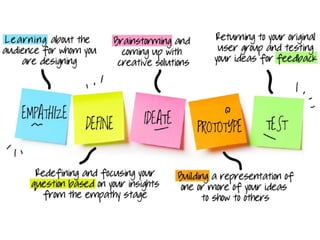
  • #13 - Five stages are not linear, which is why you might see them in different orders. In design culture, failure is seen as a step in the right direction. If we know what isn’t working, and we learn that quickly, we can regroup – rework – and retest. This process makes it possible to rapidly tweak the solution over and over again until value is created.
  • #14 Once you’ve gathered full understanding of your problem, it might take several iterations of a prototype before you find something that you should implement. The key is that you’re implementing quickly, and cheaply.
  • #15 At the heart of the process is finding that sweet spot: - What is possible, what is doable, and what is wanted
  • #16 And no matter whether you’re designing a product, a service, an app or a whole new system – you always start with empathy. You not only want to know WHAT the problem is, but WHY it is a problem and HOW it affects the end user.
  • #17 Design thinking is kicking along just great, then Jake Knapp starts to ponder. Jake Knapp is a lead designer at Google. Notices that when he has hard and fast deadlines, he produces better work Wonders how that could apply to design thinking
  • #18 So Jake takes a look at the design thinking method, and adds limitations. He limits the time to do it. He limits the people involved. He limits the tools and the technology used.
  • #19 And he comes up with a tight 5 day interpretation of design thinking, called a sprint.
  • #20 At AHS, we know that asking front-line staff, patients, or leaders to dedicate 5 days to a sprint is just not gonna fly. So we modified the approach to 2 days, with the understanding that a significant portion of the “empathy / or mapping / or research” phase taking place before the sprint occurs. Next week, at sprint school, we’re going to work with this 2-day sprint format. All the stages are there, adapted for our reality More pressure on facilitator to keep the time, capture the ideas, and trust in the process.
  • #21 Who has used design thinking in their work? – How did it change your mind set? Shawnna*** Langenburger
  • #22 RP – give some examples of how you got a sense things would be heading the wrong direction
  • #23 RP – we have some time here… 5-10
  • #24 RP
  • #25 RP – mention the challenge of knowing in advance if there could be a prototype.
  • #26 RP – how people start a sprint and over time the problem you want to solve changes Give examples?
  • #27 MvD
  • #28 MvD – we can put checklist in IM and I will walk through it
  • #29 MVD
  • #30 MVD