Design of a new SI engine intake manifold with variable length plenum
M.A. Ceviz *, M. Akın
Department of Mechanical Engineering, Faculty of Engineering, University of Atatürk, Erzurum 25240, Turkey
a r t i c l e i n f o
Article history:
Received 5 August 2009
Accepted 21 March 2010
Keywords:
Intake manifold
Intake plenum
Engine performance
a b s t r a c t
This paper investigates the effects of intake plenum length/volume on the performance characteristics of
a spark-ignited engine with electronically controlled fuel injectors. Previous work was carried out mainly
on the engine with carburetor producing a mixture desirable for combustion and dispatching the mixture
to the intake manifold. The more stringent emission legislations have driven engine development
towards concepts based on electronic-controlled fuel injection rather than the use of carburetors. In
the engine with multipoint fuel injection system using electronically controlled fuel injectors has an
intake manifold in which only the air flows and, the fuel is injected onto the intake valve. Since the intake
manifolds transport mainly air, the supercharging effects of the variable length intake plenum will be dif-
ferent from carbureted engine.
Engine tests have been carried out with the aim of constituting a base study to design a new variable
length intake manifold plenum. Engine performance characteristics such as brake torque, brake power,
thermal efficiency and specific fuel consumption were taken into consideration to evaluate the effects
of the variation in the length of intake plenum. The results showed that the variation in the plenum
length causes an improvement on the engine performance characteristics especially on the fuel consump-
tion at high load and low engine speeds which are put forward the system using for urban roads. Accord-
ing to the test results, plenum length must be extended for low engine speeds and shortened as the
engine speed increases. A system taking into account the results of the study was developed to adjust
the intake plenum length.
Ó 2010 Elsevier Ltd. All rights reserved.
1. Introduction
It is known that the design of engine components, measuring
and control methodology of the operating parameters are very
important to improve the engine performance and emission char-
acteristics. Effectively adjusting the operating parameters such as
the relative air–fuel ratio, spark timing, fuel injection timing, valve
timing, exhaust gas recirculation ratio and compression ratio in SI
and CI engines at different engine operation conditions improves
significantly the engine characteristics. The effects of such engine
operating parameters and their control technologies have been
studied excessively by researchers and the product designers. In
engines, configuration of the intake system plays also an important
role on the engine performance, and there are many experimental
and theoretical studies on the intake system and manifold design
[1–6].
Intake manifolds consist typically of a plenum, to the inlet of
which bolts the throttle-body, with the individual runners feeding
branches which lead to each cylinder. Important design criteria
are: low air flow resistance; good distribution of air and fuel be-
tween cylinders; runner and branch lengths that take advantage
of ram and tuning effects; sufficient (but not excessive) heating
to ensure adequate fuel vaporization with carbureted or throttle-
body injected engines [7]. The intake system on an engine has
one main goal, to get as much air–fuel mixture into the cylinder
as possible.
The intermittent or pulsating nature of the airflow through the
intake manifold into each cylinder may develop resonances in the
airflow at certain speeds. These may increase the engine perfor-
mance characteristics at certain engine speeds, but may reduce
at other speeds, depending on manifold dimensions and shape.
Conventional intake manifolds for vehicles have fixed air flow
geometry and static intake manifold. With a static intake manifold,
the speed at which intake tuning occurs is fixed. A static intake
manifold can only be optimized for one specific rpm, so it is bene-
ficial to develop a method to vary the intake length/volume, since
the engine operates over a broad speed range.
Variable length intake manifold technology uses the pressure
variations generated by the pulsating flow due to the periodic pis-
ton and valve motion to produce a charging effect. Various designs
for variable intake geometry have met with varying degrees of suc-
cess. The designs of the variable intake manifolds may be rather
0196-8904/$ - see front matter Ó 2010 Elsevier Ltd. All rights reserved.
doi:10.1016/j.enconman.2010.03.018
* Corresponding author. Fax: +90 442 236 09 57.
E-mail address: aceviz@atauni.edu.tr (M.A. Ceviz).
Energy Conversion and Management 51 (2010) 2239–2244
Contents lists available at ScienceDirect
Energy Conversion and Management
journal homepage: www.elsevier.com/locate/enconman
complex and expensive to produce. Difficulty in servicing and a
limited range of variable tuning may also be disadvantageous de-
sign results of variable intake manifolds. Studies on the intake
manifold design by regulating the runner length/volume for higher
engine performance, optimal fuel consumption and lower emis-
sions have significantly increased in the last years. Some of the
studies carried out by researchers and engine manufacturers (i.e.
Mazda, BMW, Audi) [8–11] change the intake runner length; how-
ever, it is known that intake plenum affects seriously the charging
conditions [12–14].
Previous work [12] on the effects of intake plenum on some en-
gine performance characteristics was carried out mainly on the
carbureted engine. The carburetor produces the fuel and air mix-
ture needed for the operation of the engine and is coupled to the
intake manifold which receives the mixture and distributes it to
the cylinders. Design of intake plenum is active on the quality of
air–fuel mixture homogeneity in carbureted engine. In the engine
with multipoint injection systems using electronically controlled
fuel injectors has an intake manifold in which only the air flows.
The fuel is injected directly into the intake ports and the system
delivers a more evenly distributed mixture of air and fuel to each
of the engine’s cylinders, which improves power and performance.
Engines with multipoint injection have a separate fuel injector lo-
cated to each cylinder intake port. Such injection systems are ideal
for complying with the demands made on the air and fuel mixture
formation system.
In this paper, the effects of intake plenum length/volume varia-
tion on the engine performance were studied experimentally on a
spark-ignited engine with multipoint injection systems using elec-
tronically controlled fuel injectors. The results were used for the
design studies of variable length/volume intake plenum. A new
plenum length control system was produced and explained in
detail.
2. Materials and methods
A schematic layout of the test setup used is indicated in Fig. 1.
The engine test bed was explained in the previous studies of the
author [12,15,16], which consists of a control panel, a hydraulic
dynamometer and measurement instruments. The engine specifi-
cation is summarized in Table 1.
The engine performance characteristics through the various
points were calculated as follows: the brake power (Pb) delivered
by the engine and absorbed by the dynamometer is,
Pb ¼ 2pnT10À3
ð1Þ
where n is the crankshaft rotational speed (rev sÀ1
) and T is the tor-
que (Nm).
The thermal efficiency of the engine is,
gth ¼
Pb
Q
ð2Þ
Q is the total heat supplied by the fuel was calculated from,
Q ¼ CV _mf ð3Þ
where _mf is the fuel consumption (kg snÀ1
) and CV is the lower cal-
orific value of the fuel (kJ kgÀ1
).
The specific fuel consumption (sfc) is the fuel flow rate per unit
power output and calculated from,
sfc ¼
_mf
Pb
ð4Þ
where _mf is the fuel consumption (g hÀ1
) and Pb is the brake power
(kW).
At the beginning of experiments, the engine was run at a near
three-quarter opening position of the throttle valve in order to at-
tain near maximum speed. After the engine reached the steady-
state conditions, the first experiment was conducted with original
intake manifold. The engine was gradually loaded by the hydraulic
dynamometer and test matrix consisted of eight speeds ranging
from 1500 to 5000 rpm with 500 rpm steps for each plenum addi-
tion operation. The experiments were repeated with separately
16 mm (40 cm3
), 32 mm (80 cm3
), 48 mm (120 cm3
) and 64 mm
(160 cm3
) plenum addition at the same engine speeds that were
attained by loading hydraulic dynamometer. The additional ple-
nums had the geometries suitable for entrance of the original in-
take manifold, and located among the throttle valve and intake
manifold plenum.
3. Results and discussion
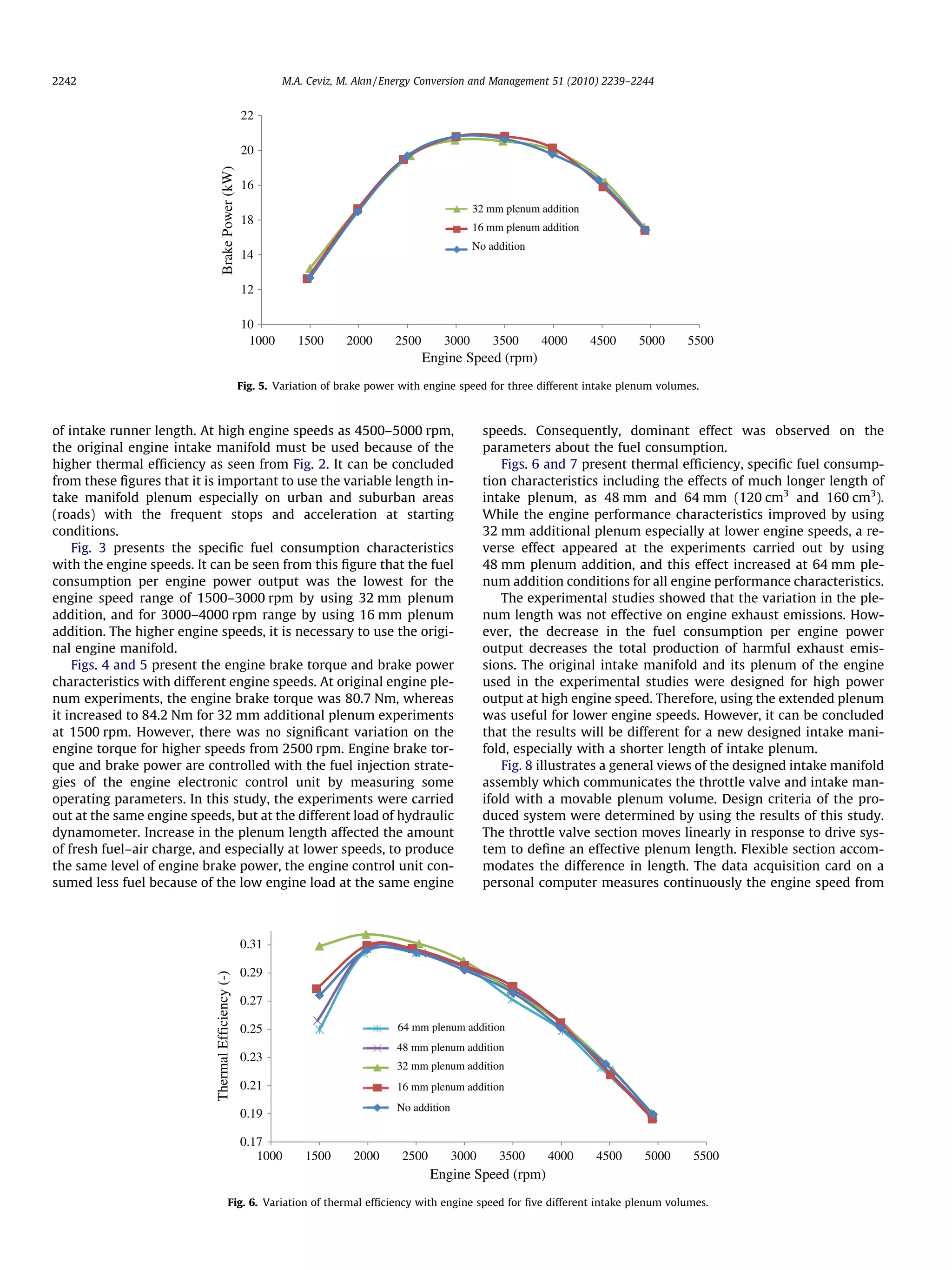
Figs. 2–5 show the effect of the plenum length on the engine
performance characteristics; thermal efficiency, specific fuel con-
sumption, torque and brake power, respectively. It can be seen
from Fig. 2 that the highest engine thermal efficiency is observed
1- Engine 7- Air flow meter
2- Hydraulic dynamometer 8- Muffler
3- Gravimetric fuel flow meter 9- Exhaust gas analyzer
4- Additional plenums 10- Distributor
5- Air surge tank 11- Fuel Injectors
6- Air flow meter probe (hot wire)
3
6
7
10
1
2
5
9
4
8
11
Fig. 1. A schematic layout of test setup.
Table 1
Engine specifications.
Engine type Ford MVH-418, fuel injected
Number of cylinders 4
Compression ratio 10:1
Bore (mm) 80.6
Stroke (mm) 88
Displacement volume (dm3
) 1.796
Maximum power 93 kW at 6250 rpm
Maximum torque 157 Nm at 4500 rpm
Cooling system Water-cooled
2240 M.A. Ceviz, M. Akın / Energy Conversion and Management 51 (2010) 2239–2244
at 32 mm plenum addition up to 3000 rpm. Improvement in the
engine thermal efficiency was especially at lower engine speeds.
At the experiments with the original engine manifold, engine ther-
mal efficiency was 27.4%, whereas it increased to 27.9% and 30.9%
for 16 mm and 32 mm plenum addition at 1500 rpm, respectively.
There was also an increase in the engine thermal efficiency at
the experiments carried out by 16 mm plenum addition up to
3000 rpm.
The highest engine thermal efficiency was attained by using
16 mm plenum addition at about the engine speed range of
3000–4000 rpm. As the engine speed increases, the higher engine
thermal efficiency was attained at lower length of intake plenum.
It is necessary to shorten of intake manifold length as the engine
speed increases because of the increase in the flow frequency as
discussed in introduction section. The results of this study agreed
well with early studies [8–11,17], which were about the effects
0.17
0.19
0.21
0.23
0.25
0.27
0.29
0.31
1000 1500 2000 2500 3000 3500 4000 4500 5000 5500
ThermalEfficiency(-)
Engine Speed (rpm)
No addition
16 mm plenum addition
32 mm plenum addition
Fig. 2. Variation of thermal efficiency with engine speed for three different intake plenum volumes.
250
300
350
400
450
500
1000 1500 2000 2500 3000 3500 4000 4500 5000 5500
SpecificFuelConsumption(g/kW.h)
Engine Speed (rpm)
No addition
16 mm plenum addition
32 mm plenum addition
Fig. 3. Variation of specific fuel consumption with engine speed for three different intake plenum volumes.
20
30
40
50
60
70
80
90
1000 1500 2000 2500 3000 3500 4000 4500 5000 5500
BrakeTorque(N.m)
Engine Speed (rpm)
No addition
16 mm plenum addition
32 mm plenum addition
Fig. 4. Variation of brake torque with engine speed for three different intake plenum volumes.
M.A. Ceviz, M. Akın / Energy Conversion and Management 51 (2010) 2239–2244 2241
of intake runner length. At high engine speeds as 4500–5000 rpm,
the original engine intake manifold must be used because of the
higher thermal efficiency as seen from Fig. 2. It can be concluded
from these figures that it is important to use the variable length in-
take manifold plenum especially on urban and suburban areas
(roads) with the frequent stops and acceleration at starting
conditions.
Fig. 3 presents the specific fuel consumption characteristics
with the engine speeds. It can be seen from this figure that the fuel
consumption per engine power output was the lowest for the
engine speed range of 1500–3000 rpm by using 32 mm plenum
addition, and for 3000–4000 rpm range by using 16 mm plenum
addition. The higher engine speeds, it is necessary to use the origi-
nal engine manifold.
Figs. 4 and 5 present the engine brake torque and brake power
characteristics with different engine speeds. At original engine ple-
num experiments, the engine brake torque was 80.7 Nm, whereas
it increased to 84.2 Nm for 32 mm additional plenum experiments
at 1500 rpm. However, there was no significant variation on the
engine torque for higher speeds from 2500 rpm. Engine brake tor-
que and brake power are controlled with the fuel injection strate-
gies of the engine electronic control unit by measuring some
operating parameters. In this study, the experiments were carried
out at the same engine speeds, but at the different load of hydraulic
dynamometer. Increase in the plenum length affected the amount
of fresh fuel–air charge, and especially at lower speeds, to produce
the same level of engine brake power, the engine control unit con-
sumed less fuel because of the low engine load at the same engine
speeds. Consequently, dominant effect was observed on the
parameters about the fuel consumption.
Figs. 6 and 7 present thermal efficiency, specific fuel consump-
tion characteristics including the effects of much longer length of
intake plenum, as 48 mm and 64 mm (120 cm3
and 160 cm3
).
While the engine performance characteristics improved by using
32 mm additional plenum especially at lower engine speeds, a re-
verse effect appeared at the experiments carried out by using
48 mm plenum addition, and this effect increased at 64 mm ple-
num addition conditions for all engine performance characteristics.
The experimental studies showed that the variation in the ple-
num length was not effective on engine exhaust emissions. How-
ever, the decrease in the fuel consumption per engine power
output decreases the total production of harmful exhaust emis-
sions. The original intake manifold and its plenum of the engine
used in the experimental studies were designed for high power
output at high engine speed. Therefore, using the extended plenum
was useful for lower engine speeds. However, it can be concluded
that the results will be different for a new designed intake mani-
fold, especially with a shorter length of intake plenum.
Fig. 8 illustrates a general views of the designed intake manifold
assembly which communicates the throttle valve and intake man-
ifold with a movable plenum volume. Design criteria of the pro-
duced system were determined by using the results of this study.
The throttle valve section moves linearly in response to drive sys-
tem to define an effective plenum length. Flexible section accom-
modates the difference in length. The data acquisition card on a
personal computer measures continuously the engine speed from
10
12
14
16
18
20
22
1000 1500 2000 2500 3000 3500 4000 4500 5000 5500
BrakePower(kW)
Engine Speed (rpm)
No addition
16 mm plenum addition
32 mm plenum addition
Fig. 5. Variation of brake power with engine speed for three different intake plenum volumes.
0.17
0.19
0.21
0.23
0.25
0.27
0.29
0.31
1000 1500 2000 2500 3000 3500 4000 4500 5000 5500
ThermalEfficiency(-)
Engine Speed (rpm)
No addition
16 mm plenum addition
32 mm plenum addition
48 mm plenum addition
64 mm plenum addition
Fig. 6. Variation of thermal efficiency with engine speed for five different intake plenum volumes.
2242 M.A. Ceviz, M. Akın / Energy Conversion and Management 51 (2010) 2239–2244
engine shaft encoder. The drive system actuates the throttle valve
section based on the engine speed information from data acquisi-
tion card. In operation at low speeds, the throttle valve section is
driven to extend the flexible section to increase the length between
plenum and throttle valve. As the engine speed increases, the
throttle valve is driven to shorten the flexible section. The system
therefore provides a cost effective variable intake manifold plenum
which will operate with different types of engines.
4. Conclusions
From the results of this study, the following conclusions can be
deduced:
1. The intake manifold plenum length/volume is highly effective
on engine performance characteristics especially with the fuel
consumption parameters for SI engines with multipoint fuel
injection system. The engine performance can be improved by
using continuously variable intake plenum length.
2. Favorable effects of the variable length intake manifold plenum
appeared at high load and low engine speeds. Therefore, vari-
able length intake manifold plenum is useful especially on
urban and suburban areas (roads) with the frequent stops and
acceleration at starting conditions.
3. It is necessary to determine the length of additional plenum
components for another engine and intake system with sensi-
tive experimental studies.
Acknowledgement
This work has been supported by The Scientific and Technolog-
ical Research Council of Turkey (TUBITAK, Project No. 107M018).
References
[1] Benajes J, Reyes E, Galindo J, Peidro J. Predesign model for intake manifolds in
internal combustion engines. SAE Paper No: 970055; 1997.
[2] Safari M, Ghamari M, Nasiritosi A. Intake manifold optimization by using 3-D
CFD analysis. SAE Paper No: 2003-32-0073; 2003.
[3] Sung NW, Choi JS, Jeong YI. A study on the flow in the engine intake system.
SAE Paper No: 952067; 1995.
[4] Tsukakoshi S, Miya H, Miyake M. Development of a plastic intake manifold.
SAE Paper No: 930085; 1993.
[5] Jawad BA, Hoste JP, Johnson BE. Intake system design for a formula SAE
application. SAE Paper No: 2001-01-2553; 2001.
[6] Jawad BA, Dragoiu A, Dyar L, Zellner K, Riedel C. Intake design for maximum
performance. SAE Paper No: 2003-01-2277; 2003.
[7] Heywood JB. Internal combustion engine fundamentals. McGraw-Hill Inc.;
1988.
[8] Krömer G, Pölzl HW, Thude M, Leitner P. The new Audi V6 engine. SAE Paper
No: 910678; 1991.
[9] Narayanaswamy K. Continuously variable intake manifold with intelligent
position control. US Patent No: 6983,727; 2006.
250
300
350
400
450
500
1000 1500 2000 2500 3000 3500 4000 4500 5000 5500
SpecificFuelConsumption(g/kW.h)
Engine Speed (rpm)
No addition
16 mm plenum addition
32 mm plenum addition
48 mm plenum addition
64 mm plenum addition
Fig. 7. Variation of specific fuel consumption with engine speed for five different intake plenum volumes.
Runner
Engine
Plenum
Flexible
section
Throttle valve
Drive
module
A
Drive
module
Throttle valve
Engine
Plenum
Runner
Runner
Flexible section
Engine
B
C
Fig. 8. (A) Front, (B) top and (C) solid view of intake manifold assembly.
M.A. Ceviz, M. Akın / Energy Conversion and Management 51 (2010) 2239–2244 2243
[10] Verkleeren RL. Split plenum manifold with variable runners. US Patent No:
5762,036; 1998.
[11] Moroto K. Variable intake air apparatus. US Patent No: 5740,770; 1998.
[12] Ceviz MA. Intake plenum volume and its influence on the engine performance,
cyclic variability and emissions. Energy Convers Manage 2007;48:961–6.
[13] Brady JM. A simple high-efficiency S.I. engine design. SAE Paper No: 2003-01-
0923; 2003.
[14] Kondapalli PS. General guidelines for improving burst pressure strength of
welded nylon air intake manifolds. SAE Paper No 2000-01-0040; 2000.
[15] Ceviz MA, Yüksel F. Effects of ethanol-unleaded gasoline blends on cyclic
variability and emissions in an SI engine. Appl Therm Eng 2005;25(5–
6):917–25.
[16] Ceviz MA, Kaymaz _I. Temperature and air–fuel ratio dependent specific heat
ratio functions for lean burned and unburned mixture. Energy Convers
Manage 2005;46:2387–404.
[17] Vitek O, Polaesk M. Tuned manifold systems-application of 1-D pipe model.
SAE Paper No: 2002-01-0004; 2002.
2244 M.A. Ceviz, M. Akın / Energy Conversion and Management 51 (2010) 2239–2244

Design of intake manifold

  • 1.
    Design of anew SI engine intake manifold with variable length plenum M.A. Ceviz *, M. Akın Department of Mechanical Engineering, Faculty of Engineering, University of Atatürk, Erzurum 25240, Turkey a r t i c l e i n f o Article history: Received 5 August 2009 Accepted 21 March 2010 Keywords: Intake manifold Intake plenum Engine performance a b s t r a c t This paper investigates the effects of intake plenum length/volume on the performance characteristics of a spark-ignited engine with electronically controlled fuel injectors. Previous work was carried out mainly on the engine with carburetor producing a mixture desirable for combustion and dispatching the mixture to the intake manifold. The more stringent emission legislations have driven engine development towards concepts based on electronic-controlled fuel injection rather than the use of carburetors. In the engine with multipoint fuel injection system using electronically controlled fuel injectors has an intake manifold in which only the air flows and, the fuel is injected onto the intake valve. Since the intake manifolds transport mainly air, the supercharging effects of the variable length intake plenum will be dif- ferent from carbureted engine. Engine tests have been carried out with the aim of constituting a base study to design a new variable length intake manifold plenum. Engine performance characteristics such as brake torque, brake power, thermal efficiency and specific fuel consumption were taken into consideration to evaluate the effects of the variation in the length of intake plenum. The results showed that the variation in the plenum length causes an improvement on the engine performance characteristics especially on the fuel consump- tion at high load and low engine speeds which are put forward the system using for urban roads. Accord- ing to the test results, plenum length must be extended for low engine speeds and shortened as the engine speed increases. A system taking into account the results of the study was developed to adjust the intake plenum length. Ó 2010 Elsevier Ltd. All rights reserved. 1. Introduction It is known that the design of engine components, measuring and control methodology of the operating parameters are very important to improve the engine performance and emission char- acteristics. Effectively adjusting the operating parameters such as the relative air–fuel ratio, spark timing, fuel injection timing, valve timing, exhaust gas recirculation ratio and compression ratio in SI and CI engines at different engine operation conditions improves significantly the engine characteristics. The effects of such engine operating parameters and their control technologies have been studied excessively by researchers and the product designers. In engines, configuration of the intake system plays also an important role on the engine performance, and there are many experimental and theoretical studies on the intake system and manifold design [1–6]. Intake manifolds consist typically of a plenum, to the inlet of which bolts the throttle-body, with the individual runners feeding branches which lead to each cylinder. Important design criteria are: low air flow resistance; good distribution of air and fuel be- tween cylinders; runner and branch lengths that take advantage of ram and tuning effects; sufficient (but not excessive) heating to ensure adequate fuel vaporization with carbureted or throttle- body injected engines [7]. The intake system on an engine has one main goal, to get as much air–fuel mixture into the cylinder as possible. The intermittent or pulsating nature of the airflow through the intake manifold into each cylinder may develop resonances in the airflow at certain speeds. These may increase the engine perfor- mance characteristics at certain engine speeds, but may reduce at other speeds, depending on manifold dimensions and shape. Conventional intake manifolds for vehicles have fixed air flow geometry and static intake manifold. With a static intake manifold, the speed at which intake tuning occurs is fixed. A static intake manifold can only be optimized for one specific rpm, so it is bene- ficial to develop a method to vary the intake length/volume, since the engine operates over a broad speed range. Variable length intake manifold technology uses the pressure variations generated by the pulsating flow due to the periodic pis- ton and valve motion to produce a charging effect. Various designs for variable intake geometry have met with varying degrees of suc- cess. The designs of the variable intake manifolds may be rather 0196-8904/$ - see front matter Ó 2010 Elsevier Ltd. All rights reserved. doi:10.1016/j.enconman.2010.03.018 * Corresponding author. Fax: +90 442 236 09 57. E-mail address: aceviz@atauni.edu.tr (M.A. Ceviz). Energy Conversion and Management 51 (2010) 2239–2244 Contents lists available at ScienceDirect Energy Conversion and Management journal homepage: www.elsevier.com/locate/enconman
  • 2.
    complex and expensiveto produce. Difficulty in servicing and a limited range of variable tuning may also be disadvantageous de- sign results of variable intake manifolds. Studies on the intake manifold design by regulating the runner length/volume for higher engine performance, optimal fuel consumption and lower emis- sions have significantly increased in the last years. Some of the studies carried out by researchers and engine manufacturers (i.e. Mazda, BMW, Audi) [8–11] change the intake runner length; how- ever, it is known that intake plenum affects seriously the charging conditions [12–14]. Previous work [12] on the effects of intake plenum on some en- gine performance characteristics was carried out mainly on the carbureted engine. The carburetor produces the fuel and air mix- ture needed for the operation of the engine and is coupled to the intake manifold which receives the mixture and distributes it to the cylinders. Design of intake plenum is active on the quality of air–fuel mixture homogeneity in carbureted engine. In the engine with multipoint injection systems using electronically controlled fuel injectors has an intake manifold in which only the air flows. The fuel is injected directly into the intake ports and the system delivers a more evenly distributed mixture of air and fuel to each of the engine’s cylinders, which improves power and performance. Engines with multipoint injection have a separate fuel injector lo- cated to each cylinder intake port. Such injection systems are ideal for complying with the demands made on the air and fuel mixture formation system. In this paper, the effects of intake plenum length/volume varia- tion on the engine performance were studied experimentally on a spark-ignited engine with multipoint injection systems using elec- tronically controlled fuel injectors. The results were used for the design studies of variable length/volume intake plenum. A new plenum length control system was produced and explained in detail. 2. Materials and methods A schematic layout of the test setup used is indicated in Fig. 1. The engine test bed was explained in the previous studies of the author [12,15,16], which consists of a control panel, a hydraulic dynamometer and measurement instruments. The engine specifi- cation is summarized in Table 1. The engine performance characteristics through the various points were calculated as follows: the brake power (Pb) delivered by the engine and absorbed by the dynamometer is, Pb ¼ 2pnT10À3 ð1Þ where n is the crankshaft rotational speed (rev sÀ1 ) and T is the tor- que (Nm). The thermal efficiency of the engine is, gth ¼ Pb Q ð2Þ Q is the total heat supplied by the fuel was calculated from, Q ¼ CV _mf ð3Þ where _mf is the fuel consumption (kg snÀ1 ) and CV is the lower cal- orific value of the fuel (kJ kgÀ1 ). The specific fuel consumption (sfc) is the fuel flow rate per unit power output and calculated from, sfc ¼ _mf Pb ð4Þ where _mf is the fuel consumption (g hÀ1 ) and Pb is the brake power (kW). At the beginning of experiments, the engine was run at a near three-quarter opening position of the throttle valve in order to at- tain near maximum speed. After the engine reached the steady- state conditions, the first experiment was conducted with original intake manifold. The engine was gradually loaded by the hydraulic dynamometer and test matrix consisted of eight speeds ranging from 1500 to 5000 rpm with 500 rpm steps for each plenum addi- tion operation. The experiments were repeated with separately 16 mm (40 cm3 ), 32 mm (80 cm3 ), 48 mm (120 cm3 ) and 64 mm (160 cm3 ) plenum addition at the same engine speeds that were attained by loading hydraulic dynamometer. The additional ple- nums had the geometries suitable for entrance of the original in- take manifold, and located among the throttle valve and intake manifold plenum. 3. Results and discussion Figs. 2–5 show the effect of the plenum length on the engine performance characteristics; thermal efficiency, specific fuel con- sumption, torque and brake power, respectively. It can be seen from Fig. 2 that the highest engine thermal efficiency is observed 1- Engine 7- Air flow meter 2- Hydraulic dynamometer 8- Muffler 3- Gravimetric fuel flow meter 9- Exhaust gas analyzer 4- Additional plenums 10- Distributor 5- Air surge tank 11- Fuel Injectors 6- Air flow meter probe (hot wire) 3 6 7 10 1 2 5 9 4 8 11 Fig. 1. A schematic layout of test setup. Table 1 Engine specifications. Engine type Ford MVH-418, fuel injected Number of cylinders 4 Compression ratio 10:1 Bore (mm) 80.6 Stroke (mm) 88 Displacement volume (dm3 ) 1.796 Maximum power 93 kW at 6250 rpm Maximum torque 157 Nm at 4500 rpm Cooling system Water-cooled 2240 M.A. Ceviz, M. Akın / Energy Conversion and Management 51 (2010) 2239–2244
  • 3.
    at 32 mmplenum addition up to 3000 rpm. Improvement in the engine thermal efficiency was especially at lower engine speeds. At the experiments with the original engine manifold, engine ther- mal efficiency was 27.4%, whereas it increased to 27.9% and 30.9% for 16 mm and 32 mm plenum addition at 1500 rpm, respectively. There was also an increase in the engine thermal efficiency at the experiments carried out by 16 mm plenum addition up to 3000 rpm. The highest engine thermal efficiency was attained by using 16 mm plenum addition at about the engine speed range of 3000–4000 rpm. As the engine speed increases, the higher engine thermal efficiency was attained at lower length of intake plenum. It is necessary to shorten of intake manifold length as the engine speed increases because of the increase in the flow frequency as discussed in introduction section. The results of this study agreed well with early studies [8–11,17], which were about the effects 0.17 0.19 0.21 0.23 0.25 0.27 0.29 0.31 1000 1500 2000 2500 3000 3500 4000 4500 5000 5500 ThermalEfficiency(-) Engine Speed (rpm) No addition 16 mm plenum addition 32 mm plenum addition Fig. 2. Variation of thermal efficiency with engine speed for three different intake plenum volumes. 250 300 350 400 450 500 1000 1500 2000 2500 3000 3500 4000 4500 5000 5500 SpecificFuelConsumption(g/kW.h) Engine Speed (rpm) No addition 16 mm plenum addition 32 mm plenum addition Fig. 3. Variation of specific fuel consumption with engine speed for three different intake plenum volumes. 20 30 40 50 60 70 80 90 1000 1500 2000 2500 3000 3500 4000 4500 5000 5500 BrakeTorque(N.m) Engine Speed (rpm) No addition 16 mm plenum addition 32 mm plenum addition Fig. 4. Variation of brake torque with engine speed for three different intake plenum volumes. M.A. Ceviz, M. Akın / Energy Conversion and Management 51 (2010) 2239–2244 2241
  • 4.
    of intake runnerlength. At high engine speeds as 4500–5000 rpm, the original engine intake manifold must be used because of the higher thermal efficiency as seen from Fig. 2. It can be concluded from these figures that it is important to use the variable length in- take manifold plenum especially on urban and suburban areas (roads) with the frequent stops and acceleration at starting conditions. Fig. 3 presents the specific fuel consumption characteristics with the engine speeds. It can be seen from this figure that the fuel consumption per engine power output was the lowest for the engine speed range of 1500–3000 rpm by using 32 mm plenum addition, and for 3000–4000 rpm range by using 16 mm plenum addition. The higher engine speeds, it is necessary to use the origi- nal engine manifold. Figs. 4 and 5 present the engine brake torque and brake power characteristics with different engine speeds. At original engine ple- num experiments, the engine brake torque was 80.7 Nm, whereas it increased to 84.2 Nm for 32 mm additional plenum experiments at 1500 rpm. However, there was no significant variation on the engine torque for higher speeds from 2500 rpm. Engine brake tor- que and brake power are controlled with the fuel injection strate- gies of the engine electronic control unit by measuring some operating parameters. In this study, the experiments were carried out at the same engine speeds, but at the different load of hydraulic dynamometer. Increase in the plenum length affected the amount of fresh fuel–air charge, and especially at lower speeds, to produce the same level of engine brake power, the engine control unit con- sumed less fuel because of the low engine load at the same engine speeds. Consequently, dominant effect was observed on the parameters about the fuel consumption. Figs. 6 and 7 present thermal efficiency, specific fuel consump- tion characteristics including the effects of much longer length of intake plenum, as 48 mm and 64 mm (120 cm3 and 160 cm3 ). While the engine performance characteristics improved by using 32 mm additional plenum especially at lower engine speeds, a re- verse effect appeared at the experiments carried out by using 48 mm plenum addition, and this effect increased at 64 mm ple- num addition conditions for all engine performance characteristics. The experimental studies showed that the variation in the ple- num length was not effective on engine exhaust emissions. How- ever, the decrease in the fuel consumption per engine power output decreases the total production of harmful exhaust emis- sions. The original intake manifold and its plenum of the engine used in the experimental studies were designed for high power output at high engine speed. Therefore, using the extended plenum was useful for lower engine speeds. However, it can be concluded that the results will be different for a new designed intake mani- fold, especially with a shorter length of intake plenum. Fig. 8 illustrates a general views of the designed intake manifold assembly which communicates the throttle valve and intake man- ifold with a movable plenum volume. Design criteria of the pro- duced system were determined by using the results of this study. The throttle valve section moves linearly in response to drive sys- tem to define an effective plenum length. Flexible section accom- modates the difference in length. The data acquisition card on a personal computer measures continuously the engine speed from 10 12 14 16 18 20 22 1000 1500 2000 2500 3000 3500 4000 4500 5000 5500 BrakePower(kW) Engine Speed (rpm) No addition 16 mm plenum addition 32 mm plenum addition Fig. 5. Variation of brake power with engine speed for three different intake plenum volumes. 0.17 0.19 0.21 0.23 0.25 0.27 0.29 0.31 1000 1500 2000 2500 3000 3500 4000 4500 5000 5500 ThermalEfficiency(-) Engine Speed (rpm) No addition 16 mm plenum addition 32 mm plenum addition 48 mm plenum addition 64 mm plenum addition Fig. 6. Variation of thermal efficiency with engine speed for five different intake plenum volumes. 2242 M.A. Ceviz, M. Akın / Energy Conversion and Management 51 (2010) 2239–2244
  • 5.
    engine shaft encoder.The drive system actuates the throttle valve section based on the engine speed information from data acquisi- tion card. In operation at low speeds, the throttle valve section is driven to extend the flexible section to increase the length between plenum and throttle valve. As the engine speed increases, the throttle valve is driven to shorten the flexible section. The system therefore provides a cost effective variable intake manifold plenum which will operate with different types of engines. 4. Conclusions From the results of this study, the following conclusions can be deduced: 1. The intake manifold plenum length/volume is highly effective on engine performance characteristics especially with the fuel consumption parameters for SI engines with multipoint fuel injection system. The engine performance can be improved by using continuously variable intake plenum length. 2. Favorable effects of the variable length intake manifold plenum appeared at high load and low engine speeds. Therefore, vari- able length intake manifold plenum is useful especially on urban and suburban areas (roads) with the frequent stops and acceleration at starting conditions. 3. It is necessary to determine the length of additional plenum components for another engine and intake system with sensi- tive experimental studies. Acknowledgement This work has been supported by The Scientific and Technolog- ical Research Council of Turkey (TUBITAK, Project No. 107M018). References [1] Benajes J, Reyes E, Galindo J, Peidro J. Predesign model for intake manifolds in internal combustion engines. SAE Paper No: 970055; 1997. [2] Safari M, Ghamari M, Nasiritosi A. Intake manifold optimization by using 3-D CFD analysis. SAE Paper No: 2003-32-0073; 2003. [3] Sung NW, Choi JS, Jeong YI. A study on the flow in the engine intake system. SAE Paper No: 952067; 1995. [4] Tsukakoshi S, Miya H, Miyake M. Development of a plastic intake manifold. SAE Paper No: 930085; 1993. [5] Jawad BA, Hoste JP, Johnson BE. Intake system design for a formula SAE application. SAE Paper No: 2001-01-2553; 2001. [6] Jawad BA, Dragoiu A, Dyar L, Zellner K, Riedel C. Intake design for maximum performance. SAE Paper No: 2003-01-2277; 2003. [7] Heywood JB. Internal combustion engine fundamentals. McGraw-Hill Inc.; 1988. [8] Krömer G, Pölzl HW, Thude M, Leitner P. The new Audi V6 engine. SAE Paper No: 910678; 1991. [9] Narayanaswamy K. Continuously variable intake manifold with intelligent position control. US Patent No: 6983,727; 2006. 250 300 350 400 450 500 1000 1500 2000 2500 3000 3500 4000 4500 5000 5500 SpecificFuelConsumption(g/kW.h) Engine Speed (rpm) No addition 16 mm plenum addition 32 mm plenum addition 48 mm plenum addition 64 mm plenum addition Fig. 7. Variation of specific fuel consumption with engine speed for five different intake plenum volumes. Runner Engine Plenum Flexible section Throttle valve Drive module A Drive module Throttle valve Engine Plenum Runner Runner Flexible section Engine B C Fig. 8. (A) Front, (B) top and (C) solid view of intake manifold assembly. M.A. Ceviz, M. Akın / Energy Conversion and Management 51 (2010) 2239–2244 2243
  • 6.
    [10] Verkleeren RL.Split plenum manifold with variable runners. US Patent No: 5762,036; 1998. [11] Moroto K. Variable intake air apparatus. US Patent No: 5740,770; 1998. [12] Ceviz MA. Intake plenum volume and its influence on the engine performance, cyclic variability and emissions. Energy Convers Manage 2007;48:961–6. [13] Brady JM. A simple high-efficiency S.I. engine design. SAE Paper No: 2003-01- 0923; 2003. [14] Kondapalli PS. General guidelines for improving burst pressure strength of welded nylon air intake manifolds. SAE Paper No 2000-01-0040; 2000. [15] Ceviz MA, Yüksel F. Effects of ethanol-unleaded gasoline blends on cyclic variability and emissions in an SI engine. Appl Therm Eng 2005;25(5– 6):917–25. [16] Ceviz MA, Kaymaz _I. Temperature and air–fuel ratio dependent specific heat ratio functions for lean burned and unburned mixture. Energy Convers Manage 2005;46:2387–404. [17] Vitek O, Polaesk M. Tuned manifold systems-application of 1-D pipe model. SAE Paper No: 2002-01-0004; 2002. 2244 M.A. Ceviz, M. Akın / Energy Conversion and Management 51 (2010) 2239–2244