1
INTAKE THROTTLE VALVE
DESIGN
Group # 8
KARTIK SUVARNA
KARAN BHAVSAR
SPONSOR: NAVISTAR
INDUSTRIAL ADVISOR: ADAM LACK
INSTRUCTOR: DR. SONG
DATE: MAY 1ST
2009
2
TABLE OF CONTENTS
 List of Figures, Tables
 Acknowledgement
 ABSTRACT
 CHAPTER 1: INTRODUCTION
o 1.1 problem topic
o 1.2 generalbackground
o 1.3 Regenerationstrategybackground
o 1.4 teamwork
 CHAPTER 2: DESIGN CONSTRAINS
o 2.1 Functional
o 2.2 Safety
o 2.3 Quality
o 2.4 Manufacturing
o 2.5 Timing
o 2.5 Economin
o 2.6 Social
 CHAPTER 3: PROJECTPLANNING
 CHAPTER 4: DESIGN SPECIFICATIONS
3
 CHAPTER 5: CONCEPT EVALUATION
 CHAPTER 6 : CONCEPTEVALUATION
 CHAPTER 7: DISCUSSION
 REFERENCES
 APPENDIX
o A: CATALYST
o B: AFTERTREATMENT
o C: EGR
o D: NAVISTAR ENGINE SPECS
o E: INTAKE THROTTLE CONFIG
o D: NAVISTAR ENGINE SPECS
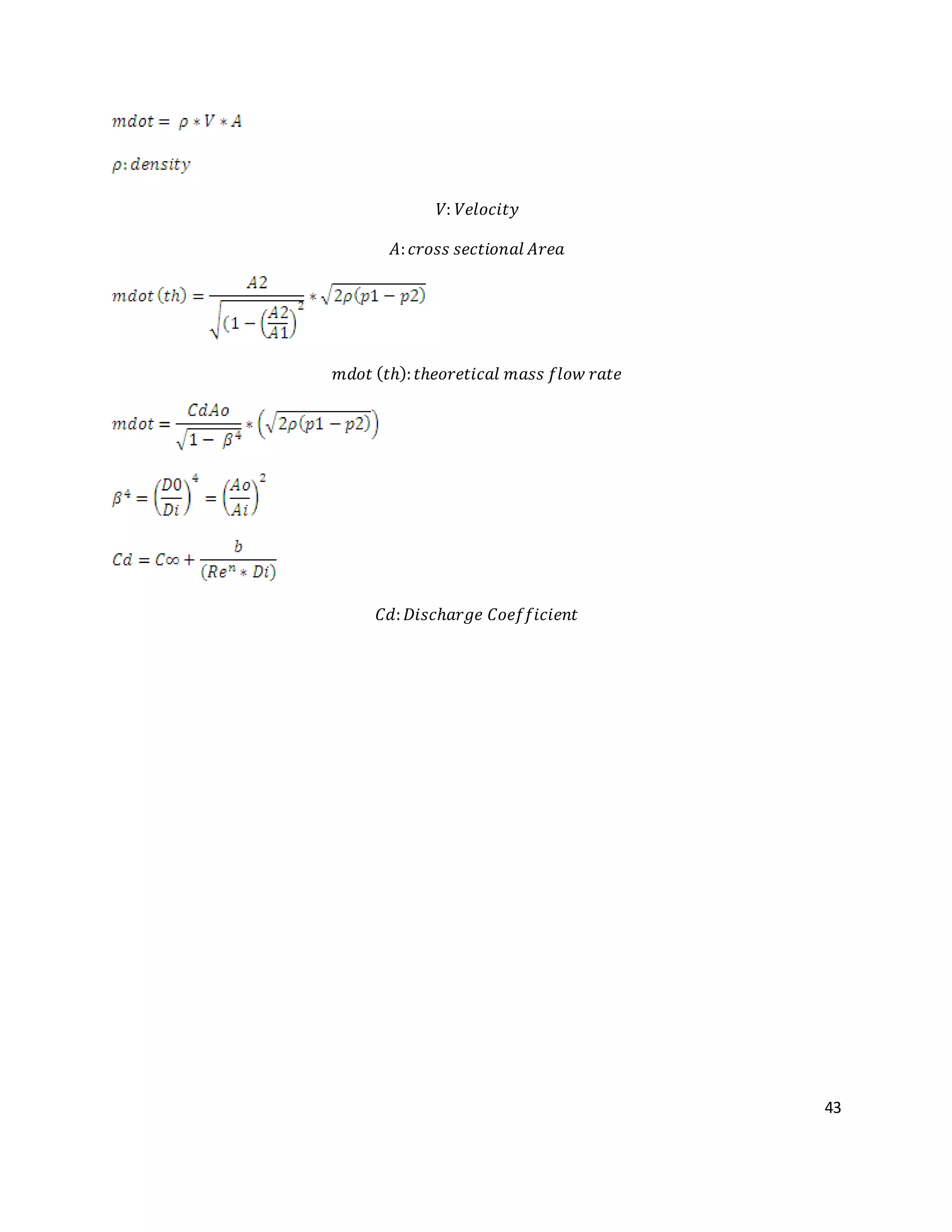
 Equations
4
FIGURES
Figure 1:3-D Plot Navistar Data
Figure 2: 2-D Plot Navistar Data
Figure 3: Timeline
Figure 4: Design Matrix
Figure 5: Concept 1: Orifice Plate
Figure 6: Concept 2: Oval shaped Valve
Figure 7: Concept 3: Reduced Diameter Valve
Figure 8:Concept Evaluation Table
Additional Figures: APPENDIX
5
CHAPTER 1
Introduction
1.1 Problem Topic:
The 6.4 L V8 Engine at Navistar that is scheduled to go into production in 2010 uses an
Intake Throttle to increase EGR rates and reduce NOx emissions. The Intake Throttle Valve is
used to control the amount of fresh cooled air to be let into the Manifold mixer to mix with
the Exhaust gas that comes in via the EGR cooler. After the Intake throttle valve reaches
about 60% of closure at high mass air flow rates, the delta P across the valve tends to
increase rapidly resulting in suction which causes the valve to close completely resulting in
the Engine to choke. This Project aims at preventing the intake throttle valve from being
closed forcefully due to suction.
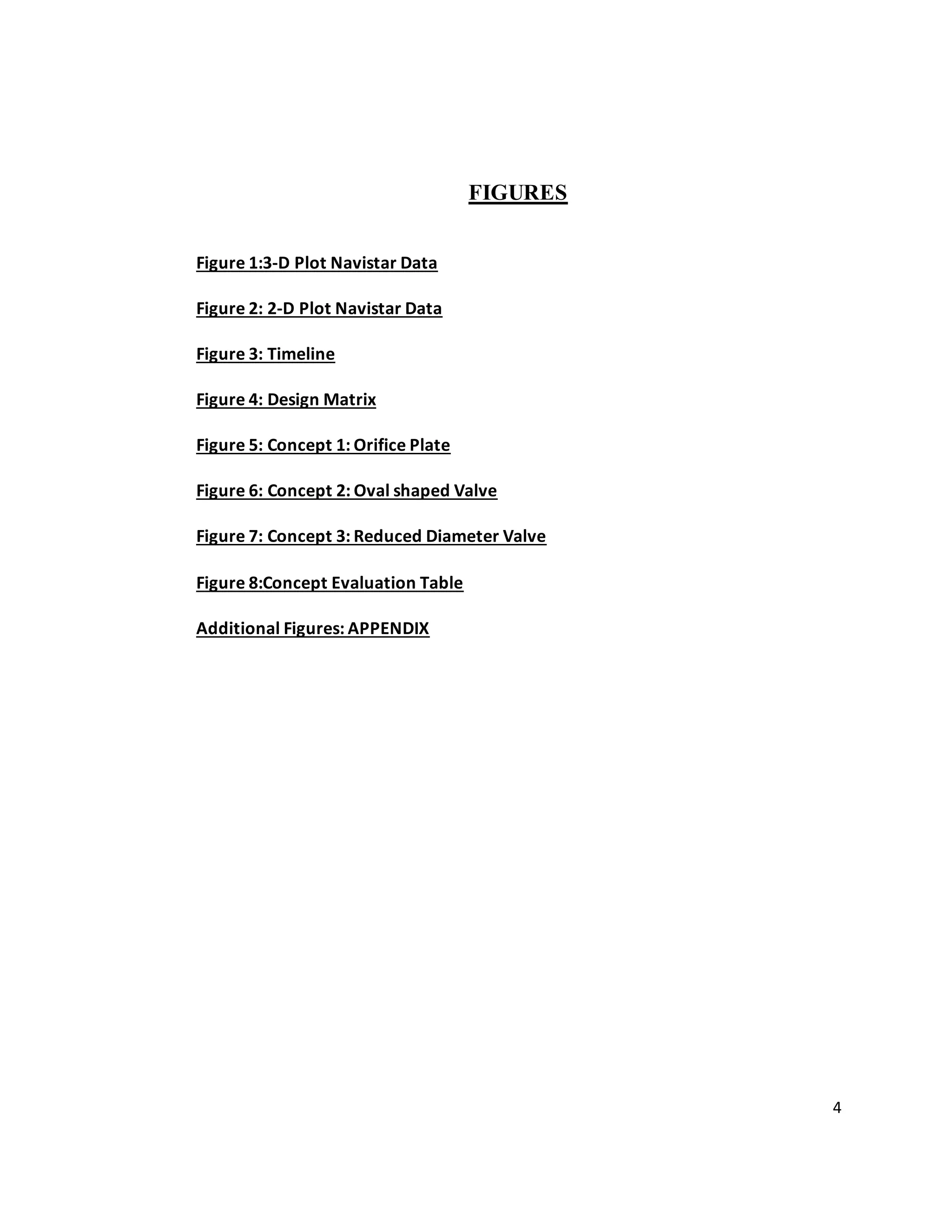
Figure 1: 3-D Plot; Intake Throttle Valve closurevs MAF vs P
6
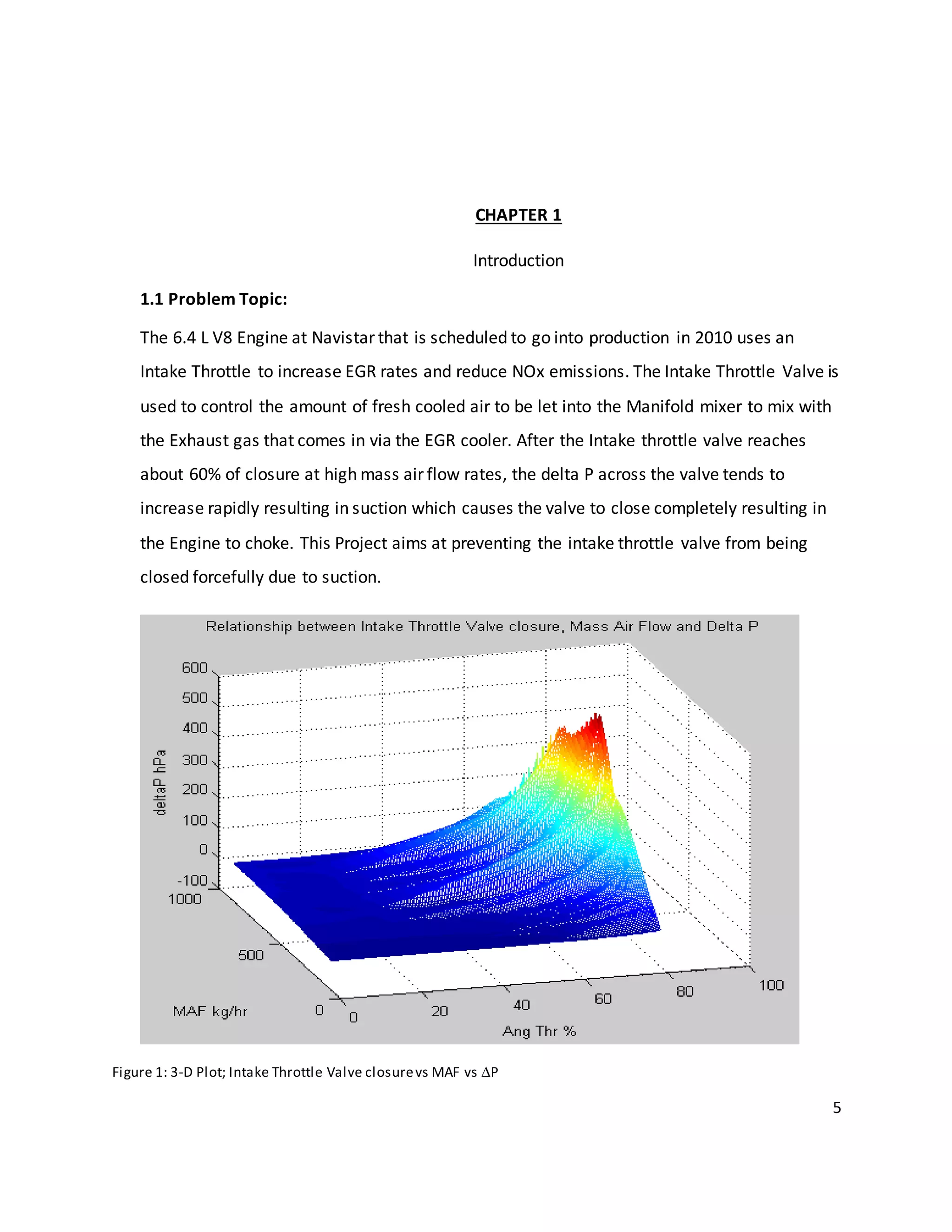
Figure 2: 2-D Plot; Intake Throttle Valve closure (%) vs Delta P
Figure 1 shows a 3-D plot of the data collected from tests that were ran at the test cells in
Navistar. It shows the relationship between the Intake throttle valve closure (%) and the rise
in pressure differential (hPa) across the valve at different Mass Air Flows (Kg/hr). Figure 2 is
the same plot in 2-D format showing only Intake throttle valve closure (%) vs the Delta P
(hPa). The graph clearly shows where the delta P tends to rapidly increase causing a rapid
closure of the valve which results in engine choking. From the graph 0% is considered to be
wide open position of the valve while 100% is considered to be a fully closed position of the
valve. As seen in the plot, there are no data points in the 100 % range. This shows that there
is only a little gap between the valve in closed position and the inner wall of the throttle.
High temperature cause the valve to expand resulting in the valve be in closed positioned
even though technically its only 80% closed. Thus concepts must be designed taking the the
expansion of the valve into consideration. A better understanding of this can be gained in
chapter 5.
1.2 General Background:
7
This project is assigned by the Aftertreatment department at Navistar. The
Aftertreatment department at Navistar deals with trying to achieve high Catalyst Inlet
temperatures in order to meet the EPA requirements. The target exhaust out temperatures
are tried to achieve by playing around with the Injection timings, EGR valve technology,
using the Intake Throttle and a Turbocharger. The target exhaust temperature going into
the Diesel Oxidation Catalyst is 275ºC - 300ºC, where as the target exhaust temperature
going into the Diesel Particulate Filter is 540ºC - 600ºC. The Target Diesel Oxidation
Temperature is needed to oxidize Carbon Monoxide (CO), Hydrocarbons (HC) and organic
fraction of diesel particulates (SOF). The Oxidation takes place as follows:
HC + O2 = CO2 + H2O ……. (I)
CO + 1/2O2 = CO2……….. (II)
2SO2 + O2 = 2SO3……… (III a)
SO3 + H20 = H2SO4……. (III b)
The target temperature going into the Diesel Particulate Filter is required for oxidation of
NOx. To read about the effects of catalysts on NOx refer Appendix [ ].
1.3 Regeneration Strategy Background:
Some of the strategies used by the companies to achieve target Exhaust out temperature for
regeneration are as follows:
1. Post Injection
Entirely new functions are performed by injection systems in engines with integrated
emission aftertreatment systems of Diesel Particulate Filters. These devices require
regeneration to burn all the soot which is provided by high temperatures or by rich
exhaust gas of rich HC content. These are achieved by late fuel injection which is also
called post injection. Thus Post injection provides a certain amount of high exhaust
8
temperature going into the DOC which is further increased by oxidation process taking
place in the DOC.
2. Intake Throttle
The intake throttle valve is an engine component which exhibits a large potential for
exhaust gas temperature optimization. By closing the intake throttle valve less air will
be let into the engine thereby decreasing the air to fuel ratio. With a lower air to fuel
ratio the same amount of fuel is added in the combustion chamber to a lower mass of
air, thereby increasing the temperature rise in the cylinder. The disadvantage to this
approach is that it will decrease the mass air flow rate into the catalysts which may
cause a delay in light off due to the lower absolute energy content in the exhaust gas.
Furthermore, this approach may cause an increase in emissions levels.
3. Turbocharger
The turbocharger is an integral and very dynamic part of the exhaust stream. The V148
turbocharger is highly complex with numerous electronically controlled parameters
including a turbine bypass valve, wastegate, and variable geometry turbine (VGT)Test
Configuration. VGT can be utilized to increase exhaust temperature by raising the
exhaust backpressure and therefore increasing the work done by the firing cylinders. By
closing the VGT a large resistance to flow is created in the turbine thereby raising the
backpressure. Another advantage in terms of exhaust gas temperature maximization
can be achieved by bypassing the turbine entirely to prevent the exhaust gasses from
rejecting energy into the large thermal mass of the turbine housing. During low load
operation the low pressure turbine is not being utilized to create boost, therefore it can
be bypassed through the wastegate to prevent the exhaust from rejecting its heat to the
housing. With the wastegate open the exhaust can bypass the low pressure turbine
housing and take a shorter path through which it will lose less energy. Simultaneously,
the high pressure turbine, equipped with a VGT, can be controlled to shut its vanes and
9
increase backpressure to the combustion chamber which theoretically will increase
exhaust gas temperature exiting the combustion chamber.
1.4 Team Work
Our group consists of two members. The initial stages of the project involved
brainstorming ideas. The next stage involved talking to the employees at Navistar asking
them if they could go over some of the major issues they are facing and if we could help
them improve a design to fix the problem. So the Navistar employees had a huge
contribution to this project assisting us with the topic, details related to the problem,
and providing us with required tests data and schematics and a couple other things. The
Advisor Dr. Song contributed by pushing us to understand the problem more and
understand how the engine operates. He made sure we understand the smallest things
about the engine that might be related in some or the other way with our project.
We as team members worked together by going to Navistar to gather
information and talking to engineers. We worked together on researching journals and
books. We distributed the work of brainstorming ideas. So overall it was a team work
which not only included the team members but also the instructor at Northern Illinois
University and the Advisor at Navistar.
10
CHAPTER 2
DESIGN CONSTRAINTS
2.1 Functional
Operation: Operation of the Throttle needs to be taken into consideration. A great
understanding of how it works and what can be changed in to achieve goal needs to be
understood.
Size: The size of the Throttle Valve needs to be taken into consideration. There must some
limitations as to how big or small the valve can be. One also should consider the fact that the
orifice or the throttle diameter would remain the same. Thus only modifications to the valve
can be made. Changing the throttle altogether would make packaging for the V152 program at
Navistar difficult.
Flow: Fluid flow which includes air and gas needs to be understood. Knowledge acquired from
the Fluid Mechanics class and research on the same must be implemented into the design at
Navistar to go about designing the new product.
Software: I-DEAS would be used to design the product. MATLAB would be used whenever
necessary. CFD analysis would have to be done for flow simulations.
2.2 Safety
Test Cell: We will always make sure that we are assisted by a technician while we are at the test
cell at Navistar. Safety glass would be worn wherever necessary on company property. Other
safety regulations required by the company would be taken into consideration
Enivronmental: This project aims at improving Environmental safety by avoiding exceeding the
EPA NOx limits. Thus this projects aims at reducing NOx emissions.
2.3 Quality
Quality assurance and control: Regulations, standards and testing.
11
Reliability: Parts designed and ordered will be tested for failure. Thus multiple concepts will be
designed to come up with a final product in the future.
2.4 Manufacturing
Supplier: A constant contact will be followed with the Navistar supplier for the Intake Throttle
Valve
2.5 Timing
Product Planning: Planning on what are the initial steps going about the product designed need
to be outlined. Now coming to the end of the semester these initial steps were outlined and
thus a project planning chart was put together which is seen in Chapter 3.
Product Schedule: A timeline of what needs to be when in order to stay within the time period
of designing the product needs to be created. A time line basically defines how many days a
task should last. It helps order and test parts on time. A time line is designed in Chapter 3.
2.6 Economic
Cost Analysis: Cost analysis of the present product used by the company still needs to be looked
at. Costs needs to be kept in mind while designing the new part thus choosing material and
other components needed that stay within company spending limits.
2.7 Social
A relationship is initialized between the team, Navistar and the supplier. This relationship tends
to grow as we go forward with the project.
12
CHAPTER 3
PROJECT PLANNING
A projectplanisa listof tasksthat needtobe completedduringthe designprocess.The
objectivesforeachtaskare statedand a timeline isdefinedbasedonthe listedtasksandthe time
periodtofinishproject.
The tasks neededtoachieve projectgoal of designingthe Intake ThrottleValveare:
1. DesignEngineeringSpecifications
Objective:Make anunderstandingof whothe customersare andwhatthe customerrequirementsare.
Create a time line basedontime periodtocomplete the projectandcreate a QFD chart.
2. Gather Information
Objective:Gatherinformationfromthe designengineers,aftertreatmentdepartment,andcalibration
departmentbasedonwhatisneededstartupwiththe project.Example:Testdatafor the current
throttle valve design.
3. Research
Objective:Researchjournals,booksandinternettogathermore informationon the projecttopic.Thisis
necessarytoget a betterunderstandingof the problemandgetideasonwhatotherpeople are doingto
preventasimilarproblem.
4. Recap FluidMechanicsKnowledge
Objective:Recapknowledge acquiredinFluidMechanicsclassbybrowsingthroughthe textbooowkto
geta betterunderstandingof fluidflowequations.
5. BrainstormConcepts
Objective:Make alistof conceptsbasedon researchandfluidmechanicsknowledge.Applyequationsto
each conceptto make a comparisonbetweenthe concepts.
6. Choose 2 or 3 concepts
13
Objective:Basedoncalculationsdone oneachbrainstormedconcept,choose 2or3 conceptsthat would
workbestjust sothat a lotof time isnot wasteddesigningeveryconcept.Determine dimensionsof
conceptsbasedoncalculations.
7. Design
Objective:Doacost evaluationonthe conceptschosenanddesignthe part.
8. Simulation
Objective:RunCFDanalysistogetdata that mighthelpverifyif the conceptsthoughtof basedon
theoretical calculationare correct.
9. OrderPart
Objective:Basedondesignandsimulationresultsorderpart.
10. Run Tests
Objective:RunDOE’swiththe orderedpartto getreal data that can be verifiedwiththeoretical and
simulationresults.Verifyreal datawithsimulationresults.
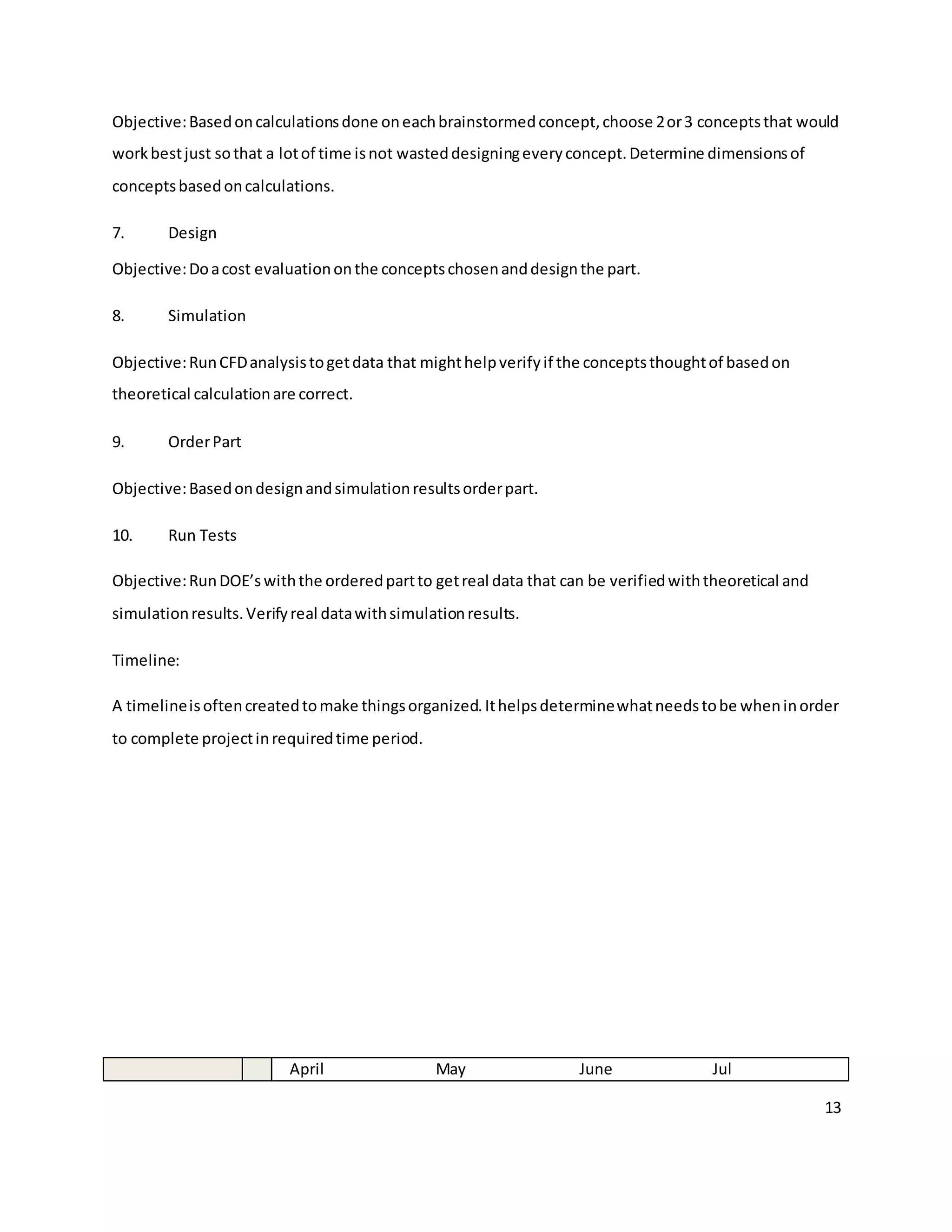
Timeline:
A timelineisoftencreatedtomake thingsorganized.Ithelpsdeterminewhatneedstobe wheninorder
to complete projectinrequiredtime period.
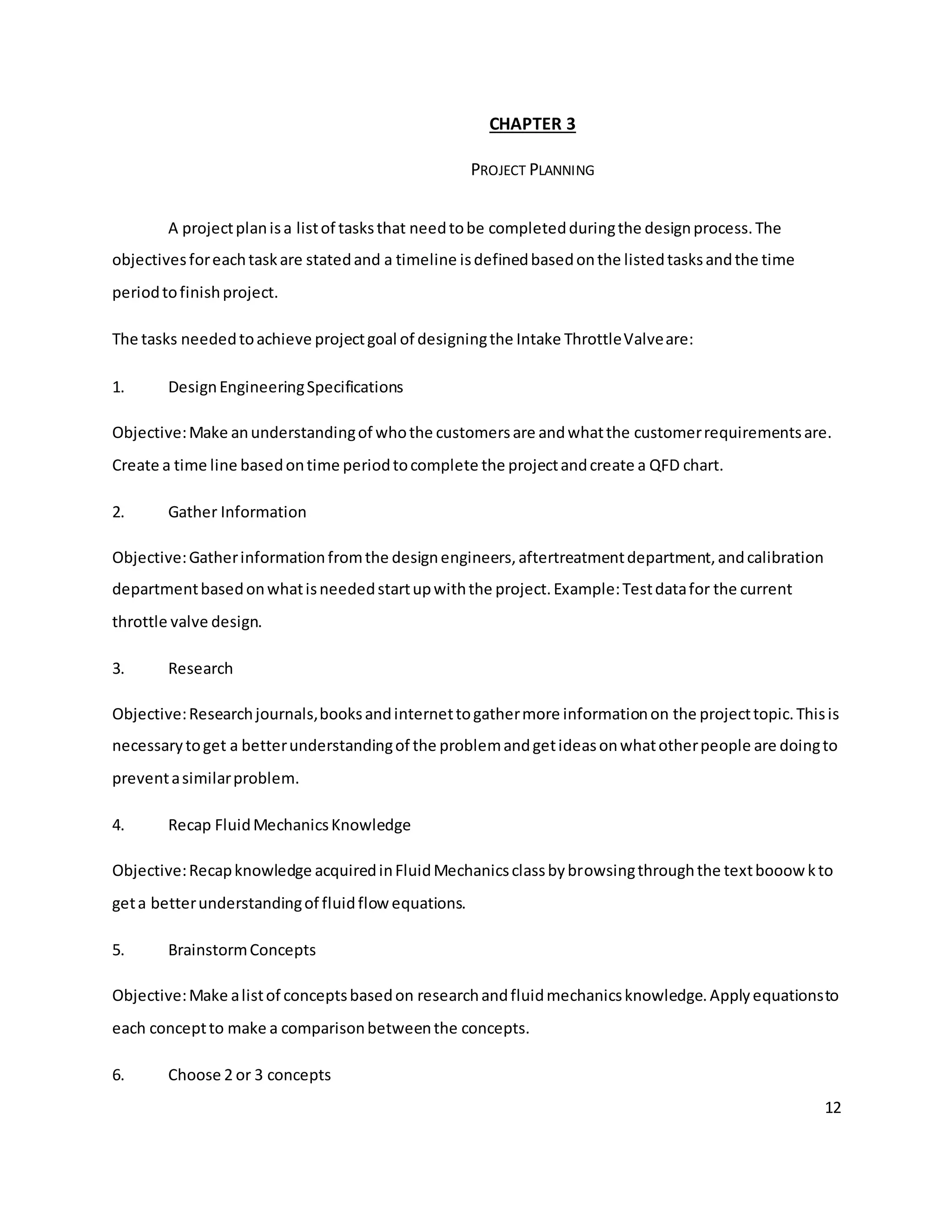
April May June Jul
14
y
W
1
W
2
W
3
W
4
W
1
W
2
W
3
W
4
W
1
W
2
W
3
W
4
W
1
W
2
W
3
W
4
Specifications
Gather
Information
Research
Recap Fluid
Mechanics
Brainstorm
Concepts
Choose 2 or 3
concepts
Design Concepts
Simulation
Order part
Run tests
Will be outof townon vacation.
Figure 3: timeline
A B C D E F G H I J
Specifications A A
Gather Information B X B
Research C X X C
Recap Fluid
Mechanics D X D
BrainstormConcepts E X X E
Choose 2 or 3
concepts F X X X F
DesignConcepts G X X X G
Simulation H X X H
Orderpart I X X I
Run tests J X J
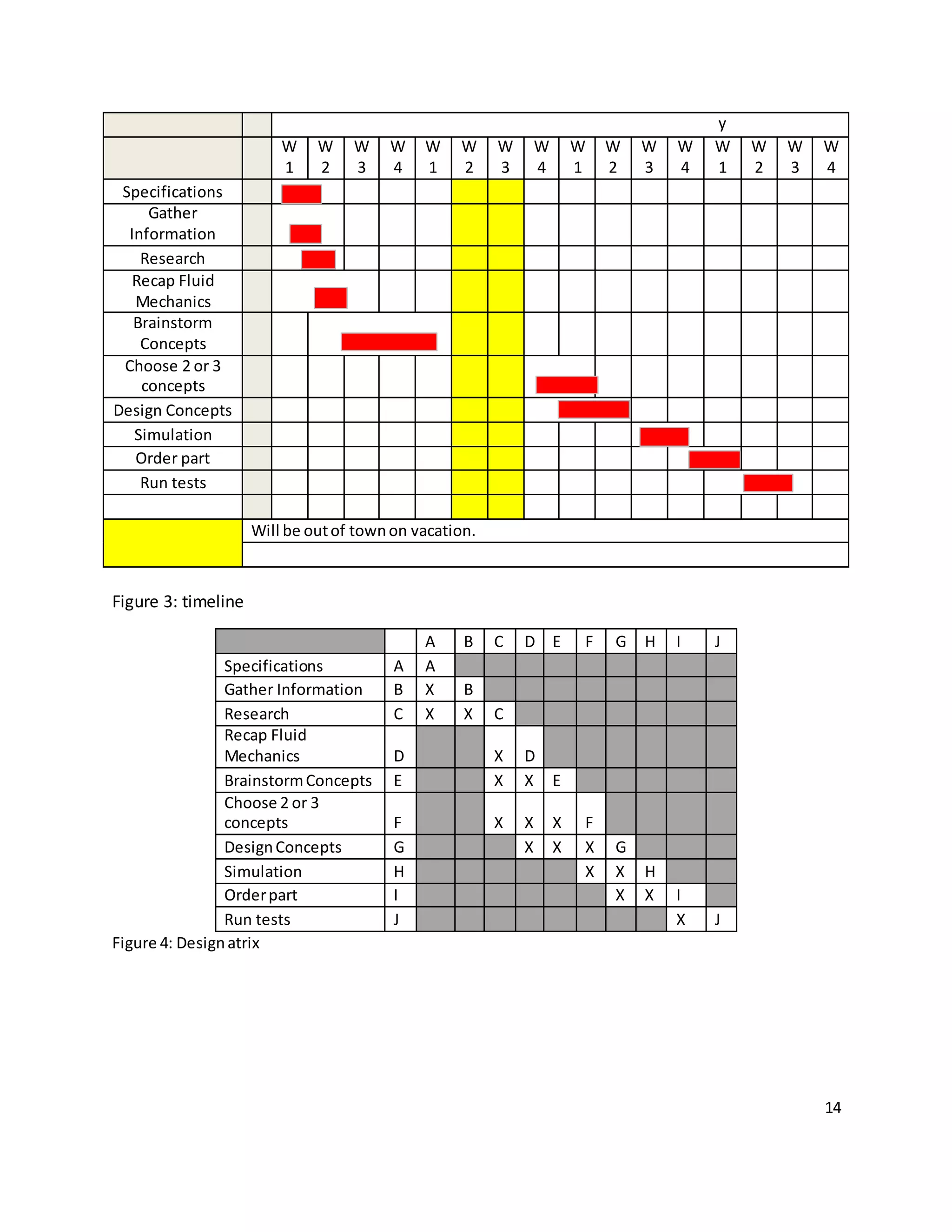
Figure 4: Designatrix
15
CHAPTER 4
SPECIFICATIONS
a. Custormers:AftertreatmentDepartmentatNavistarandrestof the design
team.
b. CustomerRequirements:Designthe Intake ThrottleValvetoachieve goal of
havinga linearrelationshipbetweenthe Intake Throttle Valve Closure (%) and
Pressure Differential acrossthe valve (P).
c. It isnecessarytounderstandhow the Intake Throttle valve works.Itisthen
necessarytounderstandhow airand exhaustflowsthroughthe intake throttle.
d. Talk to engineerstosee whatthe DeltaPrequirementswouldbe forcertain
mass flowrate to avoidsuction.Thusbrainstormconceptsandapplyfluid
mechanicstomake sure concept meetsrequirements.
e. Decide a time line todecide whatconceptworksbest,designpartandorder
part to run data.
16
CHAPTER 5
CONCEPT GENERATION
A. Orifice Plate
Orifice isnothingbutanopening,andthusa an orifice plate isa valve ora plate withan
opening.
Figure 5: Concept1: Orifice Plate
Thisis a valve whichbasicallyhasahole init.Where the hole needstobe designed?This
isnot determinedyet.Itcan be determinedwithfurthercalculations.
How doesan orifice plate help?
Since the Valve hasa hole inthe centerit allowsairincreasesairspeedsince ithastopass
througha smallerportion.Since the airhasto increase itsspeedtopassthrougha smallergap,
it resultsinreducedinternalpressurewhichmeansreducedDeltaP.ThusIf the DeltaP across
the valve iscontrolled,thenthiswill preventthe valve fromclosingdue tosuction.Some of the
calculationsthatwere lookedintothatwouldbe appliedtothisdesigntoprove whetherit
worksor nowis as follows.Thesecalculationswere basedoff of the original Fluidequationsin
Appendix [].
Orifice
17
The bestway to start aboutgoingaheadwiththisconceptwouldbe to talkto the
calibrationdepartmenttocheck,whatthe DeltaP requirementisata certainflow rate and at a
certainintake throttle angle.Thusthe minimumdiameterrequiredtomeetthe above targets
can be calculated.A numberof calculationscanbe done fordifferentcombinationsof flowrates
and intake throttle closure.The diameterof the openingcanbe determinedbasedoff of the
differentcalculationsperformed.
B. Oval shapedValve
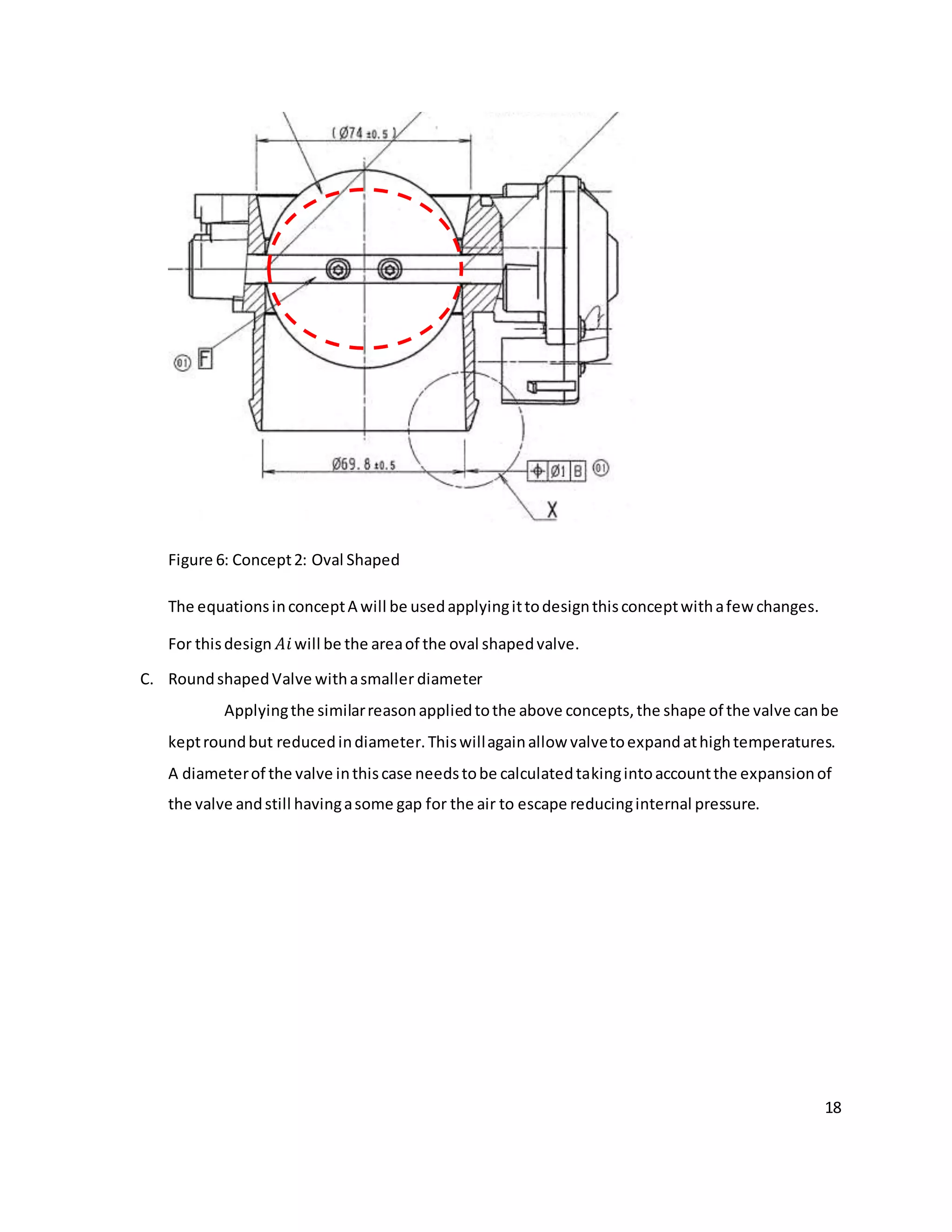
The presentIntake throttle valve isroundshaped.The presentthrottle valve hasa
diameterof 68mm as seeninAppendix[].The orifice aroundthe valveis69.8mm.Thus there isa
onlya 1.8mm gap betweenthe orifice platein closedpositionandthe throttle orifice.Athigh
temperaturesthe valve tendstoexpand,becauseof whichduringarapidincrease inDeltaP,the
throttle tendstoshutdownat 80% valve closure insteadof closingcompletelyat100% closure.
Thus reducingthe shape bymakingitoval mightbe beneficial.Thiswillnotonlygive the valve a
greaterexpansiongap.Anotherthingthatneedstobe lookedintowhile creatingthisdesignis
that dimensionsof the valve needtobe calculatedtakingintoaccountthatevenafterexpansion
of the valve athightemperaturesthere will some gapforthe air to escape whichwill prevent a
rapidrise of pressure differential acrossthe valve thuspreventingthe valvefromshuttingdown
due to suctionfurtherpreventingthe enginefromchoking.
18
Figure 6: Concept2: Oval Shaped
The equationsinconceptA will be usedapplyingittodesignthisconceptwithafew changes.
For thisdesign 𝐴𝑖will be the areaof the oval shapedvalve.
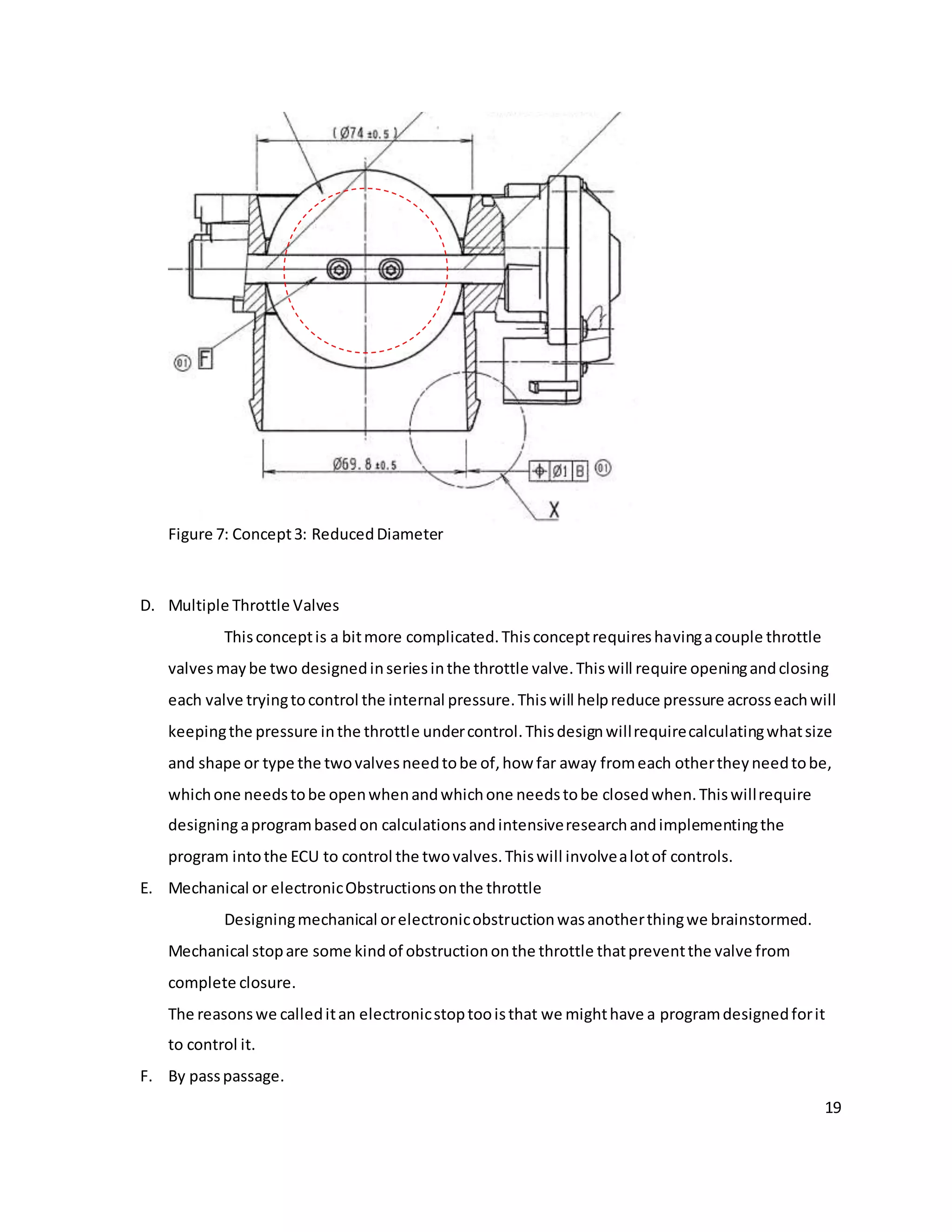
C. RoundshapedValve withasmaller diameter
Applyingthe similarreasonappliedtothe above concepts,the shape of the valve canbe
keptroundbut reducedindiameter.Thiswillagainallow valvetoexpandathightemperatures.
A diameterof the valve inthiscase needstobe calculatedtakingintoaccountthe expansionof
the valve andstill havingasome gap for the air to escape reducinginternal pressure.
19
Figure 7: Concept3: ReducedDiameter
D. Multiple Throttle Valves
Thisconceptis a bitmore complicated.Thisconceptrequireshavingacouple throttle
valves maybe two designedinseriesinthe throttle valve.Thiswill require openingandclosing
each valve tryingtocontrol the internal pressure.Thiswill helpreduce pressure acrosseachwill
keepingthe pressure inthe throttle undercontrol.Thisdesignwillrequirecalculatingwhatsize
and shape or type the twovalvesneedtobe of,how far away fromeach othertheyneedtobe,
whichone needstobe openwhenandwhichone needstobe closedwhen.Thiswillrequire
designingaprogrambasedon calculationsandintensiveresearchandimplementingthe
program intothe ECU to control the twovalves.Thiswill involvealotof controls.
E. Mechanical or electronicObstructionsonthe throttle
Designingmechanical orelectronicobstructionwasanotherthingwe brainstormed.
Mechanical stopare some kindof obstructiononthe throttle thatpreventthe valve from
complete closure.
The reasonswe calleditan electronicstoptooisthat we mighthave a programdesignedforit
to control it.
F. By passpassage.
20
By passacross the valve wasanotherideathatwe thoughtof.Thisbasicallyisa by pass
passage that will create acrossthe valve thatwill helpbypassingpressure whenitreaches
threshold.The bypasspassage lengthanddimensions needtobe designedbyworkingon
intensivecalculations. Thisdesignwill alsorequire avalve tobe designedthatwill open
wheneverpressure reachesthresholdandclose whenpressurecomesbelow threshold.
21
CHAPTER 6
CONCEPT EVALUATION
The various benefitsfromthe designwere listed.Benefitslike the designbenefittingthe engine
and the environmentwere listedandeachof the conceptswere ratedwithrespecttohow much effect
it wouldhave onthose benefits.Thishelpsprove whatconceptwouldbe more beneficial.Thuscertain
conceptscan be givenmore prioritycomparedtothe others.Thusa lotof time isnotwasteddesigning
each of the conceptsin orderto staywithinthe timeline determined.
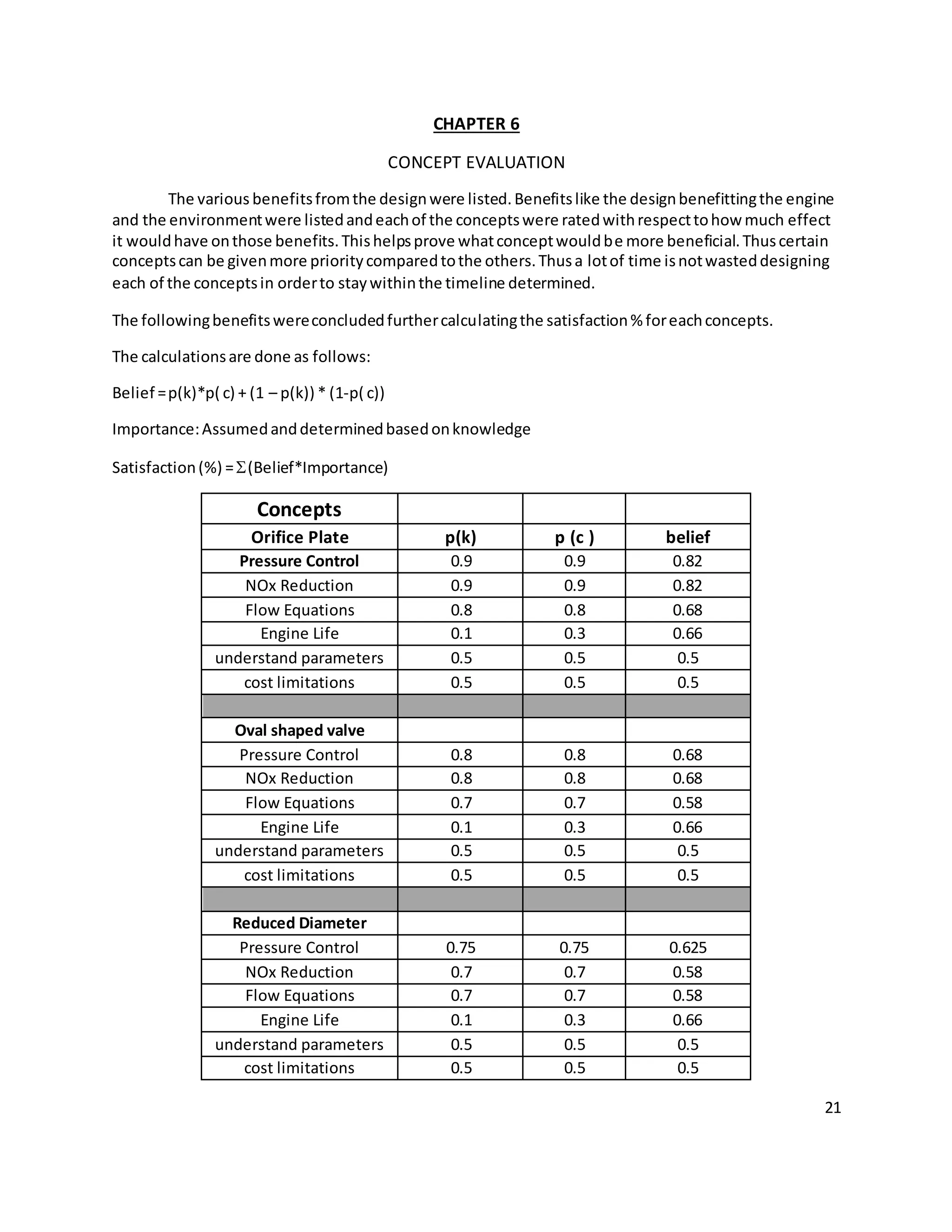
The followingbenefitswereconcludedfurthercalculatingthe satisfaction% foreachconcepts.
The calculationsare done as follows:
Belief =p(k)*p( c) + (1 – p(k)) * (1-p( c))
Importance:Assumedanddeterminedbasedonknowledge
Satisfaction(%) =(Belief*Importance)
Concepts
Orifice Plate p(k) p (c ) belief
Pressure Control 0.9 0.9 0.82
NOx Reduction 0.9 0.9 0.82
Flow Equations 0.8 0.8 0.68
Engine Life 0.1 0.3 0.66
understand parameters 0.5 0.5 0.5
cost limitations 0.5 0.5 0.5
Oval shaped valve
Pressure Control 0.8 0.8 0.68
NOx Reduction 0.8 0.8 0.68
Flow Equations 0.7 0.7 0.58
Engine Life 0.1 0.3 0.66
understand parameters 0.5 0.5 0.5
cost limitations 0.5 0.5 0.5
Reduced Diameter
Pressure Control 0.75 0.75 0.625
NOx Reduction 0.7 0.7 0.58
Flow Equations 0.7 0.7 0.58
Engine Life 0.1 0.3 0.66
understand parameters 0.5 0.5 0.5
cost limitations 0.5 0.5 0.5
22
Multiple Valves
Pressure Control 0.77 0.7 0.608
NOx Reduction 0.7 0.7 0.58
Flow Equations 0.7 0.7 0.58
Engine Life 0.1 0.3 0.66
understand parameters 0.5 0.5 0.5
cost limitations 0.8 0.8 0.68
Mechanical Obstruction
Pressure Control 0.4 0.5 0.5
NOx Reduction 0.4 0.4 0.52
Flow Equations 0 0.1 0.9
Engine Life 0.1 0.3 0.66
understand parameters 0.5 0.5 0.5
cost limitations 0.4 0.4 0.52
By pass
Pressure Control 0.4 0.5 0.5
NOx Reduction 0.3 0.3 0.58
Flow Equations 0 0.1 0.9
Engine Life 0.1 0.3 0.66
understand parameters 0.5 0.5 0.5
cost limitations 0.4 0.4 0.52
Alternative
1
Alternative
2
Alternative
3
Alternative
4
Alternative
5
Alternative
6
Critera Importance Orifice Plate
Oval
Shaped
Valve
reduced
diameter
multiple
valves
mechanical
obstruction by pass
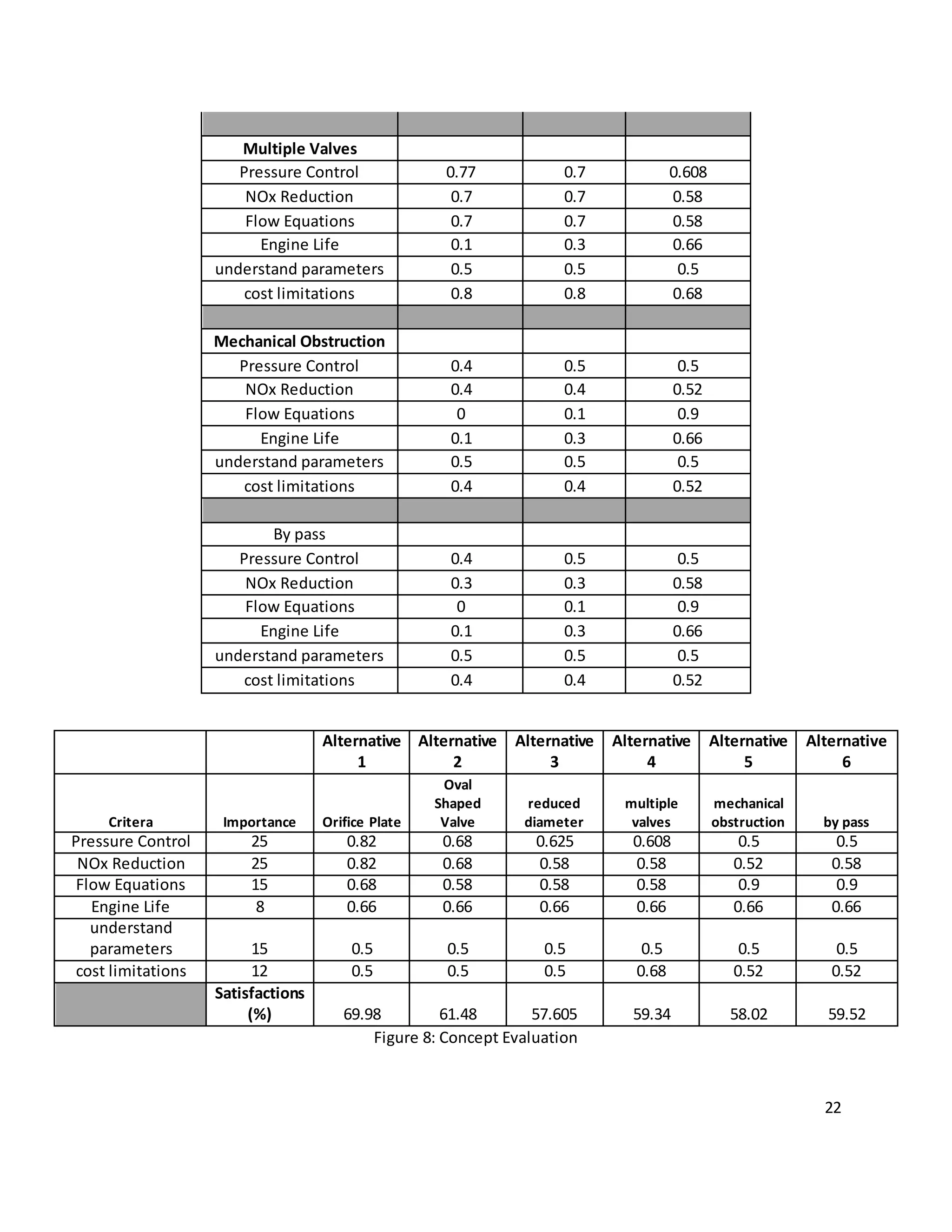
Pressure Control 25 0.82 0.68 0.625 0.608 0.5 0.5
NOx Reduction 25 0.82 0.68 0.58 0.58 0.52 0.58
Flow Equations 15 0.68 0.58 0.58 0.58 0.9 0.9
Engine Life 8 0.66 0.66 0.66 0.66 0.66 0.66
understand
parameters 15 0.5 0.5 0.5 0.5 0.5 0.5
cost limitations 12 0.5 0.5 0.5 0.68 0.52 0.52
Satisfactions
(%) 69.98 61.48 57.605 59.34 58.02 59.52
Figure 8: Concept Evaluation
23
CHAPTER 7
DISCUSSION
The topic has beenunderstood.The conceptshave beenbrainstormed.The teamisprettymuch
goingto workbasedon the timelinecreated.
The current status:A listof conceptsbrainstormedhave beenundergoing research.We are
tryingto researchon whatothercompaniesare doingandwhat mightbe betterideastofix the
problem.We are not rulingoutour currentconcepts.But we are justtryingto researcha couple more
conceptsbefore finalizingaparticularconcept.We will be spendingacouple more daysor weeks
researchingideas.Thenwe willlistthemall andcreate adecisionchartbasedon the calculationsand
flowequations.We have alreadystartedimplementingflow equationsintoourcurrentconcepts.We
are tryingto use real data and data that the calibrationdepartmentthingswe needtogeta good graph
to checkhow eachof our conceptsaffectthe problemsolution.We willdosoas we findmore concepts
on researching.
Rightnow,we haven’treallymade alotof progressonthe design.Butwe made goodprogress
on the proposal andinitial stagesthatwere taughtinclass.We justneedtocatch upon the research
stage so we couldstart the designstage andthe testingstage assoonas possible.
24
REFERENCE
1.Carberry,B., G. Grasi,S. Guerin,F.Jayat, andR. Konieczny,2005. “Pre-TurbochargerCatalyst –Fast
catalystlight-off evaluation”,SAETechnical Paper2005-01-2142
2.Kishi N.,H. Hashimoto,K.Fujimori,K.Ishii,T.Komatsudu,1998. “Developmentof the UltraLow Heat
Capacityand HighlyInsulating(ULOC) ExhaustManifoldforULEV”,SAE Technical Paper980937
3. Tomazic D.,M. Tatur, M. Thornton,2004. “Developmentof aDiesel PassengerCarMeetingTier2
EmissionsLevels”,SAETechnical Paper2004-01-0581
4. Zhang, X.,L. Meda, M. Keck,2005. “Numerical StudyonSkinTemperature andHeatLossof Vehicle
ExhaustSystem”,SAETechnical Paper2005-01-1622
5. Jääskeläinen,H.,2008. “Diesel ExhaustGas”,DieselNetTechnologyGuide,
http://www.dieselnet.com/tech/diesel_exh.html
6.Makdi K.Khair., 2008. “EGR & Components”,DieselNetTechnologyGuide,
http://www.dieselnet.com/tech/diesel_exh.html
7. Robert,Alan,Philip,“IntroductiontoFluidMechanics”
25
APPENDIX A
CATALYST
Chemical Reactions
Duringthe combustionof hydrocarbonfuels,perfectcombustionwouldbe characterizedbythe
followingreaction.
OH
m
nCOO
m
nHC mn 222
2
)
2
( 
However;due tomanyfactors includingincomplete combustion,imperfectcombustion,fuel impurities,
and the presence of nitrogeninaircombinedwiththe hightemperaturesseeninthe combustion
chamber,manyothercompoundsare formed. These compoundsmayinclude,butare notlimitedto,
oxidesof nitrogen(NOx),particulate matter(PM),hydrocarbons(HC),andcarbonmonoxide (CO).
Due to emissionsregulations,catalyticconvertersare usedtoconvertthese undesired
compoundsintocarbondioxide (CO2),water(H2O),anddiatomicnitrogen(N2). Infacilitatingthese
reactionscatalyticconvertersuse anumberof differenttechnologiesdesignedspecificallyforeach
application. The vastmajorityof catalyticconvertersuse platinumgroupmetals(PGM), whichinclude
platinum,palladium,andrhodium,tolowerthe activationenergyof eachreaction,therefore allowing
the reactionsto take place quicklyandat temperaturestypical of combustiongases. Catalytic
convertersusingmaterialsotherthanthese metalsdoexist,butare uncommoninautomotive
applications. All catalystsshare the basicprinciple of operationregardlessof compositionandchemical
reactiontakingplace byloweringthe activationenergyof the reactionwhichtheyfacilitate.
RequiredConditions
Althoughcatalystslowerthe activationenergyof the reactionswhichtheyfacilitate,theyare
not effective enoughtoperformtheirtaskattemperaturesbelow acertainthreshold. Thisthresholdin
automotive applicationsisoftenreferredtoasthe “lightoff”temperature.
The lightoff temperature isdefineddifferentlyindifferentapplications,butalwaysmakes
reference tothe conversionpercentage. Thatis,a lightoff temperature willbe definedwhere acertain
percentage of the targetchemical isconvertedacrossthe catalyst. Refertochapter 1 figure 3 for an
illustrationof thisphenomenon.
ExothermicReactions
Whenany reactiontakesplace,the productsof that reactionhave a differentchemical energy
than the reactants. This change inenergyisthe basisof definitionfortwotypesof reactions,
exothermicandendothermic. Inan endothermicreactionthe productshave ahigherenergythanthe
reactants;therefore heatisconsumedinthe process. Inversely,inanexothermicreactionthe products
have a lowerenergythanthe reactants,therefore releasingheatduringthe reaction. Anexothermic
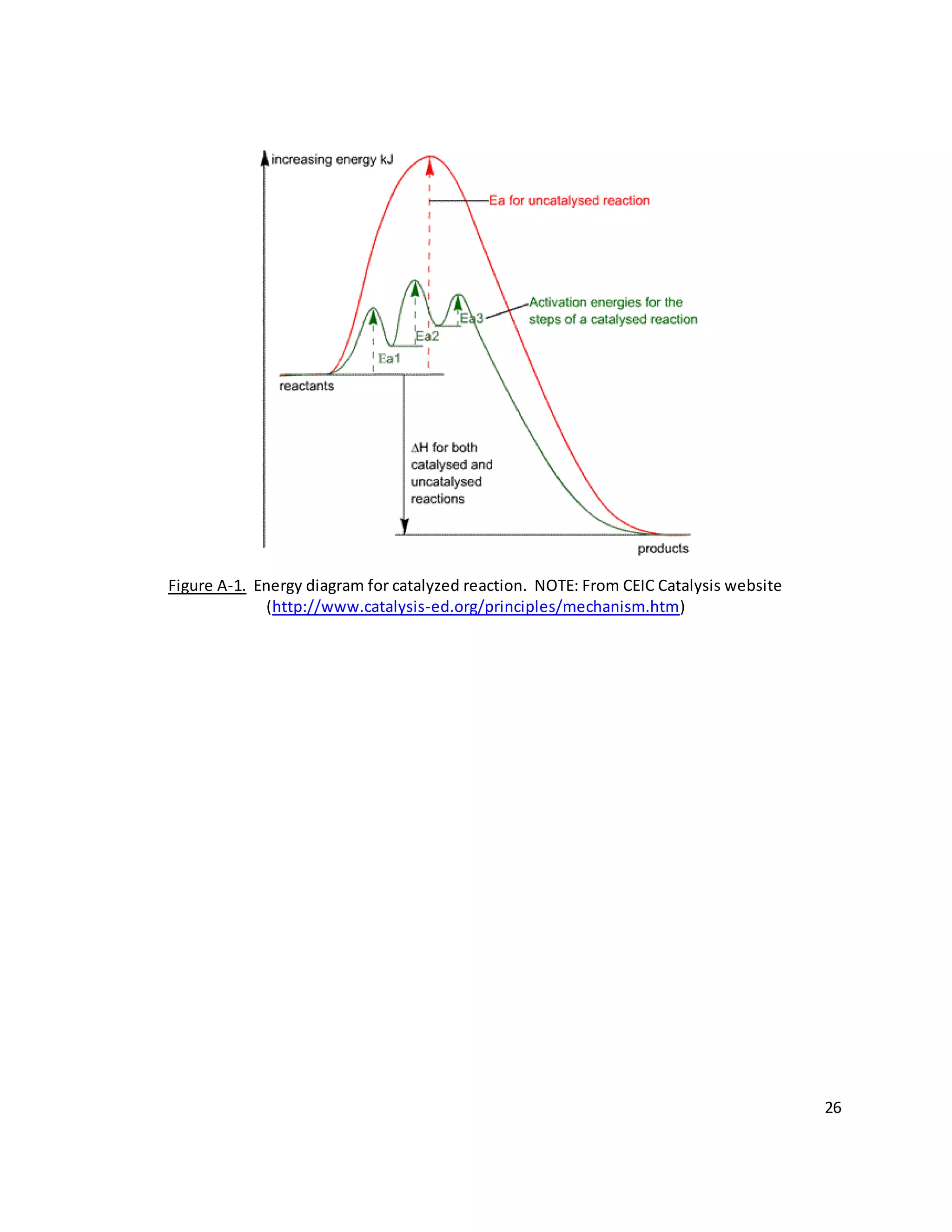
catalyzedreactionisshowninFigure A-1. It isimportantto note thatregardlessof whetherthe reaction
iscatalyzedor not,the energiesof the reactantsintheirbeginningstate are equal,asare the productsin
theirendstate. Thismeansthat any reaction,endothermicorexothermic,catalyzedoruncatalyzed,
consumesorreleasesthe same amountof heatregardlessof the reactionpathtaken.
26
Figure A-1. Energy diagram for catalyzed reaction. NOTE: From CEIC Catalysis website
(http://www.catalysis-ed.org/principles/mechanism.htm)
27
APPENDIX B
AFTERTREATMENT
AftertreatmentConfiguration
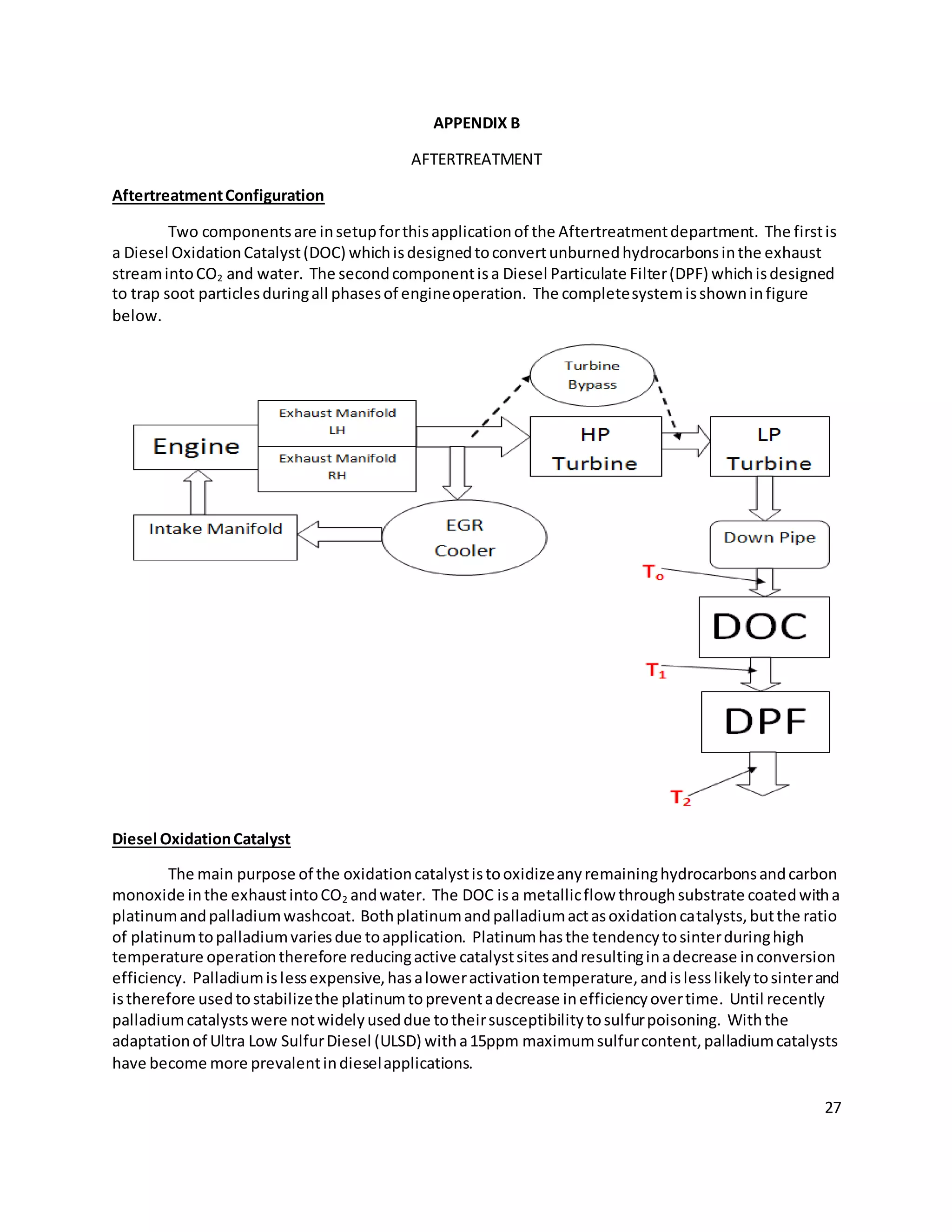
Two componentsare insetupforthisapplicationof the Aftertreatmentdepartment. The firstis
a Diesel OxidationCatalyst(DOC) whichisdesignedtoconvertunburnedhydrocarbonsinthe exhaust
streamintoCO2 and water. The secondcomponentisa Diesel Particulate Filter(DPF) whichisdesigned
to trap soot particlesduringall phasesof engineoperation. The completesystemisshowninfigure
below.
Diesel OxidationCatalyst
The main purpose of the oxidationcatalystistooxidizeanyremaininghydrocarbonsandcarbon
monoxide inthe exhaustintoCO2 andwater. The DOC isa metallicflow throughsubstrate coatedwitha
platinumandpalladiumwashcoat. Bothplatinumandpalladiumactasoxidationcatalysts,butthe ratio
of platinumtopalladiumvariesdue toapplication. Platinumhasthe tendencytosinterduringhigh
temperature operationtherefore reducingactive catalystsitesandresultinginadecrease inconversion
efficiency. Palladiumislessexpensive,hasaloweractivationtemperature,andislesslikelytosinterand
istherefore usedtostabilizethe platinumtopreventadecrease inefficiencyovertime. Until recently
palladiumcatalystswere notwidelyuseddue totheirsusceptibilitytosulfurpoisoning. Withthe
adaptationof Ultra Low SulfurDiesel (ULSD) witha15ppm maximumsulfurcontent,palladiumcatalysts
have become more prevalentindieselapplications.
28
Oxidationreactionsare chemicallyidentical tothe combustionprocess,ascombustionissimply
an oxidationreaction. Giventhisfactitis nosurprise thatthe reactiontakingplace inthe DOC isan
exothermicreaction. Thisexothermicreactioncanbe of great benefittoboththe LNT and the DPF as
will be discussed later.
Diesel Particulate Filter
The diesel particulate filterisacatalyzedfilterwhichisusedtoreduce the amountof soot
leavingthe tailpipe. The geometryof the filtersubstrate issuchthateachchannel of the ceramic
substrate isblockedonone endand openonthe other. Each channel isblockedoneitherthe inletor
outletside of the substrate,butneverboth. Thisforcesthe exhaustgasestoflow intoanopenchannel
on the inletside andpassthroughthe wall of the substrate inorder to flow outof an adjacentchannel
of the substrate whichisblockedoff atthe inletside,butnotthe outlet. A comparisonof flow through
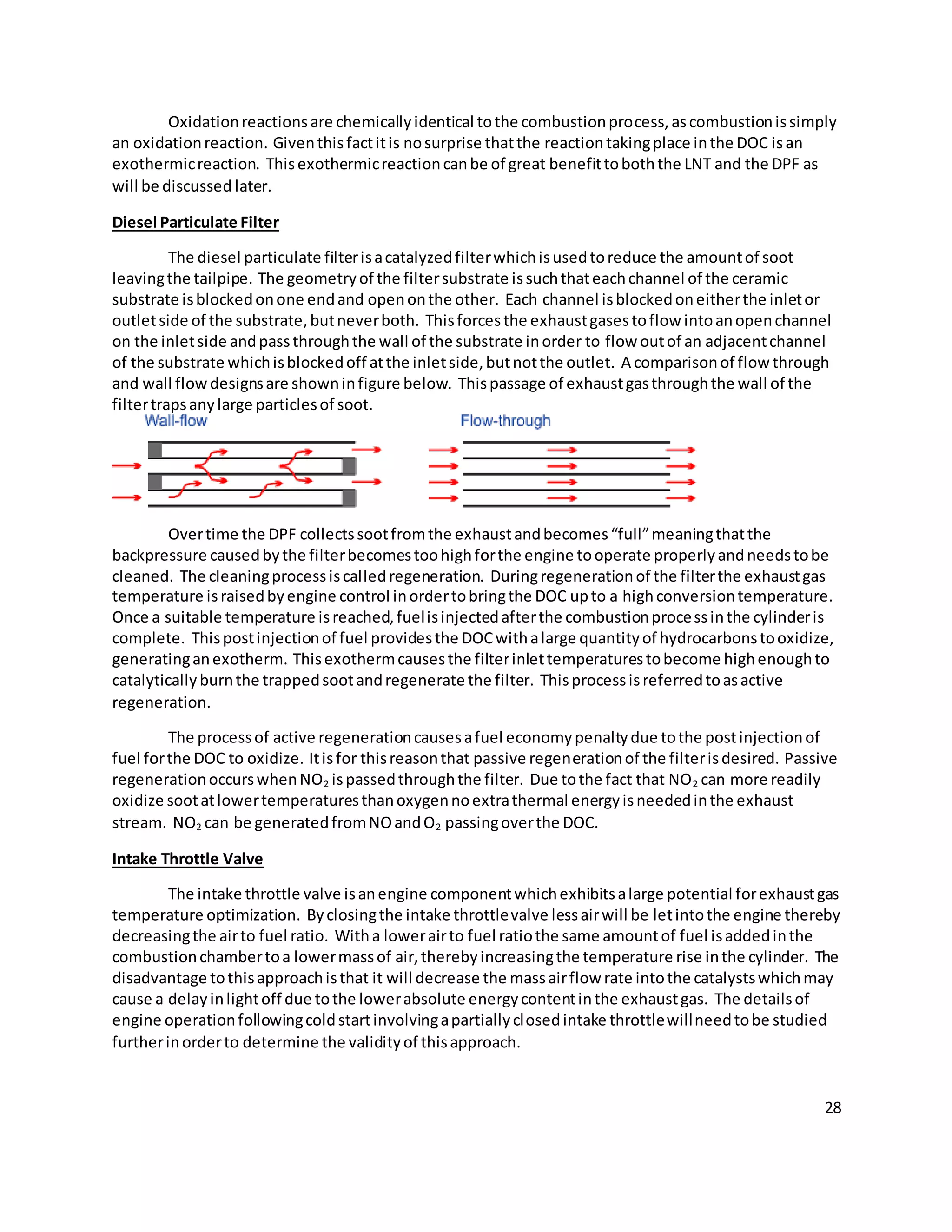
and wall flowdesignsare showninfigure below. Thispassage of exhaustgasthroughthe wall of the
filtertrapsanylarge particlesof soot.
Overtime the DPF collectssootfromthe exhaustandbecomes“full”meaningthatthe
backpressure causedbythe filterbecomestoohighforthe engine tooperate properlyandneedstobe
cleaned. The cleaningprocessiscalledregeneration. Duringregenerationof the filterthe exhaustgas
temperature israisedbyengine control inordertobringthe DOC upto a highconversiontemperature.
Once a suitable temperature isreached,fuelisinjectedafterthe combustionprocessinthe cylinderis
complete. Thispostinjectionof fuel providesthe DOCwithalarge quantityof hydrocarbonstooxidize,
generatinganexotherm. Thisexothermcausesthe filterinlettemperaturestobecome highenoughto
catalyticallyburnthe trappedsootandregenerate the filter. Thisprocessisreferredtoasactive
regeneration.
The processof active regenerationcausesafuel economypenaltydue tothe postinjectionof
fuel forthe DOC to oxidize. Itisfor thisreasonthat passive regenerationof the filterisdesired. Passive
regenerationoccurswhenNO2 ispassedthroughthe filter. Due tothe fact that NO2 can more readily
oxidize sootatlowertemperaturesthanoxygennoextrathermal energyisneededinthe exhaust
stream. NO2 can be generatedfromNOandO2 passingoverthe DOC.
Intake Throttle Valve
The intake throttle valve isanengine componentwhichexhibitsalarge potential forexhaustgas
temperature optimization. Byclosingthe intake throttlevalve lessairwill be letintothe engine thereby
decreasingthe airto fuel ratio. Witha lowerairto fuel ratiothe same amountof fuel isaddedinthe
combustionchambertoa lowermassof air,therebyincreasingthe temperature rise inthe cylinder. The
disadvantage tothisapproachisthat it will decrease the massairflow rate intothe catalystswhichmay
cause a delayinlightoff due tothe lowerabsolute energycontentinthe exhaustgas. The detailsof
engine operationfollowingcoldstartinvolvingapartiallyclosedintake throttlewillneedtobe studied
furtherinorderto determine the validityof thisapproach.
29
APPENDIX C
EGR
EGR Control Valves
The EGR rate inearlyEGR systemswascontrolledusingaproperlysized ratecontrolorifice,in a design
resemblingthe systeminFigure 1.While averysimple solution,the orifice wasnotable toprovide the
necessaryflexibilityincontrollingthe EGRrate. Withtime,the orifice wasreplacedbyacontrol valve,
whichacts as a variable orifice,thusprovidingthe necessaryflexibility.
EGR valvesutilize anumberof differentdesigns.Some valvesare apoppetstyle,whileothershave
adopteda rotary type design.Because of the mechanismof valve actuation,EGRvalvesare dividedinto
twocategories:
1. Pneumaticvalves,and
2. Electricvalves.
PneumaticvalveswerecommoninEGR systemsforlight-dutyvehicles.Diesel carsinthe 1990s utilized
almostexclusivelypneumaticEGRvalves,butnewerdieselcarmodelsincreasinglyadoptelectricEGR
valves.Electricvalve actuationwasthe standardmethodusedinEGRsystemsforheavy-dutyengines
since theirintroductioninthe 2000s.
Witha pneumaticEGRvalve,the electricactuatingsignal fromthe enginecontrol module(ECM) is
convertedbyan electro-pneumaticconverterintoapneumaticvacuumsignal.Whenthe pneumaticEGR
valve isexposedtovacuum(producedbyavacuumpump),itresultsinthe requiredvalve position.A
disadvantage of the pneumaticvalveisahysteresisinthe characteristiccurve betweenvalve opening
and valve closing[Flaig2000].
In electricEGR valves,the valve modulationisperformedusinglinearsolenoidsorsteppermotors.An
example EGRvalve forheavy-dutyenginesisshowninFigure 2.
Figure 2. Prototype of aProductionStyle EGR Valve
Lucas Control Systems
30
Withthe electricEGRvalve,the ECMsendsa control signal to the electronicsintegratedinthe EGR
valve.Insome designs,aHall sensorisusedforpositionfeedbackforcontrol of the valve,resultingin
hysteresis-free openingandclosingof the valve andina linearcharacteristiccurve.ElectricEGRvalves
mustmeetdemandingoperational requirements:actuatingspeedsof lessthan50 ms at engine
compartmenttemperaturesof upto140°C were reportedinlight-dutyapplications[Flaig2000].
Controllingthe EGRvalve iseasilyaccommodatedthroughthe ECM.Many functionsare sharedbetween
engine andEGR valve control.Inputsof engine speed,torque (oftensubstitutedforwithintakemanifold
pressure),throttleposition,andintake manifoldtemperature are justafew of the sharedsignals
betweenbothengine andEGR control.
In some applications(e.g.,2004 7.3 literNavistarengine) anairflow sensorisusedtocontrol EGR rates.
At a givenspeedandloadcondition,the freshairsignal providedbythe airflow sensorforthe no-EGR
conditionisreducedbyopeningthe EGRvalve.The signal correspondingtothe reducedfreshairflowis
usedas feedback indicatingthe properEGRrate or leadingtofurtheradjustmentinEGRvalve position
to obtaina predeterminedEGRrate.In general,aproductionEGR systemmaynotneedfullydedicated
sensors,butmayshare control signalswithexistingsensors.We willreturntothe topicof EGR control
later.
The EGR valve isoftena separate componentinstalledinthe exhaustpiping.Insome designs,however,
the valve can be integratedwithvariouspartsof the engine.A valve integratedwiththe exhaust
manifoldis showninFigure 3[Haerter1994].
Figure 3. EGR Valve/IntakeManifoldIntegral Design
EGR Coolers
The heat absorbedfromthe combustionprocessisproportionaltoEGR rate,its specificheat,andthe
difference betweencombustionandEGR temperatures.Hence,coolingthe EGR streamallowsfor
greaterheatabsorptionfromthe combustionprocesswhichleadstoalowerrate of NOx formation.In
addition,coolerEGRoccupieslessvolume inthe inletsystem.LowerEGRvolume displacesasmaller
fractionof freshfilteredintakeair,thusdisplacinglessO2,whichhelpsmaintaincombustionefficiency.
31
A schematicrepresentationof anEGR coolerisshowninFigure 4. A startingpointformany EGR cooler
designshasbeenthe shell-and-tubeheatexchanger.Exhaustgasflowsthroughthe tubesof the heat
exchangerwhile the coolant—jacketwater—flowsinthe shell.
Figure 4. SchematicDiagramof EGR Cooler
Coolereffectiveness ismeasuredbythe ratioof the actual heattransfer across the coolerto the
maximumheattransferthatwouldbe potentiallypossible consideringthe temperaturesof the exhaust
gas and the coolant(i.e.,whenthe outletgastemperature becomesequaltothe inletcoolant
temperature):
(1)ε= Q/Qmax = (Tg,in - Tg,out)/(Tg,in - Tc,in)
Heat exchangergeometrymayneedtobe consideredinapplyingEquation(1).Onlycounterflow heat
exchangers,suchasthat showninFigure 4 (butof infinitelengthorinfinitelyhighheattransfer
coefficient),couldprovidean effectivenessof 1 usingthisequation.Forparallelflow coolers,Tc,in could
be replacedbyTc,out to representthe lowesttemperature towhichthe exhaustgascouldbe cooled.
Coolerswithmixedflowpatternscanbe designed,wherethe minimumpossible outletgastemperature
issomewhere betweenTc,in and Tc,out.
However,if one considersthe heatexchangertobe a blackbox,thenEquation(1) couldbe appliedto
any heatexchangerregardlessof geometry.Itwouldthencompare anygivenheatexchangerdesignto
the infinite lengthcounterflowarrangementthatwouldinprinciple provide maximumheattransfer.
Thisapproach isoftentakenforEGR coolers[Hoard2007][Kowada 2006].
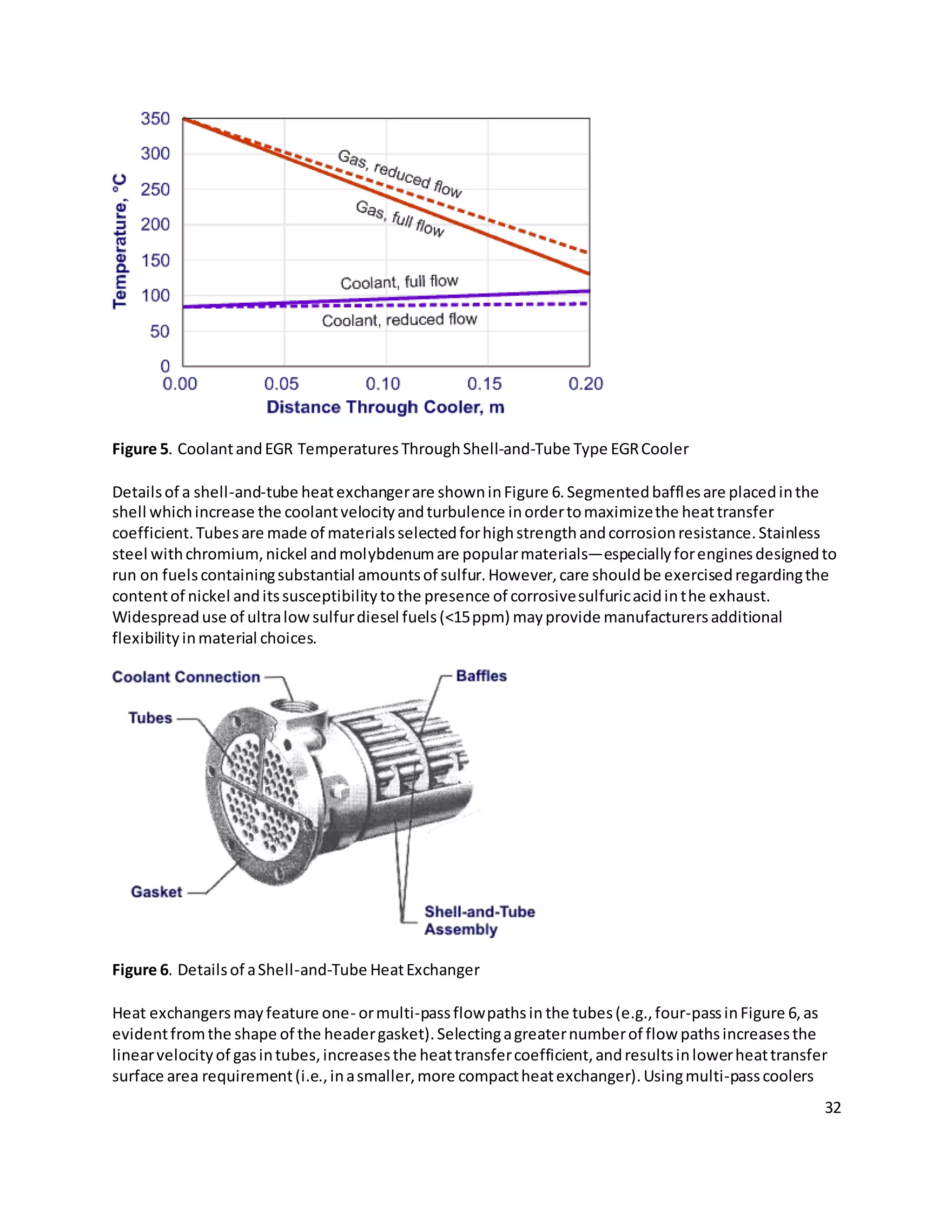
An example temperature profileandthe effectof coolantflow rate througha parallel flow shell-and-
tube EGR coolerare showninFigure 5 [Charlton1998]. In thiscase,as the coolantflow rate decreases
the effectiveness(relative tothe infinite lengthcounterflow arrangement)dropsfromabout81% to
72%.
32
Figure 5. CoolantandEGR TemperaturesThroughShell-and-Tube Type EGRCooler
Detailsof a shell-and-tube heatexchangerare showninFigure 6.Segmentedbafflesare placedinthe
shell whichincrease the coolantvelocityandturbulence inordertomaximizethe heattransfer
coefficient.Tubesare made of materialsselectedforhighstrengthandcorrosionresistance.Stainless
steel withchromium,nickel andmolybdenumare popularmaterials—especiallyforenginesdesignedto
run on fuelscontainingsubstantial amountsof sulfur.However,care shouldbe exercisedregardingthe
contentof nickel anditssusceptibilitytothe presence of corrosivesulfuricacidinthe exhaust.
Widespreaduse of ultralowsulfurdiesel fuels(<15ppm) mayprovide manufacturersadditional
flexibilityinmaterial choices.
Figure 6. Detailsof aShell-and-Tube HeatExchanger
Heat exchangersmayfeature one- ormulti-passflowpathsin the tubes(e.g.,four-passinFigure 6,as
evidentfromthe shape of the headergasket).Selectingagreaternumberof flow pathsincreasesthe
linearvelocityof gasintubes,increasesthe heattransfercoefficient,andresultsinlowerheattransfer
surface area requirement(i.e.,inasmaller,more compactheatexchanger).Usingmulti-passcoolers
33
may be dictatedbypackagingspace limitationwhile desiringlarge temperature reductions.A major
disadvantage of the greaternumberof flow pathsisthe associatedpressure drop,whichiscritical in
designingEGRsystems.Havingsmall pressuredifferencesbetweenthe exhaustandintake manifolds
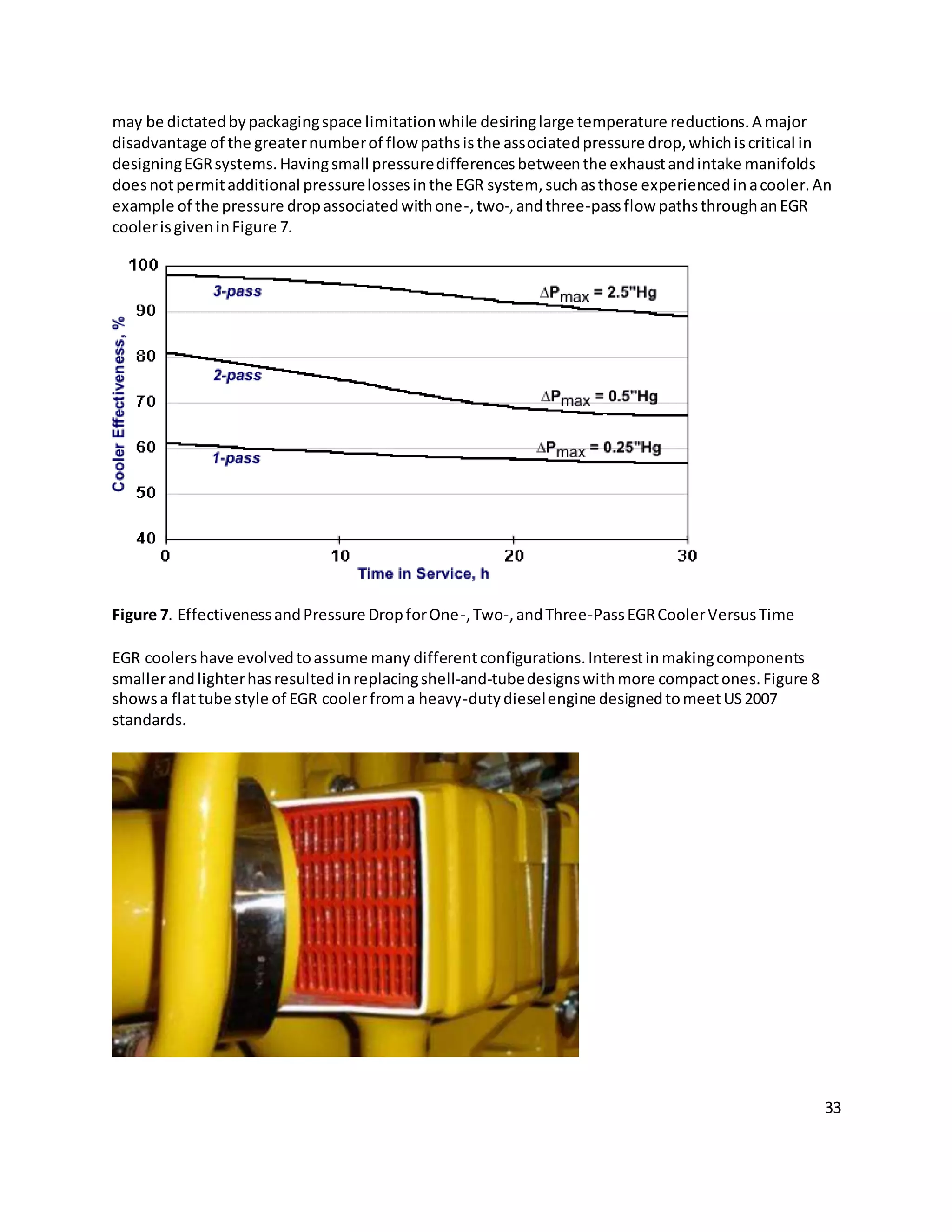
doesnotpermitadditional pressurelossesinthe EGR system, suchasthose experiencedinacooler.An
example of the pressure dropassociatedwithone-,two-,andthree-passflow pathsthroughanEGR
coolerisgiveninFigure 7.
Figure 7. EffectivenessandPressure DropforOne-,Two-,andThree-PassEGRCoolerVersusTime
EGR coolershave evolvedtoassume many differentconfigurations.Interestinmakingcomponents
smallerandlighterhasresultedinreplacingshell-and-tubedesignswithmore compactones.Figure 8
showsa flattube style of EGR coolerfroma heavy-dutydieselengine designedtomeetUS2007
standards.
34
Figure 8. FlatTube Style EGR Cooler
(Caterpillar2007 C15 ACERT engine)
Compactnessratio quantifiesthe heattransfersurface areaperunitvolume of the heatexchanger.In
some EGR coolers,more compactdesignisachievedthroughthe use of finsonthe gasside.Tube andfin
designscanhave compactnessratiosupto about 330 m2
/m3
.Plate andfincoolers—suchasthatshown
inFigure 9—can have compactnessratiosabove 1000 m2
/m3
.
Figure 9. CompactEGR CoolerAssemblyforLight-DutyApplications
(Source:Pierburg)
The EGR coolerinFigure 9, intendedforlight-dutyapplications,ismade fromdie castaluminum[Breuer
2007]. The exhaustgasfollowsaU-shapedflow patternthroughthe coolershell andpastthe fins.The
coolershell issurroundedbyenginecoolant.Thiscompactdesignisalsoveryefficient,withheat
transfercoefficientsonthe orderof 3000 W/m2
Kon the coolantside,andon the orderof 300 W/m2
Kin
the gas. Highheat transferratesare alsostimulatedbythe use of aluminum, whichhasa significantly
higherheatconductivitythanstainlesssteel.
Two-Stage Cooling.The practical lowtemperature limittowhichanEGR coolercan cool the recirculated
exhaustgaswill be somewhathigherthan the inlettemperature of the coolingmedium.ForanEGR
coolerusingengine coolantasa coolingmedium,thistemperature will be limitedbythe engine coolant
temperature—usuallyinthe range of 70-90°C. If lowerEGR temperaturesare required,asecondcooler
that usesambientairas a coolingmediumwouldbe required.Thisapproach—takenbyInternational on
some of theirUS 2007 enginesandbyScaniaforits Euro V engines—presentssomechallengessuchas
minimizingthe effectsof condensedwatertopreventcorrosionandfreezing.
35
CoolerBypass. CoolingEGR may notalwaysbe desirable.Forinstance,incoldweatherconditionswhere
EGR iscooledbelowthe dewpointtemperature,condensate mayformandmix withexhaustcontaining
sulfurandnitrogencompounds.The mixture of condensate andexhaustcanproduce acidsthat couldbe
corrosive tocomponentsof the EGR systemaswell asotherparts of the engine.Condensationof sulfur
speciesinEGR coolersandthe associatedcorrosionissueshave beenthe subjectof anumberof studies
[McKinley1997][Kreso1998b].
Some designsallowforbypassingthe EGRcoolerin coldtemperature aswell asat some driving
conditions,suchasidle orno load.Thispractice has oftenimprovedidle/noloadandpartloadfuel
economy,aswell asreducingHC andCO emissions.Itisalsoaimedatreducingthe formationof acidic
condensate thatmayimpairengine componentsdurability.A bypassarrangementalsoallowsbetter
control of EGR temperature byallowingforthe mixingof differentproportionsof cooledanduncooled
EGR. A coolercore withan integratedbypasspassage isshowninFigure 10[Beck2007]. A flapat the
inletof the coolerdirectsEGR to eitherflow throughthe coolingpassagesorthe bypasspassage.
Figure 10. EGR CoolerWithIntegratedBypassPassage
EGR coolerscanbe subjecttoconsiderable thermalstressfromthe highheatload.Toensure a long
service life,the housingstructuresof these coolerscanbe fittedwithanexpansionjoint,suchasan
expansionbeadora bellowsstructure,toprovide axial compensation.
Fouling.Foulingof the EGR coolerisa majorconcernbecause itcontributestolowercooler
effectiveness,aswell asincreasedpressureloss.Experimentsconductedonprototype coolershave
shownthat effectivenessdegradationisusuallylimitedtothe first20 to 30 hoursof use.The most rapid
drop of coolereffectivenessoccurswiththe cleancooler,inthe initial hoursof operation(thisisalso
apparentfromFigure 7 and Figure 11).
Foulingoccursprimarilyasa resultof the depositionof diesel particulate matter,aswell ascondensed
and/orpyrolysedhydrocarbons.Foulingtendstobe more severe inthe presence of “heavywetPM”,
whichismore common at lowNOx engine calibrations[Hoard2007]. The contaminantsare depositedon
the wallslargelydue tothermophoreticallyaugmentedconvective diffusion.Owingtothe insulation
effectof the depositlayer,the thermophoreticeffectlevelsoff whenthe depositbuildsup,leadingtoa
36
fallingrate of deposition.The resistance toheattransfercausedbyfoulingwillusuallyreachasteady-
state value forwhichempirical correlationsexist.One suchcorrelationis[Grillot1997]:
(2)R = 1.094 Cpart V-1.14
((Tg - Ts)/Tg)0.7
where:
R - steadystate foulingheattransferresistance,m2
K/W
Cpart - particle concentration,g/m3
V - gas flowvelocity,m/s
Tg - gas temperature,K
Ts - surface temperature,K.
A numberof approachescan be takento minimize the effectsof foulingincludingthe selectionof
appropriate geometriesthatinhibitexcessiveaccumulationof foulingmaterial andaddingextracapacity
that isintendedtobe lostto foulingduringservice of the cooler.Increasingflow velocitythroughthe
coolerand loweringthe temperature difference betweenthe gasandthe heatexchangersurface—as
suggested byEquation(2)—mayalsobe usedtominimizefouling.
An effective measure tocontrol foulingistoreduce the concentrationof particlesandother
componentsinthe EGR that may accumulate inthe heatexchanger.Forenginesequippedwithadiesel
particulate filter(DPF),anLPLEGR configurationcanbe used,where cleanexhaustgasisrecirculated
fromthe outletside of the filter(thisapproachwastaken,forexample,in2007 CaterpillarACERT
onroadengines).However,foulingmayremainaproblemforenginesthatrecirculate exhaustgasfrom
the exhaustmanifold.While aparticulate filtercouldbe placedinthe EGR line upstreamof the cooler,
the problemsof pluggingandkeepingthe filtercleanpresentasignificantchallenge.
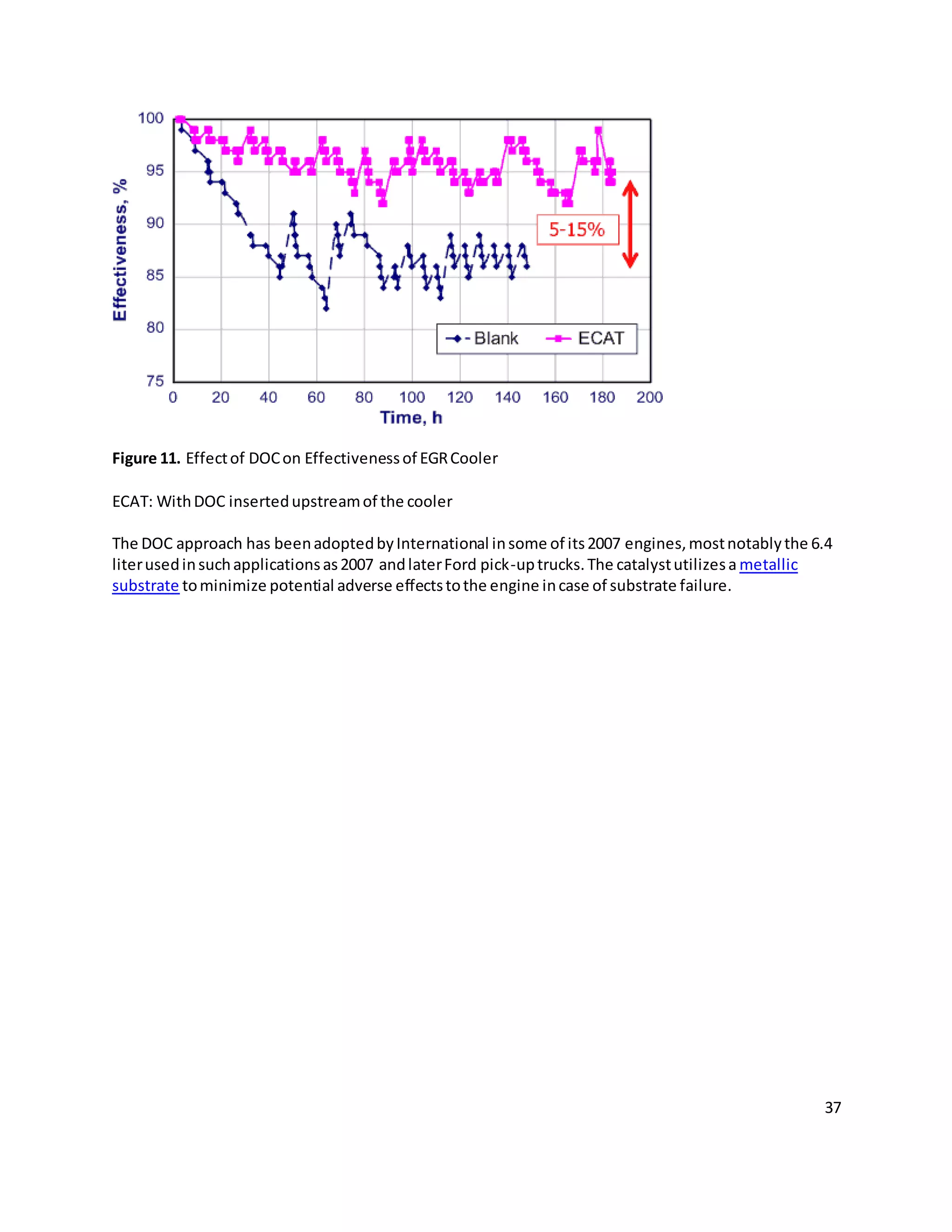
A more practical approach isto inserta diesel oxidationcatalyst(DOC) intothe EGRline upstreamof the
cooler.While notprovidingthe same levelof foulingprotectionasafilter,the catalystcansignificantly
reduce degradationof heattransfereffectivenessinanEGR cooler,as illustratedinFigure 11[Tyo
2007][Hoard 2007]. The coolereffectivenessdatawascollectedoveranengine cycle speciallydesigned
to testEGR coolerfouling.The DOCcan alsoprovide anadditional benefitof protectingthe EGRvalve
fromsticking.
37
Figure 11. Effectof DOCon Effectivenessof EGRCooler
ECAT: WithDOC insertedupstreamof the cooler
The DOC approach has beenadoptedbyInternational insome of its2007 engines,mostnotablythe 6.4
literusedinsuchapplicationsas2007 andlaterFord pick-uptrucks.The catalystutilizesa metallic
substrate tominimize potential adverse effectstothe engine incase of substrate failure.
38
APPENDIX D
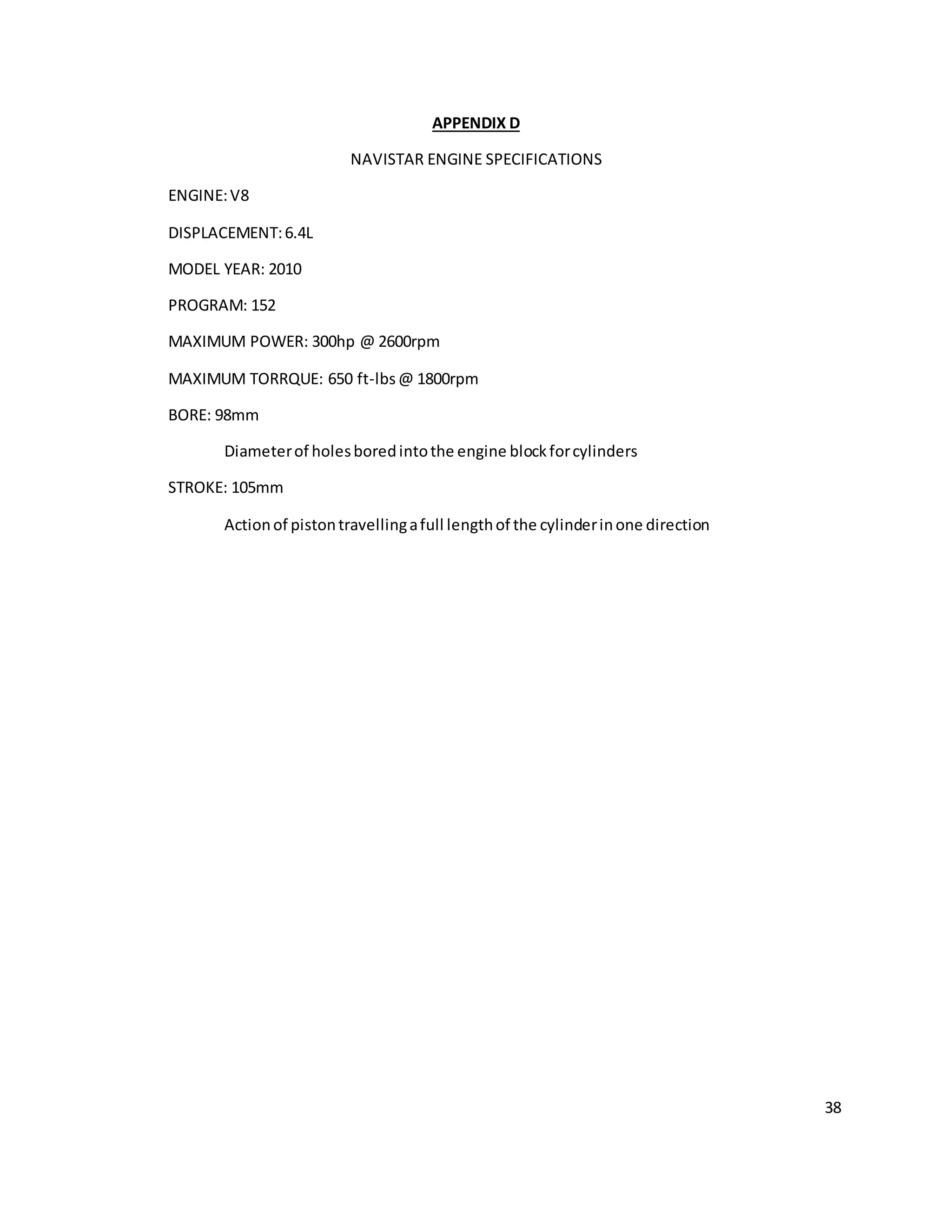
NAVISTAR ENGINE SPECIFICATIONS
ENGINE:V8
DISPLACEMENT:6.4L
MODEL YEAR: 2010
PROGRAM: 152
MAXIMUM POWER: 300hp @ 2600rpm
MAXIMUM TORRQUE: 650 ft-lbs@ 1800rpm
BORE: 98mm
Diameterof holesboredintothe engine blockforcylinders
STROKE: 105mm
Actionof pistontravellingafull lengthof the cylinderinone direction
39
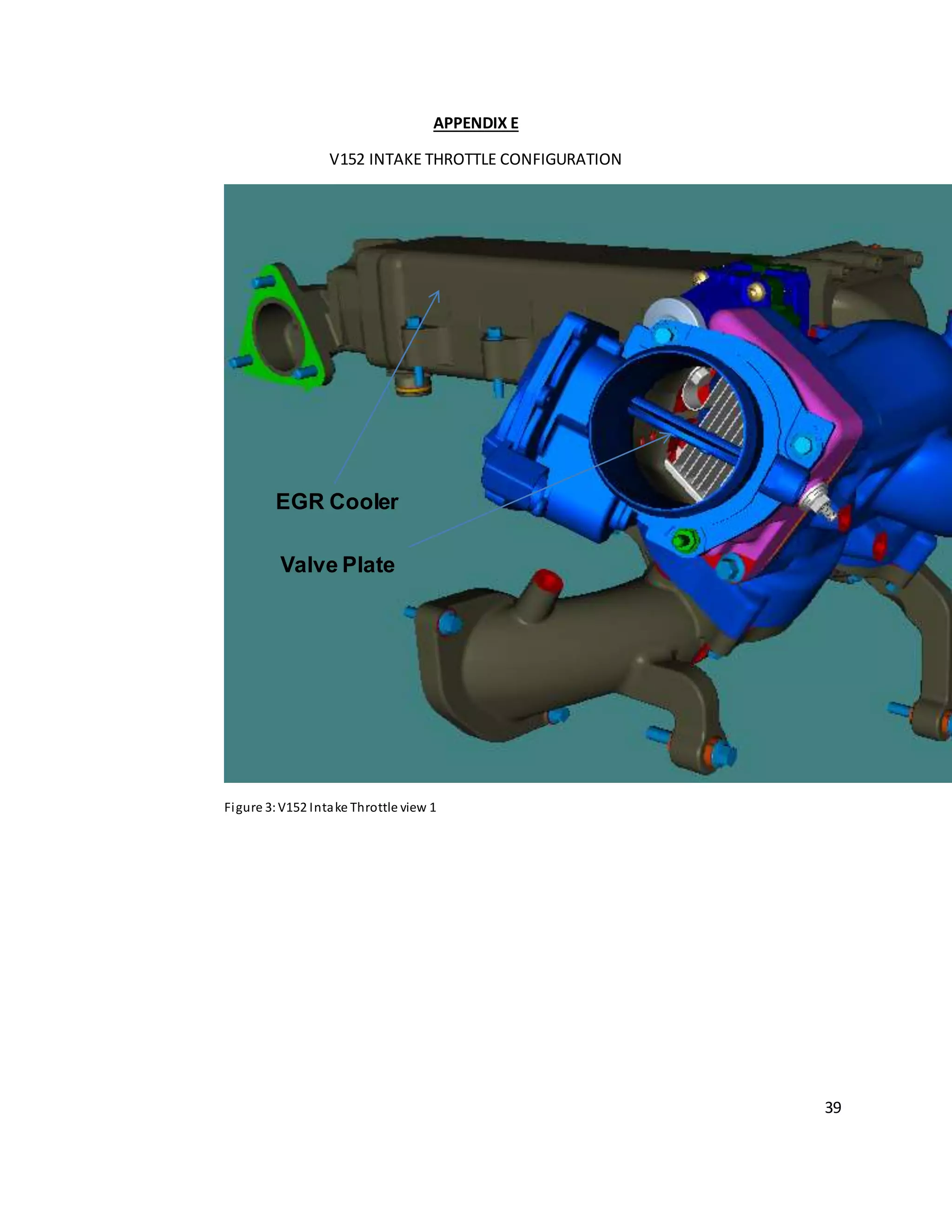
APPENDIX E
V152 INTAKE THROTTLE CONFIGURATION
Figure 3:V152 Intake Throttle view 1
EGR Cooler
Valve Plate
40
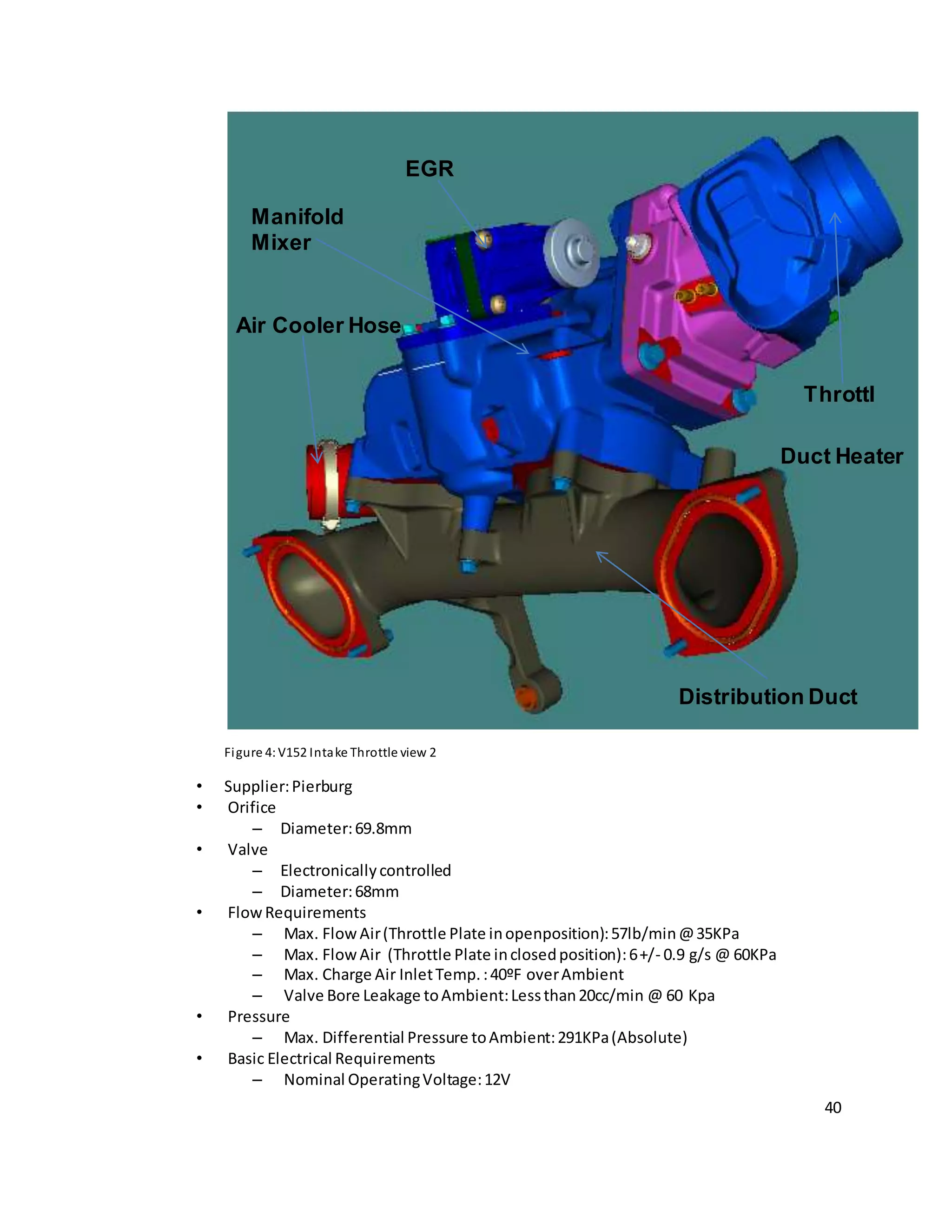
Figure 4:V152 Intake Throttle view 2
• Supplier:Pierburg
• Orifice
– Diameter:69.8mm
• Valve
– Electronicallycontrolled
– Diameter:68mm
• FlowRequirements
– Max. FlowAir(Throttle Plate inopenposition):57lb/min@35KPa
– Max. FlowAir (Throttle Plate inclosedposition):6+/- 0.9 g/s @ 60KPa
– Max. Charge Air InletTemp.:40ºF overAmbient
– Valve Bore Leakage toAmbient:Lessthan20cc/min @ 60 Kpa
• Pressure
– Max. Differential Pressure toAmbient:291KPa(Absolute)
• Basic Electrical Requirements
– Nominal OperatingVoltage:12V
Manifold
Mixer
Duct Heater
Throttl
Distribution Duct
Air Cooler Hose
EGR
41
– Max. OperatingVoltage:16V
– Min. OperatingVoltage:9V
– Max. OperatingCurrent:2A
42
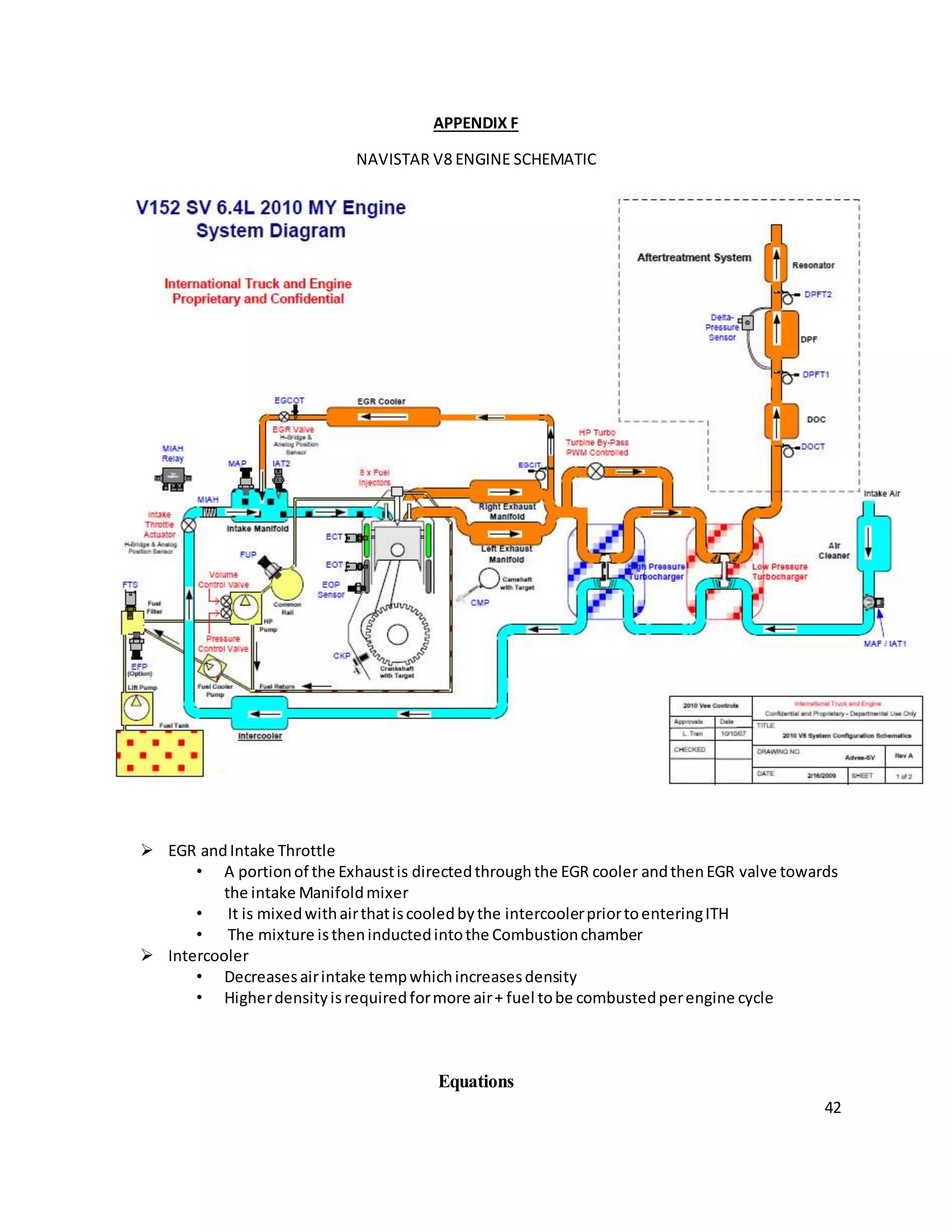
APPENDIX F
NAVISTAR V8 ENGINE SCHEMATIC
 EGR andIntake Throttle
• A portionof the Exhaustis directedthroughthe EGR cooler andthenEGR valve towards
the intake Manifoldmixer
• It is mixedwithairthatiscooledbythe intercoolerpriortoenteringITH
• The mixture istheninductedintothe Combustionchamber
 Intercooler
• Decreasesairintake tempwhichincreasesdensity
• Higherdensityisrequiredformore air+ fuel tobe combustedperengine cycle
Equations
43
𝑉: 𝑉𝑒𝑙𝑜𝑐𝑖𝑡𝑦
𝐴: 𝑐𝑟𝑜𝑠𝑠 𝑠𝑒𝑐𝑡𝑖𝑜𝑛𝑎𝑙 𝐴𝑟𝑒𝑎
𝑚𝑑𝑜𝑡 ( 𝑡ℎ): 𝑡ℎ𝑒𝑜𝑟𝑒𝑡𝑖𝑐𝑎𝑙 𝑚𝑎𝑠𝑠 𝑓𝑙𝑜𝑤 𝑟𝑎𝑡𝑒
𝐶𝑑: 𝐷𝑖𝑠𝑐ℎ𝑎𝑟𝑔𝑒 𝐶𝑜𝑒𝑓𝑓𝑖𝑐𝑖𝑒𝑛𝑡

Senior Design Project - B.S. Mechanical Engineering (ITV Research and analysis)

  • 1.
    1 INTAKE THROTTLE VALVE DESIGN Group# 8 KARTIK SUVARNA KARAN BHAVSAR SPONSOR: NAVISTAR INDUSTRIAL ADVISOR: ADAM LACK INSTRUCTOR: DR. SONG DATE: MAY 1ST 2009
  • 2.
    2 TABLE OF CONTENTS List of Figures, Tables  Acknowledgement  ABSTRACT  CHAPTER 1: INTRODUCTION o 1.1 problem topic o 1.2 generalbackground o 1.3 Regenerationstrategybackground o 1.4 teamwork  CHAPTER 2: DESIGN CONSTRAINS o 2.1 Functional o 2.2 Safety o 2.3 Quality o 2.4 Manufacturing o 2.5 Timing o 2.5 Economin o 2.6 Social  CHAPTER 3: PROJECTPLANNING  CHAPTER 4: DESIGN SPECIFICATIONS
  • 3.
    3  CHAPTER 5:CONCEPT EVALUATION  CHAPTER 6 : CONCEPTEVALUATION  CHAPTER 7: DISCUSSION  REFERENCES  APPENDIX o A: CATALYST o B: AFTERTREATMENT o C: EGR o D: NAVISTAR ENGINE SPECS o E: INTAKE THROTTLE CONFIG o D: NAVISTAR ENGINE SPECS  Equations
  • 4.
    4 FIGURES Figure 1:3-D PlotNavistar Data Figure 2: 2-D Plot Navistar Data Figure 3: Timeline Figure 4: Design Matrix Figure 5: Concept 1: Orifice Plate Figure 6: Concept 2: Oval shaped Valve Figure 7: Concept 3: Reduced Diameter Valve Figure 8:Concept Evaluation Table Additional Figures: APPENDIX
  • 5.
    5 CHAPTER 1 Introduction 1.1 ProblemTopic: The 6.4 L V8 Engine at Navistar that is scheduled to go into production in 2010 uses an Intake Throttle to increase EGR rates and reduce NOx emissions. The Intake Throttle Valve is used to control the amount of fresh cooled air to be let into the Manifold mixer to mix with the Exhaust gas that comes in via the EGR cooler. After the Intake throttle valve reaches about 60% of closure at high mass air flow rates, the delta P across the valve tends to increase rapidly resulting in suction which causes the valve to close completely resulting in the Engine to choke. This Project aims at preventing the intake throttle valve from being closed forcefully due to suction. Figure 1: 3-D Plot; Intake Throttle Valve closurevs MAF vs P
  • 6.
    6 Figure 2: 2-DPlot; Intake Throttle Valve closure (%) vs Delta P Figure 1 shows a 3-D plot of the data collected from tests that were ran at the test cells in Navistar. It shows the relationship between the Intake throttle valve closure (%) and the rise in pressure differential (hPa) across the valve at different Mass Air Flows (Kg/hr). Figure 2 is the same plot in 2-D format showing only Intake throttle valve closure (%) vs the Delta P (hPa). The graph clearly shows where the delta P tends to rapidly increase causing a rapid closure of the valve which results in engine choking. From the graph 0% is considered to be wide open position of the valve while 100% is considered to be a fully closed position of the valve. As seen in the plot, there are no data points in the 100 % range. This shows that there is only a little gap between the valve in closed position and the inner wall of the throttle. High temperature cause the valve to expand resulting in the valve be in closed positioned even though technically its only 80% closed. Thus concepts must be designed taking the the expansion of the valve into consideration. A better understanding of this can be gained in chapter 5. 1.2 General Background:
  • 7.
    7 This project isassigned by the Aftertreatment department at Navistar. The Aftertreatment department at Navistar deals with trying to achieve high Catalyst Inlet temperatures in order to meet the EPA requirements. The target exhaust out temperatures are tried to achieve by playing around with the Injection timings, EGR valve technology, using the Intake Throttle and a Turbocharger. The target exhaust temperature going into the Diesel Oxidation Catalyst is 275ºC - 300ºC, where as the target exhaust temperature going into the Diesel Particulate Filter is 540ºC - 600ºC. The Target Diesel Oxidation Temperature is needed to oxidize Carbon Monoxide (CO), Hydrocarbons (HC) and organic fraction of diesel particulates (SOF). The Oxidation takes place as follows: HC + O2 = CO2 + H2O ……. (I) CO + 1/2O2 = CO2……….. (II) 2SO2 + O2 = 2SO3……… (III a) SO3 + H20 = H2SO4……. (III b) The target temperature going into the Diesel Particulate Filter is required for oxidation of NOx. To read about the effects of catalysts on NOx refer Appendix [ ]. 1.3 Regeneration Strategy Background: Some of the strategies used by the companies to achieve target Exhaust out temperature for regeneration are as follows: 1. Post Injection Entirely new functions are performed by injection systems in engines with integrated emission aftertreatment systems of Diesel Particulate Filters. These devices require regeneration to burn all the soot which is provided by high temperatures or by rich exhaust gas of rich HC content. These are achieved by late fuel injection which is also called post injection. Thus Post injection provides a certain amount of high exhaust
  • 8.
    8 temperature going intothe DOC which is further increased by oxidation process taking place in the DOC. 2. Intake Throttle The intake throttle valve is an engine component which exhibits a large potential for exhaust gas temperature optimization. By closing the intake throttle valve less air will be let into the engine thereby decreasing the air to fuel ratio. With a lower air to fuel ratio the same amount of fuel is added in the combustion chamber to a lower mass of air, thereby increasing the temperature rise in the cylinder. The disadvantage to this approach is that it will decrease the mass air flow rate into the catalysts which may cause a delay in light off due to the lower absolute energy content in the exhaust gas. Furthermore, this approach may cause an increase in emissions levels. 3. Turbocharger The turbocharger is an integral and very dynamic part of the exhaust stream. The V148 turbocharger is highly complex with numerous electronically controlled parameters including a turbine bypass valve, wastegate, and variable geometry turbine (VGT)Test Configuration. VGT can be utilized to increase exhaust temperature by raising the exhaust backpressure and therefore increasing the work done by the firing cylinders. By closing the VGT a large resistance to flow is created in the turbine thereby raising the backpressure. Another advantage in terms of exhaust gas temperature maximization can be achieved by bypassing the turbine entirely to prevent the exhaust gasses from rejecting energy into the large thermal mass of the turbine housing. During low load operation the low pressure turbine is not being utilized to create boost, therefore it can be bypassed through the wastegate to prevent the exhaust from rejecting its heat to the housing. With the wastegate open the exhaust can bypass the low pressure turbine housing and take a shorter path through which it will lose less energy. Simultaneously, the high pressure turbine, equipped with a VGT, can be controlled to shut its vanes and
  • 9.
    9 increase backpressure tothe combustion chamber which theoretically will increase exhaust gas temperature exiting the combustion chamber. 1.4 Team Work Our group consists of two members. The initial stages of the project involved brainstorming ideas. The next stage involved talking to the employees at Navistar asking them if they could go over some of the major issues they are facing and if we could help them improve a design to fix the problem. So the Navistar employees had a huge contribution to this project assisting us with the topic, details related to the problem, and providing us with required tests data and schematics and a couple other things. The Advisor Dr. Song contributed by pushing us to understand the problem more and understand how the engine operates. He made sure we understand the smallest things about the engine that might be related in some or the other way with our project. We as team members worked together by going to Navistar to gather information and talking to engineers. We worked together on researching journals and books. We distributed the work of brainstorming ideas. So overall it was a team work which not only included the team members but also the instructor at Northern Illinois University and the Advisor at Navistar.
  • 10.
    10 CHAPTER 2 DESIGN CONSTRAINTS 2.1Functional Operation: Operation of the Throttle needs to be taken into consideration. A great understanding of how it works and what can be changed in to achieve goal needs to be understood. Size: The size of the Throttle Valve needs to be taken into consideration. There must some limitations as to how big or small the valve can be. One also should consider the fact that the orifice or the throttle diameter would remain the same. Thus only modifications to the valve can be made. Changing the throttle altogether would make packaging for the V152 program at Navistar difficult. Flow: Fluid flow which includes air and gas needs to be understood. Knowledge acquired from the Fluid Mechanics class and research on the same must be implemented into the design at Navistar to go about designing the new product. Software: I-DEAS would be used to design the product. MATLAB would be used whenever necessary. CFD analysis would have to be done for flow simulations. 2.2 Safety Test Cell: We will always make sure that we are assisted by a technician while we are at the test cell at Navistar. Safety glass would be worn wherever necessary on company property. Other safety regulations required by the company would be taken into consideration Enivronmental: This project aims at improving Environmental safety by avoiding exceeding the EPA NOx limits. Thus this projects aims at reducing NOx emissions. 2.3 Quality Quality assurance and control: Regulations, standards and testing.
  • 11.
    11 Reliability: Parts designedand ordered will be tested for failure. Thus multiple concepts will be designed to come up with a final product in the future. 2.4 Manufacturing Supplier: A constant contact will be followed with the Navistar supplier for the Intake Throttle Valve 2.5 Timing Product Planning: Planning on what are the initial steps going about the product designed need to be outlined. Now coming to the end of the semester these initial steps were outlined and thus a project planning chart was put together which is seen in Chapter 3. Product Schedule: A timeline of what needs to be when in order to stay within the time period of designing the product needs to be created. A time line basically defines how many days a task should last. It helps order and test parts on time. A time line is designed in Chapter 3. 2.6 Economic Cost Analysis: Cost analysis of the present product used by the company still needs to be looked at. Costs needs to be kept in mind while designing the new part thus choosing material and other components needed that stay within company spending limits. 2.7 Social A relationship is initialized between the team, Navistar and the supplier. This relationship tends to grow as we go forward with the project.
  • 12.
    12 CHAPTER 3 PROJECT PLANNING Aprojectplanisa listof tasksthat needtobe completedduringthe designprocess.The objectivesforeachtaskare statedand a timeline isdefinedbasedonthe listedtasksandthe time periodtofinishproject. The tasks neededtoachieve projectgoal of designingthe Intake ThrottleValveare: 1. DesignEngineeringSpecifications Objective:Make anunderstandingof whothe customersare andwhatthe customerrequirementsare. Create a time line basedontime periodtocomplete the projectandcreate a QFD chart. 2. Gather Information Objective:Gatherinformationfromthe designengineers,aftertreatmentdepartment,andcalibration departmentbasedonwhatisneededstartupwiththe project.Example:Testdatafor the current throttle valve design. 3. Research Objective:Researchjournals,booksandinternettogathermore informationon the projecttopic.Thisis necessarytoget a betterunderstandingof the problemandgetideasonwhatotherpeople are doingto preventasimilarproblem. 4. Recap FluidMechanicsKnowledge Objective:Recapknowledge acquiredinFluidMechanicsclassbybrowsingthroughthe textbooowkto geta betterunderstandingof fluidflowequations. 5. BrainstormConcepts Objective:Make alistof conceptsbasedon researchandfluidmechanicsknowledge.Applyequationsto each conceptto make a comparisonbetweenthe concepts. 6. Choose 2 or 3 concepts
  • 13.
    13 Objective:Basedoncalculationsdone oneachbrainstormedconcept,choose 2or3conceptsthat would workbestjust sothat a lotof time isnot wasteddesigningeveryconcept.Determine dimensionsof conceptsbasedoncalculations. 7. Design Objective:Doacost evaluationonthe conceptschosenanddesignthe part. 8. Simulation Objective:RunCFDanalysistogetdata that mighthelpverifyif the conceptsthoughtof basedon theoretical calculationare correct. 9. OrderPart Objective:Basedondesignandsimulationresultsorderpart. 10. Run Tests Objective:RunDOE’swiththe orderedpartto getreal data that can be verifiedwiththeoretical and simulationresults.Verifyreal datawithsimulationresults. Timeline: A timelineisoftencreatedtomake thingsorganized.Ithelpsdeterminewhatneedstobe wheninorder to complete projectinrequiredtime period. April May June Jul
  • 14.
    14 y W 1 W 2 W 3 W 4 W 1 W 2 W 3 W 4 W 1 W 2 W 3 W 4 W 1 W 2 W 3 W 4 Specifications Gather Information Research Recap Fluid Mechanics Brainstorm Concepts Choose 2or 3 concepts Design Concepts Simulation Order part Run tests Will be outof townon vacation. Figure 3: timeline A B C D E F G H I J Specifications A A Gather Information B X B Research C X X C Recap Fluid Mechanics D X D BrainstormConcepts E X X E Choose 2 or 3 concepts F X X X F DesignConcepts G X X X G Simulation H X X H Orderpart I X X I Run tests J X J Figure 4: Designatrix
  • 15.
    15 CHAPTER 4 SPECIFICATIONS a. Custormers:AftertreatmentDepartmentatNavistarandrestofthe design team. b. CustomerRequirements:Designthe Intake ThrottleValvetoachieve goal of havinga linearrelationshipbetweenthe Intake Throttle Valve Closure (%) and Pressure Differential acrossthe valve (P). c. It isnecessarytounderstandhow the Intake Throttle valve works.Itisthen necessarytounderstandhow airand exhaustflowsthroughthe intake throttle. d. Talk to engineerstosee whatthe DeltaPrequirementswouldbe forcertain mass flowrate to avoidsuction.Thusbrainstormconceptsandapplyfluid mechanicstomake sure concept meetsrequirements. e. Decide a time line todecide whatconceptworksbest,designpartandorder part to run data.
  • 16.
    16 CHAPTER 5 CONCEPT GENERATION A.Orifice Plate Orifice isnothingbutanopening,andthusa an orifice plate isa valve ora plate withan opening. Figure 5: Concept1: Orifice Plate Thisis a valve whichbasicallyhasahole init.Where the hole needstobe designed?This isnot determinedyet.Itcan be determinedwithfurthercalculations. How doesan orifice plate help? Since the Valve hasa hole inthe centerit allowsairincreasesairspeedsince ithastopass througha smallerportion.Since the airhasto increase itsspeedtopassthrougha smallergap, it resultsinreducedinternalpressurewhichmeansreducedDeltaP.ThusIf the DeltaP across the valve iscontrolled,thenthiswill preventthe valve fromclosingdue tosuction.Some of the calculationsthatwere lookedintothatwouldbe appliedtothisdesigntoprove whetherit worksor nowis as follows.Thesecalculationswere basedoff of the original Fluidequationsin Appendix []. Orifice
  • 17.
    17 The bestway tostart aboutgoingaheadwiththisconceptwouldbe to talkto the calibrationdepartmenttocheck,whatthe DeltaP requirementisata certainflow rate and at a certainintake throttle angle.Thusthe minimumdiameterrequiredtomeetthe above targets can be calculated.A numberof calculationscanbe done fordifferentcombinationsof flowrates and intake throttle closure.The diameterof the openingcanbe determinedbasedoff of the differentcalculationsperformed. B. Oval shapedValve The presentIntake throttle valve isroundshaped.The presentthrottle valve hasa diameterof 68mm as seeninAppendix[].The orifice aroundthe valveis69.8mm.Thus there isa onlya 1.8mm gap betweenthe orifice platein closedpositionandthe throttle orifice.Athigh temperaturesthe valve tendstoexpand,becauseof whichduringarapidincrease inDeltaP,the throttle tendstoshutdownat 80% valve closure insteadof closingcompletelyat100% closure. Thus reducingthe shape bymakingitoval mightbe beneficial.Thiswillnotonlygive the valve a greaterexpansiongap.Anotherthingthatneedstobe lookedintowhile creatingthisdesignis that dimensionsof the valve needtobe calculatedtakingintoaccountthatevenafterexpansion of the valve athightemperaturesthere will some gapforthe air to escape whichwill prevent a rapidrise of pressure differential acrossthe valve thuspreventingthe valvefromshuttingdown due to suctionfurtherpreventingthe enginefromchoking.
  • 18.
    18 Figure 6: Concept2:Oval Shaped The equationsinconceptA will be usedapplyingittodesignthisconceptwithafew changes. For thisdesign 𝐴𝑖will be the areaof the oval shapedvalve. C. RoundshapedValve withasmaller diameter Applyingthe similarreasonappliedtothe above concepts,the shape of the valve canbe keptroundbut reducedindiameter.Thiswillagainallow valvetoexpandathightemperatures. A diameterof the valve inthiscase needstobe calculatedtakingintoaccountthe expansionof the valve andstill havingasome gap for the air to escape reducinginternal pressure.
  • 19.
    19 Figure 7: Concept3:ReducedDiameter D. Multiple Throttle Valves Thisconceptis a bitmore complicated.Thisconceptrequireshavingacouple throttle valves maybe two designedinseriesinthe throttle valve.Thiswill require openingandclosing each valve tryingtocontrol the internal pressure.Thiswill helpreduce pressure acrosseachwill keepingthe pressure inthe throttle undercontrol.Thisdesignwillrequirecalculatingwhatsize and shape or type the twovalvesneedtobe of,how far away fromeach othertheyneedtobe, whichone needstobe openwhenandwhichone needstobe closedwhen.Thiswillrequire designingaprogrambasedon calculationsandintensiveresearchandimplementingthe program intothe ECU to control the twovalves.Thiswill involvealotof controls. E. Mechanical or electronicObstructionsonthe throttle Designingmechanical orelectronicobstructionwasanotherthingwe brainstormed. Mechanical stopare some kindof obstructiononthe throttle thatpreventthe valve from complete closure. The reasonswe calleditan electronicstoptooisthat we mighthave a programdesignedforit to control it. F. By passpassage.
  • 20.
    20 By passacross thevalve wasanotherideathatwe thoughtof.Thisbasicallyisa by pass passage that will create acrossthe valve thatwill helpbypassingpressure whenitreaches threshold.The bypasspassage lengthanddimensions needtobe designedbyworkingon intensivecalculations. Thisdesignwill alsorequire avalve tobe designedthatwill open wheneverpressure reachesthresholdandclose whenpressurecomesbelow threshold.
  • 21.
    21 CHAPTER 6 CONCEPT EVALUATION Thevarious benefitsfromthe designwere listed.Benefitslike the designbenefittingthe engine and the environmentwere listedandeachof the conceptswere ratedwithrespecttohow much effect it wouldhave onthose benefits.Thishelpsprove whatconceptwouldbe more beneficial.Thuscertain conceptscan be givenmore prioritycomparedtothe others.Thusa lotof time isnotwasteddesigning each of the conceptsin orderto staywithinthe timeline determined. The followingbenefitswereconcludedfurthercalculatingthe satisfaction% foreachconcepts. The calculationsare done as follows: Belief =p(k)*p( c) + (1 – p(k)) * (1-p( c)) Importance:Assumedanddeterminedbasedonknowledge Satisfaction(%) =(Belief*Importance) Concepts Orifice Plate p(k) p (c ) belief Pressure Control 0.9 0.9 0.82 NOx Reduction 0.9 0.9 0.82 Flow Equations 0.8 0.8 0.68 Engine Life 0.1 0.3 0.66 understand parameters 0.5 0.5 0.5 cost limitations 0.5 0.5 0.5 Oval shaped valve Pressure Control 0.8 0.8 0.68 NOx Reduction 0.8 0.8 0.68 Flow Equations 0.7 0.7 0.58 Engine Life 0.1 0.3 0.66 understand parameters 0.5 0.5 0.5 cost limitations 0.5 0.5 0.5 Reduced Diameter Pressure Control 0.75 0.75 0.625 NOx Reduction 0.7 0.7 0.58 Flow Equations 0.7 0.7 0.58 Engine Life 0.1 0.3 0.66 understand parameters 0.5 0.5 0.5 cost limitations 0.5 0.5 0.5
  • 22.
    22 Multiple Valves Pressure Control0.77 0.7 0.608 NOx Reduction 0.7 0.7 0.58 Flow Equations 0.7 0.7 0.58 Engine Life 0.1 0.3 0.66 understand parameters 0.5 0.5 0.5 cost limitations 0.8 0.8 0.68 Mechanical Obstruction Pressure Control 0.4 0.5 0.5 NOx Reduction 0.4 0.4 0.52 Flow Equations 0 0.1 0.9 Engine Life 0.1 0.3 0.66 understand parameters 0.5 0.5 0.5 cost limitations 0.4 0.4 0.52 By pass Pressure Control 0.4 0.5 0.5 NOx Reduction 0.3 0.3 0.58 Flow Equations 0 0.1 0.9 Engine Life 0.1 0.3 0.66 understand parameters 0.5 0.5 0.5 cost limitations 0.4 0.4 0.52 Alternative 1 Alternative 2 Alternative 3 Alternative 4 Alternative 5 Alternative 6 Critera Importance Orifice Plate Oval Shaped Valve reduced diameter multiple valves mechanical obstruction by pass Pressure Control 25 0.82 0.68 0.625 0.608 0.5 0.5 NOx Reduction 25 0.82 0.68 0.58 0.58 0.52 0.58 Flow Equations 15 0.68 0.58 0.58 0.58 0.9 0.9 Engine Life 8 0.66 0.66 0.66 0.66 0.66 0.66 understand parameters 15 0.5 0.5 0.5 0.5 0.5 0.5 cost limitations 12 0.5 0.5 0.5 0.68 0.52 0.52 Satisfactions (%) 69.98 61.48 57.605 59.34 58.02 59.52 Figure 8: Concept Evaluation
  • 23.
    23 CHAPTER 7 DISCUSSION The topichas beenunderstood.The conceptshave beenbrainstormed.The teamisprettymuch goingto workbasedon the timelinecreated. The current status:A listof conceptsbrainstormedhave beenundergoing research.We are tryingto researchon whatothercompaniesare doingandwhat mightbe betterideastofix the problem.We are not rulingoutour currentconcepts.But we are justtryingto researcha couple more conceptsbefore finalizingaparticularconcept.We will be spendingacouple more daysor weeks researchingideas.Thenwe willlistthemall andcreate adecisionchartbasedon the calculationsand flowequations.We have alreadystartedimplementingflow equationsintoourcurrentconcepts.We are tryingto use real data and data that the calibrationdepartmentthingswe needtogeta good graph to checkhow eachof our conceptsaffectthe problemsolution.We willdosoas we findmore concepts on researching. Rightnow,we haven’treallymade alotof progressonthe design.Butwe made goodprogress on the proposal andinitial stagesthatwere taughtinclass.We justneedtocatch upon the research stage so we couldstart the designstage andthe testingstage assoonas possible.
  • 24.
    24 REFERENCE 1.Carberry,B., G. Grasi,S.Guerin,F.Jayat, andR. Konieczny,2005. “Pre-TurbochargerCatalyst –Fast catalystlight-off evaluation”,SAETechnical Paper2005-01-2142 2.Kishi N.,H. Hashimoto,K.Fujimori,K.Ishii,T.Komatsudu,1998. “Developmentof the UltraLow Heat Capacityand HighlyInsulating(ULOC) ExhaustManifoldforULEV”,SAE Technical Paper980937 3. Tomazic D.,M. Tatur, M. Thornton,2004. “Developmentof aDiesel PassengerCarMeetingTier2 EmissionsLevels”,SAETechnical Paper2004-01-0581 4. Zhang, X.,L. Meda, M. Keck,2005. “Numerical StudyonSkinTemperature andHeatLossof Vehicle ExhaustSystem”,SAETechnical Paper2005-01-1622 5. Jääskeläinen,H.,2008. “Diesel ExhaustGas”,DieselNetTechnologyGuide, http://www.dieselnet.com/tech/diesel_exh.html 6.Makdi K.Khair., 2008. “EGR & Components”,DieselNetTechnologyGuide, http://www.dieselnet.com/tech/diesel_exh.html 7. Robert,Alan,Philip,“IntroductiontoFluidMechanics”
  • 25.
    25 APPENDIX A CATALYST Chemical Reactions Duringthecombustionof hydrocarbonfuels,perfectcombustionwouldbe characterizedbythe followingreaction. OH m nCOO m nHC mn 222 2 ) 2 (  However;due tomanyfactors includingincomplete combustion,imperfectcombustion,fuel impurities, and the presence of nitrogeninaircombinedwiththe hightemperaturesseeninthe combustion chamber,manyothercompoundsare formed. These compoundsmayinclude,butare notlimitedto, oxidesof nitrogen(NOx),particulate matter(PM),hydrocarbons(HC),andcarbonmonoxide (CO). Due to emissionsregulations,catalyticconvertersare usedtoconvertthese undesired compoundsintocarbondioxide (CO2),water(H2O),anddiatomicnitrogen(N2). Infacilitatingthese reactionscatalyticconvertersuse anumberof differenttechnologiesdesignedspecificallyforeach application. The vastmajorityof catalyticconvertersuse platinumgroupmetals(PGM), whichinclude platinum,palladium,andrhodium,tolowerthe activationenergyof eachreaction,therefore allowing the reactionsto take place quicklyandat temperaturestypical of combustiongases. Catalytic convertersusingmaterialsotherthanthese metalsdoexist,butare uncommoninautomotive applications. All catalystsshare the basicprinciple of operationregardlessof compositionandchemical reactiontakingplace byloweringthe activationenergyof the reactionwhichtheyfacilitate. RequiredConditions Althoughcatalystslowerthe activationenergyof the reactionswhichtheyfacilitate,theyare not effective enoughtoperformtheirtaskattemperaturesbelow acertainthreshold. Thisthresholdin automotive applicationsisoftenreferredtoasthe “lightoff”temperature. The lightoff temperature isdefineddifferentlyindifferentapplications,butalwaysmakes reference tothe conversionpercentage. Thatis,a lightoff temperature willbe definedwhere acertain percentage of the targetchemical isconvertedacrossthe catalyst. Refertochapter 1 figure 3 for an illustrationof thisphenomenon. ExothermicReactions Whenany reactiontakesplace,the productsof that reactionhave a differentchemical energy than the reactants. This change inenergyisthe basisof definitionfortwotypesof reactions, exothermicandendothermic. Inan endothermicreactionthe productshave ahigherenergythanthe reactants;therefore heatisconsumedinthe process. Inversely,inanexothermicreactionthe products have a lowerenergythanthe reactants,therefore releasingheatduringthe reaction. Anexothermic catalyzedreactionisshowninFigure A-1. It isimportantto note thatregardlessof whetherthe reaction iscatalyzedor not,the energiesof the reactantsintheirbeginningstate are equal,asare the productsin theirendstate. Thismeansthat any reaction,endothermicorexothermic,catalyzedoruncatalyzed, consumesorreleasesthe same amountof heatregardlessof the reactionpathtaken.
  • 26.
    26 Figure A-1. Energydiagram for catalyzed reaction. NOTE: From CEIC Catalysis website (http://www.catalysis-ed.org/principles/mechanism.htm)
  • 27.
    27 APPENDIX B AFTERTREATMENT AftertreatmentConfiguration Two componentsareinsetupforthisapplicationof the Aftertreatmentdepartment. The firstis a Diesel OxidationCatalyst(DOC) whichisdesignedtoconvertunburnedhydrocarbonsinthe exhaust streamintoCO2 and water. The secondcomponentisa Diesel Particulate Filter(DPF) whichisdesigned to trap soot particlesduringall phasesof engineoperation. The completesystemisshowninfigure below. Diesel OxidationCatalyst The main purpose of the oxidationcatalystistooxidizeanyremaininghydrocarbonsandcarbon monoxide inthe exhaustintoCO2 andwater. The DOC isa metallicflow throughsubstrate coatedwitha platinumandpalladiumwashcoat. Bothplatinumandpalladiumactasoxidationcatalysts,butthe ratio of platinumtopalladiumvariesdue toapplication. Platinumhasthe tendencytosinterduringhigh temperature operationtherefore reducingactive catalystsitesandresultinginadecrease inconversion efficiency. Palladiumislessexpensive,hasaloweractivationtemperature,andislesslikelytosinterand istherefore usedtostabilizethe platinumtopreventadecrease inefficiencyovertime. Until recently palladiumcatalystswere notwidelyuseddue totheirsusceptibilitytosulfurpoisoning. Withthe adaptationof Ultra Low SulfurDiesel (ULSD) witha15ppm maximumsulfurcontent,palladiumcatalysts have become more prevalentindieselapplications.
  • 28.
    28 Oxidationreactionsare chemicallyidentical tothecombustionprocess,ascombustionissimply an oxidationreaction. Giventhisfactitis nosurprise thatthe reactiontakingplace inthe DOC isan exothermicreaction. Thisexothermicreactioncanbe of great benefittoboththe LNT and the DPF as will be discussed later. Diesel Particulate Filter The diesel particulate filterisacatalyzedfilterwhichisusedtoreduce the amountof soot leavingthe tailpipe. The geometryof the filtersubstrate issuchthateachchannel of the ceramic substrate isblockedonone endand openonthe other. Each channel isblockedoneitherthe inletor outletside of the substrate,butneverboth. Thisforcesthe exhaustgasestoflow intoanopenchannel on the inletside andpassthroughthe wall of the substrate inorder to flow outof an adjacentchannel of the substrate whichisblockedoff atthe inletside,butnotthe outlet. A comparisonof flow through and wall flowdesignsare showninfigure below. Thispassage of exhaustgasthroughthe wall of the filtertrapsanylarge particlesof soot. Overtime the DPF collectssootfromthe exhaustandbecomes“full”meaningthatthe backpressure causedbythe filterbecomestoohighforthe engine tooperate properlyandneedstobe cleaned. The cleaningprocessiscalledregeneration. Duringregenerationof the filterthe exhaustgas temperature israisedbyengine control inordertobringthe DOC upto a highconversiontemperature. Once a suitable temperature isreached,fuelisinjectedafterthe combustionprocessinthe cylinderis complete. Thispostinjectionof fuel providesthe DOCwithalarge quantityof hydrocarbonstooxidize, generatinganexotherm. Thisexothermcausesthe filterinlettemperaturestobecome highenoughto catalyticallyburnthe trappedsootandregenerate the filter. Thisprocessisreferredtoasactive regeneration. The processof active regenerationcausesafuel economypenaltydue tothe postinjectionof fuel forthe DOC to oxidize. Itisfor thisreasonthat passive regenerationof the filterisdesired. Passive regenerationoccurswhenNO2 ispassedthroughthe filter. Due tothe fact that NO2 can more readily oxidize sootatlowertemperaturesthanoxygennoextrathermal energyisneededinthe exhaust stream. NO2 can be generatedfromNOandO2 passingoverthe DOC. Intake Throttle Valve The intake throttle valve isanengine componentwhichexhibitsalarge potential forexhaustgas temperature optimization. Byclosingthe intake throttlevalve lessairwill be letintothe engine thereby decreasingthe airto fuel ratio. Witha lowerairto fuel ratiothe same amountof fuel isaddedinthe combustionchambertoa lowermassof air,therebyincreasingthe temperature rise inthe cylinder. The disadvantage tothisapproachisthat it will decrease the massairflow rate intothe catalystswhichmay cause a delayinlightoff due tothe lowerabsolute energycontentinthe exhaustgas. The detailsof engine operationfollowingcoldstartinvolvingapartiallyclosedintake throttlewillneedtobe studied furtherinorderto determine the validityof thisapproach.
  • 29.
    29 APPENDIX C EGR EGR ControlValves The EGR rate inearlyEGR systemswascontrolledusingaproperlysized ratecontrolorifice,in a design resemblingthe systeminFigure 1.While averysimple solution,the orifice wasnotable toprovide the necessaryflexibilityincontrollingthe EGRrate. Withtime,the orifice wasreplacedbyacontrol valve, whichacts as a variable orifice,thusprovidingthe necessaryflexibility. EGR valvesutilize anumberof differentdesigns.Some valvesare apoppetstyle,whileothershave adopteda rotary type design.Because of the mechanismof valve actuation,EGRvalvesare dividedinto twocategories: 1. Pneumaticvalves,and 2. Electricvalves. PneumaticvalveswerecommoninEGR systemsforlight-dutyvehicles.Diesel carsinthe 1990s utilized almostexclusivelypneumaticEGRvalves,butnewerdieselcarmodelsincreasinglyadoptelectricEGR valves.Electricvalve actuationwasthe standardmethodusedinEGRsystemsforheavy-dutyengines since theirintroductioninthe 2000s. Witha pneumaticEGRvalve,the electricactuatingsignal fromthe enginecontrol module(ECM) is convertedbyan electro-pneumaticconverterintoapneumaticvacuumsignal.Whenthe pneumaticEGR valve isexposedtovacuum(producedbyavacuumpump),itresultsinthe requiredvalve position.A disadvantage of the pneumaticvalveisahysteresisinthe characteristiccurve betweenvalve opening and valve closing[Flaig2000]. In electricEGR valves,the valve modulationisperformedusinglinearsolenoidsorsteppermotors.An example EGRvalve forheavy-dutyenginesisshowninFigure 2. Figure 2. Prototype of aProductionStyle EGR Valve Lucas Control Systems
  • 30.
    30 Withthe electricEGRvalve,the ECMsendsacontrol signal to the electronicsintegratedinthe EGR valve.Insome designs,aHall sensorisusedforpositionfeedbackforcontrol of the valve,resultingin hysteresis-free openingandclosingof the valve andina linearcharacteristiccurve.ElectricEGRvalves mustmeetdemandingoperational requirements:actuatingspeedsof lessthan50 ms at engine compartmenttemperaturesof upto140°C were reportedinlight-dutyapplications[Flaig2000]. Controllingthe EGRvalve iseasilyaccommodatedthroughthe ECM.Many functionsare sharedbetween engine andEGR valve control.Inputsof engine speed,torque (oftensubstitutedforwithintakemanifold pressure),throttleposition,andintake manifoldtemperature are justafew of the sharedsignals betweenbothengine andEGR control. In some applications(e.g.,2004 7.3 literNavistarengine) anairflow sensorisusedtocontrol EGR rates. At a givenspeedandloadcondition,the freshairsignal providedbythe airflow sensorforthe no-EGR conditionisreducedbyopeningthe EGRvalve.The signal correspondingtothe reducedfreshairflowis usedas feedback indicatingthe properEGRrate or leadingtofurtheradjustmentinEGRvalve position to obtaina predeterminedEGRrate.In general,aproductionEGR systemmaynotneedfullydedicated sensors,butmayshare control signalswithexistingsensors.We willreturntothe topicof EGR control later. The EGR valve isoftena separate componentinstalledinthe exhaustpiping.Insome designs,however, the valve can be integratedwithvariouspartsof the engine.A valve integratedwiththe exhaust manifoldis showninFigure 3[Haerter1994]. Figure 3. EGR Valve/IntakeManifoldIntegral Design EGR Coolers The heat absorbedfromthe combustionprocessisproportionaltoEGR rate,its specificheat,andthe difference betweencombustionandEGR temperatures.Hence,coolingthe EGR streamallowsfor greaterheatabsorptionfromthe combustionprocesswhichleadstoalowerrate of NOx formation.In addition,coolerEGRoccupieslessvolume inthe inletsystem.LowerEGRvolume displacesasmaller fractionof freshfilteredintakeair,thusdisplacinglessO2,whichhelpsmaintaincombustionefficiency.
  • 31.
    31 A schematicrepresentationof anEGRcoolerisshowninFigure 4. A startingpointformany EGR cooler designshasbeenthe shell-and-tubeheatexchanger.Exhaustgasflowsthroughthe tubesof the heat exchangerwhile the coolant—jacketwater—flowsinthe shell. Figure 4. SchematicDiagramof EGR Cooler Coolereffectiveness ismeasuredbythe ratioof the actual heattransfer across the coolerto the maximumheattransferthatwouldbe potentiallypossible consideringthe temperaturesof the exhaust gas and the coolant(i.e.,whenthe outletgastemperature becomesequaltothe inletcoolant temperature): (1)ε= Q/Qmax = (Tg,in - Tg,out)/(Tg,in - Tc,in) Heat exchangergeometrymayneedtobe consideredinapplyingEquation(1).Onlycounterflow heat exchangers,suchasthat showninFigure 4 (butof infinitelengthorinfinitelyhighheattransfer coefficient),couldprovidean effectivenessof 1 usingthisequation.Forparallelflow coolers,Tc,in could be replacedbyTc,out to representthe lowesttemperature towhichthe exhaustgascouldbe cooled. Coolerswithmixedflowpatternscanbe designed,wherethe minimumpossible outletgastemperature issomewhere betweenTc,in and Tc,out. However,if one considersthe heatexchangertobe a blackbox,thenEquation(1) couldbe appliedto any heatexchangerregardlessof geometry.Itwouldthencompare anygivenheatexchangerdesignto the infinite lengthcounterflowarrangementthatwouldinprinciple provide maximumheattransfer. Thisapproach isoftentakenforEGR coolers[Hoard2007][Kowada 2006]. An example temperature profileandthe effectof coolantflow rate througha parallel flow shell-and- tube EGR coolerare showninFigure 5 [Charlton1998]. In thiscase,as the coolantflow rate decreases the effectiveness(relative tothe infinite lengthcounterflow arrangement)dropsfromabout81% to 72%.
  • 32.
    32 Figure 5. CoolantandEGRTemperaturesThroughShell-and-Tube Type EGRCooler Detailsof a shell-and-tube heatexchangerare showninFigure 6.Segmentedbafflesare placedinthe shell whichincrease the coolantvelocityandturbulence inordertomaximizethe heattransfer coefficient.Tubesare made of materialsselectedforhighstrengthandcorrosionresistance.Stainless steel withchromium,nickel andmolybdenumare popularmaterials—especiallyforenginesdesignedto run on fuelscontainingsubstantial amountsof sulfur.However,care shouldbe exercisedregardingthe contentof nickel anditssusceptibilitytothe presence of corrosivesulfuricacidinthe exhaust. Widespreaduse of ultralowsulfurdiesel fuels(<15ppm) mayprovide manufacturersadditional flexibilityinmaterial choices. Figure 6. Detailsof aShell-and-Tube HeatExchanger Heat exchangersmayfeature one- ormulti-passflowpathsin the tubes(e.g.,four-passinFigure 6,as evidentfromthe shape of the headergasket).Selectingagreaternumberof flow pathsincreasesthe linearvelocityof gasintubes,increasesthe heattransfercoefficient,andresultsinlowerheattransfer surface area requirement(i.e.,inasmaller,more compactheatexchanger).Usingmulti-passcoolers
  • 33.
    33 may be dictatedbypackagingspacelimitationwhile desiringlarge temperature reductions.A major disadvantage of the greaternumberof flow pathsisthe associatedpressure drop,whichiscritical in designingEGRsystems.Havingsmall pressuredifferencesbetweenthe exhaustandintake manifolds doesnotpermitadditional pressurelossesinthe EGR system, suchasthose experiencedinacooler.An example of the pressure dropassociatedwithone-,two-,andthree-passflow pathsthroughanEGR coolerisgiveninFigure 7. Figure 7. EffectivenessandPressure DropforOne-,Two-,andThree-PassEGRCoolerVersusTime EGR coolershave evolvedtoassume many differentconfigurations.Interestinmakingcomponents smallerandlighterhasresultedinreplacingshell-and-tubedesignswithmore compactones.Figure 8 showsa flattube style of EGR coolerfroma heavy-dutydieselengine designedtomeetUS2007 standards.
  • 34.
    34 Figure 8. FlatTubeStyle EGR Cooler (Caterpillar2007 C15 ACERT engine) Compactnessratio quantifiesthe heattransfersurface areaperunitvolume of the heatexchanger.In some EGR coolers,more compactdesignisachievedthroughthe use of finsonthe gasside.Tube andfin designscanhave compactnessratiosupto about 330 m2 /m3 .Plate andfincoolers—suchasthatshown inFigure 9—can have compactnessratiosabove 1000 m2 /m3 . Figure 9. CompactEGR CoolerAssemblyforLight-DutyApplications (Source:Pierburg) The EGR coolerinFigure 9, intendedforlight-dutyapplications,ismade fromdie castaluminum[Breuer 2007]. The exhaustgasfollowsaU-shapedflow patternthroughthe coolershell andpastthe fins.The coolershell issurroundedbyenginecoolant.Thiscompactdesignisalsoveryefficient,withheat transfercoefficientsonthe orderof 3000 W/m2 Kon the coolantside,andon the orderof 300 W/m2 Kin the gas. Highheat transferratesare alsostimulatedbythe use of aluminum, whichhasa significantly higherheatconductivitythanstainlesssteel. Two-Stage Cooling.The practical lowtemperature limittowhichanEGR coolercan cool the recirculated exhaustgaswill be somewhathigherthan the inlettemperature of the coolingmedium.ForanEGR coolerusingengine coolantasa coolingmedium,thistemperature will be limitedbythe engine coolant temperature—usuallyinthe range of 70-90°C. If lowerEGR temperaturesare required,asecondcooler that usesambientairas a coolingmediumwouldbe required.Thisapproach—takenbyInternational on some of theirUS 2007 enginesandbyScaniaforits Euro V engines—presentssomechallengessuchas minimizingthe effectsof condensedwatertopreventcorrosionandfreezing.
  • 35.
    35 CoolerBypass. CoolingEGR maynotalwaysbe desirable.Forinstance,incoldweatherconditionswhere EGR iscooledbelowthe dewpointtemperature,condensate mayformandmix withexhaustcontaining sulfurandnitrogencompounds.The mixture of condensate andexhaustcanproduce acidsthat couldbe corrosive tocomponentsof the EGR systemaswell asotherparts of the engine.Condensationof sulfur speciesinEGR coolersandthe associatedcorrosionissueshave beenthe subjectof anumberof studies [McKinley1997][Kreso1998b]. Some designsallowforbypassingthe EGRcoolerin coldtemperature aswell asat some driving conditions,suchasidle orno load.Thispractice has oftenimprovedidle/noloadandpartloadfuel economy,aswell asreducingHC andCO emissions.Itisalsoaimedatreducingthe formationof acidic condensate thatmayimpairengine componentsdurability.A bypassarrangementalsoallowsbetter control of EGR temperature byallowingforthe mixingof differentproportionsof cooledanduncooled EGR. A coolercore withan integratedbypasspassage isshowninFigure 10[Beck2007]. A flapat the inletof the coolerdirectsEGR to eitherflow throughthe coolingpassagesorthe bypasspassage. Figure 10. EGR CoolerWithIntegratedBypassPassage EGR coolerscanbe subjecttoconsiderable thermalstressfromthe highheatload.Toensure a long service life,the housingstructuresof these coolerscanbe fittedwithanexpansionjoint,suchasan expansionbeadora bellowsstructure,toprovide axial compensation. Fouling.Foulingof the EGR coolerisa majorconcernbecause itcontributestolowercooler effectiveness,aswell asincreasedpressureloss.Experimentsconductedonprototype coolershave shownthat effectivenessdegradationisusuallylimitedtothe first20 to 30 hoursof use.The most rapid drop of coolereffectivenessoccurswiththe cleancooler,inthe initial hoursof operation(thisisalso apparentfromFigure 7 and Figure 11). Foulingoccursprimarilyasa resultof the depositionof diesel particulate matter,aswell ascondensed and/orpyrolysedhydrocarbons.Foulingtendstobe more severe inthe presence of “heavywetPM”, whichismore common at lowNOx engine calibrations[Hoard2007]. The contaminantsare depositedon the wallslargelydue tothermophoreticallyaugmentedconvective diffusion.Owingtothe insulation effectof the depositlayer,the thermophoreticeffectlevelsoff whenthe depositbuildsup,leadingtoa
  • 36.
    36 fallingrate of deposition.Theresistance toheattransfercausedbyfoulingwillusuallyreachasteady- state value forwhichempirical correlationsexist.One suchcorrelationis[Grillot1997]: (2)R = 1.094 Cpart V-1.14 ((Tg - Ts)/Tg)0.7 where: R - steadystate foulingheattransferresistance,m2 K/W Cpart - particle concentration,g/m3 V - gas flowvelocity,m/s Tg - gas temperature,K Ts - surface temperature,K. A numberof approachescan be takento minimize the effectsof foulingincludingthe selectionof appropriate geometriesthatinhibitexcessiveaccumulationof foulingmaterial andaddingextracapacity that isintendedtobe lostto foulingduringservice of the cooler.Increasingflow velocitythroughthe coolerand loweringthe temperature difference betweenthe gasandthe heatexchangersurface—as suggested byEquation(2)—mayalsobe usedtominimizefouling. An effective measure tocontrol foulingistoreduce the concentrationof particlesandother componentsinthe EGR that may accumulate inthe heatexchanger.Forenginesequippedwithadiesel particulate filter(DPF),anLPLEGR configurationcanbe used,where cleanexhaustgasisrecirculated fromthe outletside of the filter(thisapproachwastaken,forexample,in2007 CaterpillarACERT onroadengines).However,foulingmayremainaproblemforenginesthatrecirculate exhaustgasfrom the exhaustmanifold.While aparticulate filtercouldbe placedinthe EGR line upstreamof the cooler, the problemsof pluggingandkeepingthe filtercleanpresentasignificantchallenge. A more practical approach isto inserta diesel oxidationcatalyst(DOC) intothe EGRline upstreamof the cooler.While notprovidingthe same levelof foulingprotectionasafilter,the catalystcansignificantly reduce degradationof heattransfereffectivenessinanEGR cooler,as illustratedinFigure 11[Tyo 2007][Hoard 2007]. The coolereffectivenessdatawascollectedoveranengine cycle speciallydesigned to testEGR coolerfouling.The DOCcan alsoprovide anadditional benefitof protectingthe EGRvalve fromsticking.
  • 37.
    37 Figure 11. EffectofDOCon Effectivenessof EGRCooler ECAT: WithDOC insertedupstreamof the cooler The DOC approach has beenadoptedbyInternational insome of its2007 engines,mostnotablythe 6.4 literusedinsuchapplicationsas2007 andlaterFord pick-uptrucks.The catalystutilizesa metallic substrate tominimize potential adverse effectstothe engine incase of substrate failure.
  • 38.
    38 APPENDIX D NAVISTAR ENGINESPECIFICATIONS ENGINE:V8 DISPLACEMENT:6.4L MODEL YEAR: 2010 PROGRAM: 152 MAXIMUM POWER: 300hp @ 2600rpm MAXIMUM TORRQUE: 650 ft-lbs@ 1800rpm BORE: 98mm Diameterof holesboredintothe engine blockforcylinders STROKE: 105mm Actionof pistontravellingafull lengthof the cylinderinone direction
  • 39.
    39 APPENDIX E V152 INTAKETHROTTLE CONFIGURATION Figure 3:V152 Intake Throttle view 1 EGR Cooler Valve Plate
  • 40.
    40 Figure 4:V152 IntakeThrottle view 2 • Supplier:Pierburg • Orifice – Diameter:69.8mm • Valve – Electronicallycontrolled – Diameter:68mm • FlowRequirements – Max. FlowAir(Throttle Plate inopenposition):57lb/min@35KPa – Max. FlowAir (Throttle Plate inclosedposition):6+/- 0.9 g/s @ 60KPa – Max. Charge Air InletTemp.:40ºF overAmbient – Valve Bore Leakage toAmbient:Lessthan20cc/min @ 60 Kpa • Pressure – Max. Differential Pressure toAmbient:291KPa(Absolute) • Basic Electrical Requirements – Nominal OperatingVoltage:12V Manifold Mixer Duct Heater Throttl Distribution Duct Air Cooler Hose EGR
  • 41.
    41 – Max. OperatingVoltage:16V –Min. OperatingVoltage:9V – Max. OperatingCurrent:2A
  • 42.
    42 APPENDIX F NAVISTAR V8ENGINE SCHEMATIC  EGR andIntake Throttle • A portionof the Exhaustis directedthroughthe EGR cooler andthenEGR valve towards the intake Manifoldmixer • It is mixedwithairthatiscooledbythe intercoolerpriortoenteringITH • The mixture istheninductedintothe Combustionchamber  Intercooler • Decreasesairintake tempwhichincreasesdensity • Higherdensityisrequiredformore air+ fuel tobe combustedperengine cycle Equations
  • 43.
    43 𝑉: 𝑉𝑒𝑙𝑜𝑐𝑖𝑡𝑦 𝐴: 𝑐𝑟𝑜𝑠𝑠𝑠𝑒𝑐𝑡𝑖𝑜𝑛𝑎𝑙 𝐴𝑟𝑒𝑎 𝑚𝑑𝑜𝑡 ( 𝑡ℎ): 𝑡ℎ𝑒𝑜𝑟𝑒𝑡𝑖𝑐𝑎𝑙 𝑚𝑎𝑠𝑠 𝑓𝑙𝑜𝑤 𝑟𝑎𝑡𝑒 𝐶𝑑: 𝐷𝑖𝑠𝑐ℎ𝑎𝑟𝑔𝑒 𝐶𝑜𝑒𝑓𝑓𝑖𝑐𝑖𝑒𝑛𝑡