JOURNAL 
DESIGN OF CONTROL TEMPERATURE MOTOR 1 
PHASE WITH COMPATIBLE LOAD BASED PIC 
MICROCONTROLLER 
16f887A 
SUBMITTED BY : 
Name : YUSMAN WESLEY R 
NPM : 10.03.0.005 
DEPARTMENT of ELECTRICAL ENGINEERING 
FACULTY ENGINEERING 
UNIVERSITY of RIAU ISLANDS 
2014
DESIGN OF CONTROL TEMPERATURE MOTOR 1 PHASE 
WITH COMPATIBLE LOAD BASED PIC 
MICROCONTROLLER 
16f887A 
Yusman Wesley 1) , Pamor Gunoto 2), Anton Viantika 3) 
Department of Electrical Engineering University of Riau Islands 
ABSTRAK 
The electric motor is widely used in electronic devices such as the fan, 
computer, water pump and so forth. Existing properties on the electric motor 
when the motor is rotating continuously, the temperature of the motor will also 
increase. When the motor has reached a high temperature and the motor 
continues to be used then the motor will be damaged, to the need for a 
temperature control device on the electric motor microcontroller based on the 
tool made. 
LM35 temperature sensor will record the data to be inserted into the 
microcontroller, sensors simultaneously recorded temperature on the electric 
motor. Incoming data to the microcontroller will be processed and the results will 
be displayed on the LCD. If the temperature of the motor temperature increases 
and reaches the upper limit specified then the Buzzer indicator by itself will give a 
signal that the motor would die. 
From the discussion and analysis of the data obtained at the time of 
measurement can be concluded that this PIC16f887A microcontroller can adjust 
according to temperature changes in the motor 1 phase. 
Keywords: Temperature, Microcontroller PIC16f887A, LM35, Motor AC. 
1) Student Department of Electrical Engineering, Faculty Engineering, UNRIKA 
BATAM. 
2) Supervisor Department of Electrical Engineering, Faculty Engineering, 
UNRIKA BATAM. 
3) Co - Supervisor Department of Electrical Engineering, Faculty Engineering, 
UNRIKA BATAM.
1 INTRODUCTION 
1.1 Background 
Electric motors are often used in electronic devices such as the fan, 
computer, water pump and so forth. Existing properties on the electric motor 
when the motor is rotating continuously, the temperature of the motor will also 
increase. When the motor has reached a high temperature and the motor continues 
to be used then the motor will be damaged. 
In larger-scale applications, so that the electric motor can operate longer 
and can work effectively then change the motor temperature must be controlled. 
Based on these considerations, the temperature control device made 1 
phase motors and motor rotation speed with compatible PIC microcontroller-based 
load 16f887A. This tool also controls the speed of the motor 1 phase when 
the temperature increases on the motor then the motor will go down and vice 
versa motor speed increases when the temperature of the motor is low. This tool 
will be displayed on the temperature and the speed of the electric motor together 
in one view. 
1.2 Problem of Formulation 
Creating a working tool that can automatically control the temperature 
changes on the motor using PIC microcontroller technology 16f887A. 
1.3 Research Objectives 
1 Make gauges motor rotation speed and temperature of the PIC 
microcontroller based 16f887A. 
2 LCD display used 
1.4 Scope of Problems 
1 Explain the switching capabilities at the relay for the activation of the 
motor along the motor temperature. 
2 16f887A PIC microcontroller programming using C language.
2 BASIC Of THEORY 
2.1 Microcontroller PIC16f887A 
Microcontroller is a microprocessor system in which there already are 
CPU, RAM, ROM, I / O, CLOCK and other internal devices are already 
connected and organized (address) with either by the manufacturer and is 
packaged in a single chip that is ready to use. So we live program ROM contents 
according to the rules of use by the factory that makes it. 
Figure 2.1 Block Diagram PIC16f887A
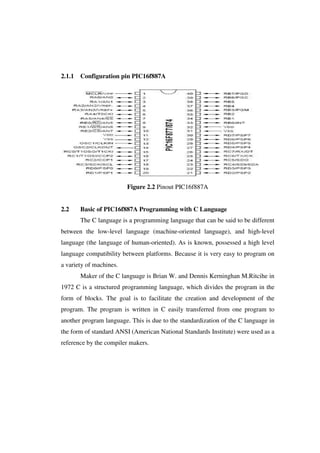
2.1.1 Configuration pin PIC16f887A 
Figure 2.2 Pinout PIC16f887A 
2.2 Basic of PIC16f887A Programming with C Language 
The C language is a programming language that can be said to be different 
between the low-level language (machine-oriented language), and high-level 
language (the language of human-oriented). As is known, possessed a high level 
language compatibility between platforms. Because it is very easy to program on 
a variety of machines. 
Maker of the C language is Brian W. and Dennis Kerninghan M.Ritcihe in 
1972 C is a structured programming language, which divides the program in the 
form of blocks. The goal is to facilitate the creation and development of the 
program. The program is written in C easily transferred from one program to 
another program language. This is due to the standardization of the C language in 
the form of standard ANSI (American National Standards Institute) were used as a 
reference by the compiler makers.
2.3 Resistor 
Resistors are electronic components poles designed to withstand electrical 
current to produce an electric voltage between the two poles, the voltage value of 
the resistance value is proportional to the current flowing, according to Ohm's 
law: 
V = I . R....................................................................................(2.1) 
2.4 Capacitors 
Capacitor in the electronic circuit denoted by the letter "C" is a device that 
can store energy in the electric field or charge current, by collecting dati internal 
imbalance of electric charge. Capacitors discovered by Michael Faraday (1791- 
1867). Unit is Farad capacitor (F). One farad = 9 x 1011 cm2, which means the 
large pieces. 
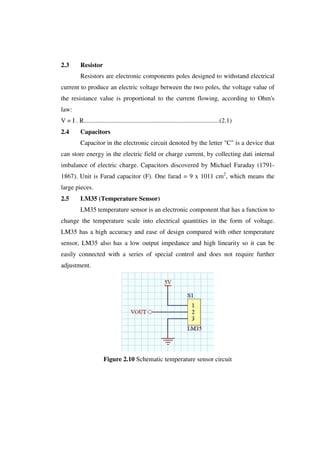
2.5 LM35 (Temperature Sensor) 
LM35 temperature sensor is an electronic component that has a function to 
change the temperature scale into electrical quantities in the form of voltage. 
LM35 has a high accuracy and ease of design compared with other temperature 
sensor, LM35 also has a low output impedance and high linearity so it can be 
easily connected with a series of special control and does not require further 
adjustment. 
Figure 2.10 Schematic temperature sensor circuit
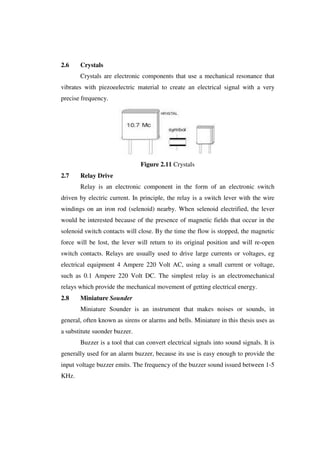
2.6 Crystals 
Crystals are electronic components that use a mechanical resonance that 
vibrates with piezoeelectric material to create an electrical signal with a very 
precise frequency. 
Figure 2.11 Crystals 
2.7 Relay Drive 
Relay is an electronic component in the form of an electronic switch 
driven by electric current. In principle, the relay is a switch lever with the wire 
windings on an iron rod (selenoid) nearby. When selenoid electrified, the lever 
would be interested because of the presence of magnetic fields that occur in the 
solenoid switch contacts will close. By the time the flow is stopped, the magnetic 
force will be lost, the lever will return to its original position and will re-open 
switch contacts. Relays are usually used to drive large currents or voltages, eg 
electrical equipment 4 Ampere 220 Volt AC, using a small current or voltage, 
such as 0.1 Ampere 220 Volt DC. The simplest relay is an electromechanical 
relays which provide the mechanical movement of getting electrical energy. 
2.8 Miniature Sounder 
Miniature Sounder is an instrument that makes noises or sounds, in 
general, often known as sirens or alarms and bells. Miniature in this thesis uses as 
a substitute suonder buzzer. 
Buzzer is a tool that can convert electrical signals into sound signals. It is 
generally used for an alarm buzzer, because its use is easy enough to provide the 
input voltage buzzer emits. The frequency of the buzzer sound issued between 1-5 
KHz.
2.9 LCD (Liquid Crystal Display) 
LCD usability lot in designing a system using mikrokontorler, LCD 
(Liquid Crystal Display) can serve to show a result the value of the sensor, show 
text, or display the menu on the application microcontroller. M1632 is a matrix 
LCD module with a configuration of 16 characters and 2 lines with each character 
formed by pixle lines and 5 columns pixle (1 pixle last line is the cursor). Already 
available within the M1632 module HD44780 issued by Hitachi, Hyundai and 
other M1632 modules. Actually HD44780 microcontroller designed specifically 
for controlling the LCD and have the ability to adjust the scanning process on the 
LCD screen which is formed by 16 COM and SEG 40 so that the microcontroller 
or device that accesses the LCD module is no longer need to set up scanning on 
the LCD screen. 
2.10 Power Supply 
Most electronic devices require a DC voltage power supply, therefore it 
takes a circuit to convert the AC voltage of the grid into a stable DC voltage. This 
circuit is commonly called a DC power source consists of lowering the voltage 
transformer (step-down) which serves to lower voltage grid to the extent required 
voltage, the rectifier (rectifier) that functions convert AC voltage into DC voltage 
smoothing capacitor filters the rectifier output to pulsation (ripple) is not too large 
and that the latter is the voltage stabilizer (voltage regulator) in the form of IC 
regulator or a zener diode to get a stable DC voltage. 
2.11 1 Phase Induction Motors 
Ac electric motors with the basic principle of operation is classified as 
asynchronous motors (induction) or synchronous motor. Induction motor is a type 
of motor where there is no external voltage is supplied to the rotor, but the current 
in the stator induces a voltage on the air gap and the rotor winding and rotor 
current to generate a magnetic field. The magnetic field of the stator and rotor 
then interact and cause the motor rotor rotates. 
2.12 PWM (Pulse Width Modulation) 
PWM is a mechanism for generating an output signal that is repeated 
periods between High and Low where we can control the duration of the signal is
High and Low in accordance with what we want. Duty Cycle is percentage of 
High signal and the signal period, the percentage duty cycle will be directly 
proportional to the average voltage is generated. 
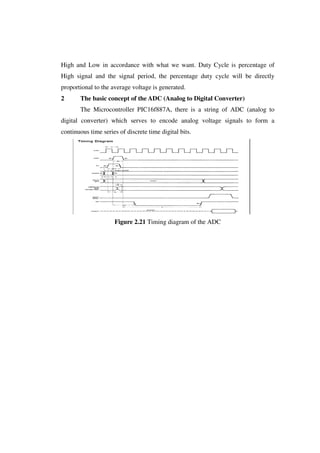
2 The basic concept of the ADC (Analog to Digital Converter) 
The Microcontroller PIC16f887A, there is a string of ADC (analog to 
digital converter) which serves to encode analog voltage signals to form a 
continuous time series of discrete time digital bits. 
Figure 2.21 Timing diagram of the ADC
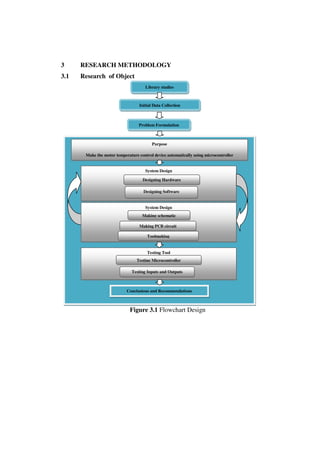
3 RESEARCH METHODOLOGY 
3.1 Research of Object 
Library studies 
Initial Data Collection 
Problem Formulation 
Purpose 
Make the motor temperature control device automatically using microcontroller 
System Design 
Designing Hardware 
Designing Software 
System Design 
Making schematic 
Making PCB circuit 
Toolmaking 
Testing Tool 
Testing Microcontroller 
Testing Inputs and Outputs 
Conclusions and Recommendations 
Figure 3.1 Flowchart Design
4 DESIGN 
4.1 System Design 
Temperatur 
Sensor Buzzer 
MikrokontrolePower supply r 
Relay Display Unit 
Motor 1 
Phase 
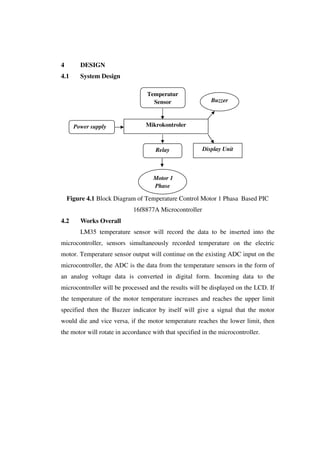
Figure 4.1 Block Diagram of Temperature Control Motor 1 Phasa Based PIC 
16f8877A Microcontroller 
4.2 Works Overall 
LM35 temperature sensor will record the data to be inserted into the 
microcontroller, sensors simultaneously recorded temperature on the electric 
motor. Temperature sensor output will continue on the existing ADC input on the 
microcontroller, the ADC is the data from the temperature sensors in the form of 
an analog voltage data is converted in digital form. Incoming data to the 
microcontroller will be processed and the results will be displayed on the LCD. If 
the temperature of the motor temperature increases and reaches the upper limit 
specified then the Buzzer indicator by itself will give a signal that the motor 
would die and vice versa, if the motor temperature reaches the lower limit, then 
the motor will rotate in accordance with that specified in the microcontroller.
4.3 Realization Each Circuit Block 
Circuit of Minimum System 
Figure 4.6 Minimum System of circuit PIC Microcontroller 
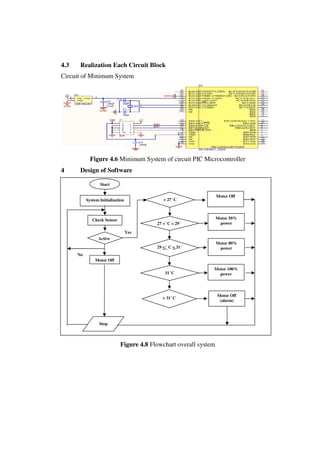
4 Design of Software 
Motor Off 
Motor 50% 
power 
Motor 80% 
power 
Motor 100% 
Figure 4.8 Flowchart overall system 
Start 
System Initialization 
Check Sensor 
Active 
Motor Off 
< 27 ̊ C 
Yes 
No 
27 < ̊ C < 29 ̊ 
29 < ̊ C < 31 ̊ 
31 ̊ C 
> 31 ̊ C 
power 
Motor Off 
(alarm) 
Stop
5 RESULTS AND DISCUSSION 
5.1 Data Collection and Analysis 
This chapter contains the phase of the study consisted of data collection 
and data analysis research. Beginning stages of an explanation about how to get 
the data and where the data is in the can. The data can then be analyzed to ensure 
the suitability of the theories that support the previous chapter. 
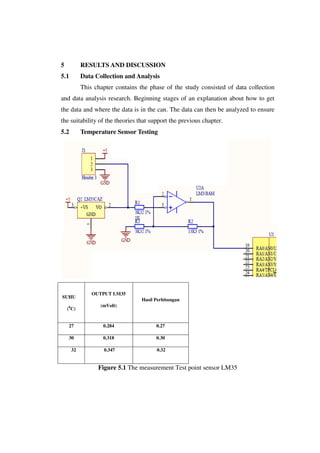
5.2 Temperature Sensor Testing 
SUHU 
(0C) 
OUTPUT LM35 
(mVolt) 
Hasil Perhitungan 
27 0.284 0.27 
30 0.318 0.30 
32 0.347 0.32 
Figure 5.1 The measurement Test point sensor LM35
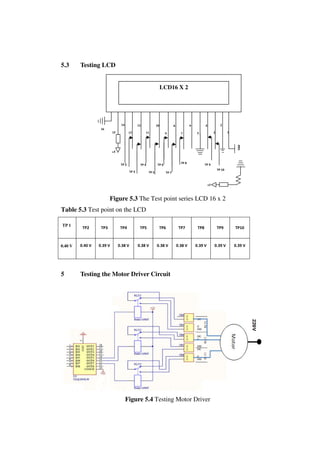
5.3 Testing LCD 
LCD16 X 2 
Figure 5.3 The Test point series LCD 16 x 2 
Table 5.3 Test point on the LCD 
TP 1 TP2 TP3 TP4 TP5 TP6 TP7 TP8 TP9 TP10 
0.40 V 0.40 V 0.39 V 0.38 V 0.38 V 0.38 V 0.38 V 0.39 V 0.39 V 0.39 V 
5 Testing the Motor Driver Circuit 
Figure 5.4 Testing Motor Driver 
16 
15 
+5 
14 
13 
12 
11 
10 
9 
8 
7 
6 
5 
4 
3 
2 
1 
Vdd 
+5 
TP 2 
TP 3 
TP 4 
TP 5 
TP 6 
TP 7 
TP 8 
TP 9 
TP 10
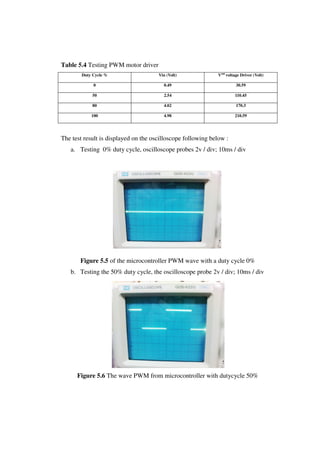
Table 5.4 Testing PWM motor driver 
Duty Cycle % Vin (Volt) Vout voltage Driver (Volt) 
0 0.49 30.59 
50 2.54 110.45 
80 4.02 170.3 
100 4.98 210.59 
The test result is displayed on the oscilloscope following below : 
a. Testing 0% duty cycle, oscilloscope probes 2v / div; 10ms / div 
Figure 5.5 of the microcontroller PWM wave with a duty cycle 0% 
b. Testing the 50% duty cycle, the oscilloscope probe 2v / div; 10ms / div 
Figure 5.6 The wave PWM from microcontroller with dutycycle 50%
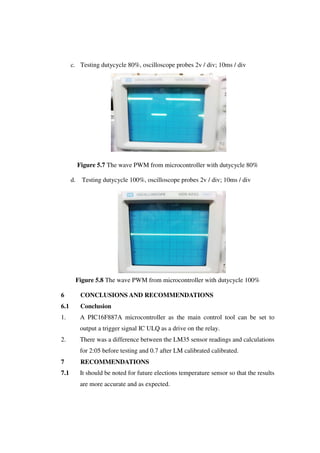
c. Testing dutycycle 80%, oscilloscope probes 2v / div; 10ms / div 
Figure 5.7 The wave PWM from microcontroller with dutycycle 80% 
d. Testing dutycycle 100%, oscilloscope probes 2v / div; 10ms / div 
Figure 5.8 The wave PWM from microcontroller with dutycycle 100% 
6 CONCLUSIONS AND RECOMMENDATIONS 
6.1 Conclusion 
1. A PIC16F887A microcontroller as the main control tool can be set to 
output a trigger signal IC ULQ as a drive on the relay. 
2. There was a difference between the LM35 sensor readings and calculations 
for 2:05 before testing and 0.7 after LM calibrated calibrated. 
7 RECOMMENDATIONS 
7.1 It should be noted for future elections temperature sensor so that the results 
are more accurate and as expected.
REFERENCES 
Anonymous, meriwardanaku.com 2011, principles of work-relay. 
USU Journal, 2007, 1 Phase Induction Motors 
Myike Predko, 1997, Programming and Customizing the PIC® microcontroller. 
Paul B.Zbar, Albert P. Malvino, Michael A.Miller, 1994, Basic Electronics. 
Stephen R.Matt, 1989, Electricity and Electronics Baasic. 
Widodo Budiharto, S, 2008, Digital Electronics + Microprocessor

DESIGN OF CONTROL TEMPERATURE MOTOR 1 PHASE WITH COMPATIBLE LOAD BASED PIC MICROCONTROLLER 16f887A

  • 1.
    JOURNAL DESIGN OFCONTROL TEMPERATURE MOTOR 1 PHASE WITH COMPATIBLE LOAD BASED PIC MICROCONTROLLER 16f887A SUBMITTED BY : Name : YUSMAN WESLEY R NPM : 10.03.0.005 DEPARTMENT of ELECTRICAL ENGINEERING FACULTY ENGINEERING UNIVERSITY of RIAU ISLANDS 2014
  • 2.
    DESIGN OF CONTROLTEMPERATURE MOTOR 1 PHASE WITH COMPATIBLE LOAD BASED PIC MICROCONTROLLER 16f887A Yusman Wesley 1) , Pamor Gunoto 2), Anton Viantika 3) Department of Electrical Engineering University of Riau Islands ABSTRAK The electric motor is widely used in electronic devices such as the fan, computer, water pump and so forth. Existing properties on the electric motor when the motor is rotating continuously, the temperature of the motor will also increase. When the motor has reached a high temperature and the motor continues to be used then the motor will be damaged, to the need for a temperature control device on the electric motor microcontroller based on the tool made. LM35 temperature sensor will record the data to be inserted into the microcontroller, sensors simultaneously recorded temperature on the electric motor. Incoming data to the microcontroller will be processed and the results will be displayed on the LCD. If the temperature of the motor temperature increases and reaches the upper limit specified then the Buzzer indicator by itself will give a signal that the motor would die. From the discussion and analysis of the data obtained at the time of measurement can be concluded that this PIC16f887A microcontroller can adjust according to temperature changes in the motor 1 phase. Keywords: Temperature, Microcontroller PIC16f887A, LM35, Motor AC. 1) Student Department of Electrical Engineering, Faculty Engineering, UNRIKA BATAM. 2) Supervisor Department of Electrical Engineering, Faculty Engineering, UNRIKA BATAM. 3) Co - Supervisor Department of Electrical Engineering, Faculty Engineering, UNRIKA BATAM.
  • 3.
    1 INTRODUCTION 1.1Background Electric motors are often used in electronic devices such as the fan, computer, water pump and so forth. Existing properties on the electric motor when the motor is rotating continuously, the temperature of the motor will also increase. When the motor has reached a high temperature and the motor continues to be used then the motor will be damaged. In larger-scale applications, so that the electric motor can operate longer and can work effectively then change the motor temperature must be controlled. Based on these considerations, the temperature control device made 1 phase motors and motor rotation speed with compatible PIC microcontroller-based load 16f887A. This tool also controls the speed of the motor 1 phase when the temperature increases on the motor then the motor will go down and vice versa motor speed increases when the temperature of the motor is low. This tool will be displayed on the temperature and the speed of the electric motor together in one view. 1.2 Problem of Formulation Creating a working tool that can automatically control the temperature changes on the motor using PIC microcontroller technology 16f887A. 1.3 Research Objectives 1 Make gauges motor rotation speed and temperature of the PIC microcontroller based 16f887A. 2 LCD display used 1.4 Scope of Problems 1 Explain the switching capabilities at the relay for the activation of the motor along the motor temperature. 2 16f887A PIC microcontroller programming using C language.
  • 4.
    2 BASIC OfTHEORY 2.1 Microcontroller PIC16f887A Microcontroller is a microprocessor system in which there already are CPU, RAM, ROM, I / O, CLOCK and other internal devices are already connected and organized (address) with either by the manufacturer and is packaged in a single chip that is ready to use. So we live program ROM contents according to the rules of use by the factory that makes it. Figure 2.1 Block Diagram PIC16f887A
  • 5.
    2.1.1 Configuration pinPIC16f887A Figure 2.2 Pinout PIC16f887A 2.2 Basic of PIC16f887A Programming with C Language The C language is a programming language that can be said to be different between the low-level language (machine-oriented language), and high-level language (the language of human-oriented). As is known, possessed a high level language compatibility between platforms. Because it is very easy to program on a variety of machines. Maker of the C language is Brian W. and Dennis Kerninghan M.Ritcihe in 1972 C is a structured programming language, which divides the program in the form of blocks. The goal is to facilitate the creation and development of the program. The program is written in C easily transferred from one program to another program language. This is due to the standardization of the C language in the form of standard ANSI (American National Standards Institute) were used as a reference by the compiler makers.
  • 6.
    2.3 Resistor Resistorsare electronic components poles designed to withstand electrical current to produce an electric voltage between the two poles, the voltage value of the resistance value is proportional to the current flowing, according to Ohm's law: V = I . R....................................................................................(2.1) 2.4 Capacitors Capacitor in the electronic circuit denoted by the letter "C" is a device that can store energy in the electric field or charge current, by collecting dati internal imbalance of electric charge. Capacitors discovered by Michael Faraday (1791- 1867). Unit is Farad capacitor (F). One farad = 9 x 1011 cm2, which means the large pieces. 2.5 LM35 (Temperature Sensor) LM35 temperature sensor is an electronic component that has a function to change the temperature scale into electrical quantities in the form of voltage. LM35 has a high accuracy and ease of design compared with other temperature sensor, LM35 also has a low output impedance and high linearity so it can be easily connected with a series of special control and does not require further adjustment. Figure 2.10 Schematic temperature sensor circuit
  • 7.
    2.6 Crystals Crystalsare electronic components that use a mechanical resonance that vibrates with piezoeelectric material to create an electrical signal with a very precise frequency. Figure 2.11 Crystals 2.7 Relay Drive Relay is an electronic component in the form of an electronic switch driven by electric current. In principle, the relay is a switch lever with the wire windings on an iron rod (selenoid) nearby. When selenoid electrified, the lever would be interested because of the presence of magnetic fields that occur in the solenoid switch contacts will close. By the time the flow is stopped, the magnetic force will be lost, the lever will return to its original position and will re-open switch contacts. Relays are usually used to drive large currents or voltages, eg electrical equipment 4 Ampere 220 Volt AC, using a small current or voltage, such as 0.1 Ampere 220 Volt DC. The simplest relay is an electromechanical relays which provide the mechanical movement of getting electrical energy. 2.8 Miniature Sounder Miniature Sounder is an instrument that makes noises or sounds, in general, often known as sirens or alarms and bells. Miniature in this thesis uses as a substitute suonder buzzer. Buzzer is a tool that can convert electrical signals into sound signals. It is generally used for an alarm buzzer, because its use is easy enough to provide the input voltage buzzer emits. The frequency of the buzzer sound issued between 1-5 KHz.
  • 8.
    2.9 LCD (LiquidCrystal Display) LCD usability lot in designing a system using mikrokontorler, LCD (Liquid Crystal Display) can serve to show a result the value of the sensor, show text, or display the menu on the application microcontroller. M1632 is a matrix LCD module with a configuration of 16 characters and 2 lines with each character formed by pixle lines and 5 columns pixle (1 pixle last line is the cursor). Already available within the M1632 module HD44780 issued by Hitachi, Hyundai and other M1632 modules. Actually HD44780 microcontroller designed specifically for controlling the LCD and have the ability to adjust the scanning process on the LCD screen which is formed by 16 COM and SEG 40 so that the microcontroller or device that accesses the LCD module is no longer need to set up scanning on the LCD screen. 2.10 Power Supply Most electronic devices require a DC voltage power supply, therefore it takes a circuit to convert the AC voltage of the grid into a stable DC voltage. This circuit is commonly called a DC power source consists of lowering the voltage transformer (step-down) which serves to lower voltage grid to the extent required voltage, the rectifier (rectifier) that functions convert AC voltage into DC voltage smoothing capacitor filters the rectifier output to pulsation (ripple) is not too large and that the latter is the voltage stabilizer (voltage regulator) in the form of IC regulator or a zener diode to get a stable DC voltage. 2.11 1 Phase Induction Motors Ac electric motors with the basic principle of operation is classified as asynchronous motors (induction) or synchronous motor. Induction motor is a type of motor where there is no external voltage is supplied to the rotor, but the current in the stator induces a voltage on the air gap and the rotor winding and rotor current to generate a magnetic field. The magnetic field of the stator and rotor then interact and cause the motor rotor rotates. 2.12 PWM (Pulse Width Modulation) PWM is a mechanism for generating an output signal that is repeated periods between High and Low where we can control the duration of the signal is
  • 9.
    High and Lowin accordance with what we want. Duty Cycle is percentage of High signal and the signal period, the percentage duty cycle will be directly proportional to the average voltage is generated. 2 The basic concept of the ADC (Analog to Digital Converter) The Microcontroller PIC16f887A, there is a string of ADC (analog to digital converter) which serves to encode analog voltage signals to form a continuous time series of discrete time digital bits. Figure 2.21 Timing diagram of the ADC
  • 10.
    3 RESEARCH METHODOLOGY 3.1 Research of Object Library studies Initial Data Collection Problem Formulation Purpose Make the motor temperature control device automatically using microcontroller System Design Designing Hardware Designing Software System Design Making schematic Making PCB circuit Toolmaking Testing Tool Testing Microcontroller Testing Inputs and Outputs Conclusions and Recommendations Figure 3.1 Flowchart Design
  • 11.
    4 DESIGN 4.1System Design Temperatur Sensor Buzzer MikrokontrolePower supply r Relay Display Unit Motor 1 Phase Figure 4.1 Block Diagram of Temperature Control Motor 1 Phasa Based PIC 16f8877A Microcontroller 4.2 Works Overall LM35 temperature sensor will record the data to be inserted into the microcontroller, sensors simultaneously recorded temperature on the electric motor. Temperature sensor output will continue on the existing ADC input on the microcontroller, the ADC is the data from the temperature sensors in the form of an analog voltage data is converted in digital form. Incoming data to the microcontroller will be processed and the results will be displayed on the LCD. If the temperature of the motor temperature increases and reaches the upper limit specified then the Buzzer indicator by itself will give a signal that the motor would die and vice versa, if the motor temperature reaches the lower limit, then the motor will rotate in accordance with that specified in the microcontroller.
  • 12.
    4.3 Realization EachCircuit Block Circuit of Minimum System Figure 4.6 Minimum System of circuit PIC Microcontroller 4 Design of Software Motor Off Motor 50% power Motor 80% power Motor 100% Figure 4.8 Flowchart overall system Start System Initialization Check Sensor Active Motor Off < 27 ̊ C Yes No 27 < ̊ C < 29 ̊ 29 < ̊ C < 31 ̊ 31 ̊ C > 31 ̊ C power Motor Off (alarm) Stop
  • 13.
    5 RESULTS ANDDISCUSSION 5.1 Data Collection and Analysis This chapter contains the phase of the study consisted of data collection and data analysis research. Beginning stages of an explanation about how to get the data and where the data is in the can. The data can then be analyzed to ensure the suitability of the theories that support the previous chapter. 5.2 Temperature Sensor Testing SUHU (0C) OUTPUT LM35 (mVolt) Hasil Perhitungan 27 0.284 0.27 30 0.318 0.30 32 0.347 0.32 Figure 5.1 The measurement Test point sensor LM35
  • 14.
    5.3 Testing LCD LCD16 X 2 Figure 5.3 The Test point series LCD 16 x 2 Table 5.3 Test point on the LCD TP 1 TP2 TP3 TP4 TP5 TP6 TP7 TP8 TP9 TP10 0.40 V 0.40 V 0.39 V 0.38 V 0.38 V 0.38 V 0.38 V 0.39 V 0.39 V 0.39 V 5 Testing the Motor Driver Circuit Figure 5.4 Testing Motor Driver 16 15 +5 14 13 12 11 10 9 8 7 6 5 4 3 2 1 Vdd +5 TP 2 TP 3 TP 4 TP 5 TP 6 TP 7 TP 8 TP 9 TP 10
  • 15.
    Table 5.4 TestingPWM motor driver Duty Cycle % Vin (Volt) Vout voltage Driver (Volt) 0 0.49 30.59 50 2.54 110.45 80 4.02 170.3 100 4.98 210.59 The test result is displayed on the oscilloscope following below : a. Testing 0% duty cycle, oscilloscope probes 2v / div; 10ms / div Figure 5.5 of the microcontroller PWM wave with a duty cycle 0% b. Testing the 50% duty cycle, the oscilloscope probe 2v / div; 10ms / div Figure 5.6 The wave PWM from microcontroller with dutycycle 50%
  • 16.
    c. Testing dutycycle80%, oscilloscope probes 2v / div; 10ms / div Figure 5.7 The wave PWM from microcontroller with dutycycle 80% d. Testing dutycycle 100%, oscilloscope probes 2v / div; 10ms / div Figure 5.8 The wave PWM from microcontroller with dutycycle 100% 6 CONCLUSIONS AND RECOMMENDATIONS 6.1 Conclusion 1. A PIC16F887A microcontroller as the main control tool can be set to output a trigger signal IC ULQ as a drive on the relay. 2. There was a difference between the LM35 sensor readings and calculations for 2:05 before testing and 0.7 after LM calibrated calibrated. 7 RECOMMENDATIONS 7.1 It should be noted for future elections temperature sensor so that the results are more accurate and as expected.
  • 17.
    REFERENCES Anonymous, meriwardanaku.com2011, principles of work-relay. USU Journal, 2007, 1 Phase Induction Motors Myike Predko, 1997, Programming and Customizing the PIC® microcontroller. Paul B.Zbar, Albert P. Malvino, Michael A.Miller, 1994, Basic Electronics. Stephen R.Matt, 1989, Electricity and Electronics Baasic. Widodo Budiharto, S, 2008, Digital Electronics + Microprocessor