1
SCHOOL OF MECHANICAL ENGINEERING
Project Phase-I Report
On
Design and Analysis of Side Force Spring in McPherson Strut
Submitted by
Mr. SIVA S
SRN: R19MMD07
Third Semester M.Tech.(Machine Design)
Under the guidance of
Dr. HEMANTH K
Associate Professor
December 2020
Rukmini Knowledge park, Kattigenahalli, Yelahanka, Bengaluru-560064
www.reva.edu.in
2
SCHOOL OF MECHANICAL ENGINEERING
CERTIFICATE
Certified that the project phase-I work entitled “Design and Analysis of Side Force Spring
in McPherson Strut” carried out under my guidance by Mr. Siva S, R19MMD07, a
bonafide student of REVA University during the academic year 2019-20, is submitting the
project phase-I report in partial fulfillment of the requirements of 3rd
semester of Master of
Technology in Machine Design under Mechanical Engineering during the academic year
2019–20. The dissertation report has been approved as it satisfies the academic requirements
in respect of Project Phase-I prescribed for the said degree.
Dr. Hemanth K
Associate Professor
Dr. K.S.Narayanaswamy
Director
3
CONTENTS
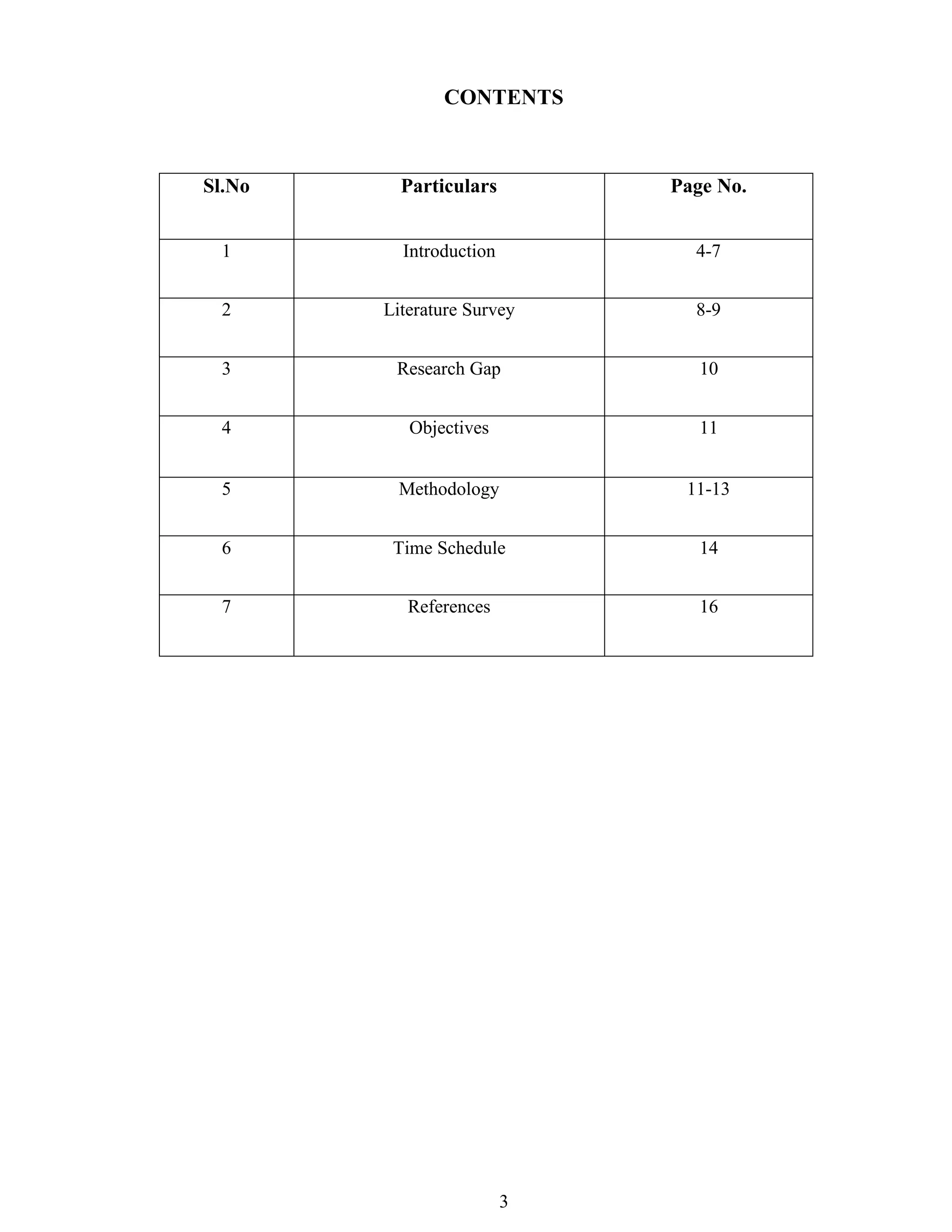
Sl.No Particulars Page No.
1 Introduction 4-7
2 Literature Survey 8-9
3 Research Gap 10
4 Objectives 11
5 Methodology 11-13
6 Time Schedule 14
7 References 16
4
INTRODUCTION
SPRINGS
A spring is defined as an elastic body, whose function is to distort when loaded and to
recover its original shape when the load is removed. The various important applications
of springs are as follows:
• To cushion, absorb or control energy due to either shock or vibration as in car
springs, railway buffers, air-craft landing gears, shock absorbers and vibration
dampers.
• To apply forces, as in brakes, clutches and spring-loaded valves.
• To control motion by maintaining contact between two elements as in cams and
followers. To measure forces, as in spring balances and engine indicators.
• To store energy.
Types of Springs
• Helical springs
• Conical and volute springs.
• Torsion springs
• Laminated or leaf springs.
• Disc or Belleville springs.
• Special purpose springs.
SUSPENSION SYSTEMS
To many focusing on ride comfort, it may seem like the suspension system is merely a set
of springs and shock absorbers which connect the wheels to the vehicle body. However,
this is a very simplistic viewpoint of the suspension system. A vehicle suspension system
provides a smooth ride over rough roads while ensuring that the wheels remain in contact
with the ground and vehicle roll is minimized.
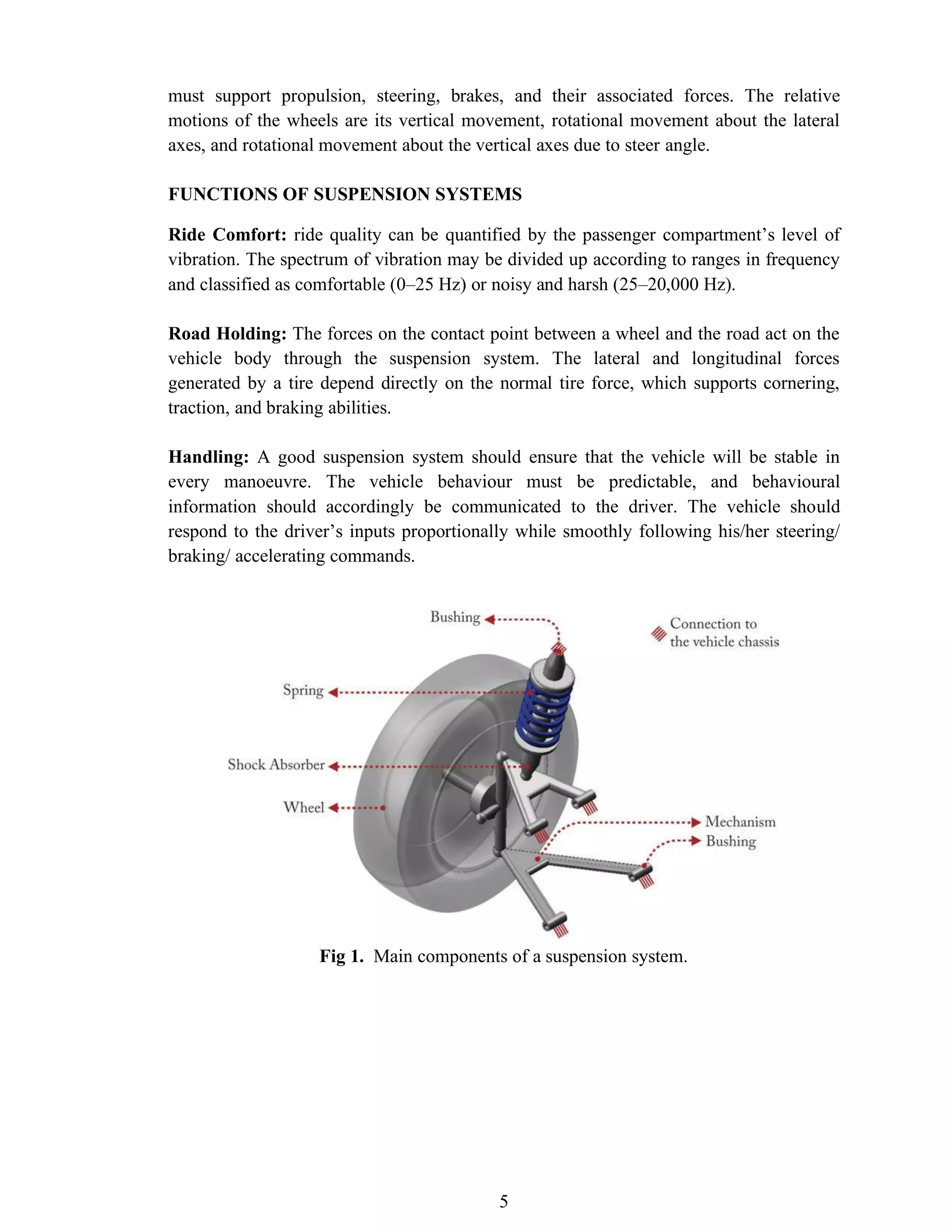
The suspension system contains three major parts: a structure that supports the vehicle’s
weight and determines suspension geometry, a spring that converts kinematic energy to
potential energy or vice versa, and a shock absorber that is a mechanical device designed
to dissipate kinetic energy.
An automotive suspension connects a vehicle’s wheels to its body while supporting the
vehicle’s weight. It allows for the relative motion between wheel and vehicle body;
theoretically, a suspension system should reduce a wheel’s degree of freedom (DOF)
from 6 to 2 on the rear axle and to 3 on the front axle even though the suspension system
5
must support propulsion, steering, brakes, and their associated forces. The relative
motions of the wheels are its vertical movement, rotational movement about the lateral
axes, and rotational movement about the vertical axes due to steer angle.
FUNCTIONS OF SUSPENSION SYSTEMS
Ride Comfort: ride quality can be quantified by the passenger compartment’s level of
vibration. The spectrum of vibration may be divided up according to ranges in frequency
and classified as comfortable (0–25 Hz) or noisy and harsh (25–20,000 Hz).
Road Holding: The forces on the contact point between a wheel and the road act on the
vehicle body through the suspension system. The lateral and longitudinal forces
generated by a tire depend directly on the normal tire force, which supports cornering,
traction, and braking abilities.
Handling: A good suspension system should ensure that the vehicle will be stable in
every manoeuvre. The vehicle behaviour must be predictable, and behavioural
information should accordingly be communicated to the driver. The vehicle should
respond to the driver’s inputs proportionally while smoothly following his/her steering/
braking/ accelerating commands.
Fig 1. Main components of a suspension system.
6
DIFFERENT SUSPENSION TYPES
1. Solid Axle: A solid axle is known to be the first suspension type used in vehicles
where the wheels are mounted at either ends of a rigid beam. A solid axle system
generally uses leaf springs. Solid axle suspension system is not classified as an
independent type of suspension, so any movement of one wheel is transmitted to the
other wheel. Solid axles have some advantages in their load carrying capacity; solid
axles are also affordable and durable. Leaf springs result in unwanted transmitted
noise and vibration. Rigid beams considerably reduce ride quality, and their size and
dimensions demand enough space above the axle to accommodate the springs.
2. Torsion Beam: The torsion beam is known as the most popular rear axle suspension
system for small- and medium- sized front-wheel drive vehicles. A torsion beam
suspension consists of two trailing arms with a flexible cross member in between.
The cross member absorbs all forces and moments and simultaneously works as an
anti-roll bar. The torsion beam is a semi-independent suspension. It boasts few
components and a simple structure; therefore, it is light, cheap, easily assembled, and
requires little space. Furthermore, cross member flexibility diminishes camber and
body roll control.
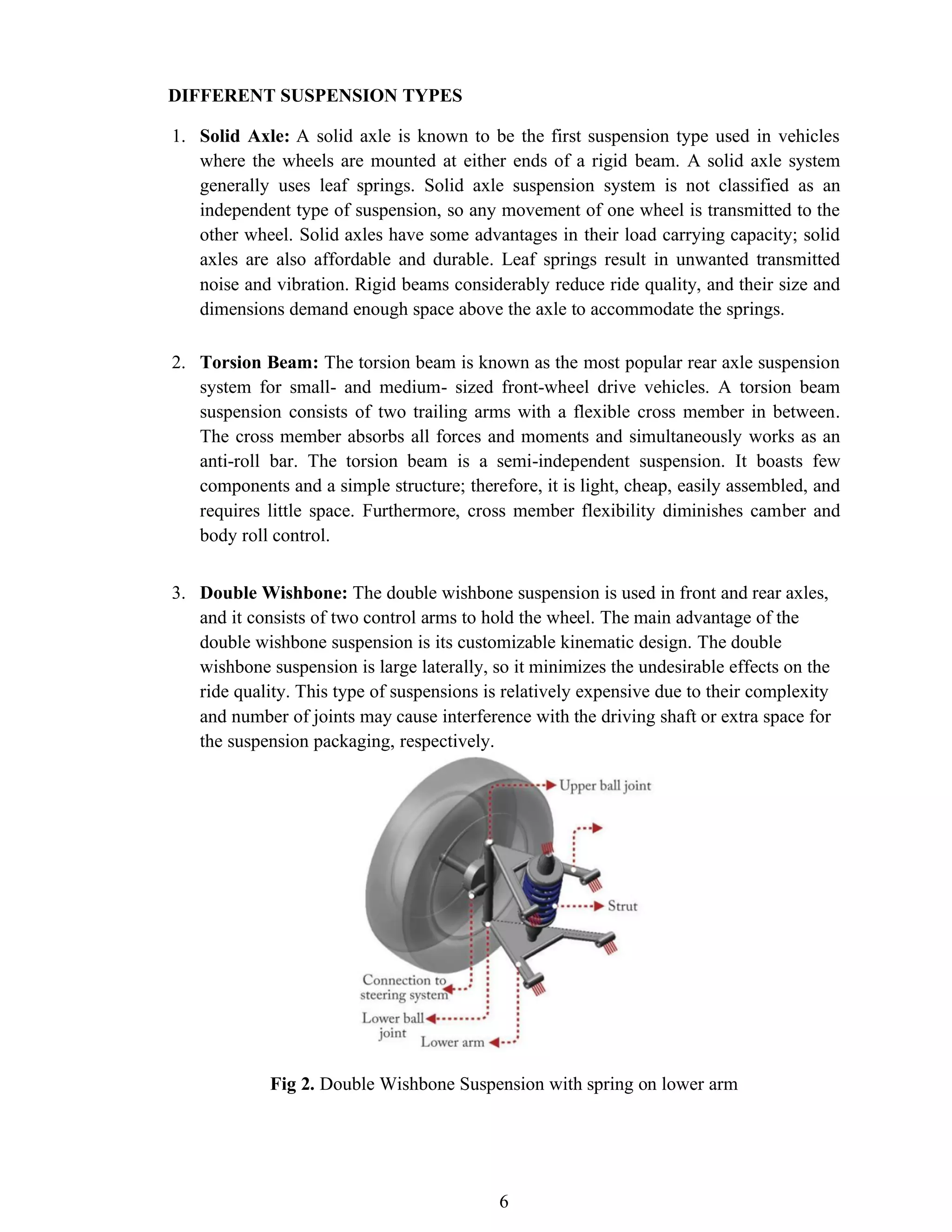
3. Double Wishbone: The double wishbone suspension is used in front and rear axles,
and it consists of two control arms to hold the wheel. The main advantage of the
double wishbone suspension is its customizable kinematic design. The double
wishbone suspension is large laterally, so it minimizes the undesirable effects on the
ride quality. This type of suspensions is relatively expensive due to their complexity
and number of joints may cause interference with the driving shaft or extra space for
the suspension packaging, respectively.
Fig 2. Double Wishbone Suspension with spring on lower arm
7
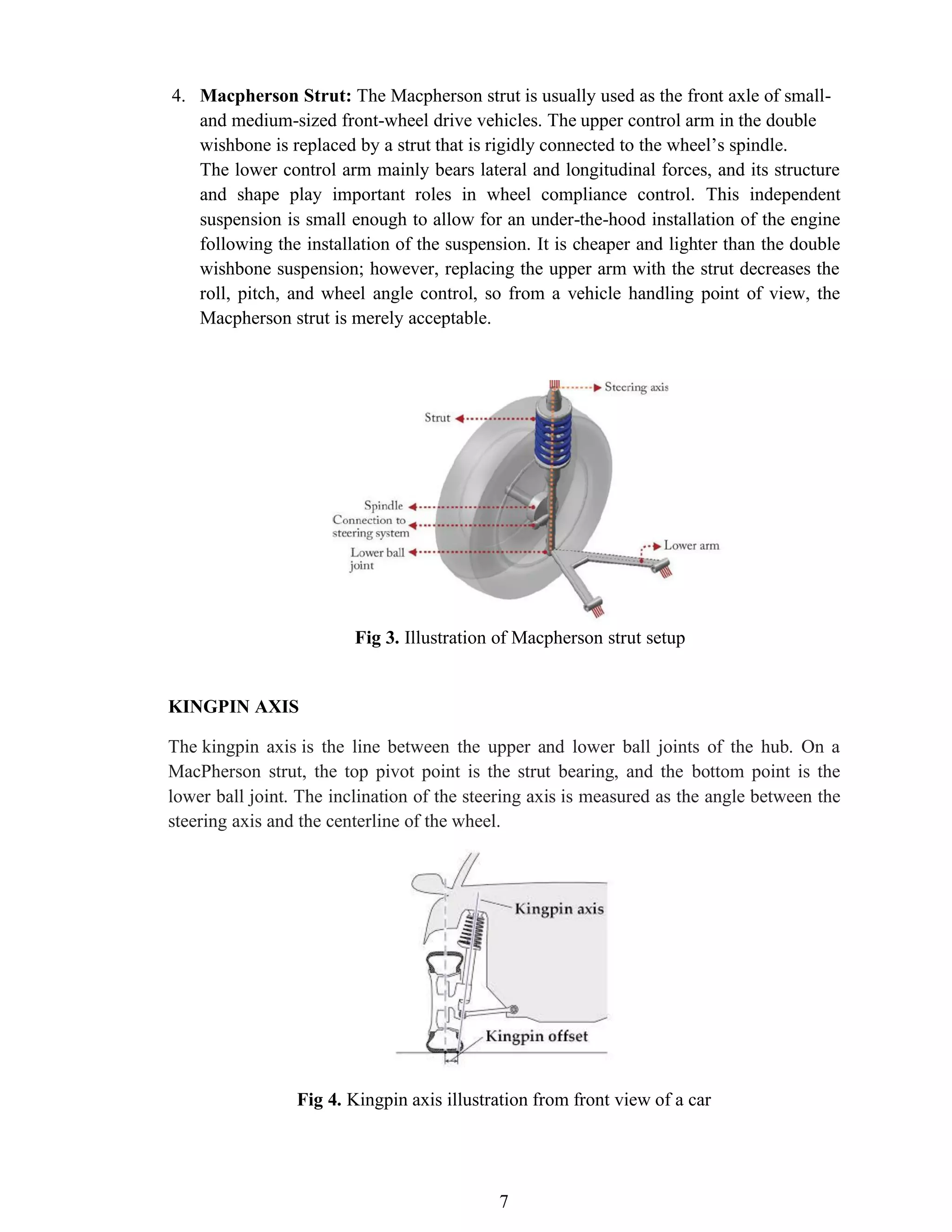
4. Macpherson Strut: The Macpherson strut is usually used as the front axle of small-
and medium-sized front-wheel drive vehicles. The upper control arm in the double
wishbone is replaced by a strut that is rigidly connected to the wheel’s spindle.
The lower control arm mainly bears lateral and longitudinal forces, and its structure
and shape play important roles in wheel compliance control. This independent
suspension is small enough to allow for an under-the-hood installation of the engine
following the installation of the suspension. It is cheaper and lighter than the double
wishbone suspension; however, replacing the upper arm with the strut decreases the
roll, pitch, and wheel angle control, so from a vehicle handling point of view, the
Macpherson strut is merely acceptable.
Fig 3. Illustration of Macpherson strut setup
KINGPIN AXIS
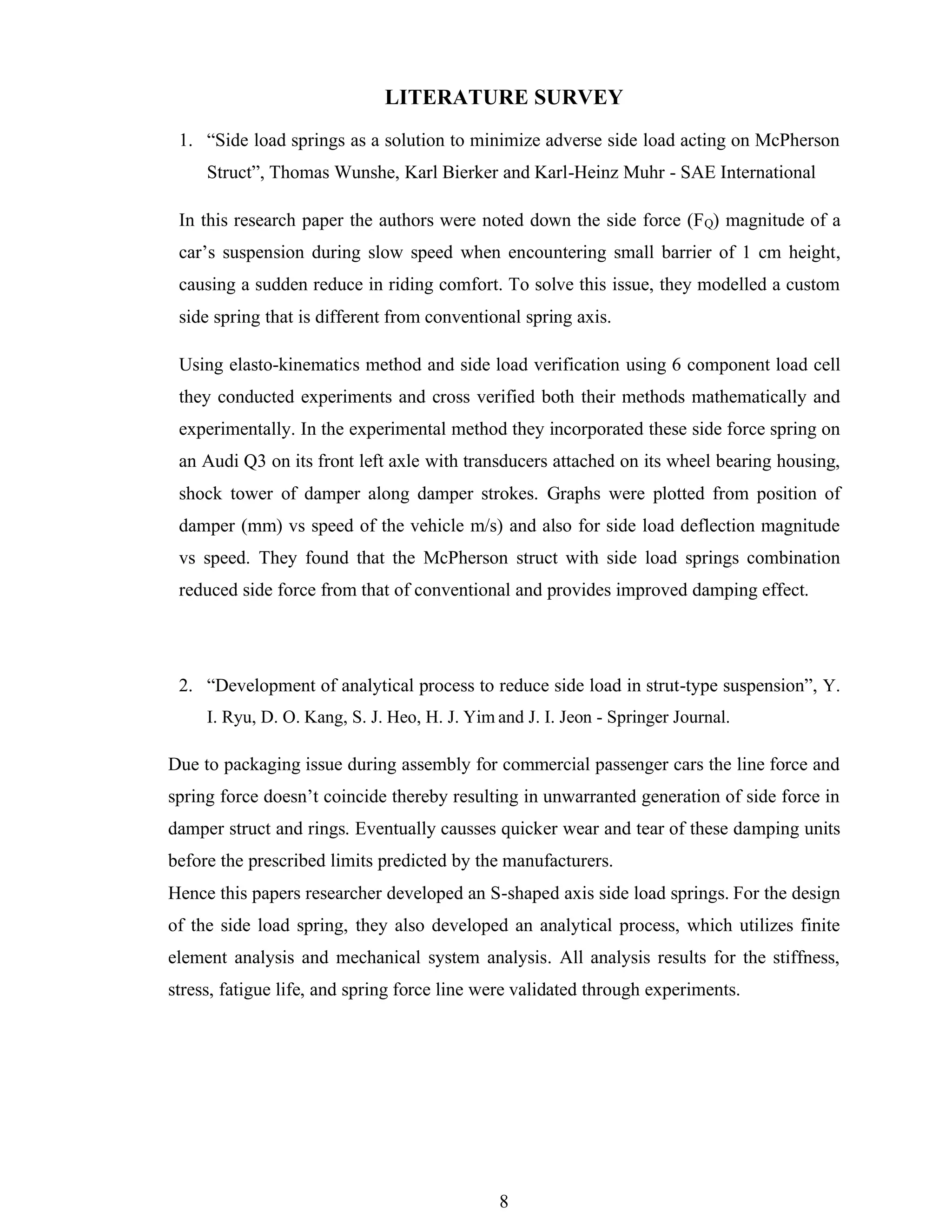
The kingpin axis is the line between the upper and lower ball joints of the hub. On a
MacPherson strut, the top pivot point is the strut bearing, and the bottom point is the
lower ball joint. The inclination of the steering axis is measured as the angle between the
steering axis and the centerline of the wheel.
Fig 4. Kingpin axis illustration from front view of a car
8
LITERATURE SURVEY
1. “Side load springs as a solution to minimize adverse side load acting on McPherson
Struct”, Thomas Wunshe, Karl Bierker and Karl-Heinz Muhr - SAE International
In this research paper the authors were noted down the side force (FQ) magnitude of a
car’s suspension during slow speed when encountering small barrier of 1 cm height,
causing a sudden reduce in riding comfort. To solve this issue, they modelled a custom
side spring that is different from conventional spring axis.
Using elasto-kinematics method and side load verification using 6 component load cell
they conducted experiments and cross verified both their methods mathematically and
experimentally. In the experimental method they incorporated these side force spring on
an Audi Q3 on its front left axle with transducers attached on its wheel bearing housing,
shock tower of damper along damper strokes. Graphs were plotted from position of
damper (mm) vs speed of the vehicle m/s) and also for side load deflection magnitude
vs speed. They found that the McPherson struct with side load springs combination
reduced side force from that of conventional and provides improved damping effect.
2. “Development of analytical process to reduce side load in strut-type suspension”, Y.
I. Ryu, D. O. Kang, S. J. Heo, H. J. Yim and J. I. Jeon - Springer Journal.
Due to packaging issue during assembly for commercial passenger cars the line force and
spring force doesn’t coincide thereby resulting in unwarranted generation of side force in
damper struct and rings. Eventually causses quicker wear and tear of these damping units
before the prescribed limits predicted by the manufacturers.
Hence this papers researcher developed an S-shaped axis side load springs. For the design
of the side load spring, they also developed an analytical process, which utilizes finite
element analysis and mechanical system analysis. All analysis results for the stiffness,
stress, fatigue life, and spring force line were validated through experiments.
9
3. Yang Moucun, Nie Hong - “Analysis approach to durability based on material initial
fatigue quality and S-N curve”, Elsevier Journal
In this paper the authors utilized probability fracture mechanics approach (PFMA),
concept of Material Initial Fatigue Quality (MIFQ)and studied on S-N Curve with crack
propagation curve. The reason they choose S-N curve as their main parameter is because
we may use it study crack growth rate under constant amplitude loading and to evaluate
the effects on durability.
The durability test adopted was of Advancing Front/Local Reconnection Procedure
(AFLR). Specimen used was Al alloy 75475. The accuracy of predicted value completely
dependent on S-N curve of high quality. During test they observed that crack propagates
slowly later it propagates uniformly or steadily. AT some point during test the crack
propagation abruptly increases due to unprediction. On verifying the results, they
concluded that the predicted results are larger than actual failure curves data.
4. Satoshi Suzuki, Syujii Kamlya and Toshiyuki Imaizumi - “Approached to
minimizing the Side Force of Helical Coil Springs for Riding comfort”, SAE
Technical Paper Series
The authors have focused the effects of tilting angle of spring seat and of the kinematic
condition of the spring on the side force. They used a verification model via finite
element model and obtained the virtual reaction forces of the spring and the same to a
six-point loading fixture to an actual model. The results were compared with graphical
data. It was found that the side force of the spring with open turn periodically increases
with the decrease of number of free coils, minimum values occurring at integer numbers
of free coils in the case where no contact between coil occurs.
It was also found that side forces can be reduced when the lateral displacements of the
spring seat coincide with the direction of the side force side force acting on it. Moreover,
they found that side force is remarkably reduced by tilting the upper seat in certain degree
of direction.
10
RESEARCH GAP
• On reviewing and researching from various journal papers, I conclude that still
there are various possibility of improvements in conventional to side force
springs. With the possibilities of various axis shape that are not yet designed, I
would utilize that as an opportunity to maximize the reach of piercing points.
• And formulating a mathematical model that can be referred from the cited journal
papers there is a possibility of defining the side force spring in accordance with
certain requirements.
• Along with the change in design of axis, variation in results can be obtained by
placing the top/bottom strut at an inclined angle where such practices are usually
provided by the manufacturer/customer that vary accordingly to the vehicle.
• While referring the Journal paper of Joshi Author, we may adopt his mathematical
model to reach the piercing points. The author has mathematically guided us on
how to obtain the coordinates required for modeling the side force spring by
applying transformation method of matrix by varying the angle and translating the
axis points to some distance. Using this method, we may infer his path to design
our model as a reference.
• Even when there is change in Automotive trend from IC vehicles to electric
vehicles, the use of McPherson strut would not vary in assembly of passenger
vehicle, as it has many cost-wise benefits which always suits in better marketing
purposes. From researching various websites and discussion with our project
guides, we found the feasibility of manufacturing a side force spring is much of
cost-effective method instead of choosing Wishbone suspension setup as it
occupies larger space while packaging and increase in complexity of
design/assembly.
11
OBJECTIVES
• To reduce the magnitude of lateral forces generated by cornering of vehicle on
dampers due to buckling action which is caused by packaging issues occurred
during the assembly of McPherson strut suspension system in passenger vehicle.
• In order to achieve our desired results, the piercing points axis must reach as close
with line of forces (Kingpin axis).
METHODOLOGY
1. Determining the input Parameters: From analyzing the research papers which was
relevant to our objection. We wanted to ensure that only correct and required data are
always available. Like possessing data points of conventional springs axis using data
coordinate system to define it axis and spline from appropriate design data sheets and
modifying to our needed side force spring axis, boundary conditions of the spring i.e.,
placement of struct at the top and bottom in angle/offset position, expected translation
position of the axis line do define its shape etc., were to be determined.
2. Design of Normal spring and Side Force spring: Once the required design data
sheets are obtained, we had to input the value as discrete data points in MS-Excel
sheets. Using helical spring design formula, we obtain the individual data of spline.
Its later converted from Spring Coordinate system to Vehicle Coordinate system for
the ease of understanding for analysis and verification purposes.
To match the seating position of the spring during assembly in passenger vehicle, an
exact replica of bottom and top structs are also designed and assembled according the
constrains. Tool used for modeling the design of helical compression spring is
CATIA. Our first objective would be defining the axis line which is a customized
shape, with various trial and error criteria for initiating the lateral displacement at
bottom and top section of the spring axis. With these design possibilities the research
work will be carried out to find the results. If piercing points are not achieved as per
our requirements, then further improvements/changes in axis design will be carried
12
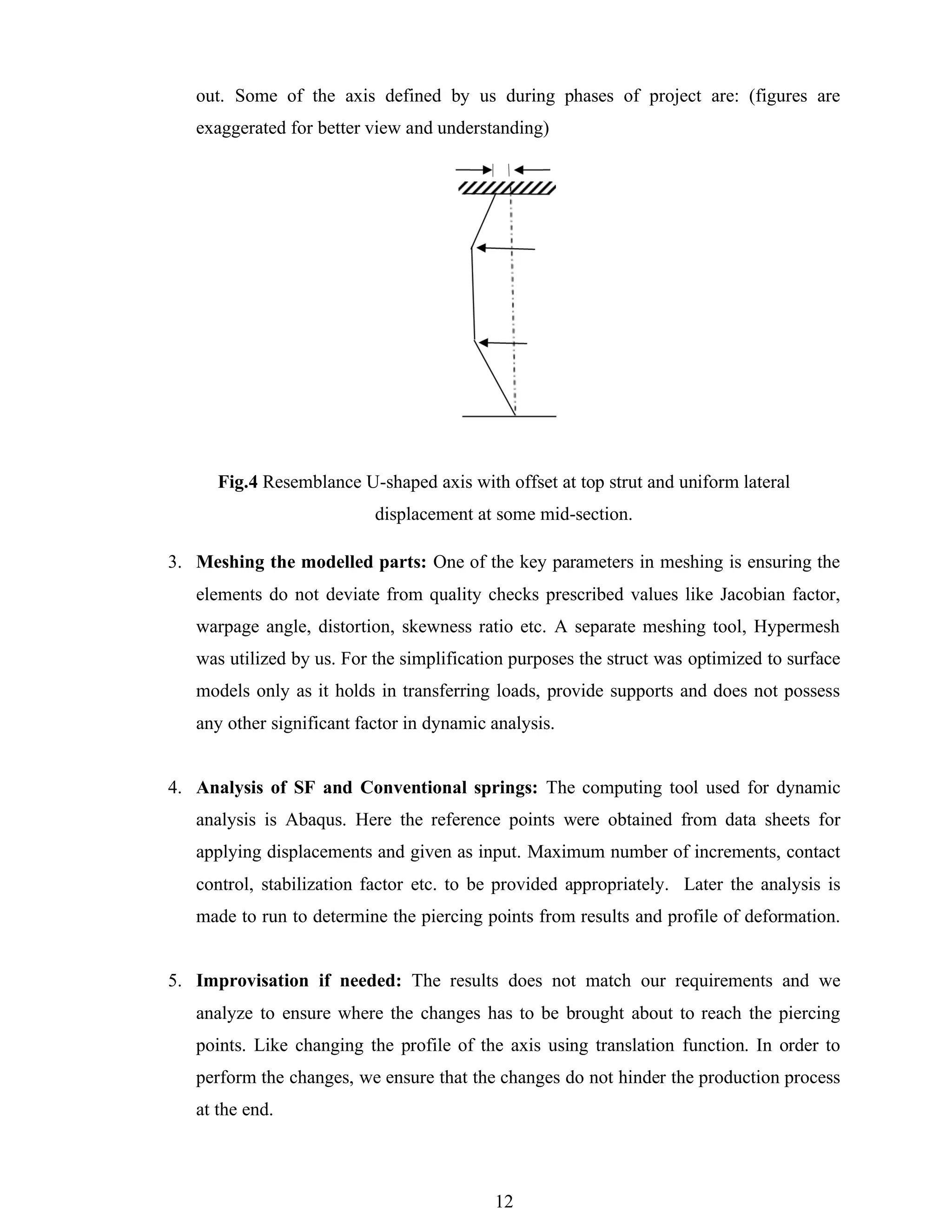
out. Some of the axis defined by us during phases of project are: (figures are
exaggerated for better view and understanding)
Fig.4 Resemblance U-shaped axis with offset at top strut and uniform lateral
displacement at some mid-section.
3. Meshing the modelled parts: One of the key parameters in meshing is ensuring the
elements do not deviate from quality checks prescribed values like Jacobian factor,
warpage angle, distortion, skewness ratio etc. A separate meshing tool, Hypermesh
was utilized by us. For the simplification purposes the struct was optimized to surface
models only as it holds in transferring loads, provide supports and does not possess
any other significant factor in dynamic analysis.
4. Analysis of SF and Conventional springs: The computing tool used for dynamic
analysis is Abaqus. Here the reference points were obtained from data sheets for
applying displacements and given as input. Maximum number of increments, contact
control, stabilization factor etc. to be provided appropriately. Later the analysis is
made to run to determine the piercing points from results and profile of deformation.
5. Improvisation if needed: The results does not match our requirements and we
analyze to ensure where the changes has to be brought about to reach the piercing
points. Like changing the profile of the axis using translation function. In order to
perform the changes, we ensure that the changes do not hinder the production process
at the end.
13
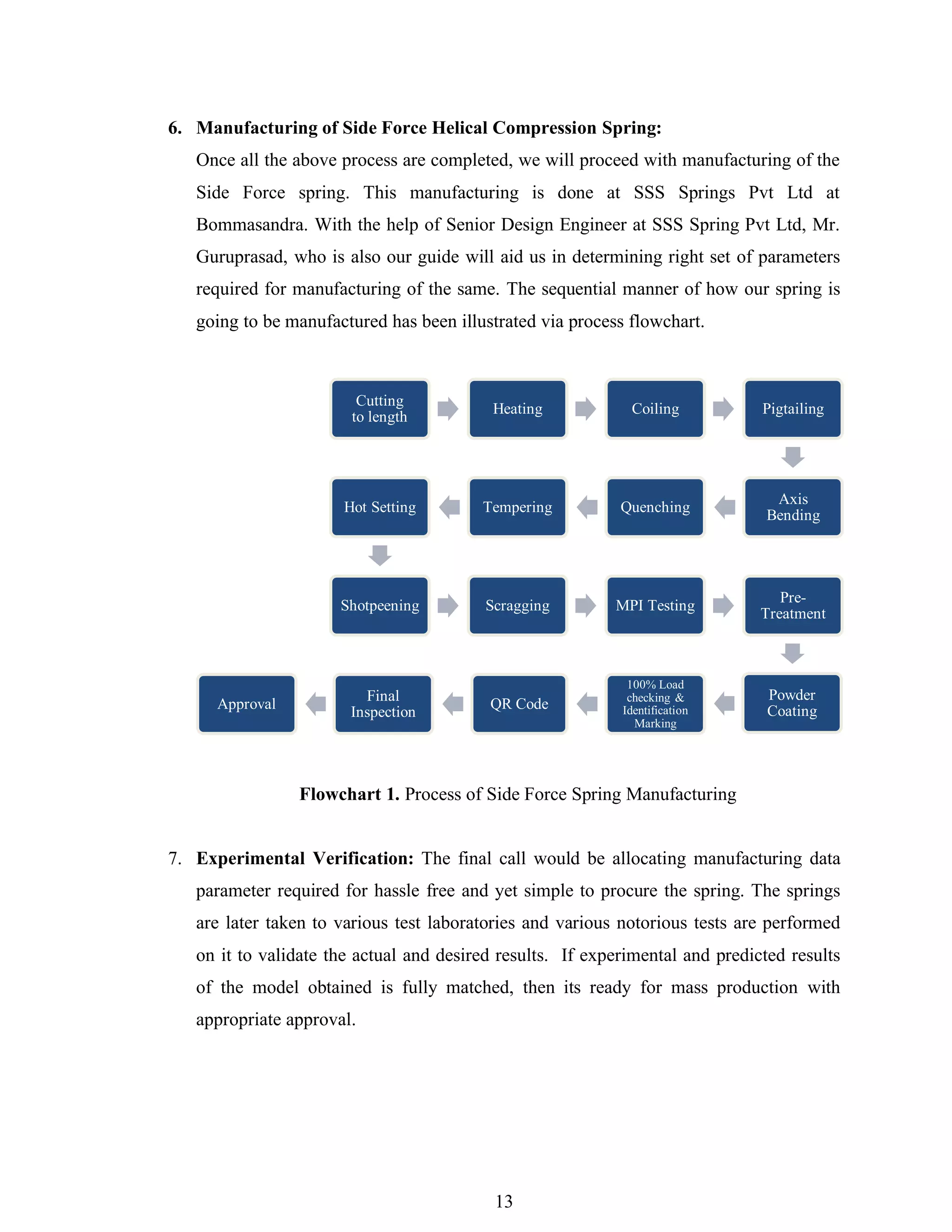
6. Manufacturing of Side Force Helical Compression Spring:
Once all the above process are completed, we will proceed with manufacturing of the
Side Force spring. This manufacturing is done at SSS Springs Pvt Ltd at
Bommasandra. With the help of Senior Design Engineer at SSS Spring Pvt Ltd, Mr.
Guruprasad, who is also our guide will aid us in determining right set of parameters
required for manufacturing of the same. The sequential manner of how our spring is
going to be manufactured has been illustrated via process flowchart.
Flowchart 1. Process of Side Force Spring Manufacturing
7. Experimental Verification: The final call would be allocating manufacturing data
parameter required for hassle free and yet simple to procure the spring. The springs
are later taken to various test laboratories and various notorious tests are performed
on it to validate the actual and desired results. If experimental and predicted results
of the model obtained is fully matched, then its ready for mass production with
appropriate approval.
Cutting
to length
Heating Coiling Pigtailing
Axis
Bending
Quenching
Tempering
Hot Setting
Shotpeening Scragging MPI Testing
Pre-
Treatment
Powder
Coating
100% Load
checking &
Identification
Marking
QR Code
Final
Inspection
Approval
14
TIME SCHEDULE
TARGETS
TIME (MONTH)
SEPTEMBER NOVEMBER DECEMBER JANUARY FECRUARY MARCH
LITERATURE
SURVEY
DESIGN &
ANALYSIS
IMPROVIZATION
EXPERIMENTAL
TEST
JOURNAL
SUBMISSION
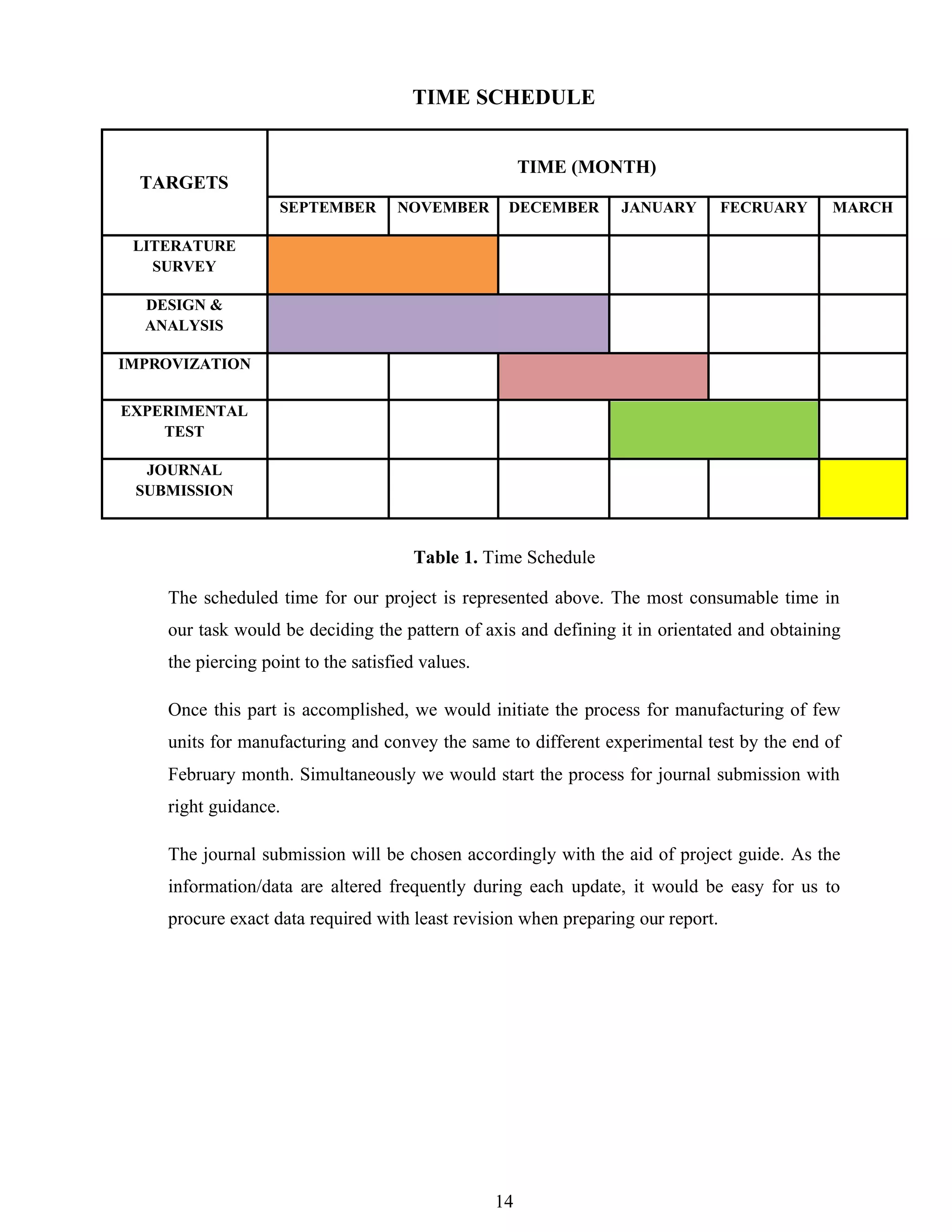
Table 1. Time Schedule
The scheduled time for our project is represented above. The most consumable time in
our task would be deciding the pattern of axis and defining it in orientated and obtaining
the piercing point to the satisfied values.
Once this part is accomplished, we would initiate the process for manufacturing of few
units for manufacturing and convey the same to different experimental test by the end of
February month. Simultaneously we would start the process for journal submission with
right guidance.
The journal submission will be chosen accordingly with the aid of project guide. As the
information/data are altered frequently during each update, it would be easy for us to
procure exact data required with least revision when preparing our report.
15
REFERENCES
[1] Y. I. Ryu, D. O. Kang, S. J. Heo, H. J. Yim and J. I. Jeon - “Development of analytical
process to reduce side load in strut-type suspension”, Springer Journal.
[2] Thomas Wunshe, Karl Bierker and Karl-Heinz Muhr - “Side load springs as a solution
to minimize adverse side load acting on McPherson Struct , SAE International.
[3] Yang Moucun, Nie Hong - “Analysis approach to durability based on material initial
fatigue quality and S-N curve”, Elsevier Journal
[4] Satoshi Suzuki, Syujii Kamlya and Toshiyuki Imaizumi - “Approached to minimizing
the Side Force of Helical Coil Springs for Riding comfort” , SAE Technical Paper Series
[5] Amol H. Joshi & Harvinder singh Chhabra, “Mathematical Model to Find Piercing
Point in McPherson Strut Suspension and Design of profile for Side Force Control
Spring” - SAE International, 2012

Design and Analysis of Side Force Spring in McPherson Strut - PHASE 1

  • 1.
    1 SCHOOL OF MECHANICALENGINEERING Project Phase-I Report On Design and Analysis of Side Force Spring in McPherson Strut Submitted by Mr. SIVA S SRN: R19MMD07 Third Semester M.Tech.(Machine Design) Under the guidance of Dr. HEMANTH K Associate Professor December 2020 Rukmini Knowledge park, Kattigenahalli, Yelahanka, Bengaluru-560064 www.reva.edu.in
  • 2.
    2 SCHOOL OF MECHANICALENGINEERING CERTIFICATE Certified that the project phase-I work entitled “Design and Analysis of Side Force Spring in McPherson Strut” carried out under my guidance by Mr. Siva S, R19MMD07, a bonafide student of REVA University during the academic year 2019-20, is submitting the project phase-I report in partial fulfillment of the requirements of 3rd semester of Master of Technology in Machine Design under Mechanical Engineering during the academic year 2019–20. The dissertation report has been approved as it satisfies the academic requirements in respect of Project Phase-I prescribed for the said degree. Dr. Hemanth K Associate Professor Dr. K.S.Narayanaswamy Director
  • 3.
    3 CONTENTS Sl.No Particulars PageNo. 1 Introduction 4-7 2 Literature Survey 8-9 3 Research Gap 10 4 Objectives 11 5 Methodology 11-13 6 Time Schedule 14 7 References 16
  • 4.
    4 INTRODUCTION SPRINGS A spring isdefined as an elastic body, whose function is to distort when loaded and to recover its original shape when the load is removed. The various important applications of springs are as follows: • To cushion, absorb or control energy due to either shock or vibration as in car springs, railway buffers, air-craft landing gears, shock absorbers and vibration dampers. • To apply forces, as in brakes, clutches and spring-loaded valves. • To control motion by maintaining contact between two elements as in cams and followers. To measure forces, as in spring balances and engine indicators. • To store energy. Types of Springs • Helical springs • Conical and volute springs. • Torsion springs • Laminated or leaf springs. • Disc or Belleville springs. • Special purpose springs. SUSPENSION SYSTEMS To many focusing on ride comfort, it may seem like the suspension system is merely a set of springs and shock absorbers which connect the wheels to the vehicle body. However, this is a very simplistic viewpoint of the suspension system. A vehicle suspension system provides a smooth ride over rough roads while ensuring that the wheels remain in contact with the ground and vehicle roll is minimized. The suspension system contains three major parts: a structure that supports the vehicle’s weight and determines suspension geometry, a spring that converts kinematic energy to potential energy or vice versa, and a shock absorber that is a mechanical device designed to dissipate kinetic energy. An automotive suspension connects a vehicle’s wheels to its body while supporting the vehicle’s weight. It allows for the relative motion between wheel and vehicle body; theoretically, a suspension system should reduce a wheel’s degree of freedom (DOF) from 6 to 2 on the rear axle and to 3 on the front axle even though the suspension system
  • 5.
    5 must support propulsion,steering, brakes, and their associated forces. The relative motions of the wheels are its vertical movement, rotational movement about the lateral axes, and rotational movement about the vertical axes due to steer angle. FUNCTIONS OF SUSPENSION SYSTEMS Ride Comfort: ride quality can be quantified by the passenger compartment’s level of vibration. The spectrum of vibration may be divided up according to ranges in frequency and classified as comfortable (0–25 Hz) or noisy and harsh (25–20,000 Hz). Road Holding: The forces on the contact point between a wheel and the road act on the vehicle body through the suspension system. The lateral and longitudinal forces generated by a tire depend directly on the normal tire force, which supports cornering, traction, and braking abilities. Handling: A good suspension system should ensure that the vehicle will be stable in every manoeuvre. The vehicle behaviour must be predictable, and behavioural information should accordingly be communicated to the driver. The vehicle should respond to the driver’s inputs proportionally while smoothly following his/her steering/ braking/ accelerating commands. Fig 1. Main components of a suspension system.
  • 6.
    6 DIFFERENT SUSPENSION TYPES 1.Solid Axle: A solid axle is known to be the first suspension type used in vehicles where the wheels are mounted at either ends of a rigid beam. A solid axle system generally uses leaf springs. Solid axle suspension system is not classified as an independent type of suspension, so any movement of one wheel is transmitted to the other wheel. Solid axles have some advantages in their load carrying capacity; solid axles are also affordable and durable. Leaf springs result in unwanted transmitted noise and vibration. Rigid beams considerably reduce ride quality, and their size and dimensions demand enough space above the axle to accommodate the springs. 2. Torsion Beam: The torsion beam is known as the most popular rear axle suspension system for small- and medium- sized front-wheel drive vehicles. A torsion beam suspension consists of two trailing arms with a flexible cross member in between. The cross member absorbs all forces and moments and simultaneously works as an anti-roll bar. The torsion beam is a semi-independent suspension. It boasts few components and a simple structure; therefore, it is light, cheap, easily assembled, and requires little space. Furthermore, cross member flexibility diminishes camber and body roll control. 3. Double Wishbone: The double wishbone suspension is used in front and rear axles, and it consists of two control arms to hold the wheel. The main advantage of the double wishbone suspension is its customizable kinematic design. The double wishbone suspension is large laterally, so it minimizes the undesirable effects on the ride quality. This type of suspensions is relatively expensive due to their complexity and number of joints may cause interference with the driving shaft or extra space for the suspension packaging, respectively. Fig 2. Double Wishbone Suspension with spring on lower arm
  • 7.
    7 4. Macpherson Strut:The Macpherson strut is usually used as the front axle of small- and medium-sized front-wheel drive vehicles. The upper control arm in the double wishbone is replaced by a strut that is rigidly connected to the wheel’s spindle. The lower control arm mainly bears lateral and longitudinal forces, and its structure and shape play important roles in wheel compliance control. This independent suspension is small enough to allow for an under-the-hood installation of the engine following the installation of the suspension. It is cheaper and lighter than the double wishbone suspension; however, replacing the upper arm with the strut decreases the roll, pitch, and wheel angle control, so from a vehicle handling point of view, the Macpherson strut is merely acceptable. Fig 3. Illustration of Macpherson strut setup KINGPIN AXIS The kingpin axis is the line between the upper and lower ball joints of the hub. On a MacPherson strut, the top pivot point is the strut bearing, and the bottom point is the lower ball joint. The inclination of the steering axis is measured as the angle between the steering axis and the centerline of the wheel. Fig 4. Kingpin axis illustration from front view of a car
  • 8.
    8 LITERATURE SURVEY 1. “Sideload springs as a solution to minimize adverse side load acting on McPherson Struct”, Thomas Wunshe, Karl Bierker and Karl-Heinz Muhr - SAE International In this research paper the authors were noted down the side force (FQ) magnitude of a car’s suspension during slow speed when encountering small barrier of 1 cm height, causing a sudden reduce in riding comfort. To solve this issue, they modelled a custom side spring that is different from conventional spring axis. Using elasto-kinematics method and side load verification using 6 component load cell they conducted experiments and cross verified both their methods mathematically and experimentally. In the experimental method they incorporated these side force spring on an Audi Q3 on its front left axle with transducers attached on its wheel bearing housing, shock tower of damper along damper strokes. Graphs were plotted from position of damper (mm) vs speed of the vehicle m/s) and also for side load deflection magnitude vs speed. They found that the McPherson struct with side load springs combination reduced side force from that of conventional and provides improved damping effect. 2. “Development of analytical process to reduce side load in strut-type suspension”, Y. I. Ryu, D. O. Kang, S. J. Heo, H. J. Yim and J. I. Jeon - Springer Journal. Due to packaging issue during assembly for commercial passenger cars the line force and spring force doesn’t coincide thereby resulting in unwarranted generation of side force in damper struct and rings. Eventually causses quicker wear and tear of these damping units before the prescribed limits predicted by the manufacturers. Hence this papers researcher developed an S-shaped axis side load springs. For the design of the side load spring, they also developed an analytical process, which utilizes finite element analysis and mechanical system analysis. All analysis results for the stiffness, stress, fatigue life, and spring force line were validated through experiments.
  • 9.
    9 3. Yang Moucun,Nie Hong - “Analysis approach to durability based on material initial fatigue quality and S-N curve”, Elsevier Journal In this paper the authors utilized probability fracture mechanics approach (PFMA), concept of Material Initial Fatigue Quality (MIFQ)and studied on S-N Curve with crack propagation curve. The reason they choose S-N curve as their main parameter is because we may use it study crack growth rate under constant amplitude loading and to evaluate the effects on durability. The durability test adopted was of Advancing Front/Local Reconnection Procedure (AFLR). Specimen used was Al alloy 75475. The accuracy of predicted value completely dependent on S-N curve of high quality. During test they observed that crack propagates slowly later it propagates uniformly or steadily. AT some point during test the crack propagation abruptly increases due to unprediction. On verifying the results, they concluded that the predicted results are larger than actual failure curves data. 4. Satoshi Suzuki, Syujii Kamlya and Toshiyuki Imaizumi - “Approached to minimizing the Side Force of Helical Coil Springs for Riding comfort”, SAE Technical Paper Series The authors have focused the effects of tilting angle of spring seat and of the kinematic condition of the spring on the side force. They used a verification model via finite element model and obtained the virtual reaction forces of the spring and the same to a six-point loading fixture to an actual model. The results were compared with graphical data. It was found that the side force of the spring with open turn periodically increases with the decrease of number of free coils, minimum values occurring at integer numbers of free coils in the case where no contact between coil occurs. It was also found that side forces can be reduced when the lateral displacements of the spring seat coincide with the direction of the side force side force acting on it. Moreover, they found that side force is remarkably reduced by tilting the upper seat in certain degree of direction.
  • 10.
    10 RESEARCH GAP • Onreviewing and researching from various journal papers, I conclude that still there are various possibility of improvements in conventional to side force springs. With the possibilities of various axis shape that are not yet designed, I would utilize that as an opportunity to maximize the reach of piercing points. • And formulating a mathematical model that can be referred from the cited journal papers there is a possibility of defining the side force spring in accordance with certain requirements. • Along with the change in design of axis, variation in results can be obtained by placing the top/bottom strut at an inclined angle where such practices are usually provided by the manufacturer/customer that vary accordingly to the vehicle. • While referring the Journal paper of Joshi Author, we may adopt his mathematical model to reach the piercing points. The author has mathematically guided us on how to obtain the coordinates required for modeling the side force spring by applying transformation method of matrix by varying the angle and translating the axis points to some distance. Using this method, we may infer his path to design our model as a reference. • Even when there is change in Automotive trend from IC vehicles to electric vehicles, the use of McPherson strut would not vary in assembly of passenger vehicle, as it has many cost-wise benefits which always suits in better marketing purposes. From researching various websites and discussion with our project guides, we found the feasibility of manufacturing a side force spring is much of cost-effective method instead of choosing Wishbone suspension setup as it occupies larger space while packaging and increase in complexity of design/assembly.
  • 11.
    11 OBJECTIVES • To reducethe magnitude of lateral forces generated by cornering of vehicle on dampers due to buckling action which is caused by packaging issues occurred during the assembly of McPherson strut suspension system in passenger vehicle. • In order to achieve our desired results, the piercing points axis must reach as close with line of forces (Kingpin axis). METHODOLOGY 1. Determining the input Parameters: From analyzing the research papers which was relevant to our objection. We wanted to ensure that only correct and required data are always available. Like possessing data points of conventional springs axis using data coordinate system to define it axis and spline from appropriate design data sheets and modifying to our needed side force spring axis, boundary conditions of the spring i.e., placement of struct at the top and bottom in angle/offset position, expected translation position of the axis line do define its shape etc., were to be determined. 2. Design of Normal spring and Side Force spring: Once the required design data sheets are obtained, we had to input the value as discrete data points in MS-Excel sheets. Using helical spring design formula, we obtain the individual data of spline. Its later converted from Spring Coordinate system to Vehicle Coordinate system for the ease of understanding for analysis and verification purposes. To match the seating position of the spring during assembly in passenger vehicle, an exact replica of bottom and top structs are also designed and assembled according the constrains. Tool used for modeling the design of helical compression spring is CATIA. Our first objective would be defining the axis line which is a customized shape, with various trial and error criteria for initiating the lateral displacement at bottom and top section of the spring axis. With these design possibilities the research work will be carried out to find the results. If piercing points are not achieved as per our requirements, then further improvements/changes in axis design will be carried
  • 12.
    12 out. Some ofthe axis defined by us during phases of project are: (figures are exaggerated for better view and understanding) Fig.4 Resemblance U-shaped axis with offset at top strut and uniform lateral displacement at some mid-section. 3. Meshing the modelled parts: One of the key parameters in meshing is ensuring the elements do not deviate from quality checks prescribed values like Jacobian factor, warpage angle, distortion, skewness ratio etc. A separate meshing tool, Hypermesh was utilized by us. For the simplification purposes the struct was optimized to surface models only as it holds in transferring loads, provide supports and does not possess any other significant factor in dynamic analysis. 4. Analysis of SF and Conventional springs: The computing tool used for dynamic analysis is Abaqus. Here the reference points were obtained from data sheets for applying displacements and given as input. Maximum number of increments, contact control, stabilization factor etc. to be provided appropriately. Later the analysis is made to run to determine the piercing points from results and profile of deformation. 5. Improvisation if needed: The results does not match our requirements and we analyze to ensure where the changes has to be brought about to reach the piercing points. Like changing the profile of the axis using translation function. In order to perform the changes, we ensure that the changes do not hinder the production process at the end.
  • 13.
    13 6. Manufacturing ofSide Force Helical Compression Spring: Once all the above process are completed, we will proceed with manufacturing of the Side Force spring. This manufacturing is done at SSS Springs Pvt Ltd at Bommasandra. With the help of Senior Design Engineer at SSS Spring Pvt Ltd, Mr. Guruprasad, who is also our guide will aid us in determining right set of parameters required for manufacturing of the same. The sequential manner of how our spring is going to be manufactured has been illustrated via process flowchart. Flowchart 1. Process of Side Force Spring Manufacturing 7. Experimental Verification: The final call would be allocating manufacturing data parameter required for hassle free and yet simple to procure the spring. The springs are later taken to various test laboratories and various notorious tests are performed on it to validate the actual and desired results. If experimental and predicted results of the model obtained is fully matched, then its ready for mass production with appropriate approval. Cutting to length Heating Coiling Pigtailing Axis Bending Quenching Tempering Hot Setting Shotpeening Scragging MPI Testing Pre- Treatment Powder Coating 100% Load checking & Identification Marking QR Code Final Inspection Approval
  • 14.
    14 TIME SCHEDULE TARGETS TIME (MONTH) SEPTEMBERNOVEMBER DECEMBER JANUARY FECRUARY MARCH LITERATURE SURVEY DESIGN & ANALYSIS IMPROVIZATION EXPERIMENTAL TEST JOURNAL SUBMISSION Table 1. Time Schedule The scheduled time for our project is represented above. The most consumable time in our task would be deciding the pattern of axis and defining it in orientated and obtaining the piercing point to the satisfied values. Once this part is accomplished, we would initiate the process for manufacturing of few units for manufacturing and convey the same to different experimental test by the end of February month. Simultaneously we would start the process for journal submission with right guidance. The journal submission will be chosen accordingly with the aid of project guide. As the information/data are altered frequently during each update, it would be easy for us to procure exact data required with least revision when preparing our report.
  • 15.
    15 REFERENCES [1] Y. I.Ryu, D. O. Kang, S. J. Heo, H. J. Yim and J. I. Jeon - “Development of analytical process to reduce side load in strut-type suspension”, Springer Journal. [2] Thomas Wunshe, Karl Bierker and Karl-Heinz Muhr - “Side load springs as a solution to minimize adverse side load acting on McPherson Struct , SAE International. [3] Yang Moucun, Nie Hong - “Analysis approach to durability based on material initial fatigue quality and S-N curve”, Elsevier Journal [4] Satoshi Suzuki, Syujii Kamlya and Toshiyuki Imaizumi - “Approached to minimizing the Side Force of Helical Coil Springs for Riding comfort” , SAE Technical Paper Series [5] Amol H. Joshi & Harvinder singh Chhabra, “Mathematical Model to Find Piercing Point in McPherson Strut Suspension and Design of profile for Side Force Control Spring” - SAE International, 2012