Chassis Operating Conditions
8/31/2021 M ANANDA MURUGAN 1
The design of an automobile chassis requires prior understanding of
the kind of conditions the chassis is likely to face on the road. The
chassis generally experiences four major loading situations, that
include,
(i) vertical bending,
(ii) longitudinal torsion,
(iii) lateral bending,
(iv) horizontal lozenging.
8/31/2021 M ANANDA MURUGAN 2
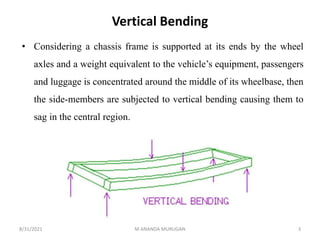
Vertical Bending
• Considering a chassis frame is supported at its ends by the wheel
axles and a weight equivalent to the vehicle’s equipment, passengers
and luggage is concentrated around the middle of its wheelbase, then
the side-members are subjected to vertical bending causing them to
sag in the central region.
8/31/2021 M ANANDA MURUGAN 3
Longitudinal Torsion
• When diagonally opposite front and rear road-wheels roll over
bumps simultaneously, the two ends of the chassis are twisted in
opposite directions so that both the side and the cross-members are
subjected to longitudinal torsion, which distorts the chassis.
8/31/2021 M ANANDA MURUGAN 4
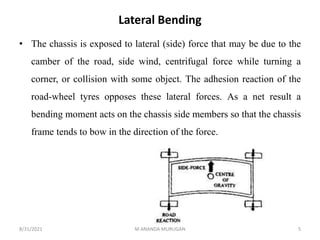
Lateral Bending
• The chassis is exposed to lateral (side) force that may be due to the
camber of the road, side wind, centrifugal force while turning a
corner, or collision with some object. The adhesion reaction of the
road-wheel tyres opposes these lateral forces. As a net result a
bending moment acts on the chassis side members so that the chassis
frame tends to bow in the direction of the force.
8/31/2021 M ANANDA MURUGAN 5
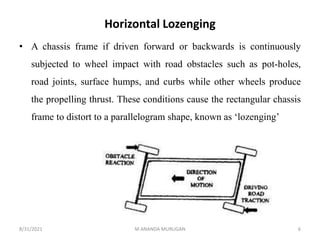
Horizontal Lozenging
• A chassis frame if driven forward or backwards is continuously
subjected to wheel impact with road obstacles such as pot-holes,
road joints, surface humps, and curbs while other wheels produce
the propelling thrust. These conditions cause the rectangular chassis
frame to distort to a parallelogram shape, known as ‘lozenging’
8/31/2021 M ANANDA MURUGAN 6

Chassis operating conditions

  • 1.
  • 2.
    The design ofan automobile chassis requires prior understanding of the kind of conditions the chassis is likely to face on the road. The chassis generally experiences four major loading situations, that include, (i) vertical bending, (ii) longitudinal torsion, (iii) lateral bending, (iv) horizontal lozenging. 8/31/2021 M ANANDA MURUGAN 2
  • 3.
    Vertical Bending • Consideringa chassis frame is supported at its ends by the wheel axles and a weight equivalent to the vehicle’s equipment, passengers and luggage is concentrated around the middle of its wheelbase, then the side-members are subjected to vertical bending causing them to sag in the central region. 8/31/2021 M ANANDA MURUGAN 3
  • 4.
    Longitudinal Torsion • Whendiagonally opposite front and rear road-wheels roll over bumps simultaneously, the two ends of the chassis are twisted in opposite directions so that both the side and the cross-members are subjected to longitudinal torsion, which distorts the chassis. 8/31/2021 M ANANDA MURUGAN 4
  • 5.
    Lateral Bending • Thechassis is exposed to lateral (side) force that may be due to the camber of the road, side wind, centrifugal force while turning a corner, or collision with some object. The adhesion reaction of the road-wheel tyres opposes these lateral forces. As a net result a bending moment acts on the chassis side members so that the chassis frame tends to bow in the direction of the force. 8/31/2021 M ANANDA MURUGAN 5
  • 6.
    Horizontal Lozenging • Achassis frame if driven forward or backwards is continuously subjected to wheel impact with road obstacles such as pot-holes, road joints, surface humps, and curbs while other wheels produce the propelling thrust. These conditions cause the rectangular chassis frame to distort to a parallelogram shape, known as ‘lozenging’ 8/31/2021 M ANANDA MURUGAN 6