



Kuwait University College of Engineering and Petroleum Department of Architecture Professional Practice 1
Lecture 1 The Architecture Profession
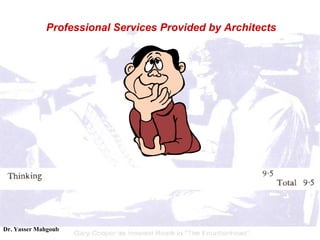
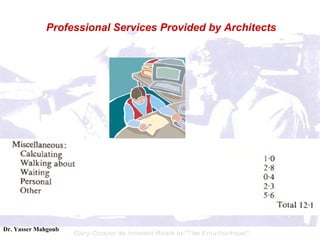
Professional Services Provided by Architects Questionnaire
Professional Practice Courses introduce architectural students to the world of professional practice.  The profession as we know it today was formalized in the nineteenth century.  The twentieth century, and especially the last three decades, has been a time of explosive growth and change for the profession. Architects are part of a larger planning, design, and construction enterprise that works to meet our needs for shelter and habitat. Introduction
International The Union of International Architects (UIA) The UIA is an international non governmental organization founded in Lausanne in  1948  to unite architects from all nations throughout the world, regardless of nationality, race, religion or architectural school of thought, within the federations of their national associations. The UIA represents over a million architects throughout the world through national architectural associations that form the 92 UIA Member Sections. A democratically structured body, the UIA is a unique world network uniting all architects.  http://www.uia-architectes.org/ The Professional Bodies Around the World
USA The American Institute of Architects (AIA) http://www.aia.org UK The Royal Institute of British Architects (RIBA)  was established to define and uphold this professional standard, and since 1931, and the Architects (Registration) Acts, UK law requires that any person who calls themselves an architect or wishes to practice as such and carries on a business with  that title must appear on a government register. Presently this register, and the rules governing qualification, conduct and disciplinary actions for architects are maintained by the Architects Registration Board (ARB). The RIBA and the ARB jointly validate the courses that lead to qualification.  http:// www. architecture.com The Professional Bodies Around the World
Kuwait Kuwait Society of Engineers (KSE) Kuwait League of Architects (KLA) The Professional Bodies Around the World
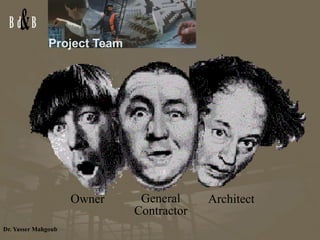
Project Team Owner Architect General Contractor
Architect  (from the Greek work  architekton  meaning master builder):  One who  designs  buildings and  superintends  their construction.
Architect An individual who starts out  knowing a little about a lot of different things ,  and, over time,  learns less and less about more and more ,  until he ends up  knowing nothing about everything .
Engineer An individual who starts out  knowing a lot about a few things ,  and, over time,  learns more and more about less and less ,  until he ends up  knowing everything about nothing .
Contractor Someone who starts out  knowing a lot about many things , but ends up  knowing nothing about anything due to his association with  architects and engineers .
Owner Someone who  starts out with a good relationship with architects, engineers, and contractors  . . . but ends up hiring an attorney.
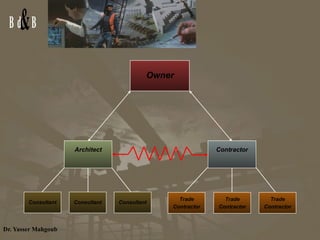
Owner Consultant Consultant Consultant Trade Contractor Trade Contractor Trade Contractor Architect Contractor
Architectural practice encompasses the activities of  organizing, managing, and documenting   the architectural project delivery process  as it applies to the modification of the built-environment through the design of buildings. These activities may be grouped into  5  major content areas: Laws and Regulations Business and Practice Management Project Finance and Building Economics  Architectural Project Delivery Process  Contracts  ARCHITECTURAL PRACTICE DEFINED (NAAB)
Legal issues refer to  the body of common law, legislation, and regulation  (public policy)  which affect architectural practice , including the basis for  registration  of Architects and legal standards of professional conduct.  This content area also includes the most common causes of actions under which architects are  sued :  Negligence,  Breach (Violation) of Contract,  Strict Liability, and  Implied Warranty. Liability, exposure, and Insurance issues will be generally addressed.  LAWS AND REGULATIONS
Management issues  refer to establishing an architectural practice under the different forms of  business organization  including the professional  ethics  applicable to the conduct of the practice of architecture.  The types of information required to document the Architect's design intent, given the Architect's duty to render " reasonably" competent professional services , as well as other methods of risk management that attempt to limit the Architect's professional liability.  The  marketing  of architectural services and the basis for  fee negotiations  and  professional compensation .  BUSINESS AND PRACTICE MANAGEMENT
Economic issues refer to the  financial aspects  of a building project, including the economics of development and  the financial management of the firm .  This content area also includes  site acquisition  and development costs,  building costs  - and the factors influencing them,  design cost  control procedures, and  value analysis . PROJECT FINANCE AND ECONOMICS
Process issues refer to  the entire range of activities involved in an architectural project  as it moves from inception through design and construction phases to beneficial occupancy by the Owner/Client/User.  These processes not only include those services performed by the architect, but also those performed by  other participants . ARCHITECTURAL PROJECT DELIVERY PROCESS
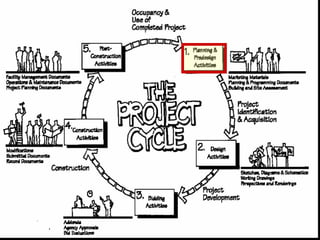
These activities (from the Architect's viewpoint) may be grouped into  6  major phases of work:  •  Pre-Design   Phase:  Program Definition, Feasibility Analysis  •  Design Phase:  Schematic Design, Design Development  •  Construction Document Phase:  Documentation of the Design Intent  •  Bidding and Negotiation Phase:  Establishing the Cost of the Design Intent  •  Construction Phase:  Administration of the Construction Contract  •  Post-Construction Phase:  Warranty Review, Post Occupancy Evaluation ARCHITECTURAL PROJECT DELIVERY PROCESS
Process issues also refer to the different types of  contractual arrangements  and to the procedures for their administration.  This includes the major participant's roles and ways in which the various major participants in the design and construction processes are related and  obligated to one another , including the specification of these relationships and obligations. ARCHITECTURAL PROJECT DELIVERY PROCESS
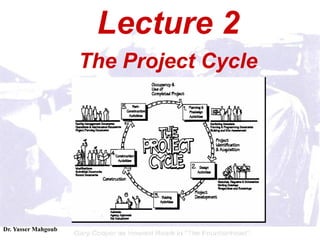
Lecture 2 The Project Cycle
 
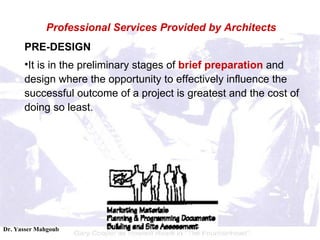
PRE-DESIGN It is in the preliminary stages of  brief preparation  and design where the opportunity to effectively influence the successful outcome of a project is greatest and the cost of doing so least. Professional Services Provided by Architects
PRE-DESIGN   The range of Pre-Design elements include:  Identification of the  client's needs  and options  Feasibility and costing  studies  Value management studies  Project delivery programs  and building procurement advice  Life-cycle cost analysis   Site , geotechnical and infrastructure investigations  Detailed  project brief preparation . Master Planning . Professional Services Provided by Architects
SCHEMATIC DESIGN Schematic Design is  an advance of the preferred planning options  while ensuring that the broad spatial and functional planning requirements are achieved.  The Schematic Design will result in the following:  Site Plan   Plans, elevations and sections  of the preferred design  Schedule of  proposed materials,  finishes  and signage   Color Board  of all materials and finishes  Cost Plan   Schematic Design  Report   Equipment  drawings. Professional Services Provided by Architects
DESIGN DEVELOPMENT From the broad brush requirements of the Schematic Design, a design proposal is developed and agreed with the client and includes:  Refinement of the  function and form   Structural  systems  Internal spaces  of the building  Mechanical   Electrical   Hydraulic  services  More  detailed estimates of cost   Provision of  time program Professional Services Provided by Architects
DESIGN DEVELOPMENT From this stage the client will receive the following:  Fully developed  Site Plan   Fully developed  plans  of each level of the preferred design  Roof  Plan  (slopes, materials and penetrations)  Elevations  of all aspects and general sections  Chosen plans and  sections  that describe the building form through the overall scheme or part of it at a scale of 1:100  Part and elevations of  typical elements  and sections   Schedule of  finishes  and  sample board   A  report  from the Building Surveyor explaining the approach to the design solution.  Professional Services Provided by Architects
CONTRACT DOCUMENTATION Drawings and specifications  are detailed from the Design Development and may include:  Bills of Quantities  sufficient for the calling of competitive tenders and to enable the building to be constructed as intended.  A  tender estimate   Coordination and integration of the work of each discipline .  Professional Services Provided by Architects
TENDER EVALUATION When design and documentation is completed, the project goes to tender and this service includes the following:  Calling of tenders   Answering tender inquiries   Evaluation of tenders  in conjunction with or on behalf of the client  Analysis and advice  in respect of tenders received, including any necessary negotiations with tenders  The preparation of  formal contract documents   Arrangements for the  execution of the contract .  Professional Services Provided by Architects
CONTRACT ADMINISTRATION The administration of the contract is carried out, including:  Reporting on  construction progress  and cost  Observance of compliance  with the documented intent by periodic inspection of the works  Supplying information ,  checking progress claims  and  issuing progress certificates , negotiating  variations  and  cost adjustments  and dealing with  claims for extensions  of time and other matters included in the building contract.  Professional Services Provided by Architects
POST CONSTRUCTION SERVICES When the project is ready for occupancy Project Services provides aftercare services including:  Manuals  for facilities management or maintenance and operation purposes  Systems and equipment  commissioning and adjustment  Periodic maintenance inspections   Replacement cost estimating for  insurance  purposes  Warranty and operational reviews   Contractor maintenance evaluation   Post-occupancy evaluation   Energy and environmental health surveys. Professional Services Provided by Architects
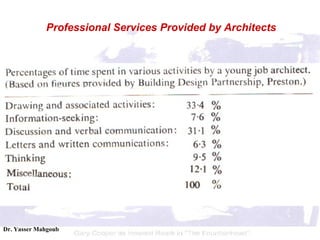
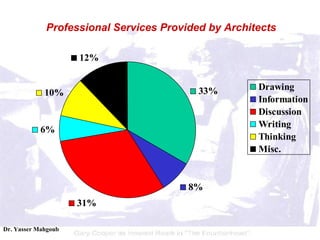
Professional Services Provided by Architects
END

The Architecture Profession

  • 1.
    Kuwait University Collegeof Engineering and Petroleum Department of Architecture Professional Practice 1
  • 2.
    Lecture 1 TheArchitecture Profession
  • 3.
    Professional Services Providedby Architects Questionnaire
  • 4.
    Professional Practice Coursesintroduce architectural students to the world of professional practice. The profession as we know it today was formalized in the nineteenth century. The twentieth century, and especially the last three decades, has been a time of explosive growth and change for the profession. Architects are part of a larger planning, design, and construction enterprise that works to meet our needs for shelter and habitat. Introduction
  • 5.
    International The Unionof International Architects (UIA) The UIA is an international non governmental organization founded in Lausanne in 1948 to unite architects from all nations throughout the world, regardless of nationality, race, religion or architectural school of thought, within the federations of their national associations. The UIA represents over a million architects throughout the world through national architectural associations that form the 92 UIA Member Sections. A democratically structured body, the UIA is a unique world network uniting all architects. http://www.uia-architectes.org/ The Professional Bodies Around the World
  • 6.
    USA The AmericanInstitute of Architects (AIA) http://www.aia.org UK The Royal Institute of British Architects (RIBA) was established to define and uphold this professional standard, and since 1931, and the Architects (Registration) Acts, UK law requires that any person who calls themselves an architect or wishes to practice as such and carries on a business with that title must appear on a government register. Presently this register, and the rules governing qualification, conduct and disciplinary actions for architects are maintained by the Architects Registration Board (ARB). The RIBA and the ARB jointly validate the courses that lead to qualification. http:// www. architecture.com The Professional Bodies Around the World
  • 7.
    Kuwait Kuwait Societyof Engineers (KSE) Kuwait League of Architects (KLA) The Professional Bodies Around the World
  • 8.
    Project Team OwnerArchitect General Contractor
  • 9.
    Architect (fromthe Greek work architekton meaning master builder): One who designs buildings and superintends their construction.
  • 10.
    Architect An individualwho starts out knowing a little about a lot of different things , and, over time, learns less and less about more and more , until he ends up knowing nothing about everything .
  • 11.
    Engineer An individualwho starts out knowing a lot about a few things , and, over time, learns more and more about less and less , until he ends up knowing everything about nothing .
  • 12.
    Contractor Someone whostarts out knowing a lot about many things , but ends up knowing nothing about anything due to his association with architects and engineers .
  • 13.
    Owner Someone who starts out with a good relationship with architects, engineers, and contractors . . . but ends up hiring an attorney.
  • 14.
    Owner Consultant ConsultantConsultant Trade Contractor Trade Contractor Trade Contractor Architect Contractor
  • 15.
    Architectural practice encompassesthe activities of organizing, managing, and documenting the architectural project delivery process as it applies to the modification of the built-environment through the design of buildings. These activities may be grouped into 5 major content areas: Laws and Regulations Business and Practice Management Project Finance and Building Economics Architectural Project Delivery Process Contracts ARCHITECTURAL PRACTICE DEFINED (NAAB)
  • 16.
    Legal issues referto the body of common law, legislation, and regulation (public policy) which affect architectural practice , including the basis for registration of Architects and legal standards of professional conduct. This content area also includes the most common causes of actions under which architects are sued : Negligence, Breach (Violation) of Contract, Strict Liability, and Implied Warranty. Liability, exposure, and Insurance issues will be generally addressed. LAWS AND REGULATIONS
  • 17.
    Management issues refer to establishing an architectural practice under the different forms of business organization including the professional ethics applicable to the conduct of the practice of architecture. The types of information required to document the Architect's design intent, given the Architect's duty to render " reasonably" competent professional services , as well as other methods of risk management that attempt to limit the Architect's professional liability. The marketing of architectural services and the basis for fee negotiations and professional compensation . BUSINESS AND PRACTICE MANAGEMENT
  • 18.
    Economic issues referto the financial aspects of a building project, including the economics of development and the financial management of the firm . This content area also includes site acquisition and development costs, building costs - and the factors influencing them, design cost control procedures, and value analysis . PROJECT FINANCE AND ECONOMICS
  • 19.
    Process issues referto the entire range of activities involved in an architectural project as it moves from inception through design and construction phases to beneficial occupancy by the Owner/Client/User. These processes not only include those services performed by the architect, but also those performed by other participants . ARCHITECTURAL PROJECT DELIVERY PROCESS
  • 20.
    These activities (fromthe Architect's viewpoint) may be grouped into 6 major phases of work: • Pre-Design Phase: Program Definition, Feasibility Analysis • Design Phase: Schematic Design, Design Development • Construction Document Phase: Documentation of the Design Intent • Bidding and Negotiation Phase: Establishing the Cost of the Design Intent • Construction Phase: Administration of the Construction Contract • Post-Construction Phase: Warranty Review, Post Occupancy Evaluation ARCHITECTURAL PROJECT DELIVERY PROCESS
  • 21.
    Process issues alsorefer to the different types of contractual arrangements and to the procedures for their administration. This includes the major participant's roles and ways in which the various major participants in the design and construction processes are related and obligated to one another , including the specification of these relationships and obligations. ARCHITECTURAL PROJECT DELIVERY PROCESS
  • 22.
    Lecture 2 TheProject Cycle
  • 23.
  • 24.
    PRE-DESIGN It isin the preliminary stages of brief preparation and design where the opportunity to effectively influence the successful outcome of a project is greatest and the cost of doing so least. Professional Services Provided by Architects
  • 25.
    PRE-DESIGN The range of Pre-Design elements include: Identification of the client's needs and options Feasibility and costing studies Value management studies Project delivery programs and building procurement advice Life-cycle cost analysis Site , geotechnical and infrastructure investigations Detailed project brief preparation . Master Planning . Professional Services Provided by Architects
  • 26.
    SCHEMATIC DESIGN SchematicDesign is an advance of the preferred planning options while ensuring that the broad spatial and functional planning requirements are achieved. The Schematic Design will result in the following: Site Plan Plans, elevations and sections of the preferred design Schedule of proposed materials, finishes and signage Color Board of all materials and finishes Cost Plan Schematic Design Report Equipment drawings. Professional Services Provided by Architects
  • 27.
    DESIGN DEVELOPMENT Fromthe broad brush requirements of the Schematic Design, a design proposal is developed and agreed with the client and includes: Refinement of the function and form Structural systems Internal spaces of the building Mechanical Electrical Hydraulic services More detailed estimates of cost Provision of time program Professional Services Provided by Architects
  • 28.
    DESIGN DEVELOPMENT Fromthis stage the client will receive the following: Fully developed Site Plan Fully developed plans of each level of the preferred design Roof Plan (slopes, materials and penetrations) Elevations of all aspects and general sections Chosen plans and sections that describe the building form through the overall scheme or part of it at a scale of 1:100 Part and elevations of typical elements and sections Schedule of finishes and sample board A report from the Building Surveyor explaining the approach to the design solution. Professional Services Provided by Architects
  • 29.
    CONTRACT DOCUMENTATION Drawingsand specifications are detailed from the Design Development and may include: Bills of Quantities sufficient for the calling of competitive tenders and to enable the building to be constructed as intended. A tender estimate Coordination and integration of the work of each discipline . Professional Services Provided by Architects
  • 30.
    TENDER EVALUATION Whendesign and documentation is completed, the project goes to tender and this service includes the following: Calling of tenders Answering tender inquiries Evaluation of tenders in conjunction with or on behalf of the client Analysis and advice in respect of tenders received, including any necessary negotiations with tenders The preparation of formal contract documents Arrangements for the execution of the contract . Professional Services Provided by Architects
  • 31.
    CONTRACT ADMINISTRATION Theadministration of the contract is carried out, including: Reporting on construction progress and cost Observance of compliance with the documented intent by periodic inspection of the works Supplying information , checking progress claims and issuing progress certificates , negotiating variations and cost adjustments and dealing with claims for extensions of time and other matters included in the building contract. Professional Services Provided by Architects
  • 32.
    POST CONSTRUCTION SERVICESWhen the project is ready for occupancy Project Services provides aftercare services including: Manuals for facilities management or maintenance and operation purposes Systems and equipment commissioning and adjustment Periodic maintenance inspections Replacement cost estimating for insurance purposes Warranty and operational reviews Contractor maintenance evaluation Post-occupancy evaluation Energy and environmental health surveys. Professional Services Provided by Architects
  • 33.
  • 34.
  • 35.
  • 36.
  • 37.
  • 38.
  • 39.
  • 40.
  • 41.