Design Thinking 101
Frankly, one of the greatest strenghts of design is that we have not
setteled on a single definitione. Fields in which definitions is now a settled
matter tend to be lethargic, dying, or dead fields, where inquiry no longer
provides challenges to what is accepted as thruth.
Richard Buchanan, 2001
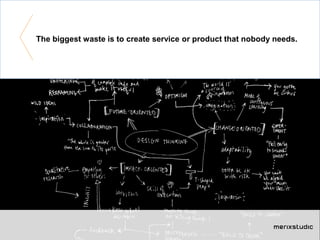
The biggest waste is to create service or product that nobody needs.
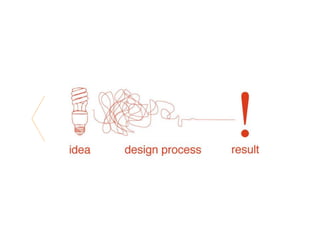
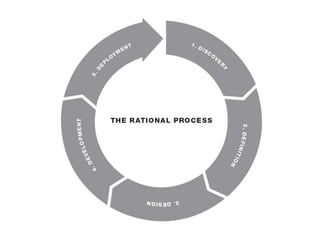
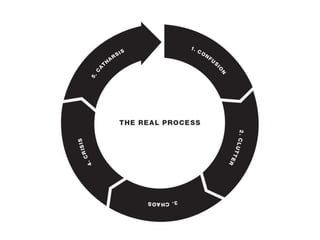
It’s all about the noprocess-process.
… A better process for innovation is something I call the “no-process
process.” It assumes that team members will uncover new ideas as they
work. Discovery, definition, and design are run on parallel tracks
instead of a single sequential track, so they can “talk” to each other and
create surprising new combinations.
Marty Neumeier
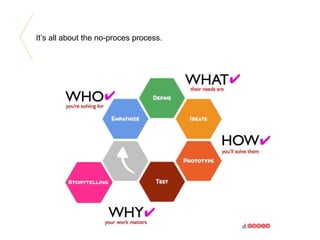
It’s all about the no-proces process.
The thinking: traditional vs. design thinking
Traditional thinking: discovering of what is right. So-called correct
answers.
Design thinking: discovering of what works. An infinity of possible
answers.
Design is a proces that turns a brief of requirement into a finished
product or design solution. The design proces can be said to
compromise seven stages: define, research, ideate, prototype, select,
implement and learn.
Each of these requires design thinking.
Define = brief
Research = background
Ideate = solutions
Prototype = resolve
Select = rationale
Implement = deliver
Learn = feedback
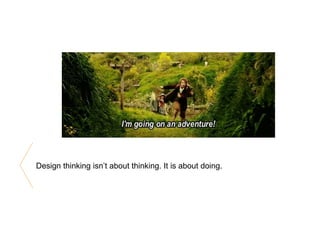
Design thinking isn’t about thinking. It is about doing.
BASIC PRINCIPLES
Deep customer empathy
Go broad to go narrow
Rapid experiments
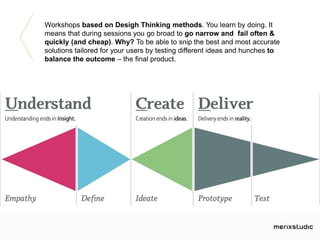
Workshops based on Desigh Thinking methods. You learn by doing. It
means that during sessions you go broad to go narrow and fail often &
quickly (and cheap). Why? To be able to snip the best and most accurate
solutions tailored for your users by testing different ideas and hunches to
balance the outcome – the final product.
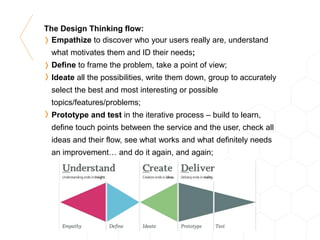
The Design Thinking flow:
Empathize to discover who your users really are, understand
what motivates them and ID their needs;
Define to frame the problem, take a point of view;
Ideate all the possibilities, write them down, group to accurately
select the best and most interesting or possible
topics/features/problems;
Prototype and test in the iterative process – build to learn,
define touch points between the service and the user, check all
ideas and their flow, see what works and what definitely needs
an improvement… and do it again, and again;
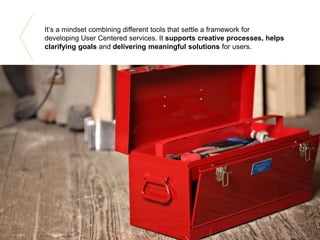
It’s a mindset combining different tools that settle a framework for
developing User Centered services. It supports creative processes, helps
clarifying goals and delivering meaningful solutions for users.
It’s a technically feasible and strategically viable way for
solving problems.
Gain: clear idea for your service – the strategy (also for future
development), logical structure of functions flow, understanding
users behavior, motives and their way of possible interactions with
your service.
This method helps you understand the whole idea of service. It
forges most „Hmm, well, I guess” into „This solution is right,
because” and „We should do it this way, because”.
How and why does it work?
Work in group enhance creativity;
Moderated to maximalize group potential (combining different
experience, unique knowledge and insight);
Work based on carefully picked tools and methods (developed
mostly by Stanford d.school and IDEO), i.e. Empathy Map,
Personas, Why-How Laddering, Service Blueprint, Mash-
Ups, Rapid Prototyping, Storytelling, creating insight
statements, Ways to Grow Framework;
Workshops session scheduled as an immersing workflow;
When you have two coffee shops right next to each other, and each sells
the exact same coffee at the exact same price, service design is what
makes you walk into one and not the other.
31 volts service design, 2008

Design Thinking 101

  • 1.
  • 2.
    Frankly, one ofthe greatest strenghts of design is that we have not setteled on a single definitione. Fields in which definitions is now a settled matter tend to be lethargic, dying, or dead fields, where inquiry no longer provides challenges to what is accepted as thruth. Richard Buchanan, 2001
  • 4.
    The biggest wasteis to create service or product that nobody needs.
  • 5.
    It’s all aboutthe noprocess-process.
  • 6.
    It’s all aboutthe noprocess-process.
  • 7.
    … A betterprocess for innovation is something I call the “no-process process.” It assumes that team members will uncover new ideas as they work. Discovery, definition, and design are run on parallel tracks instead of a single sequential track, so they can “talk” to each other and create surprising new combinations. Marty Neumeier
  • 8.
    It’s all aboutthe no-proces process.
  • 9.
    The thinking: traditionalvs. design thinking
  • 10.
    Traditional thinking: discoveringof what is right. So-called correct answers.
  • 11.
    Design thinking: discoveringof what works. An infinity of possible answers.
  • 12.
    Design is aproces that turns a brief of requirement into a finished product or design solution. The design proces can be said to compromise seven stages: define, research, ideate, prototype, select, implement and learn. Each of these requires design thinking.
  • 13.
    Define = brief Research= background Ideate = solutions Prototype = resolve Select = rationale Implement = deliver Learn = feedback
  • 14.
    Design thinking isn’tabout thinking. It is about doing.
  • 15.
    BASIC PRINCIPLES Deep customerempathy Go broad to go narrow Rapid experiments
  • 16.
    Workshops based onDesigh Thinking methods. You learn by doing. It means that during sessions you go broad to go narrow and fail often & quickly (and cheap). Why? To be able to snip the best and most accurate solutions tailored for your users by testing different ideas and hunches to balance the outcome – the final product.
  • 17.
    The Design Thinkingflow: Empathize to discover who your users really are, understand what motivates them and ID their needs; Define to frame the problem, take a point of view; Ideate all the possibilities, write them down, group to accurately select the best and most interesting or possible topics/features/problems; Prototype and test in the iterative process – build to learn, define touch points between the service and the user, check all ideas and their flow, see what works and what definitely needs an improvement… and do it again, and again;
  • 18.
    It’s a mindsetcombining different tools that settle a framework for developing User Centered services. It supports creative processes, helps clarifying goals and delivering meaningful solutions for users.
  • 19.
    It’s a technicallyfeasible and strategically viable way for solving problems. Gain: clear idea for your service – the strategy (also for future development), logical structure of functions flow, understanding users behavior, motives and their way of possible interactions with your service. This method helps you understand the whole idea of service. It forges most „Hmm, well, I guess” into „This solution is right, because” and „We should do it this way, because”.
  • 20.
    How and whydoes it work? Work in group enhance creativity; Moderated to maximalize group potential (combining different experience, unique knowledge and insight); Work based on carefully picked tools and methods (developed mostly by Stanford d.school and IDEO), i.e. Empathy Map, Personas, Why-How Laddering, Service Blueprint, Mash- Ups, Rapid Prototyping, Storytelling, creating insight statements, Ways to Grow Framework; Workshops session scheduled as an immersing workflow;
  • 21.
    When you havetwo coffee shops right next to each other, and each sells the exact same coffee at the exact same price, service design is what makes you walk into one and not the other. 31 volts service design, 2008