

Why is Design Thinking Important for Software Developers?
Andrew Maxwell, Lassonde School of Engineering
HOW DESIGN THINKING
ENHANCES INNOVATION
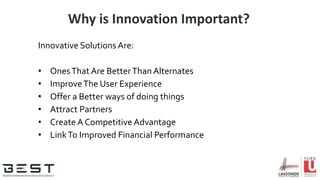
Why is Innovation Important?
Innovative Solutions Are:
• OnesThat Are BetterThan Alternates
• ImproveThe User Experience
• Offer a Better ways of doing things
• Attract Partners
• Create A Competitive Advantage
• LinkTo Improved Financial Performance
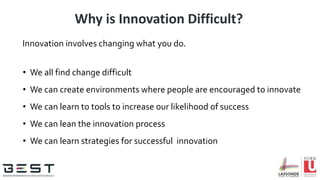
Why is Innovation Difficult?
Innovation involves changing what you do.
• We all find change difficult
• We can create environments where people are encouraged to innovate
• We can learn to tools to increase our likelihood of success
• We can lean the innovation process
• We can learn strategies for successful innovation
INTRODUCTION
DESIGN THINKING
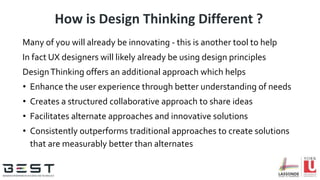
How is Design Thinking Different ?
Many of you will already be innovating - this is another tool to help
In fact UX designers will likely already be using design principles
DesignThinking offers an additional approach which helps
• Enhance the user experience through better understanding of needs
• Creates a structured collaborative approach to share ideas
• Facilitates alternate approaches and innovative solutions
• Consistently outperforms traditional approaches to create solutions
that are measurably better than alternates
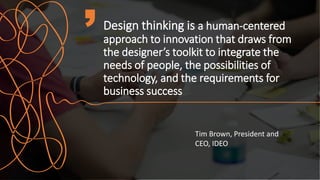
Design thinking is a human-centered
approach to innovation that draws from
the designer’s toolkit to integrate the
needs of people, the possibilities of
technology, and the requirements for
business success
Tim Brown, President and
CEO, IDEO
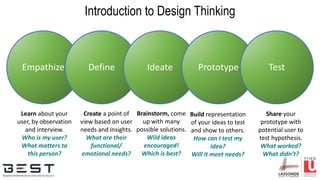
Empathize Define Ideate Prototype Test
Introduction to Design Thinking
Learn about your
user, by observation
and interview.
Who is my user?
What matters to
this person?
Create a point of
view based on user
needs and insights.
What are their
functional/
emotional needs?
Share your
prototype with
potential user to
test hypothesis.
What worked?
What didn’t?
Brainstorm, come
up with many
possible solutions.
Wild ideas
encouraged!
Which is best?
Build representation
of your ideas to test
and show to others.
How can I test my
idea?
Will it meet needs?
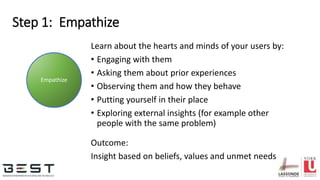
Step 1: Empathize
Learn about the hearts and minds of your users by:
• Engaging with them
• Asking them about prior experiences
• Observing them and how they behave
• Putting yourself in their place
• Exploring external insights (for example other
people with the same problem)
Outcome:
Insight based on beliefs, values and unmet needs
Empathize
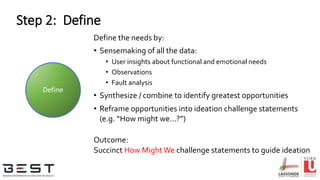
Step 2: Define
Define the needs by:
• Sensemaking of all the data:
• User insights about functional and emotional needs
• Observations
• Fault analysis
• Synthesize / combine to identify greatest opportunities
• Reframe opportunities into ideation challenge statements
(e.g. “How might we...?”)
Outcome:
Succinct How MightWe challenge statements to guide ideation
Define
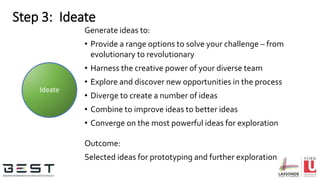
Step 3: Ideate
Generate ideas to:
• Provide a range options to solve your challenge – from
evolutionary to revolutionary
• Harness the creative power of your diverse team
• Explore and discover new opportunities in the process
• Diverge to create a number of ideas
• Combine to improve ideas to better ideas
• Converge on the most powerful ideas for exploration
Outcome:
Selected ideas for prototyping and further exploration
Ideate
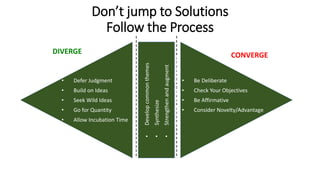
Don’t jump to Solutions
Follow the Process
DIVERGE
• Defer Judgment
• Build on Ideas
• Seek Wild Ideas
• Go for Quantity
• Allow Incubation Time
CONVERGE
• Be Deliberate
• Check Your Objectives
• Be Affirmative
• Consider Novelty/Advantage
•Developcommonthemes
•Synthesize
•Strengthenandaugment
•ConsiderNovelty/Advantage
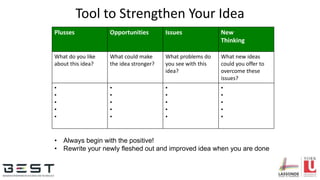
Tool to Strengthen Your Idea
Plusses Opportunities Issues New
Thinking
What do you like
about this idea?
What could make
the idea stronger?
What problems do
you see with this
idea?
What new ideas
could you offer to
overcome these
issues?
•
•
•
•
•
•
•
•
•
•
•
•
•
•
•
•
•
•
•
•
• Always begin with the positive!
• Rewrite your newly fleshed out and improved idea when you are done
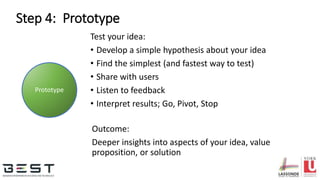
Step 4: Prototype
Test your idea:
• Develop a simple hypothesis about your idea
• Find the simplest (and fastest way to test)
• Share with users
• Listen to feedback
• Interpret results; Go, Pivot, Stop
Outcome:
Deeper insights into aspects of your idea, value
proposition, or solution
Prototype
“…if it doesn’t have wires sticking out of it,
rubber bands or duct tape, you’ve gone too
far. It’s not time to refine the look and feel
quite yet, but to get something that works.”
Gal Shaul, Co-founder, Augury
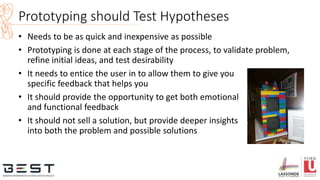
Prototyping should Test Hypotheses
• Needs to be as quick and inexpensive as possible
• Prototyping is done at each stage of the process, to validate problem,
refine initial ideas, and test desirability
• It needs to entice the user in to allow them to give you
specific feedback that helps you
• It should provide the opportunity to get both emotional
and functional feedback
• It should not sell a solution, but provide deeper insights
into both the problem and possible solutions
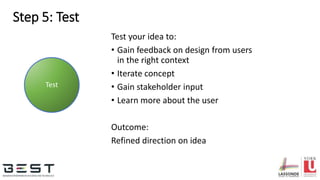
Step 5: Test
Test your idea to:
• Gain feedback on design from users
in the right context
• Iterate concept
• Gain stakeholder input
• Learn more about the user
Outcome:
Refined direction on idea
Test
HOW DESIGN THINKING
CHANGES SOFTWARE
DEVELOPMENT
Applying Design Thinking to Software Developmen
DesignThinking can be deployed at Each Stage of the Process:
• Plan
• Analysis
• Design
• Development
• Testing
• Maintenance
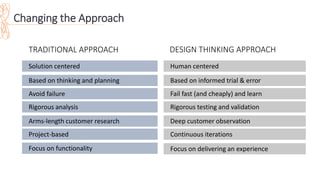
Based on thinking and planning
Avoid failure
Rigorous analysis
Arms-length customer research
Project-based
Based on informed trial & error
Fail fast (and cheaply) and learn
Rigorous testing and validation
Deep customer observation
Continuous iterations
TRADITIONAL APPROACH DESIGN THINKING APPROACH
Human centeredSolution centered
Focus on functionality Focus on delivering an experience
Changing the Approach
Design Thinking Introduction
https://hbr.org/video/4443548301001/the-explainer-design-thinking
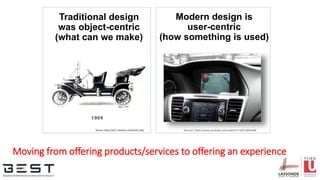
Traditional design
was object-centric
(what can we make)
Source: http://sa7.1-themes.com/ford-t.php
Modern design is
user-centric
(how something is used)
Source: https://www.youtube.com/watch?v=afCcIAlhAxM
Moving from offering products/services to offering an experience
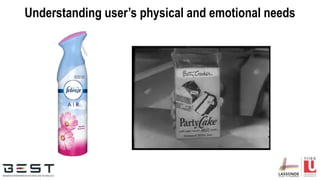
Understanding user’s physical and emotional needs
UNDERSTANDING
JOBS TO BE DONE
CLAYTON CHRISTENSEN: JOBS TO BE DONE
http://bigthink.com/experts/claytonchristensen
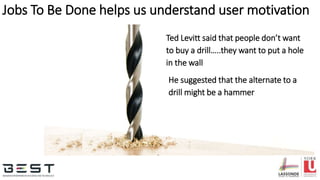
Ted Levitt said that people don’t want
to buy a drill…..they want to put a hole
in the wall
Jobs To Be Done helps us understand user motivation
He suggested that the alternate to a
drill might be a hammer
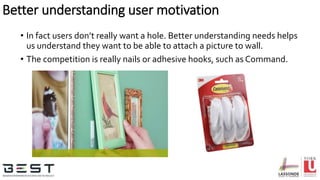
• In fact users don’t really want a hole. Better understanding needs helps
us understand they want to be able to attach a picture to wall.
• The competition is really nails or adhesive hooks, such as Command.
Better understanding user motivation
In fact we are only considering the functional
need, not the emotional need.
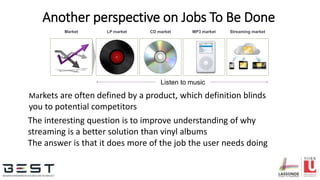
Market LP market CD market MP3 market Streaming market
Another perspective on Jobs To Be Done
Markets are often defined by a product, which definition blinds
you to potential competitors
The interesting question is to improve understanding of why
streaming is a better solution than vinyl albums
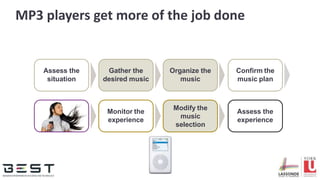
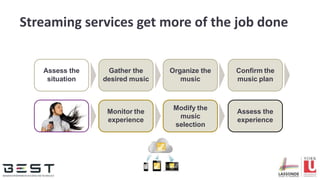
The answer is that it does more of the job the user needs doing
Listen to music
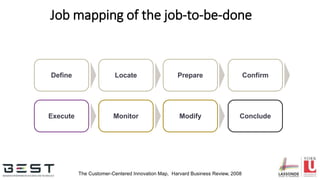
Job mapping of the job-to-be-done
Confirm
MonitorExecute
Define Locate Prepare
Modify Conclude
The Customer-Centered Innovation Map, Harvard Business Review, 2008
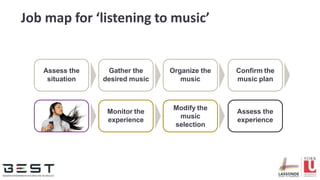
Job map for ‘listening to music’
Confirm the
music plan
Monitor the
experience
Assess the
situation
Gather the
desired music
Organize the
music
Modify the
music
selection
Assess the
experience
MP3 players get more of the job done
Confirm the
music plan
Monitor the
experience
Assess the
situation
Gather the
desired music
Organize the
music
Modify the
music
selection
Assess the
experience
Streaming services get more of the job done
Confirm the
music plan
Monitor the
experience
Assess the
situation
Gather the
desired music
Organize the
music
Modify the
music
selection
Assess the
experience
DESIGN THINKING
BEHAVIOURS AND MINDSET
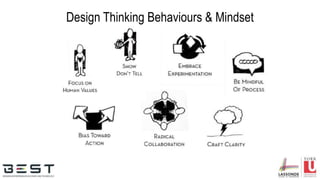
Design Thinking Behaviours & Mindset
DESIGN THINKING
SOLUTION FINDING
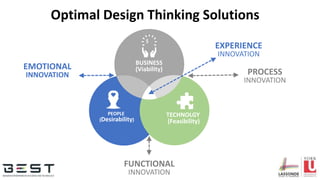
Optimal Design Thinking Solutions
EMOTIONAL
INNOVATION
EXPERIENCE
INNOVATION
PROCESS
INNOVATION
FUNCTIONAL
INNOVATION
TECHNOLGY
(Feasibility)
PEOPLE
(Desirability)
BUSINESS
(Viability)
$
Design Thinking For Software Development
DesignThinking
• Is a collaborative structured approach to develop new ideas
• Fosters both incremental and radical innovation
• Focusses on enhancing the user experience
• Considers users functional and emotional needs
• Is designed to hypothesize, test and fail fast
• Facilitates the development of solutions that offer users a better
experience than alternates – which can be a competitive advantage
Thank you
Andrew Maxwell
• Bergeron Chair inTechnology Entrepreneurship
• Andrew.Maxwell@Lassonde.yorku.ca
• www.bestlassonde.ca
•

Design thinking for software development

  • 1.
    Why is DesignThinking Important for Software Developers? Andrew Maxwell, Lassonde School of Engineering
  • 2.
  • 3.
    Why is InnovationImportant? Innovative Solutions Are: • OnesThat Are BetterThan Alternates • ImproveThe User Experience • Offer a Better ways of doing things • Attract Partners • Create A Competitive Advantage • LinkTo Improved Financial Performance
  • 4.
    Why is InnovationDifficult? Innovation involves changing what you do. • We all find change difficult • We can create environments where people are encouraged to innovate • We can learn to tools to increase our likelihood of success • We can lean the innovation process • We can learn strategies for successful innovation
  • 5.
  • 6.
    How is DesignThinking Different ? Many of you will already be innovating - this is another tool to help In fact UX designers will likely already be using design principles DesignThinking offers an additional approach which helps • Enhance the user experience through better understanding of needs • Creates a structured collaborative approach to share ideas • Facilitates alternate approaches and innovative solutions • Consistently outperforms traditional approaches to create solutions that are measurably better than alternates
  • 7.
    Design thinking isa human-centered approach to innovation that draws from the designer’s toolkit to integrate the needs of people, the possibilities of technology, and the requirements for business success Tim Brown, President and CEO, IDEO
  • 8.
    Empathize Define IdeatePrototype Test Introduction to Design Thinking Learn about your user, by observation and interview. Who is my user? What matters to this person? Create a point of view based on user needs and insights. What are their functional/ emotional needs? Share your prototype with potential user to test hypothesis. What worked? What didn’t? Brainstorm, come up with many possible solutions. Wild ideas encouraged! Which is best? Build representation of your ideas to test and show to others. How can I test my idea? Will it meet needs?
  • 9.
    Step 1: Empathize Learnabout the hearts and minds of your users by: • Engaging with them • Asking them about prior experiences • Observing them and how they behave • Putting yourself in their place • Exploring external insights (for example other people with the same problem) Outcome: Insight based on beliefs, values and unmet needs Empathize
  • 10.
    Step 2: Define Definethe needs by: • Sensemaking of all the data: • User insights about functional and emotional needs • Observations • Fault analysis • Synthesize / combine to identify greatest opportunities • Reframe opportunities into ideation challenge statements (e.g. “How might we...?”) Outcome: Succinct How MightWe challenge statements to guide ideation Define
  • 11.
    Step 3: Ideate Generateideas to: • Provide a range options to solve your challenge – from evolutionary to revolutionary • Harness the creative power of your diverse team • Explore and discover new opportunities in the process • Diverge to create a number of ideas • Combine to improve ideas to better ideas • Converge on the most powerful ideas for exploration Outcome: Selected ideas for prototyping and further exploration Ideate
  • 12.
    Don’t jump toSolutions Follow the Process DIVERGE • Defer Judgment • Build on Ideas • Seek Wild Ideas • Go for Quantity • Allow Incubation Time CONVERGE • Be Deliberate • Check Your Objectives • Be Affirmative • Consider Novelty/Advantage •Developcommonthemes •Synthesize •Strengthenandaugment •ConsiderNovelty/Advantage
  • 13.
    Tool to StrengthenYour Idea Plusses Opportunities Issues New Thinking What do you like about this idea? What could make the idea stronger? What problems do you see with this idea? What new ideas could you offer to overcome these issues? • • • • • • • • • • • • • • • • • • • • • Always begin with the positive! • Rewrite your newly fleshed out and improved idea when you are done
  • 14.
    Step 4: Prototype Testyour idea: • Develop a simple hypothesis about your idea • Find the simplest (and fastest way to test) • Share with users • Listen to feedback • Interpret results; Go, Pivot, Stop Outcome: Deeper insights into aspects of your idea, value proposition, or solution Prototype
  • 15.
    “…if it doesn’thave wires sticking out of it, rubber bands or duct tape, you’ve gone too far. It’s not time to refine the look and feel quite yet, but to get something that works.” Gal Shaul, Co-founder, Augury
  • 16.
    Prototyping should TestHypotheses • Needs to be as quick and inexpensive as possible • Prototyping is done at each stage of the process, to validate problem, refine initial ideas, and test desirability • It needs to entice the user in to allow them to give you specific feedback that helps you • It should provide the opportunity to get both emotional and functional feedback • It should not sell a solution, but provide deeper insights into both the problem and possible solutions
  • 17.
    Step 5: Test Testyour idea to: • Gain feedback on design from users in the right context • Iterate concept • Gain stakeholder input • Learn more about the user Outcome: Refined direction on idea Test
  • 18.
    HOW DESIGN THINKING CHANGESSOFTWARE DEVELOPMENT
  • 19.
    Applying Design Thinkingto Software Developmen DesignThinking can be deployed at Each Stage of the Process: • Plan • Analysis • Design • Development • Testing • Maintenance
  • 20.
    Based on thinkingand planning Avoid failure Rigorous analysis Arms-length customer research Project-based Based on informed trial & error Fail fast (and cheaply) and learn Rigorous testing and validation Deep customer observation Continuous iterations TRADITIONAL APPROACH DESIGN THINKING APPROACH Human centeredSolution centered Focus on functionality Focus on delivering an experience Changing the Approach
  • 21.
  • 22.
    Traditional design was object-centric (whatcan we make) Source: http://sa7.1-themes.com/ford-t.php Modern design is user-centric (how something is used) Source: https://www.youtube.com/watch?v=afCcIAlhAxM Moving from offering products/services to offering an experience
  • 23.
  • 24.
  • 25.
    CLAYTON CHRISTENSEN: JOBSTO BE DONE http://bigthink.com/experts/claytonchristensen
  • 26.
    Ted Levitt saidthat people don’t want to buy a drill…..they want to put a hole in the wall Jobs To Be Done helps us understand user motivation He suggested that the alternate to a drill might be a hammer
  • 27.
    • In factusers don’t really want a hole. Better understanding needs helps us understand they want to be able to attach a picture to wall. • The competition is really nails or adhesive hooks, such as Command. Better understanding user motivation
  • 28.
    In fact weare only considering the functional need, not the emotional need.
  • 29.
    Market LP marketCD market MP3 market Streaming market Another perspective on Jobs To Be Done Markets are often defined by a product, which definition blinds you to potential competitors The interesting question is to improve understanding of why streaming is a better solution than vinyl albums The answer is that it does more of the job the user needs doing Listen to music
  • 30.
    Job mapping ofthe job-to-be-done Confirm MonitorExecute Define Locate Prepare Modify Conclude The Customer-Centered Innovation Map, Harvard Business Review, 2008
  • 31.
    Job map for‘listening to music’ Confirm the music plan Monitor the experience Assess the situation Gather the desired music Organize the music Modify the music selection Assess the experience
  • 32.
    MP3 players getmore of the job done Confirm the music plan Monitor the experience Assess the situation Gather the desired music Organize the music Modify the music selection Assess the experience
  • 33.
    Streaming services getmore of the job done Confirm the music plan Monitor the experience Assess the situation Gather the desired music Organize the music Modify the music selection Assess the experience
  • 34.
  • 35.
  • 36.
  • 37.
    Optimal Design ThinkingSolutions EMOTIONAL INNOVATION EXPERIENCE INNOVATION PROCESS INNOVATION FUNCTIONAL INNOVATION TECHNOLGY (Feasibility) PEOPLE (Desirability) BUSINESS (Viability) $
  • 38.
    Design Thinking ForSoftware Development DesignThinking • Is a collaborative structured approach to develop new ideas • Fosters both incremental and radical innovation • Focusses on enhancing the user experience • Considers users functional and emotional needs • Is designed to hypothesize, test and fail fast • Facilitates the development of solutions that offer users a better experience than alternates – which can be a competitive advantage
  • 39.
    Thank you Andrew Maxwell •Bergeron Chair inTechnology Entrepreneurship • Andrew.Maxwell@Lassonde.yorku.ca • www.bestlassonde.ca •

Editor's Notes

  • #3 DT is a systemic and iterative process to identify unmet needs and to design new products or services that creates value for members DT is a divergent & convergent process, developing and testing prototypes Successful prototypes allow us to improve (or scale up) our ideas Unsuccessful prototypes cause us to pivot, and learn from failure DT Involves a substantively different mindset from traditional approaches
  • #4 Definition of Innovation
  • #5 Definition of Innovation
  • #7 Definition of Innovation
  • #8 Design thinking is used to find unique opportunities to innovate the customer experience, by anticipating functional and emotional user needs that would not arise from traditional approaches
  • #10 Foundational part of the human design process OBSERVE – WATCH THEM ENGAGE – WITH THEM IMMERSE – BE THEM Fresh set of eyes because people don’t know what they don’t know Outcome: Insights based on beliefs, values, unmet needs
  • #11 Needs/inisghts Focus – synthesizing and converging Which users are you going to be focusing on Meaningful challenge Explicity experession of the insights – and the insight reframed as a challegne statement Statement must be:
  • #12 Divergent then convergent Explore the space Have fun and be broad and wild DIVERGE - Generate new opportunities for value – new territories No judgment Go for quantity Explore wild ideas Build on others ideas Give incubation time when possible CONVERGE – be selective, use criteria, judge now
  • #14 Look over your ideas that you came up with and pick the idea that intrigues or amuses you the most. Rules for converging are: Be Deliberate Check Your Objectives Improve Your Ideas Be Affirmative Consider Novelty There is value in generative judgment – offering feedback to generate better more well thought out ideas. As a team, conduct a POINT on the idea you chose and see how well you can flesh out the idea more.
  • #15 If a picture is worth 1000 words, a prototype is worth 1000 pictures. Build to think Solve fine details Gain feedback on design – not on your performance as an artist Fail quickly Multiple iterations
  • #16 Design thinking is used to find unique opportunities to innovate the customer experience, by anticipating functional and emotional user needs that would not arise from traditional approaches
  • #17 A prototype can be a picture or a drawing. It needs to be something that entices the user in and lets the user experience your idea or solution. Your prototype lets you obtain feedback from your user: What works and doesn’t work What they like or don’t like Lets them describe their ACTUAL experience. Lets you OBSERVE their actual experience. A quick note about prototypes.
  • #18 Gain feedback on design – not on your performance as an artist Fail quickly Multiple iterations Refine what you are doing Learn more about user
  • #20 Definition of Innovation
  • #23 Slightly different for entering new markets. People will accept less to start. But as categories evolve, then you need to be user-focused.
  • #24 Had a proprietary technology – the best to remove scent vs. mask it. Launched at first with no scent. Product bombed. Sent in ethnographers to observe usage. Used Febreeze, but then another scent after. Because – what tells you a house is clean? The smell. Not the absence of smell. So they added in fragrance – now it is over a billion $ product annually.
  • #27 Traditionally drill manufacturers would think about the strength of the steel and the function of the drill and ignore the fact that people just wanted to make a hole. This is important because it changes the nature of competition from other drill manufacturers to other ways of making holes…. Such as using a hammer to make the hole.
  • #28 Used to be features Was benefits Not what the person is trying to do
  • #36 Additional behaviours: Honour the user at all times Be curious Build in perspectives Detach from ego Iterate, iterate, iterate
  • #39 Definition of Innovation
  • #40 Definition of Innovation