THORACIC AND ABDOMINAL
     NERVE BLOCKS


 MODERATOR : Dr KAMAL KISHORE
     Speaker : Tapas Singh
Contents
•   Paravertebral block
•   Intercoastal nerve block
•   Transversus abdominis plane block
•   Intrapleural block
•   Illioinguinal and illiohypogastric blocks
•   Thoracic epidural block
•   Celiac plexus block
PARAVERTABRAL BLOCKS

    POSTOPERATIVE             SURGICAL         MISCELLANEOUS
    ANALGESIA:                ANESTHESIA:
                                               •Fractured ribs
•   Thoracic surgery        • Breast surgery
•   Breast surgery          • Herniorrhaphy    •Therapeutic control
•   Cholecystectomy         • Chest wound      of hyperhydrosis
•   Renal and ureteric        exploration      •Liver capsule pain
    surgery                                    after blunt trauma
•   Herniorrhaphy                              •Acute postherpetic
•   Appendectomy                               neuralgia
•   Video-assisted
    thoracoscopic surgery
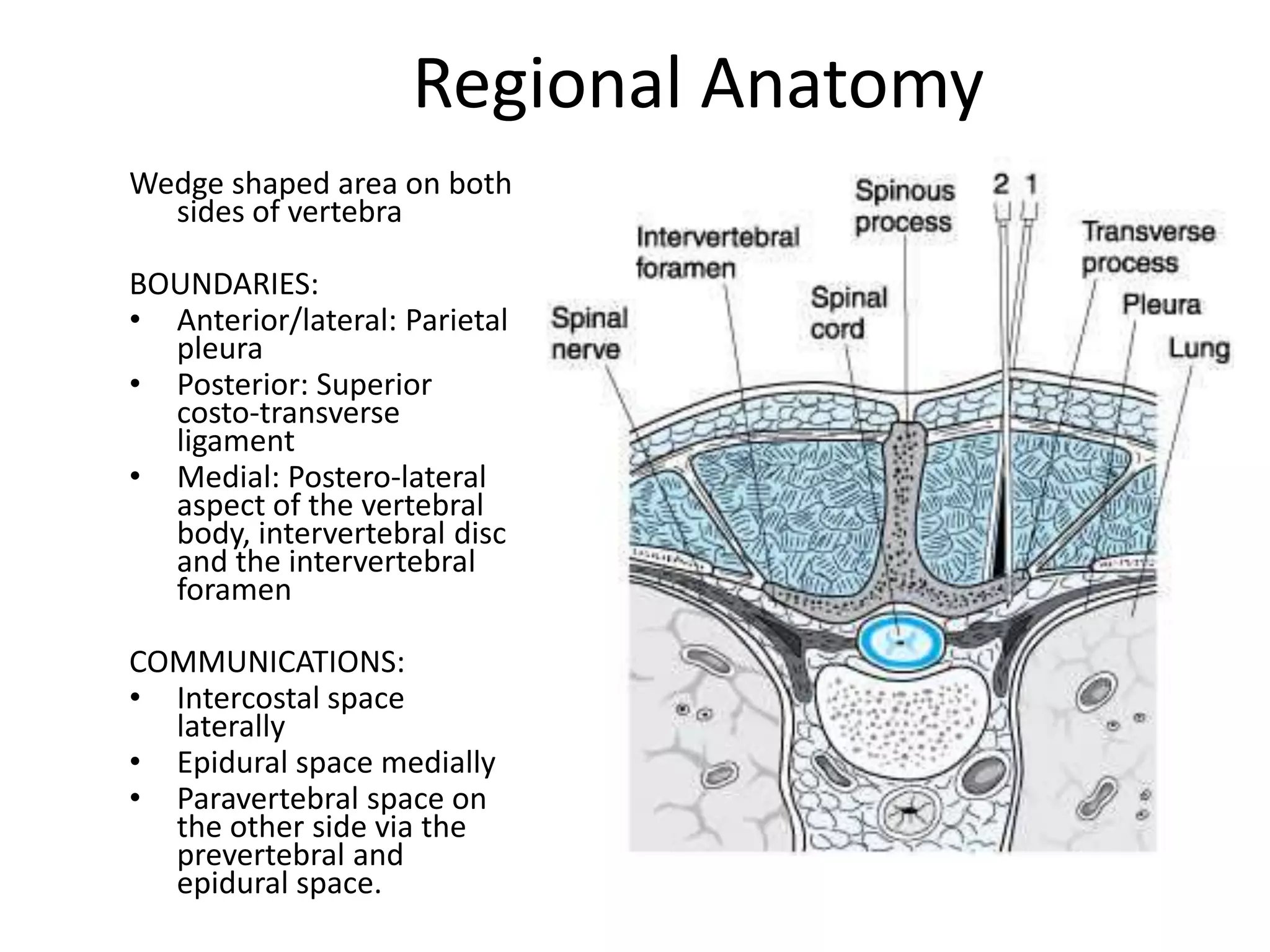
Regional Anatomy
Wedge shaped area on both
  sides of vertebra

BOUNDARIES:
• Anterior/lateral: Parietal
  pleura
• Posterior: Superior
  costo-transverse
  ligament
• Medial: Postero-lateral
  aspect of the vertebral
  body, intervertebral disc
  and the intervertebral
  foramen

COMMUNICATIONS:
• Intercostal space
  laterally
• Epidural space medially
• Paravertebral space on
  the other side via the
  prevertebral and
  epidural space.
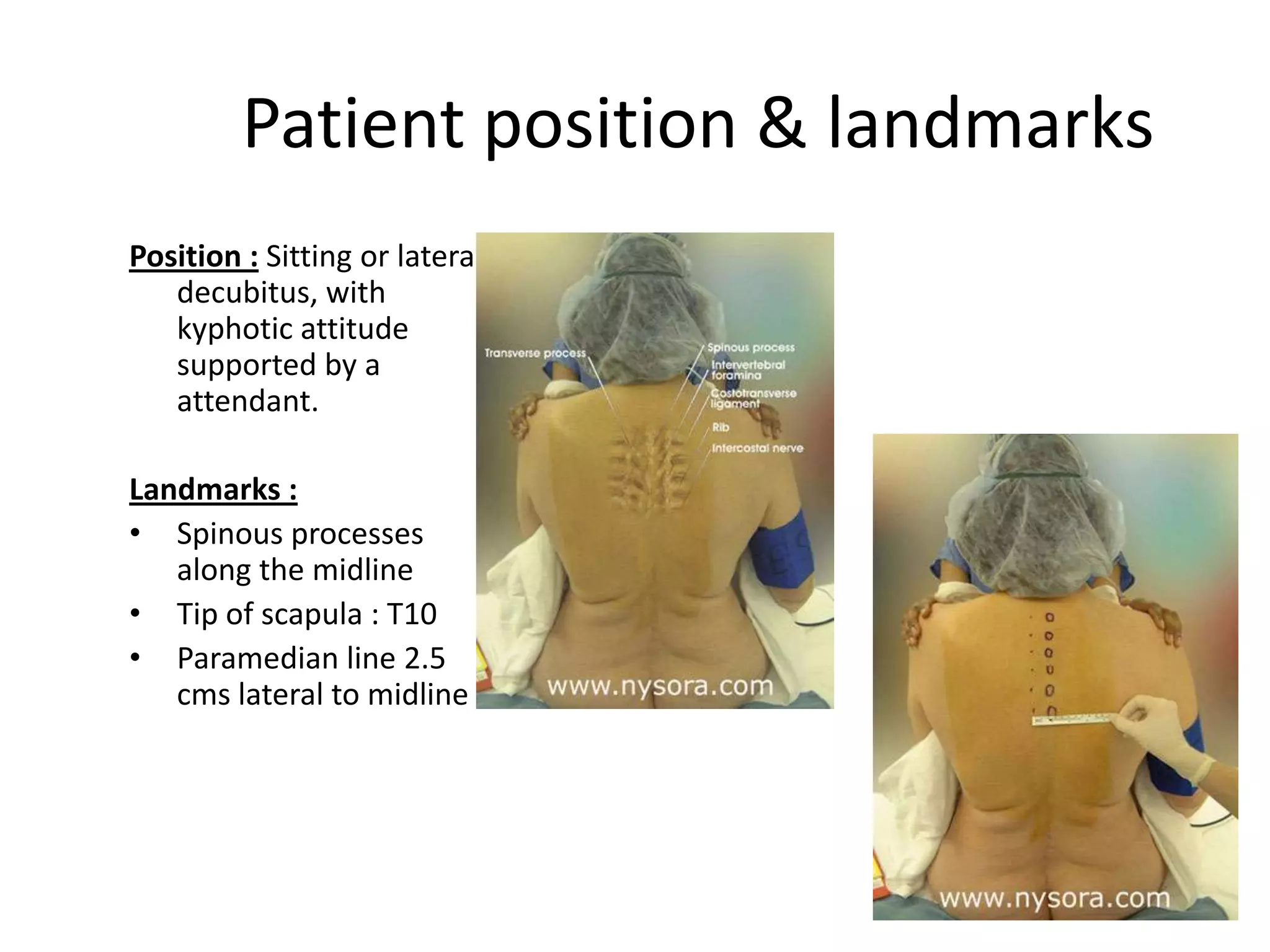
Patient position & landmarks
Position : Sitting or lateral
   decubitus, with
   kyphotic attitude
   supported by a
   attendant.

Landmarks :
• Spinous processes
   along the midline
• Tip of scapula : T10
• Paramedian line 2.5
   cms lateral to midline
Technique
• At thoracic level :
  Spinous process of
  upper vertebrae is at
  level of transverse
  process of lower
  spine.

Needle Insertion Point:
  2.5 cm lateral to the
  tip of spinous process.


                            Saggital section through the thoracic
                            paravertebral space showing a needle that
                            has been advanced above the transverse
                            process.
Technique
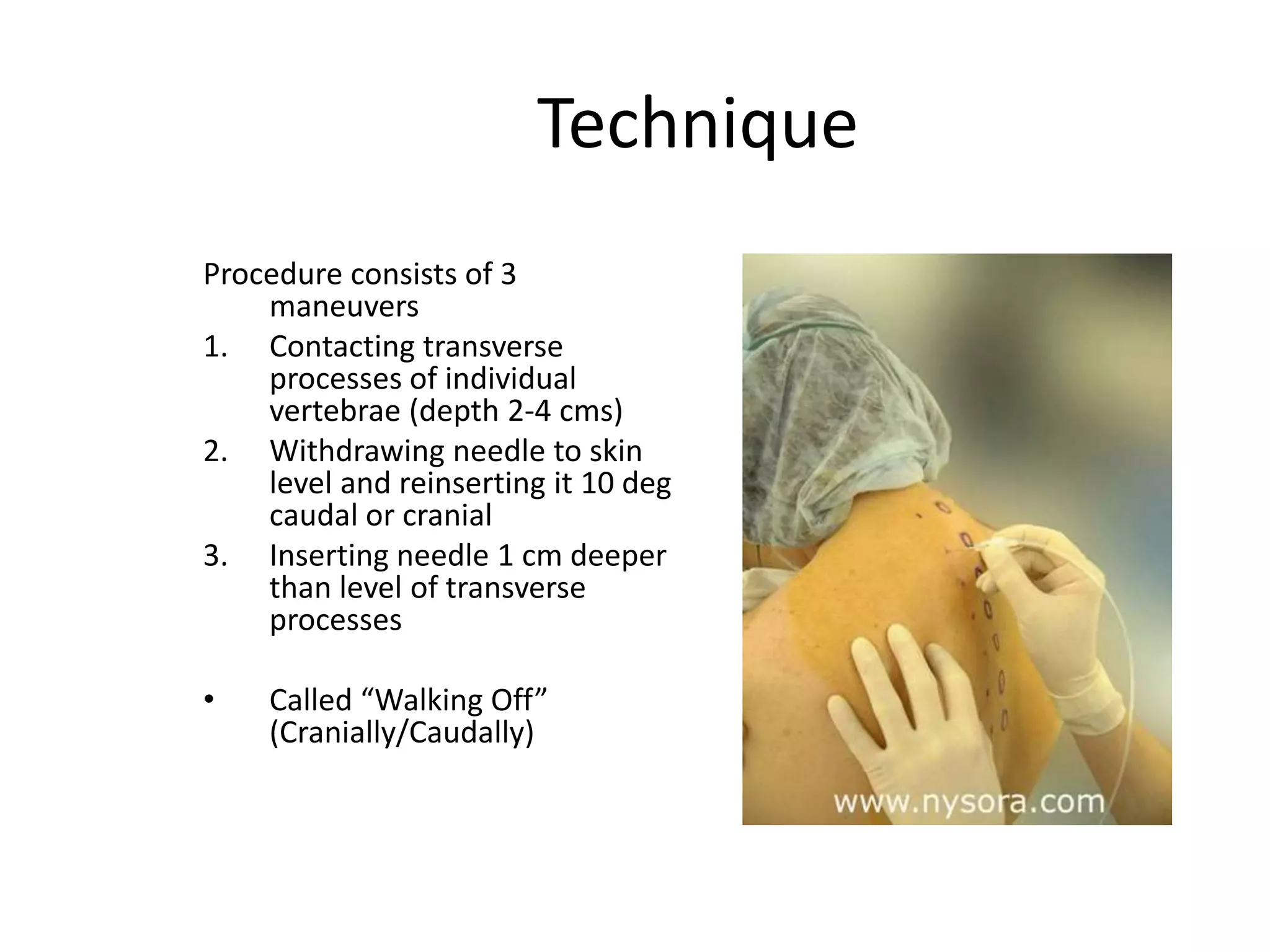
Procedure consists of 3
    maneuvers
1. Contacting transverse
    processes of individual
    vertebrae (depth 2-4 cms)
2. Withdrawing needle to skin
    level and reinserting it 10 deg
    caudal or cranial
3. Inserting needle 1 cm deeper
    than level of transverse
    processes

•   Called “Walking Off”
    (Cranially/Caudally)
Technique
Technique (Continuous Thoracic paravertebral
                   block)
• The same method can be modified and a catheter can be
  placed in the paravertebral space for giving more prolonged
  post operative analgesia
• A Touhy’s needle is used for the procedure and a catheter is
  inserted 5 cms beyond the tip of the needle
• Catheter is ideally inserted 1-2 segmental levels below the
  thoracotomy incision
Commonly used drugs
                 Onset   Anesthesia   Analgesia
                 (min)   (hrs)        (hrs)
2% Lidocaine     10-15   2-3          3-4
(plus HCO3 +
epinephrine)


0.5%             15-25   4-6          12-18
Bupivacaine
(plus
epinephrine)
0.5%             12-25   4-6          12-18
ropivaicaine
(+epinephrine)
Local Anesthetic: 3-4 ml/ level for multiple level block, 15-20 ml for single
   level, and infusion @ 0.1 ml/kg/h. Appropriate drugs: bupivacaine 0.25-
   0.5%, ropivacaine 0.25-0.5%, or lidocaine 1%; with epinephrine (2.5
   μg/ml).

Mechanism and Spread of Anesthesia: 15 ml bupivacaine 0.5% in TPVs
  produces unilateral somatic block over 5 (range: 1-9) dermatomes, and
  sympathetic block over 8 (range 6-10) dermatomes.

Possible areas of spread:
• May remain localized
• May spread to contiguous levels above and below
• Intercostal space laterally
• Epidural space, mostly unilateral and insignificant, in up to 70%
• Single 15-20 ml injection as effective as multiple 3-4 ml/site.
• Increasing volume may predispose to bilateral anesthesia
• If a wide block (≥ 5 dermatomes) is desired, preferable to do multiple
   injections, or 2 injections several dermatomes apart
Contraindications
ABSOLUTE                  RELATIVE
• Infection at the site   • Coagulopathy
  of needle insertion,    • Kyphoscoliosis (chest
• Empyema                   deformity may
• Allergy to local          predispose to pleural
  anesthetic drugs,         or thecal puncture)
  and                     • Patient with
• Tumor occupying the       previous
  TPVS.                     thoracotomy: TPVs
                            may be obliterated
                            by scar tissue and
                            adhesion of lung to
                            chest wall
INTERCOASTAL NERVE BLOCKS
              (ICNB)
• Mostly used for postoperative analgesia after
  surgeries like thoracotomy, mastectomy,
  cholecystectomy, gastrostomy etc
• Neurolytic ICNB’s are used to treat chronic
  painful conditions like post thoracotomy and
  mastectomy pain
• Also used in rib fractures
Applied anatomy
• Each intercoastal nerve has four parts
      - gray ramus comminucans
      - posterior cutaneous branch
      - lateral cutaneous branch
      - anterior cutaneous branch
• Positioning – pt may be sitting, prone or lateral.
  key is to pull scapulae laterally to facilitate access
  to posterior angle of ribs above T7
• Inferior border of ribs marked just lateral to
  sacrospinalis muscle ( 6-8cm lateral to midline in
  lower ribs, 4-6cm in upper ribs )
• A 22-24 G inserted at 20 degree cephalad angle
• After inserting to a depth of 1 cm rib is
  encountered, which is walked off in cephalad
  direction
• Insert 3 mm more tilll a pop of internal
  intercoastal fascia is felt
• After negative aspiration, 3-5 ml of LA is
  injected
• 1-2% lignocaine with or without epinephrine,
  bupibacaine 0.25-0.5% and ropivacaine 0.5-
  0.75% is used
• The ideal angle of entry into the subcostal groove is
  about 20° cephalad.
• A continuous catheter may be better tolerated in
  cases that require repeated blocks at multiple levels.
• ICNB provides excellent analgesia but is seldom
  adequate for intraoperative anesthesia.
• Supplemental analgesia may be required in
  continuous ICNB especially if the area of pain is wide.
• Epidural block should be considered as a better
  alternative to bilateral ICNBs because of the risk
  of bilateral pneumothorax and the potential for
  local anesthetic toxicity due the increased amount
  of local anesthetic required.
• Absorption of local anesthetic from the intercostal
  space is rapid and toxicity is usually an important
  concern.
• ICNB above T7 may be difficult because of the
  scapulae and an alternative technique such as
  paravertebral or epidural block should be
  considered.
complications
•   Pneumothorax
•   Lung injury
•   Local anaesthetic toxicity
•   Peritoneal and abdominal viscera injury
•   Intrathecal drug injection
Transverse abdominis plane (TAP)
               block
• INDICATIONS
 appendectomy
Hernia repair
Caesarean section
Abdominal hysterectomy
Prostactectomy
Laproscopic surgery
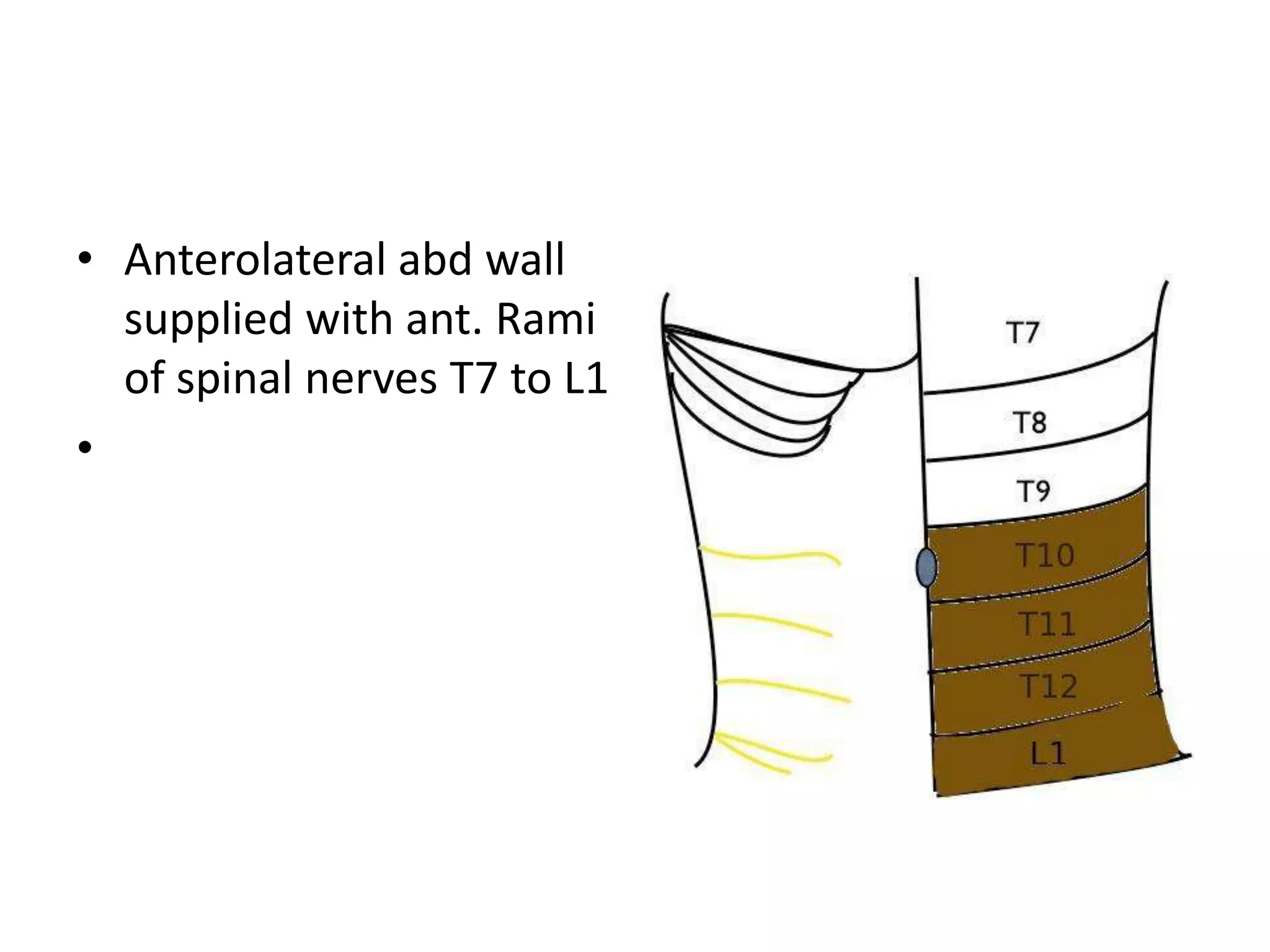
• Anterolateral abd wall
  supplied with ant. Rami
  of spinal nerves T7 to L1
•
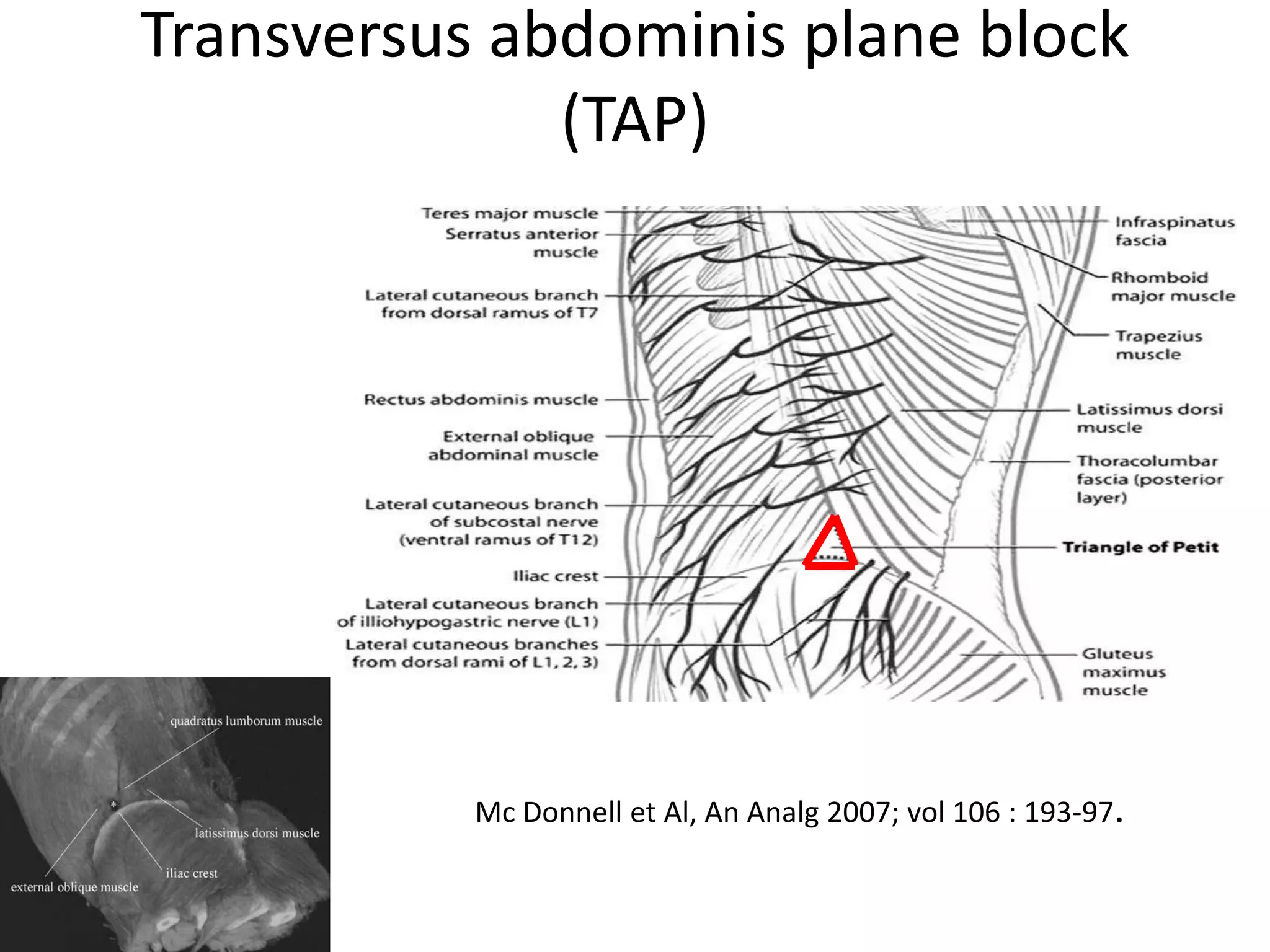
Transversus abdominis plane block
                   (TAP)


                Mc Donnell et Al, An Analg 2007; vol 106 : 193-97.

27
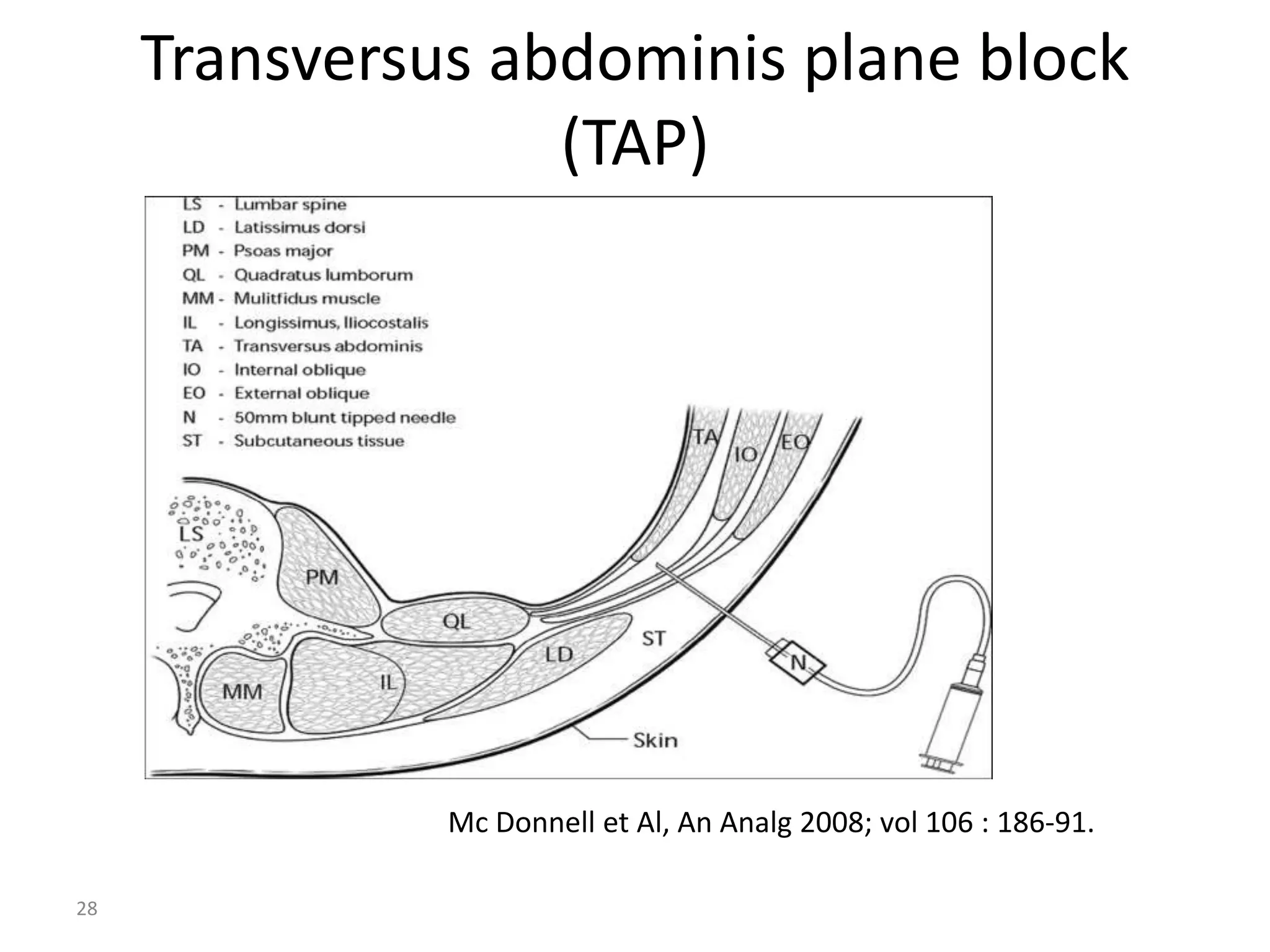
Transversus abdominis plane block
                   (TAP)


               Mc Donnell et Al, An Analg 2008; vol 106 : 186-91.

28
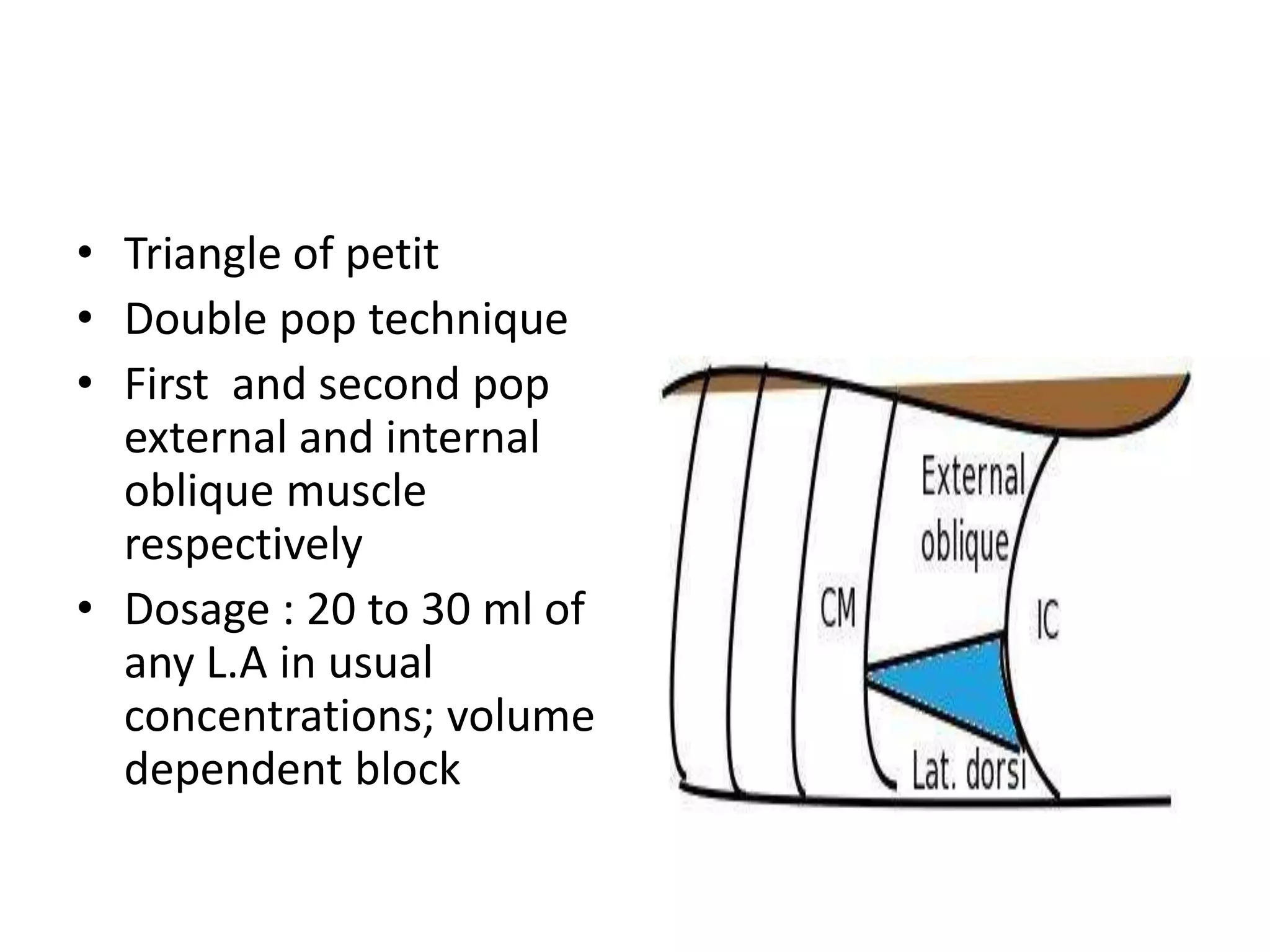
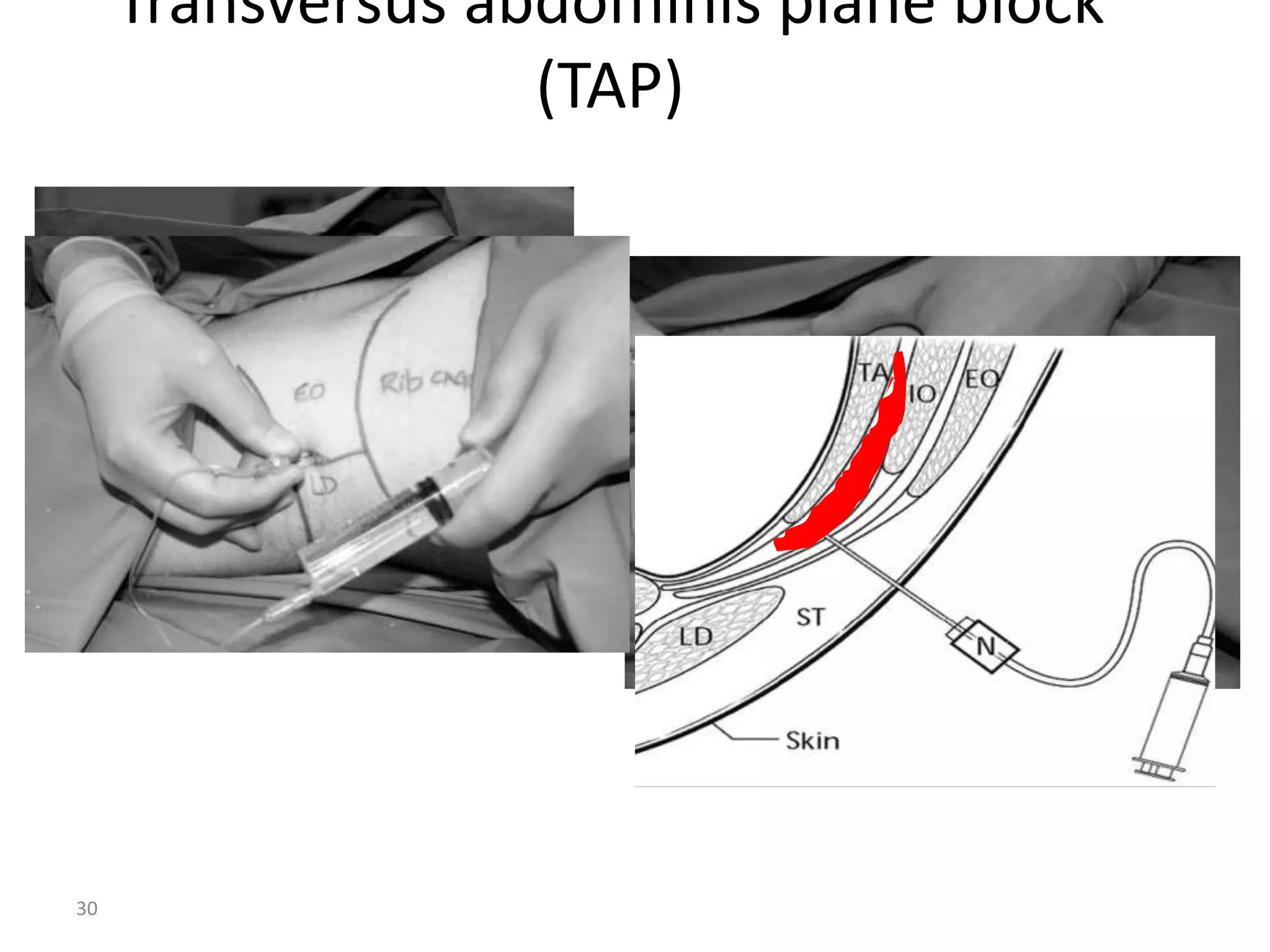
• Triangle of petit
• Double pop technique
• First and second pop
  external and internal
  oblique muscle
  respectively
• Dosage : 20 to 30 ml of
  any L.A in usual
  concentrations; volume
  dependent block
Transversus abdominis plane block
                   (TAP)


30
complications
• Few,single case report of intra hepatic
  injection
• Intraperitoneal injection
• Bowel hematoma
• Transient femoral nerve palsy
• Systemic toxicity
INTRAPLEURAL BLOCK
• Indications are open cholecystectomy, mutiple
  rib fractures and chronic painfull conditions
  like malignancy, acute herpes zoster and post
  herpetic neualgia
• Post thoracotomy analgesia is inconsistent
  due to presence of drain tubes and blood in
  pleural space
• Site is choosen between T6 to T8 at 10 cm from
  posterior midline
• Sponateously breathing patient, should be asked to
  hold his breath after exhalation
• In anaesthetised pt circuit should be disconnected
• Can be performed in both lateral and supine position
• L.A 20 to 25 ml,usually .25% bupivacaine is used
• Continous infusions have also been employed at rate of
  0.125 ml/kg/hr
• Positioning of patient imp
complications
•   Pnumothorax
•   Chest walll hematoma
•   Systemic absorption
•   Horner’s syndrome
Illioinguinal and illiohypogastric blocks
• Indications for ilioinguinal/iliohypogastric blocks
  include anesthesia for any somatic procedure
  involving the lower abdominal wall/inguinal region
  such as inguinal herniorrhaphy
• For analgesia after surgical procedures using a
  Pfannenstiel incision as for cesarean section and
  abdominal hysterectomy.
• Do not provide visceral anesthesia
• When used for inguinal herniorrhaphy, the sac must
  be infiltrated with local anesthetic to complete
  anesthesia for the procedure.
APPLIED ANATOMY
• Both the iliohypogastric and ilioinguinal nerves
  emanate from the first lumbar spinal root.
• Superomedial to the anterior superior iliac spine,
  the iliohypogastric and ilioinguinal nerves pierce the
  transversus abdominus to lie between it and the
  internal oblique muscles.
• Their ventral rami pierce the internal oblique to lie
  between the internal and external oblique muscles
  before giving off branches.
• The iliohypogastric nerve supplies the skin over the
  inguinal region. The ilioinguinal nerve runs
  anteroinferiorly to the superficial inguinal ring,
  where it emerges to supply the skin on the
  superomedial aspect of the thigh
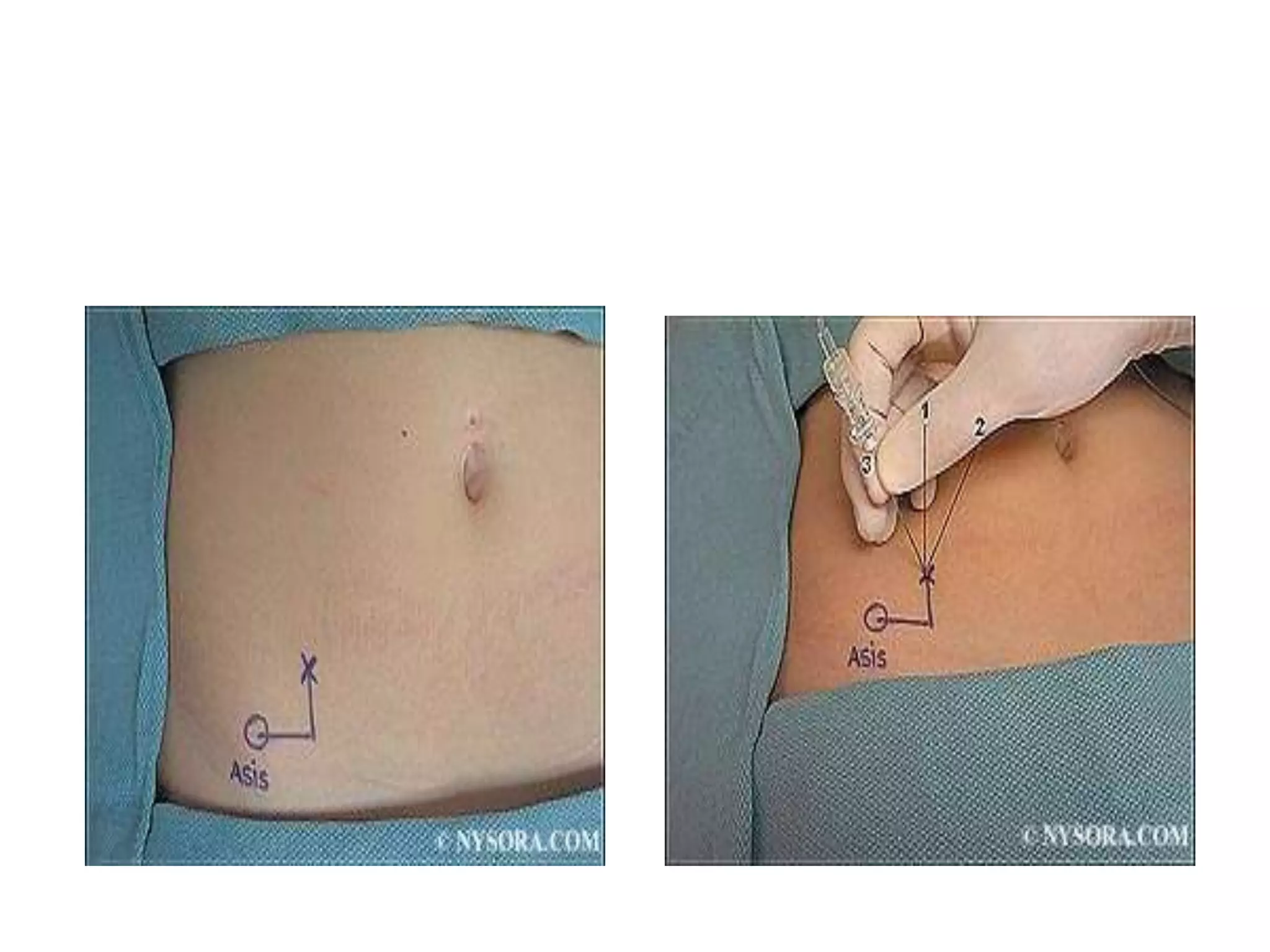
• Initially, the anterior superior iliac spine is palpated and a
  mark made 2 cm medial and 2 cm superior from it .
• The needle is inserted through the skin puncture site
  perpendicular to the skin.
• Increased resistance is met as the needle encounters the
  external oblique muscle. A loss of resistance is appreciated
  as the needle passes through the muscle to lie between it
  and the internal oblique. After the initial loss of resistance
  and negative needle aspiration for blood, 2 mL of local
  anesthetic are injected.
• The needle is then inserted farther to encounter another
  resistance, which is the internal oblique muscle.
• A further loss of resistance is appreciated once
  the needle passes through the internal oblique to
  lie between it and the transversus abdominus
  muscle. After the second loss of resistance,
  another 2 mL of local anesthetic are
  administered.
• The needle is then withdrawn to skin and
  redirected at a 45-degree angle medially to again
  pierce the external and then the internal
  obliquemuscles . After each loss of resistance, 2
  mL of local anesthetic are again administered.
• The needle is then returned to skin and
  inserted 45 degrees laterally, and the
  procedure is repeated. Thus, a total of 12 mL
  of local anesthetic is placed in a fan-like
  distribution between the external and internal
  oblique and the internal oblique and
  transversus abdominus muscles
Contraindications
• There are no specific contraindications for
  these blocks apart from the generic
  contraindications to performance of any
  regional block such as infection at the
  procedure site, allergy to local anesthetics,
  indeterminate neuropathy, and so on.
Thoracic epidural
• Most commonly used in thoracotomies for
  post op pain relief
• Anatomy of vertebral column makes
  technique of thoracic epidural slightly
  different
• Medain and para median approach
Celiac Plexus Block
• anesthesia for intra-abdominal surgery
• reduce stress and endocrine responses to
  surgery
Anatomy and Technique
• contains visceral afferent and efferent fibers
  derived from T5 to T12 by means of the
  greater, lesser, and least splanchnic nerves
• The vena cava lies anteriorly to the right, and
  on the left anteriorly is the aorta
• kidneys lie laterally, with the pancreas anterior
• patient in the prone position and a pillow
  beneath the abdomen
• lines are drawn connecting the spine of T12
  with points 7 to 8 cm laterally at the lower
  edges of the 12th ribs
• A 20-gauge, 10- to 15-cm needle is inserted on
  the left side through a skin wheal at a 45-
  degree angle toward the body of T12 or L1
Side Effects and Complications
• Hypotension
•  Spinal, epidural, or intravascular injection
•  pneumothorax
•  puncture of viscera, such as the kidney,
  ureter, or gut
• retroperitoneal hematoma.
Thank you

Thoracic and abdominal nerve blocks

  • 1.
    THORACIC AND ABDOMINAL NERVE BLOCKS MODERATOR : Dr KAMAL KISHORE Speaker : Tapas Singh
  • 2.
    Contents • Paravertebral block • Intercoastal nerve block • Transversus abdominis plane block • Intrapleural block • Illioinguinal and illiohypogastric blocks • Thoracic epidural block • Celiac plexus block
  • 3.
    PARAVERTABRAL BLOCKS POSTOPERATIVE SURGICAL MISCELLANEOUS ANALGESIA: ANESTHESIA: •Fractured ribs • Thoracic surgery • Breast surgery • Breast surgery • Herniorrhaphy •Therapeutic control • Cholecystectomy • Chest wound of hyperhydrosis • Renal and ureteric exploration •Liver capsule pain surgery after blunt trauma • Herniorrhaphy •Acute postherpetic • Appendectomy neuralgia • Video-assisted thoracoscopic surgery
  • 4.
    Regional Anatomy Wedge shapedarea on both sides of vertebra BOUNDARIES: • Anterior/lateral: Parietal pleura • Posterior: Superior costo-transverse ligament • Medial: Postero-lateral aspect of the vertebral body, intervertebral disc and the intervertebral foramen COMMUNICATIONS: • Intercostal space laterally • Epidural space medially • Paravertebral space on the other side via the prevertebral and epidural space.
  • 5.
    Patient position &landmarks Position : Sitting or lateral decubitus, with kyphotic attitude supported by a attendant. Landmarks : • Spinous processes along the midline • Tip of scapula : T10 • Paramedian line 2.5 cms lateral to midline
  • 6.
    Technique • At thoraciclevel : Spinous process of upper vertebrae is at level of transverse process of lower spine. Needle Insertion Point: 2.5 cm lateral to the tip of spinous process. Saggital section through the thoracic paravertebral space showing a needle that has been advanced above the transverse process.
  • 7.
    Technique Procedure consists of3 maneuvers 1. Contacting transverse processes of individual vertebrae (depth 2-4 cms) 2. Withdrawing needle to skin level and reinserting it 10 deg caudal or cranial 3. Inserting needle 1 cm deeper than level of transverse processes • Called “Walking Off” (Cranially/Caudally)
  • 8.
  • 9.
    Technique (Continuous Thoracicparavertebral block) • The same method can be modified and a catheter can be placed in the paravertebral space for giving more prolonged post operative analgesia • A Touhy’s needle is used for the procedure and a catheter is inserted 5 cms beyond the tip of the needle • Catheter is ideally inserted 1-2 segmental levels below the thoracotomy incision
  • 10.
    Commonly used drugs Onset Anesthesia Analgesia (min) (hrs) (hrs) 2% Lidocaine 10-15 2-3 3-4 (plus HCO3 + epinephrine) 0.5% 15-25 4-6 12-18 Bupivacaine (plus epinephrine) 0.5% 12-25 4-6 12-18 ropivaicaine (+epinephrine)
  • 11.
    Local Anesthetic: 3-4ml/ level for multiple level block, 15-20 ml for single level, and infusion @ 0.1 ml/kg/h. Appropriate drugs: bupivacaine 0.25- 0.5%, ropivacaine 0.25-0.5%, or lidocaine 1%; with epinephrine (2.5 μg/ml). Mechanism and Spread of Anesthesia: 15 ml bupivacaine 0.5% in TPVs produces unilateral somatic block over 5 (range: 1-9) dermatomes, and sympathetic block over 8 (range 6-10) dermatomes. Possible areas of spread: • May remain localized • May spread to contiguous levels above and below • Intercostal space laterally • Epidural space, mostly unilateral and insignificant, in up to 70% • Single 15-20 ml injection as effective as multiple 3-4 ml/site. • Increasing volume may predispose to bilateral anesthesia • If a wide block (≥ 5 dermatomes) is desired, preferable to do multiple injections, or 2 injections several dermatomes apart
  • 12.
    Contraindications ABSOLUTE RELATIVE • Infection at the site • Coagulopathy of needle insertion, • Kyphoscoliosis (chest • Empyema deformity may • Allergy to local predispose to pleural anesthetic drugs, or thecal puncture) and • Patient with • Tumor occupying the previous TPVS. thoracotomy: TPVs may be obliterated by scar tissue and adhesion of lung to chest wall
  • 13.
    INTERCOASTAL NERVE BLOCKS (ICNB) • Mostly used for postoperative analgesia after surgeries like thoracotomy, mastectomy, cholecystectomy, gastrostomy etc • Neurolytic ICNB’s are used to treat chronic painful conditions like post thoracotomy and mastectomy pain • Also used in rib fractures
  • 14.
    Applied anatomy • Eachintercoastal nerve has four parts - gray ramus comminucans - posterior cutaneous branch - lateral cutaneous branch - anterior cutaneous branch
  • 16.
    • Positioning –pt may be sitting, prone or lateral. key is to pull scapulae laterally to facilitate access to posterior angle of ribs above T7 • Inferior border of ribs marked just lateral to sacrospinalis muscle ( 6-8cm lateral to midline in lower ribs, 4-6cm in upper ribs ) • A 22-24 G inserted at 20 degree cephalad angle • After inserting to a depth of 1 cm rib is encountered, which is walked off in cephalad direction
  • 17.
    • Insert 3mm more tilll a pop of internal intercoastal fascia is felt • After negative aspiration, 3-5 ml of LA is injected • 1-2% lignocaine with or without epinephrine, bupibacaine 0.25-0.5% and ropivacaine 0.5- 0.75% is used
  • 21.
    • The idealangle of entry into the subcostal groove is about 20° cephalad. • A continuous catheter may be better tolerated in cases that require repeated blocks at multiple levels. • ICNB provides excellent analgesia but is seldom adequate for intraoperative anesthesia. • Supplemental analgesia may be required in continuous ICNB especially if the area of pain is wide.
  • 22.
    • Epidural blockshould be considered as a better alternative to bilateral ICNBs because of the risk of bilateral pneumothorax and the potential for local anesthetic toxicity due the increased amount of local anesthetic required. • Absorption of local anesthetic from the intercostal space is rapid and toxicity is usually an important concern. • ICNB above T7 may be difficult because of the scapulae and an alternative technique such as paravertebral or epidural block should be considered.
  • 23.
    complications • Pneumothorax • Lung injury • Local anaesthetic toxicity • Peritoneal and abdominal viscera injury • Intrathecal drug injection
  • 24.
    Transverse abdominis plane(TAP) block • INDICATIONS  appendectomy Hernia repair Caesarean section Abdominal hysterectomy Prostactectomy Laproscopic surgery
  • 26.
    • Anterolateral abdwall supplied with ant. Rami of spinal nerves T7 to L1 •
  • 27.
    Transversus abdominis planeblock (TAP) Mc Donnell et Al, An Analg 2007; vol 106 : 193-97. 27
  • 28.
    Transversus abdominis planeblock (TAP) Mc Donnell et Al, An Analg 2008; vol 106 : 186-91. 28
  • 29.
    • Triangle ofpetit • Double pop technique • First and second pop external and internal oblique muscle respectively • Dosage : 20 to 30 ml of any L.A in usual concentrations; volume dependent block
  • 30.
  • 31.
    complications • Few,single casereport of intra hepatic injection • Intraperitoneal injection • Bowel hematoma • Transient femoral nerve palsy • Systemic toxicity
  • 32.
    INTRAPLEURAL BLOCK • Indicationsare open cholecystectomy, mutiple rib fractures and chronic painfull conditions like malignancy, acute herpes zoster and post herpetic neualgia • Post thoracotomy analgesia is inconsistent due to presence of drain tubes and blood in pleural space
  • 34.
    • Site ischoosen between T6 to T8 at 10 cm from posterior midline • Sponateously breathing patient, should be asked to hold his breath after exhalation • In anaesthetised pt circuit should be disconnected • Can be performed in both lateral and supine position • L.A 20 to 25 ml,usually .25% bupivacaine is used • Continous infusions have also been employed at rate of 0.125 ml/kg/hr • Positioning of patient imp
  • 36.
    complications • Pnumothorax • Chest walll hematoma • Systemic absorption • Horner’s syndrome
  • 37.
    Illioinguinal and illiohypogastricblocks • Indications for ilioinguinal/iliohypogastric blocks include anesthesia for any somatic procedure involving the lower abdominal wall/inguinal region such as inguinal herniorrhaphy • For analgesia after surgical procedures using a Pfannenstiel incision as for cesarean section and abdominal hysterectomy. • Do not provide visceral anesthesia • When used for inguinal herniorrhaphy, the sac must be infiltrated with local anesthetic to complete anesthesia for the procedure.
  • 38.
    APPLIED ANATOMY • Boththe iliohypogastric and ilioinguinal nerves emanate from the first lumbar spinal root. • Superomedial to the anterior superior iliac spine, the iliohypogastric and ilioinguinal nerves pierce the transversus abdominus to lie between it and the internal oblique muscles. • Their ventral rami pierce the internal oblique to lie between the internal and external oblique muscles before giving off branches. • The iliohypogastric nerve supplies the skin over the inguinal region. The ilioinguinal nerve runs anteroinferiorly to the superficial inguinal ring, where it emerges to supply the skin on the superomedial aspect of the thigh
  • 40.
    • Initially, theanterior superior iliac spine is palpated and a mark made 2 cm medial and 2 cm superior from it . • The needle is inserted through the skin puncture site perpendicular to the skin. • Increased resistance is met as the needle encounters the external oblique muscle. A loss of resistance is appreciated as the needle passes through the muscle to lie between it and the internal oblique. After the initial loss of resistance and negative needle aspiration for blood, 2 mL of local anesthetic are injected. • The needle is then inserted farther to encounter another resistance, which is the internal oblique muscle.
  • 41.
    • A furtherloss of resistance is appreciated once the needle passes through the internal oblique to lie between it and the transversus abdominus muscle. After the second loss of resistance, another 2 mL of local anesthetic are administered. • The needle is then withdrawn to skin and redirected at a 45-degree angle medially to again pierce the external and then the internal obliquemuscles . After each loss of resistance, 2 mL of local anesthetic are again administered.
  • 42.
    • The needleis then returned to skin and inserted 45 degrees laterally, and the procedure is repeated. Thus, a total of 12 mL of local anesthetic is placed in a fan-like distribution between the external and internal oblique and the internal oblique and transversus abdominus muscles
  • 44.
    Contraindications • There areno specific contraindications for these blocks apart from the generic contraindications to performance of any regional block such as infection at the procedure site, allergy to local anesthetics, indeterminate neuropathy, and so on.
  • 45.
    Thoracic epidural • Mostcommonly used in thoracotomies for post op pain relief • Anatomy of vertebral column makes technique of thoracic epidural slightly different • Medain and para median approach
  • 48.
    Celiac Plexus Block •anesthesia for intra-abdominal surgery • reduce stress and endocrine responses to surgery
  • 49.
    Anatomy and Technique •contains visceral afferent and efferent fibers derived from T5 to T12 by means of the greater, lesser, and least splanchnic nerves • The vena cava lies anteriorly to the right, and on the left anteriorly is the aorta • kidneys lie laterally, with the pancreas anterior
  • 50.
    • patient inthe prone position and a pillow beneath the abdomen • lines are drawn connecting the spine of T12 with points 7 to 8 cm laterally at the lower edges of the 12th ribs • A 20-gauge, 10- to 15-cm needle is inserted on the left side through a skin wheal at a 45- degree angle toward the body of T12 or L1
  • 52.
    Side Effects andComplications • Hypotension • Spinal, epidural, or intravascular injection • pneumothorax • puncture of viscera, such as the kidney, ureter, or gut • retroperitoneal hematoma.
  • 53.