Lactic acid bacteria (LAB)
By Mehwish Manzoor
Contents...
• Lactic acid bacteria (LAB)
• Potential biomedical LAB applications
• LAB as Vaccines
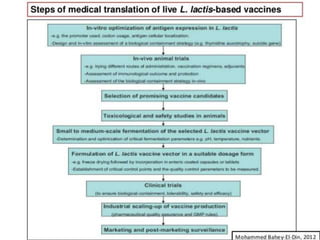
• Steps of medical translation of live L. lactis-based
vaccines
• Benefits of LAB based Vaccines
• Future perspectives
Lactic acid bacteria (LAB)
• Represent a group of different gram-positive
microorganisms,
• non sporulating bacteria
• This group is distinguished by the ability to carry out
• fermentation of carbohydrates to form lactic acid
• Beneficial role played by these microorganisms in the
humans and other animals
Cont……..
• Present in many foods and are frequently used as
probiotics
• to improve some biological functions in the host
Lactic Acid Bacteria (LAB) or Lactics applications
• plants, meat, and dairy
• Dairy products - acidophilus milk, yogurt, buttermilk,
and cheeses
• The Lactics are also important commercially in the
processing of meats (sausage, cured hams), alcoholic
beverages (beer, fortified spirits), and vegetables
(pickles, and saukerkraut).
Potential biomedical LAB applications
• LAB as adjuvants,
• immunostimulators, or
• Therapeutic drug delivery systems
• Factories to produce therapeutic molecules
Why we choose LAB as vaccines?
• Lactobacillus genus, are able to colonise cavities
such as the mouth, the urogenital or the
gastrointestinal tracts, where they play a critical role
in maintaining a balanced normal micro flora •
Preventing or lowering the incidence or recurrent
urinary or digestive tract infections
Cont…..
• LAB are quite acid resistant and certain strains are
able to effectively survive passage through the
stomach
• • Absence of LPS in their cell wall virtually eliminates
the risk of
• endotoxic shock
Lactic acid bacteria (LAB)
• Important genera of (LAB) Lactococcus,
Lactobacillus, Leuconostoc, Streptococcus and
Pediococcus.
• Therapeutically used species L. acidophilus , L.
brevis, L. casei, L. bulgaricus and L. bifidus.
Exploitation of LAB
• Live vaccine or vaccine delivery vehicle
• The evolution of genetic engineering techniques
• Expressing heterologous proteins in different cellular
compartments
• improving their antigenic potential for the
production of vaccines against viruses, bacteria, and
parasites.
LAB as vaccine delivery vehicle
• The use of bacteria as vaccine delivery vehicles
implies construction of recombinant strains that
contain the gene cassette encoding the antigen
• Several genera of LAB are being tested as vaccine
delivery vehicles
Cont……
• Vaccines deliver vehicle
• Expresses an antigen from another species
• The vaccine component to be delivered can be
either protein or DNA
• Use of live viral or bacterial vectors for the
production of replicative particulate antigens in vivo
LAB as live vaccine
• As Live bacterial vaccines
• Designed to induce an immune response Itself
• To develop LAB as live vaccines, they have to be
genetically transformed
Recent developments
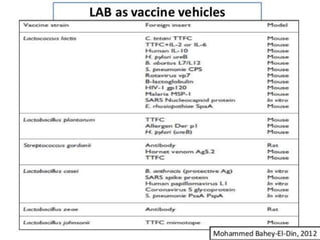
• Lactococcus lactis - Brucella abortis and Helicobacter
pylori
• Streptococcus gordonii prototype vaccines against
HIV and measles
• With Lactobacillus, prototype vaccines against
anthrax and rotavirus are under development, and
have already been obtained against tetanus
Benefits of LAB based Vaccines
• Eg: Lactococcus lactis
• Lactococcus lactis is a GRAS (generally regarded as
safe) bacterium that is widely used in the food
industry
• Intensive genetic and molecular research potential
new biomedical applications –vaccine delivery, –gene
delivery, –heterologous protein expression and –
therapeutic drug delivery
Future perspectives
• No or few lactococcal vaccine candidates are
currently under clinical investigation
• The use of biological containment strategies may be
necessary to prevent survival of genetically modified
vaccine strains in the environment
• The ultimate aim will be to develop environmentally
safe, multi-valent LAB vaccine vectors against a
variety of different pathogens
Lactic acid bacteria (lab)

Lactic acid bacteria (lab)

  • 1.
    Lactic acid bacteria(LAB) By Mehwish Manzoor
  • 2.
    Contents... • Lactic acidbacteria (LAB) • Potential biomedical LAB applications • LAB as Vaccines • Steps of medical translation of live L. lactis-based vaccines • Benefits of LAB based Vaccines • Future perspectives
  • 3.
    Lactic acid bacteria(LAB) • Represent a group of different gram-positive microorganisms, • non sporulating bacteria • This group is distinguished by the ability to carry out • fermentation of carbohydrates to form lactic acid • Beneficial role played by these microorganisms in the humans and other animals
  • 4.
    Cont…….. • Present inmany foods and are frequently used as probiotics • to improve some biological functions in the host
  • 5.
    Lactic Acid Bacteria(LAB) or Lactics applications • plants, meat, and dairy • Dairy products - acidophilus milk, yogurt, buttermilk, and cheeses • The Lactics are also important commercially in the processing of meats (sausage, cured hams), alcoholic beverages (beer, fortified spirits), and vegetables (pickles, and saukerkraut).
  • 6.
    Potential biomedical LABapplications • LAB as adjuvants, • immunostimulators, or • Therapeutic drug delivery systems • Factories to produce therapeutic molecules
  • 7.
    Why we chooseLAB as vaccines? • Lactobacillus genus, are able to colonise cavities such as the mouth, the urogenital or the gastrointestinal tracts, where they play a critical role in maintaining a balanced normal micro flora • Preventing or lowering the incidence or recurrent urinary or digestive tract infections
  • 8.
    Cont….. • LAB arequite acid resistant and certain strains are able to effectively survive passage through the stomach • • Absence of LPS in their cell wall virtually eliminates the risk of • endotoxic shock
  • 9.
    Lactic acid bacteria(LAB) • Important genera of (LAB) Lactococcus, Lactobacillus, Leuconostoc, Streptococcus and Pediococcus. • Therapeutically used species L. acidophilus , L. brevis, L. casei, L. bulgaricus and L. bifidus.
  • 10.
    Exploitation of LAB •Live vaccine or vaccine delivery vehicle • The evolution of genetic engineering techniques • Expressing heterologous proteins in different cellular compartments • improving their antigenic potential for the production of vaccines against viruses, bacteria, and parasites.
  • 11.
    LAB as vaccinedelivery vehicle • The use of bacteria as vaccine delivery vehicles implies construction of recombinant strains that contain the gene cassette encoding the antigen • Several genera of LAB are being tested as vaccine delivery vehicles
  • 12.
    Cont…… • Vaccines delivervehicle • Expresses an antigen from another species • The vaccine component to be delivered can be either protein or DNA • Use of live viral or bacterial vectors for the production of replicative particulate antigens in vivo
  • 14.
    LAB as livevaccine • As Live bacterial vaccines • Designed to induce an immune response Itself • To develop LAB as live vaccines, they have to be genetically transformed
  • 16.
    Recent developments • Lactococcuslactis - Brucella abortis and Helicobacter pylori • Streptococcus gordonii prototype vaccines against HIV and measles • With Lactobacillus, prototype vaccines against anthrax and rotavirus are under development, and have already been obtained against tetanus
  • 17.
    Benefits of LABbased Vaccines • Eg: Lactococcus lactis • Lactococcus lactis is a GRAS (generally regarded as safe) bacterium that is widely used in the food industry • Intensive genetic and molecular research potential new biomedical applications –vaccine delivery, –gene delivery, –heterologous protein expression and – therapeutic drug delivery
  • 18.
    Future perspectives • Noor few lactococcal vaccine candidates are currently under clinical investigation • The use of biological containment strategies may be necessary to prevent survival of genetically modified vaccine strains in the environment • The ultimate aim will be to develop environmentally safe, multi-valent LAB vaccine vectors against a variety of different pathogens