DESERT ECOSYSTEM
What is a Desert?
• A desert is defined as a region which receives an
annual precipitation of less than 250mm [10
inches] on an average.
• Other than low precipitation,deserts are also
characterized by scarce vegetation and extreme
temperatures oscillating between 115F or more
during daytime and 32F or less at night.
• Deserts have dry climate due to rain-blocking
mountain ranges and remoteness from oceanic
moisture.
What is Desert Ecosystem?
In an ecosystem,the biological community
interacts with the abiological physical
environment for its survival.
The desert is characterized by extreme,
specialized and very sensitive ecosystem.
ADAPTATIONS
The key to survival in desert
organisms
Adaptations in plants
• Desert plants have highly modified features that helps
them to thrive at extreme climatic condition.
• They have short growing seasons and long dormancies.
• The well known desert plant, cactus is a succulent,
meaning it has thickened, fleshy parts to store water.
• Stem is the only part that stores water and water is
stored as a thick viscous liquid.
• Cacti stem is called phylloclade.
• Cacti have lost true leaves during their adaptation,
retaining only spines which are
Adaptations in plants
highly modified leaves.
In the absence of true leaves, the stem performs
photosynthesis with the help of stomata.
Transpiration, the process in which CO2 enters and
water escapes does not take place during day at the
same time as photosynthesis but instead occurs at
night because during the cooler, more humid night
hours water loss is significantly reduced.
Adaptations in plants
Another significant modification of cacti is its
extensive root system.
The roots may grow upto 100 ft under the soil to
access water and quickly react to rainfall by
immediately absorbing water that reaches the
ground surface.
Opuntia
Golden
barrel
cactus
Tall
columnar
cactus
Tree-like
cactus
Desert lily
Saguaro flower
Adaptations in animals
• To avoid heat : The animals avoid being out in
the sun during daytime and live in burrows to
escape intense heat.
• To dissipate heat: Animals have developed long
body parts that provide greater surface area to
dissipate heat. Light colours are poor absorbers
of heat. Most desert animals are pale in colour
which prevents their bodies from absorbing more
heat from the sun.
Adaptations in animals
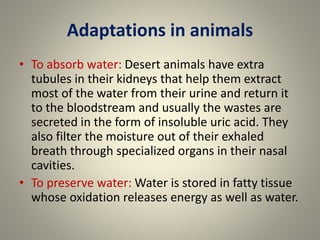
• To absorb water: Desert animals have extra
tubules in their kidneys that help them extract
most of the water from their urine and return it
to the bloodstream and usually the wastes are
secreted in the form of insoluble uric acid. They
also filter the moisture out of their exhaled
breath through specialized organs in their nasal
cavities.
• To preserve water: Water is stored in fatty tissue
whose oxidation releases energy as well as water.
Dromedary
camel
Bactrian camel
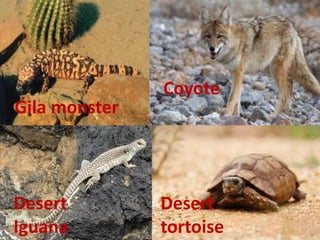
Gila monster
Coyote
Desert
Iguana
Desert
tortoise
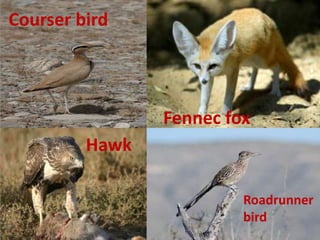
Courser bird
Fennec fox
Hawk
Roadrunner
bird
Desert Farming
Is it possible?
YES
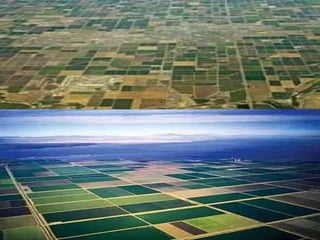
Desert farming has become a
possibility today and the best
example is the IMPERIAL VALLEY
The Imperial Valley
• The Imperial valley is located in the Sonoran
desert of Southwestern California.
• High temperature and low annual rainfall of 3
inches [76 mm]
• Thousand’s of acres of desert land have been
transformed into one of the most productive
farming regions in California with an annual
crop production worth $1 billion.
The Imperial Valley
• Water distribution includes 1400 miles [2300
km] of canals and 1100 miles [1800 km] of
water pipelines.
• Water is supplied from the Colorado river via
the All American Canal.
• Major crops grown in the Imperial Valley are
winter fruits, vegetables, cotton, grains and
Alfalfa.
All American
Canal
Imperial
dam

Desert ecosystem

  • 1.
  • 2.
    What is aDesert? • A desert is defined as a region which receives an annual precipitation of less than 250mm [10 inches] on an average. • Other than low precipitation,deserts are also characterized by scarce vegetation and extreme temperatures oscillating between 115F or more during daytime and 32F or less at night. • Deserts have dry climate due to rain-blocking mountain ranges and remoteness from oceanic moisture.
  • 3.
    What is DesertEcosystem? In an ecosystem,the biological community interacts with the abiological physical environment for its survival. The desert is characterized by extreme, specialized and very sensitive ecosystem.
  • 4.
    ADAPTATIONS The key tosurvival in desert organisms
  • 5.
    Adaptations in plants •Desert plants have highly modified features that helps them to thrive at extreme climatic condition. • They have short growing seasons and long dormancies. • The well known desert plant, cactus is a succulent, meaning it has thickened, fleshy parts to store water. • Stem is the only part that stores water and water is stored as a thick viscous liquid. • Cacti stem is called phylloclade. • Cacti have lost true leaves during their adaptation, retaining only spines which are
  • 6.
    Adaptations in plants highlymodified leaves. In the absence of true leaves, the stem performs photosynthesis with the help of stomata. Transpiration, the process in which CO2 enters and water escapes does not take place during day at the same time as photosynthesis but instead occurs at night because during the cooler, more humid night hours water loss is significantly reduced.
  • 7.
    Adaptations in plants Anothersignificant modification of cacti is its extensive root system. The roots may grow upto 100 ft under the soil to access water and quickly react to rainfall by immediately absorbing water that reaches the ground surface.
  • 8.
  • 9.
  • 10.
    Adaptations in animals •To avoid heat : The animals avoid being out in the sun during daytime and live in burrows to escape intense heat. • To dissipate heat: Animals have developed long body parts that provide greater surface area to dissipate heat. Light colours are poor absorbers of heat. Most desert animals are pale in colour which prevents their bodies from absorbing more heat from the sun.
  • 11.
    Adaptations in animals •To absorb water: Desert animals have extra tubules in their kidneys that help them extract most of the water from their urine and return it to the bloodstream and usually the wastes are secreted in the form of insoluble uric acid. They also filter the moisture out of their exhaled breath through specialized organs in their nasal cavities. • To preserve water: Water is stored in fatty tissue whose oxidation releases energy as well as water.
  • 12.
  • 13.
  • 14.
  • 15.
  • 16.
    YES Desert farming hasbecome a possibility today and the best example is the IMPERIAL VALLEY
  • 17.
    The Imperial Valley •The Imperial valley is located in the Sonoran desert of Southwestern California. • High temperature and low annual rainfall of 3 inches [76 mm] • Thousand’s of acres of desert land have been transformed into one of the most productive farming regions in California with an annual crop production worth $1 billion.
  • 18.
    The Imperial Valley •Water distribution includes 1400 miles [2300 km] of canals and 1100 miles [1800 km] of water pipelines. • Water is supplied from the Colorado river via the All American Canal. • Major crops grown in the Imperial Valley are winter fruits, vegetables, cotton, grains and Alfalfa.
  • 20.