Descriptive modeling in climate
change
Prepared by:
Raheela Shabbir
Introduction
• Models are very simple representation of a real system. For the prediction of earth
climate, model can also be used. For this sake, there is a need to represent how
oceans and atmosphere act, how winds blow, how temperature patterns changes and
so on. Like any mathematical model about natural systems, climate model is also a
simplification of real system. One important thing to remember is the choosing of
complexity of a model. Therefore, complexity of a selected model sets limitations
to the application of climate model.
• There are a number of modeling approaches in environmental modeling to be
chosen for climate modeling. Though, most comprehensive and applicable one is
descriptive modeling. Descriptive modeling is a type of mathematical modeling
that describes major historical events and the assumed or real relationship among
elements that created these events. This modeling type can be understood by taking
an example. Suppose, For instance, yesterday when I went to the store to buy milk,
it cost me $1.00 a litre, last month it was 95 cents, last year it was 80 cents. Based
on historical events, I assume it will cost me roughly $1.05 to buy a litre of milk
next month.
Descriptive modeling
• Descriptive models are typically formed
starting with the understanding of significant
components of a system, relationships between
these components and representation of them
numerically. Usually, regional environmental
models are weather based, meaning they
derive how weather components e.g.,
precipitation and temperature affects other
processes of environment
Cnt..
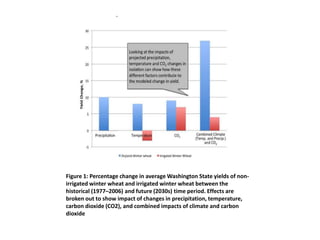
• One of the strengths of descriptive model is
that they are used to isolate contributing
factors to climate change. For example
research had been conducted by CRB forecast,
to know about changes in agricultural yield for
dryland winter wheat and irrigated winter
wheat under the influence of climate change
Figure 1: Percentage change in average Washington State yields of non-
irrigated winter wheat and irrigated winter wheat between the
historical (1977–2006) and future (2030s) time period. Effects are
broken out to show impact of changes in precipitation, temperature,
carbon dioxide (CO2), and combined impacts of climate and carbon
dioxide
Climate system
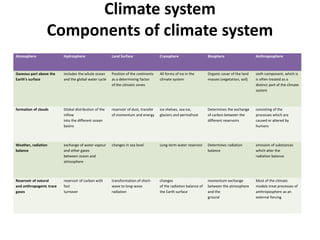
Components of climate system
Atmosphere Hydrosphere Land Surface Cryosphere Biosphere Anthroposphere
Gaseous part above the
Earth’s surface
includes the whole ocean
and the global water cycle
Position of the continents
as a determining factor
of the climatic zones
All forms of ice in the
climate system
Organic cover of the land
masses (vegetation, soil)
sixth component, which is
is often treated as a
distinct part of the climate
system
formation of clouds Global distribution of the
inflow
into the different ocean
basins
reservoir of dust, transfer
of momentum and energy
ice shelves, sea ice,
glaciers and permafrost
Determines the exchange
of carbon between the
different reservoirs
consisting of the
processes which are
caused or altered by
humans
Weather, radiation
balance
exchange of water vapour
and other gases
between ocean and
atmosphere
changes in sea level Long-term water reservior Determines radiation
balance
emission of substances
which alter the
radiation balance
Reservoir of natural
and anthropogenic trace
gases
reservoir of carbon with
fast
turnover
transformation of short-
wave to long-wave
radiation
changes
of the radiation balance of
the Earth surface
momentum exchange
between the atmosphere
and the
ground
Most of the climate
models treat processes of
anthroposphere as an
external forcing
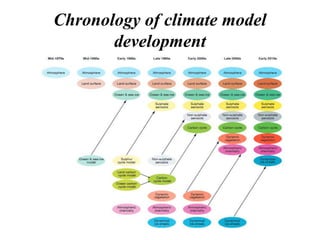
Chronology of climate model
development
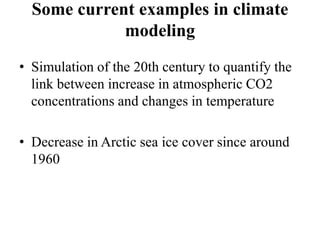
Some current examples in climate
modeling
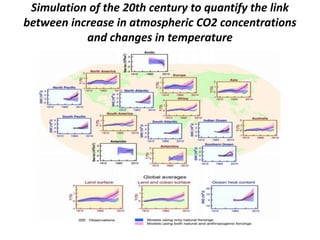
• Simulation of the 20th century to quantify the
link between increase in atmospheric CO2
concentrations and changes in temperature
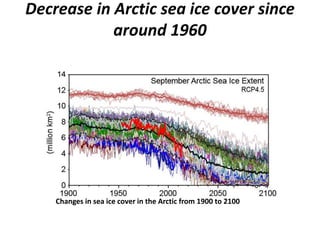
• Decrease in Arctic sea ice cover since around
1960
Simulation of the 20th century to quantify the link
between increase in atmospheric CO2 concentrations
and changes in temperature
Cnt…
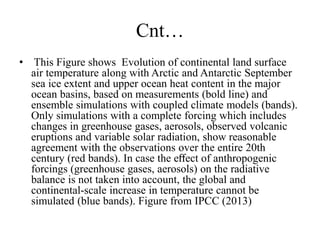
• This Figure shows Evolution of continental land surface
air temperature along with Arctic and Antarctic September
sea ice extent and upper ocean heat content in the major
ocean basins, based on measurements (bold line) and
ensemble simulations with coupled climate models (bands).
Only simulations with a complete forcing which includes
changes in greenhouse gases, aerosols, observed volcanic
eruptions and variable solar radiation, show reasonable
agreement with the observations over the entire 20th
century (red bands). In case the effect of anthropogenic
forcings (greenhouse gases, aerosols) on the radiative
balance is not taken into account, the global and
continental-scale increase in temperature cannot be
simulated (blue bands). Figure from IPCC (2013)
Decrease in Arctic sea ice cover since
around 1960
Changes in sea ice cover in the Arctic from 1900 to 2100

Descriptive modeling in climate change

  • 2.
    Descriptive modeling inclimate change Prepared by: Raheela Shabbir
  • 3.
    Introduction • Models arevery simple representation of a real system. For the prediction of earth climate, model can also be used. For this sake, there is a need to represent how oceans and atmosphere act, how winds blow, how temperature patterns changes and so on. Like any mathematical model about natural systems, climate model is also a simplification of real system. One important thing to remember is the choosing of complexity of a model. Therefore, complexity of a selected model sets limitations to the application of climate model. • There are a number of modeling approaches in environmental modeling to be chosen for climate modeling. Though, most comprehensive and applicable one is descriptive modeling. Descriptive modeling is a type of mathematical modeling that describes major historical events and the assumed or real relationship among elements that created these events. This modeling type can be understood by taking an example. Suppose, For instance, yesterday when I went to the store to buy milk, it cost me $1.00 a litre, last month it was 95 cents, last year it was 80 cents. Based on historical events, I assume it will cost me roughly $1.05 to buy a litre of milk next month.
  • 4.
    Descriptive modeling • Descriptivemodels are typically formed starting with the understanding of significant components of a system, relationships between these components and representation of them numerically. Usually, regional environmental models are weather based, meaning they derive how weather components e.g., precipitation and temperature affects other processes of environment
  • 5.
    Cnt.. • One ofthe strengths of descriptive model is that they are used to isolate contributing factors to climate change. For example research had been conducted by CRB forecast, to know about changes in agricultural yield for dryland winter wheat and irrigated winter wheat under the influence of climate change
  • 6.
    Figure 1: Percentagechange in average Washington State yields of non- irrigated winter wheat and irrigated winter wheat between the historical (1977–2006) and future (2030s) time period. Effects are broken out to show impact of changes in precipitation, temperature, carbon dioxide (CO2), and combined impacts of climate and carbon dioxide
  • 7.
    Climate system Components ofclimate system Atmosphere Hydrosphere Land Surface Cryosphere Biosphere Anthroposphere Gaseous part above the Earth’s surface includes the whole ocean and the global water cycle Position of the continents as a determining factor of the climatic zones All forms of ice in the climate system Organic cover of the land masses (vegetation, soil) sixth component, which is is often treated as a distinct part of the climate system formation of clouds Global distribution of the inflow into the different ocean basins reservoir of dust, transfer of momentum and energy ice shelves, sea ice, glaciers and permafrost Determines the exchange of carbon between the different reservoirs consisting of the processes which are caused or altered by humans Weather, radiation balance exchange of water vapour and other gases between ocean and atmosphere changes in sea level Long-term water reservior Determines radiation balance emission of substances which alter the radiation balance Reservoir of natural and anthropogenic trace gases reservoir of carbon with fast turnover transformation of short- wave to long-wave radiation changes of the radiation balance of the Earth surface momentum exchange between the atmosphere and the ground Most of the climate models treat processes of anthroposphere as an external forcing
  • 8.
    Chronology of climatemodel development
  • 9.
    Some current examplesin climate modeling • Simulation of the 20th century to quantify the link between increase in atmospheric CO2 concentrations and changes in temperature • Decrease in Arctic sea ice cover since around 1960
  • 10.
    Simulation of the20th century to quantify the link between increase in atmospheric CO2 concentrations and changes in temperature
  • 11.
    Cnt… • This Figureshows Evolution of continental land surface air temperature along with Arctic and Antarctic September sea ice extent and upper ocean heat content in the major ocean basins, based on measurements (bold line) and ensemble simulations with coupled climate models (bands). Only simulations with a complete forcing which includes changes in greenhouse gases, aerosols, observed volcanic eruptions and variable solar radiation, show reasonable agreement with the observations over the entire 20th century (red bands). In case the effect of anthropogenic forcings (greenhouse gases, aerosols) on the radiative balance is not taken into account, the global and continental-scale increase in temperature cannot be simulated (blue bands). Figure from IPCC (2013)
  • 12.
    Decrease in Arcticsea ice cover since around 1960 Changes in sea ice cover in the Arctic from 1900 to 2100