Demystifying Climate Models Andrew Gettelman Richard B Rood
Demystifying Climate Models Andrew Gettelman Richard B Rood
Demystifying Climate Models Andrew Gettelman Richard B Rood
Demystifying Climate Models Andrew Gettelman Richard B Rood
Demystifying Climate Models Andrew Gettelman Richard B Rood
1.
Demystifying Climate ModelsAndrew Gettelman
Richard B Rood download
https://ebookbell.com/product/demystifying-climate-models-andrew-
gettelman-richard-b-rood-59041856
Explore and download more ebooks at ebookbell.com
2.
Here are somerecommended products that we believe you will be
interested in. You can click the link to download.
Demystifying Climate Models A Users Guide To Earth System Models 1st
Edition Andrew Gettelman
https://ebookbell.com/product/demystifying-climate-models-a-users-
guide-to-earth-system-models-1st-edition-andrew-gettelman-5485556
Demystifying Climate Risk Volume I Environmental Health And Societal
Implications 1st Edition Carole Leblanc
https://ebookbell.com/product/demystifying-climate-risk-volume-i-
environmental-health-and-societal-implications-1st-edition-carole-
leblanc-51625632
Demystifying Emotions A Typology Of Theories In Psychology And
Philosophy Agnes Moors
https://ebookbell.com/product/demystifying-emotions-a-typology-of-
theories-in-psychology-and-philosophy-agnes-moors-44980700
Demystifying Graph Data Science Graph Algorithms Analytics Methods
Platforms Databases And Use Cases Pethuru Raj
https://ebookbell.com/product/demystifying-graph-data-science-graph-
algorithms-analytics-methods-platforms-databases-and-use-cases-
pethuru-raj-46321980
3.
Demystifying Ansible AutomationPlatform A Definitive Way To Manage
Ansible Automation Platform And Ansible Tower Sean Sullivan
https://ebookbell.com/product/demystifying-ansible-automation-
platform-a-definitive-way-to-manage-ansible-automation-platform-and-
ansible-tower-sean-sullivan-46609282
Demystifying Interventional Radiologya Guide For Medical Students
Sriharsha Athreya
https://ebookbell.com/product/demystifying-interventional-radiologya-
guide-for-medical-students-sriharsha-athreya-46697306
Demystifying Cryptography With Openssl 30 Discover The Best Techniques
To Enhance Your Network Security With Openssl 30 1st Edition Alexei
Khlebnikov
https://ebookbell.com/product/demystifying-cryptography-with-
openssl-30-discover-the-best-techniques-to-enhance-your-network-
security-with-openssl-30-1st-edition-alexei-khlebnikov-46849580
Demystifying Scholarly Metrics A Practical Guide 1st Edition Marc W
Vinyard
https://ebookbell.com/product/demystifying-scholarly-metrics-a-
practical-guide-1st-edition-marc-w-vinyard-47664920
Demystifying Islam Tackling The Tough Questions Harris Zafar
https://ebookbell.com/product/demystifying-islam-tackling-the-tough-
questions-harris-zafar-48506502
5.
Earth Systems Dataand Models
Andrew Gettelman
Richard B. Rood
Demystifying
Climate
Models
A Users Guide to Earth System Models
6.
Earth Systems Dataand Models
Volume 2
Series editors
Bernd Blasius, Carl von Ossietzky University Oldenburg, Oldenburg, Germany
William Lahoz, NILU—Norwegian Institute for Air Research, Kjeller, Norway
Dimitri P. Solomatine, UNESCO—IHE Institute for Water Education, Delft,
The Netherlands
7.
Aims and Scope
Thebook series Earth Systems Data and Models publishes state-of-the-art research
and technologies aimed at understanding processes and interactions in the earth
system. A special emphasis is given to theory, methods, and tools used in earth,
planetary and environmental sciences for: modeling, observation and analysis; data
generation, assimilation and visualization; forecasting and simulation; and
optimization. Topics in the series include but are not limited to: numerical, data-
driven and agent-based modeling of the earth system; uncertainty analysis of models;
geodynamic simulations, climate change, weather forecasting, hydroinformatics,
and complex ecological models; model evaluation for decision-making processes
and other earth science applications; and remote sensing and GIS technology.
The series publishes monographs, edited volumes and selected conference
proceedings addressing an interdisciplinary audience, which not only includes
geologists, hydrologists, meteorologists, chemists, biologists and ecologists but
also physicists, engineers and applied mathematicians, as well as policy makers
who use model outputs as the basis of decision-making processes.
More information about this series at http://www.springer.com/series/10525
8.
Andrew Gettelman •Richard B. Rood
Demystifying Climate
Models
A Users Guide to Earth System Models
Acknowledgments
Amy Marks providedvery careful and thorough edit, as well as numerous helpful
suggestions. Cheryl Craig, Teresa Foster, Andrew Dolan, and Galia Guentchev
contributed their time to reading through drafts and providing a needed reality
check. Prof. Reto Knutti helped this book take shape while Andrew Gettelman was
on sabbatical at ETH in Zurich. David Lawrence shared critical insights and
PowerPoint figures on terrestrial systems. Thanks also to Markus Jochum for
straightening us out on explaining how the ocean works. Jan Sedlacek,
ETH-Zürich, helped with figures in Chap. 11 (especially Fig. 11.6).
Mike Moran and David Edwards of the National Center for Atmospheric
Research provided financial support. Lawrence Buja and the National Center for
Atmospheric Research hosted Richard Rood’s visitor status. The National Center
for Atmospheric Research is funded by the U.S. National Science Foundation.
We thank the staff and students of the University of Michigan’s Climate Center
for reviews of the manuscript: Samantha Basile, William Baule, Matt Bishop, Laura
Briley, Daniel Brown, Kimberly Channell, Omar Gates, and Elizabeth Gibbons.
Richard Rood thanks the students in his classes on climate change problem-solving
at the University of Michigan and acknowledges in particular the project work of:
James Arnott, Christopher Curtis, Kevin Kacan, Kazuki Ito, Benjamin Lowden,
Sabrina Shuman, Kelsey Stadnikia, Anthony Torres, Zifan Yang.
Richard Rood acknowledges the support of the University of Michigan and the
Graham Sustainability Institute, and grants from the National Oceanographic and
Atmospheric Administration (Great Lakes Sciences and Assessments Center
(GLISA)—NOAA Climate Program Office NA10OAR4310213) and the
Department of the Interior, National Park Service (Cooperative Agreement
P14AC00898).
Francesca Gettelman exhibited nearly unlimited patience with some late nights.
v
About the Authors
AndrewGettelman is a Scientist in the Climate and Global Dynamics and
Atmospheric Chemistry and Modeling Laboratories at the National Center for
Atmospheric Research (NCAR). He is actively involved in developing atmosphere
and chemistry components for global climate models at NCAR. Dr. Gettelman
specializes in understanding and simulating cloud processes and their impact on
climate, especially ice clouds. He has numerous publications on cloud physics
representations in global models, as well as research on climate forcing and feed-
backs. He has participated in several international assessments of climate models,
particularly for assessing atmospheric chemistry. Gettelman holds a doctorate in
Atmospheric Science from the University of Washington, Seattle. He is a recent
recipient of the American Geophysical Union Ascent Award, and is a
Thompson-Reuters Highly Cited Researcher.
Richard B. Rood is a Professor in the Department of Climate and Space Sciences
and Engineering (CLaSP) at the University of Michigan. He is also appointed in the
School of Natural Resources and Environment. Prior to joining the University of
Michigan, he worked in modeling and high performance computing at the National
Aeronautics and Space Administration (NASA). His recent research is focused on
the usability of climate knowledge and data in management planning and practice.
He has started classes in climate-change problem solving, climate change uncer-
tainty in decision making, climate-change informatics (with Paul Edwards). In
addition to publications on numerical models, his recent publications include
software engineering, informatics, political science, social science, forestry and
public health. Rood’s professional degree is in Meteorology from Florida State
University. He recently served on the National Academy of Sciences Committee on
A National Strategy for Advancing Climate Modeling. He writes expert blogs on
climate change science and problem solving for the Weather Underground Richard
Rood is a Fellow of American Meteorological Society and a winner of the World
Meteorological Organization’s Norbert Gerbier Award.
xiii
18.
Introduction
Human-caused climate changeis perhaps the defining environmental issue of the
early twenty-first century. We observe the earth’s climate in the present, but
observations of future climate are not available yet. So in order to predict the future,
we rely on simulation models to predict future climate.
This book is designed to be a guide to climate simulation and prediction for the
non-specialist and an entry point for understanding uncertainties in climate models.
The goal is not to be simply a popular guide to climate modeling and prediction, but
to help those using climate models to understand the results. This book provides
background on the earth’s climate system and how it might change, a detailed
qualitative analysis of how climate models are constructed, and a discussion of
model results and the uncertainty inherent in those results. Throughout the text,
terms in bold will be referenced in the glossary. References are provided as foot-
notes in each chapter.
Who uses climate models? Climate model users are practitioners in many fields
who desire to incorporate information about climate and climate change into
planning and management decisions. Users may be scientists and engineers in fields
such as ecosystems or water resources. These scientists are familiar with models
and the roles of models in natural science. In other cases, the practitioners are
engineers, urban planners, epidemiologists, or architects. Though not necessarily
familiar with models of natural science, experts in these fields use quantitative
information for decision-making. These experts are potential users of climate
models. We hope in the end that by understanding climate models and their
uncertainties, the reader will understand how climate models are constructed to
represent the earth’s climate system. The book is intended to help the reader
become a more competent interpreter or translator of climate model output.
Climate is best thought of as the distribution of weather states, or the probability
of finding a particular weather state (usually described by temperature and pre-
cipitation) at any place and time. Climate science seeks to be able to describe this
distribution. In contrast, the goal of predicting the weather is to figure out exactly
which weather state will occur for a specific place and time (e.g., what the high
temperature and total precipitation will be on Tuesday for a given city). Even in
xv
19.
modern societies, weare still more dependent on the weather than we like to admit.
Think of a winter storm snarling traffic and closing schools. Windstorms and
hailstorms can cause significant damage. Or think of the impact of severe tropical
cyclones (also called hurricanes or typhoons, depending on their location), per-
sonified and immortalized with names like Sandy, Andrew, or Katrina. Persistence
(or absence) of weather events is also important. Too little rain (leading to drought
and its resulting effects on agriculture and even contributing to wildfires) and too
much rain (leading to flooding) are both damaging.
Although we are tempted to speak of a single “climate,” there are many climates.
Every place has its own. We build our societies to be comfortable during the
expected weather events (the climate) in each place. Naturally, different climates
mean different expected weather events, and our societies adapt. Buildings in
Minneapolis are built to standards different from buildings in Miami or San
Francisco. City planning is also different in different climates. Minneapolis has
connected buildings so that people do not need to walk outside in winter, for
example. Singapore has connected buildings so that people do not need to walk
outside in heat and humidity. Not just the built environment, but the fabric of
society may be different with local climates. In warmer climates, social life takes
place outdoors, for example, or the flow of a day includes a rest period (siesta in
Spanish) during the hottest period of the day.
We construct our lives for possible and sometimes rare weather events: putting
on snow tires for winter even though snow may not be around for over half a
winter. We build into our lives the ability to deal with variations in the weather.
A closet contains coats, gloves, hats, rain jackets, umbrellas, sun hats, and sun-
glasses: We are ready for a range and for a distribution of possible weather states.
Some events are rare: Snow occasionally has fallen in Los Angeles, for example.
But it is usually the rare or extreme weather events that are damaging. These
outliers of the distribution are typically damaging because they are unexpected and
therefore we do not adequately prepare for them. Or rather, the expectation
(probability) is so rare that it is not cost-effective for society to prepare for them.
This applies to the individual as well: if you live in Miami your closet contains
more warm weather gear, and less cold weather gear. It is unlikely you would be
able to dress for temperatures well below freezing. The impacts of extreme weather
are dependent on the climate of a place as well. For example, a few inches (cen-
timeters) of snow is typical for Denver, Minneapolis, or Oslo, but it will shut down
Rome or Atlanta. One inch (25 millimeters) of annual rainfall is typical for Cairo,
but a disaster in most other places.
Where the most damaging weather events occur are at the extremes of the cli-
mate distribution. One problem is that we often do not know the distribution very
well. Every time we hit a record (e.g., a high temperature, rainfall in 24 hours, days
without rain), we expand the range of observed events a little, and we learn more
about what might happen in a particular place. Because extreme events are rare, we
do not really know the true chance of their occurrence. Think about your knowledge
of the climate where you live or in a place you have visited several times. At first,
you might not have a good grasp of what the seasons are like. After a few years,
xvi Introduction
20.
you think youknow how the seasons evolve. But there are always events that will
surprise you. The record events are those that surprise everyone. What is the
probability of a hurricane flooding Houston as New Orleans was flooded by
Katrina? It has not happened since the city of Houston has been there, so we may
not know. The extremes of the distribution of possible weather states are not well
known.
This creates even more of a problem when these extremes change. Changing the
distribution of weather is what we mean by climate change. The cause of those
changes might be natural or they might be human caused (anthropogenic).
So how do we predict the future of weather and the distribution of weather that
represents climate in a location? To understand and predict the future, we need a
way to represent the system. In other words, we need a model. This book is about
how we attempt to use models to represent the complex climate system and predict
the future. Our goal is to explain and provide a better understanding of the models
we use to describe the past, present, and future of the earth system. These are
commonly known as climate models. Scientists often refer to these models formally
as earth system models, but we use the term climate model.
The purpose of this book is to demystify the models we use to simulate present
and future climate. We explain how the models are constructed, why they are
uncertain, and what level of confidence we should place in those models.
Uncertainty is not a weakness. Understanding uncertainty is a strength, and a key
part of using any model, including climate models. One key message is that the
level of confidence depends on the questions we ask. What are we certain about in
the future and why? What are we less certain of and why? For policy-makers, this is
a critical issue. Understanding how climate models work and how we get there is an
important step in making intelligent decisions using (or not using) these climate
models. Climate models are being used not just to understand the earth system but
also to provide input for policy decisions to address human-caused climate change.
The direction of our environment and economy is dependent on policy options
chosen based on results of these models.
The chapters in Part I serve as a basic primer on climate and climate change. We
hope to give readers an appreciation for the complexity and even beauty of the
complex earth system so that they can better understand how we simulate it. In
Part II, we discuss the mechanics of models of the earth system: How they are built
and what they are trying to represent. Models are built to simulate each region
of the climate system (e.g., atmosphere, ocean, and land), critical processes within
each region, as well as critical interactions between regions and processes. Finally,
in Part III, we focus on uncertainties and probabilities in prediction, with a focus on
understanding what is known, what is unknown, and the degree of certainty. We
also discuss how climate models are evaluated. In the concluding chapter, we
discuss what we know, what we may learn in the future, and why we should (or
should not) use models.
Introduction xvii
occurrence is thehighest probability (the mode). The total area under the line is the
probability. If the total area is given a value of 1, then the area under each part of
the curve is the fractional chance that an event exceeding some threshold will occur.
In Fig. 1.1, the area to the right of point T1 is the probability that the temperature
will be greater than T1, which might be about 20 % of the curve. The mean, or
expected value, is the weighted average of the points. It need not be the point with
the highest frequency. The mean value is the point at which half the probability
(50 %) is on one side of the mean, and half on the other. The median is the value at
which half the points are on one side and half on the other.
Here is an important and obvious question: How can we predict the climate (for
next season, next year, or 50 years from now) if we cannot predict the weather (in 5
or 10 days)? The answer is, we use probability: The climate is the distribution of
probable weather. The weather is a particular location in that distribution, and it is
conditional on the current state of the system. The chance of a hurricane hitting
Miami next week depends mostly on whether one has formed or is forming, and if
one has formed, whether it is heading in the direction of Miami. As another
example, the chance of having a rainy day in Seattle in January is high. But, given a
particular day in January, with a weather state that might be pushing storms well to
the north or south, the probability of rain the next day might be very low. In 50
Januaries, though, the probability of rain would be high. So climate is the distri-
bution of weather (sometimes unknown). Weather is a given state in that distri-
bution (often uncertain).
In a probability distribution of climate, the probabilities and the curve change
over time: In the middle latitudes, the chance of snow is higher in winter than in
summer. The curves will look different from place to place: Some climates have
narrow distributions (see Fig. 1.2a), which means the weather is often very close to
the average. Think about Hawaii, where the average of the daily highs and lows do
not change much over the course of the year or Alaska, where the daily highs and
lows may be the same as in Hawaii in summer, but not in winter. For Alaska the
annual distribution of temperature is a very broad distribution (more like Fig. 1.2b).
Frequency
of
Occurrence
Value (e.g., temperature)
Hot
Cold Mean T1
Fig. 1.1 A probability distribution function with the value on the horizontal axis, and the
frequency of occurrence on the vertical axis
4 1 Key Concepts in Climate Modeling
24.
Of course, evenin Hawaii, extreme events occur. For a distribution like precipi-
tation, which is bounded at one end by zero (no precipitation) the distribution might
be “skewed” (Fig. 1.2c) with a low frequency of high events marking the
‘extreme’. As events are more extreme (think about hurricanes like Katrina or
Sandy), there are fewer such events in the historical record. There may even be
possible extreme events that have not occurred. So our description of climate is
incomplete or uncertain. This is particularly true for rare (low-probability) events.
These events are also the events that cause the most damage.
One aspect of shifting distributions is that extremes can change a lot more than
the mean value (see Fig. 1.3). The mean is the value at which the area is equal on
each side of the distribution. The mean is the same as the median if the distribution
is symmetric. Simply moving the distribution to the right or left causes the area
(meaning, the probability) beyond some fixed threshold to increase (or decrease). If
the curve represents temperature, then shifting it to warmer temperatures (Fig. 1.3a)
decreases the chance of cold events and really increases the chance of warm events.
But note that some cold events still occur. Also, you can change the distribution
without changing the mean by making the distribution wider (or broader). The
mathematical term for the width of a distribution is variance, a statistical term for
variability. This situation is illustrated in Fig. 1.3b. The mean is unchanged in
Narrow
(a)
(b)
(c)
Wide
Uneven (Skewed)
Fig. 1.2 Different probability
distribution functions:
a narrow, b wide and
c skewed distributions
1.1 What Is Climate? 5
25.
Fig. 1.3b, butthe chance of exceeding a given threshold for warm or cold tem-
peratures changes. In other words, the climate (particularly a climate extreme)
changes dramatically, even if the mean stays the same. The change need not be
symmetric: Hot may change more than cold (or vice versa). Figure 1.3c is not a
symmetric distribution. The key is to see climate as the distribution, not as a fixed
number (often the mean).
This brings us to the fundamental difference between weather and climate
forecasting. In weather forecasting,2
we need to know the current state of the
system and have a model for projecting it forward. Often the model can be simple.
One “model” we all use is called persistence: What is the weather now? It may be
like that tomorrow. In many places (e.g., Hawaii), such a model is not bad, but
sometimes it is horribly wrong (e.g., when a hurricane hits Hawaii). So we try to
use more sophisticated models, now typically numerical ones. These models go by
the name numerical weather prediction (NWP) models, and they are used to
“forecast” the evolution of the earth system from its current state.
Increase in mean
Lots more ‘hot’ (some off scale: records)
(a)
(b)
(c)
Less cold
Increase in variance
More hot and cold: both off scale
Same mean
Increase in mean and variance
Lots more hot, off scale
Less cold
Fig. 1.3 Shifting probability distribution functions are illustrated in different ways going from the
blue to red distribution. The thick lines are the distribution, the thin dashed lines are the mean of
the distributions and the dotted lines are fixed points to illustrate probability. Shown is a increase
in mean, b increase in variance (width), c increase in mean and variance
2
For an overview of the history of weather forecasting, see Edwards, P. N. (2013). A Vast
Machine: Computer Models, Climate Data, and the Politics of Global Warming. Cambridge, MA:
MIT Press.
6 1 Key Concepts in Climate Modeling
26.
Climate forecasting usesessentially the same type of model. But the goal of
climate forecasting is to characterize the distribution. This may mean running the
model for a long time to describe the distribution of all possible weather states
correctly. If you start up a weather model from two different states (two different
days), you hope to get a different answer each time. But for climate, you want to get
the same distribution (the same climate), regardless of when the model started. We
return to these examples again later.
1.2 What Is a Model?
A model, in essence, is a representation of a system. A model can be physical
(building blocks) or abstract (an image on paper like a plan, or in your head).
Abstract models can also be mathematical (monetary or physical totals in a
spreadsheet). Ordinary physics that describes how cars go (or, more importantly,
how they stop suddenly) is a model for how the physical world behaves. Numbers
themselves are abstract models. A financial statement is a model of the money and
resource flows of a household, corporation or country. Models are all around us,
and we use them to abstract, make tractable and understand our human and natural
environment.
As a concrete example, think about different “models” of a building. There can
be many types of models of a building. A physical model of the building would
usually be at a smaller scale that you can hold in your hand. There are several
different abstract models of a building, and they are used for different purposes.
Architects and engineers produce building plans: two-dimensional representations
of the building, used to construct and document the building. Some of these are
highly detailed drawings of specific parts of the building, such as the exterior, or the
electrical and plumbing systems. The engineer may have built not just a physical
model of the building, but perhaps even a more detailed structural model designed
to understand how the building will react to wind or ground motion (earthquakes).
Increasingly, these models are “virtual”: The structure is simulated on a computer.
We are familiar with all these sorts of model, but there are other more abstract
models that deal with flows and budgets of materials or money. The owner and
builder also probably have a spreadsheet model of the costs of construction of the
building. This financial model is not certain, because it is really an estimate (or
forecast, see below) of all the different costs of construction. And, finally, the owner
likely has another model of the financial operation of the building: the money
borrowed to finance the building, any income from a commercial building, and the
costs of maintenance and operations of the building. The operating plan is really a
projection into the future: It depends on a lot of uncertainties, like the cost of
electricity or the value of the income from a building. The projection depends on
these inputs, which the spreadsheet does not try to predict. The prediction is con-
ditional on the inputs.
1.1 What Is Climate? 7
27.
Models All AroundUs
Models are everywhere in our world. Many models are familiar and physical,
such as a small-scale model of a building or a bridge, or a mockup of a
satellite or an airplane. Some models we use every day are made up of
numbers. Many people use a model with numbers to manage income and
expenses, savings and debts; that is, a budget. When the model of a bridge is
placed in a computer-assisted design program, or a financial budget is put into
a spreadsheet on a personal computer, then one has a “numerical” model.
These models have a set of mathematical equations that behave with a
specific set of rules, principles or laws.
Climate models are numerical models that calculate budgets of mass,
momentum (velocity) and energy based on the physical laws of conservation.
For example, energy is conserved (neither created or destroyed) and can,
therefore, be counted. The physical laws on which climate models are based
are discussed in more detail in Chap. 4. Weather and climate are dynamical
systems; that is, they evolve over time. We rely on models of dynamical
systems for many aspects of modern life. Here we illustrate a few examples of
models that affect our everyday lives.
Climate models are closely related to weather forecast models; both
simulate how fluids (air or water) move and interact, and how they exchange
heat. An obvious example of a model that affects daily life is the weather
forecast model, which is used in planning by individuals, governments,
corporations and finance. The exact same physical principles of fluid flow are
used to simulate a process in a chemical plant that takes different substances
as liquids or gasses, reacts them together under controlled temperature and
pressure, and produces new substances. Water and sewage treatment plants
share similar principles and models. Internal combustion engines used for
cars, trucks, ships and power plants are developed using models to understand
how fuel enters the engine and produces heat, and that heat produces motion.
Airplanes are also developed using modeling of the airflow around an aircraft.
In this case, computational modeling has largely replaced design using wind
tunnels. All of these models involve fluid flow and share physical princi-
ples with climate models. The details of the problem, for example, flow in
pipes as contrasted to flow in the free atmosphere, define the specific
requirements for the model construction.
So do you trust a model? Intuitively, we trust models all the time. You are
using the results of a model every time you start your car, flush your toilet,
turn on a light switch or get in an airplane. You count on models when you
drive over a bridge. When NASA sends a satellite or rover to another planet,
the path and behavior of the space vehicle relies on a model of simple physics
describing complex systems.
Models do not just describe physical objects. Models of infectious diseases
played an important role in management of the 2014 outbreak of Ebola. One
function of models is to provide plausible representations of events to come,
8 1 Key Concepts in Climate Modeling
28.
and then toplace people into those plausible futures. It is a way to anticipate
and manage complexity. Though most times these models do not give an
exact story of the future, the planning and decision making that comes from
these modeling exercises improves our ability to anticipate the unexpected
and to manage risk. Think of modeling as a virtual, computational world in
which to exercise the practice of trial and error, and therefore, a method for
reducing the “error” in trial and error. Reducing these errors saves lives and
property. Models reduce the chance of errors: Airplanes do not regularly fall
out of the sky, bridges do not normally collapse and chemical plants do not
typically leak.
Ultimately, trust of models is anchored in evaluation of models compared
to observations and experiences. Weather models are evaluated every day
with billions of observations as well as billions of individuals’ experiences.
Trust is often highly personal. By many objective measures, weather models
have remarkable accuracy, for example, letting a city know more than five
days in advance that a major tropical cyclone is likely to make landfall near
that city. Of course, if the tropical cyclone makes landfall just 60 miles
(100 km) away from the city, many people might conclude the models cannot
be trusted.
Objectively, however, a model that simulated the tropical cyclone and
represented its evolution with an error of 60 miles (100 km) on a globe that
spans many thousands of miles can, also, be construed as being quite accu-
rate. This represents the fact that models provide plausible futures that inform
decision making.
Like weather models, climate models are evaluated with billions of
observations and investigations of past events. The results of models have
been scrutinized by thousands of scientists and practitioners. With virtual
certainty, we know the Earth will warm, sea level will rise, ice will melt and
weather will change. They provide plausible futures, not prescribed futures.
There are uncertainties, and there will always be uncertainties. However, our
growing experiences and vigilant efforts to evaluate and improve will help us
to understand, manage and, sometimes, reduce uncertainty. As the models
improve, trust and usability increase. There remains some uncertainty in most
physical models, but that can be accounted for, and we discuss uncertainty,
and its value in modeling, at length.
Our world is completely dependent on physical models, and their success is
seen around us in the fact that much of the world “works” nearly all of the time.
Models are certain enough to use in dangerous contexts that are both mundane
and ubiquitous. We answer the question of whether we should trust models and
make changes in our lives based on their results every time we get in an
elevator or an airplane. There is no issue of should we trust models; we have
been doing it for centuries since the first bridge was constructed, the first train
left a station or the first time a building was built more than one story high.
1.2 What Is a Model? 9
29.
1.3 Uncertainty
Forecasting involvesprojecting what we know, using a model, onto what we do
not know. The result is a prediction or forecast. Forecasts may be wrong, of course,
and the chance of them being wrong is known as uncertainty. Uncertainty can
come from several different sources, but this is particularly the case when we think
about climate and weather. One way to better characterize uncertainty is to divide it
into categories based on model, scenario and initial conditions.3
1.3.1 Model Uncertainty
Obviously, a model can be wrong or have structural errors (model uncertainty).
For example, if one were modeling how many tires a delivery company would need
for their trucks in a year and assumed that the tires last 10,000 miles, when they
actually only last 7,000 miles, the forecast of tire use is probably wrong. If you
assumed each truck would drive 20,000 miles per year and tires last 10,000 miles,
the trucks would need two sets of tires. However, what if the trucks drove only
14,000 miles per year and each set of tires lasted only 7,000 miles, (still needing
just two sets of tires)? Then the forecast might be right, but the tire forecast would
be right for the wrong reason: in this case, a cancellation of errors.
1.3.2 Scenario Uncertainty
The preceding example also illustrates another potential uncertainty faced in climate
modeling: scenario uncertainty. The scenario4
is the uncertainty in the future
model inputs. In the tire forecast, the scenario assumed 20,000 miles per truck each
year. But the scenario was wrong. If the tire forecast model was correct (or “per-
fect”) and tires lasted 10,000 miles, but the mileage was incorrect (14,000 vs.
20,000 assumed), then the forecast will still be incorrect, even if the model is
perfect. If the actual mileage continued to deviate from the assumption (14,000
miles), then the forecast over time will continue to be incorrect. If one is concerned
with the total purchase of tires and total cost, then the situation becomes even more
uncertain. Other factors (e.g., growth of the company, change in type of tires) may
make forecasting the scenario, or inputs to the model, even more uncertain, even if
the model as it stands is perfect. As the timescale of the model looks farther into the
3
This definition of uncertainty has been developed by Hawkins, E., & Sutton, R. (2009). “The
Potential to Narrow Uncertainty in Regional Climate Prediction.” Bulletin of the American
Meteorological Society, 90(8): 1095–1107.
4
For a discussion of climate scenarios, see Chap. 10.
10 1 Key Concepts in Climate Modeling
30.
future, more andmore different “variables” become uncertain (e.g., new types of
tire, new trucks, the cost of tires). These variables that cannot be predicted, but have
to be assumed, are often called parameters. Scenario uncertainty logically domi-
nates uncertainty farther into the future (see Chap. 10 for more detail).
1.3.3 Initial Condition Uncertainty
Finally, there is uncertainty in the initial state of the system used in the model, or
initial condition uncertainty. In our tire forecast, to be specific about how many
tires we will need in the current or next year, we also need to know what the current
state of tires is on all the trucks. Changes in the current state of tires will have big
effects on the near-term forecast: If all trucks have 6,000 or 8,000 miles on their
tires, there will be more purchases of tires in a given year than if they are all brand
new. Initial condition uncertainty is a similar problem in weather forecasting. As we
will discuss, some aspects of the climate system, particularly related to the oceans,
for example, have very long timescales and “memory,” so that knowing the state of
the oceans affects climate over several decades. However, over long timescales
(longer than the timescale of a process), these uncertainties fade. If you want to
know how many tires will be needed over 5 or 10 years, the uncertainty about the
current state of tires (which affects only the first set of replacements) on the total
number of tires needed is small.
1.3.4 Total Uncertainty
In climate prediction, we must address all three types of uncertainties—model
uncertainty, scenario uncertainty and initial condition uncertainty—to estimate the
total uncertainty in a forecast. They operate on different time periods: Initial con-
dition uncertainty matters most for the short term (i.e., weather scales, or even
seasonal to annual, in some cases), and scenario uncertainty matters most in the
longer term (decades to centuries). Model uncertainty operates at all timescales and
can be “masked” or hidden by other uncertainties.
The complicated nature of these uncertainties makes prediction both harder and
easier. It certainly makes it easier to understand and characterize the uncertainty in a
forecast. One of our goals is to set down ideas and a framework for understanding
how climate predictions can be used. Judging the quality of a prediction is based on
understanding what the uncertainty is and where it comes from. Some comes from
the model and some comes from how the experiment is set up (the initial conditions
and the scenario).
1.3 Uncertainty 11
31.
1.4 Summary
Climate canbest be thought of as a distribution of all possible weather states. What
matters to us is the shape of the distribution. Weather is where we are on the
distribution at any point in time. The extreme values in the distribution, that usually
have low probability, are hard to predict, but that is where most of the impacts lie.
Weather and climate models are similar, except weather models are designed to
predict the exact location on a distribution, while climate models describe the
distribution itself.
We use models all the time to predict the future. Some models are physical
objects, some are numerical models. Climate models are one type of a numerical
model: As we shall see, they can often be thought of as giant spreadsheets that keep
track of the physical properties of the earth system, the same way a budget keeps
track of money.
Uncertainty in climate models has several components. They are related to the
model itself, to the initial conditions for the model (the starting point) and to the
inputs that affect the model over time in a “scenario.” All three must be addressed
for a model to be useful. Uncertainty is not to be feared. Uncertainty is not a failure
of models. Uncertainty can be understood and used to assess confidence in
predictions.
Key Points
• Climate is the distribution of possible weather states at any place and time.
• Extremes of climate are where the impacts are.
• We use models all the time to predict the future, some models are even
numerical.
• Weather and climate models are similar but have different goals.
• Uncertainty has several different parts (model, scenario, initial conditions).
Open Access This chapter is distributed under the terms of the Creative Commons Attribution-
Noncommercial 2.5 License (http://creativecommons.org/licenses/by-nc/2.5/) which permits any
noncommercial use, distribution, and reproduction in any medium, provided the original author(s)
and source are credited.
The images or other third party material in this chapter are included in the work’s Creative
Commons license, unless indicated otherwise in the credit line; if such material is not included in
the work’s Creative Commons license and the respective action is not permitted by statutory
regulation, users will need to obtain permission from the license holder to duplicate, adapt or
reproduce the material.
12 1 Key Concepts in Climate Modeling
These are thetraditional physical components of the earth’s climate system. We
also introduce two more “spheres.” An important fifth component of the system is
the biosphere: the living organisms on the planet, again, which span the terrestrial
surface (plants, organisms in the soil, and animals) as well as the ocean (fish and
plants in the ocean). We discuss the biosphere as part of both the ocean and
terrestrial surface. Finally, although humans are technically part of the biosphere,
our large “footprint” and impact on the global environment and the climate system
is large enough that we can define a separate sphere for human activity and impacts
called the anthroposphere (see Chap. 3).
2.1.1 The Atmosphere
The atmosphere is usually the first part of the climate system we naturally think of.
It is literally the air we breathe: mostly inert nitrogen (78 %) with oxygen (16 %)
and then other trace gases (argon, water vapor, carbon dioxide). The oxygen is a
by-product of the respiration (“breathing”) of plants and other organisms: It is
evidence of life on earth. The oxygen in the atmosphere did not exist before the
emergence of living organisms.1
Oxygen is emitted by plants as an outcome of
photosynthesis that removes carbon from carbon dioxide. Oxygen reacts with
materials (rock and ore) at the earth’s surface (oxidation) and disappears from the
atmosphere. One of the most common reactants is iron (iron oxide = rust), which is
responsible for the red color of many rocks. Unless organisms continue to produce
oxygen, it will disappear from the atmosphere. It would take a long time however:
hundreds of thousands to millions of years. But it is the trace species—water vapor,
carbon dioxide and methane—known as the greenhouse gases, that are most
important in understanding the climate system and how climate might change.
Ocean
Ice (cryosphere)
Sun
Biosphere
Atmosphere
Anthroposphere
Terrestrial (land)
Fig. 2.1 The Earth system. The climate system contains different spheres (components):
atmosphere, ocean, terrestrial, cryosphere, biosphere and anthroposphere
1
Kasting, J. F., & Siefert, J. L. (2002). “Life and the Evolution of Earth’s Atmosphere.” Science,
296(5570): 1066–1068.
14 2 Components of the Climate System
34.
The term greenhousegas refers to gases that are transparent to visible light
emitted from the sun, but opaque (absorptive) to the “infrared” radiation emitted by
the earth. This follows from fundamental physical principles described by the
Boltzmann law, after Ludwig Boltzmann, a 19th-century Austrian physicist. All
mass radiates energy, depending on temperature. The hotter a body (could be your
body, the earth, or the sun), the more energy it radiates: and the peak energy occurs
at different wavelengths. The peak radiation of the sun (surface temperature = 6,000
Kelvin2
[K] or 10,000 °F: very hot either way) radiates a lot of the light we call
visible. It is no accident our eyes evolved to be able to ‘see’ in the visible where the
maximum solar emission is. Objects with cooler temperatures such as the tem-
perature of the earth at about 300 Kelvin (80 °F) radiate in the infrared (longer
wavelengths with much lower energy). These objects include our bodies, the earth
itself, the ocean surface or clouds.
Greenhouse gases, like the glass in a greenhouse, allow in visible light from the
sun, but absorb (and re-emit back down) the infrared energy from the earth.3
The
higher the concentration of these gases in the atmosphere, the greater the warming
effect. The most important greenhouse gas is water vapor. Water vapor also has
some other important effects in the climate system. The second most important gas
is carbon dioxide.
The basic picture of the flows of energy in the atmosphere is illustrated in
Fig. 2.2. The arrows represent approximate sizes of the energy flows4
in the energy
budget. Solar energy comes in; the atmosphere, clouds and the earth absorb some
and reflect some. The technical term for the ratio of reflected over total energy is
albedo. White/light surfaces reflect a lot and have a high albedo: snow, ice, bright
sand. Black/dark surfaces absorb a lot and have a low albedo: dark green trees, the
ocean, asphalt. This is why a black car is hotter than a white car or asphalt is hotter
than concrete in the sun. The energy absorbed warms the object (clouds, atmo-
sphere, surface of the earth/ice/ocean) and it ‘re-emits’, but now at longer wave-
lengths and lower energy since the temperature of the surface is much lower than
the sun. For common temperatures at the earth’s surface (0–100 °F, –20 to 40 °C),
this emission occurs in the infrared. Infrared radiation is absorbed in the atmosphere
by greenhouse gases and clouds, and some returns to the earth. The earth warms the
atmosphere above it in two ways. The direct conduction of heat from a warm
2
The Kelvin temperature scale has the same increment as the Celsius scale but starts at absolute
zero, while Celsius starts at the freezing point of water and can be negative. The Fahrenheit scale
has a smaller increment and the freezing point of water is 32 °F. So 1 °K = 1 °C = 9/5 °F. Scientists
use °K, the United States uses °F and most other countries use °C. We will typically provide °F
and °C.
3
Strictly speaking, the analogy is not correct: The glass in a greenhouse also prevents air from
escaping, and simply being transparent in the visible and restricting air motion is sufficient to keep
a greenhouse warm. The actual “greenhouse” effect for glass is a small part of it.
4
For a more detailed treatment of the energy budget, see Trenberth, K. E., Fasullo, J. T., & Kiehl,
J. (2009) “Earth’s Global Energy Budget.” Bulletin of the American Meteorological Society, 90(3):
311–323.
2.1 Components of the Earth System 15
35.
surface occurs bysensible heat. The energy hitting the surface, particularly the
ocean surface, also can evaporate water vapor. Since this water vapor contains the
energy used to evaporate it, it also is a way of transmitting ‘heat’ (energy), without
changing the temperature. The energy in water vapor is called “latent heat”.
This is the cycle of radiative energy in the earth system, flowing through the
atmosphere. The ultimate source of the energy is the sun. One of the biggest
complications is water, in all its forms: from the oceans, to water vapor in the
atmosphere, to clouds. Put a cloud over a dark surface (ocean or forest), and you
change the energy in the system. The energy changes by reflecting solar energy
from the top of the cloud back to space (cooling). Then energy also changes by
absorbing infrared energy radiated from below in the cloud and sending some of it
back down to the surface (warming).
The movement of water through the atmosphere, the surface and the ocean is
called the hydrologic cycle (Fig. 2.3), which is also important for moving energy in
the atmosphere. Solar energy hitting the ocean causes evaporation of vapor into the
atmosphere, and plants also move water from liquid phase in the soil through their
leaves, back into the atmosphere in a process called transpiration. This water
carries the energy necessary for evaporation in the form of latent heat. The energy is
used to make water molecules in liquid move fast enough to separate from each other
into a gas. They conserve this heat of evaporation as the water vapor moves through
the atmosphere. This heat of evaporation is released when water vapor undergoes
condensation into cloud drops (or ice crystals). This can happen a long way from the
Incoming
Solar
Reflected Solar
Surface
Absorption
Surface
Reflection
Sensible Heat
Latent Heat
Outgoing Terrestrial
Emission to Surface
GHG’s
Fig. 2.2 Energy budget. Solar energy, or shortwave radiation (yellow) comes in from the sun.
Energy is then either reflected by the surface or clouds or absorbed by the atmosphere or surface
(mostly). The surface exchange includes sensible heat (red striped) and latent heat (blue) associated
with water evaporation and condensation. Terrestrial (infrared, longwave) radiation (purple) emitted
from the earth’s surface is absorbed by the atmosphere and clouds. Some escapes to space (outgoing
terrestrial) and some is re-emitted back to the surface by clouds and greenhouse gases (GHGs)
16 2 Components of the Climate System
36.
liquid source (oceans),and clouds eventually form enough drops that they get heavy
and fall (precipitate). The water thus completes a cycle, landing back on the surface.
Water then enters other components of the earth system, such as glaciers, snow,
soil or rivers. Soil moisture can go through plants to get back into the atmosphere
by transpiration. Or it can saturate the soil, become runoff and eventually get back
into the ocean, where the cycle repeats. The key is that water changes the energy
budget because it forms clouds, because it is a greenhouse gas and because it moves
heat around. Water evaporated in the tropics moves as water vapor with the winds
to higher latitudes (see Chap. 5), where it condenses as clouds and deposits heat
there. Water is magical stuff in the earth system. The cycle of water is linked to the
energy budget (through latent heat), and it links the atmosphere to other pieces of
the system.
2.1.2 The Ocean and Sea Ice
We have discussed the ocean briefly as a source of water. The world’s oceans (or
combining them into a single “ocean”) are a critical part of the climate system.5
The
ocean is a tremendous reservoir of heat and holds a lot more mass than the atmo-
sphere. Water is denser than air, and the mass of the top 30 feet (10 m) of ocean is
equal to the mass of the atmosphere above it (90 % of the atmosphere is in the first
55,000 feet or about 17 km). The ocean is critical as a very large store of heat that can
move around and come back into contact with the surface after long periods of time.
Runoff
River Discharge
Evaporation
Precipitation
Condensation
Transpiration
Soil Moisture
Fig. 2.3 The Hydrologic cycle. Water evaporates from the ocean and is carried in the atmosphere
as vapor. It condenses into clouds, and precipitates to the surface, where it can become soil
moisture, glaciers, or runoff as surface water into lakes and back to the ocean. Plants move soil
water back to the atmosphere through transpiration
5
For a good basic overview of the ocean and climate, see Vallis, G. K. (2012). Climate and the
Oceans. Princeton, NJ: Princeton University Press.
2.1 Components of the Earth System 17
37.
The ocean hascurrents that are both shallow (near the surface, the first few hundred
feet of depth) and deep (the rest of the ocean). Unlike the atmosphere, the ocean has
“edges”: Land sticks up in places, dividing the seven seas into, well, seven seas
(actually five ocean basins). The ocean surface currents are forced by the rotation of
the earth and winds. These currents are constrained by the topography in ocean
basins and generate circulation patterns of surface currents.
In addition to the near surface ocean, there is a complex vertical structure to the
ocean. The ocean is divided into a near surface region that is generally warmer and
less salty (fresher) than the deeper ocean below it. Colder and saltier water is
denser, so it tends to sink. The process often is self-reinforcing and is seen in lakes
as well: The surface warms, gets less dense and mixes less with the deeper water,
thus warming more over time (this is called stratification). Density is a critical part
of the structure of the ocean because of changes in density due to heat and salinity,
which do not change very quickly in the ocean. Density helps control the deep
ocean circulation. The deep ocean has one large circulation globally, driven by the
sinking of surface water that gets saltier and colder (denser) until it sinks from the
surface to the deep ocean. This thermohaline circulation (thermo = heat, ha-
line = salt) has sinking motion in small areas of the North Atlantic and the Southern
Ocean near Antarctica, where water is cooling as it moves poleward, and where salt
is expelled from formation of sea ice, increasing salinity. Both processes make the
surface water denser than the water beneath it, causing it to sink.
The ocean also contains parts of two other spheres. The ocean has a biosphere,
consisting of plants and animals living in the ocean and nutrients that flow through
the ocean. Most of the biosphere in the ocean is composed of small organisms,
mostly small floating plants (phytoplankton, algae) and animals that form the basis
of the marine food chain. The ocean is an important part of the flows of carbon
through the earth system as well. The ocean also holds (or supports) part of the
cryosphere as sea ice.6
Sea ice forms in winter in high latitudes in the Arctic Ocean
and in the Southern Ocean. The sea ice moves around and can grow and melt. The
ice may last several years and is a year-round feature in most of the Arctic today.
2.1.3 Terrestrial Systems
Most of the land surface is not covered by ice, however. Most of it is covered by
plants: the terrestrial biosphere. There are also lakes and rivers that channel
precipitation and return it to the ocean. The atmosphere and ocean cause changes
over time in the composition of the land by erosion and processing of rock material.
Water, wind, and waves break up rock. The rock reacts with the atmosphere (ox-
idation) and with water: Sometimes minerals in rocks dissolve in water. The land
6
For a primer on sea ice, see Marshall, S. J. (2011). The Cryosphere. Princeton, NJ: Princeton
University Press.
18 2 Components of the Climate System
38.
evolves by movingslowly as it floats over the crust. For purposes of climate, the
land is often considered static, but we know it changes over long timescales.
Volcanoes and earthquakes are evidence of this motion.
The terrestrial surface is intimately connected with the plants and the biosphere
that lives on it: Dead plant (and a bit of dead animal) material makes up a significant
part of the soil. Plants regulate the water in the soil through uptake into plant
structures and release water into the atmosphere. Plants also can be darker or lighter
than the surface soil, thus absorbing (and reflecting) a different amount of energy
than in their absence. Plants react to their environment (rainfall), but plants and the
biosphere also create their environment. Plants cycle water vapor back into the
atmosphere from the soil by moving water from the soil into the plant, where it is
lost in the process of photosynthesis back to the atmosphere. Plants also change the
reflectance of the surface, altering the energy absorbed in the system, and
the temperature of the surface. The biosphere cycles nutrients used by plants from
the soil into plant material and back again, sometimes also into the ocean. Central to
the biosphere are nutrients, and the elements that make up the structure of organic
molecules: oxygen (O) and hydrogen (H) and carbon (C).
But some of the terrestrial surface, particularly at high latitudes, is frozen. This,
of course, brings us to a discussion of ice and snow at high latitudes and altitudes:
the cryosphere. Snow may be present seasonally on land at high latitudes or high
altitudes. If snow lasts over the summer, and continues to pile up, it compacts into
ice and forms glaciers. If glaciers get big enough, they merge into ice sheets,
ranging in size from small ice sheets filling a few valleys in New Zealand or Alaska,
to ice sheets covering entire land masses (Greenland) or continents (Antarctica).
The Greenland and Antarctic ice sheets are up to 10,000 feet thick; 99 % of the
fresh water on earth is in ice sheets. Greenland holds enough frozen water to raise
the sea level 20 feet (6 m). Antarctica holds enough frozen water to raise the sea
level 200 feet (60 m).7
Finally, while physically humans are part of the biosphere, our impact on the
planet is large enough that they are often treated as a separate sphere, the anthro-
posphere. Human emissions as a by-product of our societies now play a significant
role in the climate system. Humans alter the structure of ecosystems on continent
wide scales (deforestation, and subsequent afforestation). By-products of our soci-
eties add to the greenhouse gas loading of the atmosphere, and change atmospheric
chemical processes near the surface (creating extra ozone, which is bad for humans,
plants and animals). In the upper atmosphere some of these compounds destroy
ozone in the stratosphere necessary to block ultraviolet radiation from reaching the
surface. These human actions are often modeled using economic models, or models
of entire societies and their emissions. These models are sometimes now treated as
part of the climate system because the outputs from societies can alter the climate
system.
7
Values are from the National Snow and Ice Data Center (NSIDC). http://nsidc.org/cryosphere/
quickfacts/icesheets.html.
2.1 Components of the Earth System 19
39.
2.2 Timescales andInteractions
There is a huge variety of timescales to these cycles: from seconds to millions of
years. Evaporation and precipitation formation take seconds to minutes to days to
cycle water through the atmosphere, but water that falls onto ice sheets may remain
there for hundreds of thousands of years. The energy budget changes throughout
the course of the day as the sun moves across the sky and throughout the course of a
year as the sun varies its position at any place. Many of the cycles are regulated by
the motion of the earth relative to the sun. Plant growth and decay cycles follow the
annual cycle. On even longer timescales of thousands to tens of thousands of years,
the earth wobbles a bit on its tilted axis (and the tilt changes) and in its orbit. The
wobbles alter the seasonal intensity of sunlight at any given location and also alter
the distance between the earth and the sun. The result is a slow change in the
amount of sunlight hitting the top of the atmosphere. These orbital cycles make it
warmer or colder at higher latitudes, enhancing or retarding the presence of snow
and ice on the ground, ultimately leading to ice ages.8
The motion of the plates, the
slow tectonic shifts that alter the terrestrial surface and expose new land over
millions of years, will change the ocean basins, as well as changing the supply of
raw carbon from rocks into the system, or the amount of volcanism that puts new
rock onto the surface (and gases from the earth into the atmosphere).
The interplay of cycles such as flows of water and carbon alters many aspects of
the climate system. Changing the amount of carbon dioxide in the atmosphere
changes the greenhouse effect and the temperature. The temperature change alters
water vapor concentrations, potentially further altering the temperature. The cou-
pled nature of the earth’s climate system gives rise to a constantly evolving series of
interacting processes between the different components. The interplay of forces and
pieces is a slowly evolving system with very different interactions and timescales.
The climate system is a dynamical system, meaning it can be altered in many ways,
and the climate will evolve or change over time. How it will change (or not change)
is of critical importance to ourselves and society, and why we try to build models to
understand it.
Some of the most critical interactions and flows in the climate system concern
carbon, as carbon dioxide (CO2), and water (H2O). Both CO2 and H2O are critical
for life and the biosphere. They are the building blocks of organic molecules, but
CO2 and H2O are also part of the atmosphere, and make up the largest greenhouse
gases, along with methane (CH4). This is another example of the connections and
interactions in the climate system. These connections are one of the reasons why
climate change is hard to understand: Carbon dioxide is bad? Not always: Plants
need it for their “breathing” (respiration). Carbon dioxide is used in photosynthesis,
and for that more CO2 makes photosynthesis more efficient. Water and carbon flow
through the climate system and link the different components.
8
Hays, J. D., Imbrie, J., & Shackleton, N. J. (1976). “Variations in the Earth’s Orbit: Pacemaker of
the Ice Ages.” Science, 194(4270): 1121–1132.
20 2 Components of the Climate System
40.
The cycle ofcarbon is illustrated in Fig. 2.4. Carbon dioxide in the atmosphere is
a greenhouse gas that affects the energy budget, but it may also get taken up by
plants (fixation) and form part of their structure (leaves, stems, roots). When the
plant material dies, carbon enters the soil. Carbon may be broken down by microbes
and get back into the atmosphere (respiration) as a carbon-containing gas (e.g.,
CH4, also a greenhouse gas). It may be dissolved into water and carried into the
ocean by rivers, where it also may get taken up into plant or animal tissue (oceanic
biota), or remain in the water column. Oceanic biomass “rains” down to the deep
ocean when parts of the oceanic biosphere die, and this carbon forms sediments on
the bottom of the sea. Some of the carbon dissolves in the water column, where it
comes into balance (equilibrium) with the atmosphere. The sediments under the
ocean eventually get compacted by sediments above, and shifted around over
millions of years by tectonic plate motions, where they come back onto land, and
rock is exposed to the atmosphere, where it is broken up by wind and water
(weathering), and the carbon can be dissolved again in water, and react to release
the carbon back into the air. This completes a cycle that might take millions of
years. The cycle moves carbon in the earth’s climate system and through the
biosphere. The carbon cycle contains carbon that makes up our living tissues:
literally our blood.
As noted in Fig. 2.3, water flows throughout the climate system in the hydrologic
cycle. Water evaporates from the ocean into the atmosphere, forming clouds and
affecting atmospheric and surface energy transport. It may fall on the land as rain
(or snow). Snow affects the energy budget by reflecting more sunlight to space.
When snow melts, the water can go into rivers or the soil, where it can be taken up
by plants, and then released to the atmosphere as a side effect of pores in leaves
opening up to allow carbon from the atmosphere in for photosynthesis. The water
may then form a cloud and precipitate, perhaps back into the ocean. The precipi-
tated water is fresh water, lowering the salt content and density of the surface ocean,
and affecting the ocean circulation.
Vegetation & Soil
2,400
Deep Ocean 37,000
Sediment 150
Fossil Fuels
3,700
Surface Ocean
900
Atmosphere 765
Biota 3
Weathering
Fixation
Respiration
Rivers
Amount of Carbon in Each Reservoir in 109 Tons
Fossil Fuel
Emissions
Fig. 2.4 The Carbon Cycle. The largest climate system reservoirs include the deep ocean, soil and
vegetation, the surface ocean and the atmosphere. The approximate size of exchanges (fluxes)
between boxes is given by the width of the arrows; red arrows indicate perturbations by humans
2.2 Timescales and Interactions 21
41.
2.3 Summary
The earth’sclimate system is driven by the sun. The atmosphere mediates the flow of
energy between the sun and the earth, through the action of clouds and greenhouse
gases. There are several different components of the earth’s climate system, usually
divided into “spheres”: atmosphere, terrestrial surface, ocean, cryosphere, biosphere
and even anthroposphere (the sphere of human effects). In addition to energy, several
critical substancesflowthrough the earth system. Two of the mostimportant and unique
are water and carbon. They are important for climate, and they are important for life:
Almost all living things contain and use carbon in different forms for our bodies and as
part of the cycle of energy (either photosynthesis in plants or respiration in animals).
Both carbon and water have important cycles in the earth’s climate system. In
the atmosphere they are greenhouse gases. Water is important for life and also as a
mechanism for moving heat from where it evaporates (taking up the heat to
evaporate water) and releasing it on condensation. Carbon is stored in soils and
rocks, and dissolved as a gas in the ocean. We will learn more about the carbon
cycle in Chap. 7. One of the reasons the climate system is complex, and compre-
hensive models are necessary, is because these greenhouse gases (carbon dioxide
and water vapor) are critical for understanding the energy budget, but they also flow
through the whole climate system.
Thus many interactions between parts of the climate system are critical for
describing how climate works and how it evolves. The cycles work on many different
timescales. The motion of the earth is a good example: It causes day and night, it
causes the seasons, and variations in the earth’s orbit over thousands of years alter the
conditions at the earth’s surface. The slow drift of continents and variations in
weathering can alter the climate on even longer timescales. These pieces, and time-
scales, are critical for understanding how climate may change, the subject of Chap. 3.
Key Points
• The energy in the climate system comes from the sun.
• Greenhouse gases alter the flow of energy in the atmosphere.
• Water vapor, carbon dioxide and methane are critical greenhouse gases.
• Carbon and water flow through the components of the earth system.
• The climate system has cycles that evolve on many timescales from seconds to
millions of years.
Open Access This chapter is distributed under the terms of the Creative Commons Attribution-
Noncommercial 2.5 License (http://creativecommons.org/licenses/by-nc/2.5/) which permits any
noncommercial use, distribution, and reproduction in any medium, provided the original author(s)
and source are credited.
The images or other third party material in this chapter are included in the work’s Creative
Commons license, unless indicated otherwise in the credit line; if such material is not included in
the work’s Creative Commons license and the respective action is not permitted by statutory
regulation, users will need to obtain permission from the license holder to duplicate, adapt or
reproduce the material.
22 2 Components of the Climate System
3.1 Coupling ofthe Pieces
The different components and processes in the climate system are “coupled”
together like a complex and three-dimensional jigsaw puzzle. In this context,
coupling refers to the two-way interaction between different parts of the climate
system. Take, for example, processes regulating water in the hydrologic cycle.
Water evaporates from the ocean, leaving salt and changing density, moving
through the atmosphere and depositing heat when it condenses and then precipitates
onto the terrestrial surface. All these steps couple water and energy together.
The complex coupling of the earth system means that it is constantly evolving on
many timescales from a day up to millions of years. The daily timescale is driven by
earth’s rotation. The annual cycle is the earth’s orbit around the sun. There may be
small fluctuations in the sun over an 11-year solar cycle, or over different solar
cycles. The earth’s orbit and wobble on its axis takes thousands of years, and over
millions of years the continents also rearrange themselves, affecting the components
of the system such as the ocean circulation and ice sheets. And of course there are
other events that are not cycles: from volcanic eruptions that put gases into the
atmosphere and rearrange the surface of the earth, to meteor impacts such as the
impact that likely caused the mass extinction when the dinosaurs died out. These
events are external climate forcing: They exert an external push on the climate
system, usually in terms of a change in energy in the system. When we speak of
natural forcing of the system, it is the changes on these different timescales and how
the components of the earth system interact that govern the evolution of climate.
Focus for a moment on the interactions of the various parts of the earth’s climate
system. Energy comes in through the sun, modulated by the atmosphere, by clouds,
and by hitting the surface of the earth. The energy flows through the system (into
the land, snow, oceans, and biosphere), and these components respond. The
response (change in energy flow) usually has impacts on other parts of the climate
system. This we call a feedback. (see box).
Feedbacks
Broadly, a feedback occurs when the input is modified by the output of a
process. If you have taken a microphone too close to a speaker, you have
experienced a positive feedback: Sound goes into the microphone, is
amplified by the speaker, comes back into the microphone again, is amplified
again, and SCREECH! That’s a positive feedback loop. In terms of climate
science, a feedback is an internal reaction or response of the climate system to
external changes (forcing) that results in more changes to the system (en-
hanced or reduced forcing).
A positive feedback amplifies a signal. That can mean that changes get
larger in either direction. With climate, that means a positive feedback
amplifies a change regardless of direction. Think of the example of a
snow-covered surface. Being white, it reflects away most of the sunlight. If it
24 3 Climate Change and Global Warming
44.
warms up andmelts, the darker surface beneath absorbs more energy and
warms more. This is a positive feedback. It tends to reinforce a small change:
Warming melts snow, which melts more snow and causes more warming.
But, if there is a cooling that creates more snow, this causes more cooling and
more snow. So a positive feedback pushes the system away from its original
state: It is destabilizing. This is critical to understand. A positive feedback
enhances changes in the direction they start: It enhances warming, but it also
enhances cooling. One analogy is the effect of gravity at the top of a hill. If
you push a ball forward from the top of a hill, it rolls forward down the hill; if
you push a ball backward from the top, it rolls backward down the hill. This
is an “unstable” situation, and gravity will accelerate any motion downward:
it acts in the same way as the motion.
There are also feedbacks that act to resist changes. This is called a negative
feedback. A negative feedback tends to push the system back to its original
state: a stabilizing force. Note that the connotation is the opposite of typical
usage in the context of climate change: negative feedbacks stabilize the cli-
mate system (which is usually a good thing), whereas positive feedbacks
destabilize it. An example of a negative feedback is the “temperature” feed-
back: A warmer planet radiates more energy to space, which will reduce the
tendency of the surface to warm. To continue the analogy with rolling objects,
if you are at the bottom of a valley and push a ball forward (uphill), it rolls
backward (down) to where it started. If you push a ball backward (also uphill),
it rolls forward to where it started. In this situation of a “valley,” gravity acts as
a negative feedback or stabilizing force: It acts against the motion. We discuss
these feedbacks when we discuss the atmosphere in Chap. 5.
Feedbacks are also important in understanding the climate system.1
Feedbacks
govern the sensitivity of climate to changes (also called climate sensitivity). If we
change CO2 (or more specifically the overall radiative forcing from CO2 and other
gases), how much energy will remain in the earth system? Feedbacks “amplify” (or
dampen) radiative forcing, resulting in more or less forcing of the system. If CO2
increases the energy in the system (and the temperature), this might melt more snow
and the darker surface increases the energy in the system by decreasing the albedo
(more absorption). This is a positive feedback, which increases the sensitivity of the
climate system to changes in the energy budget, the amount of energy in the earth
system. Changes to the energy budget are of fundamental importance because the
overall “level” of energy in the system governs the expected average temperature at
the surface. An overall energy change implies, “shifts” in the distribution function
of climate (refer back to Fig. 1.3), and the sensitivity tells us the degree of shift for a
1
See Stocker T. S., et al. (2001). “Physical Climate Processes and Feedbacks.” In Houghton, J. T.,
Ding, Y., Griggs, D. J., et al. (eds). Climate Change 2001: The Scientific Basis. Contribution of
Working Group I to the Third Assessment Report of the Intergovernmental Panel on Climate
Change. Cambridge, UK: Cambridge University Press.
3.1 Coupling of the Pieces 25
45.
given amount offorcing from CO2 and other gases. So it becomes a useful metric
(measure) of where the system might be heading.
We cover feedbacks in more detail when discussing the specific components of
the climate system and how we model them in Sect. 3.2. As described in the box,
there are both positive feedbacks (like the ice-albedo feedback) and negative
feedbacks (like the temperature feedback) in the climate system.
Put a lot of complex feedbacks together, and the climate system starts to sound
less like the single screech of an electronic microphone and more like the complex
tones of a symphony, perhaps one without a conductor. Many of these tones or
combinations of tones have feedback loops, like the example of the sea ice–albedo
feedback described here. We discuss this feedback more in Chap. 5, after we
introduce additional concepts about how the atmosphere works.
To understand the climate system and how it will evolve over time, it is critical
to understand these complex interactions. Most climate science is dedicated to
understanding the components of the system, their coupling, and how they work
now and have worked in the past, so that we can understand how they might work
in the future. The imperative to understand the climate system stems solely from
how society is affected by variations in high-frequency extreme weather events and
lower frequency climate extremes and how they may change over time in response
to different forcings within the system. Or even with no forcing of the system. The
importance of understanding weather and climate is independent of any human
influence. Even if we did not have reason to think the climate was changing due to
human activities, it would still be important and critical to understand and simulate
the climate system to predict the natural variability and potential changes in the
system so that we can adjust. This is also called adaptation to climate changes, as in
adapting our society to a new climate.
3.2 Forcing the Climate System
The anthroposphere, the range of human activity, now exerts a strong effect on the
climate system. The change in greenhouse gases caused by human activity changes
the energy flow in the climate system and creates a forcing on the system. Humans,
though largely terrestrial creatures (except for our boats, surfboards, and air travel)
are a significant part of the climate system. It is not from the carbon in our bodies.
We are small fish, really, compared to all the fish, or rather plankton, in the sea. Our
impact comes instead from the carbon from dead plant and animal material that we
use as energy. Fossil fuels (coal, oil, and gas) are buried sediments of carbon that
we pull out of the ground and break apart by oxidizing them at high temperatures.
We break carbon bonds in C–H (and C–H–O) compounds, adding oxygen from the
air, and get energy, heat, and the chemical by-products: gaseous CO2 and water
(H2O). There is nitrogen, too, but we consider that later.
Over the last 200 years, accelerating energy use and industrialization has led to
the build-up of CO2 in the atmosphere. We have observed this in a number of ways.
26 3 Climate Change and Global Warming
46.
The most directis through measurements of the concentration of CO2 in the
atmosphere since the 1950s. Every month for 60 years or so, a sample of air is taken
and analyzed. Since CO2 is well mixed in the atmosphere, it represents a broad
region (the Northern Hemisphere). Now there are many samples at different stations
and multiple instruments, but the answer is the same. The curve in Fig. 3.1 shows
two things. One is the upward march of CO2 concentration over time. The other is
the annual cycle of the earth’s biosphere: There is an annual cycle in atmospheric
CO2 concentration that occurs because plants in the Northern Hemisphere grow in
the spring and turn CO2 into plant material (leaves, for example), drawing down the
concentration. In the autumn, leaves fall and decompose, and much of the carbon
returns to the atmosphere. But upward the concentration goes. The curve in the
figure is iconic enough to be named the Keeling Curve after the American scientist,
Charles Keeling, who first started the measurements in 1958 and made the plot.2
The units are in parts per million, which means one molecule of CO2 for every one
million molecules of air.
Some observers like to compare this annual cycle of respiration of the whole
biosphere (the sum of life on the planet) to the “breathing” of the planet: equating
the earth to a single living being. This is an element of the Gaia hypothesis put
CO2 Concentration at Mauna Loa
1950 1960 1970 1980 1990 2000 2010 2020
Date (Years)
300
320
340
360
380
400
CO
2
Concentration
(ppm)
Fig. 3.1 Atmospheric CO2 concentration from Mauna Loa, Hawaii, in parts per million (ppm) as
a function of time
2
For a history of the Keeling curve mixed in with the science of climate (and then some policy),
see Howe, J. P. (2014). Behind the Curve: Science and the Politics of Global Warming. Seattle,
WA: University of Washington Press.
3.2 Forcing the Climate System 27
47.
forward by JamesLovelock and Lynn Margulis in the 1970s.3
It makes an inter-
esting and powerful analogy that, like a living thing, the earth and its biosphere (the
living sphere) interact to make the whole planet itself seem to act like an organism.
It is also wonderful to note that the biosphere is so entwined with our planet’s
climate system that its “breathing” changes the atmosphere. This is another way that
life changes the composition of the atmosphere (the oxygen itself is there because
of life as well). And it shows the importance of life to the cycle of CO2 in air.
Now let’s talk about the increase over time (the trend), the second important part
of Fig. 3.1. There is a steady increase of CO2 in the atmosphere. This is the result of
human emissions of greenhouse gases. It follows fairly closely with the total
amount of fossil fuel combustion (burning) estimated over the last few hundred
years, starting with the industrial revolution.
We have many lines of evidence that indicate the upward march of CO2 con-
centrations is due to human activity. One way is through a direct measurement of
the type of carbon present in the atmosphere as CO2. Different types of the same
element are called isotopes,4
with different numbers of neutrons in their atomic
nucleus (see box on carbon isotopes). This means they have slightly different mass.
And the relative amounts of the different isotopes of carbon atoms in the atmo-
sphere are looking more like the carbon isotopes in fossil fuels. Plant tissue has a
slightly different balance of carbon isotopes (see box), and the atmosphere is
becoming more abundant in this isotope. This indicates the combustion of dead
plant material from fossil fuels. If the fossil fuels were not causing the increase, we
would not see changes to the carbon isotopes.
Carbon Isotopes
The standard form (isotope) of carbon has 6 protons and 6 neutrons (12
C). In
chemical nomenclature, a preceding superscript number on the element
(C) indicates the total number of protons and neutrons. The form resulting
from cosmic rays hitting CO2 in the atmosphere has 6 protons and 8 neutrons
(14
C). 14
C is used to carbon date archaeological finds. The atmosphere is
starting to have less of a stable form of carbon that has 6 protons and 7
neutrons (13
C). 13
C occurs differently in the atmosphere than in plant tissues,
and the proportion of 13
C in the atmosphere is of the right proportion as dead
(and fossilized) plant material in fossil fuels.
3
The original paper on the Gaia hypothesis is Lovelock, J. E., & Margulis, L. (1974).
“Atmospheric Homeostasis by and for the Biosphere: The Gaia Hypothesis.” Tellus Series A
(Stockholm: International Meteorological Institute), 26(1–2): 2–10. There are some good later
books by James Lovelock, including, Lovelock, J. (1988). The Ages of Gaia: A Biography of Our
Living Earth. New York: Norton; and Lovelock, J. (2009). The Vanishing Face of Gaia. New
York: Basic Books.
4
For a background on isotopes in the environment, see Michener, R., & Lajtha, K. (2008). Stable
Isotopes in Ecology and Environmental Science. New York: Wiley.
28 3 Climate Change and Global Warming
48.
3.3 Climate History
Inaddition to direct observations of the atmosphere for the past 50 years, there exist
“fossilized” pockets of the atmosphere: samples of air trapped in ice sheets. Direct
measurements of air trapped in ice go back all the way to the formation of the
glaciers in Antarctica: nearly 800,000 years of CO2 measurements. The time is
measured first by accumulation of layers of ice, then by dating trace elements that
decay in the ice or air bubbles, or counting layers. Figure 3.2 illustrates this record
from the Vostok station ice core in Antarctica. Two curves are shown. The first is
CO2 concentrations from bubbles in the ice. Notice how it goes up and down. The
times when CO2 is low correspond to ice ages. At 10,000 years ago, the CO2
concentration rises and the last ice age ends. Why the cycles? They correspond
roughly to some of the changes in the earth’s orbit. When conditions favor colder
Northern Hemisphere land temperatures, snow sticks around in the summer and ice
sheets grow on northern continents. These conditions occur with shifts in the earth’s
orbit: changes to the tilt of the earth’s axis so that a larger tilt gives more severe
winters in the Northern Hemisphere, or a shift in orbit so that the earth is farther
from the sun during the Northern Hemisphere winter. These cycles are called
Milankovitch cycles,5
after Milutin Milanković, a Serbian geophysicist of the early
20th century. These cycles provide a way of understanding past (and future)
variations in the earth’s orbit and estimates of the change in solar input (insolation)
that results. The change in insolation is a natural forcing.
The ice core record also contains some interesting signatures in the ice itself.6
The oxygen in the ice (H2O) also has isotopes. The forms with more neutrons are
“heavier” (18
O versus 16
O). The heavier form of water tends to remain in liquid
phases when water evaporates at the ocean surface, and the relative amounts of
heavy and light oxygen in ice thus give a rough measure of the ocean temperature
when the ice was deposited. It is not a pure “thermometer” but a relative one, and
we can guess at the scale. So oxygen isotopes are used to determine an approximate
thermometer and the temperature scale on the right side of Fig. 3.2 is derived from
these isotopes (there were no thermometers half a million years ago). The oxygen
isotope record is a proxy record of temperature.
The story told in the ice is remarkable: The temperature seems to vary in lock
step (highly correlated) with the CO2. When there is more CO2 (trapping more
heat), the temperature is warmer. When there is less CO2 (less heat trapping), the
temperature is colder. We have not said whether the carbon causes the temperature
to change or the temperature changes the carbon.
5
For more details on paleo-climate, see Hays, J. D., Imbrie, J., & Shackleton, N. J. (1976).
“Variations in the Earth’s Orbit: Pacemaker of the Ice Ages,” Science, 194(4270): 1121–1132.
6
For background and details of ice core science, a good review is Alley, R. B. (2000). “Ice-Core
Evidence of Abrupt Climate Changes.” Proceedings of the National Academy of Sciences, 97(4):
1331–1334. doi:10.1073/pnas.97.4.1331.
3.3 Climate History 29
49.
One of themajor complexities of the climate system and climate change is that the
“problem” or “pollutant” we are discussing (CO2) is not something “foreign” to the
system. It is a part of the system, a critical part that is naturally all around us. We drink
CO2 (incarbonateddrinksandbeer,forexample), weexhaleit,andarebodiesaremade
up of carbon. Carbon is absorbed by plants with photosynthesis and used to build their
tissues. This creates the natural annual cycle in Fig. 3.1 of carbon in air. So CO2 is not
bad; it is a natural part of the system. The breathing is natural, but the increase is not.
Thus we have direct records of CO2 in the atmosphere and evidence that recent
changes are caused by humans. This is a strong forcing on the system. We also have
evidence through proxy records that temperature has been correlated with CO2. So
we know that in the past the earth’s climate has changed with CO2. To link the
change in energy (forcing) with the changes in temperature, we need to understand
where the energy goes in the climate system. Climate models are one tool for that,
but we can discuss the energy flow in more detail.
3.4 Understanding Where the Energy Goes
As discussed in Chap. 2. The earth radiates away energy to space. Greenhouse
gases trap some of this energy that would be radiated away. Higher levels of
greenhouse gases mean a small fraction of the energy that used to escape stays in
Vostok Ice Core Data
0 100 200 300 400 500
Time (1000s Years Before Present)
180
200
220
240
260
280
300
CO
2
Concentration
(ppm)
-10
-8
-6
-4
-2
0
2
4
Temperature
Anomaly
(K)
CO2
Temperature
Fig. 3.2 Vostok ice core data. Proxy temperature (from oxygen isotope ratios) in red (right scale)
and CO2 concentration of air bubbles in black (left scale). Data from NOAA paleoclimatology
program. Petit, J. R., et al. Vostok Ice Core Data for 420,000 Years. IGBP PAGES/World Data
Center for Paleoclimatology Data Contribution Series #2001-076. NOAA/NGDC
Paleoclimatology Program, Boulder, CO
30 3 Climate Change and Global Warming
50.
the system. Understandingwhere the energy goes is critical for understanding how
the climate might change over time. The energy has to go somewhere. It can start
by evaporating water, for example, but this energy will be released as heat when the
water condenses. The energy might heat ocean water, and this water might sink
away from the surface of the earth (though it is harder for warmer water to sink). It
might be radiated back to space somehow. Or it might go to heat up part of the earth
system eventually. The challenge is to use what we know about the system to figure
out where the energy goes. All of these possibilities imply some change in “cli-
mate” somewhere, even if there is no mean temperature change.
The increase in CO2 in the atmosphere adds more heat to the system. But we are
changing the system by only a small amount. Notice that the vertical axis on
Fig. 3.1 does not start at zero. Why should that matter? The complexity with
understanding climate change is that we are adding a tiny bit of energy to this
wonderfully complex system. What is going to happen?
Perhaps the best analogy for adding CO2 to the climate system is an analogy
with our bodies. CO2 is like a steroid,7
a natural substance in our bodies that helps
our muscles function. Add a bit more, though, and it throws the system out of
balance. Steroids enhance muscle performance in the short term (they may also
cause long-term damage), enhancing athletic performances. It only takes a small
amount of additional steroid to significantly affect athletic performance. The
analogy can be taken one step further. How do you know that any single athletic
performance was enhanced by an added steroid? A particular basket in basketball, a
hit in baseball, a goal in European football (soccer for those in the United States)
depends on a lot, not just the steroids in an athlete’s body. And the natural steroids
vary as well. So it is hard to say that a single home run in baseball, a single goal, or
a single time for a distance runner or cyclist, for example, is due to altered per-
formance. But now look at the distribution of that event over time (number of home
runs in a season, average time in a race) and the distribution may have changed
(more home runs over a season, for example). So it goes with adding carbon to the
system and shifting the distribution of climate events (hurricanes are the tropical
thunderstorm equivalent of a home run or a goal). This is how we statistically try to
ferret out climate change from all the statistical “noise” of weather events.
Returning to the concept of climate as a distribution introduced in Chap. 1,
climate change is the change in that distribution. This is illustrated graphically in
Fig. 3.3 (a reprint of Fig. 1.3). We often discuss climate as either the average (or
mean, where the area is equal on either side) or the mode (the most frequent
occurrence in the distribution).8
But as we said earlier, no one ever gets killed by
the global average temperature. Nor is anyone killed by mean temperature or
7
The analogy between CO2 and a steroid is usually credited to Jeff Masters and Anthony Broccoli.
There is a good video description at https://www2.ucar.edu/atmosnews/attribution/steroids-
baseball-climate-change.
8
Don’t be scared by the statistics. See Devore, J. L. (2011). Probability and Statistics for
Engineering and the Sciences, 8th ed. Duxbury, MA: Duxbury Press, or the terms can be looked
up specifically in Wikipedia.
3.4 Understanding Where the Energy Goes 31
51.
precipitation at agiven place and time. The extremes (often called the “tails” for
their long, skinny graphical appearance) are really the important part. And because
they are rare (not very probable; on the graph, a low extent in the vertical), they are
hard to predict statistically. Here’s a simple example: We often talk about a 50-year
flood. This means the flood’s “return time” is estimated at 50 years. Or the prob-
ability of having such an event in any year is 1/50, or 2 %. If we try to estimate this
from a 25- or 50-year record, we may be in error. What if it was a dry period, and in
25 years no floods of a given level were seen? We might conclude that the specific
level of flooding can never be higher than what occurred in the last 25 years in a
given place. This clearly may not be accurate with a short record. Thus the infre-
quent tails of the distribution are highly uncertain.
This makes climate change more difficult to estimate. Let’s shift the distribution
now and assume the climate changes. We can do this first by leaving the shape the
same (Fig. 3.3a). Notice what happens to the extremes. At the warm end, the area
under the curve beyond some threshold becomes much larger. The area is related to
the probability of an event: the fraction of the area is a percent chance of
Increase in mean
Lots more ‘hot’ (some off scale: records)
Less cold
Increase in variance
More hot and cold: both off scale
Same mean
Increase in mean and variance
Lots more hot, off scale
Less cold
(a)
(b)
(c)
Fig. 3.3 Shifting probability distribution functions are illustrated in different ways going from the
blue to red distribution. The thick lines are the distribution, the thin dashed lines are the mean of
the distributions and the dotted lines are fixed points to illustrate probability. Shown is a increase
in mean, b increase in variance (width), c increase in mean and variance
32 3 Climate Change and Global Warming
52.
occurrence. And atthe cold end, the probability (area) goes way down (gets
smaller), even though the mean of the distribution does not change that much.
Here is another example (Fig. 3.3b). Suppose we change the climate by
increasing the variability: making the curve wider. The “mean” stays the same, but
now the extremes have higher probability in both directions. Here is an example of
climate change, without changing the mean (temperature, for example). Think again
about living in such a place. Suddenly there is more hot and cold weather, even if
the average is the same. In other words, there’s a different climate (e.g., more air
conditioners or more snow shovels).
Finally, consider a change to both the mean and the distribution (Fig. 3.3c) at the
same time. Now one extreme becomes much more probable at the expense of
another.
What are the implications? Where does the heat go? When CO2 is added, the
extra heat is absorbed in the atmosphere initially. Recall that it is the heat radiated
away from the earth. It’s like another thin blanket is added to the thick blankets of
greenhouse gases in the atmosphere. The added blanket absorbs a little more heat,
which is radiated down to the oceans and land. So there is more energy available at
the land surface. There is also more energy available to the ocean surface.
Oceans can warm, but not all the heat added to the ocean will warm the surface
temperature. First, some of the heat in the surface ocean may end up in the deep
ocean away from the surface. The oceans have a complex circulation, as we will
discover in Chap. 6. Some of the water in the ocean is rapidly carried down into the
deep ocean in certain regions. If the water contains more heat, this heat will be put
deep into the ocean and will not warm the surface. Second, some energy increases
evaporation at the ocean’s surface and the warmer atmosphere can hold more water.
The increased water in the atmosphere can move more heat around. This may not
directly heat the surface locally, but it will move heat in the system.
The impacts of these CO2 changes thus induce several important feedbacks (see
box on feedbacks, earlier in this chapter). The first feedback is from additional
water vapor that results from warming temperatures. Since water vapor is also a
greenhouse gas, adding a little bit of an extra CO2 blanket to the atmosphere heats
the atmosphere by trapping more heat. This allows more water vapor in the
atmosphere, which also traps more heat (positive water vapor feedback).
Second, warming due to CO2 and water vapor may cause changes to the albedo
(whiteness) of the planet. This can happen in two ways. Warming can melt snow
and ice, or it can change clouds. Melting of snow and ice results in a darker ocean
or land surface than when frozen, so more heat is absorbed (a positive snow-albedo
feedback). Changes to clouds alter how energy is absorbed or reflected. Clouds are
the largest uncertainty in this picture. Clouds broadly cool the planet (they are white
and mostly low), but the changes to clouds may warm (if low clouds decrease and
the planet is darker) or cool (if the clouds get more extensive).
The resulting changes in the surface temperature and the distribution of heat may
change wind patterns. The energy of the water is deposited in different places and
changes clouds. The heat going into ice and snow can cause melting when it gets to
the melting point. Melting may significantly change the surface albedo. For both
3.4 Understanding Where the Energy Goes 33
53.
clouds and ice/snow,the contrast in color (white ice and clouds versus darker land
or ocean) is also important: It causes more energy absorption.
There are several important feedbacks with the terrestrial surface as well. Since
plants are made of carbon, they remove it from the atmosphere. Generally, plants
get more efficient at growing with more CO2, just like animals (including humans)
do better with more oxygen. If plants have enough water and nutrients to grow, they
should increase their growth with more CO2 in the atmosphere, removing CO2 into
their tissues. This is a negative feedback: More CO2 enhances its removal by plants.
These feedbacks are treated more fully in Chap. 7.
The main point is that increasing CO2, even a little, throws the earth’s climate
system out of balance. We have some idea of how it will adjust: There is more heat
trapped in this system. This sets off a particular set of feedbacks. Some of the
feedbacks are well understood. Some feedbacks are not well understood. Some
feedbacks are positive; some are negative. We do not fully know exactly where all
the extra energy will show up: as wind, as heat, or as rain. We expect the distri-
bution of climate to evolve over the planet.
3.5 Summary
This chapter has sketched out the essence of climate change. The climate system as
a whole responds to a forcing in complex ways. The complexity arises because the
different parts of the climate system are coupled together. There are many feedbacks
in the system. We have a good idea of the past and present forcing that is pushing
on the climate system. For the recent past, we have strong evidence that this forcing
is from a buildup of CO2 in the atmosphere over the past 150 years. From the
composition of the atmosphere (isotopes), we know this is a result of human
activities: We are changing the very composition of the atmosphere.
Section III of this book will treat in detail the uncertainties in climate prediction,
but we can make some broad statements. When discussing future climate change,
we usually mean anthropogenic (human-caused) climate change, where the change
is in response to a forcing from humans. We also can discuss natural climate
change. But the human-caused climate change is because of more CO2, trapping
more energy in the system. Globally, the distribution of global average tempera-
tures is expected to shift toward warmer conditions; hence, we sometimes refer to
anthropogenic climate change as “global warming.” The change in the regional and
local distribution of climate variables (temperature and precipitation) might be
expected to increase warm extremes at the expense of cold extremes. But the
distribution shape may shift over time in ways we do not yet understand. Since
different places have different climates with different distributions, they may change
in different ways. This might mean big differences in extreme events (the tail of the
distributions in Fig. 3.3): tropical cyclones, extended droughts.
We have theories about how the different feedbacks in the climate system work
based on observations from past and present climates. We discuss these feedbacks
34 3 Climate Change and Global Warming
54.
in the contextof models in the next chapters. To confirm our understanding, we also
try to use models of the system to estimate what has happened in the past and what
will happen in the future. We can do this by applying forcing to models and
observing how they respond. Thus climate models are used to translate the basic
constraints on climate from forcing and feedbacks into specific predictions about
regional or local climate changes.
Key Points
• Understanding how parts of the climate system are coupled with feedbacks is
critical.
• Greenhouse gases (CO2) have been increasing over the past 60 years (based on
measurements of air samples) and for the past 150 or so (based on ice cores).
• The composition of the atmosphere tells us that the increased CO2 comes from
fossil fuels.
• Increasing greenhouse gases trap more energy in the system. The energy has to
go somewhere.
Open Access This chapter is distributed under the terms of the Creative Commons Attribution-
Noncommercial 2.5 License (http://creativecommons.org/licenses/by-nc/2.5/) which permits any
noncommercial use, distribution, and reproduction in any medium, provided the original author(s)
and source are credited.
The images or other third party material in this chapter are included in the work’s Creative
Commons license, unless indicated otherwise in the credit line; if such material is not included in
the work’s Creative Commons license and the respective action is not permitted by statutory
regulation, users will need to obtain permission from the license holder to duplicate, adapt or
reproduce the material.
3.5 Summary 35
This ebook isfor the use of anyone anywhere in the United
States and most other parts of the world at no cost and with
almost no restrictions whatsoever. You may copy it, give it away
or re-use it under the terms of the Project Gutenberg License
included with this ebook or online at www.gutenberg.org. If you
are not located in the United States, you will have to check the
laws of the country where you are located before using this
eBook.
Title: Conscience & Fanaticism: An Essay on Moral Values
Author: George Henry Lane Fox Pitt-Rivers
Release date: October 19, 2018 [eBook #58136]
Language: English
Credits: E-text prepared by Turgut Dincer, Martin Pettit, and the
Online Distributed Proofreading Team
(http://www.pgdp.net) from page images generously
made available by Internet Archive
(https://archive.org)
*** START OF THE PROJECT GUTENBERG EBOOK CONSCIENCE &
FANATICISM: AN ESSAY ON MORAL VALUES ***
61.
E-text prepared byTurgut Dincer, Martin Pettit,
and the Online Distributed Proofreading Team
(http://www.pgdp.net)
from page images generously made available by
Internet Archive
(https://archive.org)
Note: Images of the original pages are available through Internet
Archive. See
https://archive.org/details/consciencefanati00pittuoft
CONSCIENCE &
FANATICISM
62.
CONSCIENCE &
FANATICISM
AN ESSAYON MORAL VALUES
BY
GEORGE PITT-RIVERS
"Æquam memento servare mentem"
LONDON: WILLIAM HEINEMANN
London: William Heinemann, 1919
63.
PREFACE
In presenting thislittle volume to the public I am fully conscious of
my presumption in introducing my personal views in a region where
many hundreds of better qualified writers have devoted their best
efforts. Since, however, no apology can justify a profitless task, if
such it be, or add to its utility, if indeed it possesses any, I will not
attempt to make one.
If I have contributed in ever so slight a degree towards an
understanding of the mental state or attitude we call fanaticism, for
the purpose of guarding against the catastrophes it begets, I shall
have achieved my purpose. It is unfortunately inevitable that a
discussion which involves current opinions and beliefs must
necessarily encounter strong prejudices and opposition, but it is less
on this account that this little work is likely to fail than for the reason
to which Hume attributed the failure which attended the publication
of his "Treatise of Human Nature," which he described as his guilt
"of a very usual indiscretion, in going to the press too early." A
circumstance which prevented that "unfortunate literary attempt
from reaching such distinction as even to excite a murmur among
the zealots."[1]
Needless to say, I have relied for my interpretation of human notions
and ideas, and the conduct which results from them, very largely
upon the works of past and contemporary writers; and my
indebtedness to those with whom I differ no less than those with
whom I agree is but very inadequately acknowledged in my
references to the works of some of them.
The earlier portions of the essay are devoted chiefly to an
examination of moral ideas, the latter portions more exclusively to
the facts of nature and of mind from which they derive their
64.
meaning. Throughout Ihave attempted to keep the argument as
free as possible from the thin air of philosophical and scholastic
dialectic, and as far as possible in terms of common usage and
thought. With this end in view, and for the sake of brevity, the
authors to whose works I have referred most frequently have been
selected either because they are better known or because their
opinions are more widely held than in the case of others. But in any
case no claim to exhaustive or even adequate treatment can be
made for so slight a review of so vast a subject.
The first problem which I have attempted to deal with is one which
confronts all moralists. It consists in the difficulty of deriving ethical
notions from notions which are not ethical, or of deducing the moral
law from the facts of experience and of nature. The attempt to
escape from this difficulty often takes the form of adopting a theory
by which the whole world is divided into two unrelated worlds, a
world of values and a physical world of mechanical sequences. In
order to bring these two independent and self-consistent systems
within the same reality and to weld them together, God is
postulated. God is necessary, it is argued, to prove the objectivity of
morality. That is to say, that since moral values are eternally valid,
independently of man's capacity to be conscious of them, they can
only have existence in the one eternal mind.[2]
The purpose of this essay is to offer a different solution. As this
question of the status of moral values is of great importance to the
moral argument, a preliminary examination of the ground may be
helpful.
The predication of value to an object which elicits moral approbation
is not, as most Theistic writers stubbornly maintain, an implicit
acknowledgment of the objectivity of the goodness predicated, it is
merely the act of appreciating the subject or valuer's attitude in
relation to the object (the relationship may be purely hypothetical),
but it may, and usually does, invite a similar attitude on the part of
any number of subjects.[3] The relation of subject to object—this
also applies to all relations—may belong to objective reality, but not
65.
the moral worthwe ascribe to the object as a result of that
relationship. This distinction is important and involves, necessarily, a
discrimination (not always made) between the treatment of
knowledge and of value. Hume, by denying the objective character
of the relations and connexions of nature equally with moral
judgment, in his interpretation of individual experience, treated
moral judgment and knowledge of natural science in an identical
manner. In the following discussion truth, to which I have denied
relativity, is accorded a position altogether distinct from value.
Appreciation of truth and interest in knowing is treated as a value,
but not truth itself to which subjectivity is denied. The method I
have adopted of treating this fundamental point may perhaps be
made clearer by a simple illustration. Let us take any particular
moral judgment, for example, "A [a conscious individual] is good."
The assertion implies that A is the habitual doer of desirable actions,
or is benevolently disposed towards the valuer, Society at large, or
God, according to the valuer's idea of goodness. In any case A's
conduct or his attitude must have evoked approbation by reason of
its effect (emotional or material) upon the valuer or those with
whom he is in sympathy. The valuer might attempt to refute this
definition by maintaining that A's habitual conduct does him the
greatest injury, but that his predication of good in respect of A is the
assertion of an objective fact. In spite of such an objection, I would
reply that the moral judgment may indeed be intended to imply
certain definite objective qualities or properties because the valuer
considers these desirable, and chooses arbitrarily to define "good" as
containing those definite properties, or because in the community to
which he addresses himself they are customarily so defined. The
veracity, however, of the moral judgment, considered as a statement
of fact, can only be tested after an agreement has been reached as
to the content of the symbol "good." It has then been given a
meaning which alone it does not possess. The validity of moral
judgment, when it is not merely the expression of individual attitude,
will therefore always depend upon the criterion of conduct previously
adopted. In this way it is held that a moral judgment differs from a
66.
statement of fact,which is valid irrespective of the existence of any
mind capable of apprehending that fact.
In the last two chapters, where an examination of psychological
processes has been necessary, I have experienced no slight difficulty
in finding appropriate terms by which to distinguish certain
conceptions which are in some respects new. An inapt terminology
and the misuse of terms is so grave a fault, and so habitually results
in errors, obscurity, and confusion, that it may not be superfluous to
call attention to the terms that are more liable to misinterpretation
and in many ways least satisfactory. For this purpose it will be
necessary to give the briefest possible account of the use to which
they are put, while their more precise definition will be left to the
chapters in which they occur.
The psychic life and the mental activity of human beings is
conditioned by three factors. The first, heredity, denotes the
accumulation of experiences and consequent structural modifications
acquired by the race during the process of its adjustment to its
environment; the manifestation of the result of this experience in
behaviour is called instinct. The second is the result of the habits
and acquirements of the individual from the moment of conception
to the end of his existence: this, together with the first, produces
what we call character. The third, those external influences operating
upon the individual, we refer to as environment.
If we would reflect upon the mental life of humanity we must
consider the individual mind in relation to the world of mankind. In
considering the individual mind I have adopted the terms objective
mind and subjective mind to denote two aspects of mind. The words
"objective" and "subjective" in conjunction with mind are used in a
special sense which has to be defined. The world of men has been
considered as the psychic environment of the individual mind, and I
have introduced a term to denote the power of aggregations of
human thoughts and impulses. It has been viewed as an aspect of
the universal process underlying the conative disposition and will-to-
power of all living beings, and on account of the mode of its
67.
operation it hasbeen termed "cosmic suggestion." The term is not
intended to imply that the psychic forces of the human mind can be
"given off" and have separate existence, like the "odylic fluid" of the
early Mesmerists. The power is that of collective minds; suggestion
an effect of its activity, not a derived essence. It must be understood
that these three terms are provisional, and will be discarded if, in the
course of time, better ones suggest themselves.
Finally, I would crave the indulgence of my readers to say a few
words about the philosophy of egoism. There is a view of egoism—
the principle of self-interest—as distinguished from altruism, which is
seen in opposition to asceticism and mysticism, a view which
prompted Lecky when he wrote: "Taking human nature with all its
defects, the influence of an enlightened self-interest first of all upon
the actions and afterwards upon the character of mankind, is shown
to be sufficient to construct the whole edifice of civilization; and if
that principle were withdrawn, all would crumble in the dust....
When, therefore, the ascetic, proclaiming the utter depravity of
mankind, seeks to extirpate his most natural passions, to crush the
expansion of his faculties, to destroy the versatility of his tastes, and
to arrest the flow and impulse of his nature, he is striking at the very
force and energy of civilization." How infinitely preferable is the spirit
of enlightened egoism to the blind altruism of the fanatic! The
egoism that enhances rather than dims the love of others. It is only
through the realization of community of interests and aims that like
thought will result in like conduct. It is a recognition of this principle
of systematic integration of interests and their concomitant
obligations, starting from egoism, in the sense of a realization of the
relation of self to environment, and then through successive stages
of widening appreciation of the full contents of environment to the
identification of the self with the community, which alone leads to
State or National morality, and will lead, ultimately it may be hoped,
to the morality of a community of all nations—that is, a world
morality. It is for this reason that we say that the end and aim of a
true ethical system is to find the interests of mankind in the interests
of the individual.
68.
And now, aswe stand on the threshold of a new era—a new world
in search of its soul—what better precept can we have than the
simple words of the great thinker who, three hundred years ago,
also stood on the threshold of a new world of thought?
"Il suffit de bien juger pour bien faire, et de juger le mieux
qu'on puisse, pour faire aussi tout son mieux, c'est-à-dire, pour
acquérir toutes les vertus, et ensemble tous les autres biens,
qu'on puisse acquérir; et lorsqu'on est certain que cela est, on
ne saurait manquer d'être content."—Descartes, "Discours de la
Méthode."
G. P. R.
Hinton St. Mary, Dorset
January 1, 1919
FOOTNOTES:
[1] Hume's "Autobiography."
[2] This is the position of the Idealistic schools and is adopted in
Professor Sorley's recently published Gifford Lectures, "Moral Values
and the Idea of God."
[3] This relationship may be expressed in psychological terms. Dr.
McDougall expresses it thus: "Objects have value for us in proportion
as they excite our conative tendencies; our consciousness of their
value, positive or negative, is our consciousness of the strength of
the conation they awake in us."—"Body and Mind," p. 329.
69.
CONTENTS
CHAP. PAGE
I. INTRODUCTION1
The importance ascribed to the word "conscience" by
public opinion: by the State: by the Church: need for
examination of its credentials
II. THE VALIDITY OF MORAL JUDGMENTS 7
Theism and Determinism: the Intuitive schools: the
Rationalistic schools: recognition of Good: the facts stated:
the Utilitarian standard demanded
III. THE MEANING OF MORAL OBLIGATION 20
The argument against Utilitarianism: Mill's defence of
Utilitarianism: a variation of Mill's position: the principle of
proximity: the meaning of Truth: duty: an illustration from
history: Robert E. Lee
IV. RELIGION AND MORALITY 32
Probing the essentials: the need for a moral code: its
artificial character: the deeper morality: Morality and
Religion: religious and political fanaticism: moral values and
psychic force: Monism and Duality: a reconciliation of
systems: conservation of the soul: education and the
formation of opinion.
V. THE LAWS OF SUGGESTION AND "SUBJECTIVE MIND" 44
The power of ideas: origin of the World War:
psychodynamics and the law of suggestion: Haeckel on
emotion: Dr. Samuel Johnson on the progress of an
agitator: consciousness: Hudson's hypothesis: the two
aspects of mind: Theology on the origin of Good and Evil:
self-knowledge: Socrates and Joan of Arc: the phenomena
of madness: men of genius: evolution and organic memory:
70.
telepathy: the powerof suggestion: psychotherapeutics:
faith-healers: Christian Science: memory: Coleridge's case:
William James: Bernard Shaw on Art.
VI. VALUER AND VALUATION 73
Factors determining valuation and arrangement of the
discussion.
(1) INSTINCT AND HEREDITY 73
Prof. Ward on heredity: Haeckel on instincts: McDougall
on instincts: imitation and morality: demagogues and
fanatics: geniuses and politicians: maternal impressions:
heredity versus environment: conscience as an emotional
and instinctive organ, and conscience as a thinking and
intellectual organ: the force of cosmic suggestion on
morality: remorse.
(2) THE FACTOR OF EMOTION 86
Emotion defined: its manifestations: its control: Ward on
emotion: James on emotion: the æsthetic emotions: Racine
and the element of mystery in Art: William Hazlitt on the
worship of names: emotional sensibility: æsthetic
appreciation.
(3) JUDGMENT OF ENDS 96
The intellectual and critical processes: realization of ends:
recognition of Good: the norm of valuation.
(4) COSMIC SUGGESTION 99
Public opinion: emotional suggestions: individual
suggestibility: gregarious attraction: ecstatic oratory:
Rasputin: Mark Antony: propaganda: the Press: Mr. Hilaire
Belloc's views: the influence of literature: the worship of
symbols: Bergson's definition of metaphysics: the necessary
task of religion: progress or decline: the highest form of
morality.
I
INTRODUCTION
In all agesconscience has been the theme of priest, politician,
philanthropist and obstructionist. So often used and so seldom
analysed, beyond a bare assertion of its function, it is curious to
reflect on the strange medley of uses to which this word is put.
Conscience is at once the standard and the refuge of orthodox and
fanatic, patriot and anarchist—according as they are described by
admirer or detractor—but, let us believe with Lecky,[4] least often of
the genuine hypocrite.
Never was a nation so beset with "conscientious" men and women
as England is to-day; some helping, some hindering, some having
little effect on the national welfare. Some flaunt the badge
obtrusively, they label themselves "conscientious objectors to
military service," "conscientious objectors to vaccination,"
"conscientious teetotallers"; in some cases anti-vivisectionists,[5]
social reformers and (formerly) suffragettes proclaim their exertions
endured for "conscience' sake"; so, for the most part, do
missionaries and religious functionaries, and, in fact, all and any who
engage in propaganda or obstruction, "because," they say,
"something higher than reason prompts our motives—'conscience'."
[6] Others refer to conscience shyly as of something too sacred to
be spoken of publicly, and again others only in moments of intense
earnestness—or alcoholic remorse.
A conscience, in fact, is an invaluable asset; where it does not gain
approbation, it at least gains some measure of respect.
Most people, then, admit the existence and the reality of what we
popularly call "conscience," and although fewer people are agreed as
73.
to its originand nature, it is, nevertheless, accorded a high place of
importance and almost universal recognition as an arbiter in the
affairs of men.
So undisputed is this claim to inviolability of conscience in twentieth-
century England that the State, in framing her laws, modifies their
application by the interspersion of caveats in the form of "conscience
clauses."
The principle on which the conscience proviso is allowed to negative
the universal applicability of the State's demand for service or
compliance with her rules appears, however, to be somewhat
arbitrary and uncertain, and can hardly be said to be devised solely
in deference to any possible religious sanction, since, although a
man's conscience is allowed to exempt him from vaccinating his
children, the plea of religious sanction, in the case of a man
professing the polygamous doctrine of Brigham Young,[7] would not
exempt him from amenability to the law concerning bigamy; or,
again, the conscience of a Quaker or of a Christadelphian[8] is
recognized as a stronger qualification for exemption from combatant
service than the equally recalcitrant consciences of, e.g. an Atheist
or a Member of the Church of England. Yet the standardization of
"privileged" denominational consciences is strongly disavowed! In
spite, however, of a certain illogical inconsistency in practice, it is
virtually conceded as a right that a man should justify any conduct
by the plea of "conscience," even, in many cases, when it militates
directly against the good of the State.
Even more than the State and public opinion does the Protestant
Church insist upon the authority and inviolability of "conscience."
Driven, step by step, from the time of the Reformation, by the
encroachments of science and the progress of Rationalism, from her
defence of the infallibility of Doctrine and Scripture, the Protestant
Church has sought to render her position impregnable by increased
insistence upon the inviolability and sanctity of revelation and
conscience. Lecky, speaking of the trend of "Protestant Rationalism,"
says: "Its central conception is the elevation of conscience into a
74.
position of supremeauthority as the religious organ, a verifying
faculty discriminating between truth and error."[9]
The most recent stalwarts of the Church of England are equally
insistent upon this point, thus the Rev. G. L. Richardson writes: "We
shall appeal to and invigorate the conscience in proportion as we
rely upon the Holy Spirit as the one source of spiritual power.... 'The
fellowship of the Holy Ghost' and His grace through the Church is
the master word of the twentieth century."[10] This passage well
illustrates the supreme importance, with regard to her position,
which the Church attaches to the appeal to conscience at the
present day. In another passage the same author says, "the
authority of conscience is ... paramount for the individual." Dr. J. N.
Figgis in his "Churches in the Modern State" says that any doctrine
which would "destroy the springs of spiritual life in the individual
conscience would be disastrous to civic as well as to religious life."
Having raised the individual conscience to a pinnacle of ethical
omniscience, the ecclesiastic next proceeds to bring it into line with,
or rather into synchronous subordination to, the aggregate "Church
Conscience." "The Church is a Divine society, her members will feel
an obligation to be loyal to her discipline.... The conscience of her
members will respond with approval or shame when they keep, or
neglect to keep, her standards." From this the resulting "code and
sentiment" is the "Church Conscience."[11]
Mr. G. K. Chesterton throws further light on this interrelationship.
"The 'Church Conscience' is rather to be conceived as a fortress to
which the individual may return for shelter and strength when the
attacks of temptation threaten to overwhelm him. At such times it is
well to feel that we are not dependent on the 'inner light' of
conscience alone, but that we can throw ourselves on a social force
mightier than our own, and behold with astonishment and
enthusiasm a Divine company and a Divine Captain."[12]
Whilst Church and State are in agreement regarding its importance
and sanctity, the same unanimity is not exhibited in dealing with the
75.
origin and characterof conscience. Equally divided in this respect are
the philosophers and psychologists.
Priests are fond of telling us that conscience is "the voice of God
within us." To some men it appears strange that the voice of the
same God should frequently induce men to oppose each other with
such particular bitterness. This objection is sometimes met by the
explanation that although it is the voice of God speaking through the
medium of our souls, we fail to recognize or interpret rightly its
significance. This explanation, again, is not altogether satisfactory,
since, if that were the case, the voice of God must be so uncertain a
guide it were better not to rely on it.
When we look back through the pages of History and consider the
actions of men and the motives to which they ascribe them, and see
what an orgy of blood, of persecutions, of burnings, of torturings, of
blind passions and religious frenzy, of diabolical imaginings and
monstrous eschatology has been conceived at the instigation of
conscience and religion, and prescribed in the name of God, we are
inclined to inquire more deeply into the meaning and credentials of
this watchword of all ages.
FOOTNOTES:
[4] "Hypocrites, who from interested motives profess opinions which
they do not really believe, are probably rarer than is usually
supposed."—"Rise and Influence of Rationalism in Europe."
[5] A few years ago the Animal Defence and Anti-Vivisection Society
distributed pamphlets from their headquarters in Piccadilly,
beginning "Do not ask of your doctor his opinion on this matter, ask
your conscience," etc.
[6] This distinction is commonly made between conscience and the
intellectual faculty of reason; thus, when a man says, "My
conscience tells me," he usually means, "No reason will deter me."
76.
[7] Mormon leaderand preacher, died in 1877, leaving seventeen
wives.
[8] The establishment of bona fide membership of either of the
above-mentioned religious societies (inter alia) by a "conscientious
objector" was recognized by Military Service Tribunals (acting under
official instructions) as sufficient cause for a verdict of exemption.
[9] "Rationalism in Europe," 1913 edition, p. 167.
[10] "Conscience, its Origin and Authority" (1915).
[11] "Conscience, its Origin and Authority," p. 150.
[12] "Orthodoxy," p. 137, quoted by G. L. Richardson.
77.
II
THE VALIDITY OFMORAL JUDGMENTS
Any investigation of the phenomenon of moral conduct, and of its
interpretation, brings us face to face with two sets of conflicting
theories. These may, for convenience, be roughly divided into the
two principal schools of thought which have been termed
respectively the "Moral Sense" or "Intuitive" schools and the
"Rationalistic schools of ethics." Certain writers in their search for
the springs of moral conduct have attempted to place the issue
between Naturalism or Determinism (by no means synonymous or
necessarily connected) on the one side, and Theism on the
other[13]; and, in their eagerness to discredit the former to the
advantage of the latter, imagine they demolish Determinism (at any
rate in the ethical sphere) by "pushing it to its logical conclusion"
and by showing that it "has connected completely and indissolubly,
as far as observation can carry us, mind with matter; it has
established a functional relation to exist between every fact of
thinking, willing or feeling, on the one side, and some molecular
change in the body on the other side, and man, with all his ways
and works, is simply a part of nature, and can, by no device of
thought, be detached from or set above it."[14]
What, after all, is involved in the acceptance of such a conclusion?
What is there to fear? To concede this, it is thought, would mean to
relegate man to the position of a mere "automaton," freed from
"accountability to God, responsibility to man, and the fears of
conscience."
So far from ridding man of responsibility, the clear recognition by
him of the true nature of his environment and antecedents, the laws
by which they influence him, and his inherent capacity of resistance
—in other words, the two processes observable in the world, action
78.
contrary to, andaction along, the line of least resistance[15]—does,
on the contrary, greatly increase his responsibility of action and his
power to know himself.
Is not mind and matter subject to the same law? Do they not react
to the same God? What matter, then, if we adopt the formula of
Pampsychism and assert that "all individual things are animated
albeit in divers degrees"? or endorse the conclusion of Professor
James Ward, who "finds no ground for separating organic life from
psychical life"? and continues: "All life is experience. We cannot
therefore assume that experience has no part in the building up of
the organism, and only begins when viable organism is already
there."[16]
The belief that there can be no life without mind does not
necessarily imply that there can be no mind without body. As John
Stuart Mill pointed out, Determinism does not imply Materialism, a
man may be a spiritual being but yet subject to the law of causation.
Neither does it deny the dynamic character of will, but allows that
not only our conduct but our character is in part amenable to our
will. The causality involved in human actions would, however, enable
any one who knew perfectly our character and our circumstances to
predict our actions.
Such considerations, however, although contributory, do not, of
themselves, decide the question with which we are here concerned,
namely, What is the real meaning and what the authority of
"conscience," or of that mental act which takes place in our minds
when we call certain conduct "right" and certain conduct "wrong"?
Apart from the question of the ultimate sanction of moral conduct,
there have always been two explanations of the mental act variously
known as "ethical judgment," "moral faculty," "moral sense" or
conscience. On the one side there have been those who considered
that moral judgment was an emotion, an intuition, or instinctive
recognition of right or wrong, which implied no rational or
intellectual process beyond that which is involved in registering or
79.
perceiving the fact.And on the other side there have been those
who treat moral approbation as essentially an act of judgment—the
result of the reasoning and intellectual function of the mind.
The earliest exponents of a morality that in no way depended upon
the work of Reason were the ancient Epicureans and Cyrenaics;
since for them good was pleasure and evil was pain, the sources and
tests of all ethical truth were necessarily, in consequence, the
feelings and emotions.
In the eighteenth century there arose a school, associated with the
names of the third Lord Shaftesbury and Francis Hutcheson, the
Scotch philosopher, which became known as the "moral sense"
school, widely different from the old hedonistic philosophers, since
they were the first to assert the existence of a distinctively ethical,
as opposed to a merely pleasurable, feeling.
The philosophers of the "moral sense" school attempted to prove
that there existed a distinct moral "faculty" which differed from all
other perceptions or ideas, in that it was a separate medium by
which men could recognize ethical truth, which was rather a matter
of the heart than of the head.
As a result of the attacks of the various rationalist schools this idea
of a "moral faculty" has been for the most part abandoned by those
who approach ethics from the Religious or Theistic standpoint, for
they are far more concerned to establish the "Divine authority" and
sacrosanct character of conscience than influenced by psychological
or metaphysical distinctions. For the most part such writers are
content to assume that "conscience" is the knowledge of one's own
soul with regard to questions of right and wrong, but insist on that
element of Divine Guidance which alone, they think, can give it the
necessary authority and sanctity.
The Rev. G. H. Richardson[17] defines conscience as "the whole
personality acting ethically; or, more precisely, conscience is the
80.
reaction, pleasurable orpainful, of the whole personality in response
to a human or Divine standard."
It is neither wholly emotional nor wholly rational, but "is sensitive to
motives of which the pure reason would take no account; it is more
akin to instinct than intelligence." Yet "without reason, conscience
would be blind impulse, though it might feel the consciousness of
obligation."[18]
Clearly, then, conscience can derive little validity from intelligence;
the concession to the Rationalists does not amount to much; it might
almost get on without reason altogether. It is the Divine authority of
conscience which, for the Theistic writer, is the factor of prime
importance.
"As we are bound to trust reason in the intellectual sphere, so we
are bound to trust conscience in the moral sphere. To deny the
authority of the one or the other is to distrust the Power in whom
physical and moral law have their source. The authority of
conscience is thus paramount for the individual; it will be better for
me to do what is objectively wrong, but what I conscientiously
believe to be right, than do what is in fact right, but what my
conscience disapproves."[19]
Here the writer appears to abandon his Rationalistic friends
altogether; the fanatic is given free rein, his ravings are sacred.
Dr. H. Rashdall, who by many is considered representative of
rationalistic ethics, insists on the "objectivity of moral judgment.
Feelings or emotions possess no objectivity; and 'without objectivity,'
in the words of Eduard von Hartmann, 'ethic has no meaning'."[20]
The all-important task for the Theistic writer is to establish the factor
of Divine impulse. "Therefore we say that conscience is a
fundamental form of man's personal consciousness of eternity; that
ineffaceable certainty that the relation of Duty, with Responsibility
and Judgment, is not a relation which stands and falls with our
relations to the world and to men, but in its essence is a relation to
81.
the holy andAlmighty God.... Additional force seems to be given to
this way of regarding the Authority of conscience if we consider that
its activity is set in motion by an impulse from the Divine
Personality."[21]
Bishop Butler refers to conscience as the "voice of God," and as
"supreme among human faculties"; and this is endorsed by
Richardson, who finds that Theism is essential to any doctrine of
conscience, because the alternative is "destructive of its authority."
Let us now summarize the Theistic conscience, variously described in
different passages, in the author's own words: "Its activity is set in
motion by an impulse from the Divine Personality, and does not
originate in the individual nor the world," yet it "reacts to public
opinion," is "often unreasonable and inconsistent," is "subject to
evolutionary growth" and is "not infallible," is "capable of infinite
variety of interpretation" and "reacts to a human standard," which,
however, "trails some clouds of glory from its Divine original"; and in
conclusion, "If we regard conscience not as a phosphorescent gleam
playing upon the surface of consciousness, but as a vital impulse,
partly rational, partly instinctive, welling up from the depths of
Personality, we shall not run the risk of denying its authority."[22] It
would be well, however, not to underestimate the risk, although it
undoubtedly caters for a great variety of tastes.
Allied to the Emotional school for the purpose of proving conscience
are those Rationalists, of whom we have taken Dr. Rashdall as an
example, who have for an object the establishment of the
"objective" validity of moral judgment. The real contention becomes
clearer; the chief point at issue is the question of authority.
We see, then, that there are two points to be decided: (1) the
ultimate validity, with which is connected the question of the Divine
Authority, of moral judgments; and (2) the mode of recognition, with
which is connected the cause or propellent which induces moral
action.
82.
Rashdall summarily dismissesthe dual character of the problem in a
phrase. "The question at issue between Rationalists and
Emotionalists is not what impels me to do a virtuous act, but how I
know it to be virtuous."[23] The connexion between motive and
judgment is too closely related to be thus calmly ignored. It is
agreed that the motive does not affect the intrinsic character or
"rightness" of an action, but at the same time it most certainly does
affect a man's estimation of his action; and this, in order to arrive at
the value of moral judgments, is most obviously relevant.
For Dr. Rashdall the distinction between how I know my action to be
right or virtuous, and how it is virtuous, does not exist. Both imply
recognition or statement of indisputable fact; for him there can be
no ultimate doubt as to the character of moral "good," which can in
no way be a matter of opinion, for good is sui generis: it is good and
nothing else; happiness may be good, honesty may be good, but
good is good for no other reason than because such an abstraction
is supposed to exist as a transcendental fact. "Therefore good can
be recognized just as any axiomatic truth can be recognized; as, for
instance, the fact that 2 + 2 = 4, or two straight lines cannot
enclose a space." How is it then that people even of the highest
intelligence do not invariably agree about what is good or morally
right?
There are no two opinions about whether 2 + 2 does, or does not,
equal 4, yet there is no such general agreement about what is right.
If asked why a thing is right or good most people would reply either
by giving a reason to show that it is desirable or else by quoting the
authority of some one else's ipse dixit (in which case it is inferred
that the authority quoted had some reason for supposing it
desirable). The reason that 2 + 2 = 4 is, on the other hand, that
there can be no possible alternative. Yet is it true to say that there
can be no possible alternative to what the consensus of opinion in
any one country considers morally right? Some things that are
considered immoral in England are considered moral in Japan, and
vice versa.
83.
Dr. Rashdall, however,conceives of but two alternatives in estimating
moral values, the first of which he dismisses, because on this view
"our moral judgments could possess no objective validity." He says:
"... I examined the question whether our moral judgments are in
ultimate analysis merely statements asserting the existence of a
particular kind of feeling in particular minds, or whether they are
intellectual judgments of universal validity—judgments, of course, of
a very peculiar and distinctive kind, but just as much intellectual and
universal judgments about the nature of Reality as the judgments 2
+ 2 = 4, or 'this is a good inference and that is a bad one'."[24]
It is difficult to know whether this arbitrary elimination of the
subjective element from ethical judgments, and the attempt to
translate moral values into terms of mathematical formulæ, is
intended to denote the infusion of a mystic factor into the "exact
sciences," or an attempt to reduce metaphysics and morality to rule
of thumb! The following thesis, however, which will be elaborated in
the course of this discussion, is based on a synchronous realization
of rational principles and psychological processes.
Thus, what an individual conceives to be morally right and good,
when he is conscious of having acted so according to his own
standard, may be either:
(1) Wholly irrational, illogical, anti-social and undesirable (from every
point of view except his own), even though arrived at solely by an
intellectual and reasoning process; or
(2) An entirely instinctive, blindly impulsive or emotional action,
afterwards endorsed by the intellect (i.e. subsequently rationalized);
or
(3) The result of thoughtful deliberation, carefully and logically
designed to bring about certain preconceived "moral" ends such as
social happiness, justice, fulfilment of duty; all of which are artificial
and conventional standards, and good only because they are
84.
desirable, not becausethey are universally valid—irrespective of
time, locality and circumstances; or
(4) Any combination of these three.
The foregoing applies as much to the aggregate moral
consciousness of a community in different stages of civilization, or in
varying states of emotional abnormality, as to the individual
conscience.
It can also be shown that the "communal conscience" reacts upon
the "individual conscience" in inverse ratio to the latter's emotional
or intellectual capacity for resistance; and that the "communal
conscience" (identified at a later stage of this inquiry with "Cosmic
Suggestion") is the integral product of the numerical and dynamic
strength of the convictions of the members of the community, and
operates upon the "individual conscience," either consciously or
subconsciously, in the same way that "Suggestion," according to the
law discovered by Liébeault and employed by the Nancy School,
operates in hypnotic phenomena.
It will then (if this view can be established) be shown that the
factors of conscience are: (1) emotional, (2) intellectual, (3) internal
(including hereditary and organic elements), and (4) external
(environment—material and psychic); and that its validity, in ultimate
analysis, can but rest on codes, which may be not only Conventional
and Artificial, but also Rational or Intellectual, Social and Utilitarian;
and in any case variable, in the same way that the soundest and
most logical policies must, to a certain extent, be variable, or
capable of adjustment as circumstances change; the only elements
which should be constant and invariable in any policy (which is not a
misnomer) being logic and truth. So it is with rules of conduct.
As regards the purely internal sanction of our actions and thoughts,
that is to say, our relationship with Ultimate Reality, which is God or
the Law of Existence, there is only one conception of the latter
which seems to comprehend the infinite with the finite, and that is
85.
Force, because itis the continuity of Existence, or after the manner
of Leibnitz: "Substance, the ultimate reality, can only be conceived
as force." Any moral law which may be said to be fundamental in
itself and independent of circumstances will be in relation to force.
But such "laws" will also be independent of the moral imperatives
and written codes, for they are independent of volition—of the will to
obey them. Can a man be possessed of love, greatness, nobility,
courage, honour, at a word of command? Therefore if it can be truly
said that "love is the greatest thing in the world," it is because it is
the most powerful force. Hate is disruptive, disintegrating and
annihilating; love is integrating and strengthening.
But there is yet one "good," one fundamental imperative which
needs no proof, and that is Truth—ultimate truth, because it is the
statement of what Is; without which logic, or, indeed, intelligible
language, would be impossible. But truth is not opinion, or assertion,
or hope, or faith, or in the words of Huxley "those idols built up of
books and traditions and fine-spun ecclesiastical cobwebs." Truth
and all its derivatives—honesty, integrity, truthfulness and sincerity—
have an intrinsic value of their own, for their negation implies the
negation of the principles of Existence.
But men require more than this, they require a "moral code" or
standard to give coherence to their relationships; this code, then, is
that which is desired, or imposed, and this want is most efficiently
supplied by the principle of "Utility."
FOOTNOTES:
[13] See "Conscience, its Origin and Authority," p. 25.
[14] W. H. Mallock, quoted by Richardson.
[15] Professor James Ward uses the terms "anabolic" and "catabolic"
processes in this connexion, also in a sense analogous to the
distinction between doing and suffering.
86.
[16] J. Ward,"Heredity and Memory," 1913.
[17] "Conscience, its Origin and Authority," p. 69.
[18] Ibid., pp. 67 and 68.
[19] "Conscience, its Origin and Authority," p. 96.
[20] Hastings Rashdall: "Is Conscience an Emotion?"
[21] "Conscience, its Origin and Authority," p. 99.
[22] "Conscience, its Origin and Authority," pp. 99, 95, 96, 70, 72
and 73.
[23] "Is Conscience an Emotion?" p. 113.
[24] "Is Conscience an Emotion?" p. 52.
87.
III
THE MEANING OFMORAL OBLIGATION
The author of "Conscience, its Origin and Authority," attempts, after
the manner of priests, to demolish the Utilitarian principle of morality
by stating that the Utilitarian must, to be logical, justify any means if
the end is desirable. As though the Utilitarian and not the Theist was
for ever trying to show that the intrinsic character or value of an
action depended upon the motive (which must be distinguished from
the intention; a man who saved another from drowning in order to
put him to death afterwards would be influenced by an intention to
murder, but the motives were: first, desire to rescue, and, for the
subsequent action, desire to kill). Mr. Richardson writes: "The Good
and the Right possess their authority to the Utilitarian because they
tend to the greatest possible happiness of the greatest number of
sentient beings." Now suppose a case which I do not think actually
happened, but which may easily be conceived as happening.
Suppose that Cecil Rhodes deliberately caused the South African
War, as many people believed at the time. This would be
characterized (and was, in fact, characterized) as an immoral act of
unscrupulous aggression. But he might defend his action thus:
"Granted that so many thousands of soldiers and citizens will be
slain, and the land cleared of its inhabitants. In a few years the land
so cleared will produce increased harvests of gold and grain. More
food will mean an increase of human productiveness and an increase
of population; thriving townships and farmsteads will support a
people more numerous and richer in the comforts which make life
desirable than could have existed without my action. Therefore on
the Utilitarian hypothesis my action was right and good, and
deserved, not reprobation, but approval."
88.
Not only isthis position not admitted by Utilitarians, but John Stuart
Mill long ago pointed out that such a hypothesis "is to mistake the
very meaning of a standard of morals, and to confound the rule of
action with the motive of it. It is the business of Ethics to tell us
what are our duties, or by what test we may know them; but no
system of ethics requires that the sole motive of all we do shall be a
feeling of duty.... The great majority of good actions are intended,
not for the benefit of the world, but for that of individuals, of which
the good of the world is made up; and the thoughts of the most
virtuous man need not on these occasions travel beyond the
particular persons concerned, except so far as is necessary to assure
himself that in benefiting them he is not violating the rights—that is,
the legitimate and authorized expectations—of any one else."[25]
This is sufficient refutation of such objections to Utilitarianism as the
one brought forward by Richardson, and clearly founded on a
misconception.
Mill, in what is still the best defence of this system, continues:
"Utilitarians ... are ... of opinion that in the long run the best proof of
a good character is good actions; and resolutely refuse to consider
any mental disposition as good, of which the predominant tendency
is to produce bad conduct."[26]
"The creed which accepts as the foundation of morals, Utility, or the
Greatest Happiness Principle, holds that actions are right in
proportion as they tend to promote happiness, wrong as they tend
to produce the reverse of happiness."[27]
The Theistic writer says "the essence of morality is sacrifice."[28]
The utilitarian morality does recognize in human beings the power of
sacrificing their own greatest good for the good of others. It only
refuses to admit that sacrifice is itself a good. A sacrifice that does
not increase, or tend to increase, the sum total of happiness, it
considers as wasted.
89.
As regards "conscience":the Utilitarian, when he attempts an
analysis, realizes that "in that complex phenomenon as it actually
exists, the simple fact is in general all encrusted over with collateral
associations derived from sympathy, from love, and still more from
fear; from all forms of religious feeling; from recollections of
childhood and of all our past life; from self-esteem, desire of the
esteem of others, and occasionally even self-abasement."[29]
For the priest "ethics cannot be built securely upon anything less
than religious sanctions, and it is for the sake of conscience that
ethics have a practical value."[30]
Can an honest and unbiased thinker doubt that the first is the truer
statement?
Let us now return to a further statement of the position of
Utilitarianism as dealt with by J. S. Mill. From Professor Sidgwick and
those Utilitarians who attempt to claim for the atheistic moralist a
conscience of mathematical accuracy we are unlikely to derive much
assistance.
"According to the Greatest Happiness Principle, the ultimate end,
with reference to, and for the sake of which, all other things are
desirable (whether we are considering our own good or that of other
people), is an existence exempt as far as possible from pain and as
rich as possible in enjoyments, both in point of quantity and quality;
the test of quality, and the rule for measuring it against quantity,
being the preference felt by those who, in their opportunities of
experience, to which must be added their habits of self-
consciousness and self-observation, are best furnished with the
means of comparison."[31]
This, according to Utilitarians, is also the standard of morality.
In conformance with this principle of moral obligation, we choose
the greater before the lesser good. Between General Morality and
the obligation of Duty, with which he associates justice, Mill draws
what appears to be a somewhat unnecessarily hard line of
90.
Welcome to ourwebsite – the perfect destination for book lovers and
knowledge seekers. We believe that every book holds a new world,
offering opportunities for learning, discovery, and personal growth.
That’s why we are dedicated to bringing you a diverse collection of
books, ranging from classic literature and specialized publications to
self-development guides and children's books.
More than just a book-buying platform, we strive to be a bridge
connecting you with timeless cultural and intellectual values. With an
elegant, user-friendly interface and a smart search system, you can
quickly find the books that best suit your interests. Additionally,
our special promotions and home delivery services help you save time
and fully enjoy the joy of reading.
Join us on a journey of knowledge exploration, passion nurturing, and
personal growth every day!
ebookbell.com





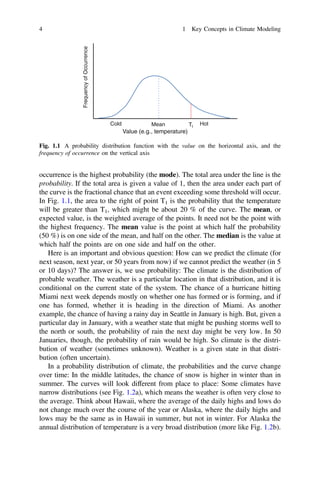
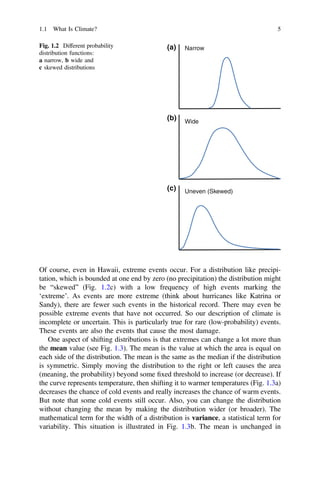
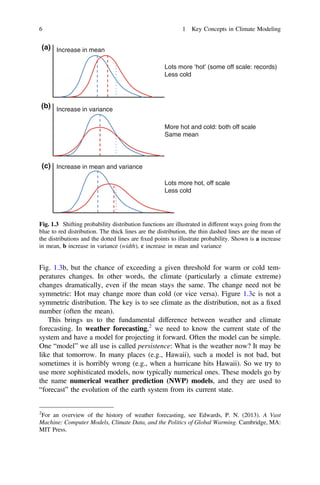
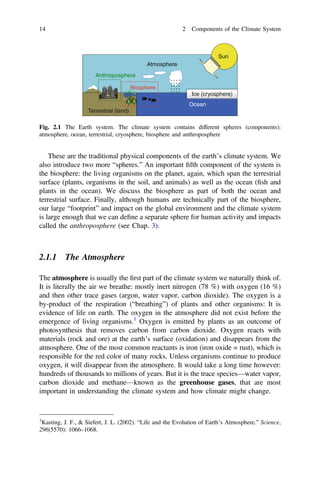
![The term greenhouse gas refers to gases that are transparent to visible light
emitted from the sun, but opaque (absorptive) to the “infrared” radiation emitted by
the earth. This follows from fundamental physical principles described by the
Boltzmann law, after Ludwig Boltzmann, a 19th-century Austrian physicist. All
mass radiates energy, depending on temperature. The hotter a body (could be your
body, the earth, or the sun), the more energy it radiates: and the peak energy occurs
at different wavelengths. The peak radiation of the sun (surface temperature = 6,000
Kelvin2
[K] or 10,000 °F: very hot either way) radiates a lot of the light we call
visible. It is no accident our eyes evolved to be able to ‘see’ in the visible where the
maximum solar emission is. Objects with cooler temperatures such as the tem-
perature of the earth at about 300 Kelvin (80 °F) radiate in the infrared (longer
wavelengths with much lower energy). These objects include our bodies, the earth
itself, the ocean surface or clouds.
Greenhouse gases, like the glass in a greenhouse, allow in visible light from the
sun, but absorb (and re-emit back down) the infrared energy from the earth.3
The
higher the concentration of these gases in the atmosphere, the greater the warming
effect. The most important greenhouse gas is water vapor. Water vapor also has
some other important effects in the climate system. The second most important gas
is carbon dioxide.
The basic picture of the flows of energy in the atmosphere is illustrated in
Fig. 2.2. The arrows represent approximate sizes of the energy flows4
in the energy
budget. Solar energy comes in; the atmosphere, clouds and the earth absorb some
and reflect some. The technical term for the ratio of reflected over total energy is
albedo. White/light surfaces reflect a lot and have a high albedo: snow, ice, bright
sand. Black/dark surfaces absorb a lot and have a low albedo: dark green trees, the
ocean, asphalt. This is why a black car is hotter than a white car or asphalt is hotter
than concrete in the sun. The energy absorbed warms the object (clouds, atmo-
sphere, surface of the earth/ice/ocean) and it ‘re-emits’, but now at longer wave-
lengths and lower energy since the temperature of the surface is much lower than
the sun. For common temperatures at the earth’s surface (0–100 °F, –20 to 40 °C),
this emission occurs in the infrared. Infrared radiation is absorbed in the atmosphere
by greenhouse gases and clouds, and some returns to the earth. The earth warms the
atmosphere above it in two ways. The direct conduction of heat from a warm
2
The Kelvin temperature scale has the same increment as the Celsius scale but starts at absolute
zero, while Celsius starts at the freezing point of water and can be negative. The Fahrenheit scale
has a smaller increment and the freezing point of water is 32 °F. So 1 °K = 1 °C = 9/5 °F. Scientists
use °K, the United States uses °F and most other countries use °C. We will typically provide °F
and °C.
3
Strictly speaking, the analogy is not correct: The glass in a greenhouse also prevents air from
escaping, and simply being transparent in the visible and restricting air motion is sufficient to keep
a greenhouse warm. The actual “greenhouse” effect for glass is a small part of it.
4
For a more detailed treatment of the energy budget, see Trenberth, K. E., Fasullo, J. T., & Kiehl,
J. (2009) “Earth’s Global Energy Budget.” Bulletin of the American Meteorological Society, 90(3):
311–323.
2.1 Components of the Earth System 15](https://image.slidesharecdn.com/29520928-250525003241-98226a38/85/Demystifying-Climate-Models-Andrew-Gettelman-Richard-B-Rood-34-320.jpg)
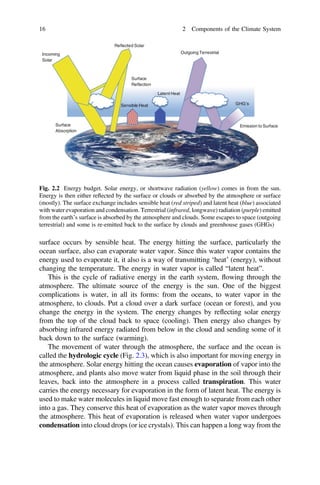
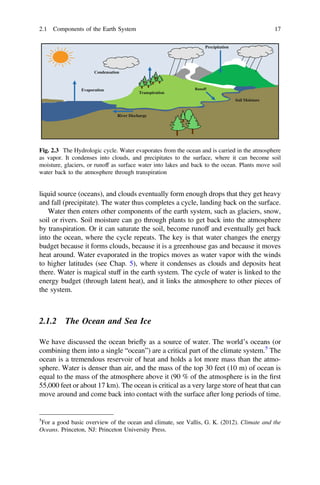
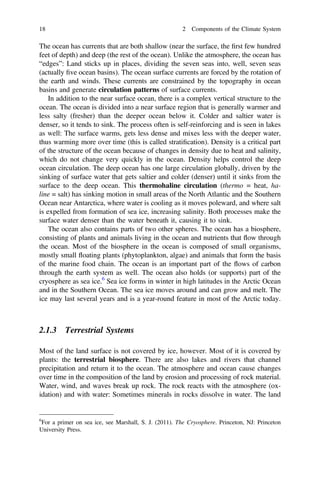
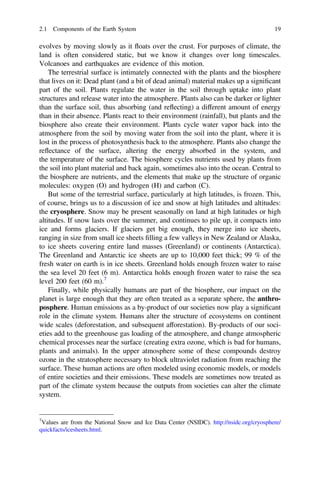
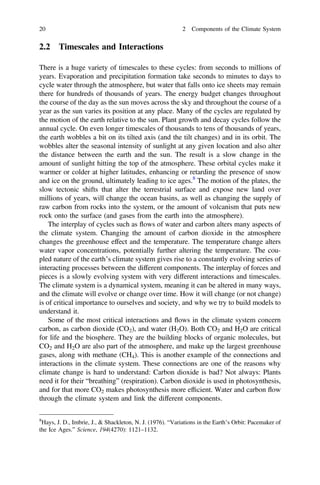
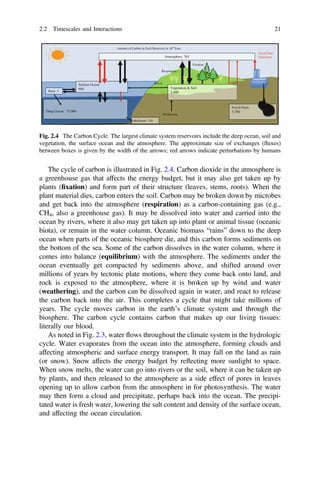
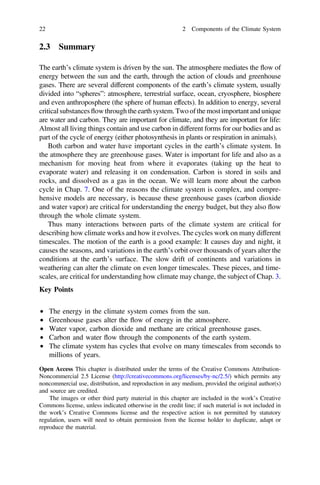
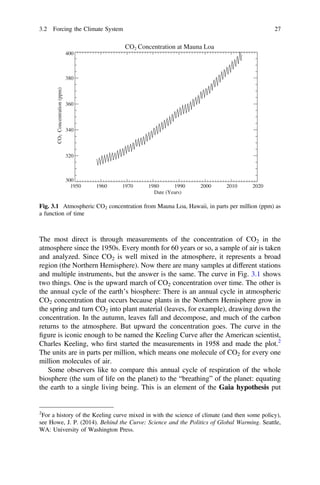
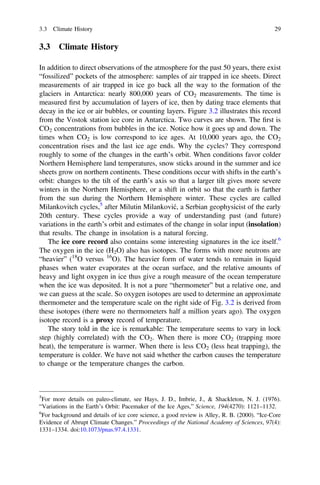
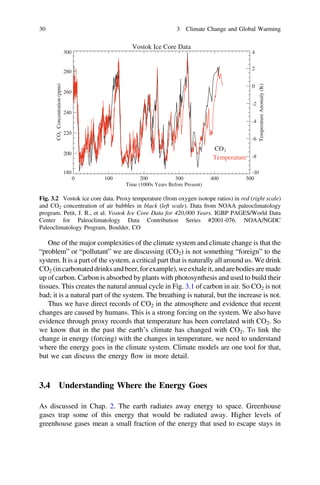
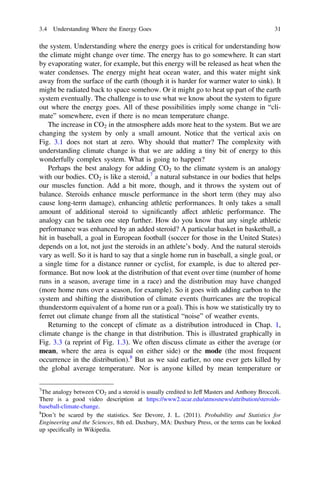
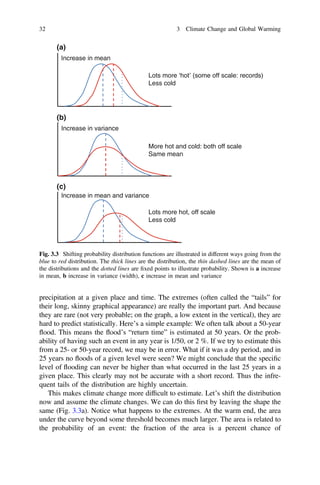
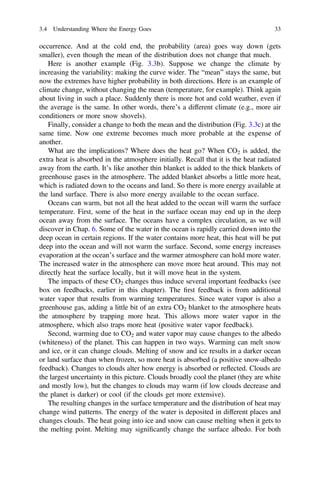
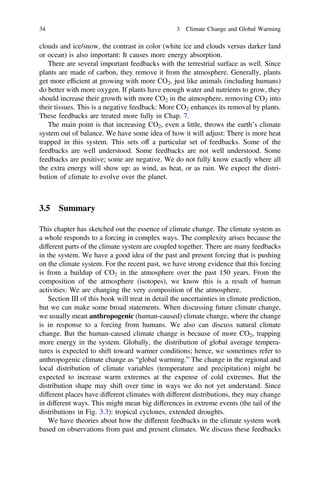


![This ebook is for the use of anyone anywhere in the United
States and most other parts of the world at no cost and with
almost no restrictions whatsoever. You may copy it, give it away
or re-use it under the terms of the Project Gutenberg License
included with this ebook or online at www.gutenberg.org. If you
are not located in the United States, you will have to check the
laws of the country where you are located before using this
eBook.
Title: Conscience & Fanaticism: An Essay on Moral Values
Author: George Henry Lane Fox Pitt-Rivers
Release date: October 19, 2018 [eBook #58136]
Language: English
Credits: E-text prepared by Turgut Dincer, Martin Pettit, and the
Online Distributed Proofreading Team
(http://www.pgdp.net) from page images generously
made available by Internet Archive
(https://archive.org)
*** START OF THE PROJECT GUTENBERG EBOOK CONSCIENCE &
FANATICISM: AN ESSAY ON MORAL VALUES ***](https://image.slidesharecdn.com/29520928-250525003241-98226a38/85/Demystifying-Climate-Models-Andrew-Gettelman-Richard-B-Rood-60-320.jpg)
![PREFACE
In presenting this little volume to the public I am fully conscious of
my presumption in introducing my personal views in a region where
many hundreds of better qualified writers have devoted their best
efforts. Since, however, no apology can justify a profitless task, if
such it be, or add to its utility, if indeed it possesses any, I will not
attempt to make one.
If I have contributed in ever so slight a degree towards an
understanding of the mental state or attitude we call fanaticism, for
the purpose of guarding against the catastrophes it begets, I shall
have achieved my purpose. It is unfortunately inevitable that a
discussion which involves current opinions and beliefs must
necessarily encounter strong prejudices and opposition, but it is less
on this account that this little work is likely to fail than for the reason
to which Hume attributed the failure which attended the publication
of his "Treatise of Human Nature," which he described as his guilt
"of a very usual indiscretion, in going to the press too early." A
circumstance which prevented that "unfortunate literary attempt
from reaching such distinction as even to excite a murmur among
the zealots."[1]
Needless to say, I have relied for my interpretation of human notions
and ideas, and the conduct which results from them, very largely
upon the works of past and contemporary writers; and my
indebtedness to those with whom I differ no less than those with
whom I agree is but very inadequately acknowledged in my
references to the works of some of them.
The earlier portions of the essay are devoted chiefly to an
examination of moral ideas, the latter portions more exclusively to
the facts of nature and of mind from which they derive their](https://image.slidesharecdn.com/29520928-250525003241-98226a38/85/Demystifying-Climate-Models-Andrew-Gettelman-Richard-B-Rood-63-320.jpg)
![meaning. Throughout I have attempted to keep the argument as
free as possible from the thin air of philosophical and scholastic
dialectic, and as far as possible in terms of common usage and
thought. With this end in view, and for the sake of brevity, the
authors to whose works I have referred most frequently have been
selected either because they are better known or because their
opinions are more widely held than in the case of others. But in any
case no claim to exhaustive or even adequate treatment can be
made for so slight a review of so vast a subject.
The first problem which I have attempted to deal with is one which
confronts all moralists. It consists in the difficulty of deriving ethical
notions from notions which are not ethical, or of deducing the moral
law from the facts of experience and of nature. The attempt to
escape from this difficulty often takes the form of adopting a theory
by which the whole world is divided into two unrelated worlds, a
world of values and a physical world of mechanical sequences. In
order to bring these two independent and self-consistent systems
within the same reality and to weld them together, God is
postulated. God is necessary, it is argued, to prove the objectivity of
morality. That is to say, that since moral values are eternally valid,
independently of man's capacity to be conscious of them, they can
only have existence in the one eternal mind.[2]
The purpose of this essay is to offer a different solution. As this
question of the status of moral values is of great importance to the
moral argument, a preliminary examination of the ground may be
helpful.
The predication of value to an object which elicits moral approbation
is not, as most Theistic writers stubbornly maintain, an implicit
acknowledgment of the objectivity of the goodness predicated, it is
merely the act of appreciating the subject or valuer's attitude in
relation to the object (the relationship may be purely hypothetical),
but it may, and usually does, invite a similar attitude on the part of
any number of subjects.[3] The relation of subject to object—this
also applies to all relations—may belong to objective reality, but not](https://image.slidesharecdn.com/29520928-250525003241-98226a38/85/Demystifying-Climate-Models-Andrew-Gettelman-Richard-B-Rood-64-320.jpg)
![the moral worth we ascribe to the object as a result of that
relationship. This distinction is important and involves, necessarily, a
discrimination (not always made) between the treatment of
knowledge and of value. Hume, by denying the objective character
of the relations and connexions of nature equally with moral
judgment, in his interpretation of individual experience, treated
moral judgment and knowledge of natural science in an identical
manner. In the following discussion truth, to which I have denied
relativity, is accorded a position altogether distinct from value.
Appreciation of truth and interest in knowing is treated as a value,
but not truth itself to which subjectivity is denied. The method I
have adopted of treating this fundamental point may perhaps be
made clearer by a simple illustration. Let us take any particular
moral judgment, for example, "A [a conscious individual] is good."
The assertion implies that A is the habitual doer of desirable actions,
or is benevolently disposed towards the valuer, Society at large, or
God, according to the valuer's idea of goodness. In any case A's
conduct or his attitude must have evoked approbation by reason of
its effect (emotional or material) upon the valuer or those with
whom he is in sympathy. The valuer might attempt to refute this
definition by maintaining that A's habitual conduct does him the
greatest injury, but that his predication of good in respect of A is the
assertion of an objective fact. In spite of such an objection, I would
reply that the moral judgment may indeed be intended to imply
certain definite objective qualities or properties because the valuer
considers these desirable, and chooses arbitrarily to define "good" as
containing those definite properties, or because in the community to
which he addresses himself they are customarily so defined. The
veracity, however, of the moral judgment, considered as a statement
of fact, can only be tested after an agreement has been reached as
to the content of the symbol "good." It has then been given a
meaning which alone it does not possess. The validity of moral
judgment, when it is not merely the expression of individual attitude,
will therefore always depend upon the criterion of conduct previously
adopted. In this way it is held that a moral judgment differs from a](https://image.slidesharecdn.com/29520928-250525003241-98226a38/85/Demystifying-Climate-Models-Andrew-Gettelman-Richard-B-Rood-65-320.jpg)
![And now, as we stand on the threshold of a new era—a new world
in search of its soul—what better precept can we have than the
simple words of the great thinker who, three hundred years ago,
also stood on the threshold of a new world of thought?
"Il suffit de bien juger pour bien faire, et de juger le mieux
qu'on puisse, pour faire aussi tout son mieux, c'est-à-dire, pour
acquérir toutes les vertus, et ensemble tous les autres biens,
qu'on puisse acquérir; et lorsqu'on est certain que cela est, on
ne saurait manquer d'être content."—Descartes, "Discours de la
Méthode."
G. P. R.
Hinton St. Mary, Dorset
January 1, 1919
FOOTNOTES:
[1] Hume's "Autobiography."
[2] This is the position of the Idealistic schools and is adopted in
Professor Sorley's recently published Gifford Lectures, "Moral Values
and the Idea of God."
[3] This relationship may be expressed in psychological terms. Dr.
McDougall expresses it thus: "Objects have value for us in proportion
as they excite our conative tendencies; our consciousness of their
value, positive or negative, is our consciousness of the strength of
the conation they awake in us."—"Body and Mind," p. 329.](https://image.slidesharecdn.com/29520928-250525003241-98226a38/85/Demystifying-Climate-Models-Andrew-Gettelman-Richard-B-Rood-68-320.jpg)

![I
INTRODUCTION
In all ages conscience has been the theme of priest, politician,
philanthropist and obstructionist. So often used and so seldom
analysed, beyond a bare assertion of its function, it is curious to
reflect on the strange medley of uses to which this word is put.
Conscience is at once the standard and the refuge of orthodox and
fanatic, patriot and anarchist—according as they are described by
admirer or detractor—but, let us believe with Lecky,[4] least often of
the genuine hypocrite.
Never was a nation so beset with "conscientious" men and women
as England is to-day; some helping, some hindering, some having
little effect on the national welfare. Some flaunt the badge
obtrusively, they label themselves "conscientious objectors to
military service," "conscientious objectors to vaccination,"
"conscientious teetotallers"; in some cases anti-vivisectionists,[5]
social reformers and (formerly) suffragettes proclaim their exertions
endured for "conscience' sake"; so, for the most part, do
missionaries and religious functionaries, and, in fact, all and any who
engage in propaganda or obstruction, "because," they say,
"something higher than reason prompts our motives—'conscience'."
[6] Others refer to conscience shyly as of something too sacred to
be spoken of publicly, and again others only in moments of intense
earnestness—or alcoholic remorse.
A conscience, in fact, is an invaluable asset; where it does not gain
approbation, it at least gains some measure of respect.
Most people, then, admit the existence and the reality of what we
popularly call "conscience," and although fewer people are agreed as](https://image.slidesharecdn.com/29520928-250525003241-98226a38/85/Demystifying-Climate-Models-Andrew-Gettelman-Richard-B-Rood-72-320.jpg)
![to its origin and nature, it is, nevertheless, accorded a high place of
importance and almost universal recognition as an arbiter in the
affairs of men.
So undisputed is this claim to inviolability of conscience in twentieth-
century England that the State, in framing her laws, modifies their
application by the interspersion of caveats in the form of "conscience
clauses."
The principle on which the conscience proviso is allowed to negative
the universal applicability of the State's demand for service or
compliance with her rules appears, however, to be somewhat
arbitrary and uncertain, and can hardly be said to be devised solely
in deference to any possible religious sanction, since, although a
man's conscience is allowed to exempt him from vaccinating his
children, the plea of religious sanction, in the case of a man
professing the polygamous doctrine of Brigham Young,[7] would not
exempt him from amenability to the law concerning bigamy; or,
again, the conscience of a Quaker or of a Christadelphian[8] is
recognized as a stronger qualification for exemption from combatant
service than the equally recalcitrant consciences of, e.g. an Atheist
or a Member of the Church of England. Yet the standardization of
"privileged" denominational consciences is strongly disavowed! In
spite, however, of a certain illogical inconsistency in practice, it is
virtually conceded as a right that a man should justify any conduct
by the plea of "conscience," even, in many cases, when it militates
directly against the good of the State.
Even more than the State and public opinion does the Protestant
Church insist upon the authority and inviolability of "conscience."
Driven, step by step, from the time of the Reformation, by the
encroachments of science and the progress of Rationalism, from her
defence of the infallibility of Doctrine and Scripture, the Protestant
Church has sought to render her position impregnable by increased
insistence upon the inviolability and sanctity of revelation and
conscience. Lecky, speaking of the trend of "Protestant Rationalism,"
says: "Its central conception is the elevation of conscience into a](https://image.slidesharecdn.com/29520928-250525003241-98226a38/85/Demystifying-Climate-Models-Andrew-Gettelman-Richard-B-Rood-73-320.jpg)
![position of supreme authority as the religious organ, a verifying
faculty discriminating between truth and error."[9]
The most recent stalwarts of the Church of England are equally
insistent upon this point, thus the Rev. G. L. Richardson writes: "We
shall appeal to and invigorate the conscience in proportion as we
rely upon the Holy Spirit as the one source of spiritual power.... 'The
fellowship of the Holy Ghost' and His grace through the Church is
the master word of the twentieth century."[10] This passage well
illustrates the supreme importance, with regard to her position,
which the Church attaches to the appeal to conscience at the
present day. In another passage the same author says, "the
authority of conscience is ... paramount for the individual." Dr. J. N.
Figgis in his "Churches in the Modern State" says that any doctrine
which would "destroy the springs of spiritual life in the individual
conscience would be disastrous to civic as well as to religious life."
Having raised the individual conscience to a pinnacle of ethical
omniscience, the ecclesiastic next proceeds to bring it into line with,
or rather into synchronous subordination to, the aggregate "Church
Conscience." "The Church is a Divine society, her members will feel
an obligation to be loyal to her discipline.... The conscience of her
members will respond with approval or shame when they keep, or
neglect to keep, her standards." From this the resulting "code and
sentiment" is the "Church Conscience."[11]
Mr. G. K. Chesterton throws further light on this interrelationship.
"The 'Church Conscience' is rather to be conceived as a fortress to
which the individual may return for shelter and strength when the
attacks of temptation threaten to overwhelm him. At such times it is
well to feel that we are not dependent on the 'inner light' of
conscience alone, but that we can throw ourselves on a social force
mightier than our own, and behold with astonishment and
enthusiasm a Divine company and a Divine Captain."[12]
Whilst Church and State are in agreement regarding its importance
and sanctity, the same unanimity is not exhibited in dealing with the](https://image.slidesharecdn.com/29520928-250525003241-98226a38/85/Demystifying-Climate-Models-Andrew-Gettelman-Richard-B-Rood-74-320.jpg)
![origin and character of conscience. Equally divided in this respect are
the philosophers and psychologists.
Priests are fond of telling us that conscience is "the voice of God
within us." To some men it appears strange that the voice of the
same God should frequently induce men to oppose each other with
such particular bitterness. This objection is sometimes met by the
explanation that although it is the voice of God speaking through the
medium of our souls, we fail to recognize or interpret rightly its
significance. This explanation, again, is not altogether satisfactory,
since, if that were the case, the voice of God must be so uncertain a
guide it were better not to rely on it.
When we look back through the pages of History and consider the
actions of men and the motives to which they ascribe them, and see
what an orgy of blood, of persecutions, of burnings, of torturings, of
blind passions and religious frenzy, of diabolical imaginings and
monstrous eschatology has been conceived at the instigation of
conscience and religion, and prescribed in the name of God, we are
inclined to inquire more deeply into the meaning and credentials of
this watchword of all ages.
FOOTNOTES:
[4] "Hypocrites, who from interested motives profess opinions which
they do not really believe, are probably rarer than is usually
supposed."—"Rise and Influence of Rationalism in Europe."
[5] A few years ago the Animal Defence and Anti-Vivisection Society
distributed pamphlets from their headquarters in Piccadilly,
beginning "Do not ask of your doctor his opinion on this matter, ask
your conscience," etc.
[6] This distinction is commonly made between conscience and the
intellectual faculty of reason; thus, when a man says, "My
conscience tells me," he usually means, "No reason will deter me."](https://image.slidesharecdn.com/29520928-250525003241-98226a38/85/Demystifying-Climate-Models-Andrew-Gettelman-Richard-B-Rood-75-320.jpg)
![[7] Mormon leader and preacher, died in 1877, leaving seventeen
wives.
[8] The establishment of bona fide membership of either of the
above-mentioned religious societies (inter alia) by a "conscientious
objector" was recognized by Military Service Tribunals (acting under
official instructions) as sufficient cause for a verdict of exemption.
[9] "Rationalism in Europe," 1913 edition, p. 167.
[10] "Conscience, its Origin and Authority" (1915).
[11] "Conscience, its Origin and Authority," p. 150.
[12] "Orthodoxy," p. 137, quoted by G. L. Richardson.](https://image.slidesharecdn.com/29520928-250525003241-98226a38/85/Demystifying-Climate-Models-Andrew-Gettelman-Richard-B-Rood-76-320.jpg)
![II
THE VALIDITY OF MORAL JUDGMENTS
Any investigation of the phenomenon of moral conduct, and of its
interpretation, brings us face to face with two sets of conflicting
theories. These may, for convenience, be roughly divided into the
two principal schools of thought which have been termed
respectively the "Moral Sense" or "Intuitive" schools and the
"Rationalistic schools of ethics." Certain writers in their search for
the springs of moral conduct have attempted to place the issue
between Naturalism or Determinism (by no means synonymous or
necessarily connected) on the one side, and Theism on the
other[13]; and, in their eagerness to discredit the former to the
advantage of the latter, imagine they demolish Determinism (at any
rate in the ethical sphere) by "pushing it to its logical conclusion"
and by showing that it "has connected completely and indissolubly,
as far as observation can carry us, mind with matter; it has
established a functional relation to exist between every fact of
thinking, willing or feeling, on the one side, and some molecular
change in the body on the other side, and man, with all his ways
and works, is simply a part of nature, and can, by no device of
thought, be detached from or set above it."[14]
What, after all, is involved in the acceptance of such a conclusion?
What is there to fear? To concede this, it is thought, would mean to
relegate man to the position of a mere "automaton," freed from
"accountability to God, responsibility to man, and the fears of
conscience."
So far from ridding man of responsibility, the clear recognition by
him of the true nature of his environment and antecedents, the laws
by which they influence him, and his inherent capacity of resistance
—in other words, the two processes observable in the world, action](https://image.slidesharecdn.com/29520928-250525003241-98226a38/85/Demystifying-Climate-Models-Andrew-Gettelman-Richard-B-Rood-77-320.jpg)
![contrary to, and action along, the line of least resistance[15]—does,
on the contrary, greatly increase his responsibility of action and his
power to know himself.
Is not mind and matter subject to the same law? Do they not react
to the same God? What matter, then, if we adopt the formula of
Pampsychism and assert that "all individual things are animated
albeit in divers degrees"? or endorse the conclusion of Professor
James Ward, who "finds no ground for separating organic life from
psychical life"? and continues: "All life is experience. We cannot
therefore assume that experience has no part in the building up of
the organism, and only begins when viable organism is already
there."[16]
The belief that there can be no life without mind does not
necessarily imply that there can be no mind without body. As John
Stuart Mill pointed out, Determinism does not imply Materialism, a
man may be a spiritual being but yet subject to the law of causation.
Neither does it deny the dynamic character of will, but allows that
not only our conduct but our character is in part amenable to our
will. The causality involved in human actions would, however, enable
any one who knew perfectly our character and our circumstances to
predict our actions.
Such considerations, however, although contributory, do not, of
themselves, decide the question with which we are here concerned,
namely, What is the real meaning and what the authority of
"conscience," or of that mental act which takes place in our minds
when we call certain conduct "right" and certain conduct "wrong"?
Apart from the question of the ultimate sanction of moral conduct,
there have always been two explanations of the mental act variously
known as "ethical judgment," "moral faculty," "moral sense" or
conscience. On the one side there have been those who considered
that moral judgment was an emotion, an intuition, or instinctive
recognition of right or wrong, which implied no rational or
intellectual process beyond that which is involved in registering or](https://image.slidesharecdn.com/29520928-250525003241-98226a38/85/Demystifying-Climate-Models-Andrew-Gettelman-Richard-B-Rood-78-320.jpg)
![perceiving the fact. And on the other side there have been those
who treat moral approbation as essentially an act of judgment—the
result of the reasoning and intellectual function of the mind.
The earliest exponents of a morality that in no way depended upon
the work of Reason were the ancient Epicureans and Cyrenaics;
since for them good was pleasure and evil was pain, the sources and
tests of all ethical truth were necessarily, in consequence, the
feelings and emotions.
In the eighteenth century there arose a school, associated with the
names of the third Lord Shaftesbury and Francis Hutcheson, the
Scotch philosopher, which became known as the "moral sense"
school, widely different from the old hedonistic philosophers, since
they were the first to assert the existence of a distinctively ethical,
as opposed to a merely pleasurable, feeling.
The philosophers of the "moral sense" school attempted to prove
that there existed a distinct moral "faculty" which differed from all
other perceptions or ideas, in that it was a separate medium by
which men could recognize ethical truth, which was rather a matter
of the heart than of the head.
As a result of the attacks of the various rationalist schools this idea
of a "moral faculty" has been for the most part abandoned by those
who approach ethics from the Religious or Theistic standpoint, for
they are far more concerned to establish the "Divine authority" and
sacrosanct character of conscience than influenced by psychological
or metaphysical distinctions. For the most part such writers are
content to assume that "conscience" is the knowledge of one's own
soul with regard to questions of right and wrong, but insist on that
element of Divine Guidance which alone, they think, can give it the
necessary authority and sanctity.
The Rev. G. H. Richardson[17] defines conscience as "the whole
personality acting ethically; or, more precisely, conscience is the](https://image.slidesharecdn.com/29520928-250525003241-98226a38/85/Demystifying-Climate-Models-Andrew-Gettelman-Richard-B-Rood-79-320.jpg)
![reaction, pleasurable or painful, of the whole personality in response
to a human or Divine standard."
It is neither wholly emotional nor wholly rational, but "is sensitive to
motives of which the pure reason would take no account; it is more
akin to instinct than intelligence." Yet "without reason, conscience
would be blind impulse, though it might feel the consciousness of
obligation."[18]
Clearly, then, conscience can derive little validity from intelligence;
the concession to the Rationalists does not amount to much; it might
almost get on without reason altogether. It is the Divine authority of
conscience which, for the Theistic writer, is the factor of prime
importance.
"As we are bound to trust reason in the intellectual sphere, so we
are bound to trust conscience in the moral sphere. To deny the
authority of the one or the other is to distrust the Power in whom
physical and moral law have their source. The authority of
conscience is thus paramount for the individual; it will be better for
me to do what is objectively wrong, but what I conscientiously
believe to be right, than do what is in fact right, but what my
conscience disapproves."[19]
Here the writer appears to abandon his Rationalistic friends
altogether; the fanatic is given free rein, his ravings are sacred.
Dr. H. Rashdall, who by many is considered representative of
rationalistic ethics, insists on the "objectivity of moral judgment.
Feelings or emotions possess no objectivity; and 'without objectivity,'
in the words of Eduard von Hartmann, 'ethic has no meaning'."[20]
The all-important task for the Theistic writer is to establish the factor
of Divine impulse. "Therefore we say that conscience is a
fundamental form of man's personal consciousness of eternity; that
ineffaceable certainty that the relation of Duty, with Responsibility
and Judgment, is not a relation which stands and falls with our
relations to the world and to men, but in its essence is a relation to](https://image.slidesharecdn.com/29520928-250525003241-98226a38/85/Demystifying-Climate-Models-Andrew-Gettelman-Richard-B-Rood-80-320.jpg)
![the holy and Almighty God.... Additional force seems to be given to
this way of regarding the Authority of conscience if we consider that
its activity is set in motion by an impulse from the Divine
Personality."[21]
Bishop Butler refers to conscience as the "voice of God," and as
"supreme among human faculties"; and this is endorsed by
Richardson, who finds that Theism is essential to any doctrine of
conscience, because the alternative is "destructive of its authority."
Let us now summarize the Theistic conscience, variously described in
different passages, in the author's own words: "Its activity is set in
motion by an impulse from the Divine Personality, and does not
originate in the individual nor the world," yet it "reacts to public
opinion," is "often unreasonable and inconsistent," is "subject to
evolutionary growth" and is "not infallible," is "capable of infinite
variety of interpretation" and "reacts to a human standard," which,
however, "trails some clouds of glory from its Divine original"; and in
conclusion, "If we regard conscience not as a phosphorescent gleam
playing upon the surface of consciousness, but as a vital impulse,
partly rational, partly instinctive, welling up from the depths of
Personality, we shall not run the risk of denying its authority."[22] It
would be well, however, not to underestimate the risk, although it
undoubtedly caters for a great variety of tastes.
Allied to the Emotional school for the purpose of proving conscience
are those Rationalists, of whom we have taken Dr. Rashdall as an
example, who have for an object the establishment of the
"objective" validity of moral judgment. The real contention becomes
clearer; the chief point at issue is the question of authority.
We see, then, that there are two points to be decided: (1) the
ultimate validity, with which is connected the question of the Divine
Authority, of moral judgments; and (2) the mode of recognition, with
which is connected the cause or propellent which induces moral
action.](https://image.slidesharecdn.com/29520928-250525003241-98226a38/85/Demystifying-Climate-Models-Andrew-Gettelman-Richard-B-Rood-81-320.jpg)
![Rashdall summarily dismisses the dual character of the problem in a
phrase. "The question at issue between Rationalists and
Emotionalists is not what impels me to do a virtuous act, but how I
know it to be virtuous."[23] The connexion between motive and
judgment is too closely related to be thus calmly ignored. It is
agreed that the motive does not affect the intrinsic character or
"rightness" of an action, but at the same time it most certainly does
affect a man's estimation of his action; and this, in order to arrive at
the value of moral judgments, is most obviously relevant.
For Dr. Rashdall the distinction between how I know my action to be
right or virtuous, and how it is virtuous, does not exist. Both imply
recognition or statement of indisputable fact; for him there can be
no ultimate doubt as to the character of moral "good," which can in
no way be a matter of opinion, for good is sui generis: it is good and
nothing else; happiness may be good, honesty may be good, but
good is good for no other reason than because such an abstraction
is supposed to exist as a transcendental fact. "Therefore good can
be recognized just as any axiomatic truth can be recognized; as, for
instance, the fact that 2 + 2 = 4, or two straight lines cannot
enclose a space." How is it then that people even of the highest
intelligence do not invariably agree about what is good or morally
right?
There are no two opinions about whether 2 + 2 does, or does not,
equal 4, yet there is no such general agreement about what is right.
If asked why a thing is right or good most people would reply either
by giving a reason to show that it is desirable or else by quoting the
authority of some one else's ipse dixit (in which case it is inferred
that the authority quoted had some reason for supposing it
desirable). The reason that 2 + 2 = 4 is, on the other hand, that
there can be no possible alternative. Yet is it true to say that there
can be no possible alternative to what the consensus of opinion in
any one country considers morally right? Some things that are
considered immoral in England are considered moral in Japan, and
vice versa.](https://image.slidesharecdn.com/29520928-250525003241-98226a38/85/Demystifying-Climate-Models-Andrew-Gettelman-Richard-B-Rood-82-320.jpg)
![Dr. Rashdall, however, conceives of but two alternatives in estimating
moral values, the first of which he dismisses, because on this view
"our moral judgments could possess no objective validity." He says:
"... I examined the question whether our moral judgments are in
ultimate analysis merely statements asserting the existence of a
particular kind of feeling in particular minds, or whether they are
intellectual judgments of universal validity—judgments, of course, of
a very peculiar and distinctive kind, but just as much intellectual and
universal judgments about the nature of Reality as the judgments 2
+ 2 = 4, or 'this is a good inference and that is a bad one'."[24]
It is difficult to know whether this arbitrary elimination of the
subjective element from ethical judgments, and the attempt to
translate moral values into terms of mathematical formulæ, is
intended to denote the infusion of a mystic factor into the "exact
sciences," or an attempt to reduce metaphysics and morality to rule
of thumb! The following thesis, however, which will be elaborated in
the course of this discussion, is based on a synchronous realization
of rational principles and psychological processes.
Thus, what an individual conceives to be morally right and good,
when he is conscious of having acted so according to his own
standard, may be either:
(1) Wholly irrational, illogical, anti-social and undesirable (from every
point of view except his own), even though arrived at solely by an
intellectual and reasoning process; or
(2) An entirely instinctive, blindly impulsive or emotional action,
afterwards endorsed by the intellect (i.e. subsequently rationalized);
or
(3) The result of thoughtful deliberation, carefully and logically
designed to bring about certain preconceived "moral" ends such as
social happiness, justice, fulfilment of duty; all of which are artificial
and conventional standards, and good only because they are](https://image.slidesharecdn.com/29520928-250525003241-98226a38/85/Demystifying-Climate-Models-Andrew-Gettelman-Richard-B-Rood-83-320.jpg)
![Force, because it is the continuity of Existence, or after the manner
of Leibnitz: "Substance, the ultimate reality, can only be conceived
as force." Any moral law which may be said to be fundamental in
itself and independent of circumstances will be in relation to force.
But such "laws" will also be independent of the moral imperatives
and written codes, for they are independent of volition—of the will to
obey them. Can a man be possessed of love, greatness, nobility,
courage, honour, at a word of command? Therefore if it can be truly
said that "love is the greatest thing in the world," it is because it is
the most powerful force. Hate is disruptive, disintegrating and
annihilating; love is integrating and strengthening.
But there is yet one "good," one fundamental imperative which
needs no proof, and that is Truth—ultimate truth, because it is the
statement of what Is; without which logic, or, indeed, intelligible
language, would be impossible. But truth is not opinion, or assertion,
or hope, or faith, or in the words of Huxley "those idols built up of
books and traditions and fine-spun ecclesiastical cobwebs." Truth
and all its derivatives—honesty, integrity, truthfulness and sincerity—
have an intrinsic value of their own, for their negation implies the
negation of the principles of Existence.
But men require more than this, they require a "moral code" or
standard to give coherence to their relationships; this code, then, is
that which is desired, or imposed, and this want is most efficiently
supplied by the principle of "Utility."
FOOTNOTES:
[13] See "Conscience, its Origin and Authority," p. 25.
[14] W. H. Mallock, quoted by Richardson.
[15] Professor James Ward uses the terms "anabolic" and "catabolic"
processes in this connexion, also in a sense analogous to the
distinction between doing and suffering.](https://image.slidesharecdn.com/29520928-250525003241-98226a38/85/Demystifying-Climate-Models-Andrew-Gettelman-Richard-B-Rood-85-320.jpg)
![[16] J. Ward, "Heredity and Memory," 1913.
[17] "Conscience, its Origin and Authority," p. 69.
[18] Ibid., pp. 67 and 68.
[19] "Conscience, its Origin and Authority," p. 96.
[20] Hastings Rashdall: "Is Conscience an Emotion?"
[21] "Conscience, its Origin and Authority," p. 99.
[22] "Conscience, its Origin and Authority," pp. 99, 95, 96, 70, 72
and 73.
[23] "Is Conscience an Emotion?" p. 113.
[24] "Is Conscience an Emotion?" p. 52.](https://image.slidesharecdn.com/29520928-250525003241-98226a38/85/Demystifying-Climate-Models-Andrew-Gettelman-Richard-B-Rood-86-320.jpg)
![Not only is this position not admitted by Utilitarians, but John Stuart
Mill long ago pointed out that such a hypothesis "is to mistake the
very meaning of a standard of morals, and to confound the rule of
action with the motive of it. It is the business of Ethics to tell us
what are our duties, or by what test we may know them; but no
system of ethics requires that the sole motive of all we do shall be a
feeling of duty.... The great majority of good actions are intended,
not for the benefit of the world, but for that of individuals, of which
the good of the world is made up; and the thoughts of the most
virtuous man need not on these occasions travel beyond the
particular persons concerned, except so far as is necessary to assure
himself that in benefiting them he is not violating the rights—that is,
the legitimate and authorized expectations—of any one else."[25]
This is sufficient refutation of such objections to Utilitarianism as the
one brought forward by Richardson, and clearly founded on a
misconception.
Mill, in what is still the best defence of this system, continues:
"Utilitarians ... are ... of opinion that in the long run the best proof of
a good character is good actions; and resolutely refuse to consider
any mental disposition as good, of which the predominant tendency
is to produce bad conduct."[26]
"The creed which accepts as the foundation of morals, Utility, or the
Greatest Happiness Principle, holds that actions are right in
proportion as they tend to promote happiness, wrong as they tend
to produce the reverse of happiness."[27]
The Theistic writer says "the essence of morality is sacrifice."[28]
The utilitarian morality does recognize in human beings the power of
sacrificing their own greatest good for the good of others. It only
refuses to admit that sacrifice is itself a good. A sacrifice that does
not increase, or tend to increase, the sum total of happiness, it
considers as wasted.](https://image.slidesharecdn.com/29520928-250525003241-98226a38/85/Demystifying-Climate-Models-Andrew-Gettelman-Richard-B-Rood-88-320.jpg)
![As regards "conscience": the Utilitarian, when he attempts an
analysis, realizes that "in that complex phenomenon as it actually
exists, the simple fact is in general all encrusted over with collateral
associations derived from sympathy, from love, and still more from
fear; from all forms of religious feeling; from recollections of
childhood and of all our past life; from self-esteem, desire of the
esteem of others, and occasionally even self-abasement."[29]
For the priest "ethics cannot be built securely upon anything less
than religious sanctions, and it is for the sake of conscience that
ethics have a practical value."[30]
Can an honest and unbiased thinker doubt that the first is the truer
statement?
Let us now return to a further statement of the position of
Utilitarianism as dealt with by J. S. Mill. From Professor Sidgwick and
those Utilitarians who attempt to claim for the atheistic moralist a
conscience of mathematical accuracy we are unlikely to derive much
assistance.
"According to the Greatest Happiness Principle, the ultimate end,
with reference to, and for the sake of which, all other things are
desirable (whether we are considering our own good or that of other
people), is an existence exempt as far as possible from pain and as
rich as possible in enjoyments, both in point of quantity and quality;
the test of quality, and the rule for measuring it against quantity,
being the preference felt by those who, in their opportunities of
experience, to which must be added their habits of self-
consciousness and self-observation, are best furnished with the
means of comparison."[31]
This, according to Utilitarians, is also the standard of morality.
In conformance with this principle of moral obligation, we choose
the greater before the lesser good. Between General Morality and
the obligation of Duty, with which he associates justice, Mill draws
what appears to be a somewhat unnecessarily hard line of](https://image.slidesharecdn.com/29520928-250525003241-98226a38/85/Demystifying-Climate-Models-Andrew-Gettelman-Richard-B-Rood-89-320.jpg)