Section 3.4-‹#›
Copyright © 2014, 2012, 2010 Pearson Education, Inc.
Lecture Slides
Elementary Statistics
Twelfth Edition
and the Triola Statistics Series
by Mario F. Triola
Section 3.4-‹#›
Copyright © 2014, 2012, 2010 Pearson Education, Inc.
Chapter 3
Statistics for Describing,
Exploring, and Comparing Data
3-1 Review and Preview
3-2 Measures of Center
3-3 Measures of Variation
3-4 Measures of Relative Standing and
Boxplots
Section 3.4-‹#›
Copyright © 2014, 2012, 2010 Pearson Education, Inc.
Key Concept
This section introduces measures of relative
standing, which are numbers showing the
location of data values relative to the other values
within a data set.
They can be used to compare values from
different data sets, or to compare values within
the same data set.
The most important concept is the z score.
We will also discuss percentiles and quartiles, as
well as a new statistical graph called the boxplot.
Section 3.4-‹#›
Copyright © 2014, 2012, 2010 Pearson Education, Inc.
Basics of z Scores,
Percentiles, Quartiles, and
Boxplots
Part 1
Section 3.4-‹#›
Copyright © 2014, 2012, 2010 Pearson Education, Inc.
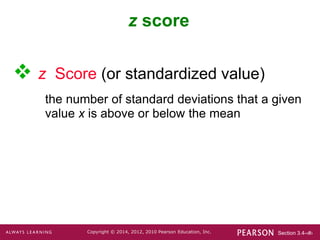
 z Score (or standardized value)
the number of standard deviations that a given
value x is above or below the mean
z score
Section 3.4-‹#›
Copyright © 2014, 2012, 2010 Pearson Education, Inc.
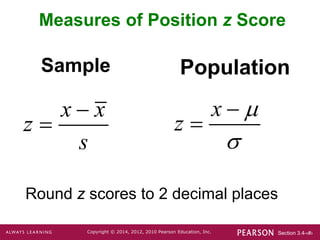
Sample
x x
z
s


Population
Round z scores to 2 decimal places
Measures of Position z Score
x
z




Section 3.4-‹#›
Copyright © 2014, 2012, 2010 Pearson Education, Inc.
Interpreting Z Scores
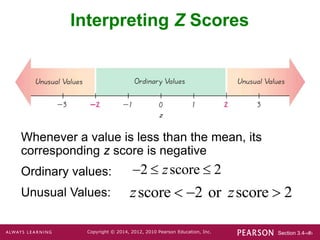
Whenever a value is less than the mean, its
corresponding z score is negative
Ordinary values:
Unusual Values:
2 score 2
z
  
score 2 or score 2
z z
  
Section 3.4-‹#›
Copyright © 2014, 2012, 2010 Pearson Education, Inc.
Example
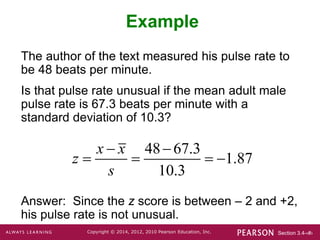
The author of the text measured his pulse rate to
be 48 beats per minute.
Is that pulse rate unusual if the mean adult male
pulse rate is 67.3 beats per minute with a
standard deviation of 10.3?
Answer: Since the z score is between – 2 and +2,
his pulse rate is not unusual.
48 67.3
1.87
10.3
x x
z
s
 
   
Section 3.4-‹#›
Copyright © 2014, 2012, 2010 Pearson Education, Inc.
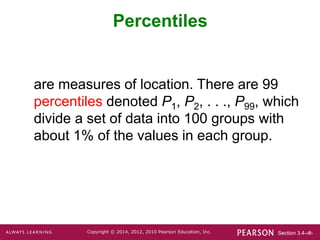
Percentiles
are measures of location. There are 99
percentiles denoted P1, P2, . . ., P99, which
divide a set of data into 100 groups with
about 1% of the values in each group.
Section 3.4-‹#›
Copyright © 2014, 2012, 2010 Pearson Education, Inc.
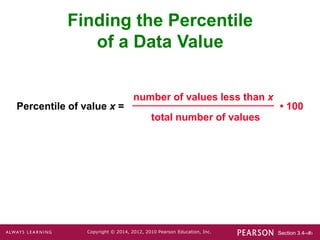
Finding the Percentile
of a Data Value
Percentile of value x = • 100
number of values less than x
total number of values
Section 3.4-‹#›
Copyright © 2014, 2012, 2010 Pearson Education, Inc.
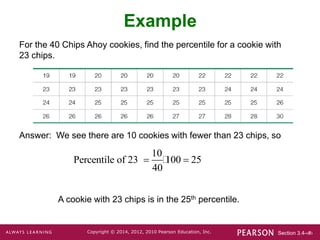
Example
For the 40 Chips Ahoy cookies, find the percentile for a cookie with
23 chips.
Answer: We see there are 10 cookies with fewer than 23 chips, so
A cookie with 23 chips is in the 25th percentile.
10
Percentile of 23 100 25
40
 
Section 3.4-‹#›
Copyright © 2014, 2012, 2010 Pearson Education, Inc.
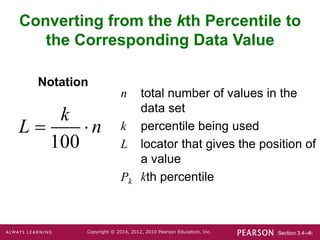
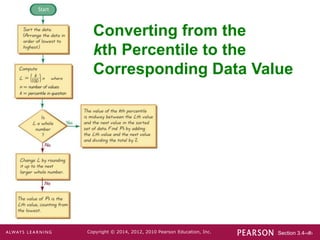
n total number of values in the
data set
k percentile being used
L locator that gives the position of
a value
Pk kth percentile
Notation
Converting from the kth Percentile to
the Corresponding Data Value
100
k
L n
 
Section 3.4-‹#›
Copyright © 2014, 2012, 2010 Pearson Education, Inc.
Converting from the
kth Percentile to the
Corresponding Data Value
Section 3.4-‹#›
Copyright © 2014, 2012, 2010 Pearson Education, Inc.
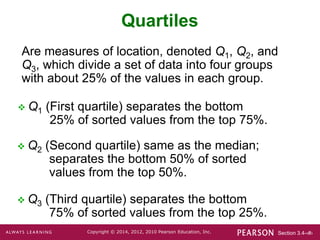
Quartiles
 Q1 (First quartile) separates the bottom
25% of sorted values from the top 75%.
 Q2 (Second quartile) same as the median;
separates the bottom 50% of sorted
values from the top 50%.
 Q3 (Third quartile) separates the bottom
75% of sorted values from the top 25%.
Are measures of location, denoted Q1, Q2, and
Q3, which divide a set of data into four groups
with about 25% of the values in each group.
Section 3.4-‹#›
Copyright © 2014, 2012, 2010 Pearson Education, Inc.
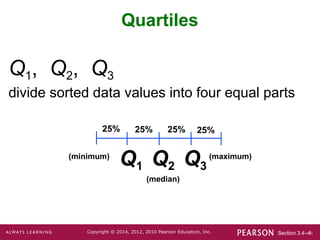
Q1, Q2, Q3
divide sorted data values into four equal parts
Quartiles
25% 25% 25% 25%
Q3
Q2
Q1
(minimum) (maximum)
(median)
Section 3.4-‹#›
Copyright © 2014, 2012, 2010 Pearson Education, Inc.
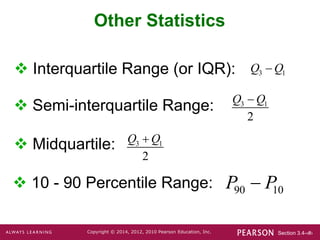
Other Statistics
 Interquartile Range (or IQR):
 10 - 90 Percentile Range:
 Midquartile:
 Semi-interquartile Range: 3 1
2
Q Q

3 1
Q Q

3 1
2
Q Q

90 10
P P

Section 3.4-‹#›
Copyright © 2014, 2012, 2010 Pearson Education, Inc.
 For a set of data, the 5-number summary
consists of these five values:
1. Minimum value
2. First quartile Q1
3. Second quartile Q2 (same as median)
4. Third quartile, Q3
5. Maximum value
5-Number Summary
Section 3.4-‹#›
Copyright © 2014, 2012, 2010 Pearson Education, Inc.
 A boxplot (or box-and-whisker-diagram) is a
graph of a data set that consists of a line
extending from the minimum value to the
maximum value, and a box with lines drawn
at the first quartile, Q1, the median, and the
third quartile, Q3.
Boxplot
Section 3.4-‹#›
Copyright © 2014, 2012, 2010 Pearson Education, Inc.
1. Find the 5-number summary.
2. Construct a scale with values that include
the minimum and maximum data values.
3. Construct a box (rectangle) extending from
Q1 to Q3 and draw a line in the box at the
value of Q2 (median).
4. Draw lines extending outward from the box
to the minimum and maximum values.
Boxplot - Construction
Section 3.4-‹#›
Copyright © 2014, 2012, 2010 Pearson Education, Inc.
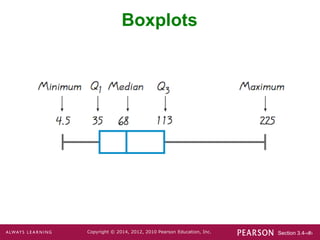
Boxplots
Section 3.4-‹#›
Copyright © 2014, 2012, 2010 Pearson Education, Inc.
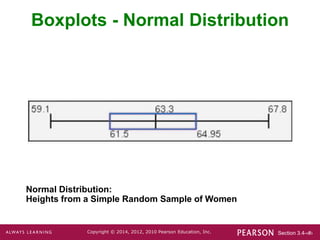
Boxplots - Normal Distribution
Normal Distribution:
Heights from a Simple Random Sample of Women
Section 3.4-‹#›
Copyright © 2014, 2012, 2010 Pearson Education, Inc.
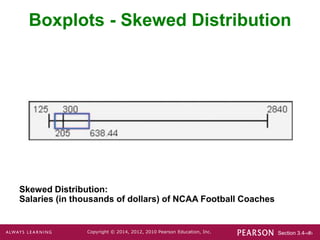
Boxplots - Skewed Distribution
Skewed Distribution:
Salaries (in thousands of dollars) of NCAA Football Coaches
Section 3.4-‹#›
Copyright © 2014, 2012, 2010 Pearson Education, Inc.
Outliers and
Modified Boxplots
Part 2
Section 3.4-‹#›
Copyright © 2014, 2012, 2010 Pearson Education, Inc.
Outliers
 An outlier is a value that lies very far away
from the vast majority of the other values
in a data set.
Section 3.4-‹#›
Copyright © 2014, 2012, 2010 Pearson Education, Inc.
Important Principles
 An outlier can have a dramatic effect on the
mean and the standard deviation.
 An outlier can have a dramatic effect on the
scale of the histogram so that the true nature of
the distribution is totally obscured.
Section 3.4-‹#›
Copyright © 2014, 2012, 2010 Pearson Education, Inc.
Outliers for Modified Boxplots
For purposes of constructing modified boxplots, we
can consider outliers to be data values meeting
specific criteria.
In modified boxplots, a data value is an outlier if it is:
above Q3 by an amount greater than
1.5  IQR
below Q1 by an amount greater than
1.5  IQR
or
Section 3.4-‹#›
Copyright © 2014, 2012, 2010 Pearson Education, Inc.
Modified Boxplots
Boxplots described earlier are called skeletal (or
regular) boxplots.
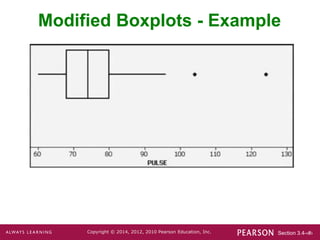
Some statistical packages provide modified
boxplots which represent outliers as special
points.
Section 3.4-‹#›
Copyright © 2014, 2012, 2010 Pearson Education, Inc.
Modified Boxplot Construction
 A special symbol (such as an asterisk) is
used to identify outliers.
 The solid horizontal line extends only as far
as the minimum data value that is not an
outlier and the maximum data value that is
not an outlier.
A modified boxplot is constructed with these
specifications:
Section 3.4-‹#›
Copyright © 2014, 2012, 2010 Pearson Education, Inc.
Modified Boxplots - Example
Section 3.4-‹#›
Copyright © 2014, 2012, 2010 Pearson Education, Inc.
Putting It All Together
 So far, we have discussed several basic tools
commonly used in statistics –
 Context of data
 Source of data
 Sampling method
 Measures of center and variation
 Distribution and outliers
 Changing patterns over time
 Conclusions and practical implications
 This is an excellent checklist, but it should not
replace thinking about any other relevant factors.

Chapter 3 Section 4.ppt

  • 1.
    Section 3.4-‹#› Copyright ©2014, 2012, 2010 Pearson Education, Inc. Lecture Slides Elementary Statistics Twelfth Edition and the Triola Statistics Series by Mario F. Triola
  • 2.
    Section 3.4-‹#› Copyright ©2014, 2012, 2010 Pearson Education, Inc. Chapter 3 Statistics for Describing, Exploring, and Comparing Data 3-1 Review and Preview 3-2 Measures of Center 3-3 Measures of Variation 3-4 Measures of Relative Standing and Boxplots
  • 3.
    Section 3.4-‹#› Copyright ©2014, 2012, 2010 Pearson Education, Inc. Key Concept This section introduces measures of relative standing, which are numbers showing the location of data values relative to the other values within a data set. They can be used to compare values from different data sets, or to compare values within the same data set. The most important concept is the z score. We will also discuss percentiles and quartiles, as well as a new statistical graph called the boxplot.
  • 4.
    Section 3.4-‹#› Copyright ©2014, 2012, 2010 Pearson Education, Inc. Basics of z Scores, Percentiles, Quartiles, and Boxplots Part 1
  • 5.
    Section 3.4-‹#› Copyright ©2014, 2012, 2010 Pearson Education, Inc.  z Score (or standardized value) the number of standard deviations that a given value x is above or below the mean z score
  • 6.
    Section 3.4-‹#› Copyright ©2014, 2012, 2010 Pearson Education, Inc. Sample x x z s   Population Round z scores to 2 decimal places Measures of Position z Score x z    
  • 7.
    Section 3.4-‹#› Copyright ©2014, 2012, 2010 Pearson Education, Inc. Interpreting Z Scores Whenever a value is less than the mean, its corresponding z score is negative Ordinary values: Unusual Values: 2 score 2 z    score 2 or score 2 z z   
  • 8.
    Section 3.4-‹#› Copyright ©2014, 2012, 2010 Pearson Education, Inc. Example The author of the text measured his pulse rate to be 48 beats per minute. Is that pulse rate unusual if the mean adult male pulse rate is 67.3 beats per minute with a standard deviation of 10.3? Answer: Since the z score is between – 2 and +2, his pulse rate is not unusual. 48 67.3 1.87 10.3 x x z s      
  • 9.
    Section 3.4-‹#› Copyright ©2014, 2012, 2010 Pearson Education, Inc. Percentiles are measures of location. There are 99 percentiles denoted P1, P2, . . ., P99, which divide a set of data into 100 groups with about 1% of the values in each group.
  • 10.
    Section 3.4-‹#› Copyright ©2014, 2012, 2010 Pearson Education, Inc. Finding the Percentile of a Data Value Percentile of value x = • 100 number of values less than x total number of values
  • 11.
    Section 3.4-‹#› Copyright ©2014, 2012, 2010 Pearson Education, Inc. Example For the 40 Chips Ahoy cookies, find the percentile for a cookie with 23 chips. Answer: We see there are 10 cookies with fewer than 23 chips, so A cookie with 23 chips is in the 25th percentile. 10 Percentile of 23 100 25 40  
  • 12.
    Section 3.4-‹#› Copyright ©2014, 2012, 2010 Pearson Education, Inc. n total number of values in the data set k percentile being used L locator that gives the position of a value Pk kth percentile Notation Converting from the kth Percentile to the Corresponding Data Value 100 k L n  
  • 13.
    Section 3.4-‹#› Copyright ©2014, 2012, 2010 Pearson Education, Inc. Converting from the kth Percentile to the Corresponding Data Value
  • 14.
    Section 3.4-‹#› Copyright ©2014, 2012, 2010 Pearson Education, Inc. Quartiles  Q1 (First quartile) separates the bottom 25% of sorted values from the top 75%.  Q2 (Second quartile) same as the median; separates the bottom 50% of sorted values from the top 50%.  Q3 (Third quartile) separates the bottom 75% of sorted values from the top 25%. Are measures of location, denoted Q1, Q2, and Q3, which divide a set of data into four groups with about 25% of the values in each group.
  • 15.
    Section 3.4-‹#› Copyright ©2014, 2012, 2010 Pearson Education, Inc. Q1, Q2, Q3 divide sorted data values into four equal parts Quartiles 25% 25% 25% 25% Q3 Q2 Q1 (minimum) (maximum) (median)
  • 16.
    Section 3.4-‹#› Copyright ©2014, 2012, 2010 Pearson Education, Inc. Other Statistics  Interquartile Range (or IQR):  10 - 90 Percentile Range:  Midquartile:  Semi-interquartile Range: 3 1 2 Q Q  3 1 Q Q  3 1 2 Q Q  90 10 P P 
  • 17.
    Section 3.4-‹#› Copyright ©2014, 2012, 2010 Pearson Education, Inc.  For a set of data, the 5-number summary consists of these five values: 1. Minimum value 2. First quartile Q1 3. Second quartile Q2 (same as median) 4. Third quartile, Q3 5. Maximum value 5-Number Summary
  • 18.
    Section 3.4-‹#› Copyright ©2014, 2012, 2010 Pearson Education, Inc.  A boxplot (or box-and-whisker-diagram) is a graph of a data set that consists of a line extending from the minimum value to the maximum value, and a box with lines drawn at the first quartile, Q1, the median, and the third quartile, Q3. Boxplot
  • 19.
    Section 3.4-‹#› Copyright ©2014, 2012, 2010 Pearson Education, Inc. 1. Find the 5-number summary. 2. Construct a scale with values that include the minimum and maximum data values. 3. Construct a box (rectangle) extending from Q1 to Q3 and draw a line in the box at the value of Q2 (median). 4. Draw lines extending outward from the box to the minimum and maximum values. Boxplot - Construction
  • 20.
    Section 3.4-‹#› Copyright ©2014, 2012, 2010 Pearson Education, Inc. Boxplots
  • 21.
    Section 3.4-‹#› Copyright ©2014, 2012, 2010 Pearson Education, Inc. Boxplots - Normal Distribution Normal Distribution: Heights from a Simple Random Sample of Women
  • 22.
    Section 3.4-‹#› Copyright ©2014, 2012, 2010 Pearson Education, Inc. Boxplots - Skewed Distribution Skewed Distribution: Salaries (in thousands of dollars) of NCAA Football Coaches
  • 23.
    Section 3.4-‹#› Copyright ©2014, 2012, 2010 Pearson Education, Inc. Outliers and Modified Boxplots Part 2
  • 24.
    Section 3.4-‹#› Copyright ©2014, 2012, 2010 Pearson Education, Inc. Outliers  An outlier is a value that lies very far away from the vast majority of the other values in a data set.
  • 25.
    Section 3.4-‹#› Copyright ©2014, 2012, 2010 Pearson Education, Inc. Important Principles  An outlier can have a dramatic effect on the mean and the standard deviation.  An outlier can have a dramatic effect on the scale of the histogram so that the true nature of the distribution is totally obscured.
  • 26.
    Section 3.4-‹#› Copyright ©2014, 2012, 2010 Pearson Education, Inc. Outliers for Modified Boxplots For purposes of constructing modified boxplots, we can consider outliers to be data values meeting specific criteria. In modified boxplots, a data value is an outlier if it is: above Q3 by an amount greater than 1.5  IQR below Q1 by an amount greater than 1.5  IQR or
  • 27.
    Section 3.4-‹#› Copyright ©2014, 2012, 2010 Pearson Education, Inc. Modified Boxplots Boxplots described earlier are called skeletal (or regular) boxplots. Some statistical packages provide modified boxplots which represent outliers as special points.
  • 28.
    Section 3.4-‹#› Copyright ©2014, 2012, 2010 Pearson Education, Inc. Modified Boxplot Construction  A special symbol (such as an asterisk) is used to identify outliers.  The solid horizontal line extends only as far as the minimum data value that is not an outlier and the maximum data value that is not an outlier. A modified boxplot is constructed with these specifications:
  • 29.
    Section 3.4-‹#› Copyright ©2014, 2012, 2010 Pearson Education, Inc. Modified Boxplots - Example
  • 30.
    Section 3.4-‹#› Copyright ©2014, 2012, 2010 Pearson Education, Inc. Putting It All Together  So far, we have discussed several basic tools commonly used in statistics –  Context of data  Source of data  Sampling method  Measures of center and variation  Distribution and outliers  Changing patterns over time  Conclusions and practical implications  This is an excellent checklist, but it should not replace thinking about any other relevant factors.