Describing
 Teachers
Jeremy Harmer, Third Edition
Practice II
Cortese, Solange Lopez,  Angela
What is a teacher?
Teachers' perceptions of themselves...
ACTORS ORCHESTRAL CONDUCTORS GARDENERS
What is a teacher?
 Cambridge
International Dictionary
of English: 
“teaching means to give
(someone) knowledge or to
instruct or train (someone)”.
 Longman Dictionary of
Contemporary English:
 “to show somebody how
to do something or to
change somebody’s ideas”.
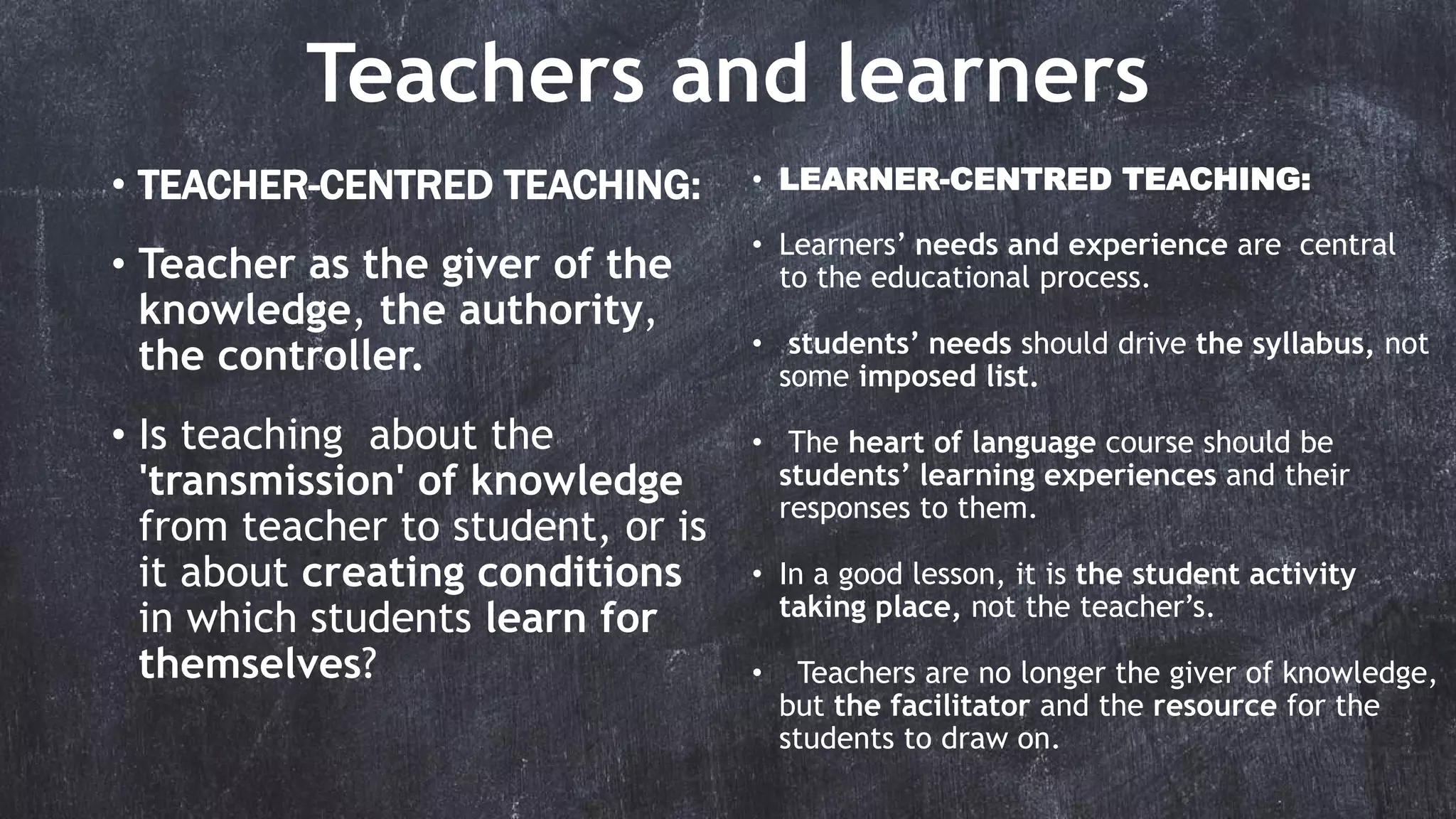
Teachers and learners
• TEACHER-CENTRED TEACHING:
• Teacher as the giver of the
knowledge, the authority,
the controller.
• Is teaching  about the
'transmission' of knowledge
from teacher to student, or is
it about creating conditions
in which students learn for
themselves?
• LEARNER-CENTRED TEACHING:
• Learners’ needs and experience are  central
to the educational process.
•  students’ needs should drive the syllabus, not
some imposed list.
•  The heart of language course should be
students’ learning experiences and their
responses to them. 
• In a good lesson, it is the student activity
taking place, not the teacher’s.
•   Teachers are no longer the giver of knowledge,
but the facilitator and the resource for the
students to draw on.
LEARNER-CENTRED TEACHING
•In this aproach, special qualities are
required for teachers:
Maturity
Openness
to
student
input
Intuition
Greater 
tolerance
of
uncertainty.
Educational
skills
THE ROLES OF A TEACHER
CONTROLLER
ORGANISER
ASSESOR
PROMPTER
PARTICIPANT
RESOURCE
TUTOR
OBSERVER
CONTROLLER
ØThe most common teacher
role.
ØTeachers in charge of the
class and of the activity.
ØTeachers fronted-classroom.
ØTeachers take the roll, tell
students things, organise
drills and read loud.
CONTROLLER
Advantages: 
v  Announcements need to be
made
vOrder has to be restored
vExplanations are given  
vTeacher is leading a question-
answer session 
Disadvantages:
v Denies students Access to their
own experiential learning. 
vCuts down on opportunities for
students to speak.
v Lacks on variety in activities and
classroom atmosphere.
v Denies teachers and students
many other possibilities and
modes of learning.
ORGANISER
Teachers organize
students by:
Giving them
information
Demonstrating the way
they are expected to do
an activity
Guiding them in the
performance of the
activitiesGrouping
students
Closing things down
when it is time to stop
Organising content
feedback: questions or
detailed discussion of
what has taken place.
We can summarize the role of organizer
as follows :
•
Engage Instruct Initiate
Organize
feedback
  ASSESSOR
It consists of:
ØOffering feedback and correction
ØGrading students in various ways
ØIndicating whether or not students
are getting their English right
ØGiving reasons what students are
been assessed for and how.
Drawbacks:
ØMisuse of fairness
ØWe should not make them
feel they are being unfairly
judged. 
ØA bad grade can be made far
more acceptable if it is given
with sensitivity and support.
PROMPTER
• Teachers adopt a prompter role when students lose track of what they
are doing and they give them a boost in a discreet way.
• When we prompt we need to: 
Do it sensitively and encouragingly, but with discretion. 
DRAWBACKS: 
•  If we are too adamant we risk taking initiative away from the students.
•  If we are too retiring we may not supply the right amount of
encouragement.
PARTICIPANT
• Teachers may want to join in an activity not as teachers, but as
participants in their own right.
•  Participating in an activity, for the teacher, is more enjoyable than
acting as a resource.
• Students will certainly enjoy having the teacher with them
 Downside: 
•  Teachers can easily dominate the proceedings and students, who still
see them as teachers, tend to follow only what they suggest. 
RESOURCE
Ø Teachers should act as a resource for students and not as a controller of the task or as spoon-feeding
Ø Teachers will want to be helpful and available for students.
Ø  Teachers can be one of the most important resources students have when they:  
Ø  -   Ask how to say or write something, 
Ø  -   Want to know what a word or phrase means 
Ø  -   Want to know information in the middle of  an activity about task or where to look for something. 
Ø   No teacher knows everything about the language. 
Ø No need to answer each question, instead encourage students to use resource materials for themselves
Tutor
• Teachers are expected to
work with individuals or small
groups, pointing students in
directions they have not yet
thought of taking.
The term implies a more
intimate relationship than
that of the controller or
organiser
Teachers will allow more
personal contact and real
chance for students to feel
supported and helped
Downside:
•Teachers have to make sure that they
do not intrude too much, hindering
learner autonomy, or too little which
results in the teacher being unhelpful.
Observer
Ø Teachers observe in order to give useful feedback both individual and as a group.
Ø They need to be careful not to be too intrusive as it will distract them.
Ø Teachers not only have to observe what learners get wrong but also praise their
achievements.
Ø Observing for success often gives us a different feel for how well our students are doing. 
Ø Even when acting as other roles, we need to be observing at the same time, being alert to
the effect our actions are having: trying to tease out feelings and reactions in the classroom.
Ø Teachers also observe to judge the success of the different materials and activities so they
can, if necessary, make changes.
WHICH ROLE?
Teachers need to be able
to switch between the
various roles, judging
when it is appropriate to
use one or the other.
It depends on the
objective teachers want
their students to achieve.
Teachers need to be
aware of how they carry
out the selective role and
how they perform it.
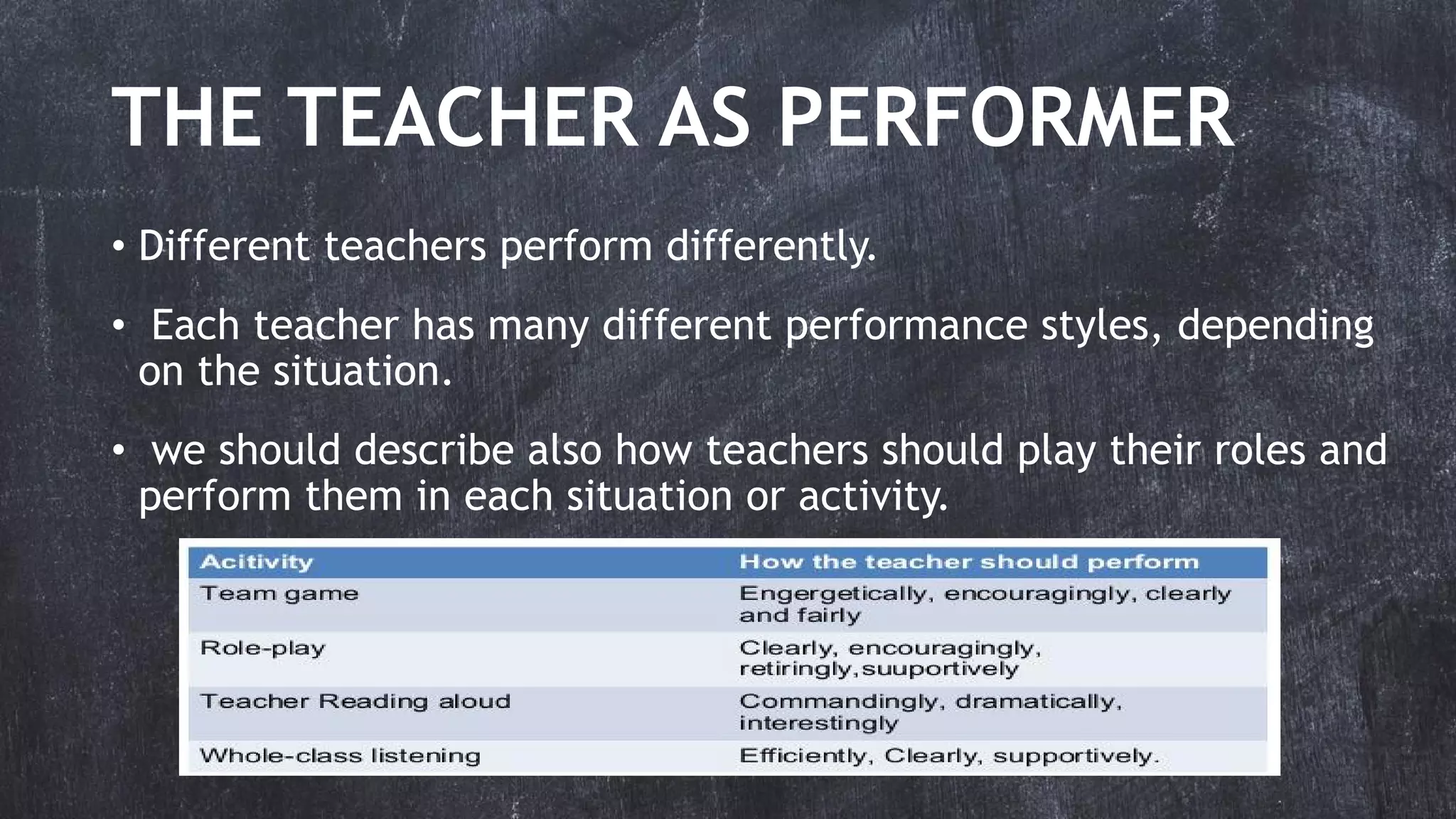
THE TEACHER AS PERFORMER
• Different teachers perform differently.
•  Each teacher has many different performance styles, depending
on the situation.
•  we should describe also how teachers should play their roles and
perform them in each situation or activity.
THE TEACHER AS TEACHING AID
• Mime and gesture: 
    The ability of using our body to convey meaning and atmosphere
• Teacher as a language model:
  Through the reading of materials, from audio and videotapes
 Reading passages aloud can capture imagination and mood like nothing else.
• The teacher as providers of comprehensible input:   
 (STT)Student-talking time ( production)    VS  (TTT)  teacher-talking time (exposure)

Describing teachers (angela lopez, solange cortese)

  • 1.
  • 2.
    What is ateacher? Teachers' perceptions of themselves... ACTORS ORCHESTRAL CONDUCTORS GARDENERS
  • 3.
    What is ateacher?  Cambridge International Dictionary of English:  “teaching means to give (someone) knowledge or to instruct or train (someone)”.  Longman Dictionary of Contemporary English:  “to show somebody how to do something or to change somebody’s ideas”.
  • 4.
    Teachers and learners •TEACHER-CENTRED TEACHING: • Teacher as the giver of the knowledge, the authority, the controller. • Is teaching  about the 'transmission' of knowledge from teacher to student, or is it about creating conditions in which students learn for themselves? • LEARNER-CENTRED TEACHING: • Learners’ needs and experience are  central to the educational process. •  students’ needs should drive the syllabus, not some imposed list. •  The heart of language course should be students’ learning experiences and their responses to them.  • In a good lesson, it is the student activity taking place, not the teacher’s. •   Teachers are no longer the giver of knowledge, but the facilitator and the resource for the students to draw on.
  • 5.
    LEARNER-CENTRED TEACHING •In thisaproach, special qualities are required for teachers: Maturity Openness to student input Intuition Greater  tolerance of uncertainty. Educational skills
  • 6.
    THE ROLES OFA TEACHER CONTROLLER ORGANISER ASSESOR PROMPTER PARTICIPANT RESOURCE TUTOR OBSERVER
  • 7.
    CONTROLLER ØThe most commonteacher role. ØTeachers in charge of the class and of the activity. ØTeachers fronted-classroom. ØTeachers take the roll, tell students things, organise drills and read loud.
  • 8.
    CONTROLLER Advantages:  v  Announcements needto be made vOrder has to be restored vExplanations are given   vTeacher is leading a question- answer session  Disadvantages: v Denies students Access to their own experiential learning.  vCuts down on opportunities for students to speak. v Lacks on variety in activities and classroom atmosphere. v Denies teachers and students many other possibilities and modes of learning.
  • 9.
    ORGANISER Teachers organize students by: Givingthem information Demonstrating the way they are expected to do an activity Guiding them in the performance of the activitiesGrouping students Closing things down when it is time to stop Organising content feedback: questions or detailed discussion of what has taken place.
  • 10.
    We can summarizethe role of organizer as follows : • Engage Instruct Initiate Organize feedback
  • 11.
      ASSESSOR It consistsof: ØOffering feedback and correction ØGrading students in various ways ØIndicating whether or not students are getting their English right ØGiving reasons what students are been assessed for and how. Drawbacks: ØMisuse of fairness ØWe should not make them feel they are being unfairly judged.  ØA bad grade can be made far more acceptable if it is given with sensitivity and support.
  • 12.
    PROMPTER • Teachers adopta prompter role when students lose track of what they are doing and they give them a boost in a discreet way. • When we prompt we need to:  Do it sensitively and encouragingly, but with discretion.  DRAWBACKS:  •  If we are too adamant we risk taking initiative away from the students. •  If we are too retiring we may not supply the right amount of encouragement.
  • 13.
    PARTICIPANT • Teachers maywant to join in an activity not as teachers, but as participants in their own right. •  Participating in an activity, for the teacher, is more enjoyable than acting as a resource. • Students will certainly enjoy having the teacher with them  Downside:  •  Teachers can easily dominate the proceedings and students, who still see them as teachers, tend to follow only what they suggest. 
  • 14.
    RESOURCE Ø Teachers shouldact as a resource for students and not as a controller of the task or as spoon-feeding Ø Teachers will want to be helpful and available for students. Ø  Teachers can be one of the most important resources students have when they:   Ø  -   Ask how to say or write something,  Ø  -   Want to know what a word or phrase means  Ø  -   Want to know information in the middle of  an activity about task or where to look for something.  Ø   No teacher knows everything about the language.  Ø No need to answer each question, instead encourage students to use resource materials for themselves
  • 15.
    Tutor • Teachers areexpected to work with individuals or small groups, pointing students in directions they have not yet thought of taking. The term implies a more intimate relationship than that of the controller or organiser Teachers will allow more personal contact and real chance for students to feel supported and helped Downside: •Teachers have to make sure that they do not intrude too much, hindering learner autonomy, or too little which results in the teacher being unhelpful.
  • 16.
    Observer Ø Teachers observein order to give useful feedback both individual and as a group. Ø They need to be careful not to be too intrusive as it will distract them. Ø Teachers not only have to observe what learners get wrong but also praise their achievements. Ø Observing for success often gives us a different feel for how well our students are doing.  Ø Even when acting as other roles, we need to be observing at the same time, being alert to the effect our actions are having: trying to tease out feelings and reactions in the classroom. Ø Teachers also observe to judge the success of the different materials and activities so they can, if necessary, make changes.
  • 17.
    WHICH ROLE? Teachers needto be able to switch between the various roles, judging when it is appropriate to use one or the other. It depends on the objective teachers want their students to achieve. Teachers need to be aware of how they carry out the selective role and how they perform it.
  • 18.
    THE TEACHER ASPERFORMER • Different teachers perform differently. •  Each teacher has many different performance styles, depending on the situation. •  we should describe also how teachers should play their roles and perform them in each situation or activity.
  • 19.
    THE TEACHER ASTEACHING AID • Mime and gesture:      The ability of using our body to convey meaning and atmosphere • Teacher as a language model:   Through the reading of materials, from audio and videotapes  Reading passages aloud can capture imagination and mood like nothing else. • The teacher as providers of comprehensible input:     (STT)Student-talking time ( production)    VS  (TTT)  teacher-talking time (exposure)