The practice of ENGLISH LANGUAGE TEACHING
by Jeremy Harmer
Subject: Practice II, Didactics of ELT.
Year: 2018
Teacher: Estela Braun
Teacher Assistants: Vanesa Cabral and María Luján Ramos
Members: Paola Nieto and Lucrecia Corral.
What is a teacher?
ACTORS: “We are always on the stage”
ORCHESTRAL: “because we direct conversation
and set the pace and tone”
GARDENERS: “because we plant the seeds and
then watch them grow”
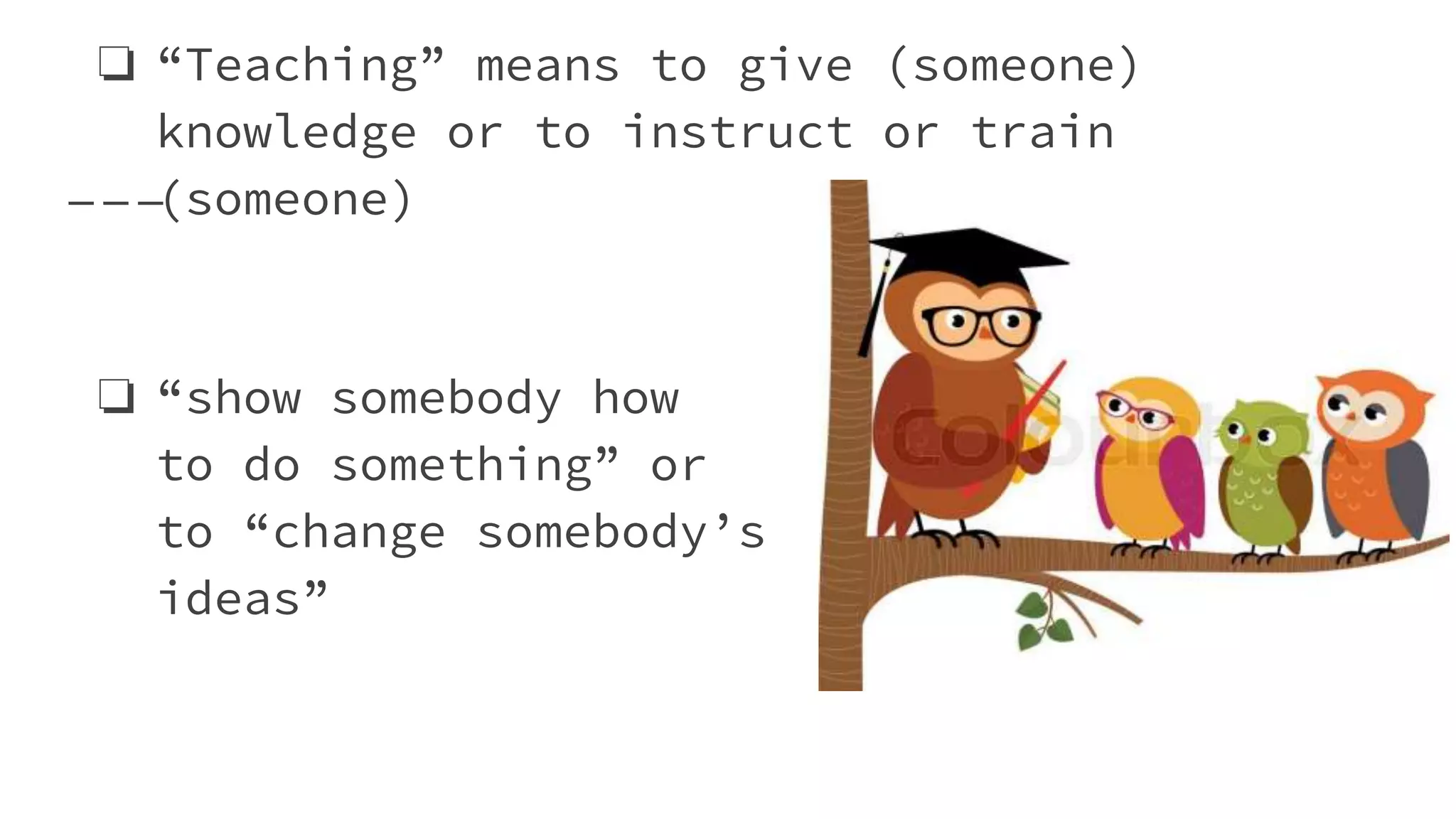
❏ “Teaching” means to give (someone)
knowledge or to instruct or train
(someone)
❏ “show somebody how
to do something” or
to “change somebody’s
ideas”
Teachers and learners
“Learner-centred teaching”
“Teacher-fronting”
The roles of a teacher
Controller
❖ Take the roll
❖ Tell students things
❖ Organise drills
❖ Read aloud
❖ Exemplify the qualities of a teacher-
fronted classroom.
Organiser
Engage instruct
(demonstrate)
initiate
organise
feedback.
Assessor
★ Offering feedback on performance.
★ Handing out grades.
★ Saying whether students can pass to the
next level.
★ FAIRNESS: Being sensitive to the students’
reactions and make a bad grade more
acceptable.
Prompter
To “nudge” students forward
in a discreet and supportive way
when they lose the thread of what
is going on.
● Neither too adamant nor too
retiring.
Participant
➔ Join in activities
not as teachers, but as
as a participants.
➔ Students enjoy
having the teacher
with them.
➔ For the teacher, participating is more
enjoyable than acting as a resource.
Resource
❖ No teacher knows everything about the
language!
● To offer guidance.
● To direct students to a good dictionary.
● To be helpful and available but avoid
student’s over-reliance.
Tutor
★ A combination of the prompter and resource
roles
★ Stay briefly with each group or individual
★ Help every single student to
avoid feeling aggrieved
★ Pupils will feel supported and helped
★ Class atmosphere will be enhanced
★ Don’t intrude either too much or too little
Observer
❏ Give group and individual feedback
❏ Take down notes about what they get wrong
and right
❏ Work, observe, listen
and watch simultaneously
❏ Create the best kind
of rapport
Which role?
➔ It depends on the context
➔ We should switch between the various roles
The teacher as performer
● A transmissive and teacher-centred behaviour
● Performance styles depend on the situation
ACTIVITY HOW TEACHERS SHOULD PERFORM
1) Team game energetically, encouragingly, clearly, fairly
2) Role-play clearly, encouragingly, retiringly, supportively
3) Teacher reading aloud commandingly, dramatically, interestingly
4) Whole-class listening efficiently, clearly, supportively
The teacher as teaching aid
We are useful when using:
➢ Mime and gesture
➢ Language models
➢ Providers of comprehensible
input
Mime and gesture
❖ Are used to convey meaning and atmosphere
❖ Exaggeration makes their
meaning explicit
❖ Do not have universal meanings
❖ Should be used with care
Language model
➢ Textbooks, reading materials, audio, videotapes
and teachers
➢ Reading aloud→ motivation,
enjoyment,
imagination and mood
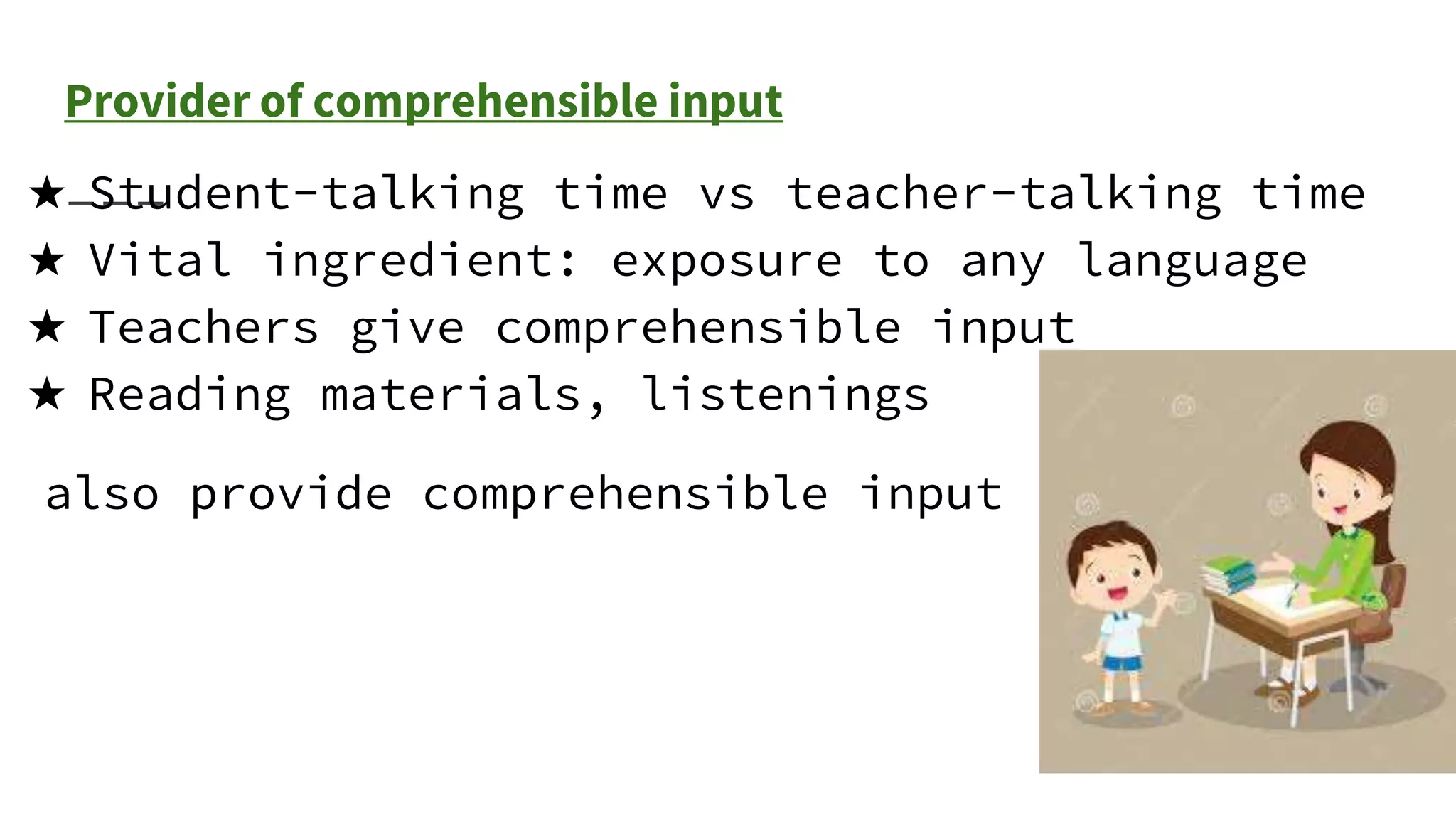
Provider of comprehensible input
★ Student-talking time vs teacher-talking time
★ Vital ingredient: exposure to any language
★ Teachers give comprehensible input
★ Reading materials, listenings
also provide comprehensible input

The practice of english language teaching

  • 1.
    The practice ofENGLISH LANGUAGE TEACHING by Jeremy Harmer Subject: Practice II, Didactics of ELT. Year: 2018 Teacher: Estela Braun Teacher Assistants: Vanesa Cabral and María Luján Ramos Members: Paola Nieto and Lucrecia Corral.
  • 2.
    What is ateacher? ACTORS: “We are always on the stage” ORCHESTRAL: “because we direct conversation and set the pace and tone” GARDENERS: “because we plant the seeds and then watch them grow”
  • 3.
    ❏ “Teaching” meansto give (someone) knowledge or to instruct or train (someone) ❏ “show somebody how to do something” or to “change somebody’s ideas”
  • 4.
    Teachers and learners “Learner-centredteaching” “Teacher-fronting”
  • 5.
    The roles ofa teacher Controller ❖ Take the roll ❖ Tell students things ❖ Organise drills ❖ Read aloud ❖ Exemplify the qualities of a teacher- fronted classroom.
  • 6.
  • 7.
    Assessor ★ Offering feedbackon performance. ★ Handing out grades. ★ Saying whether students can pass to the next level. ★ FAIRNESS: Being sensitive to the students’ reactions and make a bad grade more acceptable.
  • 8.
    Prompter To “nudge” studentsforward in a discreet and supportive way when they lose the thread of what is going on. ● Neither too adamant nor too retiring.
  • 9.
    Participant ➔ Join inactivities not as teachers, but as as a participants. ➔ Students enjoy having the teacher with them. ➔ For the teacher, participating is more enjoyable than acting as a resource.
  • 10.
    Resource ❖ No teacherknows everything about the language! ● To offer guidance. ● To direct students to a good dictionary. ● To be helpful and available but avoid student’s over-reliance.
  • 11.
    Tutor ★ A combinationof the prompter and resource roles ★ Stay briefly with each group or individual ★ Help every single student to avoid feeling aggrieved
  • 12.
    ★ Pupils willfeel supported and helped ★ Class atmosphere will be enhanced ★ Don’t intrude either too much or too little
  • 13.
    Observer ❏ Give groupand individual feedback ❏ Take down notes about what they get wrong and right ❏ Work, observe, listen and watch simultaneously ❏ Create the best kind of rapport
  • 14.
    Which role? ➔ Itdepends on the context ➔ We should switch between the various roles
  • 15.
    The teacher asperformer ● A transmissive and teacher-centred behaviour ● Performance styles depend on the situation ACTIVITY HOW TEACHERS SHOULD PERFORM 1) Team game energetically, encouragingly, clearly, fairly 2) Role-play clearly, encouragingly, retiringly, supportively 3) Teacher reading aloud commandingly, dramatically, interestingly 4) Whole-class listening efficiently, clearly, supportively
  • 16.
    The teacher asteaching aid We are useful when using: ➢ Mime and gesture ➢ Language models ➢ Providers of comprehensible input
  • 17.
    Mime and gesture ❖Are used to convey meaning and atmosphere ❖ Exaggeration makes their meaning explicit ❖ Do not have universal meanings ❖ Should be used with care
  • 18.
    Language model ➢ Textbooks,reading materials, audio, videotapes and teachers ➢ Reading aloud→ motivation, enjoyment, imagination and mood
  • 19.
    Provider of comprehensibleinput ★ Student-talking time vs teacher-talking time ★ Vital ingredient: exposure to any language ★ Teachers give comprehensible input ★ Reading materials, listenings also provide comprehensible input