Practice II, Didactics of ELT and Practicum Primary School level. Adjunto Regular
a/c Prof. Estela Braun (2019).
Full Name/s: Angela López, Solange Cortese.
Topic: Take-Home Third Parcial Practice II - A project that empower students by
taking into account their socio-cultural identity and social context.
A project that empowers students by taking into account their socio-cultural
identity and social context.
This paper aims at demonstrating the empowering and enriching advantages
of teaching English from an Intercultural Perspective where the social-cultural context
of the learners is taken into account. This will give students opportunities to acquire
meaningful knowledge that will undoubtedly benefit the construction of their identities.
To back up our claims, we will provide you with a description of our lessons using the
intercultural approach to teach English, which we will also relate and connect with
Silvana Barboni’s theory (2011), the chapter 9 of “Understanding Language
Classroom Contexts: the starting point for Change by Wedel and Malderez” (2013), as
well as the curricular guidelines from our province and NAPs for Foreign Language
Teaching in Argentina.
To begin with, Barboni states that everyday, the public school intervenes in the
construction of childrens’ identity in multiple ways. In the English class, we can deal
with contents related to their surroundings. That is to say, their physical geographical
context, the society in which they are immersed, their everyday lives and customs,
their harsh or kind realities, among other aspects. In this way, we go against the
stereotyped English class which revolved around the mere repetitive exercise of
grammatical forms and functions. These traditional classes were lessons in which
none of the students would never recognize themselves and that had little to do with
their realities, customs and identity. These were lessons that responded to a foreign
model where students had to think as if you were a native english speaker, leaving
aside their own identity. The purpose behind this was clearly to maintain an imperialist
ideology.
Nowadays, grammar notions and functions continue to be present in the class,
since they are part of the language. But the good thing is that everything tends to be
articulated and integrated so that students, along with the teacher can create
meanings on different issues that are related to and familiar to the students’ lives. The
teaching of the English language from an intercultural approach helps students to
eliminate this feeling of the English subject not having any connection with their
realities. It is no longer deemed as something “strange”. On the contrary, the English
classroom has become a system that each individual appropriates to mean their own,
and recognizing in this exercise the Other, the diverse.
The issues stated before can be reflected in one of our experiences when doing
our practicum at school n° 92. According to the school annual planning, we had to
teach the grammatical forms “There is”, “There are”, “There isn’t” and “There aren’t”.
In the traditional form, the teachers tend to teach it just by explaining pupils the
meanings of these structures and by instructing how to use them. Consequently, they
are encouraged to apply the acquired knowledge using exercises out of context
without promoting creativity, critical thinking, reflection, motivation and fruitful
experiences. Furthermore, these standardized lessons normally ignore the cultural
and social framework of students. In order to avoid these pointless English classroom
environments, we decided to teach these structures by taking into account the place
our learners know best and that forms part of their daily lives: their neighbourhood. For
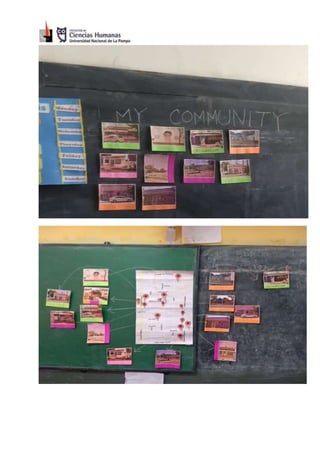
this lesson, We designed a project named “My community” where we hoped all
students would feel part of it. And actually this was what happened.
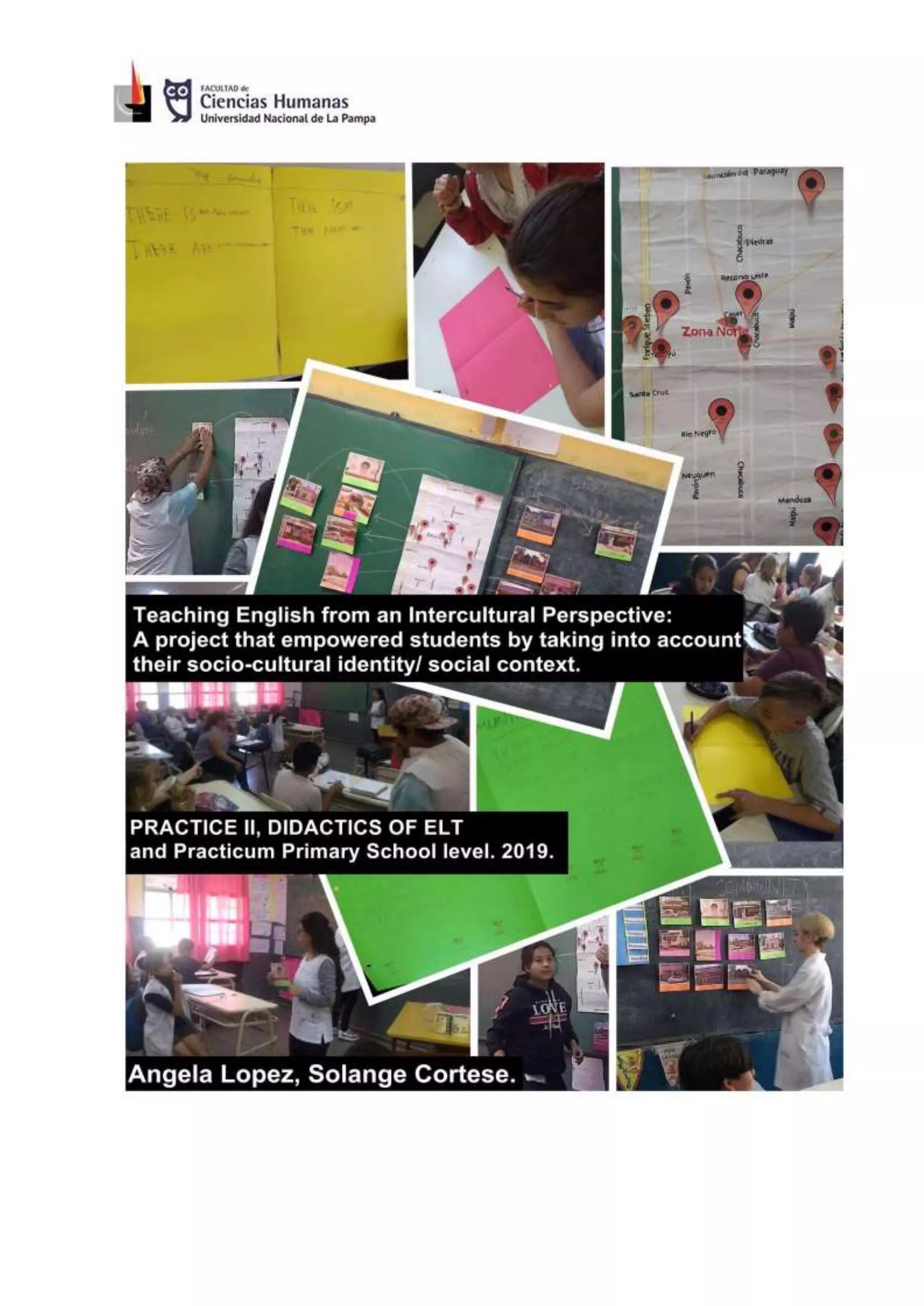
Picture illustrating our project !!!
For this, we first explained the structures and how to use them using visual
material to support our explanations. To provide students with instances to apply and
put into practise the acquisition of the new knowledge, we took pictures of the most
concurring places that exist in the “ Zona Norte” neighbourhood. This is the area which
the school n° 92 belongs to and where most of the our students live. The pictures
feature places that we consider are essentials for the inhabitants of the neighborhood,
for example: greengrocery, public infirmary, butcher’s, football field, school, diner,
among others. With these places they had to form sentences using the structures
mentioned before. For example: “There is a diner in my neighborhood”. But before
that, we showed them all the pictures one by one. They were so enthusiastic,
motivated excited, and curious about this. In fact, all of them had something to say,
as they knew the neighborhood perfectly well. Participation was improved enormously
as a result. They also learned new vocabulary which was easy to learn because of the
associations they could make between the words and images of real places.
Something to highlight is that when we showed them the picture featuring the school
n° 92, some of them chanted “Our school!”, “Our school!”, some of them even clapped.
They were not only learning contents, but as Barboni claims, they were appropriating
a new system to mean their own, using contents with which they feel identified.
Following Barboni's line of thought, we can reflect that educators are faced with
a multiplicity of socio-historical changes that are forcing them to redefine the role of
the school as well as the roll of the educators. There is the challenge of adjusting to
new times, thinking of new contents and ways of teaching them (Dussel and Finocchio,
2003). We need to leave behind those subtracting models that support and respond
to processes with imperialistic, homogenizing and colonialist features (Holliday, 2007;
Pennycook, 2001; Phillipson, 1992). We need to stop using them because they aim at
molding the identity of the learners from the linguistic habits with the argument that
English is inherently a useful language and ,therefore, have to be taught. In other
words, the English language has been given a certain priority and supremacy that
attend to homogenization at the cost of the disappearance of other languages, and
with them their cultures in many regions of the world (Pillipson, 1992; Canagarah,
1999). In the process of learning English, we do not necessarily have to adopt their
cultural patterns, we can perfectly learn a new linguistic system to communicate and
express our own cultural meanings in interaction with others. If we as educators adapt
and modify the curriculum contents using an intercultural perspective whenever it is
possible, we can effectively counteract the transmission of particular beliefs either
explicitly or implicitly that can lead to a cultural and ideological colonization. That is to
say, a form of indoctrination since we have to remember that we cannot dissociate
English itself from the social, cultural, historical, economic, political and religious
relations in which it exists (Pennycook and Coutand-Marin, 2003; Osler and Starkey,
2000; Starkey , 2007), Based on what we was just mentioned, we strongly believe that
we, as future English teachers, have the political must of creating classrooms
environments where English does not constitute a threat to students’ identities. Our
intercultural project “ My community” not only promoted values related to their
citizenship and the appreciation of what they have in their neighbourhood, but also the
opportunity of claiming for their rights by reflecting on what was lacking in their
surroundings. Through the use of the structure “ there isn’t” and “ there aren’t”, we
encouraged learners to mention the essential places that are absent in the
neighbourhood and that are necessary to cover their basic needs. “ we need a
hospital” said Avigail ( who has a lot of knowledge about English), “ necesitamos
mejores streets porque están todas rotas” protested Gonzalo, “ y que arreglen las
cloacas porque no se puede aguantar el mal olor cuando jugamos en las calles” added
Lali, “library, teacher, nosotros no tenemos” shouted Ezequiel. The contributions and
exchanges were quite considerable to include all of them, but we want to mention this
last comment by Derian “ lo que necesitamos es un barrio más tranquilo” which gives
an account not only on how reflective students would be, but it also tells us about the
daily environment children face. After this reflection and exchange of opinions, they
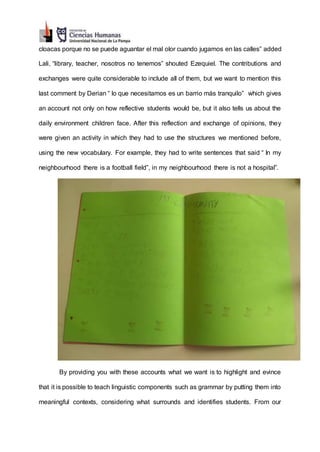
were given an activity in which they had to use the structures we mentioned before,
using the new vocabulary. For example, they had to write sentences that said “ In my
neighbourhood there is a football field”, in my neighbourhood there is not a hospital”.
By providing you with these accounts what we want is to highlight and evince
that it is possible to teach linguistic components such as grammar by putting them into
meaningful contexts, considering what surrounds and identifies students. From our
experience, teaching using this approach results in more effective learning, where
children make relations and association between the contents they learn and their
local realities,living no space for cultural and linguistic imperialism.
Now, something that we want to make clear is that we are not against teachers
and learners tackling and interacting with contents and environments related to other
cultures and realities since it enriches children’s view of the world and allows them to
put themselves in the place of the Other. Moreover, childrens’ contact with other
cultures promote respect for cultural differences at the same time they learn a new
language. So, we can provide learners with environments where they become aware
of the existence of other cultures, but making sure that they do not devalue their own.
On the other hand, According to Wedel and Malderez (2013), one of the
reasons behind changes in the english language classroom is Globalization and its
consequent need for the citizens to be able to use english to access and make use of
all available knowledge resources worldwide.
This is the case of Argentina where the reformed curriculum, which encouraged
multilingualism and multiculturalism, viewed english as the language for international
communication that would give its speakers access to many cultures and would
thereby empower future Argentine generations with the necessary symbolic resources
needed to fully function in the global market. English was thus seen as necessary to
every Argentine citizen. Even though globalization seems a justifiable reason for
policy-makers to introduce educational changes, they do it with little regard as to
whether they are contextually appropriate. These are the cases where teachers’ role
come into play producing lessons in which students’ learning is supported by the
necessary changes.
Despite numerous attempts to introduce more communicative, learner centred
approaches to education systems worldwide, many features of teaching and learning
in most systems remain at Transmission-based classroom. This is no entirely
surprising since rapid change in many visible material and technological aspects of life
seems to be the norm all around the world. Therefore, educational planners have often
expected the visible outcomes of their change initiatives to be achieved within a
similarity short-time span. Even though the results of transmission-based classroom
are more easy and quick to perceive, when it comes to production, students find it very
difficult to use their own words to express themselves.
Even if teaching from an intercultural and communicative point of view takes
effort and requires time, the results are more rewarding both for students and teachers.
Learning becomes meaningful and when something is meaningful and relevant for the
life of students, it lasts forever in their memories.
Coming up next, we are going to present the legal framework behind this
multicultural approach:
Curricular guidelines at primary level. (Materiales curriculares de educación
primaria):
According to the national law Nº 26.206, article 27, as well as the provincial law
n° 2511, article 29, it is necessary to provide equitative opportunities to all children
equally to acquire relevant, significant and meaningful knowledge from different fields,
especially, language, communication, social sciences, mathematics, natural sciences,
the environment, foreign language, art and culture and the ability to apply that
knowledge to their daily lives; as well as to provide them with knowledge and cognitive
tools necessary to continue with secondary school education.
Purposes:
The primary school should promote situations where:
● The foreign language is seen as an experience of high formative value that
transcends the school environment and contribute to citizenship.
● The students acquire the ability to distinguish sociocultural aspects in texts in
foreign language and respect for languages varieties that are not their own, to
revalue their own language and culture.
● Students develop the ability to reflect on the language and its functioning
● Student develop diverse strategies to understand and produce oral and written
texts in the foreign language that at the sime time will strengthen their sense of
collaboration and cooperation as well as encourage participatory dialogue.
● Critical thinking, reflection and exchange of ideas is encouraged.
● Student feel confident in the possibilities of learning an LE, respecting their own
learning rhythms and styles, that leads to a progressive construction of
autonomy.
● Mistakes are seen as a constitutive part of the learning process.
● The foreign language is seen as means for learning and expanding the cultural
universe.
● It is possible to articulate the foreign language with other areas of the
curriculum.
GENERAL OBJECTIVES:
In order for children to achieve meaningful learning of foreign language and so
that they can gradually increase and improve their intercultural and communicative
competence, both oral and written in English, they are expected to:
● Respect other languages and cultures and revalue their own.
● Consider that learning another language allows them to expand their cultural
universe
● Progressively develop comprehension and production strategies of diverse
texts, written and oral, in the foreign language.
● Enjoy literary texts in the foreign language and recreate them through different
artistic expressions.
● Participate in projects and problem solving tasks that promote the development
of cooperative and collaborative work.
● Make use of technological resources for the realization of tasks and Projects.
● Interact in contextualized situations from the use of the foreign language for
the exchange of ideas and points of view.
NAPs (Núcleos de Aprendizaje Prioritarios)
The NAP compiles agreements established for Compulsory Education. The
purposes of the NAP is to generate equal opportunities for all children in Argentina. In
this sense, the NAP provides the knowledge that as a society we consider to be
relevant and significant for children, adolescents and young people, so they can grow,
study, live and participate in a democratic and fair country. In a context of high
fragmentation and social heterogeneity, The Federal Council for Culture and
Education agreed to identify NAP (Núcleos de Aprendizaje Prioritarios) for Primary
and Secondary Education as a measure to give unity to the Argentine Educational
System.
Its objective is to guarantee equal conditions of education by building unity and
return the school to its public function, so that all the habitants reach equivalent
competence, abilities and knowledge regardless of their social and territorial location.
The NAPs have been developed considering the fundamental principles that must
support the teaching of a foreign language. Created from an intercultural and
multilingual perspective, the NAPs emphasize their role as builders of socio-cultural
identity of children and adolescents. The NAPs privilege both the knowledge of
languages and the formation of citizens that respect linguistic and cultural differences,
promoting new ways of facing sociocultural and linguistic diversity. The intercultural
and multilingual perspective combines language learning with the capacity for critical
reflection, necessary for coexistence in societies of great cultural diversity; in other
words, it encourages active participation in democratic processes and contributes to
build citizenship and peace.
Conclusion:
Taking everything into account, we can conclude by stating that teaching english
from a multicultural perspective is not only a beneficial and enriching experience for
students but also it is their right, as it is stated in the NAPs and in the curricular
guidelines. Even such abstract notions like grammar can become concrete when
they are taught using relevant examples extracted from students’ everyday lives.
Learning becomes meaningful because students make a direct connection between
vocabulary and real entities they know very well. When learning is meaningful, it
lasts forever and they can progressively appropriate the foreign language to mean
their own and consequently, increase their autonomy. Of course, teaching from this
perspective requires time and effort, it implies designing our own materials and to re-
think our posture as teachers, but the results are worth it, both for the teacher and
the students as well.
Lesson plan following a multicultural approach:
Practice II, Didactics of ELT and Practicum Primary School level. Adjunto Regular
a/c Prof. Estela Braun (2019).
Full Name/s: Angela López, Solange Cortese.
Topic: Intercultural Project “My community”
Course: 6A
Timetable: Tuesdays 13:10 - 13:50
Wednesday 13:10 - 13:50
Description of the group: Grade 6A. Beginning level of English language
proficiency. State primary school. 80-minutes a week. There are fifteen students in
the class (7 girls and 8 boys). Students’ age: 11-12-13 years old. There are a couple
of students that represent a challenge for the teacher as they normally misbehave
hindering the teaching and the flow of the lesson. There are occasions when they
show certain interest in the activities planned by the teacher, although, there are a
constant effort to get their attention to carry out the activities.
Time 40 minutes
Objectives By the end of the lessons students will
be able to:
-Identify important places in the
neighborhood.
-Acquire vocabulary related to buildings
and places of the city.
-Match the names of building with
pictures
-Complete sentences with prepositions
following a map of the neighborhood
- use the structures there is/ there are
and there isn’t/ there aren’t in an
appropriate way.
Structures Imperatives (Complete…)
There is/There are (There is a bus stop
next to the school)
Target Vocabulary Building and places of the city
Prepositions of place (next to, on, under,
behind, in, near, in front)
You will need:
● Map of the neighbourhood “Zona norte” with pictures of important places and
buildings.
https://docs.google.com/document/d/1NOhR1eDs1QC9Ke79F9ddDGViweZU7SIk
OfVhH6g732Q/edit
● Posters
● Worksheet (Complete with prepositions)
● pictures
● flashcards
Procedure
Lesson n° 1: “My community”
Warm-up
Brainstorming
Poster with a map of the neighbourhood
“Zona Norte” with pictures of important
places and buildings it has.
● Students will be asked if they live
near the school and to describe their
neighbourhoods naming important
places they can find there to
mention. If they don't know how to
say it in english they will say it in
spanish. The teacher will write the
different places they name on the
board.
● Students will be shown a map of the
“Zona Norte” neighborhood that
displays pictures of important
building and places (Local infirmary,
dinner, parks, shops, banks)
● Students will be asked if they
recognize any of the places
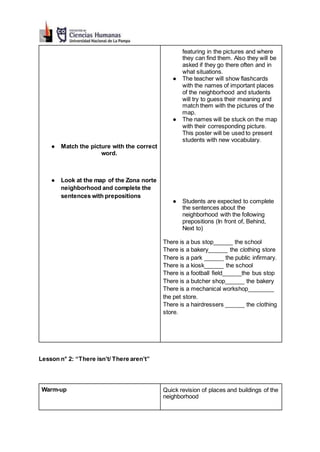
● Match the picture with the correct
word.
● Look at the map of the Zona norte
neighborhood and complete the
sentences with prepositions
featuring in the pictures and where
they can find them. Also they will be
asked if they go there often and in
what situations.
● The teacher will show flashcards
with the names of important places
of the neighborhood and students
will try to guess their meaning and
match them with the pictures of the
map.
● The names will be stuck on the map
with their corresponding picture.
This poster will be used to present
students with new vocabulary.
● Students are expected to complete
the sentences about the
neighborhood with the following
prepositions (In front of, Behind,
Next to)
There is a bus stop______ the school
There is a bakery______ the clothing store
There is a park ______ the public infirmary.
There is a kiosk______ the school
There is a football field______the bus stop
There is a butcher shop______ the bakery
There is a mechanical workshop________
the pet store.
There is a hairdressers ______ the clothing
store.
Lesson n° 2: “There isn’t/ There aren’t”
Warm-up Quick revision of places and buildings of the
neighborhood
Brainstorming
Introduction structure “there isn’t/ there
aren’t”
Describing my neighborhood using there
is/there are/ there isnt/there aren't.
Ask students to name places that are not
present in the map of the neighborhood and
write them on the board. Ask students to
name places and facilities they would like to
have in their neighbourhood.
Introduce students with new vocabulary
related to places of the city.
Explain to students that we use the
structure “there isn’t/ there aren’t” to refer
to “no hay”, in other words, to describe
things that cannot be find in a particular
place.
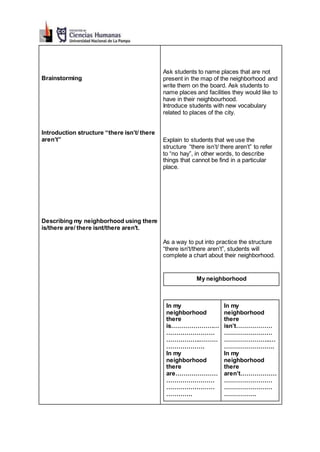
As a way to put into practice the structure
“there isn't/there aren’t”, students will
complete a chart about their neighborhood.
My neighborhood
In my
neighborhood
there
is……………………
……………………
……………..………
……………….
In my
neighborhood
there
are…………………
……………………
……………………
………….
In my
neighborhood
there
isn’t………………
……………………
…………………..…
…………………….
In my
neighborhood
there
aren’t………………
……………………
……………………
…………….
Lesson n°3: “What can we do to improve our neighborhood?”
Warm-up
Brainstorming
“What can we do to improve our
neighborhood?”
Group work.
Presentation
Quick revision about previous classes.
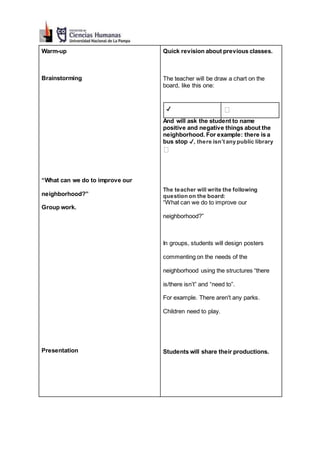
The teacher will be draw a chart on the
board, like this one:
✔ ✖️
And will ask the student to name
positive and negative things about the
neighborhood. For example: there is a
bus stop ✔, there isn’t any public library
✖️
The teacher will write the following
question on the board:
“What can we do to improve our
neighborhood?”
In groups, students will design posters
commenting on the needs of the
neighborhood using the structures “there
is/there isn’t” and “need to”.
For example. There aren't any parks.
Children need to play.
Students will share their productions.
Bibliography:
● Chapter 9, Wedel and Malderez. Wedell, M. & Malderez, A. (2013). Understanding
Language Classroom Contexts: the starting point for Change. London, Bloomsbury.
● Barboni,Silvana (2011). Enseñanza de Inglés e Identidad Nacional. Buenos Aires,
Editorial El Margen.
● Curricular guidelines from our province and NAP for Foreign Language Teaching in
Argentina.

Third mid term. angela lopez, solange cortese.

  • 2.
    Practice II, Didacticsof ELT and Practicum Primary School level. Adjunto Regular a/c Prof. Estela Braun (2019). Full Name/s: Angela López, Solange Cortese. Topic: Take-Home Third Parcial Practice II - A project that empower students by taking into account their socio-cultural identity and social context. A project that empowers students by taking into account their socio-cultural identity and social context. This paper aims at demonstrating the empowering and enriching advantages of teaching English from an Intercultural Perspective where the social-cultural context of the learners is taken into account. This will give students opportunities to acquire meaningful knowledge that will undoubtedly benefit the construction of their identities. To back up our claims, we will provide you with a description of our lessons using the intercultural approach to teach English, which we will also relate and connect with Silvana Barboni’s theory (2011), the chapter 9 of “Understanding Language Classroom Contexts: the starting point for Change by Wedel and Malderez” (2013), as well as the curricular guidelines from our province and NAPs for Foreign Language Teaching in Argentina. To begin with, Barboni states that everyday, the public school intervenes in the construction of childrens’ identity in multiple ways. In the English class, we can deal with contents related to their surroundings. That is to say, their physical geographical context, the society in which they are immersed, their everyday lives and customs,
  • 3.
    their harsh orkind realities, among other aspects. In this way, we go against the stereotyped English class which revolved around the mere repetitive exercise of grammatical forms and functions. These traditional classes were lessons in which none of the students would never recognize themselves and that had little to do with their realities, customs and identity. These were lessons that responded to a foreign model where students had to think as if you were a native english speaker, leaving aside their own identity. The purpose behind this was clearly to maintain an imperialist ideology. Nowadays, grammar notions and functions continue to be present in the class, since they are part of the language. But the good thing is that everything tends to be articulated and integrated so that students, along with the teacher can create meanings on different issues that are related to and familiar to the students’ lives. The teaching of the English language from an intercultural approach helps students to eliminate this feeling of the English subject not having any connection with their realities. It is no longer deemed as something “strange”. On the contrary, the English classroom has become a system that each individual appropriates to mean their own, and recognizing in this exercise the Other, the diverse. The issues stated before can be reflected in one of our experiences when doing our practicum at school n° 92. According to the school annual planning, we had to teach the grammatical forms “There is”, “There are”, “There isn’t” and “There aren’t”. In the traditional form, the teachers tend to teach it just by explaining pupils the meanings of these structures and by instructing how to use them. Consequently, they are encouraged to apply the acquired knowledge using exercises out of context without promoting creativity, critical thinking, reflection, motivation and fruitful
  • 4.
    experiences. Furthermore, thesestandardized lessons normally ignore the cultural and social framework of students. In order to avoid these pointless English classroom environments, we decided to teach these structures by taking into account the place our learners know best and that forms part of their daily lives: their neighbourhood. For this lesson, We designed a project named “My community” where we hoped all students would feel part of it. And actually this was what happened. Picture illustrating our project !!!
  • 6.
    For this, wefirst explained the structures and how to use them using visual material to support our explanations. To provide students with instances to apply and put into practise the acquisition of the new knowledge, we took pictures of the most concurring places that exist in the “ Zona Norte” neighbourhood. This is the area which the school n° 92 belongs to and where most of the our students live. The pictures feature places that we consider are essentials for the inhabitants of the neighborhood, for example: greengrocery, public infirmary, butcher’s, football field, school, diner, among others. With these places they had to form sentences using the structures mentioned before. For example: “There is a diner in my neighborhood”. But before that, we showed them all the pictures one by one. They were so enthusiastic, motivated excited, and curious about this. In fact, all of them had something to say, as they knew the neighborhood perfectly well. Participation was improved enormously as a result. They also learned new vocabulary which was easy to learn because of the associations they could make between the words and images of real places. Something to highlight is that when we showed them the picture featuring the school n° 92, some of them chanted “Our school!”, “Our school!”, some of them even clapped. They were not only learning contents, but as Barboni claims, they were appropriating a new system to mean their own, using contents with which they feel identified. Following Barboni's line of thought, we can reflect that educators are faced with a multiplicity of socio-historical changes that are forcing them to redefine the role of the school as well as the roll of the educators. There is the challenge of adjusting to new times, thinking of new contents and ways of teaching them (Dussel and Finocchio, 2003). We need to leave behind those subtracting models that support and respond to processes with imperialistic, homogenizing and colonialist features (Holliday, 2007; Pennycook, 2001; Phillipson, 1992). We need to stop using them because they aim at
  • 7.
    molding the identityof the learners from the linguistic habits with the argument that English is inherently a useful language and ,therefore, have to be taught. In other words, the English language has been given a certain priority and supremacy that attend to homogenization at the cost of the disappearance of other languages, and with them their cultures in many regions of the world (Pillipson, 1992; Canagarah, 1999). In the process of learning English, we do not necessarily have to adopt their cultural patterns, we can perfectly learn a new linguistic system to communicate and express our own cultural meanings in interaction with others. If we as educators adapt and modify the curriculum contents using an intercultural perspective whenever it is possible, we can effectively counteract the transmission of particular beliefs either explicitly or implicitly that can lead to a cultural and ideological colonization. That is to say, a form of indoctrination since we have to remember that we cannot dissociate English itself from the social, cultural, historical, economic, political and religious relations in which it exists (Pennycook and Coutand-Marin, 2003; Osler and Starkey, 2000; Starkey , 2007), Based on what we was just mentioned, we strongly believe that we, as future English teachers, have the political must of creating classrooms environments where English does not constitute a threat to students’ identities. Our intercultural project “ My community” not only promoted values related to their citizenship and the appreciation of what they have in their neighbourhood, but also the opportunity of claiming for their rights by reflecting on what was lacking in their surroundings. Through the use of the structure “ there isn’t” and “ there aren’t”, we encouraged learners to mention the essential places that are absent in the neighbourhood and that are necessary to cover their basic needs. “ we need a hospital” said Avigail ( who has a lot of knowledge about English), “ necesitamos mejores streets porque están todas rotas” protested Gonzalo, “ y que arreglen las
  • 8.
    cloacas porque nose puede aguantar el mal olor cuando jugamos en las calles” added Lali, “library, teacher, nosotros no tenemos” shouted Ezequiel. The contributions and exchanges were quite considerable to include all of them, but we want to mention this last comment by Derian “ lo que necesitamos es un barrio más tranquilo” which gives an account not only on how reflective students would be, but it also tells us about the daily environment children face. After this reflection and exchange of opinions, they were given an activity in which they had to use the structures we mentioned before, using the new vocabulary. For example, they had to write sentences that said “ In my neighbourhood there is a football field”, in my neighbourhood there is not a hospital”. By providing you with these accounts what we want is to highlight and evince that it is possible to teach linguistic components such as grammar by putting them into meaningful contexts, considering what surrounds and identifies students. From our
  • 9.
    experience, teaching usingthis approach results in more effective learning, where children make relations and association between the contents they learn and their local realities,living no space for cultural and linguistic imperialism. Now, something that we want to make clear is that we are not against teachers and learners tackling and interacting with contents and environments related to other cultures and realities since it enriches children’s view of the world and allows them to put themselves in the place of the Other. Moreover, childrens’ contact with other cultures promote respect for cultural differences at the same time they learn a new language. So, we can provide learners with environments where they become aware of the existence of other cultures, but making sure that they do not devalue their own. On the other hand, According to Wedel and Malderez (2013), one of the reasons behind changes in the english language classroom is Globalization and its consequent need for the citizens to be able to use english to access and make use of all available knowledge resources worldwide. This is the case of Argentina where the reformed curriculum, which encouraged multilingualism and multiculturalism, viewed english as the language for international communication that would give its speakers access to many cultures and would thereby empower future Argentine generations with the necessary symbolic resources needed to fully function in the global market. English was thus seen as necessary to every Argentine citizen. Even though globalization seems a justifiable reason for policy-makers to introduce educational changes, they do it with little regard as to
  • 10.
    whether they arecontextually appropriate. These are the cases where teachers’ role come into play producing lessons in which students’ learning is supported by the necessary changes. Despite numerous attempts to introduce more communicative, learner centred approaches to education systems worldwide, many features of teaching and learning in most systems remain at Transmission-based classroom. This is no entirely surprising since rapid change in many visible material and technological aspects of life seems to be the norm all around the world. Therefore, educational planners have often expected the visible outcomes of their change initiatives to be achieved within a similarity short-time span. Even though the results of transmission-based classroom are more easy and quick to perceive, when it comes to production, students find it very difficult to use their own words to express themselves. Even if teaching from an intercultural and communicative point of view takes effort and requires time, the results are more rewarding both for students and teachers. Learning becomes meaningful and when something is meaningful and relevant for the life of students, it lasts forever in their memories. Coming up next, we are going to present the legal framework behind this multicultural approach: Curricular guidelines at primary level. (Materiales curriculares de educación primaria): According to the national law Nº 26.206, article 27, as well as the provincial law n° 2511, article 29, it is necessary to provide equitative opportunities to all children
  • 11.
    equally to acquirerelevant, significant and meaningful knowledge from different fields, especially, language, communication, social sciences, mathematics, natural sciences, the environment, foreign language, art and culture and the ability to apply that knowledge to their daily lives; as well as to provide them with knowledge and cognitive tools necessary to continue with secondary school education. Purposes: The primary school should promote situations where: ● The foreign language is seen as an experience of high formative value that transcends the school environment and contribute to citizenship. ● The students acquire the ability to distinguish sociocultural aspects in texts in foreign language and respect for languages varieties that are not their own, to revalue their own language and culture. ● Students develop the ability to reflect on the language and its functioning ● Student develop diverse strategies to understand and produce oral and written texts in the foreign language that at the sime time will strengthen their sense of collaboration and cooperation as well as encourage participatory dialogue. ● Critical thinking, reflection and exchange of ideas is encouraged. ● Student feel confident in the possibilities of learning an LE, respecting their own learning rhythms and styles, that leads to a progressive construction of autonomy. ● Mistakes are seen as a constitutive part of the learning process. ● The foreign language is seen as means for learning and expanding the cultural universe.
  • 12.
    ● It ispossible to articulate the foreign language with other areas of the curriculum. GENERAL OBJECTIVES: In order for children to achieve meaningful learning of foreign language and so that they can gradually increase and improve their intercultural and communicative competence, both oral and written in English, they are expected to: ● Respect other languages and cultures and revalue their own. ● Consider that learning another language allows them to expand their cultural universe ● Progressively develop comprehension and production strategies of diverse texts, written and oral, in the foreign language. ● Enjoy literary texts in the foreign language and recreate them through different artistic expressions. ● Participate in projects and problem solving tasks that promote the development of cooperative and collaborative work. ● Make use of technological resources for the realization of tasks and Projects. ● Interact in contextualized situations from the use of the foreign language for the exchange of ideas and points of view. NAPs (Núcleos de Aprendizaje Prioritarios) The NAP compiles agreements established for Compulsory Education. The purposes of the NAP is to generate equal opportunities for all children in Argentina. In this sense, the NAP provides the knowledge that as a society we consider to be
  • 13.
    relevant and significantfor children, adolescents and young people, so they can grow, study, live and participate in a democratic and fair country. In a context of high fragmentation and social heterogeneity, The Federal Council for Culture and Education agreed to identify NAP (Núcleos de Aprendizaje Prioritarios) for Primary and Secondary Education as a measure to give unity to the Argentine Educational System. Its objective is to guarantee equal conditions of education by building unity and return the school to its public function, so that all the habitants reach equivalent competence, abilities and knowledge regardless of their social and territorial location. The NAPs have been developed considering the fundamental principles that must support the teaching of a foreign language. Created from an intercultural and multilingual perspective, the NAPs emphasize their role as builders of socio-cultural identity of children and adolescents. The NAPs privilege both the knowledge of languages and the formation of citizens that respect linguistic and cultural differences, promoting new ways of facing sociocultural and linguistic diversity. The intercultural and multilingual perspective combines language learning with the capacity for critical reflection, necessary for coexistence in societies of great cultural diversity; in other words, it encourages active participation in democratic processes and contributes to build citizenship and peace. Conclusion: Taking everything into account, we can conclude by stating that teaching english from a multicultural perspective is not only a beneficial and enriching experience for students but also it is their right, as it is stated in the NAPs and in the curricular
  • 14.
    guidelines. Even suchabstract notions like grammar can become concrete when they are taught using relevant examples extracted from students’ everyday lives. Learning becomes meaningful because students make a direct connection between vocabulary and real entities they know very well. When learning is meaningful, it lasts forever and they can progressively appropriate the foreign language to mean their own and consequently, increase their autonomy. Of course, teaching from this perspective requires time and effort, it implies designing our own materials and to re- think our posture as teachers, but the results are worth it, both for the teacher and the students as well. Lesson plan following a multicultural approach: Practice II, Didactics of ELT and Practicum Primary School level. Adjunto Regular a/c Prof. Estela Braun (2019). Full Name/s: Angela López, Solange Cortese. Topic: Intercultural Project “My community” Course: 6A Timetable: Tuesdays 13:10 - 13:50 Wednesday 13:10 - 13:50 Description of the group: Grade 6A. Beginning level of English language proficiency. State primary school. 80-minutes a week. There are fifteen students in the class (7 girls and 8 boys). Students’ age: 11-12-13 years old. There are a couple
  • 15.
    of students thatrepresent a challenge for the teacher as they normally misbehave hindering the teaching and the flow of the lesson. There are occasions when they show certain interest in the activities planned by the teacher, although, there are a constant effort to get their attention to carry out the activities. Time 40 minutes Objectives By the end of the lessons students will be able to: -Identify important places in the neighborhood. -Acquire vocabulary related to buildings and places of the city. -Match the names of building with pictures -Complete sentences with prepositions following a map of the neighborhood - use the structures there is/ there are and there isn’t/ there aren’t in an appropriate way. Structures Imperatives (Complete…)
  • 16.
    There is/There are(There is a bus stop next to the school) Target Vocabulary Building and places of the city Prepositions of place (next to, on, under, behind, in, near, in front) You will need: ● Map of the neighbourhood “Zona norte” with pictures of important places and buildings. https://docs.google.com/document/d/1NOhR1eDs1QC9Ke79F9ddDGViweZU7SIk OfVhH6g732Q/edit ● Posters ● Worksheet (Complete with prepositions) ● pictures ● flashcards Procedure Lesson n° 1: “My community” Warm-up Brainstorming Poster with a map of the neighbourhood “Zona Norte” with pictures of important places and buildings it has. ● Students will be asked if they live near the school and to describe their neighbourhoods naming important places they can find there to mention. If they don't know how to say it in english they will say it in spanish. The teacher will write the different places they name on the board. ● Students will be shown a map of the “Zona Norte” neighborhood that displays pictures of important building and places (Local infirmary, dinner, parks, shops, banks) ● Students will be asked if they recognize any of the places
  • 17.
    ● Match thepicture with the correct word. ● Look at the map of the Zona norte neighborhood and complete the sentences with prepositions featuring in the pictures and where they can find them. Also they will be asked if they go there often and in what situations. ● The teacher will show flashcards with the names of important places of the neighborhood and students will try to guess their meaning and match them with the pictures of the map. ● The names will be stuck on the map with their corresponding picture. This poster will be used to present students with new vocabulary. ● Students are expected to complete the sentences about the neighborhood with the following prepositions (In front of, Behind, Next to) There is a bus stop______ the school There is a bakery______ the clothing store There is a park ______ the public infirmary. There is a kiosk______ the school There is a football field______the bus stop There is a butcher shop______ the bakery There is a mechanical workshop________ the pet store. There is a hairdressers ______ the clothing store. Lesson n° 2: “There isn’t/ There aren’t” Warm-up Quick revision of places and buildings of the neighborhood
  • 18.
    Brainstorming Introduction structure “thereisn’t/ there aren’t” Describing my neighborhood using there is/there are/ there isnt/there aren't. Ask students to name places that are not present in the map of the neighborhood and write them on the board. Ask students to name places and facilities they would like to have in their neighbourhood. Introduce students with new vocabulary related to places of the city. Explain to students that we use the structure “there isn’t/ there aren’t” to refer to “no hay”, in other words, to describe things that cannot be find in a particular place. As a way to put into practice the structure “there isn't/there aren’t”, students will complete a chart about their neighborhood. My neighborhood In my neighborhood there is…………………… …………………… ……………..……… ………………. In my neighborhood there are………………… …………………… …………………… …………. In my neighborhood there isn’t……………… …………………… …………………..… ……………………. In my neighborhood there aren’t……………… …………………… …………………… …………….
  • 19.
    Lesson n°3: “Whatcan we do to improve our neighborhood?”
  • 20.
    Warm-up Brainstorming “What can wedo to improve our neighborhood?” Group work. Presentation Quick revision about previous classes. The teacher will be draw a chart on the board, like this one: ✔ ✖️ And will ask the student to name positive and negative things about the neighborhood. For example: there is a bus stop ✔, there isn’t any public library ✖️ The teacher will write the following question on the board: “What can we do to improve our neighborhood?” In groups, students will design posters commenting on the needs of the neighborhood using the structures “there is/there isn’t” and “need to”. For example. There aren't any parks. Children need to play. Students will share their productions.
  • 21.
    Bibliography: ● Chapter 9,Wedel and Malderez. Wedell, M. & Malderez, A. (2013). Understanding Language Classroom Contexts: the starting point for Change. London, Bloomsbury. ● Barboni,Silvana (2011). Enseñanza de Inglés e Identidad Nacional. Buenos Aires, Editorial El Margen. ● Curricular guidelines from our province and NAP for Foreign Language Teaching in Argentina.