DERMOEPIDERMAL
JUNCTION AND
DESMOGLEINS
DR. MOHNISH SEKAR
INTRODUCTION
• The dermo-epidermal junction (BMZ) is the interface between
the lower part of the epidermis and the top layer of the dermis
• Plays a key role in epidermal–dermal interactions.
• DEJ mediates adhesion between the basal keratinocytes and the
dermis and provides resistance against shearing forces on the
skin.
DEVELOPMENT
• DEJ develops from a simple, generic basement membrane in
the embryo  highly complex, multilayered structure in the
2nd trimester of fetus.
• The embryonic DEJ  lamina densa and lamina lucida.
• Composed of molecules common to all basement membrane
zones (e.g. type IV collagen, laminin, heparan sulfate,
proteoglycans).
• 8 weeks  Skin- specific components of the DEJ start to
appear after the embryonic–fetal coincident with the onset of
epidermal stratification.
• 12 weeks  almost all of the structures characteristic of the
mature DEJ.
• Hemidesmosomes, anchoring filaments and anchoring fibrils
 synthesized by basal keratinocytes.
• Type VII collagen-containing anchoring fibrils localizing to the
sub-lamina densa.
• Laminin 5 and the bullous pemphigoid antigens also expressed.
• As development progresses, the flat embryonic DEJ acquires
the rete ridges and dermal papillae  the adult DEJ.
STRUCTURE AND
ULTRASTRUCTURE
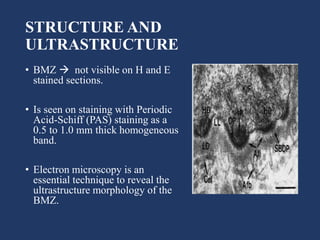
• BMZ  not visible on H and E
stained sections.
• Is seen on staining with Periodic
Acid-Schiff (PAS) staining as a
0.5 to 1.0 mm thick homogeneous
band.
• Electron microscopy is an
essential technique to reveal the
ultrastructure morphology of the
BMZ.
LAYERS OF BMZ
• A specialized portion in the basal-most part of the basal cell
layer  hemidesmosome.
• An electron lucent sub-basal zone  lamina lucida (approx.
40 nm thick).
• An electron- dense zone  lamina densa (approx. 50 nm
thick) or basal lamina.
• Lamina fibroreticularis.
HEMIDESMOSOMES
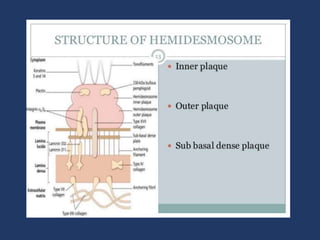
• Focal thickenings of plasma membrane.
• Adhesion between epidermis and dermis.
• Cytoplasmic portion  inner plaque, to which tonofilaments
(keratin 14, 5) are attached.
• Portion near basal plasma membrane  outer plaque.
• Sub basal dense plaque
• Sub-basal dense plaque (extracellular component)  parallel
and beneath the outer plaque, approx. 10 nm away from
outer surface of plasma membrane.
• No. of hemidesmosomes  constant in each individual.
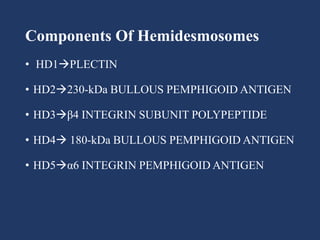
Components Of Hemidesmosomes
• HD1PLECTIN
• HD2230-kDa BULLOUS PEMPHIGOID ANTIGEN
• HD3β4 INTEGRIN SUBUNIT POLYPEPTIDE
• HD4 180-kDa BULLOUS PEMPHIGOID ANTIGEN
• HD5α6 INTEGRIN PEMPHIGOID ANTIGEN
Lamina Lucida
• Less electron dense on transmission electron microscopy
COMPONENTS
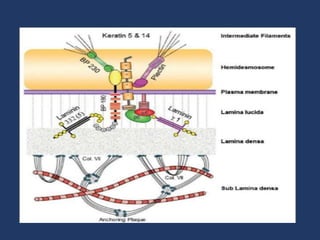
• Anchoring filaments span lamina lucida and connecting
hemidesmosomes with lamina densa.
• Laminin 5, α6β4 integrin, ectodomain of the 180 kDa
BPAg2/BP180  major constituents of the lamina lucida.
• The endodomain of BP180  in the outer plaque of the
hemidesmosome.
Anchoring Filaments
• Fine thread like structures,3-4nm in diameter
• Major antigenLAMININ322Binds to α6β4 INTEGRIN
in HD and to TYPEVII COLLAGEN in anchoring fibrils
• OTHER ANTIGENS
125-kDa,19-DEJ-1,105kDa,LAD-1.
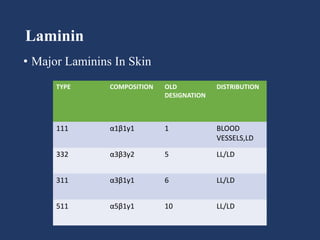
Laminin
• Major Laminins In Skin
TYPE COMPOSITION OLD
DESIGNATION
DISTRIBUTION
111 α1β1γ1 1 BLOOD
VESSELS,LD
332 α3β3γ2 5 LL/LD
311 α3β1γ1 6 LL/LD
511 α5β1γ1 10 LL/LD
Functions
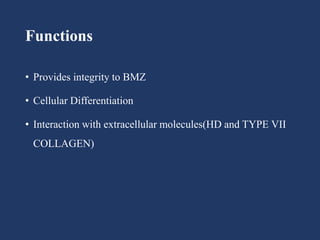
• Provides integrity to BMZ
• Cellular Differentiation
• Interaction with extracellular molecules(HD and TYPE VII
COLLAGEN)
Lamina Densa
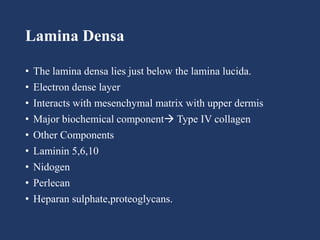
• The lamina densa lies just below the lamina lucida.
• Electron dense layer
• Interacts with mesenchymal matrix with upper dermis
• Major biochemical component Type IV collagen
• Other Components
• Laminin 5,6,10
• Nidogen
• Perlecan
• Heparan sulphate,proteoglycans.
COLLAGEN
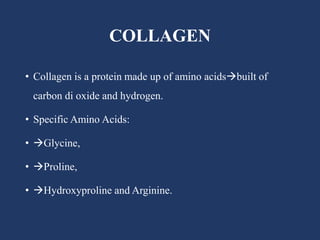
• Collagen is a protein made up of amino acidsbuilt of
carbon di oxide and hydrogen.
• Specific Amino Acids:
• Glycine,
• Proline,
• Hydroxyproline and Arginine.
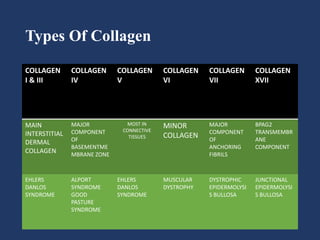
Types Of Collagen
COLLAGEN
I & III
COLLAGEN
IV
COLLAGEN
V
COLLAGEN
VI
COLLAGEN
VII
COLLAGEN
XVII
MAIN
INTERSTITIAL
DERMAL
COLLAGEN
MAJOR
COMPONENT
OF
BASEMENTME
MBRANE ZONE
MOST IN
CONNECTIVE
TISSUES
MINOR
COLLAGEN
MAJOR
COMPONENT
OF
ANCHORING
FIBRILS
BPAG2
TRANSMEMBR
ANE
COMPONENT
EHLERS
DANLOS
SYNDROME
ALPORT
SYNDROME
GOOD
PASTURE
SYNDROME
EHLERS
DANLOS
SYNDROME
MUSCULAR
DYSTROPHY
DYSTROPHIC
EPIDERMOLYSI
S BULLOSA
JUNCTIONAL
EPIDERMOLYSI
S BULLOSA
Type IV Collagen
Collagen IV primary collagen found in the extracellular
basement membrane.
Major component of the dermal–epidermal junction lamina
densa.
Collagen IV is a heterotrimeric molecule containing two α1-
like and one α2-like genes.
Lamina Fibroreticularis
• Anchoring fibrils  major component of the lamina
fibroreticularis.
• Short, curved, central portion  irregularly spaced cross
banding.
• Insert into the lamina densa, project into papillary dermis.
• Main constituent  type VII collagen.
• Elastic fibers (consist of microfibril bundles)  another
component of the lamina fibroreticularis.
• Attached to the undersurface of the lamina densa.
• Extend into the dermis  enmesh with the microfibrillar
system surrounding dermal elastin.
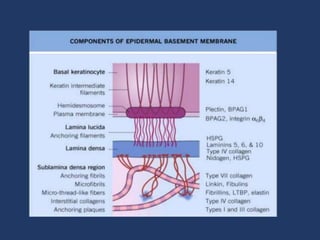
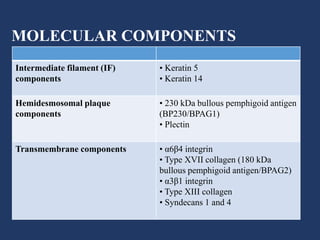
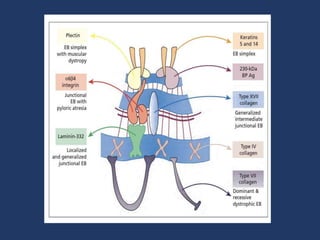
MOLECULAR COMPONENTS
Intermediate filament (IF)
components
• Keratin 5
• Keratin 14
Hemidesmosomal plaque
components
• 230 kDa bullous pemphigoid antigen
(BP230/BPAG1)
• Plectin
Transmembrane components • α6β4 integrin
• Type XVII collagen (180 kDa
bullous pemphigoid antigen/BPAG2)
• α3β1 integrin
• Type XIII collagen
• Syndecans 1 and 4
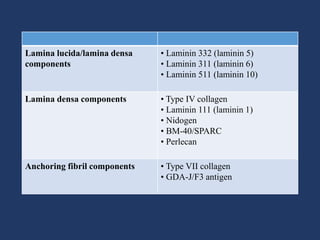
Lamina lucida/lamina densa
components
• Laminin 332 (laminin 5)
• Laminin 311 (laminin 6)
• Laminin 511 (laminin 10)
Lamina densa components • Type IV collagen
• Laminin 111 (laminin 1)
• Nidogen
• BM‐40/SPARC
• Perlecan
Anchoring fibril components • Type VII collagen
• GDA‐J/F3 antigen
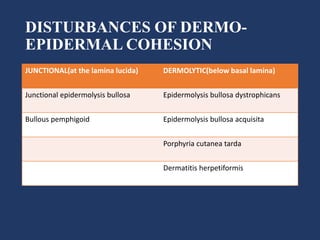
DISTURBANCES OF DERMO-
EPIDERMAL COHESION
JUNCTIONAL(at the lamina lucida) DERMOLYTIC(below basal lamina)
Junctional epidermolysis bullosa Epidermolysis bullosa dystrophicans
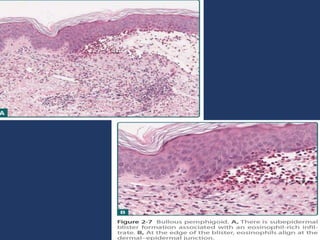
Bullous pemphigoid Epidermolysis bullosa acquisita
Porphyria cutanea tarda
Dermatitis herpetiformis
DESMOGLEINS
• Desmosomal cadherins major role in stabilizing cell-cell
adhesion in the living layers of the epidermis
• Desmosomal cadherins are transmembrane proteins whose
extracellular amino-terminal domains interact to form the
trans-adhesive interface between the cells.
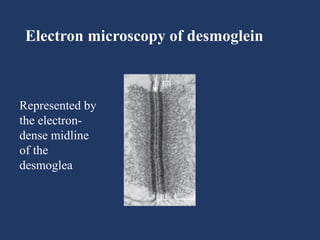
Electron microscopy of desmoglein
Represented by
the electron-
dense midline
of the
desmoglea
Within Normal Epidermis
• Dsg1&4expressed predominantly in the differentiated
cells of the superficial epidermis.
• Dsg2&3 expressed more strongly in the basal &/or
suprabasal layers.
Among different epithelial tissues
• Dsg1&3 expression largely limited to stratified squamous
epithelia of skin &oropharynx, as well as thymic epithelial
cells.
• Dsg3  also strongly expressed in SCCs ,other H&N cancers,
where it has been proposed as a potential molecular target for
therapy.
• Dsg2  major desmoglein isoform in the most simple and
transitional epithelia, as well as cardiac myocytes.
• Dsg4 prominent in desmosomes of hair follicle, testis, and
prostate.
Desmoglein 1
• Target of pathologic proteolytic cleavage in the infectious
disorders bullous impetigo and SSSS& inherited ichthyosis
associated with Netherton syndrome
• Pathogenic autoAbs to desmoglein 1 found in
Pemphigus foliaceus
• Mucocutaneous pemphigus vulgaris
• Paraneoplastic pemphigus
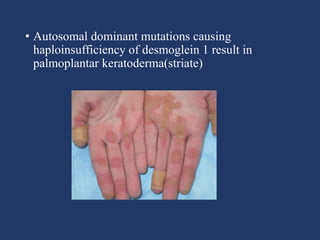
• Autosomal dominant mutations causing
haploinsufficiency of desmoglein 1 result in
palmoplantar keratoderma(striate)
Desmoglein 2
• Dsg2implicated as a cause of autosomal dominant
arrhythmogenic right ventricular cardiomyopathy
(ARVC)
• The lack of skin phenotypes in affected patients indicates 
desmoglein 2 not required for epidermal adhesion, likely due
to compensatory adhesion from other more highly expressed
epidermal desmosomal cadherin isoforms.
Desmoglein 3
Target of pathogenic autoantibodies in
• Mucosal & Mucocutaneous pemphigus vulgaris.
• Paraneoplastic pemphigus.
• Most pathogenic autoantibodies in pemphigus vulgaris
target the amino-terminal extracellular (EC1–2) domains of
desmoglein.
Desmoglein 4
Desmoglein 4 mutations rare autosomal recessive forms of
hypotrichosis & monilethrix.
Desmoglein 4 immunoreactivity observed in pemphigus
vulgaris and pemphigus foliaceus sera,but subsequent studies
have attributed this to cross-reactivity from Dsg1
autoantibodies.
References
• McGrath A, Uitto J. Structure and Function of the Skin. In:
Griffiths E. M, editor. Rook’s Textbook of Dermatology 9th ed.
Blackwell Publishing, Ltd 2010. p. 2.20-2.29.
• Elenitsas R, Chu Y. Pathology of Skin Lesions. In: Kang S,
editor. Fitzpatrick’s Dermatology 9th ed. Mc-Graw Hill
Education 2019. p. 23-5
• Vandergriff W, Bergstresser R. Anatomy and Physiology. In:
Bolognia L. Bolognia Dermatology 3rd Ed. Elsevier Limited
2012. p. 43-4
• Thappa D. M, Konda D. Structure and Functions of the Skin.
In: Sacchidanand S, editor. IADVL Textbook of Dermatology
4th ed. Bhalani Publishing House 2018. p.27-30
• James W, Elston M, Treat R et al. Skin: Basic Structure and
Function. In: James D, editor. Andrew’s Diseases of the Skin
13th ed. Elsevier Inc. 2020. p. 4
• Ortonne JP. The dermo-epidermal junction and its acquired
and hereditary pathology- A few recent advances. Pathol
Biol (Paris). 1992; 40(2):121-32.
• Campbell ID, Humphries MJ. Integrin structure, activation,
and interactions. Cold Spring Harb Perspect Biol.
2011;3(3):a004994.
• Amagai M, Stanley JR. Desmoglein as a target in skin disease
and beyond. J Invest Dermatol. 2012;132(3 Pt 2):776-84.
• Katz SI. The epidermal basement membrane zone--
structure, ontogeny, and role in disease. J Am Acad
Dermatol. 1984;11(6):1025-37
• Abreu-Velez AM, Howard MS. Collagen IV in Normal Skin
and in Pathological Processes. N Am J Med Sci. 2012;4(1):1-8
THANK YOU

Dermo-epidermal junction and Desmogleins

  • 1.
  • 2.
    INTRODUCTION • The dermo-epidermaljunction (BMZ) is the interface between the lower part of the epidermis and the top layer of the dermis • Plays a key role in epidermal–dermal interactions. • DEJ mediates adhesion between the basal keratinocytes and the dermis and provides resistance against shearing forces on the skin.
  • 3.
    DEVELOPMENT • DEJ developsfrom a simple, generic basement membrane in the embryo  highly complex, multilayered structure in the 2nd trimester of fetus. • The embryonic DEJ  lamina densa and lamina lucida. • Composed of molecules common to all basement membrane zones (e.g. type IV collagen, laminin, heparan sulfate, proteoglycans).
  • 4.
    • 8 weeks Skin- specific components of the DEJ start to appear after the embryonic–fetal coincident with the onset of epidermal stratification. • 12 weeks  almost all of the structures characteristic of the mature DEJ. • Hemidesmosomes, anchoring filaments and anchoring fibrils  synthesized by basal keratinocytes.
  • 5.
    • Type VIIcollagen-containing anchoring fibrils localizing to the sub-lamina densa. • Laminin 5 and the bullous pemphigoid antigens also expressed. • As development progresses, the flat embryonic DEJ acquires the rete ridges and dermal papillae  the adult DEJ.
  • 6.
    STRUCTURE AND ULTRASTRUCTURE • BMZ not visible on H and E stained sections. • Is seen on staining with Periodic Acid-Schiff (PAS) staining as a 0.5 to 1.0 mm thick homogeneous band. • Electron microscopy is an essential technique to reveal the ultrastructure morphology of the BMZ.
  • 7.
    LAYERS OF BMZ •A specialized portion in the basal-most part of the basal cell layer  hemidesmosome. • An electron lucent sub-basal zone  lamina lucida (approx. 40 nm thick). • An electron- dense zone  lamina densa (approx. 50 nm thick) or basal lamina. • Lamina fibroreticularis.
  • 8.
    HEMIDESMOSOMES • Focal thickeningsof plasma membrane. • Adhesion between epidermis and dermis. • Cytoplasmic portion  inner plaque, to which tonofilaments (keratin 14, 5) are attached. • Portion near basal plasma membrane  outer plaque. • Sub basal dense plaque
  • 9.
    • Sub-basal denseplaque (extracellular component)  parallel and beneath the outer plaque, approx. 10 nm away from outer surface of plasma membrane. • No. of hemidesmosomes  constant in each individual.
  • 11.
    Components Of Hemidesmosomes •HD1PLECTIN • HD2230-kDa BULLOUS PEMPHIGOID ANTIGEN • HD3β4 INTEGRIN SUBUNIT POLYPEPTIDE • HD4 180-kDa BULLOUS PEMPHIGOID ANTIGEN • HD5α6 INTEGRIN PEMPHIGOID ANTIGEN
  • 13.
    Lamina Lucida • Lesselectron dense on transmission electron microscopy COMPONENTS • Anchoring filaments span lamina lucida and connecting hemidesmosomes with lamina densa. • Laminin 5, α6β4 integrin, ectodomain of the 180 kDa BPAg2/BP180  major constituents of the lamina lucida. • The endodomain of BP180  in the outer plaque of the hemidesmosome.
  • 14.
    Anchoring Filaments • Finethread like structures,3-4nm in diameter • Major antigenLAMININ322Binds to α6β4 INTEGRIN in HD and to TYPEVII COLLAGEN in anchoring fibrils • OTHER ANTIGENS 125-kDa,19-DEJ-1,105kDa,LAD-1.
  • 15.
    Laminin • Major LamininsIn Skin TYPE COMPOSITION OLD DESIGNATION DISTRIBUTION 111 α1β1γ1 1 BLOOD VESSELS,LD 332 α3β3γ2 5 LL/LD 311 α3β1γ1 6 LL/LD 511 α5β1γ1 10 LL/LD
  • 17.
    Functions • Provides integrityto BMZ • Cellular Differentiation • Interaction with extracellular molecules(HD and TYPE VII COLLAGEN)
  • 18.
    Lamina Densa • Thelamina densa lies just below the lamina lucida. • Electron dense layer • Interacts with mesenchymal matrix with upper dermis • Major biochemical component Type IV collagen • Other Components • Laminin 5,6,10 • Nidogen • Perlecan • Heparan sulphate,proteoglycans.
  • 19.
    COLLAGEN • Collagen isa protein made up of amino acidsbuilt of carbon di oxide and hydrogen. • Specific Amino Acids: • Glycine, • Proline, • Hydroxyproline and Arginine.
  • 20.
    Types Of Collagen COLLAGEN I& III COLLAGEN IV COLLAGEN V COLLAGEN VI COLLAGEN VII COLLAGEN XVII MAIN INTERSTITIAL DERMAL COLLAGEN MAJOR COMPONENT OF BASEMENTME MBRANE ZONE MOST IN CONNECTIVE TISSUES MINOR COLLAGEN MAJOR COMPONENT OF ANCHORING FIBRILS BPAG2 TRANSMEMBR ANE COMPONENT EHLERS DANLOS SYNDROME ALPORT SYNDROME GOOD PASTURE SYNDROME EHLERS DANLOS SYNDROME MUSCULAR DYSTROPHY DYSTROPHIC EPIDERMOLYSI S BULLOSA JUNCTIONAL EPIDERMOLYSI S BULLOSA
  • 21.
    Type IV Collagen CollagenIV primary collagen found in the extracellular basement membrane. Major component of the dermal–epidermal junction lamina densa. Collagen IV is a heterotrimeric molecule containing two α1- like and one α2-like genes.
  • 22.
    Lamina Fibroreticularis • Anchoringfibrils  major component of the lamina fibroreticularis. • Short, curved, central portion  irregularly spaced cross banding. • Insert into the lamina densa, project into papillary dermis. • Main constituent  type VII collagen.
  • 23.
    • Elastic fibers(consist of microfibril bundles)  another component of the lamina fibroreticularis. • Attached to the undersurface of the lamina densa. • Extend into the dermis  enmesh with the microfibrillar system surrounding dermal elastin.
  • 24.
    MOLECULAR COMPONENTS Intermediate filament(IF) components • Keratin 5 • Keratin 14 Hemidesmosomal plaque components • 230 kDa bullous pemphigoid antigen (BP230/BPAG1) • Plectin Transmembrane components • α6β4 integrin • Type XVII collagen (180 kDa bullous pemphigoid antigen/BPAG2) • α3β1 integrin • Type XIII collagen • Syndecans 1 and 4
  • 25.
    Lamina lucida/lamina densa components •Laminin 332 (laminin 5) • Laminin 311 (laminin 6) • Laminin 511 (laminin 10) Lamina densa components • Type IV collagen • Laminin 111 (laminin 1) • Nidogen • BM‐40/SPARC • Perlecan Anchoring fibril components • Type VII collagen • GDA‐J/F3 antigen
  • 26.
    DISTURBANCES OF DERMO- EPIDERMALCOHESION JUNCTIONAL(at the lamina lucida) DERMOLYTIC(below basal lamina) Junctional epidermolysis bullosa Epidermolysis bullosa dystrophicans Bullous pemphigoid Epidermolysis bullosa acquisita Porphyria cutanea tarda Dermatitis herpetiformis
  • 29.
    DESMOGLEINS • Desmosomal cadherinsmajor role in stabilizing cell-cell adhesion in the living layers of the epidermis • Desmosomal cadherins are transmembrane proteins whose extracellular amino-terminal domains interact to form the trans-adhesive interface between the cells.
  • 30.
    Electron microscopy ofdesmoglein Represented by the electron- dense midline of the desmoglea
  • 31.
    Within Normal Epidermis •Dsg1&4expressed predominantly in the differentiated cells of the superficial epidermis. • Dsg2&3 expressed more strongly in the basal &/or suprabasal layers.
  • 32.
    Among different epithelialtissues • Dsg1&3 expression largely limited to stratified squamous epithelia of skin &oropharynx, as well as thymic epithelial cells. • Dsg3  also strongly expressed in SCCs ,other H&N cancers, where it has been proposed as a potential molecular target for therapy. • Dsg2  major desmoglein isoform in the most simple and transitional epithelia, as well as cardiac myocytes. • Dsg4 prominent in desmosomes of hair follicle, testis, and prostate.
  • 33.
    Desmoglein 1 • Targetof pathologic proteolytic cleavage in the infectious disorders bullous impetigo and SSSS& inherited ichthyosis associated with Netherton syndrome • Pathogenic autoAbs to desmoglein 1 found in Pemphigus foliaceus • Mucocutaneous pemphigus vulgaris • Paraneoplastic pemphigus
  • 34.
    • Autosomal dominantmutations causing haploinsufficiency of desmoglein 1 result in palmoplantar keratoderma(striate)
  • 35.
    Desmoglein 2 • Dsg2implicatedas a cause of autosomal dominant arrhythmogenic right ventricular cardiomyopathy (ARVC) • The lack of skin phenotypes in affected patients indicates  desmoglein 2 not required for epidermal adhesion, likely due to compensatory adhesion from other more highly expressed epidermal desmosomal cadherin isoforms.
  • 36.
    Desmoglein 3 Target ofpathogenic autoantibodies in • Mucosal & Mucocutaneous pemphigus vulgaris. • Paraneoplastic pemphigus. • Most pathogenic autoantibodies in pemphigus vulgaris target the amino-terminal extracellular (EC1–2) domains of desmoglein.
  • 37.
    Desmoglein 4 Desmoglein 4mutations rare autosomal recessive forms of hypotrichosis & monilethrix. Desmoglein 4 immunoreactivity observed in pemphigus vulgaris and pemphigus foliaceus sera,but subsequent studies have attributed this to cross-reactivity from Dsg1 autoantibodies.
  • 38.
    References • McGrath A,Uitto J. Structure and Function of the Skin. In: Griffiths E. M, editor. Rook’s Textbook of Dermatology 9th ed. Blackwell Publishing, Ltd 2010. p. 2.20-2.29. • Elenitsas R, Chu Y. Pathology of Skin Lesions. In: Kang S, editor. Fitzpatrick’s Dermatology 9th ed. Mc-Graw Hill Education 2019. p. 23-5 • Vandergriff W, Bergstresser R. Anatomy and Physiology. In: Bolognia L. Bolognia Dermatology 3rd Ed. Elsevier Limited 2012. p. 43-4 • Thappa D. M, Konda D. Structure and Functions of the Skin. In: Sacchidanand S, editor. IADVL Textbook of Dermatology 4th ed. Bhalani Publishing House 2018. p.27-30
  • 39.
    • James W,Elston M, Treat R et al. Skin: Basic Structure and Function. In: James D, editor. Andrew’s Diseases of the Skin 13th ed. Elsevier Inc. 2020. p. 4 • Ortonne JP. The dermo-epidermal junction and its acquired and hereditary pathology- A few recent advances. Pathol Biol (Paris). 1992; 40(2):121-32. • Campbell ID, Humphries MJ. Integrin structure, activation, and interactions. Cold Spring Harb Perspect Biol. 2011;3(3):a004994. • Amagai M, Stanley JR. Desmoglein as a target in skin disease and beyond. J Invest Dermatol. 2012;132(3 Pt 2):776-84.
  • 40.
    • Katz SI.The epidermal basement membrane zone-- structure, ontogeny, and role in disease. J Am Acad Dermatol. 1984;11(6):1025-37 • Abreu-Velez AM, Howard MS. Collagen IV in Normal Skin and in Pathological Processes. N Am J Med Sci. 2012;4(1):1-8
  • 41.