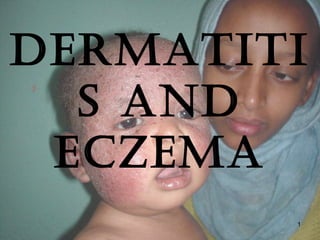
Dermatiti
s anD
eczema
1
Introduction
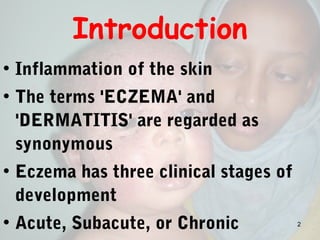
• Inflammation of the skin
• The terms 'ECZEMA' and
'DERMATITIS' are regarded as
synonymous
• Eczema has three clinical stages of
development
• Acute, Subacute, or Chronic 2
Epidemiology
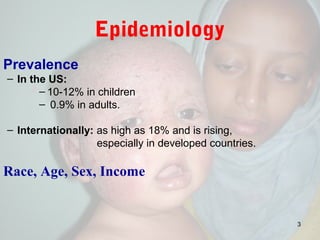
Prevalence
– In the US:
– 10-12% in children
– 0.9% in adults.
– Internationally: as high as 18% and is rising,
especially in developed countries.
Race, Age, Sex, Income
3
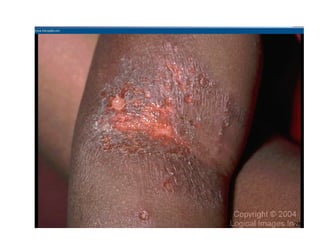
Atopic Eczema
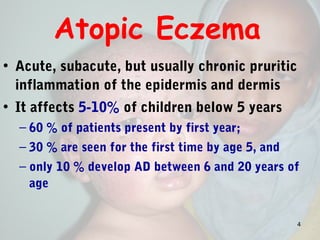
• Acute, subacute, but usually chronic pruritic
inflammation of the epidermis and dermis
• It affects 5-10% of children below 5 years
– 60 % of patients present by first year;
– 30 % are seen for the first time by age 5, and
– only 10 % develop AD between 6 and 20 years of
age
4
Atopic Eczema
• Patients with AD:
–30% develop asthma
–35% have Allergic Rhinitis.
5
Atopic Eczema
• Interaction of genetics and environmental
factors results in development of atopic
eczema.
• Both IgE mediated and cell mediated
hypersensitivity reactions are involved
6
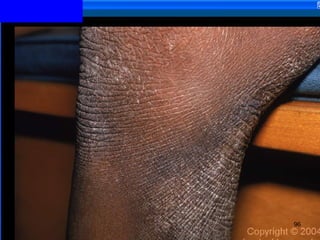
Atopic Eczema
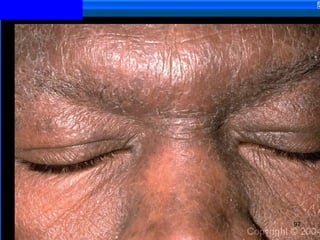
• Pruritus is the sine qua non of atopic
dermatitis.
• There is no fever or other constitutional
symptoms.
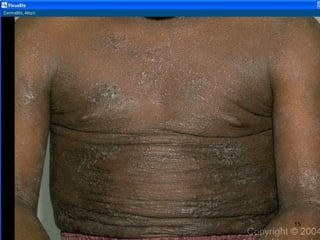
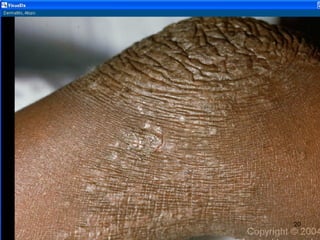
• Lichenification because of repeated scratching
is commonly seen.
• Other atopic diathesis may present at the same
time.
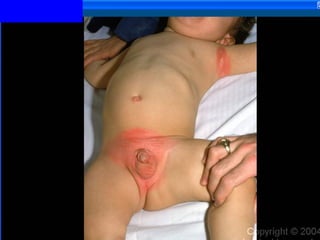
• Sparing of the diaper area is more common in
7
Atopic Eczema
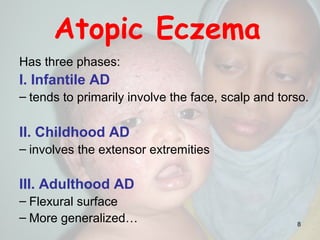
Has three phases:
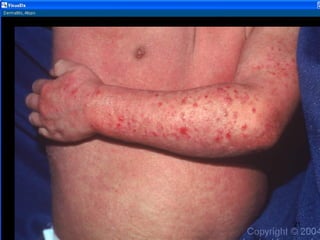
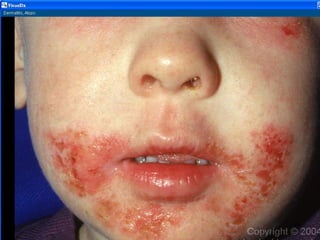
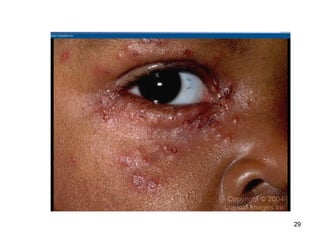
I. Infantile AD
– tends to primarily involve the face, scalp and torso.
II. Childhood AD
– involves the extensor extremities
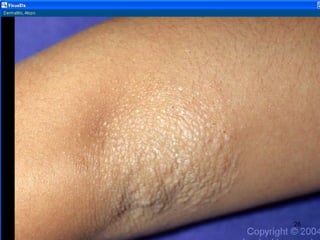
III. Adulthood AD
– Flexural surface
– More generalized… 8
Atopic Eczema
• The exact cause of the condition is UK:
– Most patients have
• marked xerosis and
• inability to retain moisture in the skin.
• Environmental triggers
– heat, humidity, detergents/soaps;
– abrasive clothing, chemicals, and smoke and stress
9
Diagnostic Criteria
Hanifin diagnostic criteria:
Major
– Pruritus
– Typical and age-specific changes:
– Chronic and relapsing course
– Family Hx
10
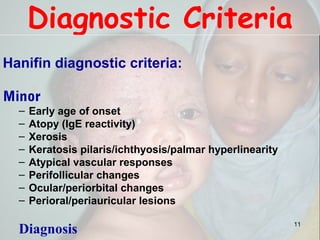
Diagnostic Criteria
Hanifin diagnostic criteria:
Minor
– Early age of onset
– Atopy (IgE reactivity)
– Xerosis
– Keratosis pilaris/ichthyosis/palmar hyperlinearity
– Atypical vascular responses
– Perifollicular changes
– Ocular/periorbital changes
– Perioral/periauricular lesions
Diagnosis 11
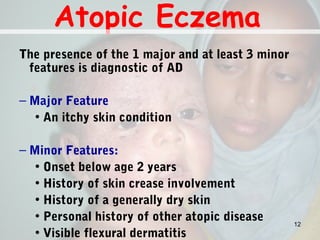
Atopic Eczema
The presence of the 1 major and at least 3 minor
features is diagnostic of AD
– Major Feature
• An itchy skin condition
– Minor Features:
• Onset below age 2 years
• History of skin crease involvement
• History of a generally dry skin
• Personal history of other atopic disease
• Visible flexural dermatitis
12
13
Atopic Eczema
•
14
15
16
17
18
19
20
21
22
23
24
25
26
Atopic Eczema
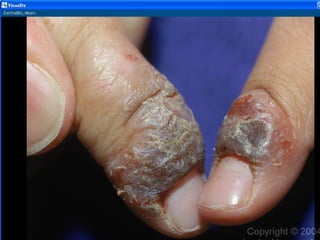
• Are particularly prone to
I. Cutaneous Infections/Infestations
• Bacterial
• Viral
• Fungal
• Scabies
27
28
29
30
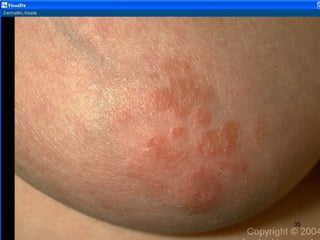
Atopic Eczema
• Are particularly prone to
II. Localized eczemas
31
32
33
34
35
36
Management
Eduacation on prophylactic
measures
Bathing and soaps
 Recommend non-soap cleansers such as Cetaphil or
moisturizing soaps such as Dove.
Clothing,
Emollients
 Ichthammol and coal tar,
 Make sure a humid household environment is
37
Management
 Topical Corticosteroids,
 Antihistamines, ???
 Antibiotics
 Topical immuno-modulators
 Tacrolimus ointment 0.03%, 0.1% bid.
OR
 Pimecrolimus 1% cream bid.
Long term prognosis generally good
38
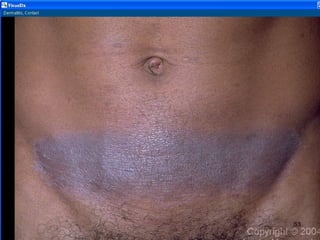
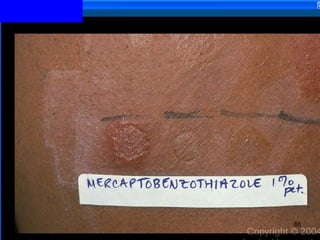
Contact Dermatitis [ CD ]
–Acute or chronic inflammatory reactions to
substances that come in contact with the
skin.
–Two forms of CD exist
• Irritant Contact Dermatitis (ICD)
• Allergic Contact Dermatitis (ACD)
39
Contact Dermatitis [ CD ]
• Common allergen-containing products include
• cosmetics
• Soaps
• dyes and
• jewelry.
• The most frequent sensitizers are
• fragrance
• nickel, neomycin
• formaldehyde, lanolin, and
• a host of other common environmental chemicals.
40
Contact Dermatitis
41
42
43
44
45
46
The distribution of the rash should drive the
examiner's history to possible allergen exposures.
• Facial distributions
– suggest a personal skin care product.
• Ear lobes
– suggest nickel allergy from earrings.
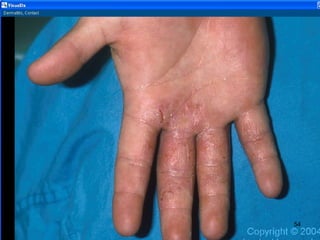
• Hand dermatitis
– should provoke questions regarding
• occupation, hobbies, and habits
• especially those working in hair or nail salons
• There are photo-dependent allergic reactions
47
48
49
50
51
52
53
54
55
56
Contact Dermatitis
 Avoid the agent.
 Topical steroids and if severe
systemic
for a short time.
 Antipruritics
 Treat the complications. 57
Lichen Simplex Chronicus
Thickening of the skin with variable
scaling that arises secondary to
repetitive scratching or rubbing.
It is not a primary process.
occur mainly at the nuchal area. 58
Lichen Simplex
Chronicus
59
60
61
62
63
64
Lichen Simplex Chronicus
 Break the itch-scratch-itch cycle with
 Antihistamines
 Potent topical steroids and
 Treat lichenification with keratolytics
 Advice patients not to scratch the
area
 Trim nails 65
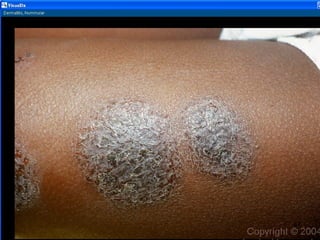
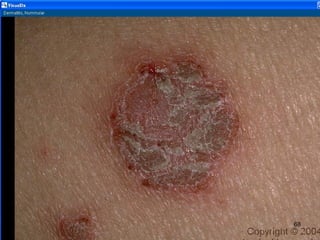
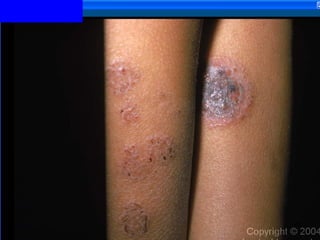
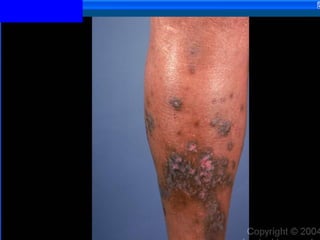
Discoid Eczema
 Nummular or Microbial eczema
 A chronic, pruritic, inflammatory dermatitis
occurring in the form of coin-shaped plaques.
 Unknown cause.
 Unrelated to atopic diathesis
 IgE levels are normal
 Commonly seen in the lower leg
66
67
68
69
Discoid Eczema
 Skin hydration and application of
potent steroid with or with out
antihistamines.
 Usually recurs.
70
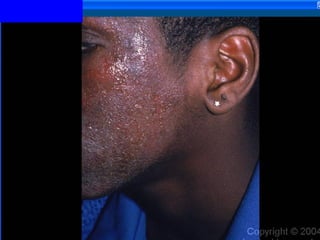
Seborrhoeic Dermatitis
 Very common chronic dermatosis
characterized by redness and scaling.
 Occurs in regions where the sebaceous
glands are most active.
 Affects 4 – 5 % of the population
 Mild form in the scalp is Called
dandruff 71
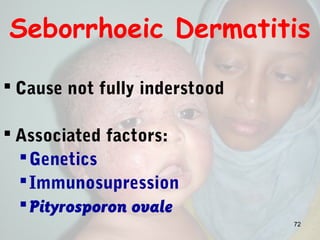
Seborrhoeic Dermatitis
 Cause not fully inderstood
 Associated factors:
Genetics
Immunosupression
Pityrosporon ovale
72
Seborrhoeic
Dermatitis
Has two pick ages of onset:
Infancy, and Puberty
73
74
75
76
77
Seborrhoeic Dermatitis
Selenium sulfide shampoo
Ketoconazole shampoo
Topical steroids
Systemic azoles
UV radiation
Recurrences and remissions are
common 78
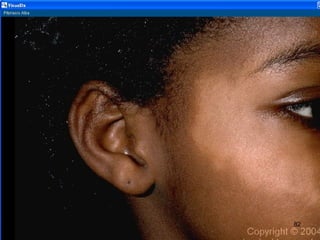
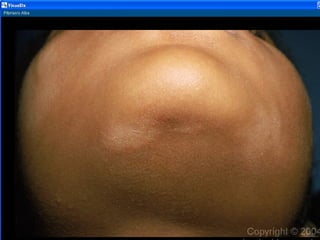
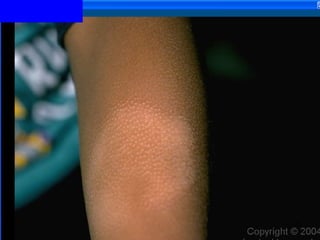
Pityriasis Alba
 A common disfiguring hypomelanosis of
the face presenting as
 White area (alba)
 Mild scaling (pityriasis)
 Cause is not known
 Atopic state may be present:
 A forerunner of AD 79
Pityriasis Alba
80
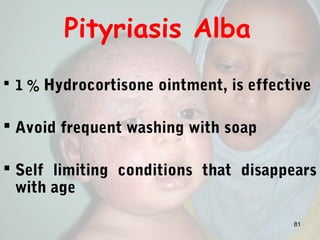
Pityriasis Alba
 1 % Hydrocortisone ointment, is effective
 Avoid frequent washing with soap
 Self limiting conditions that disappears
with age
81
82
83
84
85
Exercise
86
87
88
89
90
91
92
93
94
95
96
97
98
99
100
101
102
103
104
Discoid Eczema
105
106
107
108
109
110
111

Dermatitis and eczema

  • 1.
  • 2.
    Introduction • Inflammation ofthe skin • The terms 'ECZEMA' and 'DERMATITIS' are regarded as synonymous • Eczema has three clinical stages of development • Acute, Subacute, or Chronic 2
  • 3.
    Epidemiology Prevalence – In theUS: – 10-12% in children – 0.9% in adults. – Internationally: as high as 18% and is rising, especially in developed countries. Race, Age, Sex, Income 3
  • 4.
    Atopic Eczema • Acute,subacute, but usually chronic pruritic inflammation of the epidermis and dermis • It affects 5-10% of children below 5 years – 60 % of patients present by first year; – 30 % are seen for the first time by age 5, and – only 10 % develop AD between 6 and 20 years of age 4
  • 5.
    Atopic Eczema • Patientswith AD: –30% develop asthma –35% have Allergic Rhinitis. 5
  • 6.
    Atopic Eczema • Interactionof genetics and environmental factors results in development of atopic eczema. • Both IgE mediated and cell mediated hypersensitivity reactions are involved 6
  • 7.
    Atopic Eczema • Pruritusis the sine qua non of atopic dermatitis. • There is no fever or other constitutional symptoms. • Lichenification because of repeated scratching is commonly seen. • Other atopic diathesis may present at the same time. • Sparing of the diaper area is more common in 7
  • 8.
    Atopic Eczema Has threephases: I. Infantile AD – tends to primarily involve the face, scalp and torso. II. Childhood AD – involves the extensor extremities III. Adulthood AD – Flexural surface – More generalized… 8
  • 9.
    Atopic Eczema • Theexact cause of the condition is UK: – Most patients have • marked xerosis and • inability to retain moisture in the skin. • Environmental triggers – heat, humidity, detergents/soaps; – abrasive clothing, chemicals, and smoke and stress 9
  • 10.
    Diagnostic Criteria Hanifin diagnosticcriteria: Major – Pruritus – Typical and age-specific changes: – Chronic and relapsing course – Family Hx 10
  • 11.
    Diagnostic Criteria Hanifin diagnosticcriteria: Minor – Early age of onset – Atopy (IgE reactivity) – Xerosis – Keratosis pilaris/ichthyosis/palmar hyperlinearity – Atypical vascular responses – Perifollicular changes – Ocular/periorbital changes – Perioral/periauricular lesions Diagnosis 11
  • 12.
    Atopic Eczema The presenceof the 1 major and at least 3 minor features is diagnostic of AD – Major Feature • An itchy skin condition – Minor Features: • Onset below age 2 years • History of skin crease involvement • History of a generally dry skin • Personal history of other atopic disease • Visible flexural dermatitis 12
  • 13.
  • 14.
  • 15.
  • 16.
  • 17.
  • 18.
  • 19.
  • 20.
  • 21.
  • 22.
  • 23.
  • 24.
  • 25.
  • 26.
  • 27.
    Atopic Eczema • Areparticularly prone to I. Cutaneous Infections/Infestations • Bacterial • Viral • Fungal • Scabies 27
  • 28.
  • 29.
  • 30.
  • 31.
    Atopic Eczema • Areparticularly prone to II. Localized eczemas 31
  • 32.
  • 33.
  • 34.
  • 35.
  • 36.
  • 37.
    Management Eduacation on prophylactic measures Bathingand soaps  Recommend non-soap cleansers such as Cetaphil or moisturizing soaps such as Dove. Clothing, Emollients  Ichthammol and coal tar,  Make sure a humid household environment is 37
  • 38.
    Management  Topical Corticosteroids, Antihistamines, ???  Antibiotics  Topical immuno-modulators  Tacrolimus ointment 0.03%, 0.1% bid. OR  Pimecrolimus 1% cream bid. Long term prognosis generally good 38
  • 39.
    Contact Dermatitis [CD ] –Acute or chronic inflammatory reactions to substances that come in contact with the skin. –Two forms of CD exist • Irritant Contact Dermatitis (ICD) • Allergic Contact Dermatitis (ACD) 39
  • 40.
    Contact Dermatitis [CD ] • Common allergen-containing products include • cosmetics • Soaps • dyes and • jewelry. • The most frequent sensitizers are • fragrance • nickel, neomycin • formaldehyde, lanolin, and • a host of other common environmental chemicals. 40
  • 41.
  • 42.
  • 43.
  • 44.
  • 45.
  • 46.
  • 47.
    The distribution ofthe rash should drive the examiner's history to possible allergen exposures. • Facial distributions – suggest a personal skin care product. • Ear lobes – suggest nickel allergy from earrings. • Hand dermatitis – should provoke questions regarding • occupation, hobbies, and habits • especially those working in hair or nail salons • There are photo-dependent allergic reactions 47
  • 48.
  • 49.
  • 50.
  • 51.
  • 52.
  • 53.
  • 54.
  • 55.
  • 56.
  • 57.
    Contact Dermatitis  Avoidthe agent.  Topical steroids and if severe systemic for a short time.  Antipruritics  Treat the complications. 57
  • 58.
    Lichen Simplex Chronicus Thickeningof the skin with variable scaling that arises secondary to repetitive scratching or rubbing. It is not a primary process. occur mainly at the nuchal area. 58
  • 59.
  • 60.
  • 61.
  • 62.
  • 63.
  • 64.
  • 65.
    Lichen Simplex Chronicus Break the itch-scratch-itch cycle with  Antihistamines  Potent topical steroids and  Treat lichenification with keratolytics  Advice patients not to scratch the area  Trim nails 65
  • 66.
    Discoid Eczema  Nummularor Microbial eczema  A chronic, pruritic, inflammatory dermatitis occurring in the form of coin-shaped plaques.  Unknown cause.  Unrelated to atopic diathesis  IgE levels are normal  Commonly seen in the lower leg 66
  • 67.
  • 68.
  • 69.
  • 70.
    Discoid Eczema  Skinhydration and application of potent steroid with or with out antihistamines.  Usually recurs. 70
  • 71.
    Seborrhoeic Dermatitis  Verycommon chronic dermatosis characterized by redness and scaling.  Occurs in regions where the sebaceous glands are most active.  Affects 4 – 5 % of the population  Mild form in the scalp is Called dandruff 71
  • 72.
    Seborrhoeic Dermatitis  Causenot fully inderstood  Associated factors: Genetics Immunosupression Pityrosporon ovale 72
  • 73.
    Seborrhoeic Dermatitis Has two pickages of onset: Infancy, and Puberty 73
  • 74.
  • 75.
  • 76.
  • 77.
  • 78.
    Seborrhoeic Dermatitis Selenium sulfideshampoo Ketoconazole shampoo Topical steroids Systemic azoles UV radiation Recurrences and remissions are common 78
  • 79.
    Pityriasis Alba  Acommon disfiguring hypomelanosis of the face presenting as  White area (alba)  Mild scaling (pityriasis)  Cause is not known  Atopic state may be present:  A forerunner of AD 79
  • 80.
  • 81.
    Pityriasis Alba  1% Hydrocortisone ointment, is effective  Avoid frequent washing with soap  Self limiting conditions that disappears with age 81
  • 82.
  • 83.
  • 84.
  • 85.
  • 86.
  • 87.
  • 88.
  • 89.
  • 90.
  • 91.
  • 92.
  • 93.
  • 94.
  • 95.
  • 96.
  • 97.
  • 98.
  • 99.
  • 100.
  • 101.
  • 102.
  • 103.
  • 104.
  • 105.
  • 106.
  • 107.
  • 108.
  • 109.
  • 110.
  • 111.