Clinical Biochemistry
SIMS-305
Dr. Ali Raza
Senior Lecturer
Centre for Human Genetics and Molecular Medicine (CHGMM),
Sindh Institute of Medical Sciences (SIMS), SIUT.
1
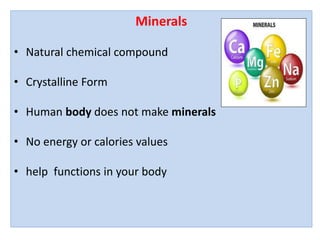
Minerals
• Natural chemical compound
• Crystalline Form
• Human body does not make minerals
• No energy or calories values
• help functions in your body
Minerals
• At least 29 different types of elements in our body.
• Carbohydrates
• Proteins
• Lipids
90% consist of
• Carbon
• Hydrogen
• Oxygen
• Nitrogen
The elements of the body are divided in
Five major groups:
• Group. I
• Group. II
• Group. III
• Group. IV
• Group. V
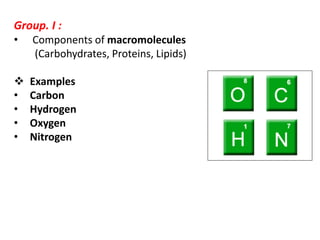
Group. I :
• Components of macromolecules
(Carbohydrates, Proteins, Lipids)
 Examples
• Carbon
• Hydrogen
• Oxygen
• Nitrogen
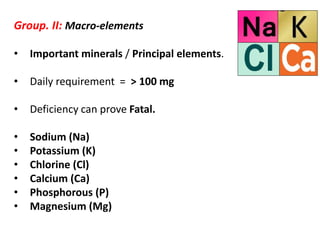
Group. II: Macro-elements
• Important minerals / Principal elements.
• Daily requirement = > 100 mg
• Deficiency can prove Fatal.
• Sodium (Na)
• Potassium (K)
• Chlorine (Cl)
• Calcium (Ca)
• Phosphorous (P)
• Magnesium (Mg)
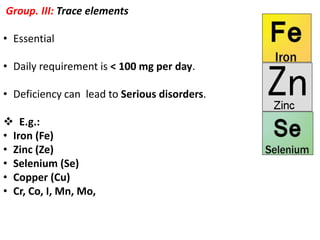
Group. III: Trace elements
• Essential
• Daily requirement is < 100 mg per day.
• Deficiency can lead to Serious disorders.
 E.g.:
• Iron (Fe)
• Zinc (Ze)
• Selenium (Se)
• Copper (Cu)
• Cr, Co, I, Mn, Mo,
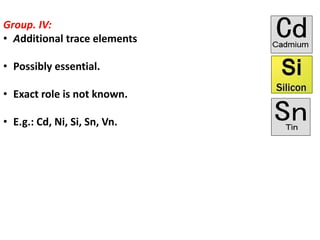
Group. IV:
• Additional trace elements
• Possibly essential.
• Exact role is not known.
• E.g.: Cd, Ni, Si, Sn, Vn.
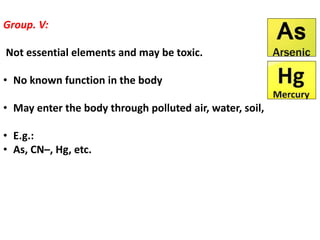
Group. V:
Not essential elements and may be toxic.
• No known function in the body
• May enter the body through polluted air, water, soil,
• E.g.:
• As, CN–, Hg, etc.

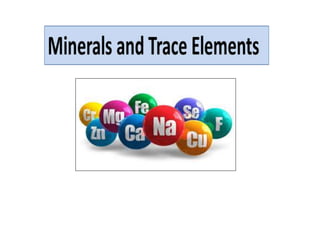
Minerals and trace elements introduction

  • 1.
    Clinical Biochemistry SIMS-305 Dr. AliRaza Senior Lecturer Centre for Human Genetics and Molecular Medicine (CHGMM), Sindh Institute of Medical Sciences (SIMS), SIUT. 1
  • 3.
    Minerals • Natural chemicalcompound • Crystalline Form • Human body does not make minerals • No energy or calories values • help functions in your body
  • 4.
    Minerals • At least29 different types of elements in our body. • Carbohydrates • Proteins • Lipids 90% consist of • Carbon • Hydrogen • Oxygen • Nitrogen
  • 5.
    The elements ofthe body are divided in Five major groups: • Group. I • Group. II • Group. III • Group. IV • Group. V
  • 6.
    Group. I : •Components of macromolecules (Carbohydrates, Proteins, Lipids)  Examples • Carbon • Hydrogen • Oxygen • Nitrogen
  • 7.
    Group. II: Macro-elements •Important minerals / Principal elements. • Daily requirement = > 100 mg • Deficiency can prove Fatal. • Sodium (Na) • Potassium (K) • Chlorine (Cl) • Calcium (Ca) • Phosphorous (P) • Magnesium (Mg)
  • 8.
    Group. III: Traceelements • Essential • Daily requirement is < 100 mg per day. • Deficiency can lead to Serious disorders.  E.g.: • Iron (Fe) • Zinc (Ze) • Selenium (Se) • Copper (Cu) • Cr, Co, I, Mn, Mo,
  • 9.
    Group. IV: • Additionaltrace elements • Possibly essential. • Exact role is not known. • E.g.: Cd, Ni, Si, Sn, Vn.
  • 10.
    Group. V: Not essentialelements and may be toxic. • No known function in the body • May enter the body through polluted air, water, soil, • E.g.: • As, CN–, Hg, etc.

Editor's Notes

  • #4 Naturally occurring chemical compound usually of crystalline form Minerals do not give you energy or calories, but can help with other functions in your body. Human body does not make minerals Trace minerals are elements that are needed is smaller amounts, 1-100mg/day by adults and are less than .01 percent of total body weight. These include Copper, Chromium, Fluoride, Iodine, Iron, Molybdenum, Manganese,Selenium, and Zinc.