CASE2: GYNECOLOGICAL
TUMORS (CERVICAL
CANCER)
Covered by:
Arwa H. Al-Onayzan.
ID: 215007943.
Serial number: 44
OUR CASE
Amira is 60 years old and has 5 children.
 She enjoyed good health.
 She went through menopause 7 year ago.
 She used aspirin and statin as preventive measure
from CVD.
 Last weak, she noticed some light vaginal bleeding.
 The GP take smear and the result is “Pap IV”.
 She referred to a gynecologist who diagnose:
 An invasive stage IIIa cervical carcinoma.
LEARNING OBJECTIVE
 Mrs. Amira agrees to intensive chemo
radiation therapy. (What is this?)
What disciplines are involved in the treatment
process and what are there respective tasks?
Is there one person who can and should take
on the role of ‘case manger’?
INTRODUCTION
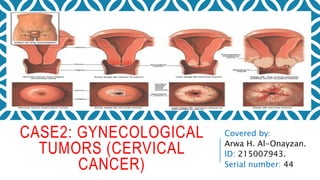
 Cervical cancer is a cancer arising from the cervix.
 Mostly caused by (human papillomavirus infection).
 Symptoms (abnormal vaginal discharge and pain).
 Diagnosis by (Pap smear).
 Treatment is depend on the tumor stage.
CASE QUESTION
 Mrs. Amira agrees to intensive
chemo radiation therapy. (What is
this?)
WHAT IS CHEMO-RADIATION
THERAPY?
 Is a treatment that combines chemotherapy with radiation
therapy.
 For some stages of cervical cancer, this is the preferred
treatment. Why?
 Because the chemo helps the radiation work better.
 Chemo drugs most often used to treat advanced cervical
cancer include:
 Cisplatin.
 Carboplatin.
 5-fluorouracil (5-FU).
CON…
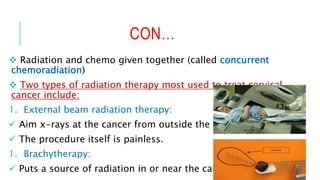
 Radiation and chemo given together (called concurrent
chemoradiation)
 Two types of radiation therapy most used to treat cervical
cancer include:
1. External beam radiation therapy:
 Aim x-rays at the cancer from outside the body.
 The procedure itself is painless.
1. Brachytherapy:
 Puts a source of radiation in or near the cancer.
WHAT DISCIPLINES ARE INVOLVED IN
THE TREATMENT PROCESS AND WHAT
ARE THERE RESPECTIVE TASKS?
DISCIPLINES INVOLVED IN
TREATMENT PROCESS
 Multi-Disciplinary Approach to Cancer Care:
Medical collaboration integral in the treatment of cancer.
 The optimal management of patients with cancer is critically
dependent on:
A. The medical disciplines.
•E.x: Oncologist, GP and Radiologist.
B. Paramedical disciplines.
•E.x: nurses, social workers and spiritual adviser.
MEDICAL DISCIPLINE IN CERVICAL
CANCER CARE
 Oncologist  (specializes in diagnosing and treating cancer).
 Radiotherapist  (helps the patient get into the right position
for treatment and then actually gives the treatment)
 Gynecologist  specializes in diagnosing and treating female
health issues.
 Anesthesiologist  specializes in giving drugs or other agents
(like gasses) that cause a total loss of feeling or relieve pain.
 GP the first contact with the patient not specialist.
 Pathologist  determines whether a tumor is cancer, and, if
cancer, the exact cell type (where it started) and grade (how fast it
likely will grow).
PARAMEDICAL DISCIPLINE IN CERVICAL
CANCER CARE
 Nurses  (in ward and clinic).
 Social worker  (dealing with social, emotional, and environmental
problems that may come with illness or disability).
 Psychologist  (Assesses a person’s mental and emotional status and
provides testing and counseling services)
 Assistance  (physician assistance, laboratory assistance)
 Psychiatrist  (provide counseling and prescribe medicines or
other treatments).
 Spiral advisor  (provide spiral support to the patients).
IS THERE ONE PERSON WHO CAN
AND SHOULD TAKE ON THE ROLE
OF ‘CASE MANGER’?
IS THERE ONE PERSON WHO CAN
AND SHOULD TAKE ON THE ROLE
OF ‘CASE MANGER’?
Yes.
 Case manager:
 The member of the cancer care team who coordinates the patient’s care
throughout diagnosis, treatment, and recovery; often a nurse or cancer
nurse specialist.
 The goal of case management is that one person directs or oversees the
patient’s care. For example, a case manager may help the patient get
through the complexities like health insurance company.
SUMMARY
 General information about cervical cancer.
 Chemo-radiation therapy of cervical cancer.
 Medical and Paramedical disciplines of cancer care.
QUIZ
Q1- Give 2 examples of medical discipline?
Q2- This picture is example of:
A. External beam radiation therapy.
B. Brachytherapy.
ANY QUESTION!
REFERENCE
 Cancer.org. (2017). Health Professionals Associated With Cancer
Care. [online] Available at:
https://www.cancer.org/treatment/finding-and-paying-for-
treatment/choosing-your-treatment-team/health-professionals-
associated-with-cancer-care.html [Accessed 27 Sep. 2017].
 Cancer.org. (2017). Chemotherapy for Cervical Cancer. [online]
Available at: https://www.cancer.org/cancer/cervical-
cancer/treating/chemotherapy.html [Accessed 27 Sep. 2017].
 Emedicine.medscape.com. (2017). Cervical Cancer Treatment
Protocols: Treatment Protocols. [online] Available at:
http://emedicine.medscape.com/article/2005259-overview
[Accessed 27 Sep. 2017].

Case 2: Cervical Cancer

  • 1.
    CASE2: GYNECOLOGICAL TUMORS (CERVICAL CANCER) Coveredby: Arwa H. Al-Onayzan. ID: 215007943. Serial number: 44
  • 2.
    OUR CASE Amira is60 years old and has 5 children.  She enjoyed good health.  She went through menopause 7 year ago.  She used aspirin and statin as preventive measure from CVD.  Last weak, she noticed some light vaginal bleeding.  The GP take smear and the result is “Pap IV”.  She referred to a gynecologist who diagnose:  An invasive stage IIIa cervical carcinoma.
  • 3.
    LEARNING OBJECTIVE  Mrs.Amira agrees to intensive chemo radiation therapy. (What is this?) What disciplines are involved in the treatment process and what are there respective tasks? Is there one person who can and should take on the role of ‘case manger’?
  • 4.
    INTRODUCTION  Cervical canceris a cancer arising from the cervix.  Mostly caused by (human papillomavirus infection).  Symptoms (abnormal vaginal discharge and pain).  Diagnosis by (Pap smear).  Treatment is depend on the tumor stage.
  • 5.
    CASE QUESTION  Mrs.Amira agrees to intensive chemo radiation therapy. (What is this?)
  • 6.
    WHAT IS CHEMO-RADIATION THERAPY? Is a treatment that combines chemotherapy with radiation therapy.  For some stages of cervical cancer, this is the preferred treatment. Why?  Because the chemo helps the radiation work better.  Chemo drugs most often used to treat advanced cervical cancer include:  Cisplatin.  Carboplatin.  5-fluorouracil (5-FU).
  • 7.
    CON…  Radiation andchemo given together (called concurrent chemoradiation)  Two types of radiation therapy most used to treat cervical cancer include: 1. External beam radiation therapy:  Aim x-rays at the cancer from outside the body.  The procedure itself is painless. 1. Brachytherapy:  Puts a source of radiation in or near the cancer.
  • 8.
    WHAT DISCIPLINES AREINVOLVED IN THE TREATMENT PROCESS AND WHAT ARE THERE RESPECTIVE TASKS?
  • 9.
    DISCIPLINES INVOLVED IN TREATMENTPROCESS  Multi-Disciplinary Approach to Cancer Care: Medical collaboration integral in the treatment of cancer.  The optimal management of patients with cancer is critically dependent on: A. The medical disciplines. •E.x: Oncologist, GP and Radiologist. B. Paramedical disciplines. •E.x: nurses, social workers and spiritual adviser.
  • 10.
    MEDICAL DISCIPLINE INCERVICAL CANCER CARE  Oncologist  (specializes in diagnosing and treating cancer).  Radiotherapist  (helps the patient get into the right position for treatment and then actually gives the treatment)  Gynecologist  specializes in diagnosing and treating female health issues.  Anesthesiologist  specializes in giving drugs or other agents (like gasses) that cause a total loss of feeling or relieve pain.  GP the first contact with the patient not specialist.  Pathologist  determines whether a tumor is cancer, and, if cancer, the exact cell type (where it started) and grade (how fast it likely will grow).
  • 11.
    PARAMEDICAL DISCIPLINE INCERVICAL CANCER CARE  Nurses  (in ward and clinic).  Social worker  (dealing with social, emotional, and environmental problems that may come with illness or disability).  Psychologist  (Assesses a person’s mental and emotional status and provides testing and counseling services)  Assistance  (physician assistance, laboratory assistance)  Psychiatrist  (provide counseling and prescribe medicines or other treatments).  Spiral advisor  (provide spiral support to the patients).
  • 12.
    IS THERE ONEPERSON WHO CAN AND SHOULD TAKE ON THE ROLE OF ‘CASE MANGER’?
  • 13.
    IS THERE ONEPERSON WHO CAN AND SHOULD TAKE ON THE ROLE OF ‘CASE MANGER’? Yes.  Case manager:  The member of the cancer care team who coordinates the patient’s care throughout diagnosis, treatment, and recovery; often a nurse or cancer nurse specialist.  The goal of case management is that one person directs or oversees the patient’s care. For example, a case manager may help the patient get through the complexities like health insurance company.
  • 14.
    SUMMARY  General informationabout cervical cancer.  Chemo-radiation therapy of cervical cancer.  Medical and Paramedical disciplines of cancer care.
  • 15.
    QUIZ Q1- Give 2examples of medical discipline? Q2- This picture is example of: A. External beam radiation therapy. B. Brachytherapy.
  • 16.
  • 17.
    REFERENCE  Cancer.org. (2017).Health Professionals Associated With Cancer Care. [online] Available at: https://www.cancer.org/treatment/finding-and-paying-for- treatment/choosing-your-treatment-team/health-professionals- associated-with-cancer-care.html [Accessed 27 Sep. 2017].  Cancer.org. (2017). Chemotherapy for Cervical Cancer. [online] Available at: https://www.cancer.org/cancer/cervical- cancer/treating/chemotherapy.html [Accessed 27 Sep. 2017].  Emedicine.medscape.com. (2017). Cervical Cancer Treatment Protocols: Treatment Protocols. [online] Available at: http://emedicine.medscape.com/article/2005259-overview [Accessed 27 Sep. 2017].

Editor's Notes

  • #7 Cisplatin given weekly during radiation. This drug is given into a vein (IV) about 4 hours before the radiation appointment. Cisplatin plus 5-fluorouracil (5-FU) given every 4 weeks during radiation. Chemotherapy uses anti-cancer drugs (injected into a vein or given by mouth).  For other stages, radiation and chemo given together (called concurrent chemoradiation)
  • #8 aim x-rays at the cancer from outside the body. This is called external beam radiation therapy (EBRT). Treatment is much like getting a regular x-ray, but the radiation dose is stronger. Brachytherapy, or internal radiation therapy, puts a source of radiation in or near the cancer.  There are two types of brachytherapy: Low-dose rate (LDR) brachytherapy is completed over a few days. During this time, the patient stays in bed in a private room in the hospital with instruments holding the radioactive material in place. While the radiation therapy is being given, the hospital staff will care for you, but also take precautions to lessen their own radiation exposure. High-dose rate (HDR) brachytherapy is done as an outpatient over several treatments (often at least a week apart). For each high-dose treatment, the radioactive material is inserted for a few minutes and then removed. The advantage of HDR treatment is that you do not have to stay in the hospital or stay still for long periods of time.
  • #9 members who worked as team in treatment processing in cervical cancer
  • #10 The special skill of oncologists is judgement in matters relating to cancer.
  • #14 The goal of case management is that one person directs or oversees the patient’s care. For example, a case manager may help the patient get through the complexities of the health care system by working with the health insurance company, getting quicker answers to important questions, managing crises, and connecting the patient and family to needed resources.